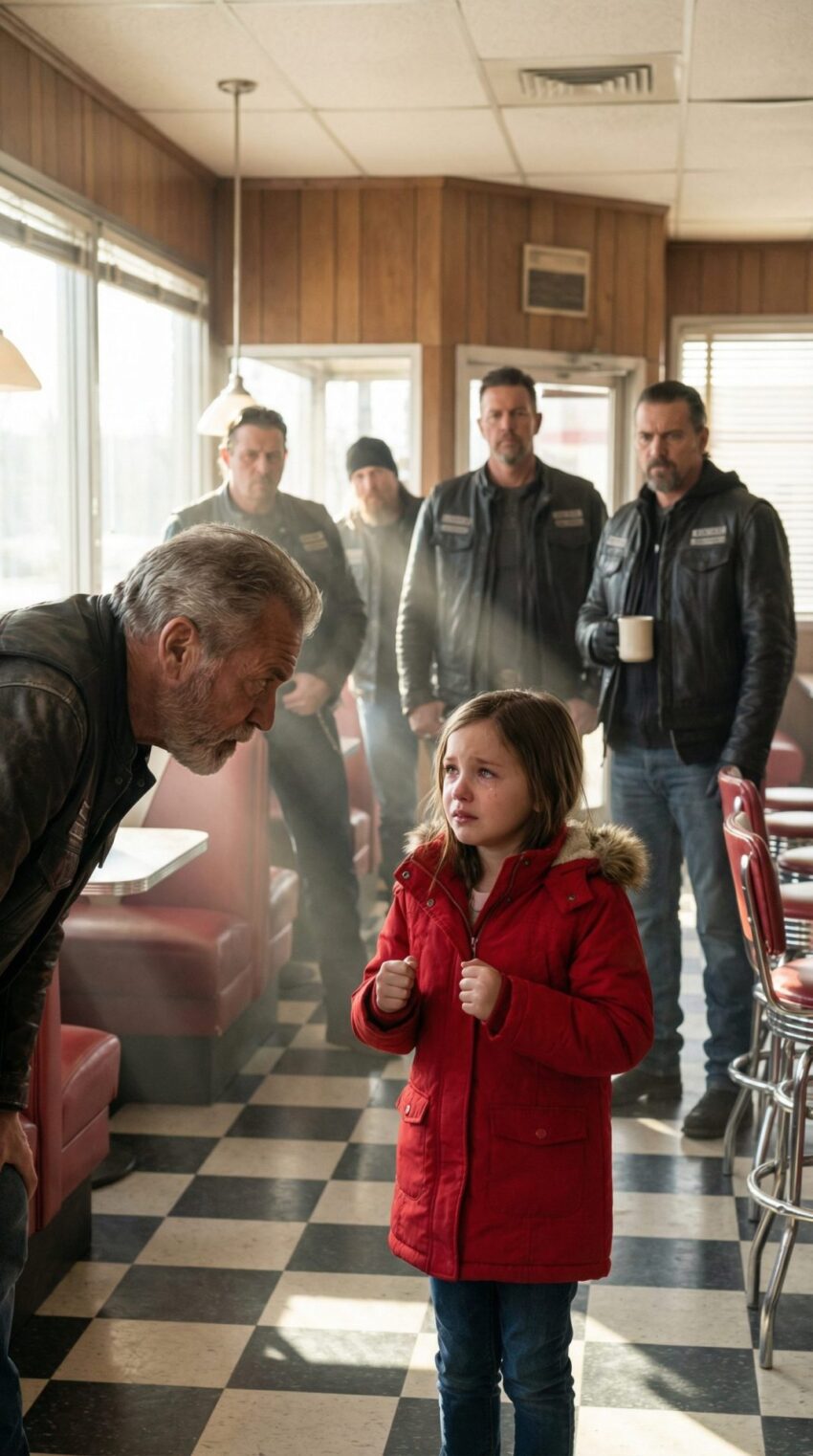
The Door at Hollow Creek Tavern
The door to Hollow Creek Tavern flew open so hard it rattled the old glass in its frame.
A little girl burst inside like the building itself had called her name.
She was maybe seven—small for her age, cheeks flushed from the cold, a red jacket hanging loose on her shoulders as if it belonged to someone older. Her hair was messy, and her breaths came fast and shallow, as though she had been running for a long time and didn’t dare stop even now.
She didn’t head for the bar.
She didn’t look at the men playing pool or the couple in a booth.
She went straight to the back corner, where a group of bikers sat around two pushed-together tables, their vests heavy with patches, their boots planted like anchors. Twelve of them. Quiet. Watchful. Not loud, not showy—just present in the way people are when they’ve seen enough life to know how quickly it can turn.
The biggest man at the table lifted his gaze.
His name was Mason “Hawk” Caldwell. A pale scar ran down one cheek, and his beard was threaded with gray. He set his bottle down slowly, as if sudden movement might scare the child right out the door again.
The girl stopped in front of him. Her whole body trembled.
“Please,” she whispered, and her voice cracked on the word. “I need help.”
Hawk leaned forward, lowering himself to her level without crowding her.
“Hey,” he said gently. “What’s your name, sweetheart?”
She swallowed hard. “Gracie.”
“Okay, Gracie.” Hawk’s voice stayed calm, steady. “Where’s your mom?”
Gracie’s fingers shook so badly she struggled to grip her own collar. She tugged the red jacket down from one shoulder, exposing skin that was already turning every shade of bruise a body could hold—purple, green, yellow, fading into one another like a storm cloud spreading.
There were marks that didn’t look accidental. Dark impressions shaped like hands. Like someone had grabbed too hard and didn’t care what it left behind.
A younger biker shot up so fast his chair scraped and nearly toppled.
“No… no way,” he muttered, voice full of disbelief.
Hawk didn’t flinch. But something tightened in his chest anyway, something deep and old. He had lived through violence in his life—seen it in places people don’t put on postcards—but seeing it on a child felt like a different kind of wrong. The kind that makes the air taste bitter.
He kept his tone soft.
“Who did this to you?”
Gracie’s lower lip quivered. Tears welled, slipped free, and ran down her cheeks.
“My mom says we have to stay quiet,” she whispered.
The words landed like a weight on the table.
Quiet.
Not because the world was peaceful.
Quiet because someone had taught them that speaking would cost more.
Hawk drew a slow breath, keeping his face gentle so the child wouldn’t see what the words did to him inside.
“Your mom told you to stay quiet about this?”
Gracie nodded quickly and wiped her face with her sleeve, but the tears kept coming anyway.
“She says if we tell, he’ll do worse,” she said. “But he hurt her really bad last night. She couldn’t get up this morning.”
Hawk’s hand curled lightly against the edge of the table. Not rage—something steadier. Protective. The kind of feeling that doesn’t make noise but does make decisions.
He stood.
The others stood with him, one after another, like a single thought passing through the group.
“Where is she right now?” Hawk asked.
Gracie pulled a crumpled note from her pocket. Her hands were so shaky the paper fluttered like a scared bird.
“Blue trailer… number seventeen,” she read.
Hawk glanced to his right. A man called “Boone” was already reaching for his jacket.
Hawk’s voice stayed low and controlled.
“Get the truck.”
Boone nodded once and headed for the back door without a word.
Hawk turned to another rider, a lean man with reading glasses pushed up on his head.
“Call Miles,” Hawk said. “Tell him we’re bringing someone who needs him.”
The man—road name “Ledger”—was already pulling out his phone.
Hawk crouched in front of Gracie. His knees cracked when he bent, and his age showed for a second in the movement. But his eyes stayed kind.
Up close, he could see it—fear, exhaustion, the weight no seven-year-old should carry like a backpack.
“Listen to me, Gracie,” Hawk said. “You did the right thing coming here.”
Her chin trembled. “I was so scared,” she admitted. “I didn’t know where else to go.”
“You came to the right place,” Hawk told her, and his throat tightened on the truth of it. “We’re going to get your mom, and we’re going to make sure nobody hurts either of you again. That’s a promise.”
Gracie blinked fast. “What if he comes back early?”
Hawk’s expression didn’t turn harsh, but it did turn certain.
“Then we’ll handle it,” he said.
Something in his face must have steadied her, because for the first time since she’d run in, her breathing slowed.
Behind Hawk, the oldest biker in the club—a seventy-something Vietnam veteran everyone called “Pops”—let out a quiet, rough sound that might have been approval.
“Kid’s got guts,” Pops said.
Hawk nodded once. “Yeah. She does.”
The Quiet Drive Out of Town
They didn’t roar off on motorcycles.
That wasn’t the plan.
A truck was quieter. A truck didn’t announce itself from three blocks away. A truck looked like someone going to pick up a buddy, not like a dozen men arriving with purpose.
When the black pickup rolled up behind the tavern, Hawk guided Gracie outside with a hand resting lightly on her shoulder—careful not to touch the bruised side.
The cold air hit her, and she shivered. She clutched a worn stuffed rabbit to her chest. One ear was missing, and the fabric on its belly had been stitched back together with thread that didn’t match.
The driver, a broad-shouldered man named Wade “Reef” Mercer, leaned over the wheel and looked at the rabbit.
“That’s a serious-looking bunny,” he said quietly.
Gracie blinked. “His name’s Button.”
“Button,” Reef repeated, like the name mattered. “I like it.”
Hawk helped her into the front seat between him and Reef. In the back, other bikers climbed in without chatter, boots thumping softly against the truck bed.
Another rider, the club’s “tech guy,” slid into the passenger-side back seat and already had his phone out.
His name was Nolan “Switch” Price, and he could find anything about anyone if you gave him a first name and a reason.
“You know his name?” Switch asked gently, keeping his voice neutral.
Gracie swallowed. “Derek Lyle.”
Switch’s thumbs moved. “Okay,” he murmured. “Let’s see what’s already out there.”
Hawk kept his eyes forward as Reef drove. He didn’t want Gracie to see the way his jaw held tight, like a hinge refusing to shake.
“What time does he usually get home?” Hawk asked.
“Around five,” Gracie said. “He works at the plant.”
Hawk checked his watch. 2:15.
Time mattered. But not more than safety.
He looked down at the rabbit in her lap.
“Button missing an ear?” he asked, carefully.
Gracie nodded once, barely.
“He got mad when I wouldn’t stop crying,” she whispered.
Reef’s hands tightened around the wheel until his knuckles went pale.
Hawk’s voice stayed low, steady.
“You won’t have to cry like that anymore,” he said. “Not where we’re taking you.”
Gracie stared out the window, the passing streets blurring into gray winter light.
And for the first time in longer than she could remember, something unfamiliar flickered in her chest.
Not certainty.
Not comfort.
But a thin, stubborn thread of hope.
Trailer Seventeen on Miller’s Run
Miller’s Run was the kind of road people forgot once they turned off it. A line of trailers tucked behind leaning fences, tired porches, and yards full of things that had once been useful.
Reef drove slowly until Gracie’s small hand lifted and pointed.
“There,” she whispered. “That one.”
Trailer seventeen wasn’t really blue anymore. The paint had faded into a tired gray, and rust streaked down the siding like tears that dried mid-fall. One window was patched with cardboard and tape. The steps were crooked, as if they’d been bent by too many hard nights.
The truck stopped two houses down, out of direct view, and the riders moved with practiced quiet.
Hawk turned to Gracie.
“You stay in the truck,” he said firmly. “Lock the doors after we get out. Don’t open them unless it’s me or Reef. Understand?”
Gracie nodded hard.
“Yes.”
Hawk touched her shoulder—only the unbruised one—and gave her a small, steady look.
“We’ll bring your mom out,” he promised. “I’m right here.”
Then he stepped out.
The air felt colder near the trailer, like the place held its own weather.
Hawk climbed the crooked steps and knocked three times—firm, not aggressive
No answer.
He knocked again.
“Ma’am,” he called. “My name’s Hawk. Your daughter sent us. We’re here to help.”
Silence.
Hawk tried the handle.
Unlocked.
He pushed the door open slowly, the hinges complaining like they didn’t want to participate in what was about to change.
The smell hit first—stale beer, old smoke, and something sour that reminded Hawk of rooms where fear lived too long.
The living room was small: a torn couch, bottles on the floor, a TV perched on a milk crate, wrappers scattered like nobody cared enough to clean because caring required energy.
And on the couch, curled beneath a thin blanket, lay a woman.
She didn’t move when the door opened.
Hawk stepped forward.
“Ma’am?”
Her eyes fluttered open. One was swollen almost shut. Her lip was split, and dried blood marked her chin. Bruises climbed her neck and arms like shadows.
She tried to sit up and immediately winced, pressing a hand to her side.
“Don’t move,” Hawk said quickly, voice gentle. “Please. Just breathe. Your daughter came to us.”
Her gaze sharpened with panic.
“Gracie?”
“She’s safe,” Hawk promised. “She’s outside with us. We’re here to get you out.”
The woman’s eyes filled with tears.
“You can’t,” she whispered, voice thin. “He’ll find us.”
Hawk held her gaze without blinking.
“He won’t,” he said calmly. “Not this time.”
She shook her head in small, terrified motions.
“You don’t understand,” she breathed. “He always finds me.”
Hawk knelt by the couch, keeping his hands visible, his posture nonthreatening.
“I understand more than you think,” he said. “Men like that only keep power when everyone else looks away. We’re not looking away.”
A tear slipped down her cheek.
“Who are you?”
“My name’s Mason Caldwell,” he answered. “People call me Hawk. And the men outside… they’re my brothers. We protect people who can’t protect themselves.”
The woman stared at him, searching his face like she was trying to figure out if kindness could be real.
Finally, she whispered, “I’m Natalie.”
Hawk nodded once. “Natalie. Okay. We’re going to take care of you.”
He looked over his shoulder.
“Miles,” he called. “Come in.”
A man in his fifties stepped through the door carrying a small medical bag. His real name was Miles Harrow. In the club, they called him “Patch,” because he’d been a combat medic and he could patch up a person fast and steady.
Patch knelt beside Natalie.
“Hi,” he said softly. “I’m going to check you, okay? I need you to tell me where it hurts most.”
Natalie swallowed. “My ribs,” she whispered. “Left side.”
Patch’s touch was careful, professional. He checked her breathing, watched her flinch, read the bruising like a map.
His voice stayed quiet, but serious.
“You’ve got broken ribs,” he said. “More than one. You need proper medical care soon. Tonight.”
Natalie’s head jerked.
“No hospital,” she said quickly. “They’ll ask questions. They’ll call someone. And he’ll show up.”
Hawk’s expression didn’t harden into cruelty—only resolve.
“We’ll get you care without putting you in danger,” he said. “I promise.”
Natalie stared at him, trembling.
“His name is Derek Lyle,” she whispered, like speaking it aloud might summon him. “He works at the plant.”
Switch appeared in the doorway, phone still in hand.
“He’s got a record,” Switch said, voice tight. “Prior charges. Nothing that should’ve been ignored.”
Hawk exhaled slowly.
Not surprised.
Just disappointed in how often the world let things slide until a kid ran through a bar door begging.
Hawk stepped outside and made a call.
A woman answered on the second ring.
“Evelyn,” Hawk said. “It’s Hawk. I need a safe place for a woman and her child. Quiet help. Medical help.”
There was a short pause, then a steady voice.
“Bring them,” Evelyn said. “I’ll be ready.”
The Place That Doesn’t Show Up on Maps
They moved quickly, but not roughly.
Patch wrapped Natalie’s ribs carefully, gave her water, and explained everything in a calm voice so she didn’t feel like she was being dragged into another unknown.
Hawk helped Natalie stand with Reef on the other side. She swayed, breathing shallow, but stayed upright.
Outside, Gracie watched from the truck window, face pressed close to the glass. When Hawk raised a thumb to signal “okay,” her shoulders dropped with a soft relief that looked like her body finally realized it was allowed to breathe.
Natalie slid into the back seat with careful help. Gracie climbed in beside her and immediately reached for her mother’s hand.
Natalie’s eyes crumpled.
“Baby…” she whispered.
Gracie hugged her gently, mindful of the ribs.
“It’s okay, Mom,” she murmured. “We’re safe now.”
They drove to a small cabin outside town, hidden at the end of a dirt road lined with trees. It wasn’t fancy, but it was clean, warm, and stocked like someone had prepared for this moment long before it arrived.
The woman who met them at the door was Evelyn Hart—a tough, kind middle-aged shelter director with eyes that missed nothing. She helped Natalie inside like she’d done it a thousand times.
“You’re okay now,” Evelyn told her. “One step at a time.”
A retired physician arrived soon after—Dr. Marlene Fitch—carrying a medical bag and a calm presence that made the room feel steadier.
She examined Natalie carefully and spoke in quiet facts that didn’t scare, but didn’t sugarcoat either.
“Several ribs are broken,” she told Hawk. “She needs rest, monitoring, and follow-up care. But she’ll recover with proper support.”
Then Dr. Fitch looked at Gracie, who sat on the edge of the bed clutching Button.
Her voice softened.
“And you,” she said, “you’re going to need time too. Your body heals faster than your heart. But both can heal.”
Gracie nodded, eyes wide, not fully understanding—but wanting to believe.
The Conversation at Five O’Clock
Hawk didn’t celebrate.
He didn’t relax.
He didn’t pretend moving Natalie and Gracie meant the danger disappeared.
Danger just changed shape. It became a question: would Derek Lyle accept “gone,” or would he try to claw back what he thought he owned?
At 4:15, Hawk and a smaller group returned to Miller’s Run and parked out of sight.
They waited.
Quiet.
At 4:58, a dented white pickup turned onto the road.
Derek.
He pulled into the driveway of trailer seventeen like it was the most ordinary thing in the world. Work boots. Stained jeans. A cap pulled low. A six-pack in hand.
He walked inside without looking around.
Hawk didn’t move until two minutes passed.
Then he nodded once.
“Now,” he said.
They approached the trailer in a line—eight men, calm and deliberate. Not threatening in the loud way. Threatening in the certain way.
Derek spotted them through the window and slammed the door. The lock clicked.
Hawk climbed the steps and knocked three times.
“Derek Lyle,” he called. “Open the door. We need to talk.”
From inside, a voice barked, rough and angry.
“Get off my property or I’m calling the police!”
Hawk’s voice didn’t rise.
“Go ahead,” he said. “Call.”
Silence.
Then the door opened.
Derek stood there, trying to look tough, but his eyes darted like a cornered animal
“Who the hell are you?” he snapped.
Hawk held his gaze.
“Friends of Natalie and Gracie,” he said simply.
Derek’s mouth twisted.
“That woman took my kid and ran.”
Reef’s voice came low and hard.
“She didn’t ‘take’ anything. She escaped.”
Derek’s shoulders tensed. His hand shifted near his belt like he wanted to feel powerful.
Hawk noticed the movement and spoke with a quiet warning.
“Don’t,” he said.
Derek froze, reading something in Hawk’s tone that made him reconsider.
Hawk continued, calm as stone.
“Here’s how this goes,” he said. “Natalie and Gracie are somewhere you will not find. You will not call them. You will not follow them. You will not show up at schools, jobs, or places you think they might be.”
Derek scoffed, but his voice wavered.
“You can’t tell me what to do.”
Switch stepped forward and lifted his phone.
“We can,” he said. “And we already have your record, your workplace contacts, and the right people ready to see what you’ve been hiding.”
Derek’s face paled.
Hawk watched him carefully.
This wasn’t about winning an argument.
It was about removing a threat.
Hawk spoke again, slow and clear.
“You’re leaving town tonight,” he said. “Not next week. Not when you feel like it. Tonight.”
Derek’s jaw worked as if he wanted to spit, shout, fight.
But he looked past Hawk and saw eight men who weren’t bluffing and weren’t emotional.
They were controlled.
And control is what fear respects.
Finally, Derek hissed, “Fine.”
Hawk nodded.
“Pack a bag,” he said. “We’ll wait.”
Fifteen minutes later, Derek came out with a duffel bag and keys in his hand.
He paused at the bottom step and tried one last hook.
“You tell Natalie she’s making a mistake,” he said.
Hawk’s expression didn’t change.
“She won’t,” he replied.
Derek climbed into his truck and drove off fast, tires spitting gravel as if speed could erase shame.
Hawk didn’t watch him go like a victory.
He watched him go like a job that wasn’t finished until the taillights disappeared.
A New Apartment and a Small Kindness
In the weeks that followed, life didn’t become perfect.
It became possible.
Natalie moved into a small apartment in a neighboring town—two bedrooms, clean windows, locks that worked, and a kitchen stocked by Evelyn’s shelter.
The club covered the first months of rent quietly, without banners or speeches.
Evelyn helped Natalie replace lost documents, enroll Gracie in a new school, and connect with resources that didn’t judge her for needing them.
Natalie found a job at a diner called Maple & Main—simple work, decent tips, a manager who didn’t ask questions on day one but always asked, “How are you holding up?” on day ten.
Gracie started second grade at a small elementary school where teachers smiled and kids worried about crayons and recess, not survival plans.
She still slept with Button tucked against her chest.
But she slept.
That alone felt like a miracle.
One Saturday morning, Hawk stopped by with a small framed photo in his hands. He’d found it in the trailer—Natalie and Gracie smiling in a park, back when smiles came easier.
Natalie opened the door, and for a second her eyes widened with old fear—then softened when she recognized him.
“Hawk,” she breathed.
“Hey,” he said gently. “I didn’t want you to lose this.”
He handed her the frame.
Natalie stared at the picture like it was proof she hadn’t imagined the good parts of her life.
Her eyes filled.
“Thank you,” she whispered.
Gracie peeked from behind her mother, then stepped forward.
“That was Jefferson Park,” she said softly. “I was five. We got ice cream.”
Natalie’s mouth trembled into a real smile.
“We did,” she said. “You got two scoops.”
Hawk nodded once, satisfied, like the small normal memory mattered as much as the big rescue.
Before he left, Gracie tugged his sleeve.
“Are you coming back?” she asked.
Hawk crouched, meeting her eyes.
“Anytime you need me,” he said. “You call, I answer. That’s how it works now.”
Gracie nodded, then hugged him tight.
Hawk stood, looked at Natalie, and said the thing people rarely say out loud but should.
“You were brave,” he told her. “Getting out takes strength.”
Natalie shook her head, tears bright.
“Gracie was brave,” she whispered. “She ran for help.”
Hawk glanced at the child.
“Yeah,” he said softly. “She was.”
Years Later, the Same Words—Different Hands
Time moved the way time always does—quietly, stubbornly, carrying people forward even when they don’t feel ready.
Gracie grew taller. Stronger. She joined a soccer team. Made friends. Learned what it felt like to laugh without checking the room first.
Natalie worked her way up at the diner, slowly building a life she could recognize as her own.
And the club stayed what it had been—rough edges, steady hearts, showing up when someone had nowhere else to go.
One day, years later, Gracie sat in an office with her name on the door.
She had a college degree and a job at a nonprofit that helped families find safety and stability. On her wall was a photo: her, Natalie, and Hawk at her graduation. Three people smiling like the future could be trusted.
A woman stepped into the office holding the hand of a small boy. Both looked scared in the familiar, quiet way fear wears.
The woman’s voice shook.
“I don’t know where else to go,” she admitted.
Gracie stood, walked around her desk, and offered a chair like she was offering a lifeline.
Her voice came out calm, steady—older than her years, but kind.
“You came to the right place,” she said.
The woman’s eyes filled with tears.
“You promise?”
Gracie reached out, took her hand.
“I promise,” she said. “Nobody should have to stay quiet to survive.”
In her mind, she heard Hawk’s voice from long ago.
You did the right thing coming here.
And in a quiet way, Gracie understood she was living proof that one brave choice can change a whole life.
You deserve a life where you can breathe normally, sleep peacefully, and speak without fear—because safety is not a luxury, it is a basic human need that every person is worthy of receiving.
If you have been taught to stay silent to “keep the peace,” please remember that silence often protects the person causing harm, not the person being hurt, and your voice can be the first step toward change.
Asking for help is not weakness; it is courage in its purest form, because it means you still believe your life can be different, even when your world has tried to convince you otherwise.
People who care about you do not demand your quiet; they make room for your truth, even if it’s messy, even if it’s painful, even if it takes time to say out loud.
No child should carry adult fear, adult secrets, or adult responsibilities, and if you are an adult reading this, your kindness could be the reason a child learns hope instead of helplessness.
Healing is not a straight line, and it doesn’t happen overnight, but every safe day you create—every meal, every calm morning, every gentle conversation—adds up into a new future.
You are not “too much” for needing support, and you are not “a burden” for needing protection; the right people will help because it’s the right thing to do.
Even if the past left marks on your heart, it does not get to decide your entire story, because you can build a new chapter with different people, different choices, and a different kind of love.
If you are trying to leave a harmful situation, remember that you don’t have to do it perfectly—you just have to take one careful step, then another, until the door behind you becomes a memory.
When someone reaches out for help, answering them—listening, believing, guiding, protecting—can be the moment that breaks a cycle of fear and begins a cycle of hope.