The Morning Everyone Judged the Wrong Man
That morning, I stood in line at a small branch bank in Cedar Falls, Iowa, holding a stack of overdue bills that felt heavier than paper ever should. I had already done the math three times before leaving home, and every version ended the same way. One payment would have to wait. Maybe two. I kept telling myself I would figure it out by the end of the week, even though I had been saying that for months.
The bank was quiet in the careful, polished way banks always seem to be. Soft instrumental music drifted from hidden speakers. Keyboards clicked in short, tidy bursts. People spoke in lowered voices, as if money became less frightening when you whispered around it.
I was third in line, trying not to look at the balance written in my notebook, when the front door opened with a forceful push that broke the room’s carefully managed calm.
It was not loud enough to be called a slam.
But it was loud enough to make every head turn.
A Man Who Did Not Fit the Room

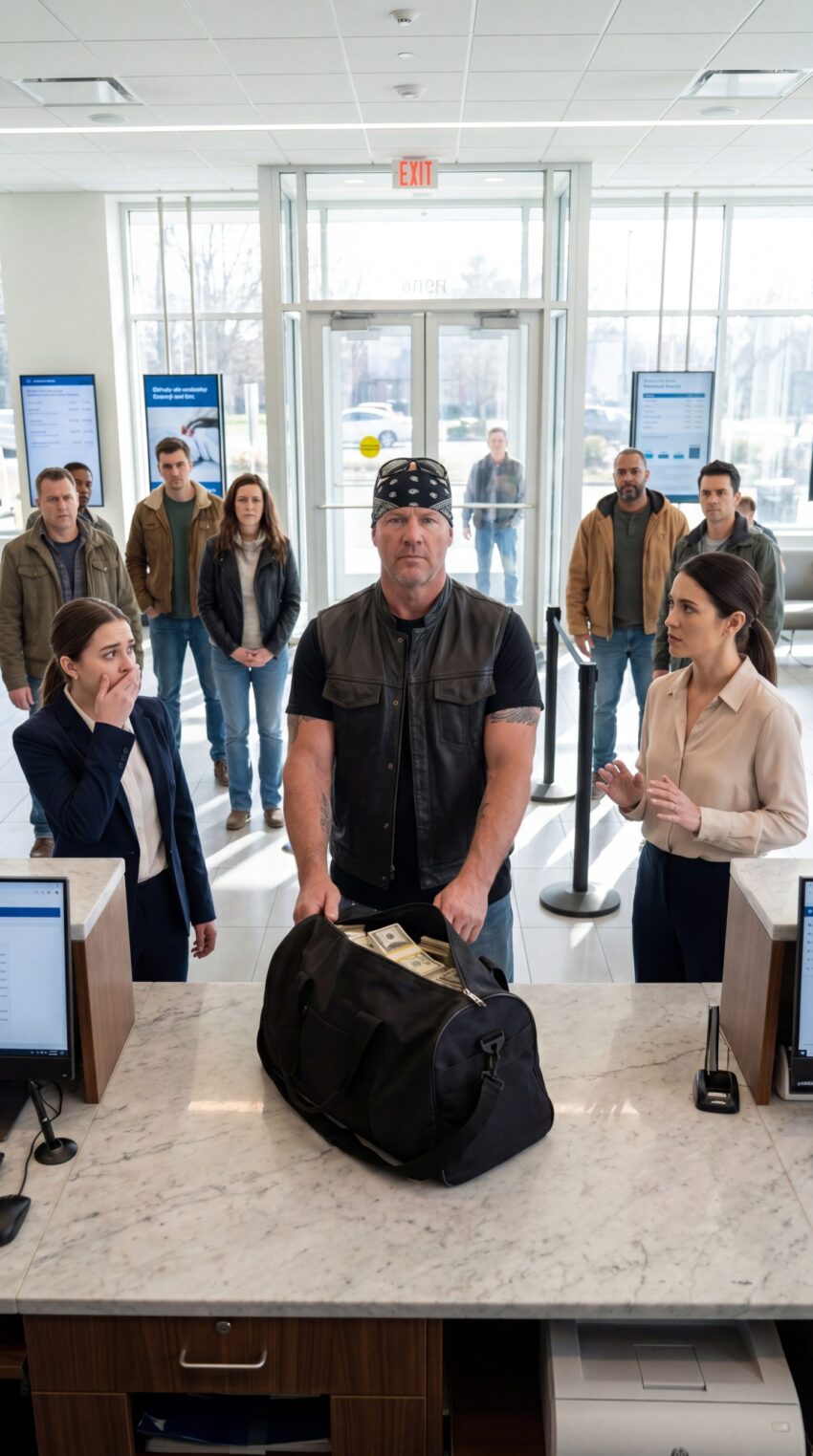
The man who walked in looked like he had been carved out of a completely different world than the one inside that bank. He was tall, broad through the shoulders, and dressed in a faded black leather vest over a dark thermal shirt. Ink climbed up one side of his neck and disappeared beneath the collar. Heavy boots struck the floor with a steady rhythm that made the room feel smaller with every step.
People noticed him instantly, then tried to pretend they had not.
I saw a woman near the loan desk pull her purse closer. A man by the brochures lowered his eyes as if avoiding trouble could become a kind of shield. One teller stopped mid-sentence, her hands hovering above the keyboard.
The biker did not seem to care about any of it.
He did not scan the room. He did not posture. He did not make a scene in the way everyone silently feared he might.
He walked straight to the counter with the kind of focus that made the air tighten around him.
No hesitation. No wandering glance. No wasted movement.
Then he lifted a worn duffel bag from his shoulder and dropped it onto the marble counter with a heavy, flat thud.
The zipper had not been fully closed. Several thick stacks of cash pushed against the opening, visible enough to make the nearest teller freeze.
A hush moved across the room so fast it was almost physical.
One Sentence That Made Everything Stranger
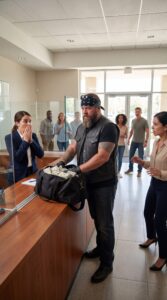
The teller in front of him was a young woman with auburn hair pinned neatly back and a nameplate that read ELISE. She blinked once, then twice, as if her eyes had not yet agreed on what they were seeing.
The man rested one palm on the counter and spoke in a deep, level voice.
“I need you to freeze my account.”
For a moment, nobody moved.
Elise looked from the bag to his face, then back to the bag again. Her confusion was so plain that it pulled everyone else into it. If he had come in angry, people would have understood what box to put him in. If he had come in frightened, people would have known how to read that too.
But calm made him harder to place.
“Sir… I’m sorry?” she asked carefully.
He did not raise his voice. He did not lean closer. He only repeated himself with a little more weight in the words.
“Freeze it. Right now.”
Behind me, someone whispered, “What is this?” Another person murmured something about security. My own fingers tightened around the envelopes I was holding.
Nothing about the situation made sense.
If he was desperate, why bring a bag full of cash into a bank already watching him.
If he meant trouble, why ask them to stop his own money.
If he was confused, why did he seem like the only person in the room who knew exactly what needed to happen.
The Guard Moves In
The security guard near the front entrance had already started walking over. He was a square-built man in his fifties with close-cropped gray hair and the guarded expression of someone trying not to escalate a tense moment too soon. One hand rested near the radio on his shoulder.
Elise swallowed and straightened in her chair.
“I’ll need identification before I can access any account information,” she said.
The biker gave a small nod, reached slowly into his back pocket, and removed his wallet. Every movement was deliberate. Every motion seemed measured for the benefit of the frightened room around him. He pulled out his license, placed it on the counter, and took exactly one step back.
That step changed something for me.
Not for everyone. Some people still looked ready to bolt for the door. But I noticed what that small choice revealed. He was not trying to control the room. He was trying to give it enough space to do what he came there for.
Elise picked up the ID and read it quickly.
“Mr. Dorian Mercer?”
He answered with a single nod.
That name settled into the silence as she turned to her computer and began typing. The guard edged closer. So did everyone’s attention.
I should have looked away. I should have minded my own business and thought about rent, groceries, and utility shutoff dates. But something in Dorian Mercer’s face kept me watching.
He did not look angry.
He did not look embarrassed.
He looked focused in the kind of way people do when they are counting seconds.
The Screen Changes Everything
Elise typed his information into the system, her nails tapping softly against the keys. It was such an ordinary sound, and yet in that silence it felt louder than boots on tile.
Then her hands stopped.
It was only for a second at first, but it was enough for everyone nearby to feel it. Her eyes narrowed slightly. She leaned closer to the monitor. A strange new tension moved across her face, something more serious than uncertainty.
Dorian did not ask what she saw.
He waited.
Elise clicked again. Her lips parted. The color seemed to leave her face by degrees.
I leaned slightly to one side, trying without trying to see more than I should have.
She drew in a shallow breath.
“Sir,” she said, and this time her voice had changed completely, “what is this transaction?”
The question sounded careful, controlled, and much quieter than before.
Dorian’s jaw tightened. He looked at the monitor the way a man looks at a fire he already knew was burning.
But he still did not explain.
The guard stepped up to the counter.
“What’s going on?” he asked Elise.
She did not answer him right away. She clicked into the newest activity on the account. Her eyes darted across the screen, then flicked up at Dorian with a look I will never forget. It was no longer suspicion.
It was concern.
The Truth Begins to Surface
By then, a second employee had quietly moved toward the manager’s office. Someone else had already called local police, because within moments two officers entered through the front doors and crossed the lobby with alert, professional expressions.
The taller one approached the counter first.
“Sir, I need you to step back and keep your hands where I can see them,” he said.
Dorian immediately moved back one pace and lifted his hands slightly away from his sides. He did not argue. He did not protest the tone. He only kept his eyes on Elise.
The officer noticed that too.
Elise turned the screen just enough to glance at the officer while shielding it from the rest of the room.
“There was a large withdrawal request initiated from another location,” she said softly. “And a pending transfer tied to it.”
“Did he make it?” the officer asked.
Elise shook her head once. “It doesn’t match the account history. Not at all.”
The other officer moved closer. The guard finally stepped back half a foot, less certain now than he had been moments earlier.
Elise clicked deeper into the transfer details.
Her brow furrowed.
Then her expression shifted again, this time into something close to disbelief.
“The destination account is flagged,” she said.
“Flagged for what?” the second officer asked.
Elise’s throat moved as she swallowed.
“Multiple reports. Unauthorized transfers. Identity fraud. Cases in several states.”
The words seemed to drain the room of oxygen.
A murmur spread behind me, but it was not the same murmur from before. Before, people had whispered with judgment. Now they whispered with uncertainty, as if the story in their minds had cracked open and none of them knew what to do with the pieces.
The taller officer looked back at Dorian.
“Did you approve this transfer?”
Dorian met his eyes and answered in a voice so steady it made my chest tighten.
“No.”
Just that.
One word.
No performance. No plea for sympathy. No anger over being misunderstood.
Only the truth, placed in the room as plainly as the duffel bag full of money.
The Race to Stop It
Everything changed after that.
The officer turned sharply toward Elise.
“Freeze the account immediately,” he said. “Cancel any pending authorization. Now.”
Her hands flew over the keyboard. The hesitation that had slowed her before was gone. She was all focus now, all urgency. The manager appeared at her shoulder. The second officer leaned in, eyes fixed on the screen.
I did not know until that moment how long a few seconds could feel.
The system loaded. Refreshed. Hung for one frightening beat.
Nobody in the bank seemed to breathe.
Even the music overhead felt far away.
Dorian stood still with his arms lowered now, but his posture carried a kind of silent strain, as if he had run hard to get there and had only just reached the part where standing still was harder than moving.
Then the screen updated.
Elise exhaled sharply.
“The transfer has been halted,” she said.
The manager looked over the display and nodded. “Account frozen.”
The taller officer let out a slow breath and glanced back at Dorian with a face that had softened by several years in the space of one minute.
“You got the notification and came straight here,” he said.
Dorian gave a single nod.
“Phone alert hit while I was at a gas station,” he said. “I knew I wouldn’t reach customer service fast enough.”
It was the longest sentence he had spoken since entering the bank.
And somehow it made the whole thing even more human.
What We Had All Assumed
I looked around then and saw the same realization dawning across face after face.
The woman who had clutched her purse now seemed embarrassed by her own hands.
The guard shifted his weight and looked down for a second, as if he needed the floor to explain something to him.
A man near the brochure rack coughed and turned away.
Nobody said the obvious thing out loud, but it hung over all of us anyway: we had written a story about Dorian Mercer before he had spoken five words.
Leather vest. Tattoos. Heavy boots. A bag of money. A hard entrance.
That had been enough for the room to decide who he was.
Not one of us had considered that he might be the victim in front of us.
Not one of us had imagined that the calm man at the counter had rushed there to save what someone else was trying to take.
And maybe what unsettled me most was how quickly we had all been willing to believe the worst.
The Quiet After the Storm
When the manager confirmed everything had been secured, the officers relaxed visibly. One of them spoke into his radio to report the fraud flag and the stopped transfer. The other handed Dorian back his license.
“You did the right thing,” the taller officer told him. “You probably prevented a much bigger loss.”
Dorian slid the ID back into his wallet.
“That’s all I came to do,” he said.
Elise looked up at him, still shaken but steadier now.
“Mr. Mercer,” she said softly, “if you want, we can start the fraud report here before you leave.”
He considered it for half a second.
“Do what you need to do,” he replied. “Just make sure nothing else moves.”
“It won’t,” she said, and for the first time there was something like respect in her voice.
He gave the smallest nod. Not dramatic. Not proud. Just grateful enough to be seen clearly at last.
Then he picked up the duffel bag, turned, and began walking toward the entrance.
No one stopped him.
No one stared openly anymore.
The room had gone from fear to silence, and from silence to something almost like shame.
The front door opened, and a wash of bright late-morning light spilled across the floor. Then he stepped out into it and was gone.
The Bills in My Hands Felt Different
For a moment after he left, none of us seemed ready to move.
Then, slowly, the ordinary noises returned. A printer started up somewhere in the back. A phone rang at one of the desks. Someone cleared their throat. The music resumed its place at the edge of hearing.
But the room was not the same.
I walked up to the counter a few minutes later when it was my turn, still holding the same unpaid bills, still facing the same hard numbers. Nothing in my own life had magically improved because of what I had witnessed. My rent was still due. My electric bill had still been marked past notice. I was still tired in the deep, practical way that comes from carrying too many worries for too long.
And yet something inside me had shifted.
Not because I had watched a man stop a fraud transfer.
But because I had watched an entire room be wrong about him.
I had watched appearances speak louder than truth, right up until truth forced itself onto the screen in front of us.
Elise helped me make my payment that morning with gentler eyes than she had worn before. Maybe she had changed too. Maybe all of us had, at least for a little while.
When I stepped back outside, I found myself scanning the parking lot, half expecting to see Dorian Mercer straddling a motorcycle beneath the pale Iowa sun.
I did not see him.
But I kept thinking about him all the way home.
About the speed with which he had acted.
About the restraint in his voice.
About the fact that he had no interest in defending himself to strangers who had already decided who he must be.
He had come in to protect what was his, handled the danger, and walked away without demanding anyone’s apology.
There was a kind of strength in that I did not know how to describe at the time.
I only knew it stayed with me.
What That Morning Left Behind
Some people look rough because life has asked rough things of them, and judging their surface tells you nothing about the battles they are quietly winning.
There are moments when the calmest person in the room is not the least concerned one, but the one carrying the clearest sense of what must be done before everything gets worse.
It is easy to form an opinion from clothing, posture, or the way someone enters a room, but real character is usually revealed in the choices a person makes when fear would give them every excuse to lose control.
That morning reminded me that dignity does not always arrive dressed in a way the world finds comfortable, and sometimes integrity wears boots, old leather, and a face most people misunderstand.
The truth is that many good people move through life without soft edges, not because they lack kindness, but because experience taught them to be steady before it taught them to be easily received.
I also learned that silence can hold many things at once, including urgency, wisdom, discipline, and pain, and the people who speak the least are not always the ones with the least to say.
There is something deeply human about realizing you were wrong, and if we are honest, those moments can become a gift when they teach us to see more carefully the next time someone walks in carrying a story we do not yet understand.
What stays with me most is not the money on the counter or the flagged transaction on the screen, but the image of a man who refused to become louder just because everyone around him was prepared to fear him.
In a world that rewards quick judgment and shallow certainty, choosing patience, attention, and fairness may be one of the quietest forms of decency we still have left.
And sometimes the person everyone expects to bring trouble is actually the one who arrives just in time to stop it.