The Girl at the Crosswalk
Morning traffic outside Cedar Grove Elementary in Dayton, Ohio, always felt rushed.
Parents pulled up too fast. Engines hummed. Coffee cups sat in cup holders. Adults checked the time more than they checked the sidewalk.
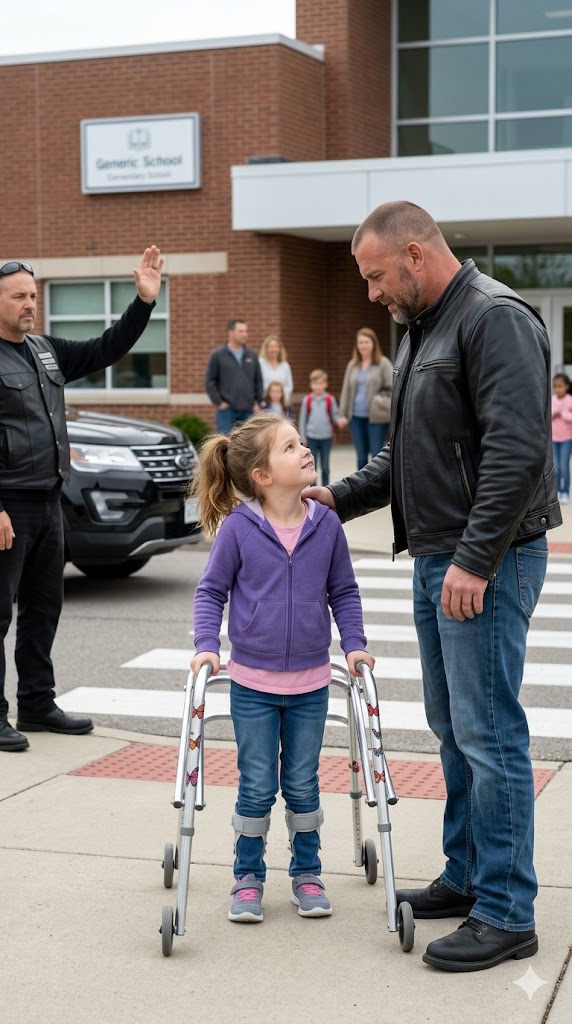
At the corner stood nine-year-old Emma Calloway, holding a small walker covered with bright butterfly stickers.
Her legs moved slowly because of the braces beneath her jeans. Across the street, school was close enough to see.
But the crossing guard was not there.
Emma swallowed hard and whispered, “Mom said I could do hard things.”
Then a car turned too close, and she froze.
The Men Everyone Judged
Near the diner across the street, a group of bikers stood beside their motorcycles.
Big jackets. Heavy boots. Rough faces. The kind of men people looked at once and judged twice.
Emma didn’t see danger.
She saw adults who were not walking away.
She lifted one trembling hand and called, “Excuse me… can someone help me cross?”
The bikers went quiet.
The tallest one, Wade “Bear” Lawson, turned first. He had broad shoulders, a gray beard, and a face that looked hard until he saw Emma’s eyes.
Then his whole expression softened.
He walked over slowly, knelt down, and said, “Hey, sweetheart. You want us to walk with you?”
Emma nodded. “I don’t want to be late.”
Wade smiled gently. “Then we’ll go at your speed.”
Walking at Her Speed
Two other bikers stepped forward.
One held up a hand to stop traffic. Another walked beside Emma’s walker. Wade stayed close enough to catch her if she stumbled.
Cars waited.
Some drivers looked annoyed.
The bikers did not care.
Emma took one small step, then another. Her braces clicked softly. Her walker shook against the pavement.
Wade said, “Nice and easy. Nobody rushes you today.”
When they reached the other side, Emma breathed out like she had been holding fear inside her chest all morning.
“Thank you,” she whispered.
Wade nodded. “You did the hard part. We just walked beside you.”
The Truth Behind Her Quiet Voice
At the school doors, Emma still looked worried.
Wade noticed.
“Need us to walk you inside?” he asked.
Emma hesitated, then nodded.
As they moved toward the entrance, teachers and parents stared. Three bikers walking beside a little girl with butterfly stickers on her walker was not something anyone expected to see.
Wade asked softly, “Did someone usually help you in the mornings?”
Emma looked down.
“My mom used to.”
Wade’s voice became careful. “Used to?”
Emma answered quietly, “She passed away in February.”
The bikers stopped for half a second.
No one said anything.
Emma kept moving like she had learned to carry that sadness without making noise.
“She practiced with me,” Emma added. “She said I was brave enough.”
A Father Doing His Best
The next morning, Wade and the bikers came back.
At 7:35, an old blue sedan stopped near the corner. A tired man in a delivery uniform helped Emma out.
His name was Brian Calloway.
When he saw the bikers, his body stiffened.
Wade raised both hands calmly. “Sir, we helped Emma cross yesterday. We just want to make sure she gets in safely.”
Brian’s face shifted from fear to shame.
“I know she shouldn’t be doing it alone,” he said, his voice low. “I’m trying. Her mom handled mornings. Since we lost her, I’m still learning how to be two parents.”
Wade looked at the man’s tired eyes and believed every word.
“Then let us handle this corner for a while,” Wade said.
Brian blinked.
“You’d do that?”
Wade nodded. “For her? Every morning.”
The Corner Changed
From that day on, the bikers returned.
Sometimes there were two of them. Sometimes five.
They wore reflective vests over leather jackets. They brought small stop signs. They stood near the crosswalk with quiet patience.
At first, parents whispered.
Then they watched.
Then they started saying thank you.
The diner owner began leaving coffee outside with a note: For the men keeping the kids safe.
Emma changed too.
She smiled more.
She told Wade about spelling tests, library books, and the butterfly stickers peeling off her walker.
One biker fixed the squeaky wheel.
Another brought new stickers.
Wade listened to everything like every word mattered.
One rainy morning, Emma asked, “Were people ever wrong about you?”
Wade gave a small laugh. “All the time.”
“Does it hurt?”He looked at her gently.
“Sometimes. But the right people eventually see your heart.”
The Day the School Finally Saw Them
A few weeks later, Cedar Grove Elementary held a small assembly.
The principal stood in front of the students and thanked the bikers for helping keep the crosswalk safe.
The applause began politely.
Then Emma stood with her walker and turned toward the room.
“These are my biker friends,” she said proudly. “People thought they were scary, but they helped me when I was scared.”
The gym went silent.
Then the applause grew louder.
Wade looked down, blinking hard.
For years, people had judged him by his jacket, his size, and his motorcycle.
But one little girl had judged him by what he did when nobody else stopped.
The Drawing in His Vest Pocket
After the assembly, Emma handed Wade a folded piece of paper.
On the front, written in uneven purple marker, were the words:
Thank you for walking at my speed.
Inside was a drawing of Emma, her walker, and a row of big bikers standing around her like a wall of kindness.
Above them was a bright yellow sun.
At the bottom, Emma had written:
Mom said good people don’t always look the way we expect. I think she was right.
Wade folded the paper carefully and placed it inside his vest pocket, right over his heart.
He kept it there from then on.
Not because it made him feel like a hero.
But because it reminded him that sometimes changing a child’s whole world begins with one simple choice:
to stop, kneel down, listen, and walk beside her.
10 Long Messages and Reflections
Sometimes the people society judges first are the ones who understand pain deeply enough to notice when someone small is silently struggling.
A child does not always need a perfect hero; sometimes she only needs one steady adult who refuses to rush her.
Kindness becomes powerful when it moves at the speed of the person who needs help.
A rough face, a leather jacket, or a quiet past can never tell the full truth about someone’s heart.
When a parent is doing their best under impossible pressure, compassion can help more than judgment ever will.
The smallest act of protection can become the memory a child carries for the rest of her life.
A safe community is not built by titles or appearances, but by people who choose to show up every day.
Some children learn bravery too early, and the world should be gentle enough to meet them halfway.
Real strength is not making people afraid; real strength is making someone vulnerable feel safe.
Sometimes the most beautiful thing one person can say to another is not “I’ll fix everything,” but “I’ll walk with you.”