My Husband Locked the Door While I Had a 104°F Fever—He Thought I Was Too Confused to Discover Why His Family Needed Me Declared Incapable
The Morning I Finally Saw My Marriage Clearly
“If you can stand, you can cook.”
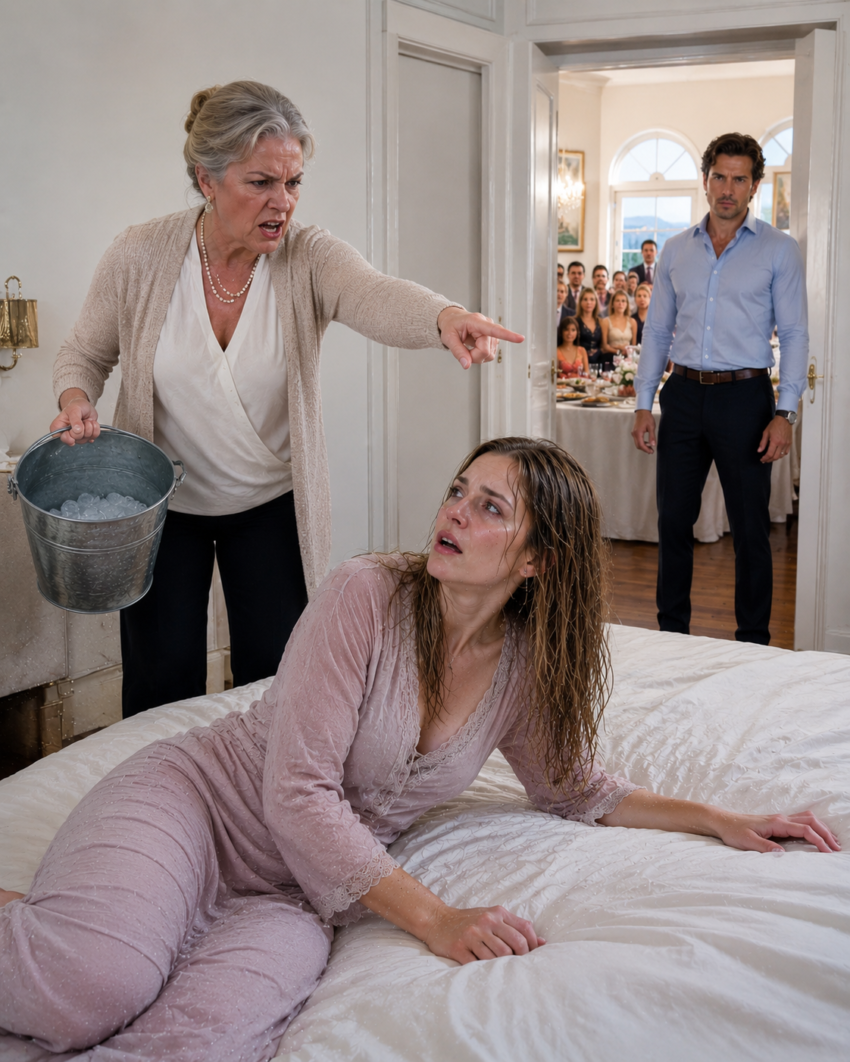
The words reached me seconds before freezing water splashed across my face and chest.
I jerked awake, coughing and gasping as my wet pajamas clung to my skin. My head was pounding, my entire body ached, and the digital thermometer on the nightstand had shown 104°F less than twenty minutes earlier.
Standing beside the bed was my mother-in-law, Judith Mercer, holding an empty plastic pitcher.
“There are more than forty people downstairs,” she said. “This family has been planning today’s memorial luncheon for weeks. Nobody is going hungry because you decided to stay in bed.”
My name is Claire Rowan. I was thirty-one years old and had been married to Judith’s son, Grant Mercer, for four years.
The night before, I had told Grant that something felt seriously wrong. I had chills, dizziness, and a racing heartbeat that would not settle.
That morning I begged him to take me to urgent care.
Instead, he left medicine and a glass of water beside the bed.
“You can go tomorrow,” he said. “If you disappear today, everyone will think I can’t even rely on my own wife.”
Then he walked out.
A few minutes later, I heard the lock turn from the other side.
At first I told myself I must have misunderstood.
Then Judith came upstairs.
And now I was sitting on a soaked mattress while music and laughter floated up from the backyard of their large family home outside Asheville, North Carolina.
“Five minutes,” Judith said before leaving. “Then I expect you in the kitchen.”
I stared at the closed door.
For four years, I had worked hard to become the kind of daughter-in-law they said they respected.
I helped cover Judith’s medical bills when her insurance left gaps. I loaned money to Grant’s sister, Mallory, after her boutique struggled. I allowed Grant to handle several administrative accounts for the interior design studio I had built years before meeting him.
Whenever I questioned how much I was giving, Grant always said the same thing.
“Marriage means there’s no yours and mine.”
Yet whenever I needed something, everything suddenly became mine alone.
My exhaustion.
My fear.
My illness.
My problem.
Something inside me changed that morning.
I stood, using the wall for balance.
I did not change my clothes.
I walked downstairs dripping wet.
Forty People Went Silent
The backyard was filled with relatives seated beneath white rental tents. Long tables were covered with food, flowers, and framed family photographs.
Grant stood near the patio telling a story.
“Claire makes the best chicken casserole,” he announced proudly. “She learned the recipe from Mom.”
I stepped outside.
One conversation stopped.
Then another.
Within seconds, almost everyone was staring at me.
Grant’s smile disappeared.
Judith froze near the serving table.
“Claire,” Grant whispered. “What are you doing?”
I tried to answer, but my knees weakened.
I made it two more steps before dropping beside Grant’s uncle, Harold Mercer, the oldest member of the family.
“Please help me,” I said. “I have a fever over one hundred four. Grant wouldn’t take me to urgent care, and Judith poured cold water over me because she wanted me to cook.”
Judith rushed toward us.
“She’s being dramatic. She hasn’t been herself lately.”
Uncle Harold placed the back of his hand against my forehead.
His expression immediately changed.
“She needs medical attention now.”
I remember trying to say thank you.
Then everything blurred.
When I opened my eyes again, I was in a hospital in Asheville.
Late that afternoon, a nurse came into my room with a concerned expression.
She asked several questions about medication, supplements, and home remedies.
Then she pulled a chair closer.
“Your infection explains part of what happened,” she said carefully. “But your screening showed something else that may have contributed to your symptoms.”
My stomach tightened.
“What kind of something?”
She explained that there were signs of a substance that did not match the medication I remembered taking.
Immediately, I thought about the herbal drink Judith had brought me two nights earlier.
She had stood over me until I finished it.
“It’ll help you sleep,” she had promised.
The nurse hesitated before adding something else.
“Your husband asked several times whether what happened could cause confusion, poor memory, or temporary problems with judgment.”
For several seconds, I could not speak.
Grant had not asked whether I would recover.
He had asked whether I might seem mentally confused.
That question frightened me more than the fever.
The Attorney Who Knew My Father
The next morning, Grant arrived carrying a coffee and acting as if the previous day had been nothing more than a misunderstanding.
“Mom feels terrible,” he said. “We should probably let this go. Everyone was stressed.”
I studied him.
“Did you ask the hospital whether I could lose my memory?”
His face barely changed, but I noticed the pause.
“You were saying strange things. I was worried.”
Before I could answer, he kissed my forehead and left.
An hour later, a silver-haired man in a charcoal suit entered my room.
“Claire Rowan?”
“Yes.”
“My name is Nathaniel Brooks. I represent Warren Rowan.”
I stopped breathing for a moment.
Warren Rowan was my biological father.
The man I had been told was gone from my life permanently.
Nathaniel placed a leather folder on the table.
The story he told me changed everything I believed about my childhood.
My father had spent years trying to locate me after a bitter family dispute separated us when I was young. I had eventually been raised by another couple who became the parents I knew and loved.
Warren had never stopped searching.
He had also become the owner of a successful building-materials company with operations across several states.
When he finally learned where I was—and who I had married—he quietly began looking into the Mercer family.
That investigation uncovered something extraordinary.
The large property where Judith lived had not been financially secure for years.
The Mercers had borrowed heavily against it and almost lost the land a decade earlier.
Through one of his companies, my father had purchased the debt.
The agreement gave the Mercer family ten years to repay what they owed.
There were twenty-seven days left.
If they failed, control of the property would return to the company holding the debt.
And because of the way my father’s estate planning had been structured, I was the primary beneficiary.
I stared at Nathaniel.
“Does Grant know?”
Instead of answering, he opened another folder.
Inside were printed messages.
Grant.
Judith.
A questionable financial adviser.
They discussed medical evaluations, temporary financial authority, signatures, and the possibility of having someone manage my assets if I were considered unable to make reliable decisions.
My hands started shaking.
They did not simply want the land.
They wanted me legally unable to challenge them.
I Pretended Not to Understand
Nathaniel told me the smartest thing I could do was let Grant believe his plan was working.
So I stopped confronting him.
When Grant visited that evening, I stared at him as though I were struggling to recognize him.
“Claire, do you know who I am?”
I waited.
“Are you one of the doctors?”
The look in his eyes lasted less than a second.
Relief.
He sat beside me.
“I’m Grant. Your husband.”
He pulled several papers from his bag.
Some would have given him access to financial accounts.
Others involved my design company.
One document concerned property rights connected to the Mercer land.
“I just need you to sign these so I can help you while you recover.”
I took the pen.
Then deliberately drew an uneven line across the wrong page.
Grant clenched his jaw.
“Claire, concentrate.”
I stared toward the window.
“I don’t understand.”
He gathered the papers and left.
What he did not know was that my attorney had already begun documenting everything legally.
And what we discovered next was even worse.
My Best Friend Had Given Him the Map
Grant had been diverting clients from my studio for months.
Projects that should have gone through my company were being moved to another business called Northline Interiors.
The registered owner was Brielle Tate.
My closest friend from college.
Brielle was one of the only people who knew about my biological father.
Years ago, I had confessed to her that I might someday inherit significant assets, but I wanted to build my own career without depending on family money.
She also happened to be the person who encouraged me to date Grant.
“He doesn’t seem interested in money,” she had told me back then. “He likes you for you.”
Now I understood why Grant had always seemed to know exactly what mattered to me.
Brielle had told him.
Further review showed that she and Grant had redirected contracts from my company for nearly a year.
Their plan was straightforward.
Weaken my business.
Make me appear unable to manage it.
Gain control over my accounts.
Protect the Mercer property.
Then remove me from the picture financially.
But there was one more secret.
Grant and Brielle had also been involved with each other behind my back for almost two years.
When Nathaniel showed me the evidence, I did not cry.
I had already passed the point where betrayal surprised me.
Grant Made One Mistake Too Many
A qualified specialist later evaluated me and confirmed that I was mentally capable of handling my own affairs.
Grant did not know.
So he returned to the hospital believing he still had an advantage.
This time he was less patient.
“You need to sign tonight.”
I pushed the papers away.
“I’m tired.”
His expression hardened.
“You have no idea how much trouble you’ve caused everyone.”
Then he stepped into the hallway and made a phone call.
The conversation raised serious concerns that he intended to remove me from the hospital without proper approval.
Hospital security was notified.
So were the appropriate authorities.
The following evening, Grant arrived with two unfamiliar men and Judith.
They claimed they were there to take me home.
But when staff questioned them, their explanations did not match.
Security arrived within moments.
Grant began arguing.
“She’s my wife. I’m allowed to take care of her.”
Nathaniel appeared behind the security officers.
“Then you should have no difficulty explaining the documents, the unauthorized financial activity, and the messages discussing how to obtain control of her property.”
Grant stopped talking.
For the first time since I had known him, he had no answer ready.
Judith Finally Said Too Much
The investigation widened quickly.
I revoked Grant’s access to my business accounts and froze every company permission I legally could.
Brielle attempted to distance herself from him.
Mallory claimed she knew nothing.
Judith insisted everything had been misunderstood.
Then, a week later, I returned to the Mercer house with legal supervision to collect my belongings.
Judith confronted me in the living room.
“You caused all of this because you never understood your place in this family.”
I turned around.
“What exactly was my place?”
“Grant was trying to protect everything we built.”
“By making everyone believe I couldn’t manage my own life?”
Mallory stepped into the room.
“Mom, stop talking.”
But Judith was too angry to listen.
“I only gave you the remedy we were told would calm you down. Nobody said you would react that badly.”
The room became completely still.
Judith realized what she had said.
Too late.
The conversation was documented and turned over to the investigators along with medical records and messages discussing how long certain side effects might last.
For months, I had believed Judith simply disliked me.
The truth was colder.
This had never been about personality.
It was about control.
The Friend Who Wanted My Life
When Brielle was finally confronted with the financial records, her calm image disappeared.
“You always had everything,” she snapped. “Talent, a business, parents who loved you, and another family still looking for you. You acted like you were ordinary when you had all of that waiting in the background.”
I looked at her.
“So you decided to help my husband take it?”
Her silence was answer enough.
Then I asked the question I had been avoiding.
“How long have you and Grant been together?”
Grant looked away.
Judith closed her eyes.
Brielle finally answered.
Almost two years.
Their plan had been to weaken my company, secure control of the property, and eventually end my marriage once I had nothing left to challenge them with.
Months of legal reviews followed.
There was no overnight movie ending.
There were accountants, interviews, hearings, business audits, and mountains of documents.
But paper trails are difficult to argue with.
Grant had to answer for the financial activity connected to my business and for his attempts to obtain authority over my assets.
Brielle faced consequences connected to diverted clients and company funds.
Mallory cooperated after investigators uncovered her involvement in selling designs that belonged to my studio.
Judith lost the reputation she had spent years protecting.
And I filed for divorce.
At our final meeting, Grant looked smaller than I remembered.
“Brielle pushed everything too far,” he said.
I almost laughed.
“You were a grown man, Grant. She didn’t make your choices for you.”
“I panicked.”
“No. You chose.”
He looked down.
“If I could go back—”
“So would I. I would go back to the day we met and keep walking.”
Then I signed the final papers.
What I Did With the Property
The Mercer family failed to satisfy the terms connected to the property.
Once the legal process was completed, the land became part of the assets I controlled through my father’s estate structure.
Several Mercer relatives asked me to meet.
Uncle Harold spoke first.
“Claire, legally you may have rights here, but this property has been connected to our family for generations.”
Another relative added, “You aren’t married to Grant anymore.”
I stared at him.
“My rights were never dependent on staying married to Grant.”
Judith sat silently at the far end of the room.
Then she finally asked the question everyone was thinking.
“Are you going to take everything away from us?”
“No.”
Relief spread across several faces.
Then I continued.
“But I’m not giving it back to you either.”
Part of the land was placed into a structure supporting educational and community programs.
Another portion began generating funding for scholarships for local students whose families could not easily afford college or vocational training.
The main house could continue being used for community events under strict rules.
Uncle Harold stared at me.
“You could sell all of it.”
“I could.”
“Why don’t you?”
I thought about the parents who raised me.
They had never been wealthy.
But they gave me stability, encouragement, meals, tuition help, and affection without once calculating what I might someday give them in return.
“Because inheritance isn’t just about what you own,” I said. “It’s about what you decide to do with it.”
The Family I Chose to Keep
My biological father came to North Carolina several weeks later.
Our reunion was not cinematic.
I did not run across an airport terminal and fall into his arms.
We sat across from each other at a quiet table and talked for hours.
He had regrets.
I had questions.
Finally, he said, “I should have found you sooner.”
I answered, “You should have told me the truth sooner.”
He nodded.
“Yes.”
That simple answer mattered.
He did not make excuses.
He did not ask me to erase the past.
We simply started from where we were.
Over the next year, I rebuilt my studio.
Several employees who had tried to warn me about Grant returned. My longtime project manager, Ethan Holloway, became a minority partner because he had protected the business even when I did not realize it needed protecting.
A year after the hospital incident, I returned to the former Mercer property for the first scholarship ceremony.
Students filled the garden.
Teachers spoke with families beneath the same white tents that had once been used for that memorial luncheon.
My adoptive parents sat in the front row.
My biological father sat beside them.
Uncle Harold approached me before the ceremony.
“This family owes you an apology.”
I looked toward the patio.
It was almost exactly where I had collapsed while wet, sick, and terrified.
“I don’t need anyone to change the past,” I told him. “I just need what happened to me to never become normal for another woman in this family.”
He nodded.
Judith was sitting far away.
Our eyes met.
I felt no desire to embarrass her.
I also felt no desire to invite her back into my life.
That was when I finally understood something about forgiveness.
Sometimes forgiveness does not mean reconciliation.
Sometimes it simply means refusing to carry someone else’s choices inside your heart forever.
For years, I had confused patience with love.
Silence with loyalty.
Sacrifice with marriage.
I had believed being a good wife meant enduring whatever kept everyone else comfortable.
I know better now.
People sometimes ask what I consider my greatest victory.
Was it saving my business?
Keeping control of the property?
Learning the truth about my father?
Walking away from Grant?
Those things mattered.
But my real victory happened much earlier.
It happened the morning I was standing in that locked bedroom, soaked, feverish, and barely steady on my feet.
Judith had told me that if I could still stand, I could go downstairs and serve her family.
In one strange way, she was right.
I could still stand.
So I did.
I just did not stand up to cook for them.
I stood up to save myself.
Sometimes the moment that feels like your lowest point becomes the first moment of your freedom, because once you clearly see how little someone values your dignity, you can finally stop exhausting yourself trying to earn the love they were never willing to give honestly.
A healthy family does not measure your worth by how much money, labor, silence, patience, or sacrifice you provide; the people who truly care about you will still protect your dignity on the days when you have nothing left to offer them.
Being patient does not mean accepting every unfair demand forever, because patience without boundaries can slowly teach other people that your comfort, dreams, health, and future will always come second to whatever they want from you.
Love should never require you to become smaller so someone else can feel more powerful, and a marriage that survives only when one person stays silent is not really surviving—it is simply postponing the moment when the truth can no longer be ignored.
Financial independence is not about refusing help or distrusting everyone you love; it is about understanding enough about your own accounts, contracts, business, and property that nobody can quietly rewrite your life while telling you they are only trying to protect you.
Betrayal hurts most when it comes from people who were trusted with the private parts of your life, but even that pain can become useful when it teaches you that trust should be given with love while still being supported by healthy boundaries and clear judgment.
Forgiveness does not always require reopening the door to someone who hurt you, because sometimes the most peaceful form of forgiveness is accepting what happened, releasing the need for revenge, and choosing a future in which that person no longer controls your emotions.
An inheritance is not valuable only because of the money, land, or property attached to it; its deeper value comes from the choices we make with what we receive and whether those choices create more fear, more control, or something genuinely useful for the people who come after us.
The strongest decision you make may not look dramatic from the outside, because strength can be as quiet as asking for help, reading a document carefully, changing a password, walking through a door, or finally saying that the treatment you have tolerated for years will not continue for one more day.
Never confuse losing a harmful relationship with losing your family, because sometimes walking away from people who only valued what they could take from you is exactly what creates enough space to recognize the people who love you without asking you to surrender yourself in return.