The Call That Pulled Him Home
If you saw Ryland Mercer from across a parking lot, you would probably think you had him figured out in five seconds.
Most people thought they did.
They noticed the leather first, then the scar over his brow, then the heavy boots, then the old Harley that sounded like thunder rolling low across the pavement. He was six foot four, broad-shouldered, white, with tattooed hands and a face that looked as if life had tested it more than once and never once apologized. He wore silence the way some men wore cologne. It entered a room before he did.
By the time he reached St. Matthew’s Medical Center in Wichita Falls, Texas, he had been riding almost twenty-three hours with barely a pause. Road dust clung to his vest and shoulders. His eyes were red from wind, fatigue, and the kind of fear a son carries when he believes he may already be too late.
That fear was exactly why his younger sister, Delaney, had called him.
At 3:11 in the morning, she told him their mother had less than a day left.
She said if he wanted to see her alive, he needed to leave right then.
Ryland had ignored holidays, birthdays, and every awkward family attempt to patch old wounds with soft voices and casseroles. He did not answer guilt. He did not answer nostalgia. He did not answer family just because family was calling.
But death?
Death was the one thing he still answered.
So he rode through the night with truck-stop coffee in his stomach, old anger in his chest, and the kind of restless prayer men say without speaking when they grip the handlebars hard enough to make their knuckles ache.
He rode like a man trying to beat regret to the finish line.
Then he walked into room 418 and found his mother very much alive.
She was sitting up in bed, tired but alert, adjusting her blanket and arguing with a nurse about bland food.
Ryland stopped in the doorway.
I was already in the room when he came in, and I watched his face change without him moving much at all. That was the worst part. There was no shouting at first. No explosion. No wild scene.
Just one long stare at Mom.
Then Delaney.
Then me.
And then his voice, low and dry from the road.
“So who’s dying?”
Nobody answered fast enough.
That silence told him everything.
The Sister Who Chose the Lie
Our mother, Elaine Mercer, started apologizing before anyone else found their voice. She said she had no idea Delaney had told him that. She said she had only come in for a procedure and would be fine. She said the last thing she wanted was for him to see her like this, hooked to monitors and looking weaker than she felt.
Ryland did not look at her again.
He looked at Delaney.
“You used Mom.”
Delaney’s eyes filled instantly. She had always cried quietly, like she did not believe she had earned the right to make noise.
“Yeah,” she said.
“For what?”
She pressed both hands together so tightly her fingers shook. I knew what she was about to say, and even I wanted to stop her. Not because it was untrue, but because I knew what that name still did to our brother.
She stepped into the hallway after him when he turned to leave. I followed a few seconds later.
Ryland stood under the harsh hospital lights looking like a storm that had learned how to stay upright.
Delaney swallowed hard and forced the words out.
“Mom wasn’t why I called you home.”
He said nothing.
“He’s here.”
Ryland’s jaw tightened.
“Don’t.”
“He asked for you.”
That was the moment the air changed.
Because the man waiting in the room down the hall was not just any father. He was Vernon Mercer, the one who had disappeared thirty years earlier with no real goodbye, no honest explanation, and no courage to look back.
He had left when Ryland was seventeen, I was nine, and Delaney was six.
One note.
One unpaid electric bill.
One kitchen full of kids too young to understand why the house suddenly felt colder.
Ryland had spent thirty years burying that man so deeply inside himself that even hearing the word father made something in his face turn hard as stone.
Now that man was in the next room, close to the end of his life, and according to Delaney, he had only asked for one person.
Ryland.
The Boy He Used to Be
People who met my brother later in life thought the motorcycle made him hard.
They had it backward.
Life made him hard first.
The bike only gave him somewhere to carry it.
When our father left, Ryland found the note before any of us did. He read it once, folded it carefully, slid it into his pocket, and walked out to the garage. A minute later, we heard glass shatter. He had punched through the side window so hard his hand split open.
He never cried in front of us.
Not when Mom lost the house two years later.
Not when he dropped out of school to take refinery work and pipeline jobs.
Not when he started mailing half his paychecks home so Delaney could get braces and I could stay in school.
Not when Mom came home from double shifts at the nursing facility so tired she could barely lift her feet.
He never cried.
He simply became the kind of young man broken homes often produce—watchful, restless, dependable in ways nobody should have to become so early.
He found motorcycles not because he wanted to look dangerous, but because riding gave him order. It gave him rules. It gave him movement when standing still hurt too much. Later he found a small biker brotherhood near Abilene—mechanics, welders, one retired Marine, one quiet man who sold farm equipment, another who coached Little League on Saturdays. They were not saints, but they were the kind of men who showed up when someone needed help and did not ask for applause afterward.
Ryland fit there.
He could sit beside grief without trying to decorate it.
He could repair an engine in a motel lot with half the right tools.
He could read trouble in a room before anyone else noticed it.
He could also hold a grudge like it was something sacred.
He never spoke our father’s name unless it came out sounding like a verdict.
And yet there were details that never matched the tough image strangers gave him. He kept a sewing kit in one saddlebag next to a tire gauge and a rusted multitool. He never drove past a stranded motorist without at least slowing down. He tipped waitresses like he knew what rent cost. He called Mom every Mother’s Day but only when he was sure she would not answer, then left messages too short and too gentle for anyone who only knew the man in the leather vest.
That was who Delaney had lied to.
Not just a biker.
A son who still loved too deeply to admit it safely.
The Corridor Between Then and Now
Ryland made it halfway down the corridor before I caught up with him near the vending machines.
He was breathing hard, not from the ride anymore, but from the effort of holding himself together. Nurses glanced over and then looked away. Families sat in plastic chairs pretending they were not listening. My brother looked like fury from a distance, but standing near him, I knew better.
It was not fury first.
It was grief with nowhere clean to go.
“He is dying,” I said.
Ryland let out a harsh breath.
“He started dying the day he got in that truck and left us there.”
I should have stopped talking.
Instead, I said, “Maybe this isn’t about him.”
That made him look at me.
Really look.
And because exhaustion strips a man down to what is true, I saw beneath the anger what had always been there.
Fear.
Not fear of Vernon Mercer.
Fear of what one last room, one last conversation, one last unfinished sentence might do to him.
Delaney joined us holding a cream-colored envelope, bent at one corner as if too many hands had almost opened it.
“He wrote this yesterday,” she said. “He told the nurse not to give it to you unless you came.”
Ryland stared at the envelope like it might burn.
“Read it yourself.”
“No,” Delaney whispered. “It’s yours.”
Mom had come down the hall by then too, still wearing her hospital wristband, too stubborn to stay in bed while one child faced the wreckage of the family alone.
Ryland finally took the letter.
His hands looked wrong holding paper. They were scarred and broad, built for wrenches and handlebars and hard work, not for shaking open the past.
He unfolded the page and read in silence.
I did not see every line, but I saw enough in his face.
At one point he stopped and looked up.
“What box?”
Delaney lowered her gaze.
“The one from the garage.”
That hit him harder than the letter.
Because when our father left, he had taken more than clothes and money. He had taken a cardboard box from the garage that Ryland had searched for all summer. It held old motocross pictures, a cracked number plate, a trophy from a county fair race, and a worn leather map pouch from our grandfather, the only gift Ryland had ever treated like treasure.
For thirty years, my brother believed that box was lost forever.
It wasn’t.
Our father had kept it.
The Room Next Door
When Ryland finally stood, every movement looked deliberate, as if his body had turned into a list of things that had to be done one by one.
He folded the letter and slipped it into the inside pocket of his vest.
He rubbed one hand over his beard.
Then he said, “I’m not doing this for him.”
No one argued.
We walked together to the room at the end of the hall.
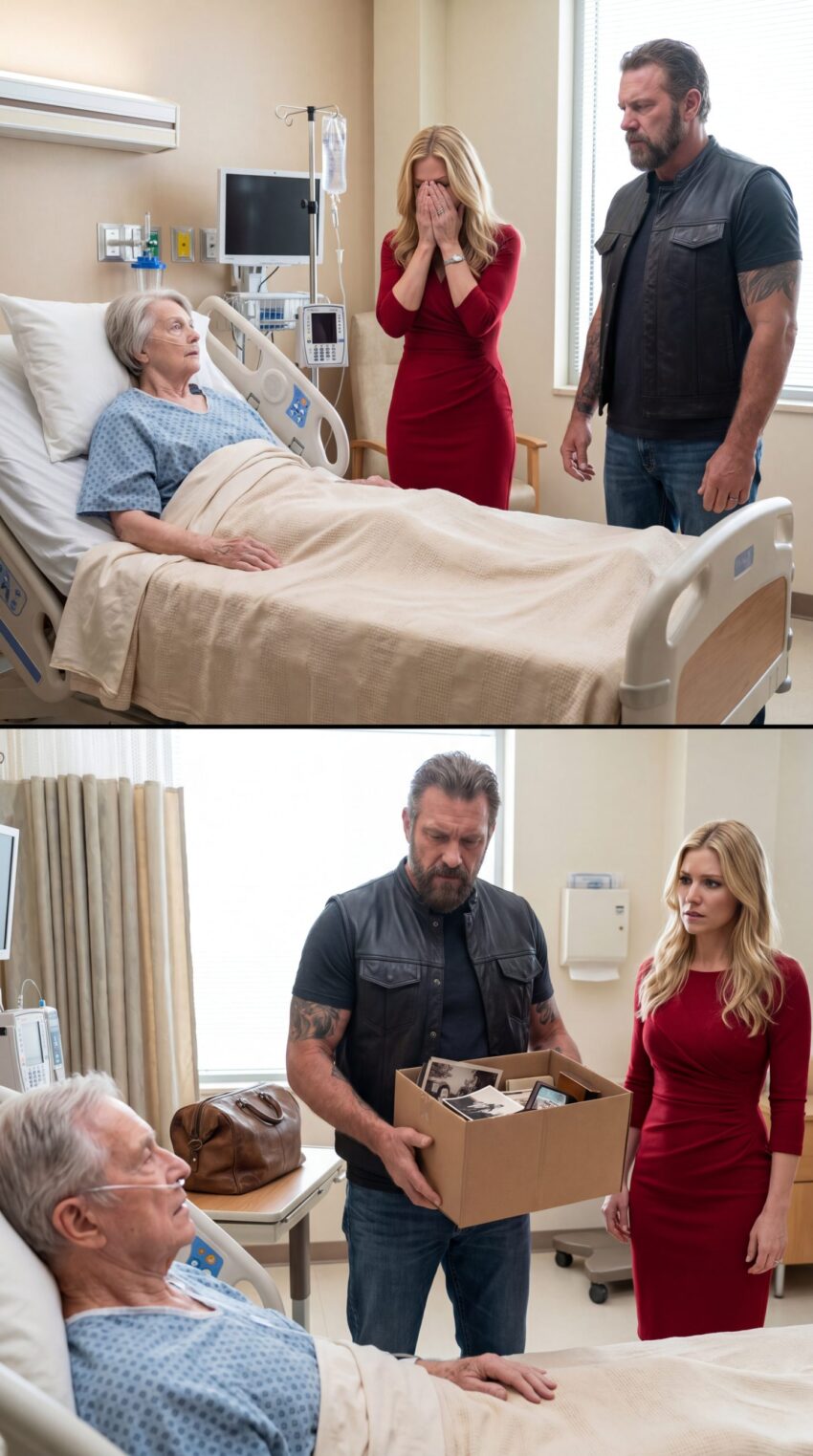
The man in that bed looked smaller than memory had any right to allow. Vernon Mercer had once filled a doorway with noise, excuses, and restless energy. Now he looked thin, worn down, and strangely fragile beneath the hospital blanket. Oxygen rested under his nose. His skin had gone pale and loose. The years had not been gentle.
A cardboard box sat on the chair by the window.
Ryland noticed that before he looked at the man in the bed.
That alone told the whole story.
Our father opened his eyes when we entered. He saw Mom first, then Delaney, then me, and at last Ryland.
Whatever speech he had prepared disappeared the moment he found his son standing there.
Ryland stayed by the chair.
He did not step closer.
He did not offer comfort.
He simply waited.
At last Vernon looked toward the box.
“That’s yours.”
Ryland’s voice stayed flat.
“Why did you keep it?”
Our father swallowed before answering.
“Because bringing it back would’ve meant facing what I did.”
Ryland gave one short nod.
“So you kept both.”
That line was so clean and true even Mom turned her face away.
The room stayed quiet for a few seconds. Hospital rooms always have their own soundtrack—monitor beeps, air vents, rubber soles in the hallway, ice clattering into a machine somewhere far off. It all keeps going no matter what breaks inside the walls.
Vernon closed his eyes briefly.
“I told myself leaving was better for you,” he said. “I told myself I was no good for any of you. That sounded honest in my own head. Truth was, I was weak. Then every year I stayed away made it harder to come back.”
Ryland rested one hand on the top of the box.
His fingers did not tremble, but I could feel the effort it took for him to keep them still.
“You don’t get points for knowing that now.”
“I know,” Vernon said.
The Things a Man Carries
Ryland opened the box slowly.
Inside were the pieces of a life he had lost before he was old enough to understand how much it would cost him. Old racing photos yellowed at the edges. His number plate. The cheap trophy with his last name misspelled. The worn leather map pouch from our grandfather with the family name scratched inside by an unsteady knife years earlier.
Then he found something else at the bottom.
A Polaroid.
Ryland at seventeen, all sharp bones and stubborn eyes, standing beside his first bike in our old garage.
On the back, in younger handwriting, were four words:
You were always headed home.
My brother stared at that picture longer than anything else in the box.
Our father’s voice came quieter now.
“I heard things over the years. About the refinery. About the bike. About Delaney’s wedding. I saw a picture once. You looked like your grandfather.”
Ryland almost laughed, but there was no humor in it.
“You don’t get to claim that either.”
“No,” Vernon said softly. “I don’t.”
Then came the part that somehow hurt in a different way.
“I tried sending money,” he said.
Mom let out a tired breath.
“Twice,” she replied. “Forty dollars once. Sixty another time. No return address.”
Vernon looked ashamed enough to disappear into the pillow.
“That was all I had.”
For years, Ryland had believed our father never thought of us again. The truth was uglier in its own way. He had thought of us. He had remembered us. He simply had not been brave enough to return while it still mattered.
Feeling something is not the same as showing up.
That is the kind of failure children remember forever.
Ryland pulled a chair to the bed and sat down.
Not close enough to pretend things were healed.
Not far enough to deny the moment.
He did not offer forgiveness, and he did not lie for the comfort of a dying man.
He only said, “You should’ve come sooner.”
Vernon looked at him with the kind of sorrow that arrives too late to fix anything.
“I know.”
Ryland placed one rough hand over his father’s wrist.
Scarred skin over paper-thin skin.
Son over father.
Presence over absence.
He stayed there.
That was all.
Sometimes that is the most honest gift a broken family can still give.
What Stayed After the Night Ended
Vernon Mercer passed away that night with Ryland still in the room.
My brother did not fall apart. He did not deliver some grand speech. He did not suddenly become soft because the world likes stories that end neatly.
He simply stayed.
After the funeral, he remained in town four more days. Long enough to help Mom sort documents. Long enough to sit on Delaney’s porch at sunrise with burnt coffee and not mention the lie again. Long enough to load every item from that old box into his saddlebags one piece at a time, as if handling them too quickly would disturb something sacred.
On his last morning, he rode out alone to the lot where our old house used to stand before the county cleared it years ago. Nothing remained except a strip of cracked concrete where the garage had once been.
He stood there in the wind for a long time.
Then he took the Polaroid from the leather map pouch, looked at it quietly, and tucked it into the lining of his vest.
Not into his wallet.
Not into the saddlebag.
Inside the cut, close to his chest.
He still rides every Father’s Day.
Same roads when weather allows it.
Same diner outside Tucumcari.
Same habit of leaving before sunrise and not explaining himself to anybody.
He does not talk about the hospital. He does not talk about our father. He does not use big words for pain or healing.
But last fall I watched him stop at a gas station outside Clovis to help a teenage boy whose old Honda would not start. The kid’s father stood nearby looking embarrassed and useless. Ryland tightened a loose cable, handed the wrench back, and said only one thing before climbing onto his Harley again.
“Show up before somebody else has to.”
That was the closest thing to a sermon he will probably ever give.
And maybe it says everything.
Some men spend years riding to get away from what hurt them.
My brother rode all night because he thought he was about to lose his mother.
He stayed because a father who had failed him was finally out of time.
He left without pretending the wound had never existed.
But he did not leave empty.
He left carrying the truth that love can survive disappointment without becoming blind, that presence still matters even when it arrives late, and that a man does not have to call something forgiven in order to lay it down gently and keep moving.
The road darkened when he finally rode west again. His taillight grew smaller under the long American dusk until it looked less like a motorcycle disappearing and more like a promise refusing to die.
Some people would still take one look at Ryland Mercer and decide they knew him.
They would see the leather, the scar, the bike, the hard face.
They would miss the sewing kit in the saddlebag, the old photo inside the vest, the long ride he answered because somewhere under all that silence, he had never stopped being a son.
Family wounds do not disappear just because time passes, but time does give people a chance to choose whether they will let pain turn into cruelty or into something quieter and wiser.
Sometimes the bravest thing a person can do is walk into the room they have spent years avoiding and remain there long enough to face the truth without running from it.
Not every parent deserves easy forgiveness, and not every child is able to offer it, but honesty can still become a form of dignity when nothing else can be repaired.
A person’s appearance often tells strangers almost nothing about the tenderness they protect, the burdens they carry, or the memories they keep hidden close to their heart.
The people who look the hardest on the outside are sometimes the ones who learned early that softness had to be guarded if they wanted it to survive.
Showing up late is still better than never showing up at all, but the story reminds us that love needs courage in the present, not just regret in the final hour.
Children do not forget who stayed, who left, and who tried, and those quiet memories shape the adults they become in ways the world rarely sees.
Real strength is not found in loud promises or dramatic words, but in the ability to stay present in painful moments without pretending they are easier than they are.
There are some apologies too late to fix the past, yet even then, truth can still return something valuable to the people who thought it was gone forever.
And in the end, the road home is not always about finding peace all at once, but about carrying what is true, releasing what is false, and continuing forward with a heart that remains scarred, honest, and still capable of love.