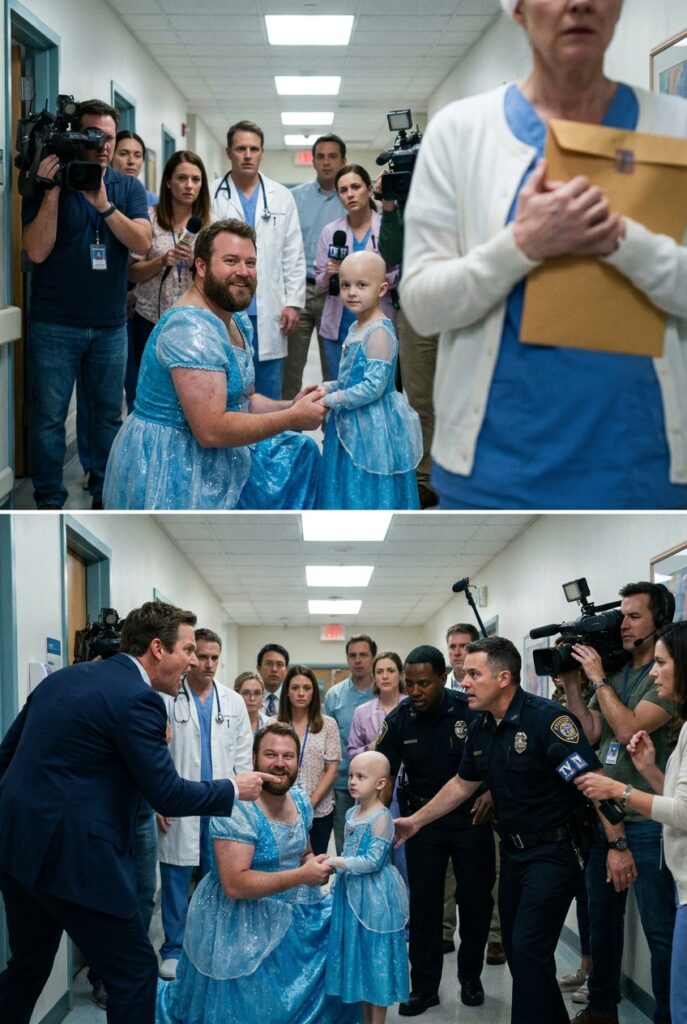
I Put On My Daughter’s Blue Elsa Dress Over My 285-Pound Frame to Keep a Promise at the Cancer Ward—Until a Billionaire Called Security to Drag Me Out, Unaware of the Sealed Letter the Nurse Held in Her Trembling Hands
The heavy glass doors of the pediatric oncology wing at St. Jude’s Memorial closed behind me with a soft, pneumatic hiss, shutting out the sterile roar of the main lobby. Outside, the summer sun was blazing, but inside the fourth-floor hallway, the air always smelled of rubbing alcohol, floor wax, and a quiet, heavy stillness that made every footstep feel dangerous.
My name is Marcus. I am thirty-eight years old, six-foot-five, two hundred and eighty-five pounds, with a shaved head, a thick graying beard, and arms covered in heavy ink from my years as a diesel mechanic and road captain for a regional riding club.
Under my heavy black leather boots, the linoleum floor squeaked loudly.
Over my flannel shirt and jeans, I was wearing a floor-length, shimmering ice-blue polyester Elsa costume. The silver sequined corset dug painfully into my chest, the fake blonde synthetic braid sat crookedly over my right ear, and the sheer snowflake cape trailed three feet behind me on the clean floor.
=
I looked ridiculous. I looked absurd.
And as I pushed open the double doors into Playroom B, six-year-old Sophie—her tiny head covered in a soft yellow knitted cap, her arm hooked up to a rolling IV pole—looked up from her coloring book, let out a gasping squeal, and burst into a fit of wild, unstoppable giggles.
Within three seconds, four other children—kids with pale cheeks, dark circles under their eyes, and surgical tape on their small hands—rushed toward me across the foam play mats.
“Queen Elsa!” eight-year-old Toby shouted, waving a plastic broom handle like a sword. “You’re back!”
“I am,” I said, my voice dropping into a terribly fake, high-pitched princess register that made Nurse Sarah cover her mouth in the doorway to hide her laughter. “And I have returned to frozen kingdom rules! No medicine allowed for the next sixty minutes!”
For three years, every single July 14th, I wore that blue dress through those hospital doors.
I didn’t do it for attention. I didn’t do it for social media.
I did it because four years ago, on a freezing Tuesday morning in room 412, my seven-year-old daughter, Chloe, lost her fourteen-month battle with acute lymphoblastic leukemia. Three days before she closed her eyes for the last time, while she was too weak to lift her juice cup, she had held my massive, calloused hand, looked at my rough face, and whispered:
“Daddy… when I’m gone, will you go back to the playground floor in your frozen dress? The kids get so scared when the doctors come in. If they laugh at you, they won’t remember their arm hurts.”
I had promised her. And a father’s promise to his dying child doesn’t end when the pulse monitor goes flat.
The Humiliation in the Hallway
For forty-five minutes, Playroom B wasn’t a cancer ward.
It was an ice castle. We sang “Let It Go” entirely out of tune—me bellowing the chorus like a foghorn while three little girls spun around my heavy boots, their laughter echoing down the hallway. For forty-five minutes, mothers who hadn’t slept in three weeks rested their foreheads against the wall and wiped away quiet, grateful tears as their children forgot about chemotherapy, spinal taps, and nausea.
Then the heavy wooden doors swung open, and the music died.
Standing in the doorway was Julian Croft—a sixty-year-old pharmaceutical billionaire, regional real estate mogul, and the primary benefactor whose name was stamped in silver letters on the building’s exterior wall. Behind him walked two local news camera crews, three PR assistants holding clipboards, and Dr. Harrison, the chief of pediatric medicine.
Julian was wearing a three-thousand-dollar tailored suit, his silver hair perfectly parted. He had brought the cameras for his annual, highly publicized photo-op and donation check presentation.
When Julian’s sharp blue eyes landed on me—a massive, tattooed biker in a torn princess gown dancing on the play mat—his face contorted into an expression of profound, disgusted outrage.
“What in God’s name is this?” Julian’s voice boomed over the room, sharp and abrasive.
The children froze. Little Sophie stepped behind my leg, her small fingers wrapping tightly around my sheer blue cape.
“Mr. Croft,” Dr. Harrison began quickly, stepping forward with an anxious smile. “This is Marcus. He’s a parent volunteer, his daughter—”
“I don’t care who he is!” Julian interrupted, snapping his fingers toward the hall. “This is a world-class medical institution, not a cheap, unprofessional circus! I brought major corporate donors and television networks here today to showcase serious medical research, and I walk in to find a tattooed vagrant playing dress-up in front of sick children?”
“Sir, he visits every year—” Nurse Sarah tried to explain, her voice trembling with rising anger.
“Security!” Julian roared toward the hallway, entirely ignoring her. “Remove this man from the floor immediately! If he is on this property in three minutes, I am pulling my foundation’s endowment from this facility before the 6:00 PM news broadcast!”
Two tall, uniform security guards stepped into the doorway, looking deeply uncomfortable, their hands resting awkwardly on their utility belts.
“Marcus…” one of the guards whispered softly, his eyes filled with genuine apology. “I’m sorry, man. You know we love having you here, but…”
“It’s okay, Dave,” I said quietly.
I didn’t yell. I didn’t raise my fists. I didn’t drop my posture. My knuckles were white as I squeezed my snowflake wand, my chest tight with a cold, suffocating grief, but I had made a vow to Chloe that I would never bring anger or violence into the room where she had spent her final days.
I slowly dropped down onto one knee, looking Sophie in her big brown eyes. I handed her my plastic snowflake wand.
“The Snow Queen has to step out for a minute, sweet pea,” I whispered, forcing a gentle smile through my thick beard. “You hold the kingdom down for me, okay?”
Sophie’s lip trembled. Tears filled her eyes. “Don’t go, Elsa…”
“I have to, baby,” I murmured, standing up to my full height.
I turned and walked toward the doorway, my sheer cape trailing behind me, my black boots thudding against the floor as the television cameras swung around to capture the spectacle of a giant, embarrassed biker being escorted past a line of crying children.
Julian stood by the door, his arms crossed over his tailored suit, a cold, triumphant smirk on his lips as I approached. “Unbelievable,” he muttered under his breath as I passed. “The nerve of some people.”
The Unsealed Envelope
“Wait! Stop the elevator! Please, stop!”
Nurse Sarah’s voice rang through the hallway, sharp and desperate.
She was sprinting down the tiled corridor, her rubber clogs squeaking against the floor, ignoring the security guards and the cameras. In her trembling hands, she held a thick, yellowed paper envelope sealed with worn floral tape.
Julian frowned, stepping forward to block her. “Sarah, what is the meaning of this? The media is waiting in the auditorium—”
“Shut your mouth, Mr. Croft!” Sarah yelled, her voice cracking with an intense, raw emotion that made the entire hallway freeze.
The camera crews stopped moving. The reporters paused, their microphones held mid-air.
Sarah didn’t look at Julian. She walked straight past him, her eyes locked on me, her hands shaking so violently she could barely hold the paper.
“I kept it in her file, Marcus,” Sarah sobbed, tears spilling over her cheeks onto her scrubs. “She gave it to me the night before she passed. She made me promise not to open it unless someone tried to stop you from coming back.”
I froze near the elevator doors. My throat locked up. “Sarah… what is that?”
Sarah turned toward the television cameras, her voice trembling, but carrying with a fierce, absolute clarity that echoed off the cold glass walls.
“This is a letter written four years ago by seven-year-old Chloe Callahan,” Sarah announced to the reporters. “Written three days before she died in Room 412.”
Sarah tore open the worn floral tape, pulled out a single sheet of wide-ruled notebook paper written in crooked, shaky purple crayon, and began to read aloud:
“To whoever is in charge of the hospital when I am gone:
My daddy looks very scary to people who don’t know him. He is very big, he rides a loud motorcycle, and he has dark pictures on his arms. People look at him funny in the grocery store.
But my daddy is the gentlest man in the whole world. When my head hurts from the medicine, he sits on the floor for six hours and lets me paint his fingernails pink.
He promised me he will wear my blue Elsa dress every year on my birthday to visit the children who are still stuck in the beds. He promised he will make them laugh so they forget about the needles.
Please do not be mad at him when he wears the dress. He looks strongest in his leather jacket, but he looks kindest in my Elsa dress. Real heroes are willing to look silly just to make scared children smile.
Love, Chloe Callahan (Age 7, Room 412).”
The Silence of the Hallway
The silence that fell over the fourth floor was absolute.
You could hear the faint, rhythmic beep of an IV monitor three doors down. You could hear the hum of the air filtration units.
Nurse Sarah slowly lowered the paper, her shoulders shaking with quiet sobs.
The two television camera operators hadn’t stopped recording. One of them, a heavy-set man with graying hair, was wiping tears from his eyes with the back of his sleeve, keeping the lens locked squarely on the yellowed crayon letter.
Every doctor, every nurse, every parent standing along the corridor was staring at Julian Croft.
The billionaire stood paralyzed in the center of the hallway. His hands, which had been crossed triumphantly over his three-thousand-dollar suit, had dropped to his sides. The arrogant, dismissive smirk on his face had completely vanished, replaced by a pale, hollow shock as he looked from the yellowed crayon letter to my worn leather boots, and finally up to my eyes.
He didn’t just look wrong; he looked microscopic.
Julian swallowed hard, his throat moving against his crisp silk collar. His mouth opened, then closed, unable to formulate a single word as he felt the collective, burning weight of fifty people’s absolute disgust settling onto his shoulders.
“Mr. Croft?” one of the lead reporters asked quietly, holding a microphone out toward the billionaire’s face. “Do you have a statement regarding your decision to remove Mr. Callahan?”
Julian didn’t answer. He turned on his heel, his face contorted in humiliation and panic, and rushed down the side stairwell, his assistants scrambling after him in absolute chaos.
He never made it to the fundraising gala downstairs.
The Legacy of the Dress
The news footage broadcast that evening didn’t focus on Julian Croft’s financial donations.
It broadcast six-foot-five Marcus Callahan kneeling on a foam play mat in a blue polyester Elsa dress, holding a plastic snowflake wand, reading a letter written in purple crayon.
Within forty-eight hours, the story swept across the country. Over three million people watched the broadcast online.
The public backlash against Julian Croft’s corporate firm was swift and merciless. Within a week, three major institutional partners severed their ties with his foundation. Under immense public pressure, Julian resigned from the hospital’s board of directors, quietly issuing a written apology before retreating from public life entirely.
The hospital board didn’t just invite me back.
One month later, the board voted unanimously to officially rename the fourth-floor pediatric wing The Chloe Callahan Play and Recovery Center.
Using over $4 million in spontaneous, grassroots public donations that poured in from around the world following the broadcast, the hospital constructed a state-of-the-art facility featuring music therapy rooms, interactive art stations, a costume closet filled with hundreds of princess gowns and superhero suits, and a quiet garden where sick children could feel the sun on their faces.
Lessons Built in Blue
It is now Tuesday, July 21, 2026. Four years have passed since Nurse Sarah read that purple crayon letter in the hallway.
The lessons from that long, blue-sequined afternoon are permanently carved into the foundation of my life:
True strength is measured by what you are willing to carry for someone else: The world measures power by suit prices, bank ledgers, and titles on a door. But real strength is a two-hundred-and-eighty-pound man standing in a crowded room wearing a silly dress, refusing to let a sick child see his pain.
Arrogance always trips over its own platform: Julian Croft thought his money bought him the right to step on a grieving father’s quiet promise. He learned that all the wealth in the world cannot buy protection from the sheer, unyielding power of a child’s pure truth.
A promise made in love never dies: I thought I was just keeping a small, sad promise to my dying daughter. I had no idea that her final wish would ripple out across an entire country, building a permanent sanctuary where thousands of sick children could find laughter in the dark.
The Unbroken Kingdom
If you walk into the fourth-floor playroom at St. Jude’s Memorial today, you won’t hear the sterile hum of fear or see children sitting alone with their IV poles.
You’ll find a wide, sun-lit room filled with miniature stage lights, art tables, and an entire wall of costumes.
Hanging near the entrance is a large, beautifully framed oil painting of Chloe—smiling, healthy, wearing her favorite blue dress, holding a wand toward the sky.
Below her portrait sits a small brass plaque that reads:
“Real heroes are willing to look silly just to make scared children smile.”
Every July 14th, the hospital driveway doesn’t fill with corporate limousines or private security guards.
It fills with the thunderous, beautiful roar of two hundred custom motorcycles. Two hundred heavy bikers—men and women covered in leather and tattoos—pull into the parking lot, dressed as princesses, superheroes, cartoon figures, and pirates, their arms filled with toys, games, and art supplies.
I still wear the same worn, shimmering ice-blue Elsa dress every year. The sequins are slightly faded now, the silver lace repaired with fresh thread, but when I walk through those double doors and hear forty sick children burst into wild, joyous laughter, I look up toward the ceiling, wipe a quiet tear from my beard, and smile.
Because somewhere up there, behind the clear blue sky, my little girl is sitting on a throne of ice, watching her daddy keep his promise forever.