The Day My Husband Tried to Take Everything
My husband stood across from me in a family courtroom in Columbus, Ohio, and calmly told the judge that I was emotionally unstable, financially irresponsible, and incapable of raising our ten-year-old daughter.
He did not hesitate.
He did not look ashamed.
He simply adjusted the sleeve of his charcoal-gray suit and spoke as though he were describing a stranger instead of the woman he had been married to for nearly twelve years.
“Your Honor, I’m asking for primary custody because I genuinely believe my daughter needs a more stable home.”
His name was Derek Hollis.
Once, hearing his voice had made me feel safe.
That morning, every word coming from his mouth made me wonder how I had ever trusted him.
Sitting beside Derek was his attorney, a polished man with silver glasses who kept glancing at me as though the case had already been decided.
Behind them sat Sienna Cole, the woman Derek had moved in with several months earlier.
She was twenty-eight, dressed in an elegant cream blouse and navy skirt, with one hand resting protectively over what appeared to be a small pregnancy bump.
Every few minutes, she touched it while looking in my direction.
I tried not to react.
Beside me sat my daughter, Callie.
She wore a pale blue dress I had ironed before sunrise.
Her brown hair was tied into two braids that were slightly uneven because my hands had been shaking when I made them.
Callie slipped her hand into mine beneath the table.
She was the only reason I had made it into that courtroom without falling apart.
The Story Derek Wanted Everyone to Believe
Derek’s attorney stood.
“Mrs. Hollis has demonstrated a pattern of emotional instability. She works irregular hours at a neighborhood pharmacy, frequently appears overwhelmed, and several neighbors have reported hearing arguments from inside the residence.”
I stared at him.
Every statement contained just enough truth to make the rest sound believable.
Yes, I worked irregular shifts.
I had taken extra evening hours after Derek moved out because someone had to pay the mortgage, utilities, groceries, school costs, and everything else.
Yes, I had cried.
I had cried when I discovered our joint savings account almost empty.
I had cried when I realized money from Callie’s small college fund was missing too.
And yes, neighbors had occasionally heard me raising my voice.
What nobody knew was why.
For months, strange things had been happening inside my house.
My keys would disappear and appear in different places.
Food in the refrigerator would be rearranged.
Important papers vanished from the desk and later turned up inside drawers I knew I had checked.
I would wake up convinced I had left something in one place, only to find it somewhere completely different.
At first, I blamed exhaustion.
Then I began blaming myself.
That frightened me more than anything.
My mother had spent the final years of her life struggling with serious memory problems, and Derek knew it was one of my deepest fears.
Whenever I mentioned something strange, he gave me the same concerned expression.
“Natalie, are you sure you’re remembering correctly?”
Or:
“Maybe you should talk to someone. You’ve been under a lot of pressure.”
Over time, I stopped trusting my own memory.
The House He Wanted
The house was another reason Derek suddenly seemed so interested in proving I could not manage my life.
My grandmother had left it to me years earlier.
It was not a mansion, but property values in our neighborhood had increased significantly. The house was worth far more than it had been when Derek and I married.
During our separation, Derek repeatedly suggested selling it.
I always refused.
It was the one place that felt permanently connected to my family.
Callie had taken her first steps in that living room.
My grandmother’s rose bushes still grew along the back fence.
I was not selling it.
That was when Derek’s behavior toward me changed dramatically.
Now, sitting inside the courtroom, I understood that the custody case was tied to something larger.
Derek was not simply trying to become the better parent.
He wanted control.
The Perfect Father Performance
Derek stood when the judge invited him to speak.
His expression became soft and sorrowful.
“I’m not trying to punish Natalie. She’s Callie’s mother, and I respect that. I just want my daughter to have consistency.”
I almost laughed.
Derek had attended one parent-teacher conference in three years.
He did not know Callie’s science teacher’s name.
He could not remember which medication she needed when seasonal allergies became bad.
He rarely knew when school projects were due.
Yet there he stood, presenting himself as the parent who had been carrying everything.
Then he gestured toward Sienna.
“Sienna and I are building a stable family. We’re expecting a baby, and Callie would have a structured environment with us.”
Sienna lowered her eyes and touched her stomach again.
The performance was convincing.
I looked toward the judge, Elaine Whitaker, a woman in her late fifties with a calm expression and thin-framed glasses.
She turned toward me.
“Mrs. Hollis, would you like to respond?”
I had prepared for that moment.
For weeks, I had written down everything I wanted to say.
But suddenly my throat closed.
I looked at Derek.
He gave me the smallest smile.
It was barely visible.
But I recognized it.
He knew exactly what was happening.
For years, he had taught me to question my own words before speaking them.
Callie Raised Her Hand
Callie squeezed my hand.
Then she let go.
For several seconds, she stared down at her lap.
Suddenly she stood.
Her face had gone pale.
Her little blue dress looked painfully bright in that serious courtroom.
She slowly raised one hand.
“Your Honor?”
Judge Whitaker looked surprised.
“Yes, sweetheart?”
Callie’s voice trembled.
“Can I show you something my mom doesn’t know about?”
Everything changed.
Derek immediately straightened.
“Callie, sit down. This is an adult conversation.”
The judge’s eyes moved toward him.
“Mr. Hollis, please allow your daughter to speak.”
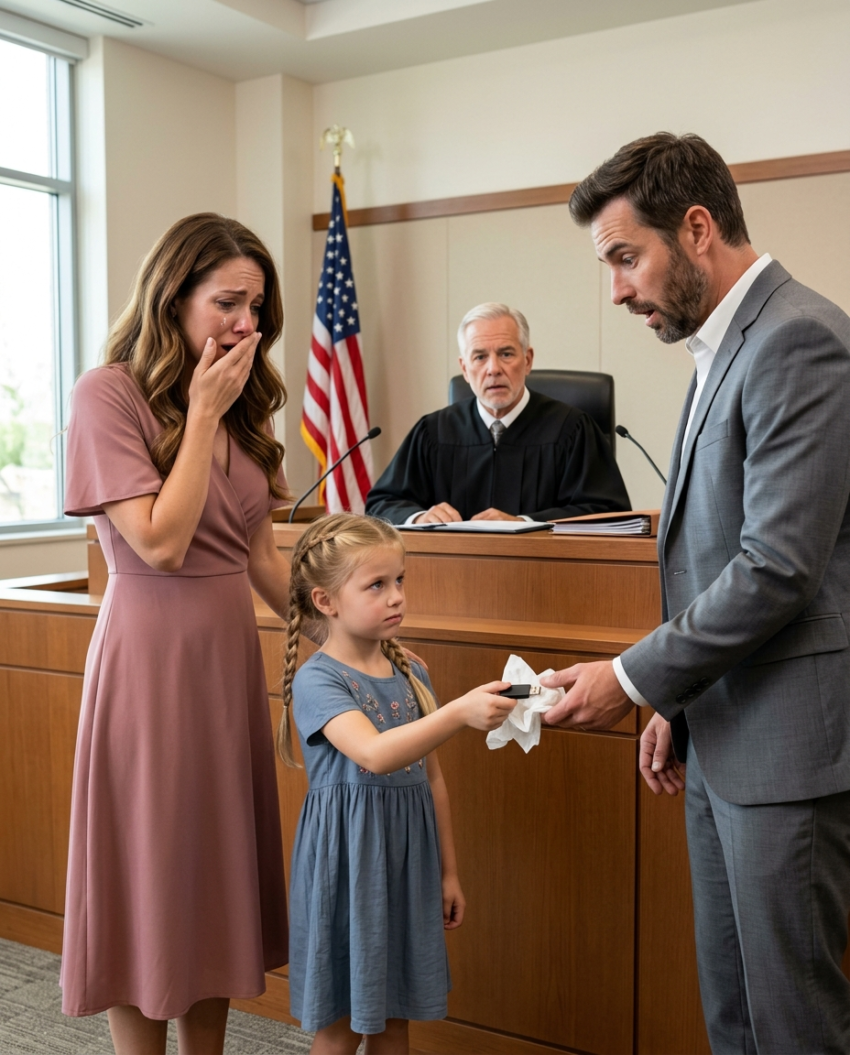
Callie reached beneath the table and pulled her backpack onto her chair.
It was purple with tiny white stars and a worn zipper.
She opened the front pocket.
From inside, she removed a small black USB drive wrapped in a tissue.
I stared at it.
“Callie, what is that?”
Her eyes filled with tears.
“I’m sorry, Mom. I didn’t tell you because I thought you’d be scared.”
My stomach dropped.
Derek stood halfway out of his chair.
“Whatever she thinks she has, Natalie obviously coached her.”
The judge’s expression hardened.
“Sit down, Mr. Hollis.”
He sat.
But the color had disappeared from his face.
What My Daughter Had Been Doing
Callie held the USB tightly.
“I started recording because things kept moving in our house.”
I stopped breathing.
She continued.
“Mom kept saying she must be forgetting things, but I knew she wasn’t.”
I turned toward her.
She had noticed.
All those months when I thought I had hidden my fear from her, she had been watching everything.
“One night I heard Dad come inside while Mom was working late. I hid in my closet with my old tablet.”
Derek shook his head.
“This is ridiculous.”
Callie looked directly at him.
“No, Dad. I saw you.”
Silence filled the room.
Then Callie said the sentence that changed the entire hearing.
“I heard you tell Sienna that if Mom looked confused enough, people would believe she couldn’t take care of me.”
Derek’s attorney leaned toward him.
For the first time that morning, the attorney looked worried.
Judge Whitaker turned toward the court clerk.
“Can we review what’s on that drive?”
The clerk nodded.
Derek immediately objected, but the judge stopped him.
“We will determine what is appropriate to consider. You will remain seated.”
Callie handed over the USB.
My hands had started shaking again.
This time, not from fear.
From the terrible possibility that my daughter had discovered the truth before I did.
The First Recording
The clerk connected the drive.
Several folders appeared on the courtroom monitor.
One was labeled with the date from six weeks earlier.
The video began.
It showed my living room.
The angle was strange, low and partially blocked by the closet door.
Then Derek walked into view.
Sienna was with him.
I recognized the sweater she was wearing because I had seen it in pictures online.
They sat on my couch.
My couch.
Inside my house.
While I had been working.
Their voices were clear.
Sienna sounded nervous.
“What if Natalie figures out you’re coming here?”
Derek laughed softly.
“She already thinks she’s forgetting things.”
My hand flew to my mouth.
He continued.
“I move a few things every time. Keys, papers, groceries. Nothing major. Just enough.”
Sienna laughed.
“That’s terrible.”
“It’s useful.”
The courtroom became completely silent.
The recording continued.
Then Derek said:
“If she looks unreliable during the custody evaluation, I have a much better chance. Once Callie’s living with me, selling the house gets easier.”
My entire body went cold.
There it was.
Not confusion.
Not exhaustion.
Not my imagination.
A plan.
The Coffee
Callie whispered beside me.
“There’s another one.”
The next clip showed my kitchen.
Derek entered alone.
He opened a cabinet.
He moved paperwork.
He took my spare house key from a drawer and placed it behind several cookbooks.
Then he opened the refrigerator and moved containers from one shelf to another.
It seemed almost absurd.
Small actions.
Tiny changes.
But those tiny changes had made me question my own mind for months.
Then the recording showed something else.
Derek took my travel mug from the counter.
He opened a small bottle and added several drops of something to the mug.
I stared at the screen.
Callie grabbed my arm.
“That’s why I kept telling you your coffee smelled different.”
I remembered.
Several mornings I had felt unusually tired and unfocused after drinking coffee I had prepared the night before.
I had blamed long work shifts.
Derek’s attorney looked horrified.
Sienna stopped staring at the screen.
“I didn’t know he was doing that,” she suddenly said.
Derek turned toward her.
“Don’t.”
She looked at him.
“You told me it was just something mild to make her sleepy. You never told me you were going into the house this often.”
The judge immediately raised her hand.
“No one is leaving this courtroom until we clarify what we’ve just seen.”
The Biggest Lie
Sienna began crying.
Not dramatically this time.
Her confidence disappeared completely.
“I didn’t know all of it.”
Derek whispered her name sharply.
She ignored him.
Then she placed both hands on her stomach.
For one strange second, I thought she was protecting the baby.
Instead, she reached beneath her blouse.
There was a stunned silence.
Sienna removed a small padded insert.
My mouth fell open.
Callie’s eyes widened.
There was no pregnancy.
There had never been one.
Sienna covered her face.
“He told me it would make us look more stable. He said the judge would see us as a new family.”
Even Derek’s attorney turned away from him.
The perfect picture Derek had presented that morning collapsed in less than fifteen minutes.
The devoted father.
The stable new relationship.
The growing family.
The concerned husband worried about his former wife’s well-being.
Every piece of it had been carefully arranged.
The Folder That Explained Everything
There were more files.
Screenshots of messages.
Audio recordings.
Photographs Callie had quietly taken.
One folder contained a conversation between Derek and two neighbors
He had promised them gift cards and help with several household expenses if they would say they frequently heard me shouting.
Another recording captured Derek laughing about leaving almost nothing in our joint checking account.
Then came the file that made me finally understand why he had been so desperate to win custody.
In an audio message, Derek told Sienna:
“Once Natalie looks incapable, I can push for control of Callie’s finances and convince the court she can’t manage the property either. That house is worth enough for us to start over somewhere else.”
Sienna responded:
“And she’ll agree?”
Derek laughed.
“By then she won’t trust herself enough to fight me.”
I closed my eyes.
That sentence hurt more than everything else.
Because it was almost true.
I had been losing the ability to fight.
My Daughter Found My Voice Before I Did
I turned toward Callie.
She was crying silently.
I wrapped both arms around her.
“Why didn’t you tell me?”
She pressed her face against my shoulder.
“Because every time you got scared, you stopped sleeping. I wanted to make sure I had proof first.”
My ten-year-old daughter should never have needed to think that way.
She should have been worrying about spelling tests, soccer practice, and whether her best friend would sit beside her at lunch.
Instead, she had been collecting evidence because the adults around her had failed to make her feel secure.
“I’m sorry,” she whispered.
I held her tighter.
“You have nothing to be sorry for.”
Then she looked at me.
“You’re not forgetting things, Mom.”
I started crying.
Not because I was embarrassed.
Because those were the words I had needed to hear for months.
The Judge’s Decision
Judge Whitaker removed her glasses and looked toward Derek.
The warmth had disappeared from her expression.
“Mr. Hollis, based on what this court has just reviewed, I have serious concerns about your conduct and about the accuracy of the claims presented this morning.”
Derek tried to speak.
“Your Honor, the recordings are taken out of context.”
She did not raise her voice.
She did not need to.
“What context would make deliberately entering someone’s home, moving personal belongings, manipulating witnesses, and interfering with a person’s drink acceptable?”
Derek had no answer.
The judge ordered the evidence preserved for further review by the appropriate authorities.
She also put immediate temporary protections in place preventing Derek from entering my home or contacting me outside approved channels.
Most importantly, Callie would remain with me.
When the judge said those words, I felt something inside my chest finally loosen.
For months, I had been terrified someone might take my daughter away because I could no longer prove that my memories were real.
Now the truth was sitting on a courtroom computer for everyone to see.
Walking Out Together
It was raining when Callie and I left the courthouse.
A warm summer rain covered the sidewalk and darkened the shoulders of my blouse.
I had forgotten the umbrella in the car.
Normally, I would have run.
That afternoon, I did not.
Callie reached for my hand.
We walked slowly through the rain.
Halfway to the parking garage, she looked up at me.
“Mom?”
“Yeah?”
“Is Dad ever going to come into our house at night again?”
I stopped.
I crouched so we were eye level.
“No, sweetheart. He doesn’t have that power anymore.”
She searched my face.
“Promise?”
“I promise.”
Then she smiled.
It was the first completely relaxed smile I had seen from her in months.
What Happened Afterward
The custody dispute changed dramatically after that hearing.
Derek’s claims about my parenting were closely reviewed, along with the recordings Callie had provided.
The people who had supported his story began changing theirs once investigators started asking detailed questions.
Sienna eventually admitted that several parts of their relationship had been staged specifically to strengthen Derek’s appearance in court.
She moved away shortly afterward.
Derek also lost the professional reputation he had worked so hard to protect.
For the first time, the image he showed the world no longer mattered more than what he had actually done behind closed doors.
I kept working at the pharmacy.
Money did not suddenly become easy.
I still worked extra shifts.
I still worried about bills.
But something important had changed.
I could sleep.
I stopped checking drawers five times to make sure I had remembered correctly.
I stopped staring at my coffee and wondering whether I was imagining a strange taste.
I stopped waking in the middle of the night convinced someone had entered the house.
And slowly, I started trusting myself again.
The Night Callie Finally Slept
Several weeks later, I found Callie asleep on the couch with her tablet beside her.
For months, she had kept that tablet charged every night.
Just in case.
That evening, the battery was almost empty.
She had forgotten to plug it in.
I realized what that meant.
She no longer believed she needed to be constantly prepared.
I covered her with a blanket.
She opened her eyes slightly.
“Mom?”
“I’m right here.”
She smiled sleepily.
“I knew you weren’t confused.”
I brushed the hair away from her forehead.
“You believed me before I believed myself.”
She reached for my hand.
“You’re stronger now.”
I looked around the quiet living room.
My grandmother’s old clock was ticking.
The refrigerator hummed in the kitchen.
My keys were exactly where I had left them.
Nothing had moved.
Nothing needed explaining.
For the first time in a very long time, my home felt like my home again.
And more importantly, my mind felt like mine again.
Sometimes the deepest kind of control does not begin with shouting or obvious cruelty; it begins when someone repeatedly makes you question small things until you slowly stop trusting your own memory, judgment, and instincts.
A person who constantly tells you that you are confused, overly emotional, or incapable may not always be trying to help you improve, especially when those accusations conveniently give them more control over your choices, relationships, money, or future.
Children often understand far more than adults realize, and even when they remain quiet, they may be carefully watching the tension, inconsistencies, and unspoken fear that the adults around them believe they have successfully hidden.
No child should ever feel responsible for protecting a parent, but when a child finally speaks about something important, adults should listen calmly and respectfully instead of immediately dismissing what they say because of their age.
Financial independence may not solve every problem, but having access to your own documents, accounts, important records, and trusted support can make an enormous difference when someone attempts to control the story of your life.
When your confidence has been weakened for a long time, the truth may feel frightening even when it is standing directly in front of you, which is why support from trustworthy people can help you rebuild the ability to believe your own experiences again.
A polished appearance, respectable career, expensive clothes, or convincing public personality cannot tell you how someone behaves in private, because character is revealed most clearly in the moments when a person believes nobody is watching.
Leaving a difficult relationship is not always one dramatic decision; sometimes freedom begins with dozens of small steps, including documenting what happened, asking questions, protecting important records, accepting help, and learning to trust yourself again.
Healing does not mean forgetting everything that happened, because real healing often means remembering the past clearly while reaching a point where those memories no longer control how safely and confidently you live today.
If someone has spent years convincing you that your voice does not matter, one of the most powerful things you can eventually discover is that your voice was never truly gone—it was simply waiting for a safe moment to be heard again.