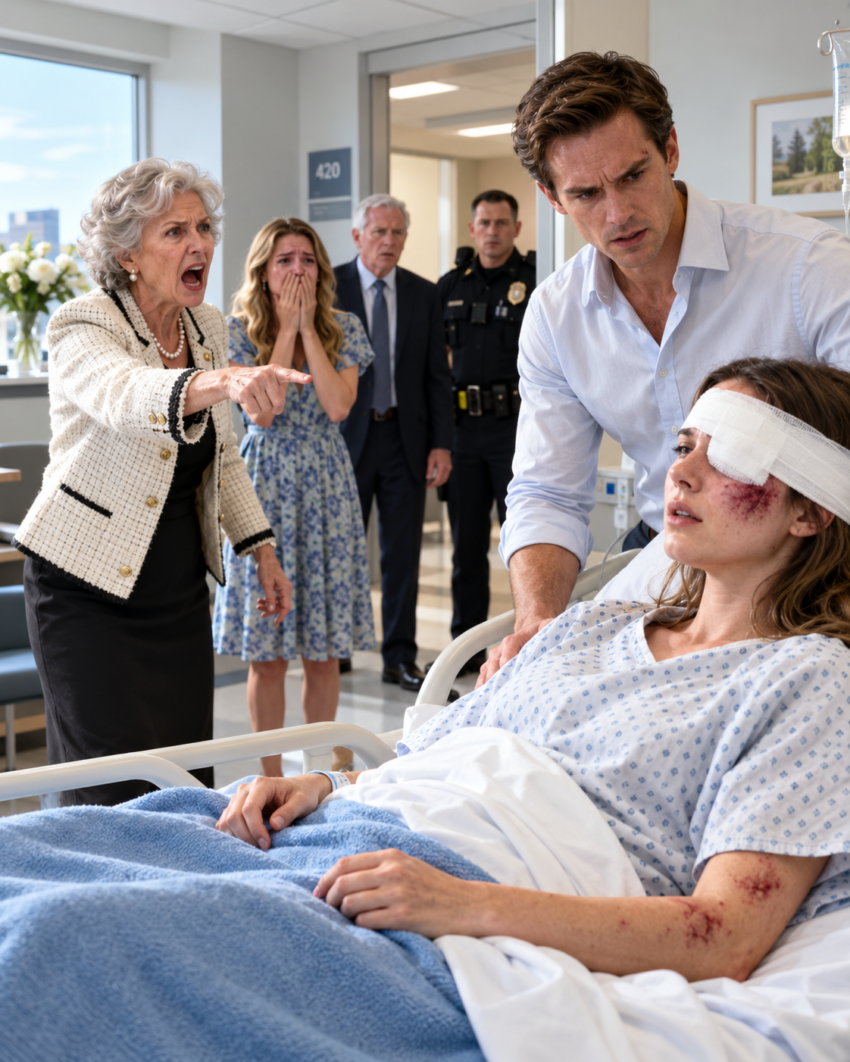
“Let’s See If He Still Loves You With That Face”
“Let’s see if Wyatt still loves you with that face.”
My mother was laughing when she said it.
I was already on the ground beside my parents’ front steps, one hand pressed against the left side of my face. The brick my father had been holding lay on the sidewalk less than two feet from my blue heel. I could hear Wyatt shouting my name, but his voice seemed far away, as if he were standing at the other end of a tunnel.
A few seconds earlier, I had been holding a cream envelope with our wedding date inside.
Now there were dark drops across it.
Wyatt dropped beside me and caught my wrist before I pressed harder against my eye.
“Sadie, don’t touch it. Look at me. Can you see me?”
I tried. His face doubled, blurred, then disappeared on my left side.
“My eye.”
“I know. Ambulance is coming.”
My father, Gregory Davis, stood at the edge of the porch breathing hard. He was sixty-one, broad through the shoulders, and still looked like the man who had spent thirty years running a small contracting crew around Columbus. My mother, Brenda, stood behind him with one hand against the porch railing.
Neither came toward me.
My sister Melanie was near the door.
She was holding her phone.
That detail stayed with me.
Not the brick. Not even my mother’s laugh.
Melanie’s phone.
She had spent four months finding reasons to text my fiancé, show up near his office, appear at his gym, and tell relatives I was becoming “possessive.” Now I was on the sidewalk bleeding, and she was simply holding that phone against her chest.
Wyatt looked up at my father.
“Back away from her.”
Dad pointed at him.
“You did this.”
Wyatt stared at him.
“What?”
“You came into this family and turned my daughters against each other.”
“Greg, stop,” Mom said, but she wasn’t telling him to stop threatening Wyatt. She was looking toward the neighboring houses. “People are watching.”
That was when a man in work boots came running across the lawn.
I didn’t know him. Later I learned his name was Eric Dawson, an electrician who had arrived to repair an outdoor panel two houses down.
He stepped between Dad and us.
“Sir, stay where you are. I already called 911.”
Dad’s expression changed.
“This is a family matter.”
“Not anymore.”
Wyatt took off his jacket and folded it beneath my head. He kept one hand around mine while Eric stood between us and my father.
My mother finally came down one step.
For half a second, I thought she was coming to me.
Instead, she picked up the cream envelope that had fallen beside the brick.
She looked at the date printed inside.
October 17.
Our wedding date.
Then she folded the envelope in half and put it on the porch railing.
They Had Already Chosen My Replacement
I had spent most of my life making excuses for my family because excuses were easier than admitting what was happening.
Melanie was three years younger than me. When she was born, Dad told people he finally had a daughter who “looked like a Davis.” I didn’t understand what that meant when I was six. By sixteen, I understood perfectly.
Melanie got the bigger bedroom because she “needed space.” She got the newer car because she “had more activities.” If we argued, I was supposed to be mature because I was older. If she wanted something I had, Mom called sharing an act of love.
There was one thing they couldn’t give her.
Wyatt.
I met Wyatt Campbell when I was thirty-one. He owned a small construction-management company then, and for the first two years we dated, my parents treated him politely but without much interest.
Then he sold his company.
I never knew exactly how much he received, and I never asked. I knew it was enough that he could take time off, invest, and start thinking about another business without worrying about his mortgage.
My parents became fascinated with him almost overnight.
Sunday dinners went from once every few months to twice a month. Melanie suddenly attended all of them, even though she had spent years complaining that family dinners were boring.
Then she started appearing elsewhere.
Wyatt came home from the gym one morning and mentioned that Melanie had been there.
Two weeks later, she showed up at a coffee shop near his office.
Then she called him asking for “business advice.”
When I told Mom it was becoming uncomfortable, she sighed.
“Sadie, she likes talking to him. Why does everything have to become a competition with you?”
“I didn’t make it a competition.”
“Then stop acting threatened.”
Wyatt solved it more directly.
He blocked Melanie.
That should have ended it.
Instead, Dad called me the next evening.
“Tell Wyatt to unblock your sister.”
I was standing in my kitchen with a grocery bag against my hip.
“No.”
There was a pause.
Dad wasn’t used to hearing that from me.
“She’s family.”
“She’s my family. She isn’t entitled to my fiancé.”
He hung up.
I should have understood then that something had shifted.
Instead, I agreed to one more family dinner because Wyatt and I had finally chosen our wedding date, and some stubborn part of me wanted to believe a wedding could make us normal.
That was why I had carried the cream envelope to my parents’ house.
Dinner lasted twenty-three minutes before Dad put down his fork.
“Wyatt, have you ever seriously thought about whether Sadie is the right person for you?”
Wyatt stopped chewing.
I looked at Melanie.
She was staring at her plate.
Mom reached for her water.
“Gregory is only saying what everyone has been thinking.”
“Who’s everyone?” I asked.
Nobody answered.
Dad leaned toward Wyatt.
“Melanie understands the kind of life you’re going to have now. She’s social. She knows how to present herself. She’d be an asset to you.”
Wyatt pushed his chair back.
“We’re leaving.”
Melanie finally looked up.
“You won’t even think about it?”
I remember Wyatt’s expression more clearly than anything else from that dinner. He wasn’t angry yet.
He looked confused.
“Think about leaving the woman I’m marrying for her sister?”
Dad stood.
“You picked the wrong daughter.”
Wyatt took my hand.
“No. I didn’t.”
We walked outside.
Dad followed us.
So did Mom and Melanie.
The argument continued on the porch until Dad stepped toward Wyatt and told him he was making a mistake he would regret. I moved between them because I had seen that look on my father’s face before.
Then I saw the brick in his hand.
After that, I remembered white light.
Six People Saw What Happened
The emergency room smelled like disinfectant and burnt coffee.
A nurse cleaned the blood around my eyebrow while another doctor examined my eye. There were fractures around my cheekbone and orbital area, but the first scans suggested the eye itself had escaped the worst damage.
“We have good reason to be optimistic about your vision,” the doctor told me.
Wyatt was sitting beside the bed.
His shirt had my blood on the collar.
“Can I stay?”
The doctor nodded.
“As long as she wants you here.”
I tightened my fingers around Wyatt’s hand.
“Stay.”
A Columbus police detective named Marcus Hale came in about an hour later. He pulled a chair close enough that I didn’t have to turn my head.
He asked what happened.
I told him.
Then he asked whether my father had ever behaved violently toward me before.
I hesitated.
There hadn’t been another brick.
But there had been broken things.
When I was nine, my maternal grandfather had given me a small wooden cradle he had built by hand for my dolls. It had my initials carved beneath one rail.
Dad hated it.
I never understood why.
One afternoon after Grandpa had argued with him in our driveway, Dad carried the cradle into the garage and broke it apart with a hammer. Mom told me Grandpa had caused the problem by refusing to respect Dad.
Detective Hale wrote something down.
“Did your father have problems with your grandfather?”
“Apparently. I wasn’t told much.”
I explained the rest: Melanie, the sudden attention toward Wyatt after his company sale, the unwanted messages, the appearances at his gym and office.
Wyatt unlocked his phone and handed it to the detective.
“I kept some of the messages.”
Hale scrolled quietly.
Then he looked at me.
“Ms. Davis, there’s something I want you to know before your family starts contacting you.”My stomach tightened.
“What?”
“This isn’t your word against theirs.”
He closed his notebook.
“We have six witnesses.”
Wyatt leaned forward.
Hale continued.
“Three neighboring homes have exterior cameras. At least two captured portions of the incident.”
I stared at him.
For most of my life, my parents had controlled what happened after every family argument. Dad decided what had been said. Mom decided who had overreacted. Melanie cried, and somehow I became the person expected to apologize.
This time, six strangers had seen it.
And three cameras had no reason to protect my father.
“Delete It”
My family came to the hospital that evening.
I didn’t invite them.
I heard my mother’s voice outside before the door opened.
“We’re her family.”
Detective Hale happened to be standing near the nurses’ station. Another officer came into my room first and asked whether I wanted them allowed inside.
I looked at Wyatt.
Then I said yes.
I wanted to hear what they would say when there was no dinner table to control.
Dad entered first.
He had changed his shirt.
That bothered me more than I expected.
Mom followed him carrying her purse, and Melanie came last.
Dad stopped several feet from my bed.
“Tell them what actually happened.”
Wyatt stood.
“Gregory—”
I touched his arm.
“Let him talk.”
Dad looked relieved.
“You got between me and Wyatt. You were screaming. You came at me.”
I watched my mother.
“Is that what happened?”
She adjusted the strap of her purse.
“Things got out of hand.”
“Did Dad hit me with the brick?”
“Sadie, don’t make me choose sides.”
My face was wrapped in gauze. I could barely open my left eye.
I almost laughed.
Melanie spoke quietly.
“You were acting crazy.”
Detective Hale appeared in the doorway.
“That’s interesting.”
Dad turned.
Hale stepped inside.
“Because we currently have six witnesses who describe something very different.”
Nobody spoke.
“We also have video from multiple houses.”
Dad’s face changed.
“Video?”
“Yes.”
Dad looked toward the hallway.
Then he said the strangest thing he could possibly have said.
“Delete it.”
Detective Hale stared at him.
“Excuse me?”
Dad seemed to hear himself too late.
“I’m saying you don’t have permission to use recordings of my property.”
“The recordings weren’t made on your property.”
Mom grabbed Dad’s sleeve.
“Greg, stop talking.”
The detective looked at another officer.
That officer stepped closer to my father.
Mom’s voice rose.
“Wait. We’re trying to resolve this as a family.”
Hale looked at her.
“Ma’am, that stopped being an option when your daughter was taken away in an ambulance.”
Dad was escorted out.
Melanie followed my mother into the hallway, but Mom turned once before leaving.
She didn’t apologize.
She looked at Wyatt.
Then she looked at my bandaged face.
For the first time that day, she wasn’t smiling.
And for the first time in my life, I didn’t need her to admit what she had done for me to know it had happened.
The Man Behind the Window
Two days later, an older man named Harvey Berry asked to see me.
I recognized him immediately.
He had been standing behind the front window of the house across from my parents’ place when the ambulance arrived.
Harvey was seventy-four and walked with a wooden cane. He sat beside my hospital bed with a grocery-store paper bag resting between his shoes.
“I knew your grandfather.”
I looked at him.
“How?”
“Best friends for forty-six years.”
He reached into the bag and removed a stack of envelopes tied with faded blue string.
Every envelope had my name on it.
Sadie.
Some had birthdays written in the corner.
12th.
16th.
21st.
I picked up the oldest one.
The handwriting was unfamiliar.
“These are from Grandpa?”
Harvey nodded.
“Your father wouldn’t let him near you after things fell apart between them.”
“Why?”
Harvey rubbed his thumb against the top of his cane.
“Your grandfather discovered some things Gregory didn’t want discussed.”
He didn’t explain immediately.
Instead, he reached back into the bag.
What he placed on my blanket was a curved piece of dark wood.
There was an S carved into it.
I stopped breathing for a second.
It was part of the cradle.
“He kept this?”
“I did. Your grandfather brought the pieces to my shop after your father broke it. We couldn’t save the whole thing.”
I ran my thumb over the carved letter.
For twenty years, I had remembered that cradle as proof that my father could destroy anything connected to someone he disliked.
Now I was holding proof that someone else had tried to save it.
Harvey placed one hand over the envelopes.
“Your grandfather wrote every year.”
I looked at the stack.
“I never got one.”
“I know.”
That was the first time since the attack that I cried.
Not because of my face.
Because there were twenty years of birthday cards sitting on my hospital blanket.
And someone had wanted me to have every one of them.
My Aunt Brought a Will I Had Never Seen
Three days after Harvey’s visit, a woman named Janice Foster walked into my hospital room.
She had my father’s eyes.
That was how I knew she was telling the truth before she showed me her driver’s license.
“I’m Gregory’s sister.”
I stared at her.
“My father doesn’t have a sister.”
Her mouth tightened.
“That’s what he wanted you to believe.”
Janice hadn’t spoken to Dad in more than twenty years. Their break happened after my grandfather discovered money missing from the family’s hardware business.
Dad had been taking it.
Not millions. Not some complicated criminal empire.
Enough money, taken often enough, that Grandpa finally confronted him.
Dad denied it.Grandpa changed his will.
Janice placed a copy on the rolling table beside my bed.
I didn’t understand most of the legal language, but one section had been marked.
Grandpa’s estate included property, investments, the old hardware store building, a lake cabin and several accounts. The current estimated value was a little over eleven million dollars.
Dad had expected to inherit most of it eventually.
There was a condition.
If Gregory was ever convicted of an intentional violent offense against either of his daughters, his interest in the estate would be forfeited.
I read the paragraph twice.
“Why would Grandpa put this in here?”
Janice looked down at the paper.
“Because he was afraid of your father.”
That answer was enough.
She explained that Grandpa had seen Dad’s temper long before I was old enough to understand it. The broken cradle hadn’t been an isolated incident. It had been the incident that convinced Grandpa his son was willing to use destruction as punishment.
I looked toward Wyatt.
He had been standing by the window.
“Does Dad know about this clause?”
Janice nodded.
“He knew there were conditions. I don’t think he ever believed they’d matter.”
That evening Detective Hale returned.
What he told us made the will feel almost secondary.
Police had obtained access to several devices and accounts as part of the investigation. The messages they found went back nearly four months.
Mom.
Dad.
Melanie.
All three.
They had been discussing Wyatt.
Not casually.
Systematically.
Melanie tracked where he worked out. Mom passed along information about our plans. Dad encouraged Melanie to contact people Wyatt knew professionally and present herself as the more “stable” sister.
There were fake social-media accounts spreading embarrassing stories about me.
There were notes about our schedule.
And there was a handwritten page recovered from my parents’ home.
At the top, someone had written:
WAYS TO MAKE SADIE LEAVE WYATT.
My stomach turned.
Hale didn’t show me every line.
He didn’t need to.
The final one had been circled.
Make her unattractive enough that he won’t want to look at her.
I touched the bandage over my cheek.
Wyatt read the line once.
Then he put the paper down.
Wyatt Never Left
The investigation moved faster after that.
My parents had spent the first days insisting the brick was a terrible accident during an argument. The messages made that explanation harder to maintain.
The handwritten list made it worse.
Dad’s defense eventually focused on claiming he never intended to cause serious injury. Mom tried to distance herself from the physical attack while explaining the messages as family discussions that had “gone too far.” Melanie insisted she had only wanted Wyatt to understand he had options.
I stopped listening to their explanations.
Three weeks after the attack, I sat in an ophthalmology exam room while the last dressing was removed.
Wyatt stood behind the doctor.
The room was blurry at first.
Then shapes sharpened.
The doctor’s white coat.
The black frame of the eye chart.
The window.
Wyatt.
I blinked several times.
He leaned forward.
“Can you see me?”
“Unfortunately.”
He laughed so suddenly that the nurse laughed too.
I could see him.
Not perfectly yet, but clearly enough.
He had been there every morning.
He had slept in hospital chairs, learned my medication schedule, washed dried shampoo from my hair when I couldn’t bend my head properly, and never once looked away when the swelling was at its worst.
My family had built their entire plan around one assumption.
That Wyatt’s love had a limit they could expose.
They had been wrong.
The One Thing My Father Never Expected to Lose
The criminal cases took months, not days.
There was no dramatic courtroom confession. No judge delivered a speech about karma. The evidence simply became harder and harder to argue with.
Witnesses testified.
The camera footage was authenticated.
The messages were introduced.
The handwritten list was connected to the planning.
Dad faced the most serious consequences because he had carried out the physical attack. Mom was held responsible for her role in the conspiracy and her efforts afterward to misrepresent what happened. Melanie faced consequences for the stalking, fake accounts and planning that had led to that night.
When Dad was convicted, Grandpa’s will did exactly what it said it would do.
Gregory lost his inheritance.
The assets passed according to the remaining provisions.
To me.
I sat in an attorney’s office staring at a figure slightly above eleven million dollars.
Wyatt was beside me.
“You okay?”
I looked at the paperwork.
“I don’t know.”
The strange part was that I didn’t feel victorious.
I kept thinking about the piece of cradle wood in my apartment.
Dad had destroyed that cradle because it came from Grandpa.
Years later, he had nearly destroyed me for refusing to give Melanie the man she wanted.
And both times, he had assumed he could decide what happened afterward.
He couldn’t anymore.
I used part of the inheritance to reopen my grandfather’s old hardware store building. Not as the business it had been, but as a training center connected to local tradespeople.
Electricians.
Carpenters.
Plumbers.
HVAC technicians.
People like Eric Dawson, the electrician who had been working two houses away and ran across the lawn when everyone who shared my last name stood still.
We created scholarships for certification programs and paid apprenticeships for young adults who couldn’t afford college or simply didn’t want that path.
I named the program after Grandpa.
Harvey came to the opening.
So did Janice.
Near the entrance, we mounted a small plaque with Grandpa’s name. Beneath it, inside a simple glass case, I placed the surviving curved piece of the cradle.
Harvey stood beside me for a long time.
“He would’ve liked this.”
I looked at the carved S.
“I wish he’d known I didn’t forget him.”
Harvey smiled.
“Sadie, he knew.”
October 17
Wyatt and I drove to Grandpa’s lake cabin on the first weekend I was cleared to travel without another medical appointment hanging over me.
The cabin wasn’t grand. It had cedar siding, an old dock and a kitchen that looked as if nobody had updated it since 1998.
I loved it immediately.
We sat near the water after dinner.
The scars around my eye were still visible. Doctors had told me some would fade considerably and others might always remain.
Wyatt had never asked what I planned to do about them.
That evening he reached into his jacket.
“I need to ask you something.”
I looked at him.
“You already asked me once.”
“I know.”
He took out my engagement ring.
I hadn’t worn it during the hospital stay because of the swelling in my hands, and afterward I had left it in its box longer than I meant to.
Wyatt held it between us.
“Sadie Davis, after everything that’s happened, do you still want to marry me?”
I looked at the man my family had spent four months trying to hand to my sister as if he were property.
Then I held out my left hand.
“Yes.”
He slid the ring onto my finger.
Later, inside the cabin, I opened the small wooden box I had brought with me.
The piece of Grandpa’s cradle rested inside.
Wyatt sat beside me while I ran my finger over the S carved into the wood.
My father had once broken it because he wanted to erase the person who made it.
Harvey had saved one piece.
That turned out to be enough.