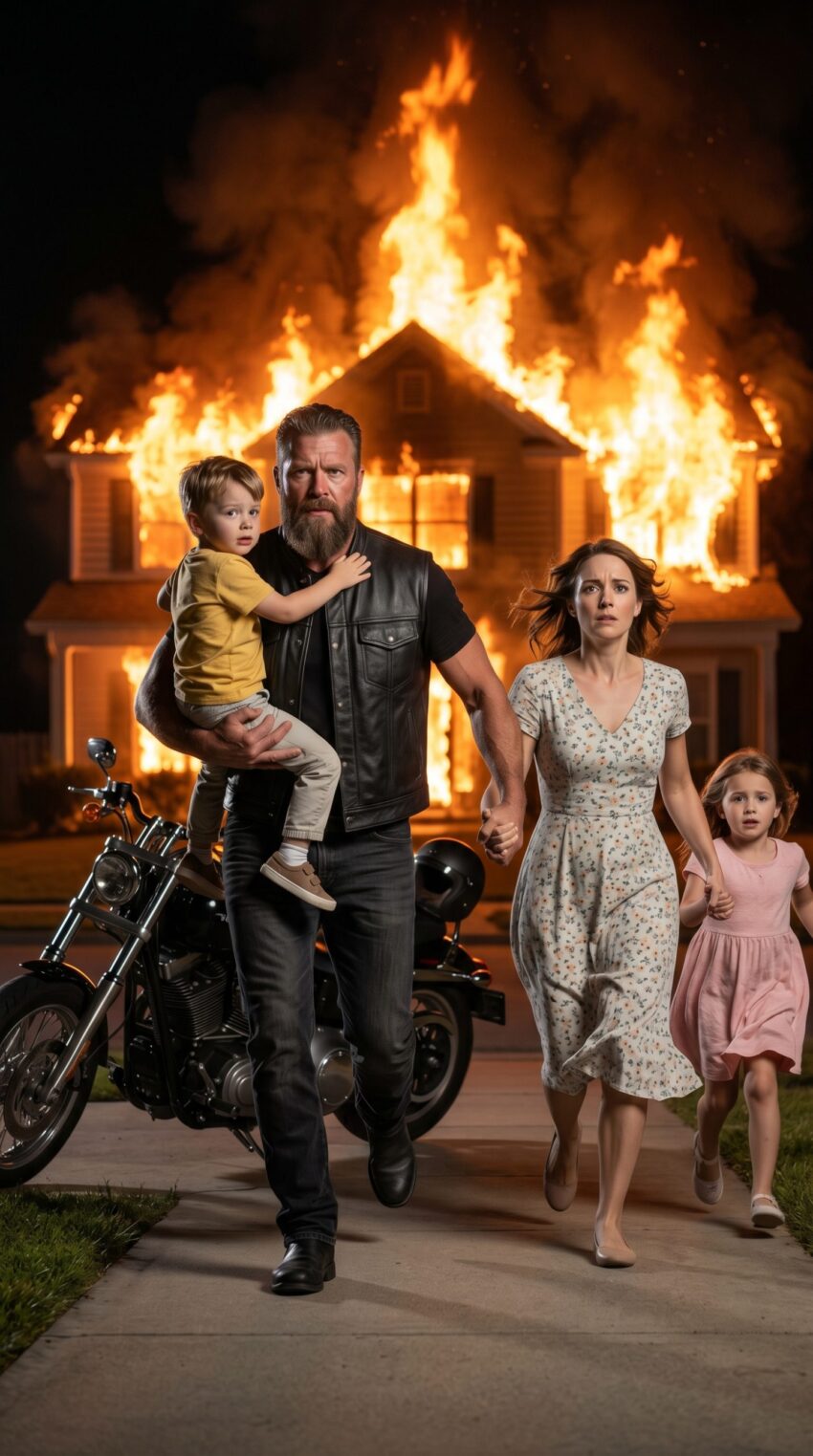
The Night the Stranger Broke the Door
The man who shattered our front door at 2:14 in the morning wore a weathered leather vest with a skull stitched across the back and heavy boots that tracked dark stains across the kitchen floor. When my grandmother asked him who he was, he looked at her with a face that seemed carved out of old grief and said, “It doesn’t matter. You need to get out now.”
He said it again less than a minute later. The second time, he had my little boy balanced on one arm as if he had spent his whole life carrying frightened children through impossible nights.
My name is Lacey Briar. Until last summer, I lived in a small one-story rental on Red Maple Lane in Montgomery, Alabama, with my seventy-two-year-old grandmother Evelyn, my six-year-old daughter Tessa, and my four-year-old son Nolan. The house was never much to look at. The porch sagged a little on the left side, one of the bedroom windows never shut all the way in humid weather, and the hallway light flickered every time the washing machine ran. Still, it was ours in all the ways that mattered. It held school backpacks by the door, my grandmother’s tea tin on the counter, and the sound of my children laughing from one room to another.
That house was gone before sunrise on a Wednesday in August.
The problem started above the hallway, in the attic space where old wiring had been ignored for too many years. Later, the fire marshal explained it carefully, almost gently, as if facts could soften the memory. The flames started overhead, and by the time the first alarm screamed through the house, the route from the bedrooms to the front door was already full of smoke and heat.
By every practical measure, we should not have made it out.
The fire marshal used phrases like rare outcome and extremely low survival odds. He spoke about blocked exits, late-night response windows, young children, and an elderly woman with limited mobility. He said families in situations like ours often did not get a second chance.
But we did get one.
And that second chance arrived on a motorcycle.
The Man No One Expected
I never saw the bike itself that night. I only heard it. Even now, I can still remember the sound of it cutting through the darkness before the sirens reached our street. It was a low, uneven roar, deep enough to shake the quiet neighborhood awake. The engine faded toward Carter Hill Road before the first fire truck turned the corner.
He was gone before anyone in uniform could ask questions.
Everything I know about him came later, pieced together from my grandmother’s memories, from neighbors standing barefoot in their yards, and from the strange trail of details that refused to leave me alone after the smoke cleared.
He was tall. Maybe six-foot-three. Broad through the shoulders, with a beard streaked black and silver. His arms were covered in tattoos that caught the glow of the flames in hard, twisting patterns. On the front of his vest was a diamond-shaped patch that told the kind of story most people prefer not to ask about. My grandmother noticed that before anything else because she had lived long enough to know when a man had seen too much life to care what strangers thought of him.
She also said he smelled like road dust, leather, oil, and the lingering scent of smoke that did not belong to our house. It was older than that. Deeper. As though fire had once become part of him and had never fully left.
He broke through the front door with a single kick.
He lifted my grandmother first. She is small, barely a hundred pounds on a good day, and he carried her outside as easily as if he were moving a folded blanket. Then he went back for Tessa. Then again for Nolan. Then a fourth time for me, because I had collapsed near the hallway after trying to get to my children.
The firefighters later told me that if he had hesitated even another minute or so, my story would have ended inside that house.
Instead, he laid all four of us on the grass beneath the front yard oak tree.
My grandmother says he crouched beside her and told her, “Stay low. Cover your mouth. Keep the little ones close.”
Then he stood up, walked to the mailbox, and did something none of us understood.
He removed his vest.
He folded it carefully.
And he left it there.
What He Left Behind
The rescue itself was enough to keep me awake at night. The idea that a stranger had seen smoke, chosen to stop, and walked into danger for people he did not know felt too large to hold in my hands. But what haunted me even more was what he left behind.
Not the vest itself, though that was strange enough.
It was what had been hidden inside it.
The next afternoon, once I had been checked and released from the hospital with bandaged fingers and a head full of fog, I finally looked at the leather he had folded so carefully. I had not wanted to touch it before then. It felt personal in a way I could not explain. As if opening it meant stepping into a place in his life I had not been invited to see.
The leather was old, softened by years of use. The shoulders were cracked from sun and rain. The inside lining had faded almost to gray. There were patches on the back and lower panels I promised myself I would not study too closely, because something about the way he had left it told me this was not a trophy and not a message. It was something else. Something finished.
Inside the pocket over his heart was a photograph.
It was black and white, worn nearly smooth at the corners. The image showed a young woman standing on a wooden porch with two boys. One stood close to her side, trying to look brave for the camera. The younger one rested against her, face turned inward, as though he belonged nowhere safer than the space between her shoulder and her neck.
On the back, in faint pencil, were four words and a year.
Mother, Daniel, and Micah. 1973.
I stared at it for a long time, waiting for some obvious meaning to appear. None did.
Then Nolan wandered into the room, looked up at the photograph on the bedspread, and said in his soft little voice, “That’s him.”
I frowned. “Who is, baby?”
He pointed to the smaller boy in the picture.
“The man who carried me.”
The Search That Changed Everything
At first, I thought it was the kind of thing children say when they are trying to make sense of fear. Nolan had spent the last three weeks drawing the man over and over again with thick crayons. Every picture showed the same giant figure with a beard, a black vest, and something round on the back that stood in for the skull patch.
Under almost every drawing, my son had written one word he had never written before that night.
Dad.
His father had left before Nolan was born. There had been no bedtime visits, no birthday cards, no voice in his memory connected to that word. Yet after the fire, he kept writing it as though his small heart had attached it to the first man who had ever lifted him out of terror and carried him toward safety.
I should have kept the photograph to myself. I know that now. But gratitude makes people reckless, and unanswered questions can hollow out your sleep. So I took the picture to a local reporter named Marissa Kane, who had covered the fire the morning after it happened. She had kind eyes, quick instincts, and enough curiosity to follow a story farther than most people would.
We spent one afternoon digging through old archives from central Alabama. Newspaper scans. Obituary pages. Local notes. City records that had not been touched in decades.
She found it in less than half an hour.
A newspaper clipping from September 1974.
A late-night house fire in Birmingham had destroyed a small family home. A mother and her older son had not survived. A younger boy, age four, had been brought out through a bedroom window by a neighbor who saw flames and ran toward them without waiting for help.
The child’s name was Micah Vale.
The neighbor’s name was Leonard Boone.
He was described in the article, almost casually, as a local mechanic and motorcycle rider from the same street.
We looked at each other in silence after reading it.
The date on the photograph. The age of the boy. The image in the pocket. The way Nolan had pointed to the child in the picture without hesitation.
The man who saved us had once been that child.
The Name He Left Behind
Once Marissa found the clipping, other pieces began falling into place.
Micah Vale had disappeared from most public records after early adulthood. At eighteen, he entered foster care transition housing. At twenty, he enlisted. A few years later, he drifted out of the usual paper trails people leave behind. Employment records became harder to trace. Addresses changed. Names disappeared into the private places where damaged men sometimes rebuild themselves one piece at a time.
Eventually, someone from a motorcycle chapter in southern Alabama agreed to meet me.
He was older, white-bearded, calm in the way some men are calm because they have already survived every storm that could frighten them. We met at a quiet gas station outside the city. He sat on his bike and kept his sunglasses on the whole time.
I asked him the question that had been carrying all the weight in me.
“Can you tell me his name?”
He shook his head once.
“No, ma’am.”
“Why not?”
He was quiet long enough for traffic noise to fill the space between us. Then he said, “Because he spent forty years trying not to be that boy anymore. If you hand that name back to him, you hand back everything that came with it.”
At the time, I did not fully understand.
I do now.
Some people survive one terrible night, but they spend the rest of their lives surviving what that night turned them into. The child in the photograph did not vanish because he was forgotten. He vanished because becoming someone else was the only way he knew to stay standing.
The man who kicked in my door was not trying to be a hero. He was answering a sound his heart had recognized before his mind ever caught up. Somewhere inside him, a four-year-old boy had heard another family trapped behind smoke and fear, and that child had taken over the handlebars.
He had not stopped because he was brave in the grand, shining way people like to talk about on television.
He had stopped because once, long ago, someone had stopped for him.
Why the Vest Stayed
That realization changed the meaning of everything.
The vest was not carelessly abandoned. It was returned.
The old photograph was not forgotten by accident. It was left on purpose.
The chapter president handed me a folded note before I left that gas station. The handwriting was rough and spare, not his.
Keep the vest where the children can see it.
There was no signature.
I read that sentence ten times on the drive home.
By then I understood enough to know that the vest had a history longer than our fire. Maybe it had once belonged to the man who saved Micah. Maybe it marked a promise, a debt, or a memory carried across thousands of miles. Whatever it meant, the leather had done its work. A saved child had grown into a man, and that man had used his life to pull someone else out of the dark.
The circle had closed.
Or maybe it had not closed at all. Maybe it had simply widened.
We moved six months later into another house across town. A real home with a sturdy staircase, wide windows, and enough room for my children to sleep without hearing my nightmares through the wall. We brought very little with us from the old place. A few dishes. Some photographs. My grandmother’s cedar chest. Tessa’s books. Nolan’s stuffed dog with one missing ear.
And the vest.
It hangs by our front door now on a wooden hook low enough for the children to touch.
The photograph is framed beside it.
Every morning before school, Tessa brushes her fingers against the leather as if it carries luck. Every evening Nolan sits cross-legged on the floor and gives the picture a report about his day.
“I colored a bird today.”
“I didn’t cry when I missed you.”
“A boy pushed in line, but I stayed nice.”
He talks to the woman and the boys in that picture as though they are listening. Maybe they are. Maybe the heart does not need logic in order to know when it has found a place to set down its gratitude.
My grandmother, who says she has never been a particularly religious woman, bought herself a small iron cross after the fire. She wears it every day. Once, while helping me unpack kitchen boxes, she held it between two fingers and said, “A man walked into the worst night of our lives and carried us back out. I like having something I can touch when I remember that.”
I knew exactly what she meant.
The Flowers Every August
We never saw him again.
I stopped asking the chapter for answers because some kindnesses do not want to be followed home. Whatever name he lives under now, whatever road he rides, whatever old sorrow still keeps him company, he made his wishes plain. He did not save us to become part of our lives. He saved us because once someone had done the same for him.
Still, every year on August fourteenth, a bouquet of white carnations appears on our porch before sunrise.
No note.
No card.
No sound of tires in the driveway.
Just flowers waiting in the blue light of early morning.
Nolan always finds them first. He picks them up with both hands and carries them inside like something sacred. Then he sets them beside the photograph in the hallway and stands there for a long moment, quiet in a way children usually are not.
Last year he came home from school with a crayon drawing folded in half inside his backpack. It showed five figures standing together. Me. My grandmother. Tessa. Nolan. And behind us, bigger than all of us, a man in a black vest with a symbol on his back.
At the bottom, in careful uneven letters, my son had written:
OUR FAMILY AND THE MAN.
I taped it to the refrigerator, and every time I pass it, I think about how close that drawing came to never existing at all.
Somewhere out there, on some stretch of Southern highway, a motorcycle still runs under the same midnight sky. I do not know where he sleeps. I do not know if he ever thinks about our little house on Red Maple Lane. I do not know whether he remembers my grandmother asking his name or my son falling asleep against his shoulder in the yard.
But I know this.
When he saw smoke, he did not keep riding.
When he heard danger, he did not tell himself someone else would handle it.
When the door stood between life and loss, he kicked it in.
And then he left before anyone could make him carry praise for it.
Some people spend their whole lives trying to become larger than the worst thing that ever happened to them. Others quietly turn around and use their pain as shelter for someone else.
The man who saved us did both.
And that is why I am writing this now.
Because sometimes the stranger who appears in the darkest hour is not sent to impress the world. Sometimes he arrives because, years earlier, somebody reached into the flames and gave him one more life than he expected to have.
And when that happens, the debt does not disappear.
It travels.
It waits.
And one night, when another family runs out of time, it comes roaring back on two wheels.
There are people in this world who will never stand in front of cameras, never tell their version of what they did, and never ask to be thanked, yet their quiet courage becomes the reason another family gets to wake up together the next morning, and that kind of goodness deserves to be remembered even when the person behind it chooses to stay unknown.
Sometimes the people who look the hardest from the outside are carrying the oldest wounds inside them, and the truth is that pain does not always turn a person cruel; in the right heart, it can turn into a deep and steady kind of mercy that moves faster than fear when somebody else is in trouble.
We often assume that a person’s appearance tells us who they are, but life has a way of humbling that judgment, because the one who looks dangerous to the world may be the very one who knows best how to protect a frightened child, lift an elderly woman, and walk straight into disaster without asking what it might cost him.
A single act of rescue does more than save a body in one moment; it can reshape the emotional future of a family, teach children that goodness is real, restore faith to an exhausted heart, and leave behind a story strong enough to guide people long after the smoke has cleared.
The kindness we receive in our most helpless moments does not end with us unless we let it, because every life touched by compassion carries the power to pass that compassion forward, and sometimes the most meaningful legacy a person leaves behind is not wealth or recognition but the proof that help arrived when hope had almost run out.
There is something profoundly moving about the idea that a person who was once rescued as a child can grow up carrying that memory for decades and then, when the world presents him with the same terrible choice, answer it not with bitterness or avoidance but with action, as if gratitude itself had become a lifelong promise.
Families are not only held together by blood, history, or shared walls; they are also held together by the unexpected hands that reach toward them in moments of crisis, and some strangers, even if they never return, become part of the emotional structure of a home forever simply because they chose to care.
We live in a time when many people are quick to notice what is broken, frightening, or cynical in the world, but stories like this remind us that underneath all the noise there are still men and women who quietly refuse to look away, and their choices continue to keep humanity softer, safer, and more beautiful than it sometimes appears.
Children remember more than adults realize, especially the moments when someone makes them feel protected, and that is why one strong act of love, even from a stranger, can live inside a child for years as a foundation of trust, shaping the way they see courage, safety, and the possibility of goodness in other people.
If this story leaves anything behind in the heart, let it be the reminder that we never fully know what another person has survived, what promise they are still keeping, or what memory is guiding them through the dark, and for that reason alone, we should be slower to judge, quicker to appreciate, and always willing to believe that grace can arrive wearing unexpected clothes.