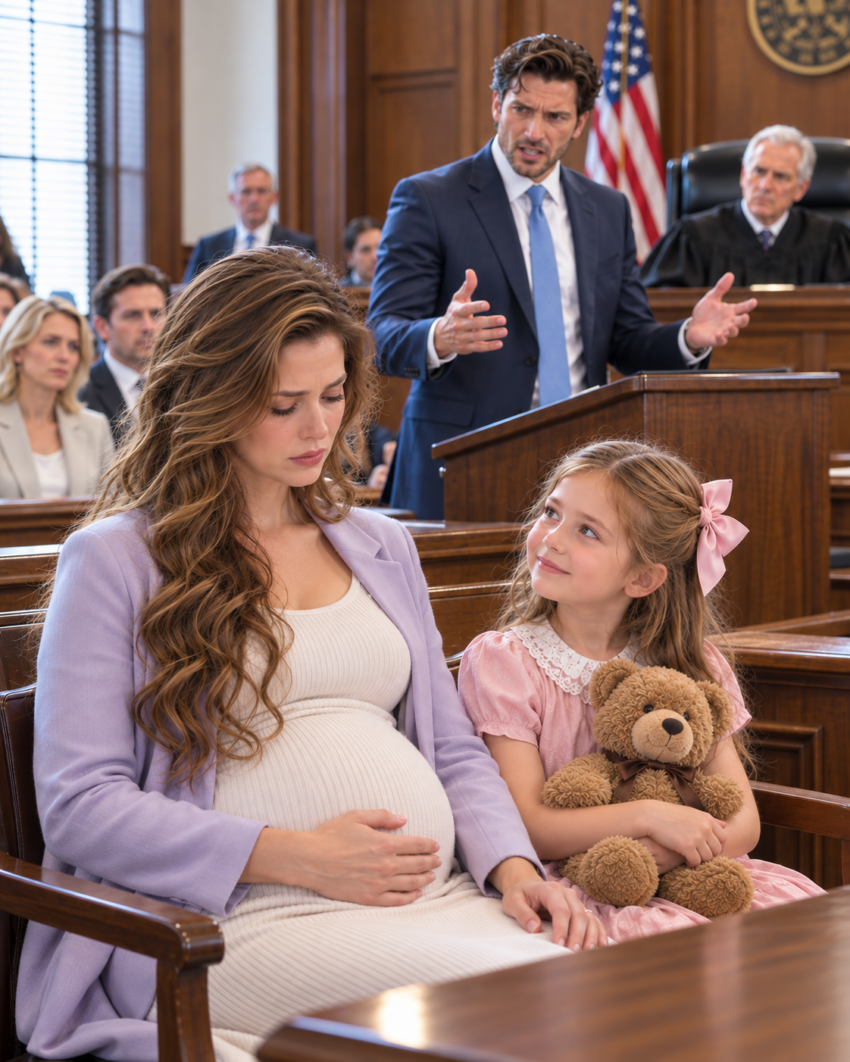
Eight Months Pregnant, I Was Ready to Give My Husband Everything—Until His Six-Year-Old Daughter Walked Into Court
At eight months pregnant, I walked into a courthouse in Raleigh, North Carolina, prepared to leave almost everything behind.
The house could stay with my husband.
The cars could stay with him too.
I was even willing to stop arguing over our savings and my interest in the small development company we had spent years building together.
My attorney, Rachel Monroe, thought I had lost my mind.
“Tessa, you understand how much you’re giving up, don’t you?”
I rested one hand over my stomach and looked down at the settlement papers.
“I understand.”
“Then why are you doing this?”
I took a slow breath.
“Because my baby is coming soon, Rachel. I don’t want to spend the first months of his life fighting with someone who stopped wanting this family a long time ago.”
My husband, Everett Hale, sat across the courtroom with his attorney.
He looked calm.
Almost pleased.
Outside the courtroom waited Mallory Crane, the woman he had spent months insisting was only a business associate.
By then, neither of us bothered pretending anymore.
Our marriage was ending.
I thought the only question left was how much I would have to surrender before Everett finally let me go.
I was wrong.
Because before the judge approved a single page, she closed the file, looked directly at my husband, and said:
“Mr. Hale, before we continue, there is something this court needs to address regarding your daughter.”
Everett’s expression changed instantly.
And then the side door opened.
His six-year-old daughter walked in.
The Little Girl I Had Raised as My Own
Piper was not my biological daughter.
She was Everett’s child from a relationship that ended years before we met.
When I married Everett, Piper was three.
She was shy around me at first.
For almost two weeks, she called me “Miss Tessa.”
Then one morning, while I was making pancakes, she climbed onto a kitchen stool and asked:
“Can I just call you Tessa? Miss Tessa sounds like school.”
I laughed.
“Tessa is perfect.”
Somewhere along the way, I stopped thinking of myself as her father’s wife.
I simply became one of the people responsible for loving her.
I packed her lunches.
I knew strawberries had to be sliced because she refused to eat them whole.
I knew she hated the crust on grilled cheese.
I attended parent-teacher conferences, dentist appointments and dance recitals.
When she woke from a bad dream, she usually called for me.
Everett loved his daughter, but his business consumed more and more of his time.
So most mornings, school pickups and bedtime routines became mine.
That was why leaving Everett hurt in a way I had never expected.
I wasn’t only leaving a marriage.
I might lose Piper too.
Everett knew that.
And during one of our last arguments, he had looked directly at me and said:
“You need to remember something, Tessa. Piper is my daughter. If this divorce becomes ugly, you don’t get to decide whether you ever see her again.”
I never forgot those words.
Maybe that was why I became so willing to surrender everything else.
The Marriage I Could No Longer Recognize
Everett hadn’t always been cold.
When we first met, he was funny, ambitious and almost embarrassingly attentive.
He remembered how I took my coffee.
He left notes inside my work bag.
When we bought our first house outside Raleigh, we spent three weekends painting it ourselves because we couldn’t afford contractors.
Later, Everett’s construction business began doing well.
We moved into a larger home.
We traveled.
We talked about having another child.
For years, I believed we had built something strong.
Then Mallory started appearing everywhere.
She worked with a supplier connected to Everett’s company.
At first, her name came up occasionally.
Then constantly.
Mallory had called.
Mallory needed help with a contract.
Mallory was joining a business dinner.
Mallory had a problem with her apartment.
Whenever I questioned the amount of time they spent together, Everett made me feel foolish.
“You’re reading too much into this.”
I wanted to believe him.
Especially after I learned I was pregnant.
But eventually, Everett stopped trying very hard to hide the truth.
The late nights became more frequent.
He stopped wearing his wedding ring.
He guarded his phone.
And one evening, when I asked him directly whether there was someone else, he didn’t deny it.
He simply said:
“Maybe we’ve both known for a while that this isn’t working.”
That sentence ended something inside me.
A month later, divorce papers arrived.
The Hearing I Thought Would End Everything
By the morning of our hearing, my ankles were swollen and my back ached constantly.
I had barely slept the night before.
All I wanted was peace.
Judge Caroline Mercer reviewed our proposed settlement quietly.
Then she looked at me.
“Mrs. Hale, your attorney indicates that you’re prepared to waive claims to several significant marital assets. Is that correct?”
“Yes, Your Honor.”
“Including your interest in the residence?”
“Yes.”
Across the aisle, Everett shifted slightly.
He looked almost relieved.
The judge continued.
“And you understand that once certain agreements are finalized, reversing them may be difficult?”
“I understand.”
She studied me for several seconds.
Then she closed the folder.
“I’m not approving this today.”
Everett’s attorney immediately stood.
“Your Honor, may I ask why?”
Judge Mercer turned toward Everett.
“Because another matter has been brought to the court’s attention.”
Then came the sentence that changed everything.
“It concerns Mr. Hale’s daughter.”
Everett froze.
“Piper?”
The judge nodded toward a court officer.
“Please bring her in.”
The Yellow Sweater
When Piper entered, my heart dropped.
She wore a pale yellow sweater and carried the stuffed gray rabbit she had slept with since preschool.
Her ponytail was slightly crooked.
The second she saw me, her eyes filled with tears.
“Tessa.”
I instinctively started to rise.
“Sweetheart?”
The court officer gently guided her toward a chair near the judge.
Everett leaned toward his attorney.
“Why is my daughter here?”
Judge Mercer looked at him firmly.
“Mr. Hale, please remain seated.”
Then her expression softened as she turned toward Piper.
“Do you remember speaking with me earlier?”
Piper nodded.
“You’re not in trouble, okay?”
Another nod.
“And if you become uncomfortable, we can stop.”
Piper squeezed her stuffed rabbit.
Then she looked at Everett.
Her shoulders tightened.
That small movement frightened me more than anything else.
The judge noticed it too.
“Piper, can you tell us what you wanted the adults here to know?”
For several seconds, she said nothing.
Then she whispered:
“Daddy and Mallory have a secret.”
Nobody moved.
The Secret Piper Was Afraid to Tell
Judge Mercer spoke gently.
“What kind of secret?”
Piper looked at me.
“They’re making Tessa leave.”
Everett shook his head.
“She’s confused.”
The judge raised her hand.
“Mr. Hale, please do not interrupt her.”
Piper continued.
She explained that she had sometimes sat outside Everett’s home office while playing with her tablet.
She had heard Everett and Mallory talking inside.
At first, she didn’t understand most of it.
But she remembered my name.
She remembered “the house.”
She remembered “the company.”
And she remembered them discussing papers.
Judge Mercer leaned forward.
“What papers, Piper?”
Piper swallowed.
“The ones under Tessa’s tea.”
My attorney turned toward me.
“Tea?”
I stared at Piper.
Then I understood.
I owned a wooden tea chest with several compartments. It sat inside a kitchen cabinet and held chamomile, peppermint and other teas I had started drinking more often during pregnancy.
“You mean my wooden tea box?” I asked.
Piper nodded.
“Mallory put papers under the inside part.”
My skin went cold.
Judge Mercer asked:
“Did you see her do that?”
Piper nodded again.
“She lifted the tray.”
Everett’s confidence disappeared.
His attorney immediately began whispering to him.
Then Piper added something else.
“Daddy said Tessa would sign them later.”
My hand tightened over my stomach.
“Why later?” the judge asked.
Piper looked confused, as if repeating words she didn’t completely understand.
“Because after the baby comes, she’ll be really tired.”
The courtroom became completely silent.
What Was Under the Tea
The hearing stopped.
Nothing was signed that morning.
My attorney immediately asked the court to prevent any property or financial changes until the situation could be properly reviewed.
Everett insisted there had been a misunderstanding.
He claimed Piper had overheard ordinary conversations about the divorce and mixed them together.
For a moment, part of me wanted to believe him.
Then the tea box was examined through the proper process.
Piper had been right.
Documents had been placed beneath the removable wooden tray.
There were papers involving the house.
Financial releases.
Business documents.
And proposed terms affecting future parenting arrangements.
Some contained empty signature lines.
Others used language that could have dramatically reduced my rights if I had signed without understanding them.
My attorney looked at me after reviewing them.
“Tessa, did you know these existed?”
“No.”
“Did you agree to any of this?”
“Never.”
Then more questions began.
And those questions led to financial records.
The Money I Never Knew Was Leaving
For more than a year, money from accounts connected to our marriage had been used for expenses I knew nothing about.
Payments connected to Mallory’s apartment.
Restaurant bills.
Trips.
Personal purchases.
There were also transfers involving Everett’s business that required further explanation.
But the most painful discovery wasn’t the money.
It was the notes.
Someone had been documenting ordinary moments from my pregnancy and presenting them as if they meant something completely different.
Days when I slept in the afternoon.
Times when I cried.
Appointments I rescheduled.
Moments when I became emotional.
I stared at the pages in disbelief.
Of course I was tired.
I was eight months pregnant.
Of course I sometimes cried.
My marriage was ending while I was preparing to give birth.
Those moments didn’t define me.
But written down without context, they created a version of me I barely recognized.
My attorney sat across from me and quietly said:
“You came into court ready to give him everything.”
I nodded.
“I thought surrendering was the fastest way to find peace.”
Rachel shook her head.
“Peace and surrender aren’t always the same thing.”
For the first time, I understood what she meant.
Three Weeks Later
My son arrived three weeks later.
I named him Owen.
The moment the nurse placed him against my chest, the world became very small.
There was no courthouse.
No paperwork.
No Everett.
No Mallory.
Just my son’s warm cheek against me.
The next afternoon, Piper came to visit.
She stood beside the hospital bed staring at Owen.
“That’s really my baby brother?”
I smiled.
“That’s really him.”
She studied him seriously.
“He’s smaller than I thought.”
“Don’t tell him. He thinks he’s very impressive.”
Piper giggled.
It was the first time I had heard that sound in weeks.
Then she became quiet.
“Tessa?”
“Yes?”
“Am I in trouble because I told?”
My smile disappeared.
I reached for her hand.
“No, sweetheart.”
“But I wasn’t supposed to.”
“You never have to keep a secret that makes you scared.”
She looked at me carefully.
“Even if a grown-up tells me to?”
I squeezed her hand.
“Especially then.”
Piper leaned against my shoulder.
After a moment, she whispered:
“I want to stay with you and Owen.”
I closed my eyes.
“I want that too.”
When We Returned to Court
Months later, we returned to the same courthouse.
This time I wasn’t eight months pregnant.
Owen slept against my chest.
Piper waited nearby with the professional appointed to represent her interests while the adults worked through the remaining family arrangements.
Everett looked different.
Tired.
Quieter.
Mallory was no longer beside him.
Their relationship had ended somewhere between the financial review, attorneys and consequences of everything that had surfaced.
The court examined the actual value of our marital property.
The house.
The company.
The accounts.
The unexplained spending.
The documents.
I didn’t receive everything.
That was never the point.
But I also wasn’t required to surrender what legally belonged to me simply because I had once been too exhausted to fight for it.
The house remained with me as part of the final resolution.
Everett remained responsible for his obligations toward Owen.
And Piper stayed in my care while the longer-term arrangements concerning her were handled carefully.
When we walked into the hallway afterward, Everett called my name.
I turned.
He looked at Owen.
Then at Piper.
Finally, he looked at me.
“You got what you wanted.”
Months earlier, those words would have hurt.
This time they didn’t.
“No, Everett.”
His jaw tightened.
“You took everything from me.”
I looked down as Piper slipped her small hand into mine.
Then I met Everett’s eyes.
“I didn’t take everything from you. I finally stopped giving everything away from us.”
And I walked away.
The Tea Box
There was no perfect ending.
There were still appointments.
More paperwork.
Counseling.
Questions from Piper that I sometimes struggled to answer.
Owen woke every few hours.
I was exhausted.
But this exhaustion felt different.
It came from building a new life rather than trying to hold together an old one.
One evening, after both children were asleep, I opened the kitchen cabinet.
The wooden tea box was there.
For several seconds, I simply stared at it.
That ordinary little box had once hidden papers that could have changed my future.
I carried it to the counter.
I removed every old tea packet.
I cleaned the box carefully.
Then I filled it again.
Chamomile.
Peppermint.
Earl Grey.
Nothing hidden underneath.
Nothing waiting for me.
Just tea.
A few weeks later, Piper came home from school carrying a drawing.
Three people stood in front of a house.
A woman.
A little girl.
A baby.
Above them was an enormous yellow sun.
At the bottom, in uneven first-grade handwriting, Piper had written:
“MY SAFE HOME.”
I stared at those three words for a long time.
I had entered divorce court believing freedom meant walking away with nothing.
I had been wrong.
Sometimes freedom isn’t about leaving everything behind.
Sometimes it means finally understanding what should never have been taken from you in the first place.
And sometimes the bravest person in the room isn’t the attorney, the judge, or the adult who thinks they have everything under control.
Sometimes it’s a six-year-old girl in a yellow sweater, holding a stuffed rabbit and finding enough courage to say:
“There’s something you need to know.”
Sometimes we become so exhausted from fighting for peace that we begin surrendering things we never should have surrendered, but true peace should never require us to abandon our dignity, our voice, or the future we worked years to build.
A person can appear calm when walking away from a painful relationship, yet that calm should never be mistaken for weakness, because choosing not to argue does not mean someone has stopped seeing the truth.
When someone repeatedly tells you that giving in is the easiest way to end a conflict, remember that the easiest decision today can sometimes become the hardest consequence to undo tomorrow.
Children often notice far more than adults realize, and when a child gathers the courage to share something that frightens or confuses them, the most important response is to create a safe space where they know their voice matters.
Pregnancy, exhaustion, tears, fear and emotional moments do not make a woman weak; sometimes they simply reveal how much she has been carrying while still finding the strength to move forward.
A home is not made safe by expensive furniture, a large bank account or a perfect family photograph; it becomes safe when the people inside know they can speak honestly without fearing that love will disappear.
Walking away from a relationship does not always mean walking away from everything you built, because ending one chapter of your life should not require erasing your contribution to all the chapters that came before it.
There are moments when protecting your future requires more courage than preserving the appearance of peace, and learning that difference can change not only your own life but also the lives of the children watching you.
The truth does not always arrive through the loudest person in the room; sometimes it comes quietly, through a trembling voice and a detail everyone else overlooked, yet that small truth can completely change what happens next.
Starting over is rarely clean or easy, but when your new life is built on honesty, safety, respect and the freedom to speak without fear, even the exhausting days can feel lighter than the comfortable life you once struggled so hard to preserve.