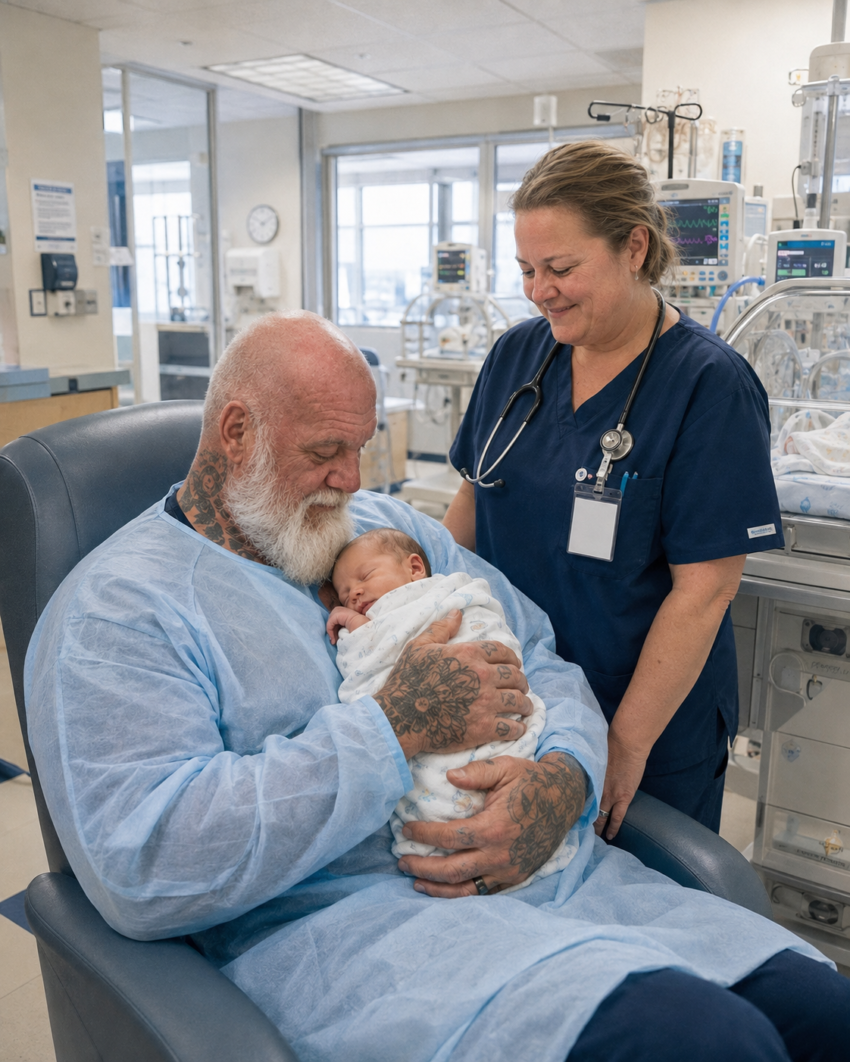
The first time Wade Holden asked me to place a premature baby in his arms, I looked at his hands and almost said no.
They were enormous.
Scarred knuckles. Thick fingers. Faded tattoos disappearing beneath the sleeves of a disposable blue hospital gown.
Then I looked at the baby screaming inside the bassinet beside us.
“You sure about this?” I asked.
Wade nodded.
“If you think he can handle me.”
That answer surprised me.
Most new volunteers asked whether they could handle the babies.
Wade was worried the baby couldn’t handle him.
I had been a NICU nurse at Pine Valley Children’s Hospital for thirteen years, long enough to know that appearances rarely told the whole story. Still, when Wade “Grizzly” Holden first walked through our secured doors, I assumed somebody had sent him to the wrong floor.
He stood close to six-foot-seven.
His head was shaved. His beard was thick and almost completely white. Both forearms were covered in tattoos, and old scars crossed the backs of his hands.
Hospital policy required him to leave his black leather motorcycle vest outside the unit. Underneath it, he wore a plain gray T-shirt, jeans, and heavy boots.
One of our younger nurses leaned toward me.
“That’s the cuddler?”
I lowered my voice.
“Apparently.”
Wade heard us anyway.
He looked down at his boots.
“I can change the shoes if those are a problem.”
I felt my face warm.
“They’re fine.”
He nodded once.
No complaint. No joke.
Just that.
The Baby Nobody Could Settle
The baby crying that morning was listed on our board as Baby Boy Nolan.
He had arrived weeks too early and small enough that the first photograph in his chart showed more wires than baby.
By then he had improved.
He no longer required the same level of respiratory support he’d needed during his first days, but he still tired easily. Feeding remained difficult. His weight had begun moving in the right direction, though slowly.
The harder problem wasn’t written beside his vital signs.
Nobody came.
His mother, Shelby Nolan, had delivered him after a complicated pregnancy. She was young, frightened, and apparently dealing with more problems outside the hospital than we understood.
She had left before completing everything with our social worker.
The number she’d provided stopped working.
There was no father at the bedside.
No grandparents.
No aunt carrying balloons.
No folded blanket from home.
Nothing.
Usually, even our smallest babies had evidence of somebody waiting for them. A stuffed animal beside the window. Family photographs taped near the incubator. A handwritten card.
Baby Boy Nolan had a white hospital blanket with tiny blue squares.
That was it.
That morning he had been restless for nearly an hour.
I checked his diaper.
Another nurse adjusted his position.
We checked his temperature and oxygen saturation. I offered his pacifier.
He spit it out and kept crying.
Wade stood several feet away.
He had completed his volunteer orientation and infection-control training. His paperwork was approved. He was cleared to participate in our infant-cuddling program.
Still, I had planned to start him with one of our more stable babies.
Instead, he pointed toward Baby Boy Nolan.
“What’s wrong with him?”
“Nothing obvious.”
“Hungry?”
“Already fed.”
“Hurting?”
“We don’t think so.”
Wade watched him.
The baby’s face had turned red from crying. His fists opened and closed against the blanket.
“Maybe he’s lonely.”
I looked at Wade.
It was such a simple thing to say that I almost dismissed it.
But babies in the NICU didn’t stop needing ordinary human contact simply because machines surrounded them.
Wade washed his hands again without being asked.
Then he sat in the recliner.
“Can I try?”
I hesitated.
Only for a second, but he noticed.
He glanced at his hands.
“I know.”
“Know what?”
“I look like I should be fixing a transmission, not holding something that weighs five pounds.”
I smiled despite myself.
“He doesn’t weigh five pounds.”
Wade raised an eyebrow.
“Well, that’s not helping my confidence.”
That was the first time I heard him joke.
I checked Baby Boy Nolan once more.
Then I lifted him carefully.
Wade immediately stopped smiling.
He sat perfectly still.
I showed him exactly where to place his arms.
“Support his head here.”
“Here?”
“Yes.”
“And this hand?”
“Under him. Gently.”
He followed every instruction.
I lowered the baby against his chest.
For a moment, nothing changed.
Baby Boy Nolan kept crying.
Wade didn’t bounce him.
Didn’t shift nervously.
Didn’t start asking questions.
He simply waited.
Then he lowered his face slightly.
“Easy now, little bear.”
The crying continued.
Wade rubbed one finger slowly across the baby’s back.
“I’m right here.”
Something changed on the monitor.
I looked up.
His heart rate had started coming down.
Not dramatically.
Just gradually.
The sharp cries became shorter.
Then softer.
Wade continued speaking in the same low voice.
I couldn’t hear every word.
Something about motorcycles.
Something about a dog he’d once owned.
Nothing meant for anyone except the tiny boy on his chest.
Within several minutes, Baby Boy Nolan stopped crying.
His fist loosened against Wade’s gown.
His breathing became slow and even.
Then he fell asleep.
I stood beside the chair longer than necessary.
Wade looked up.
“Am I doing it right?”
I checked the monitor again.
“Don’t move.”
His eyes widened.
“Something wrong?”
“No.”
I pulled the blanket a little higher around the baby.
“That’s why I don’t want you to move.”
The Man We Stopped Watching
Wade came back two days later.
Then again the following week.
Before long, his visits developed a routine.
He arrived in his leather vest and left it outside.
He scrubbed his hands.
He put on the required gown.
Then he asked the same question.
“Who needs somebody today?”
Sometimes it was Baby Boy Nolan.
Sometimes it was a premature twin whose parents were dividing their days between the hospital and two older children at home.
Sometimes it was a baby whose mother had returned to work because she had no paid leave left.
Wade never asked why a parent wasn’t there.
That mattered to me.
NICU families carried enough guilt without strangers adding to it.
One afternoon I found him sitting with Baby Boy Nolan again.
The baby’s cheek rested against the center of Wade’s chest.
One tiny hand had somehow worked free of the blanket and was wrapped around the edge of his finger.
Wade hadn’t moved.
“How long have you been sitting like that?” I asked.
He glanced at the clock.
“Hour and a half.”
“Your arm isn’t numb?”
“Completely.”
“You can move it.”
He looked down at the baby.
“He seems comfortable.”
“Wade.”
“I’ve had worse.”
I shook my head and walked away.
By then, nobody called him “the biker volunteer” anymore.
He was just Wade.
Even our neonatologist began looking for him when a baby had been unusually restless.
Baby Boy Nolan seemed to recognize him most of all.
I didn’t believe it at first.
Then I watched it happen.
Wade would enter the room speaking to one of us, and the baby would turn his head toward the sound.
Not every time.
But often enough that we noticed.
One morning, Wade leaned over the bassinet.
“Morning, little bear.”
Baby Boy Nolan opened his eyes.
Wade smiled.
It changed his entire face.
Why He Kept Coming Back
I finally asked him on a quiet Thursday afternoon.
Baby Boy Nolan was asleep against him. Sunlight came through the blinds in thin white lines across the floor.
I was updating a chart when I said, “Why this?”
Wade looked at me.
“Why what?”
“You could volunteer anywhere.”
He didn’t answer.
I almost let it go.
Then he looked down at the baby.
His thumb moved once across the edge of the blanket.
“My wife and I had a daughter.”
I stopped typing.
Wade kept his eyes on Baby Boy Nolan.
“Long time ago.”
I waited.
“She was early.”
The monitor beside him continued its steady rhythm.
“How early?”
He shook his head slightly.
“Early enough.”
There was no anger in his voice.
No attempt to make the story bigger than it was.
“We never brought her home.”
I looked at his scarred hand beneath Baby Boy Nolan’s tiny body.
“I’m sorry.”
He nodded.
“Yeah.”
For several seconds, neither of us spoke.
Then Wade said, “My wife could barely walk past a hospital after that.”
“And you?”
He gave a small shrug.
“I got on my bike.”
That sounded like the end of the answer.
It wasn’t.
“I rode a lot. Worked a lot. Stayed busy.”
Baby Boy Nolan shifted.
Wade automatically placed a hand across his back.
The baby settled immediately.
“Didn’t help much.”
I closed the chart.
“Is your wife still—”
“She died six years ago.”
I didn’t know what to say.
Wade saved me from trying.
“She would’ve liked this program.”
He looked around the NICU.
“Probably would’ve signed me up herself.”
I smiled.
“Without asking you?”
“Definitely without asking me.”
Then his expression changed.
Not much.
Just enough.
“I couldn’t do anything for my little girl.”
He looked down at Baby Boy Nolan.
“Maybe I can do something for somebody else’s.”
I had spent years teaching families that touch mattered.
Skin-to-skin contact mattered.
Voice mattered.
Presence mattered.
But sitting there, watching a man with scarred hands hold a baby who had almost nobody, those words felt less clinical than they ever had before.
Wade looked up.
“Don’t go telling everybody I got sentimental.”
“Your secret’s safe.”
“Good.”
Baby Boy Nolan stirred.
Wade lowered his voice.
“Easy, little bear.”
The baby’s fingers closed around his index finger.
That finger was thicker than the baby’s entire hand.
Wade went completely still.
I watched the monitor.
Steady heart rate.
Steady breathing.
A sleeping child.
A man who had once walked out of a hospital without his daughter.
Neither of us said anything else.
For the next hour, Wade sat there with his numb arm and his scarred finger trapped inside that tiny fist, and he never once tried to pull it free.
The Woman Standing Outside the NICU
By the time Baby Boy Nolan reached five pounds, Wade had stopped asking which baby needed him.
He still held other infants when we asked, but he always checked Nolan’s bassinet first.
“Morning, little bear.”
Some days Nolan was asleep.
Some days his eyes opened at the sound.
Wade insisted that meant nothing.
“He’s probably wondering why the loud old guy keeps showing up.”
But he smiled every time it happened.
Nolan was improving.
His breathing had stabilized. He was taking more of his feedings by bottle, and the alarms around his bed went off less often.
For the first time, discharge was something we could discuss without immediately adding a dozen conditions.
There was still one problem.
We didn’t know who would take him home.
Our social worker had continued trying to reach Shelby Nolan. There had been a few brief contacts, then silence again.
Nobody on our staff spoke badly about her.
NICU nurses learn quickly that people can love their children and still fall apart.
Then, on a Tuesday afternoon, I saw a young woman standing outside the secured doors.
She wore jeans, an oversized gray sweatshirt, and white sneakers. Her hair was pulled into a loose ponytail.
She kept rubbing her palms against her jeans.
When I opened the door, she didn’t step forward.
“Can I help you?”
Her eyes moved past me toward the unit.
“I’m Shelby Nolan.”
I knew the name immediately.
She swallowed.
“I’m his mother.”
I let her inside.
Shelby followed me to the handwashing station.
She scrubbed for longer than necessary.
“Is he okay?”
“He’s doing well.”
She nodded without looking at me.
“I know I should’ve called.”
I didn’t answer that.
She dried her hands.
“I kept thinking I’d come tomorrow.”
Her voice was quiet.
“Then tomorrow came.”
We walked toward Nolan’s bed.
Wade wasn’t there that afternoon.
I was glad.
Shelby deserved to meet her son again without an audience.
She stopped several feet from the bassinet.
Nolan was sleeping in a pale blue onesie.
His face had filled out. His cheeks were rounder than they had been when Shelby left.
She covered her mouth.
I waited beside her.
“That’s him?”
“That’s him.”
She stepped closer.
Her hand hovered above the bassinet.
Then she pulled it back.
“Can I touch him?”
“Of course.”
She touched two fingers to his cheek.
Nolan moved his head.
Shelby froze.
“Did I wake him?”
“He’s fine.”
I pulled the recliner closer.
“Would you like to hold him?”
She stared at me.
“Am I allowed?”
That question stayed with me.
“You’re his mother.”
She sat down.
I placed Nolan in her arms the same way I had once placed him against Wade’s chest.
Shelby’s arms were much smaller.
But they shook more.
“Support his head right there.”
“Like this?”
“Exactly.”
Nolan made a small sound.
Shelby’s face tightened.
“I’m sorry.”
I wasn’t sure whether she was speaking to me or to him.
Probably him.
Shelby Came Back
Shelby returned the next morning.
And the morning after that.
She met with our social worker. She completed paperwork she’d left unfinished. She arranged transportation and agreed to follow-up appointments.
I learned only pieces of what had happened.
She had been staying between a friend’s apartment and her older cousin’s house.
Nolan’s father wasn’t involved.
Shelby had lost her job during the pregnancy and had convinced herself that leaving the hospital meant admitting she couldn’t be a mother.
Our social worker helped her connect with programs that could provide practical support after discharge.
Nobody promised her it would be easy.
Shelby didn’t ask us to.
She learned how to feed Nolan.
How to hold him upright afterward.
How to watch his breathing.
How to recognize when he was tired.
The first time she changed his diaper, she stared at me afterward.
“That’s it?”
“That’s it.”
“I thought there’d be more instructions.”
“There will always be more instructions.”
She laughed.
It was the first time I’d heard her laugh.
Wade came in that afternoon.
He was halfway through tying his gown when he noticed Shelby sitting beside Nolan.
He stopped.
“That’s Mom?”
I nodded.
Wade looked toward the door.
“I’ll take somebody else today.”
He turned away.
Shelby had heard him.
“Wait.”
Wade stopped.
She stood.
“Are you Wade?”
He looked at me.
I hadn’t told her much. Only that a volunteer had spent considerable time with Nolan.
“Yes, ma’am.”
Shelby looked him over.
I recognized the expression.
The shaved head.
The white beard.
The tattoos.
The scarred hands.
Then she looked down at Nolan.
“You’re the one who’s been holding him?”
“Sometimes.”
I almost laughed.
Sometimes wasn’t exactly accurate.
Shelby stepped closer.
“They said you came almost every week.”
Wade rubbed the back of his neck.
“I had time.”
“They said he knows your voice.”
“Babies like low sounds.”
Shelby stared at him for a moment.
Then her eyes filled.
Wade immediately looked uncomfortable.
“Oh, don’t do that.”
She wiped her cheek.
“I’m trying not to.”
“Good.”
That made her laugh through the tears.
Then she looked at her son.
“You were here when I wasn’t.”
Wade didn’t answer.
“I left him.”
“You came back.”
“That doesn’t erase it.”
“Didn’t say it did.”
His voice remained gentle.
Shelby looked at him.
Wade pulled a chair closer to her.
“Sit down.”
She did.
He remained standing.
“That boy didn’t need me specifically.”
Shelby frowned.
“What?”
Wade nodded toward Nolan.
“He needed somebody.”
He paused.
“For a while, I could be somebody.”
Shelby lowered her eyes.
“Now you’re here.”
She pressed her lips together.
“What if I mess this up?”
Wade glanced at me before answering.
“You probably will.”
Shelby stared at him.
He shrugged.
“Everybody does.”
I had to look away to hide my smile.
“That’s not very comforting.”
“Wasn’t trying to be.”
Then he leaned slightly toward her.
“You showed up today. Show up tomorrow.”
Shelby nodded.
“Then do it again.”
That was all.
No speech.
No forgiveness offered on behalf of a child who couldn’t give it.
Just tomorrow.
Learning to Be His Mother
Over the next two weeks, I watched something happen that had nothing to do with medicine.
Wade slowly moved out of Nolan’s routine.
Not completely.
He still visited.
Still called him little bear.
But when Shelby was there, Wade gave her the chair.
If Nolan cried, Wade waited.
At first Shelby would look toward him.
“What should I do?”
Wade always gave the same answer.
“What do you think?”
She would check his diaper.
Offer the pacifier.
Shift him against her chest.
Talk quietly.
One afternoon Nolan became fussy after feeding.
Shelby stood and began walking slowly beside the window.
“You’re okay,” she whispered. “Mom’s here.”
Nolan settled against her shoulder.
Wade was across the room holding another infant.
He heard her.
Our eyes met.
He gave one small nod.
Nothing more.
Later, while Shelby spoke with the discharge coordinator, I found Wade washing his hands.
“You’re quiet today.”
“I’m always quiet.”
I raised an eyebrow.
“You tell premature babies motorcycle stories.”
“They’re educational.”
I handed him a paper towel.
He looked toward Shelby.
“She’ll be all right.”
It wasn’t a question.
“She’s working hard.”
Wade nodded.
“Good.”
Then he threw the paper towel away.
“Kid’s got his person now.”
I remembered what he’d told me weeks earlier.
He couldn’t bring his daughter home.
Maybe he could do something for somebody else’s child.
Watching him step aside for Shelby, I finally understood that holding Nolan had never been about replacing anyone.
Wade had simply kept a place warm until someone could return to it.
The Day Little Bear Went Home
Nolan’s discharge happened on a Friday.
Shelby arrived carrying an infant car seat that looked almost too large for her.
She had packed a small diaper bag.
Inside were bottles, diapers, two blankets, and enough extra clothing for what appeared to be a three-week expedition.
“You know you’re going home, not crossing the country?” I asked.
“I like being prepared.”
That was new.
The woman who had once disappeared before completing her paperwork now had a folder containing every discharge instruction we’d given her.
Nolan wore a tiny blue outfit with little white clouds across the front.
Shelby had bought it herself.
Wade arrived before noon.
He stood near the doorway while Shelby secured Nolan into the car seat.
For once, Wade didn’t seem to know what to do with his hands.
Shelby noticed.
“You want to hold him?”
“He’s ready to go.”
“I know.”
She lifted Nolan again.
“Hold him.”
Wade sat.
Shelby placed her son in his arms.
Nolan was heavier now.
Stronger.
His eyes stayed open.
Wade looked down at him.
“Well, little bear.”
His voice sounded rougher than usual.
“Looks like you’re getting out of here.”
Nolan moved one hand.
Wade offered a finger.
The tiny hand closed around it.
The same scarred finger Nolan had held weeks earlier.
Nobody spoke.
Shelby stood beside the chair.
Then she said, “I’m going to tell him about you.”
Wade looked up.
“Don’t make me sound too good.”
“I’m serious.”
“So am I.”
Shelby smiled.
“I’ll tell him there was this terrifying biker at the hospital.”
“Better.”
“And that he held him when his mother couldn’t.”
Wade’s smile disappeared.
He looked at Shelby for a long moment.
“Tell him his mother came back.”
Shelby’s eyes filled again.
This time Wade didn’t tell her not to cry.
He carefully returned Nolan to her arms.
“Take care of each other.”
“We will.”
Shelby carried her son toward the doors.
I walked beside her.
Wade stayed behind.
At the entrance, Shelby turned.
Wade lifted one hand.
She did the same.
Then the doors closed.
For a few seconds, I stood looking through the glass as Shelby adjusted the blanket around her son’s legs before heading toward the elevators.
Weeks earlier, that baby had lain beneath a plain hospital blanket with nobody beside him.
Now his mother carried him home.
When I returned to the unit, Wade was removing his gown.
“Heading out?” I asked.
“Think so.”
He folded the gown into the disposal bin and reached for his leather vest.
Then a baby started crying.
It came from the far side of the NICU.
Wade stopped.
We both listened.
The crying continued.
He looked toward the door.
Then toward the row of bassinets.
“You know,” he said, setting the vest back down, “I think somebody needs holding.”
I smiled and handed him another gown.
He scrubbed his scarred hands at the sink, pulled the blue gown over his shoulders, and walked toward the crying baby.
The first time I’d seen those hands, I’d wondered whether they belonged in our NICU.
By then, I knew better.
Sometimes the gentlest hands in the room belonged to the person who understood exactly how precious it was to have something small enough to lose.