The Man Who Walked Into My Salon
I have been a hair stylist for almost sixteen years, and I thought I had already seen every kind of customer a small-town salon could bring through the door.
I had fixed home dye disasters before family weddings. I had cut bangs for women who regretted them before I even finished. I had colored gray roots, shaved heads during summer heat, and once even helped a nervous teenage boy get a bright green streak because he wanted to impress a girl at school.
But nothing prepared me for the man who stepped into my salon on a quiet Tuesday afternoon.
My shop sat between a bakery and a tax office in a little strip mall in Bloomington, Indiana. Tuesdays were usually slow. The kind of slow where you sweep the same clean floor twice just to stay busy.
Then the bell above the door rang.
When I looked up, a giant man in black leather had to lower his head to step inside.
Advertisements
He was tall, broad, and heavy in the way some men are when life has made them strong without asking permission. His beard was thick and gray around the edges. Tattoos covered both arms. His leather vest had patches sewn across the front and back, and his motorcycle boots sounded heavy against the floor.
Outside, I could see a big Harley parked near the window.
For one second, I wondered if he had walked into the wrong place.
Most men like him went to the barber shop across the parking lot. They asked for a simple trim, paid in cash, and left. They did not usually walk into a salon with pink chairs, soft music, and shelves full of bright hair color.
But this man looked around once, then came straight to my station.
He sat down carefully, even though the chair looked far too small for him.
Then he pointed at the brightest blue color on my display wall.
“That one,” he said. “I need my whole head that color.”
The Brightest Blue On The Wall
At first, I thought he was joking.
The color he had chosen was not a quiet blue. It was not navy, not denim, not anything a grown man could pretend was subtle.
It was electric blue. Loud, bright, almost cartoon-like.
It was the kind of color a teenager picked when she wanted the whole hallway at school to notice her.
I laughed a little because I truly believed he had lost a bet.
“Are you sure?” I asked. “That is a very bright blue.”
The man looked at me through the mirror.
He did not smile.
“Yes, ma’am,” he said. “As bright as you can make it.”
I picked up the color sample and held it closer to him.
“There is no hiding this color,” I warned him. “People will stare.”
He nodded once.
“Good,” he said. “That is the point.”
Something in his voice made me stop smiling.
I set the color sample down and asked softly, “Can I ask why?”
He looked down at his hands for a moment. They were huge hands, rough and scarred, the kind of hands that had built things, fixed things, carried things, and probably held back more pain than they ever showed.
Then he said the words I will never forget.
“My little girl has blue hair. I need mine to match hers.”
A Little Girl Named Willow
His name was Russell Boone.
He was forty-seven years old, worked as a mechanic, and rode with a motorcycle group that did charity events around the state. He looked intimidating to strangers, but the way he spoke about his daughter changed his whole face.
Her name was Willow.
She was eight years old, small for her age, and, according to Russell, the kindest person he had ever known.
He told me she loved stray cats, library books, strawberry pancakes, and the color blue. She noticed lonely people. She remembered birthdays. She worried about children she had never met.
A few weeks earlier, Willow’s elementary school had started a fundraiser for a children’s hospital in Indianapolis. The students were encouraged to do something bold and fun to raise money and show support for kids going through difficult treatments.
Some children wore silly hats. Some wore costumes. Some promised to do extra chores if family members donated.
Willow chose to dye her hair blue.
Russell said she had been so proud of it.
She had looked in the bathroom mirror after her mother helped with the color and grinned like she had just done the bravest thing in the world.
“Daddy, do you think the kids at the hospital will like it?” she had asked him.
Russell told her, “I think they will love it, sweetheart.”
And he meant it.
Because to him, that blue hair was not silly. It was not strange. It was his daughter’s way of saying, I see you. I care about you. I am willing to stand out so you feel less alone.
When Kindness Was Laughed At
The next morning, Willow went to school excited.
By the time she came home, that excitement was gone.
Russell told me she walked through the front door with her shoulders folded inward, like she was trying to make herself smaller.
At first, she said she was fine.
Children say that when they are trying not to fall apart.
But later that evening, Russell found her sitting on the edge of her bed, brushing her blue hair over and over, tears running down her cheeks.
Some kids had laughed at her.
They told her she looked weird. They asked why she wanted to look like a cartoon. One child said her hair was ugly. Another said she looked like she came from another planet.
The words were childish, but they landed hard.
Willow had not dyed her hair to get attention for herself. She had done it because she wanted to help. And somehow, the thing that had made her feel brave in her bathroom mirror had become the thing that made her want to hide.
For the next several days, she did not want to go to school.
She tried to wear a hood. She asked if the color could be washed out. She cried when her mother gently reminded her that the fundraiser was not over yet.
Russell told me he did not know what to say at first.
“I can fix an engine,” he said quietly in my chair. “I can weld a frame. I can rebuild a bike from parts. But I did not know how to fix my little girl thinking kindness made her ugly.”
A Father’s Quiet Decision
Russell did not storm into the school.
He did not yell at children. He did not demand that the world instantly become gentle.
He wanted to. I could tell he wanted to.
But he understood something many adults forget.
His daughter did not need a bigger fight.
She needed someone to stand beside her.
So he sat in his garage late one night, staring at a wall full of tools, and thought about what had really hurt Willow.
It was not only the teasing.
It was the loneliness.
It was the feeling that she was the only one standing out, the only one being pointed at, the only one who looked different.
And Russell decided that if his daughter had to be different, she would not be different alone.
That was why he came into my salon.
Not because of a bet.
Not because he wanted attention.
Not because he cared about looking cool.He came because his little girl had lowered her head, and he wanted to help her lift it again.
When he finished telling me the story, I had to blink a few times before I could speak.
Then I picked up my mixing bowl.
“All right,” I said. “Let’s make you blue.”
The Color Of Love
Coloring Russell’s hair took a long time.
His hair was thick, dark, and stubborn. I had to lighten it first before the blue would show the way he wanted. He sat still through the whole process, his giant boots planted on the floor, his hands resting on his knees.
Advertisements
Other customers came and went. Every one of them looked twice.
Russell ignored the stares.
At one point, I asked if he wanted to see the progress.
He shook his head.
“No,” he said. “I just need it right.”
When the final color was rinsed, dried, and styled back, I turned the chair toward the mirror.
For a moment, neither of us said anything.
There he was — a huge, tattooed biker with a gray beard, a leather vest, and the brightest blue hair I had ever put on a grown man.
He stared at himself.
Then he gave one small nod.
“That’ll do,” he said.
But his voice was not rough anymore.
It was soft.
He paid, left a tip far too generous, and stood at the door with his helmet tucked under one arm.
Before he walked out, he looked back at me.
“Thank you,” he said. “My girl needed this.”
The School Pickup Line
Later, I heard the rest of the story from Russell’s wife, from two parents who came into my salon, and from half the town after the photo started spreading.
Russell rode straight from my salon to Willow’s school.
Classes let out at three o’clock.
He parked his Harley near the pickup line and stood beside it with his arms folded, his blue hair shining in the afternoon sun.
Parents stared.
Teachers stared.
A few children pointed.
Russell did not move.
He only watched the school doors.
Then Willow came outside.
She was walking with her head down, her backpack hanging low, her blue hair pushed behind her ears as if she could make it disappear.
She looked tired in the way only a hurt child can look tired.
Then she saw the motorcycle.
Then she saw her father.
She stopped in the middle of the sidewalk.
Her mouth opened.
For a few seconds, she did not move at all.
Then her backpack slid off one shoulder and dropped to the ground.
“Daddy?” she called.
Russell smiled.
Willow took a few steps closer, still staring.
“Daddy, your hair,” she whispered.
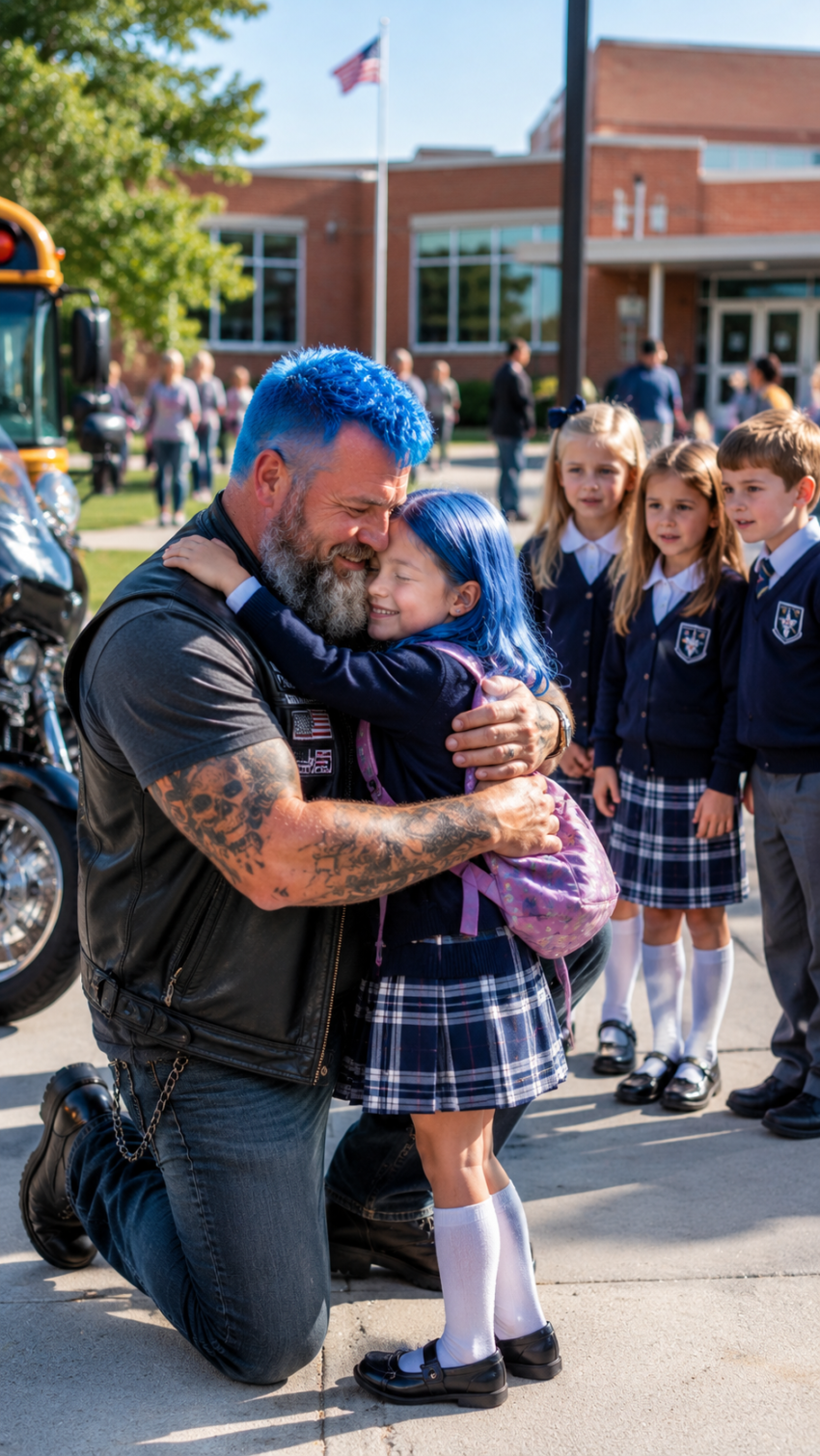
He lowered himself onto one knee right there in front of everyone, so his face was level with hers.
“Yep,” he said. “Now we match.”
Her lips started trembling.
“Why did you do that?”
Russell reached out and gently touched the end of her blue hair.
“Because if people are going to stare, they can stare at both of us,” he said. “And if anyone thinks blue hair is strange, then I guess your old dad is strange too.”
Willow began to cry, but this time it was not the same kind of crying.
This was relief.
This was a child realizing she had not been left alone in her shame.
Russell opened his arms, and she ran into them.
He held her so tightly and so carefully, as if she were both the strongest and most breakable thing in the world.
Then he said, loud enough for the parents nearby to hear:
“Listen to me, Willow. You colored your hair because you wanted to help children who are having a hard time. That is not ugly. That is not silly. That is brave. Nobody gets to make you feel small for doing something kind.”
The pickup line went quiet.
Not awkward quiet.
The kind of quiet that happens when people know they are seeing something they will remember.
The Photo That Changed The Town
One parent took a picture.
It showed Russell on one knee beside his Harley, his bright blue head bent toward his little girl, while Willow wrapped her arms around his neck.
The photo was not perfect. It was a little blurry. The angle was not professional. There were cars in the background and backpacks on the sidewalk.
But it had something real in it.
By that night, people in town were sharing it.
By the next morning, it had reached friends of friends, then families from other schools, then local pages that shared uplifting stories.
The words attached to the photo were simple: A father dyed his hair blue so his daughter would not feel alone.
That was enough.
People understood it immediately.
They understood that love is not always a speech. Sometimes love is sitting in a salon chair and letting a stranger turn your hair electric blue. Sometimes love is looking foolish on purpose so your child can feel brave again.
The next day, Willow walked into school with her head up.
The same blue hair that had made her want to hide now felt different.
Because now it matched her father’s.
And everyone had seen why.
More Blue Heads
Something unexpected happened after that.
A teacher at Willow’s school added a blue streak to her hair.
Then one of the mothers in the pickup line dyed the ends of her hair blue.
Then a father who had never colored his hair in his life came into my salon and asked for a small blue patch above his ear.
Within two weeks, blue hair began appearing all over town.
Not everyone did their whole head like Russell. Some people chose streaks. Some chose temporary color. A few kids used blue ribbons or blue hats.
But the message was the same.
Willow was not alone.
The fundraiser grew bigger than anyone expected.
People who had never donated before gave money. Local businesses put jars on their counters. The bakery next to my salon sold blue cupcakes for a weekend and gave part of the money to the hospital fund.
Advertisements
Russell’s motorcycle group organized a small charity ride.
They called it the Blue Ride for Brave Kids.
A dozen bikers showed up with blue streaks in their beards, blue bandanas, or blue ribbons tied to their handlebars.
And right in the middle of it all was Willow, smiling shyly beside her father, her blue hair shining in the sun.
What The Fundraiser Became
By the end of the fundraiser, Willow’s school raised far more than anyone had expected.
It was not just the amount that mattered.
It was what the money represented.
Every dollar came from someone who had heard about a little girl who tried to do something kind and a father who refused to let cruelty have the final word.
Russell and Willow were invited to help present the donation to the children’s hospital in Indianapolis.
Willow was nervous that day.
Russell told her, “You do not have to say anything fancy. Just be yourself.”
She looked up at him and asked, “What if I cry?”
He smiled.
“Then I will probably cry too,” he said. “We can match there as well.”
At the hospital, Willow met nurses, staff members, and a few families who thanked her for what she had done.
One mother hugged Russell and told him that her son had smiled when he saw the photo of the giant biker with blue hair.
Russell had to turn away for a moment.
He later told me that was the moment he knew the blue hair had been worth every stare.
Six Months Of Blue
Russell kept his hair blue much longer than anyone expected.
Weeks passed.
Then months.
He went to work with blue hair. He went to diners with blue hair. He fixed engines, bought groceries, and attended school events with blue hair.
People asked about it everywhere he went.
He always told them the same thing.
“My daughter did something kind, and I wanted her to know I was proud of her.”
That was all.
He did not make himself the hero of the story.
He never acted like he had done something huge.
To him, it was simple.
His child had needed him, so he showed up in the way she needed.
After about six months, the color began to grow out. His natural dark hair, threaded with gray, started showing at the roots.
One evening, Willow sat beside him on the porch and studied his head.
“Daddy,” she said, “your real hair is coming back.”
Russell touched the top of his head and laughed.
“Guess I need another appointment.”
Willow shook her head.
“You do not have to keep it blue forever,” she said.
He looked at her carefully.
“You sure?”
She leaned against his arm.
“Yes,” she said. “You already showed me.”
What Willow Remembered
Years later, people in Bloomington still remembered the blue hair.
They remembered the picture. They remembered the fundraiser. They remembered the way one man’s love made an entire town look at kindness differently.
But Willow remembered something even deeper.
She remembered walking out of school with her head down and seeing her father standing there, looking just as different as she did.
She remembered that he did not tell her to toughen up.
He did not tell her to ignore it.
He did not tell her children would be children and pain would pass.
He entered the hard place with her.
That was what changed her.
She learned that standing out was not always something to fear.
She learned that kindness was not weakness.
She learned that the people who love you do not always remove the problem from your path. Sometimes they step into the path beside you, take your hand, and make sure you do not walk it alone.
And every year, when fundraiser season comes back around, Russell still visits my salon.
He does not color his whole head anymore.
Now he asks for one bright blue streak.
Just one.
Enough for Willow to see.
Enough for him to remember.
Enough to tell the world, without needing many words, that a father’s love can turn even the brightest, strangest color into something beautiful.
Sometimes the strongest love is not loud, dramatic, or complicated; sometimes it is simply a parent choosing to stand beside their child in the exact place where the world made that child feel alone.
A child may forget many ordinary days, but they will never forget the day someone they loved showed up for them when embarrassment, fear, and sadness felt too heavy to carry alone.
Kindness should never be treated like weakness, because it takes real courage to care about people you may never meet and to do something bold just to make their burden feel a little lighter.
The people who look intimidating from the outside are sometimes the very people with the softest hearts, and this is why we should be careful about judging anyone before we know what they are carrying inside.
Children do not always need perfect answers from adults; sometimes they simply need proof that someone sees their pain, believes their heart, and is willing to stand next to them without shame.
A small act of love can travel farther than we imagine, because one father’s choice to dye his hair blue did more than comfort one little girl; it reminded a whole town how powerful compassion can be.
The world will always have people who laugh at what they do not understand, but one steady voice of love can be stronger than a crowd of careless words.
When a child does something kind and gets hurt for it, the answer should never be to teach that child to hide their goodness, but to remind them that goodness is still worth protecting.
Real strength is not measured by how tough someone looks, how loud they speak, or how much fear they can create; real strength is shown in the tenderness they are willing to offer when someone small needs them most.
If we want children to grow into brave and caring adults, we must show them that being different for the right reason is never something to be ashamed of, especially when love is standing right beside them.