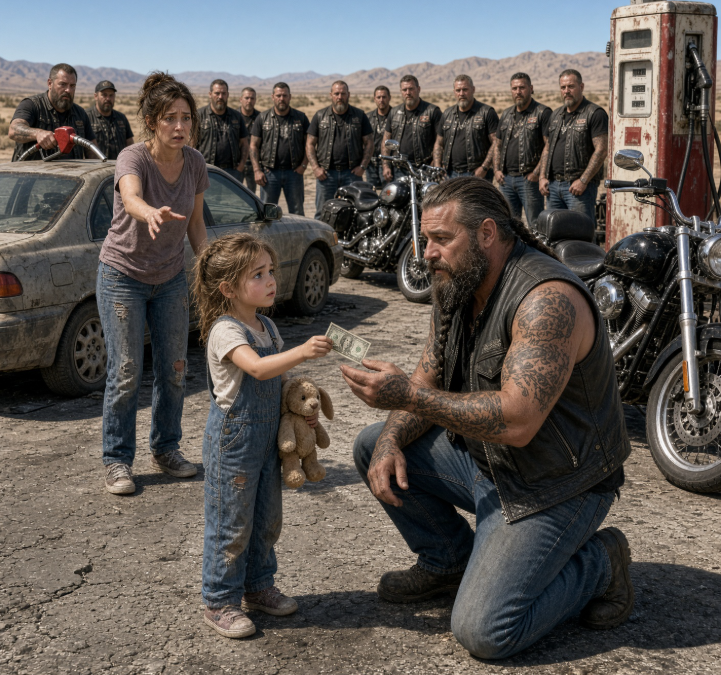
I was too busy deciding whether I could get Chloe into the car before anyone noticed us.
Then Chloe moved.
One second she was behind me.
The next, she had slipped around my leg and was crossing the oil-stained concrete toward the giant biker.
My heart stopped.
“Chloe, no.”
My voice came out strangled.
I tried to move, but panic turned my legs heavy and useless.
She walked right up to him, Mr. Buttons tucked beneath one arm, and tilted her face toward his.
“Excuse me, mister.”
The whole gas station went quiet.
Men who looked like they had survived prisons, wars, highways, and every dark thing between them turned their eyes toward my little girl.
Jackson slowly looked down.
His expression did not change, but the air around him did.
“What is it, little bird?”
Chloe reached into the front pocket of her faded denim overalls and pulled out a folded bill.
My breath left me.
Her two-dollar bill.
Her lucky two-dollar bill.
My father had given it to her the last time we saw him before he died. He told her it was special because people did not see them often, and rare things should be protected. Chloe kept it folded inside a plastic sleeve most days, tucked behind Mr. Buttons’ tiny stitched vest.
It was the only thing she owned that felt like treasure.
She held it up to Jackson with both hands.
“You can have my money for your gas.”
Nobody moved.
Jackson stared at the bill.
Then at Chloe.
Then, slowly, he crouched down until his huge frame lowered to her eye level. His leather vest creaked. His hands rested on his knees. Up close, he looked even more intimidating.
But his voice changed.
It dropped into something rough and gentle.
“This yours?”
Chloe nodded.
“My grandpa gave it to me before he went to heaven. He said it was lucky.”
Jackson’s face tightened almost imperceptibly.
Chloe pushed the bill closer.
“You look like you need some luck today so you can get home. You shouldn’t be stuck out here in the hot sun.”
I finally broke free of the fear holding me still.
I ran forward, grabbed Chloe by the shoulders, and pulled her back against my legs.
“I’m so sorry,” I said, my words tumbling over each other. “Please excuse her. We don’t want trouble. She didn’t mean anything. We’re leaving.”
Jackson did not stand right away.
He stayed crouched, eyes moving from Chloe’s open face to mine.
He saw too much.
I knew it immediately.
The dark circles beneath my eyes.
The way my hands shook.
The bruise on my upper arm I had tried to cover with my sleeve.
The packed car.
The empty pump.
The child in the shade.
The mother pretending she still had a plan.
He reached out one calloused hand.
For a split second, terror flashed through me.
Then he gently took the two-dollar bill from Chloe’s fingers.
“I appreciate it, kid.”
He looked at the bill for a long moment.
Then folded it carefully and placed it inside his breast pocket, right over his heart.
Chloe smiled.
He stood, towering over both of us again.
“You running from something, Mama?”
“No.”
The lie came too fast.
“Just heading north. We’re fine.”
Jackson glanced at the Civic.
Worn tires.
Expired registration.
Back seat filled with trash bags and folded blankets.
He looked back at me.
“What’s your name?”
I hesitated.
“Abigail.”
“And the little bird?”
“Chloe.”
Jackson nodded once.
Then reached inside his vest.
I stiffened.
But what he pulled out was cash.
A thick roll of bills.
He peeled off five hundreds and held them toward me.
I stepped back.
“No. I can’t take that.”
“You can.”
“Please, she just wanted to help. I don’t want—”
“Your kid gave me her lucky bill,” he said. “Out of respect, I’m returning the favor. That makes it an exchange.”
My eyes burned.
“I can’t repay you.”
“Didn’t ask.”
I looked at the money like it might disappear if I blinked.
Jackson’s tone softened just enough.
“Take it. Fill your tank. Get food in her belly. Get off this highway before dark.”
I reached out with trembling fingers.
Five hundred dollars.
More cash than I had seen in months.
“Thank you,” I whispered.
Jackson said nothing.
He turned toward one of the other riders.
“Mike.”
The scarred man tossed him a fuel nozzle.
While Jackson fueled his bike, Chloe leaned into my side.
“Was that okay, Mommy?”
I looked down at her.
I wanted to say no.
I wanted to tell her never to walk up to strange men, never to offer money, never to trust someone because they looked like they needed help.
But then I looked at Jackson, standing beside his Harley with my daughter’s lucky bill over his heart.
“It was kind,” I said carefully. “But next time, you stay with me.”
She nodded solemnly.
When the motorcycles started again, the sound filled the whole station. Jackson pulled out last. As he passed, he looked back over his shoulder and lifted two fingers in a solemn salute to Chloe.
She waved wildly with Mr. Buttons.
The riders disappeared onto the highway in a wave of heat, chrome, and thunder.
When they were gone, I leaned against the Civic and sobbed into my hands.
Not pretty crying.
Not soft tears.
The kind of crying that comes when your body has been preparing to die and suddenly receives water instead.
I thought we had been saved.
I did not know yet that Jackson Cole had seen the black Chevy Tahoe parked across the highway behind a sun-bleached billboard.
I did not know he had caught the license plate.
I did not know that by the time Chloe and I pulled out of the gas station with a full tank, Jackson was already making calls.
Fifty miles later, I stopped at the Starlight Motel.
Calling it a motel was generous.
It was a strip of cracked stucco rooms wrapped around a parking lot where the neon sign flickered like it was losing an argument with darkness. But the room had a lock. The air conditioner rattled. The bed sagged, but it was clean enough if I did not look too closely.
The five hundred dollars bought gas, sandwiches, water, a small carton of milk for Chloe, and two nights in room 114.
For the first time in days, I let my daughter take off her shoes and lie on a bed.
She fell asleep holding Mr. Buttons under her chin.
I sat by the window, peering through a gap in the curtain.
The parking lot was quiet.
Too quiet.
Every passing car made my chest tighten.
Every shadow became a man outside our duplex window.
Around eleven, I washed my face in the cracked bathroom mirror and looked at myself under fluorescent light.
I barely recognized the woman staring back.
My hair was tangled.
My lips were dry.
The bruise on my arm had darkened at the edges.
I pressed my fingers gently over it and heard Bowman’s voice in my head.
Sign, Abigail. Be smart. People like you don’t win against people like me.
I turned off the bathroom light and went back to the window.
That was when the black Chevy Tahoe pulled into the parking lot.
No headlights after the first turn.
Just a dark shape rolling slowly past the office.
My blood went cold.
The vehicle stopped two spaces from my Civic.
Two men got out.
Then a third.
One of them was built like a concrete block.
Tommy Fowler.
Bowman’s enforcer.
I had seen him once before, standing outside our duplex with a toothpick between his teeth, smiling while another man shattered my kitchen window.
My breath stopped.
I stumbled backward and rushed to the bed.
“Chloe. Baby. Wake up.”
She stirred.
“Mommy?”
“We have to be quiet.”
Footsteps climbed the exterior walkway.
Heavy.
Slow.
Mocking.
Bang.
Bang.
Bang.
The door shook in its frame.
“Abigail Weston,” a voice called. “We know you’re in there.”
Chloe began to cry.
I clamped one hand gently over her mouth and held a finger to my lips.
Fowler laughed outside.
“Mr. Bowman sent us to collect your signature. Open up and we can do this easy.”
I looked around for a weapon.
Lamp.
Chair.
Anything.
Nothing in that room could stop three men.
“Please,” I called, my voice breaking. “Leave us alone. I’ll sign whatever you want. Just don’t hurt my daughter.”
“Then unlock the door.”
I stood frozen.
Every instinct screamed not to open it.
Every memory told me locked doors only delayed men like that.
Fowler kicked the bottom of the door.
The frame splintered slightly.
“Now, Abigail.”
Chloe clung to me, shaking.
I took one step toward the deadbolt.
Then the night began to rumble.
At first, I thought fear had entered my ears and become sound.
But Fowler heard it too.
The men outside stopped.
The rumble grew.
Deeper.
Louder.
A rolling thunder sweeping in from the highway.
I went to the curtain and looked through the crack.
Headlights poured into the motel parking lot.
One motorcycle.
Then another.
Then more.
The sound bounced off the stucco walls until the cheap windows trembled.
Fifteen Harley-Davidsons rolled into the Starlight Motel and formed a wide arc around the black Tahoe, cutting off the exit.
My knees almost gave out.
Chloe whispered, “The gas man.”
Jackson Cole stepped off his bike.
He did not hurry.
He walked with the slow, deliberate heaviness of a man who knew exactly where he was going and exactly why.
Beside him was another older rider, barrel-chested, gray-bearded, his eyes sharp beneath the parking lot lights. Behind them came Iron Mike and the others.
No one shouted.
No one swung chains.
No one fired a gun.
They did not need chaos.
Their calm was worse.
Fowler backed away from our door.
“This ain’t your business, Jackson.”
Jackson reached into his vest.
For one terrible second, I thought he was reaching for a weapon.
He was not.
He pulled out Chloe’s two-dollar bill.
Held it up beneath the flickering neon.
“She made it my business.”
Fowler glanced at the bill and sneered.
“She’s nobody.”
The older rider stepped forward.
His voice was quiet.
That made it terrifying.
“Careful how you talk about a child.”
Fowler swallowed.
“We’re just here for paperwork.”
Jackson looked toward room 114.
Then back at Fowler.
“You came to a motel at night to threaten a mother and a six-year-old over a signature. That’s not paperwork. That’s cowardice with a clipboard.”
One of Fowler’s men shifted, hand moving toward his jacket.
Every biker in the lot noticed.
So did I.
Jackson’s voice cut through the air.
“Don’t.”
The man froze.
The older rider nodded toward the motel office.
“Owner already called sheriff’s deputies. Cameras are recording. We’ve got your plates, your faces, and three witnesses who heard you threaten the kid.”
Fowler’s expression flickered.
He had expected violence.
He had expected fear.
He had not expected procedure.
Iron Mike lifted a phone.
“And I’ve been livestreaming to our attorney since we pulled in.”
Fowler looked suddenly less certain.
Jackson stepped closer, still holding the two-dollar bill.
“Here’s what happens now. You and your boys put your hands where everyone can see them. You wait for law enforcement. You tell them who sent you. Or you explain why you’re standing outside a single mother’s motel room at midnight after kicking her door.”
Fowler’s mouth twisted.
“You think Bowman’s scared of cops?”
“No,” Jackson said. “I think Bowman’s scared of evidence.”
In the distance, sirens began to rise.
Real sirens.
Closer every second.
Fowler’s face changed.
The men with him looked toward the Tahoe, but the motorcycles blocked every path.
Inside the room, Chloe pressed her face into my shirt.
“Are they going to hurt us?”
“No,” I whispered, though I was crying so hard the word almost broke.
A minute later, deputies pulled into the lot.
Then highway patrol.
Then a woman in plain clothes driving an unmarked sedan who turned out to be an investigator from the county district attorney’s office.
I later learned Jackson had called her before he ever called the motel.
Her name was Marisol Vega.
She had been building a case against Richard Bowman for months.
Illegal evictions.
Forged signatures.
Harassment.
Bribed inspectors.
The problem had always been witnesses too frightened to stay.
Jackson had not come to start a war in a motel parking lot.
He had come to make sure I lived long enough to testify.
There is a difference.
A deputy knocked on our door gently.
Not like Fowler.
“Ms. Weston? You’re safe. We need to take a statement when you’re ready.”
I opened the door with Chloe in my arms.
Jackson stood at the bottom of the walkway, looking up at us.
His huge shoulders blocked the flashing lights.
“They can’t hurt you right now,” he said.
Right now.
I appreciated the honesty.
He did not promise forever in a parking lot.
He promised the moment he could control.
That was enough to let me breathe.
Fowler and his men were questioned, separated, and eventually detained. The deputies found zip ties in the Tahoe. A folder of preprinted documents. My name. My old address. Chloe’s school name written on a sticky note.
When one deputy read that, his jaw tightened.
Marisol Vega took my statement inside the motel office with Chloe asleep across my lap.
Jackson waited outside the glass door.
Not hovering.
Not listening.
Just there.
At dawn, Marisol helped arrange a safe placement through a domestic violence housing program that handled intimidation cases tied to illegal evictions. It was not glamorous. It was not instant justice. It was paperwork, phone calls, emergency forms, quiet women with tired eyes, and one social worker who brought Chloe apple juice.
But it was real.
Before we left the motel, Chloe asked to see Jackson.
I hesitated.
Then nodded.
He crouched on the walkway, knees cracking, until he was eye level with her again.
She held Mr. Buttons against her chest.
“Did my money help?”
Jackson touched his vest pocket.
“More than you know, little bird.”
“Are you going home now?”
“After we make sure you and your mom get where you’re going.”
She studied him with the solemn seriousness only children can manage.
“You were stuck too?”
He blinked.
“What?”
“At the gas station. You needed gas.”
For the first time, I saw Jackson smile.
A real smile.
Small, but real.
“Yeah,” he said. “I guess I was.”
Chloe nodded.
“Then it was good I had two dollars.”
Jackson’s eyes softened.
“It was.”
Over the next two weeks, my life became a stack of forms and locked doors.
Safe housing.
Protective order.
Police reports.
Tenant rights statements.
Photographs of the broken windows.
A copy of the motel surveillance.
Marisol moved fast because she already knew where to push. She did not promise easy. She promised clear.
“You are not the first tenant Bowman tried to scare,” she told me. “But you may be the first one we can keep safe long enough to stand.”
That sentence frightened me.
It also made me angry.
Not loud anger.
Not movie anger.
The kind that sits down inside your spine and refuses to move.
Jackson and the others did not disappear.
They did not crowd me either.
That mattered.
A few times, a rider sat across from the safe house in daylight, not hiding, just visible. Marisol said it was legal as long as they remained on public property and did not confront anyone. The point was not to threaten. It was to discourage Bowman’s men from pretending nobody was watching.
Chloe called them the motorcycle uncles.
I corrected her twice.
Then gave up.
Iron Mike brought her coloring books.
Sully, the older rider, brought groceries and claimed he had “accidentally bought too much cereal,” which fooled absolutely no one.
Jackson brought nothing for the first week.
Only presence.
Then one afternoon, he arrived with a small envelope.
Inside was Chloe’s two-dollar bill.
Pressed flat.
Protected in a clear sleeve.
I looked at him, confused.
“I thought you kept it.”
“I did.”
“Then why—”
“Look closer.”
Behind the bill was a second one.
Another two-dollar bill.
Older.
Worn soft.
“My daughter gave me that one,” he said.
I went still.
Jackson looked toward the safe house window where Chloe was drawing at the table.
“She was seven when she died. Leukemia. Long time ago.”
I had no idea what to say.
He saved me from trying.
“She used to call them lucky too. After she passed, I carried it like carrying it could keep me from losing anything else. Didn’t work, of course.”
His thumb brushed the edge of the envelope.
“When your girl handed me hers, I remembered something I hadn’t thought in years.”
“What?”
“That luck doesn’t mean keeping pain away. Sometimes it means sending help to the right place before it’s too late.”
My eyes filled.
He held out the envelope.
“I’m not taking Chloe’s luck from her. I’m adding mine to it.”
I took it with both hands.
“Jackson…”
He shook his head once.
“No big speech, Mama.”
So I nodded.
No big speech.
But that night, after Chloe fell asleep, I cried quietly over two two-dollar bills in a plastic sleeve.
One from my father.
One from a biker’s dead daughter.
Two small pieces of paper carrying more love than money was ever meant to hold.
Bowman’s case broke open faster than anyone expected.
Not because the Hells Angels stormed his estate or forced him to sign anything in blood.
Because fear cracks when witnesses realize they are not alone.
After Fowler’s arrest, other tenants came forward.
An elderly man from another Bowman property.
A young couple with a baby.
A disabled veteran whose signature had been forged on a relocation waiver.
A former employee who had copied files before quitting.
Marisol connected them.
The district attorney moved.
The press finally paid attention.
Bowman went on television first, of course.
Men like him always believe cameras belong to them.
He wore a navy suit and said he was the victim of a smear campaign by criminals and disgruntled tenants.
Then the reporter played motel footage.
Fowler outside my room.
His voice threatening my child.
The folder in the Tahoe.
The plate records tying his vehicle to Bowman’s office.
Bowman’s smile did not survive the segment.
Within a month, he was under investigation for fraud, intimidation, bribery, and conspiracy tied to illegal evictions.
His company’s accounts were frozen.
The city council distanced itself with the speed of rats leaving a sinking ship.
The duplex project stalled.
Then collapsed.
My old building was not magically restored to peace. Windows still needed repair. People still had trauma. Some tenants had already scattered to couches, motels, and shelters. Legal victories often arrive late to the wreckage.
But they arrived.
The relocation fund Bowman had tried to avoid became part of a court-monitored settlement. Tenants received compensation. Some units were transferred into a nonprofit housing trust.
Mine was one of them.
I did not own it outright like a fairy tale.
But I got something better than a fantasy deed signed under fear.
I got a legal lease.
Protection.
Back rent cleared.
Repairs completed.
A chance to return without wondering who would break the window next.
When Chloe and I walked back into our duplex three months after we fled, the basil plant on the kitchen windowsill was dead.
Chloe stared at it.
“Can we get another salad tree?”
“Yes,” I said.
My voice broke on that one word.
“Yes.”
She ran to her room.
The glow-in-the-dark stars were still there.
Some had fallen.
Most held.
That night, we slept in our own beds.
I woke three times.
Checked the locks.
Looked out the window.
Listened.
No footsteps.
No whispering through broken glass.
No Tahoe idling by the curb.
Just the hum of the refrigerator and Chloe breathing softly down the hall.
The first time Jackson came by after we returned, he stayed on the sidewalk.
He did not come to the door until I waved.
That was one of the things I trusted about him.
He understood distance.
Chloe ran out with Mr. Buttons tucked under one arm.
“Mr. Jackson!”
He crouched as she threw herself into a hug against his vest.
He froze for half a second, as if tenderness still surprised him.
Then patted her back gently with one huge hand.
“You keeping your mom out of trouble, little bird?”
Chloe nodded.
“We got a new salad tree.”
“Important.”
“It’s basil.”
“Even more important.”
He looked at me.
“You good?”
“Getting there.”
He nodded.
“Good place to be.”
From his saddlebag, he pulled out a tiny denim jacket.
Not leather.
Not a club cut.
Denim, with a stitched patch on the back of a little stuffed rabbit under two crossed wrench shapes.
Around it were the words:
Little Bird Logistics Crew.
I laughed through tears.
Chloe gasped as if he had handed her royal armor.
“It has Mr. Buttons!”
“Looks like him?”
“It’s perfect.”
Jackson tapped his breast pocket.
“Figured a girl who funds emergency fuel operations should have a uniform.”
I smiled.
“No Hells Angels patch?”
He looked at me seriously.
“She’s a child. She belongs to herself.”
That sentence stayed with me.
Because so many people had treated Chloe like an extension of my fear, my poverty, Bowman’s threats, a case file, a charity need, a headline.
Jackson did not.
She belongs to herself.
Yes.
She did.
So did I.
The months that followed were not easy.
People like clean endings because they cost less.
My ending was not clean.
I still had nightmares.
Chloe still startled when someone knocked too hard.
I still had to rebuild credit, replace documents, meet with attorneys, explain things to school staff, sit in offices where fluorescent lights made everyone look tired and paperwork moved slower than pain.
But we were no longer alone.
Marisol helped me enroll in a tenant advocacy training program.
At first, I thought that was ridiculous.
“I barely survived my own case,” I told her.
“That’s why you’ll understand the next woman who walks in shaking.”
“I’m not brave.”
“You keep confusing brave with calm.”
She was right.
I started volunteering twice a week.
Then working part-time.
Then more.
I learned the words that had once frightened me.
Injunction.
Retaliatory eviction.
Relocation assistance.
Code enforcement.
Tenant harassment.
Documentation.
Evidence.
Rights.
I learned how to make copies before handing over originals.
How to take photographs with dates visible.
How to write down threats word for word.
How to sit beside someone crying and not rush them toward strength before they had finished being afraid.
The first time another mother told me, “He said nobody will believe me,” I heard my own voice answer before I could think.
“I believe you. Now let’s make the paper believe you too.”
Jackson heard about that somehow.
Of course he did.
The motorcycle uncles had a way of knowing things.
He showed up outside the advocacy office one afternoon with coffee for everyone and juice for Chloe.
“You’re working now?” he asked.
“Trying.”
“That counts.”
“I’m helping with intake forms.”
He nodded.
“Good.”
“Good?”
“Paperwork scares cowards who rely on silence.”
I smiled.
“You sound like Marisol.”
“Don’t insult me.”
“You like her.”
“She uses too many folders.”
“She wins.”
He considered that.
“Folders have their place.”
By the following summer, Bowman’s name had become a warning instead of a threat. His company collapsed under lawsuits and investigations. Fowler took a plea. Others did too. Not every person harmed by them got back what they lost. Some losses cannot be reimbursed. Some fear outlives settlement checks.
But the pattern stopped.
That mattered.
One evening, almost a year after the gas station, Chloe and I drove past the old Sonoco outside Barstow.
We were not running.
We were on our way to visit my cousin, finally, under normal circumstances. The Civic had new tires. The gas tank was full. Chloe had snacks in the back seat, shoes on her feet, and Mr. Buttons buckled beside her because she insisted he deserved seat safety.
“Can we stop?” she asked.
I tightened my hands on the wheel.
At first, I wanted to say no.
Then I pulled in.
The station looked the same.
Cracked asphalt.
Buzzing sign.
Dust.
Heat rising in waves.
Pump three.
I parked beside it and sat there for a moment.
My body remembered.
Empty tank.
Four dollars and thirty cents.
Motorcycles.
Fear.
A little hand holding out a two-dollar bill.
Chloe unbuckled Mr. Buttons and climbed out.
She walked to the edge of the shade where she had sat that day.
“I was hot,” she said.
“You were.”
“You were scared.”
“Yes.”
“Mr. Jackson looked scary.”
“Yes.”
“But he was nice.”
I came around the car and crouched in front of her.
“He was helpful. And kind. But I still need you to be careful with strangers.”
She nodded, serious.
“I know. Ask Mommy first.”
“Always.”
She touched the pocket of her shorts.
Inside was the plastic sleeve with the two bills.
She still carried them sometimes.
“Grandpa luck and Jackson luck,” she said.
“Yes.”
“Do we still need luck?”
I looked at the pump.
The highway.
The empty stretch of desert where I had once believed the world had narrowed to heat and danger.
“Yes,” I said. “But now we also have a plan.”
She smiled.
“Plans are good.”
“They are.”
“Can plans have ice cream?”
“The best ones do.”
We bought two ice cream sandwiches from the gas station freezer.
I paid with my card.
Approved.
Such a small word.
Such a holy one.
Outside, we sat in the shade and ate before the desert could melt them.
A motorcycle passed on the highway.
Chloe lifted her hand and waved.
The rider did not see.
That was okay.
Not every kindness returns to witness what it changed.
Years later, people would tell the story like a miracle dropped out of the sky.
A little girl gave a biker two dollars for gas.
The Hells Angels saved her family.
The bad man fell.
The house was safe.
The end.
But I know the truth was made of smaller, harder pieces.
A child’s generosity.
A stranger’s attention.
A mother’s terror.
A biker who noticed a bruise and a hidden tailing car.
An investigator already building a case.
A motel owner willing to preserve footage.
Other tenants finding courage because one story became visible.
A community that learned fear loses some power when people stop carrying it alone.
Jackson did not save us because he was dangerous.
He helped save us because he paid attention.
That is a different kind of power.
The world had taught me to fear men who looked like him.
And honestly, I still believe caution is wise.
Chloe will grow up knowing kindness does not mean carelessness. She will know not every stranger deserves trust. She will know motorcycle patches, suits, badges, smiles, and titles are all only pieces of a person, not the whole of them.
But she will also know this:
The man in the expensive suit was the one who sent threats through our door.
The man in leather was the one who stood beneath a motel light and made sure the truth had witnesses.
That does not make all men in suits dangerous or all men in leather safe.
It means you have to look past the costume and watch what people do with power.
Richard Bowman used power to make families disappear.
Jackson Cole used his to make sure one frightened mother did not.
That is the difference Chloe remembers.
On her eighth birthday, she asked if she could invite Jackson.
I said yes, assuming he would politely decline.
He arrived with Iron Mike, Sully, and Marisol, all of them carrying gifts wrapped badly enough to prove no women had helped. Jackson gave Chloe a children’s toolbox because, he said, “Little Bird Logistics needs maintenance skills.”
She gave him a handmade card.
On the front, she drew a motorcycle, a gas pump, a rabbit, and two green rectangles that were meant to be dollar bills.
Inside, in careful second-grade handwriting, she wrote:
Thank you for using my luck.
Jackson read it once.
Then again.
His face went still.
He folded the card with great care and tucked it into the same breast pocket where he had carried her bill.
“Best payment I ever got,” he said.
Chloe beamed.
After cake, while the children ran around the yard, I found Jackson standing near the porch, watching quietly.
“Do you ever get tired of being thanked?” I asked.
“Yes.”
“Sorry.”
He shrugged.
“People thank you when they don’t know where to put what they feel.”
“That sounds wise.”
“It’s stolen. My daughter said it about birthday presents once.”
I leaned against the porch rail.
“What was her name?”
For a long moment, I thought he would not answer.
Then he said, “Lily.”
Little bird.
I understood then.
Or enough.
“Chloe would like knowing that.”
“Maybe someday.”
“Whenever you’re ready.”
He looked at me.
“Funny thing, being ready. People talk like it arrives before you do something hard.”
“It doesn’t?”
“No. Usually shows up halfway through, annoyed you started without it.”
I laughed.
So did he.
Barely.
But enough.
The duplex became home again.
Not the same home.
A changed one.
The window was replaced. The basil grew back. Chloe’s glow stars multiplied until her ceiling looked like the universe had exploded badly but enthusiastically. I kept emergency cash in a jar, copies of documents in three places, and a full tank whenever I could afford it.
And in a small frame near the front door, I kept a photograph Marisol took the day Chloe received her denim jacket.
Jackson crouched beside her, huge and leathered and scarred, looking uncomfortable with the camera. Chloe stood proudly in her Little Bird jacket, holding Mr. Buttons. I stood behind her, one hand on her shoulder, smiling like a woman who had not yet healed but had finally stopped running.
Beside the photograph, in the same frame, rested a copy of a two-dollar bill.
Not the real ones.
Those stayed with Chloe.
Grandpa luck.
Jackson luck.
The copy was enough for me.
A reminder.
Not that strangers will always save you.
They will not.
Not that danger can be solved by louder danger.
It cannot.
A reminder that even on the worst day of your life, the smallest act of kindness can create a trail for help to follow.
My daughter thought she was giving gas money to a stranded biker.