CHAPTER 1 – Fourteen Seconds Beside the Blue Walker
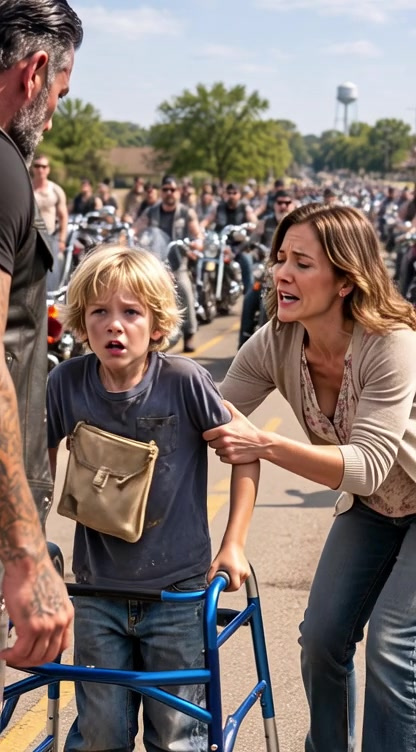
The boy stepped directly into the road, and I had less than three seconds to decide whether to stop thirty-seven motorcycles or risk running over an eleven-year-old child. I raised my fist. Thirty-seven engines roared down into silence, one after another, until the only sounds remaining were the ticking of cooling exhaust pipes and the distant honking of a car behind us.
The boy stood in the middle of Ashland’s main road, gripping a blue walker with both hands. His jeans were too loose around his thin legs. His blond hair fell across his forehead, and his face had the pale, exhausted look of someone who had spent too much time in hospital waiting rooms.
A woman hurried toward him from the sidewalk.
“Eli! Sweetheart, please!”
She looked terrified. I understood why. I was six-foot-five, weighed close to 270 pounds, and had enough tattoos covering my arms to make strangers cross the street rather than walk past me. My black leather vest carried the Iron Saints insignia, and the men behind me weren’t exactly dressed for a children’s birthday party.
Within seconds, phones appeared. People gathered along the pavement. A man stepped out of a hardware store, already filming. Two women whispered to each other while watching the frightened-looking boy standing in front of a wall of motorcycles. From where they stood, it probably looked like a child had wandered into trouble.
They couldn’t have been more wrong. I took one careful step toward him.
“Hey, buddy. Let’s get you somewhere safe, all right?”
He tightened his grip on the walker. His mother reached him and extended one hand.
“Come with me, sweetheart.”
He pulled away.
“No.”
“Eli, please.”
“No, Mom.”
His voice trembled, but there was something unusually firm beneath the fear. I lowered myself slightly, keeping my hands visible.
“Nobody’s going to hurt you. We just need to get you out of the road.”
He looked straight at me.
“Please step back.”
I stopped.
“Okay. I’ll stay right here.”
He shook his head.
“Not you.”
I frowned.
“What do you mean?”
“You stay right here.”
He pointed toward the space between my boots and his walker. Then he looked past me at the rows of motorcycles.
“All of them.”
I glanced over my shoulder. Doyle Rusk, my vice president and closest friend for nearly two decades, was already taking off his sunglasses.
“What is this?” he muttered.
I turned back toward the boy.
“What’s your name?”
“Eli.”
“I’m Gabriel.”
“I know.”
That answer caught me off guard. His mother covered her mouth briefly, then lowered her hand.
“Eli, honey, we didn’t come here to frighten anyone.”
I looked at her.
“Ma’am, nobody’s frightened of you. We just want to understand what’s happening.”
She nodded, but her eyes remained fixed on her son. Eli shifted his weight against the walker. His fingers were trembling. Then he looked at the pavement.
“Three feet.”
I glanced down.
“What?”
“That’s how far you need to stay from me.”
I took half a step backward.
“All right. Three feet.”
He watched me carefully, as though checking whether I intended to keep my promise. Behind me, one of the riders switched off his engine completely. The others followed. The street became strangely quiet. Then Eli whispered something.
“Fourteen.”
I leaned forward slightly.
“Sorry, buddy. What was that?”
He repeated it.
“Fourteen.”
His mother made a small sound. It wasn’t quite a gasp. It was something closer to the noise a person makes when an old wound is suddenly touched. Her hand flew to her mouth. For several seconds, she didn’t move.
I looked between them.
“Ma’am?”
She shook her head.
“Please,” she whispered. “Don’t make him do this here.”
Eli’s eyes filled with tears.
“I’m not making anybody do anything.”
He looked back at me.
“I just need them to stay.”
I studied him. He wasn’t asking for money. He wasn’t looking for attention. He wasn’t even asking us to help him cross the road. He wanted witnesses. And whatever he intended to tell us, he wanted every single rider to hear it.
I turned toward my men.
“Nobody moves.”
Doyle stepped forward.
“Gabriel, come on. We’ve got a memorial schedule to keep. We can’t block the entire road because a kid decided to—”
“Enough.”
He stopped. I turned back to Eli.
“All right. You’ve got our attention.”
The boy nodded. Then, with surprising determination, he moved his blue walker toward the sidewalk. His mother hurried to help, but he shook his head again.
“I can do it.”
She walked beside him without touching him. I followed at a distance. Behind us, thirty-seven motorcycles remained lined up along the road. And every single one of their riders was watching. The nearby diner had a large parking lot, so we moved there once Eli had safely reached the pavement.
A few people followed us. Others stayed near the road, disappointed that the spectacle hadn’t turned into the confrontation they’d expected. I parked my motorcycle near the entrance and removed my helmet. Doyle pulled alongside me.
“What’s the plan?”
“Let the boy talk.”
“He’s a child.”
“Exactly.”
Doyle gave me a hard look.
“Gabriel, we’ve got people waiting for us at the memorial gathering. The whole ride is running late.”
“I know.”
“Then let’s get moving.”
I glanced toward Eli. He was standing beside a concrete planter, both hands resting on his walker. His mother had crouched in front of him, speaking quietly. He shook his head. She tried again. He shook it harder. Doyle followed my gaze.
“What’s he carrying?”
I looked at the boy. A small canvas pouch hung from a strap across his chest. It was faded brown, with a darkened metal clasp and frayed stitching near one corner.
“I don’t know.”
“Looks like some old junk.”
“Then why are you interested?”
He didn’t answer immediately. Instead, he walked toward the boy.
“Eli, isn’t it?”
The child looked up. Doyle forced a smile.
“I’m Doyle. I’ve been riding with Gabriel for a long time.”
“I know who you are.”
Doyle’s smile weakened.
“Well, that’s good. Listen, we’ve got a lot of people waiting. Why don’t you give your mother that little bag and let her take you somewhere comfortable?”
Eli immediately covered the pouch with one hand.
“No.”
“Nobody’s trying to take anything from you.”
“Then don’t ask for it.”
Doyle looked toward Mara.
“Maybe you should explain to him that this isn’t the place.”
Mara stood.
“I’ve tried.”
“Then try harder.”
I stepped between them.
“That’s enough, Doyle.”
He looked at me.
“What?”
“You heard the boy. Leave him alone.”
Doyle exhaled through his nose. I had known that expression for years. It was the face he made when a mechanic refused to admit he’d installed something backward, or when another rider challenged one of his decisions. But this wasn’t a workshop.
And Eli wasn’t one of our men. I crouched in front of the boy.
“Do you want some water?”
He nodded. I turned toward the diner entrance.
“Nina!”
A woman standing near the doorway raised her hand. She was in her forties, wearing a faded green cardigan and carrying a small stack of folded chairs.
“Coming!”
She hurried over. I recognized her from previous Ashland memorial gatherings.
“Nina, could you get some water for Eli?”
“Of course.”
She disappeared inside. Mara looked at me.
“Thank you.”
I nodded.
“What’s going on here?”
She glanced toward the boy.
“I wish I could explain.”
“Then start wherever you can.”
Her eyes moved to Doyle. He was standing several feet away, pretending to inspect one of the motorcycles.
“I don’t think this is the time.”
I lowered my voice.
“Your son stopped thirty-seven motorcycles in the middle of a road. I’d say the time has already arrived.”
She almost smiled. Almost. Then Eli spoke.
“Mom, tell him.”
She closed her eyes.
“Eli…”
“Tell him who I am.”
I turned toward the boy. He looked directly at me.
“My last name is Mercer.”
The name struck somewhere deep in my memory. I stared at him.
“Mercer?”
He nodded.
“My dad was Jonah Mercer.”
For a moment, the parking lot seemed to tilt. Jonah. I hadn’t heard that name spoken aloud in this way for years. He had been one of the original Iron Saints. A good rider, a generous friend, and one of the few men who could tell me I was being an idiot without starting a fight.
He had laughed loudly, worked harder than everyone else, and always carried spare tools for strangers stranded along the road. I’d known him long before the accident. Long before the empty chair at our gatherings. I looked at Mara again.
“You’re Jonah’s family?”
She nodded.
“I’m Mara. His sister.”
I looked back at Eli.
“You’re Jonah’s boy?”
“Yes.”
My throat tightened. I hadn’t expected this. I’d seen Jonah’s family at a distance over the years, but time had passed, people had moved, and life had a way of separating people who once believed they’d always be together. I looked at the boy’s legs.
The braces were visible beneath the loose denim when he shifted his weight. I swallowed.
“How old are you, son?”
“Eleven.”
“Eleven…”
He nodded. I didn’t know what else to say. Doyle suddenly moved closer.
“All right, that’s enough. We need to get this wrapped up.”
I turned.
“Not yet.”
“Gabriel, the boy’s identified himself. You’ve heard the family connection. We can take care of whatever they need later.”
“Later?”
“Yes. Later.”
Mara looked at him sharply.
“He needs to speak now.”
Doyle’s jaw tightened.
“Nobody’s stopping him.”
“Then stop trying to move him.”
The words came from Mara, and they landed harder than I expected. Doyle looked at her.
“Excuse me?”
“You heard me.”
For a few seconds, neither spoke. Nina returned with a bottle of water. She handed it to Eli, who took a small drink before placing it in the holder attached to his walker. Then she looked at Mara.
“Are you all right?”
Mara nodded, although her face suggested otherwise. I moved closer to her.
“How long has he been asking to see us?”
She didn’t answer. Instead, she watched Eli.
“Long enough.”
I glanced at the canvas pouch.
“What is that he’s carrying?”
Mara’s shoulders stiffened.
“Something that belongs to him.”
Doyle gave a short laugh.
“Looks like something that belongs in a rubbish bin.”
Eli’s hand immediately closed around the strap.
“Don’t.”
Doyle raised both palms.
“Easy, kid.”
“Don’t talk about it.”
I watched Doyle’s expression. He wasn’t angry in the usual way. There was something else in his face, something difficult to identify. His eyes kept returning to the pouch. I noticed it. So did Eli. The boy shifted his walker slightly, putting his body between Doyle and the bag.
Doyle looked away. I turned toward Mara.
“Does he need medical assistance?”
“No.”
“Are you sure?”
“I’m sure.”
“Then what does he need?”
She looked at me for a long moment.
“To be heard.”
I nodded.
“All right.”
I turned toward the other riders.
“Everybody stays.”
A few men exchanged glances. One of them, standing beside a touring motorcycle, nodded. Another removed his helmet and sat on the curb. Doyle shook his head.
“This is ridiculous.”
I faced him.
“You’re welcome to disagree.”
“We’ve got a responsibility to the club.”
“And I’ve got a responsibility to the people standing in front of me.”
He stared at me. I kept my voice level.
“We’re not leaving until this boy has had his say.”
For once, Doyle didn’t have an immediate answer. The Ashland community center was only a short distance away. Nina suggested we use its courtyard rather than keep everyone standing in the diner parking lot. Mara agreed, provided Eli could walk there at his own pace.
So we went. I walked beside him, keeping the distance he’d requested. The other riders followed behind us. Their boots made a steady rhythm against the pavement. At the community center, Nina unlocked the courtyard gate and moved several chairs beneath the shade of a large tree.
The afternoon sun fell across the concrete. Eli stopped near the middle of the courtyard. He looked around at the riders. Then he looked at me.
“All of them came?”
I glanced behind me. Every man was there.
“Every one.”
He nodded. Mara pulled a chair closer.
“Sweetheart, sit down for a minute.”
“In a minute.”
“Your legs are tired.”
“I know.”
“Then please.”
He considered her request before finally lowering himself into the chair. I noticed the way he carefully positioned his legs. It wasn’t a movement he had learned recently. It was practiced, precise, and familiar. Mara sat beside him. I remained standing.
Doyle positioned himself near the gate, arms folded across his chest. Rex Holloway stood a few feet behind him. Rex was the oldest active member of our club. Sixty-two years old, with a weathered face and hands permanently stained from decades of motorcycle work.
He hadn’t said much since we’d stopped. Now he watched Eli with an expression I couldn’t quite read. I looked at the boy.
“You said your father was Jonah.”
“Yes.”
“I knew him.”
“I know.”
“He was a good man.”
Eli looked down at his hands.
“He liked you.”
The words caught me off guard. I pulled out the chair opposite him and sat.
“Did he?”
“He said you were stubborn.”
A few riders chuckled. I smiled despite myself.
“That sounds about right.”
“He said you always tried to fix things.”
I looked at the ground.
“Sometimes I did.”
Eli studied my face.
“Did you know him before he got hurt?”
I nodded slowly.
“Yes.”
“Did you see what happened?”
The courtyard went quiet. I glanced toward Mara. She was watching me carefully. I looked back at Eli.
“I was there afterward.”
“Afterward?”
“Yes.”
He nodded, absorbing the answer.
“Do you remember the road?”
I felt a tightening in my chest. There were some roads a man never forgot. Some stretches of asphalt stayed in his head long after the engine stopped and the years moved on.
“Yes,” I said.
“Do you remember the bend?”
I stared at him.
“What bend?”
“The one before the old fence. Where the road gets narrow.”
I didn’t answer immediately. I remembered the stretch he was describing. A country road outside Ashland. A bend. An old fence. And a day in September 2012 that I had spent years wishing I could undo.
“Yes,” I finally said.
Eli nodded.
“That’s where it happened.”
I looked at Mara. Her face had gone pale again.
“How do you know that?” I asked.
He shrugged.
“My dad told me.”
Doyle shifted near the gate.
“Can we get to the point?”
I turned toward him.
“You’re welcome to sit down, Doyle.”
“I’m fine.”
Eli looked at him. Then he turned back to me.
“I need you to understand something.”
“Go ahead.”
“I didn’t stop you because I needed help crossing the road.”
I waited.
“I stopped you because I needed you to listen.”
I nodded.
“I’m listening.”
He placed both hands on the canvas pouch. Mara’s fingers tightened around the edge of her chair. I noticed. So did he.
“Mom?”
She looked at him.
“Yes?”
“Can I?”
She swallowed. For a moment, I thought she might refuse. Then she slowly nodded. Eli lifted the pouch into his lap. His fingers worked at the old metal clasp. Doyle took one step forward.
“Kid, don’t—”
“Stay back,” I said.
Doyle stopped. Eli looked down at the bag. He opened it only a few inches. Something metallic caught the afternoon light. A small emblem. Old. Worn. Silver-colored, with darkened edges and a familiar shape. I leaned forward. I knew that insignia.
I’d seen it on old club photographs, leather vests, and the motorcycles belonging to the men who had built the Iron Saints before the rest of us joined. It was the original Iron Saints motorcycle emblem. Eli held it carefully between his fingers.
Mara pressed her lips together. Rex stopped moving. And Doyle Rusk, the man who had stood beside me through funerals, breakdowns, hospital visits, and fourteen years of brotherhood, suddenly looked as though someone had pulled the ground out from beneath him.
He stared at the little metal emblem. Then his eyes snapped toward Eli.
“Where did you get that?”
“Give it back.”
Doyle’s voice cut across the community center courtyard. Eli’s fingers closed around the small metal emblem. He pulled the canvas pouch against his chest and looked up at the man standing in front of him.
“No.”
Doyle took another step.
“That doesn’t belong to you.”
Mara immediately rose from her chair.
“Don’t come any closer.”
Doyle ignored her. His eyes remained fixed on the pouch.
“Kid, you don’t understand what you’re holding.”
Eli’s chin lifted.
“Then tell me.”
For a moment, Doyle said nothing. Thirty-six riders stood behind me, watching. Nina had stopped arranging the chairs. Rex remained near the courtyard gate, his hands hanging at his sides. I looked at the emblem again. It was unmistakably an old Iron Saints insignia. Not one of the newer designs we’d used during the past decade, but the original symbol worn by the first members.
I’d seen it on Jonah’s vest. I’d seen it in photographs from the club’s early days. And now an eleven-year-old boy had produced one from a canvas pouch, making a grown man who had faced more roadside confrontations than I could count look like he’d just seen something buried in his past.
“Doyle,” I said, “step back.”
He turned toward me.
“Gabriel, this is club property.”
“Then explain why you’re demanding it from a child.”
“Because he shouldn’t have it.”
Eli looked down at the emblem.
“My dad gave it to me.”
Doyle’s jaw tightened.
“Your father shouldn’t have kept it.”
Mara moved between them.
“That’s enough.”
Doyle pointed at the pouch.
“Do you have any idea what that thing means?”
“Apparently, you do,” I said.
He looked at me sharply. I stood.
“Now, why don’t you tell us?”
He glanced toward the riders.
“Not here.”
“Why not?”
“Because this isn’t a club meeting.”
I looked around the courtyard.
“Thirty-seven motorcycles are parked outside. Every rider came here because this boy asked us to stay. If you have something to say about that emblem, this is exactly where you should say it.”
Doyle gave a humorless laugh.
“You’ve lost your judgment.”
“Maybe. But I’m still the one leading this ride.”
He stepped closer.
“I’ve been your vice president for years. I’ve stood beside you through everything. You don’t get to order me around because a kid showed up with an old piece of metal.”
I looked him directly in the eyes.
“Step away from Eli, Doyle. Now.”
Nobody moved. Doyle stared at me as if he expected me to take the words back. I didn’t. Finally, he stepped backward. It was only one step, but every rider in that courtyard saw it. Rex lowered his eyes. Nina moved closer to Mara.
Eli looked at me, then carefully returned the emblem to his pouch. Doyle pointed toward the gate.
“We’re leaving.”
I shook my head.
“No.”
“Gabriel—”
“You’re not taking the club anywhere until we understand what’s happening.”
He turned toward the other riders.
“Anybody who thinks we’ve got better things to do than stand around listening to a child should get on his bike.”
Nobody moved. One of the older riders folded his arms. Another shook his head. Doyle looked around, searching for someone willing to support him. He found no one. For the first time since I’d known him, his position in the club didn’t seem to carry the weight he expected.
He looked at Eli again. Then he walked toward the gate without another word. I waited until Doyle was out of earshot before turning toward Mara. She was sitting beside Eli again, adjusting the strap of his canvas pouch.
“Can we talk?”
She looked up.
“About what?”
“About Jonah.”
Her hands stopped. Eli watched us. I lowered my voice.
“Just for a minute.”
Mara glanced at her son.
“Not in front of him.”
“He’s the reason we’re all standing here.”
“He’s also eleven years old.”
“I know that.”
“Then stop treating him like he’s an adult who can carry every ugly thing the grown-ups failed to deal with.”
I looked at Eli. He was staring at the pavement, his fingers moving slowly over the edge of the pouch. I nodded toward a bench several feet away.
“All right. Over there.”
Mara stood. Before following me, she bent toward Eli.
“Stay with Nina, sweetheart.”
“I will.”
“And don’t try to stand up without your walker.”
“I know, Mom.”
She touched his shoulder and followed me. We stopped beside the courtyard wall. For a few seconds, neither of us spoke. Then I asked the question that had been pressing against my ribs since he’d told me his father’s name.
“Why didn’t you tell me?”
Mara folded her arms.
“Tell you what?”
“That Jonah had a son.”
“I didn’t think it was my place.”
“Your brother was my friend.”
“I know.”
“I rode with him.”
“I know that too.”
I looked toward Eli.
“He’s eleven, Mara. Eleven. I knew Jonah was gone, but I didn’t know he had a boy growing up without him.”
Her expression tightened.
“He didn’t grow up without him. He grew up with stories about him.”
“That’s not the same.”
“No,” she said. “It isn’t.”
Her voice softened.
“Jonah talked about you.”
I looked at her.
“What did he say?”
“That you were stubborn. That you were loyal. That you could fix almost anything if someone gave you enough time and a wrench.”
I almost smiled.
“That sounds like Jonah.”
“It does.”
She looked toward Eli again.
“But there were things he didn’t want Eli carrying.”
I leaned against the wall.
“Like what happened on that road?”
Mara’s face changed.
“Don’t.”
“What?”
“Don’t start doing that.”
“Doing what?”
“Taking everything that happened and putting it on your shoulders.”
I stared at her. She shook her head.
“You’ve been doing it for years, haven’t you?”
I didn’t answer.
“Gabriel, I was there when Jonah’s life changed. I saw what happened afterward. I watched him struggle through the months that followed. I watched him try to be a father while his body kept reminding him of that road.”
My throat tightened.
“I should have—”
“No.”
“I could have done something.”
“You don’t even remember everything clearly.”
The words stopped me. She continued, more quietly.
“You’ve spent years apologizing for something you cannot properly describe. You talk about that day as though every detail is carved into your memory, but when I ask you what happened, you tell me pieces. You remember arriving. You remember the wreckage. You remember Jonah being hurt.”
I looked down at my hands. She was right. My memories were broken pieces. A motorcycle on its side. The smell of gasoline. A man shouting. A child crying. Jonah’s face. And the awful certainty that I’d somehow failed them.
But the exact sequence of events had always been difficult to reconstruct. I rubbed my thumb against an old scar on my palm.
“I should have stayed closer to him.”
Mara’s eyes hardened.
“Stop.”
“Mara—”
“Don’t apologize for the accident.”
I looked at her. She stepped closer.
“You keep trying to make yourself responsible for something you don’t remember clearly. I won’t let you do that in front of my son.”
I swallowed.
“What am I supposed to tell him?”
“The truth.”
“Which truth?”
“That you knew his father. That you cared about him. That you’re standing here now.”
She glanced at Eli.
“That’s enough for today.”
I wanted to argue. Instead, I looked toward the boy. He was speaking quietly with Nina. His walker stood beside him, and the canvas pouch rested against his stomach. He looked small beneath the tree. Too small for the weight of whatever had brought him here.
“Does he know everything?” I asked.
Mara shook her head.
“He knows enough to ask questions.”
“About the emblem?”
“About his father.”
“Why is Doyle so interested in it?”
She looked away.
“I can’t answer that for you.”
“Can you answer anything?”
She hesitated.
Then she said, “You need to talk to Rex.”
I turned toward the courtyard gate. Rex was still standing there, watching Doyle’s motorcycle.
“Why Rex?”
“Because he was there.”
The words came quietly. I stared at her.
“At the accident?”
She nodded.
“Rex was there.”
I looked back at her.
“Why didn’t you tell me that before?”
“Because I wasn’t ready to have this conversation fourteen years ago. And because I wasn’t ready to have it today until Eli decided he was.”
She started walking toward her son. I stayed beside the wall for another moment. Then I followed. The riders eventually moved to the Ashland diner. We needed somewhere to sit, and Nina offered to stay with Mara and Eli at the community center while I spoke with Rex.
Doyle had gone outside before us. I saw him beside his motorcycle, speaking to nobody. When he noticed me, he turned away. I didn’t follow him. Not yet. Inside the diner, the afternoon light came through the windows in long strips, falling across the empty booths.
Rex sat near the back. His helmet rested on the seat beside him. I slid into the booth opposite him. He looked at me.
“What?”
“Mara said you were there.”
He didn’t move.
“Where?”
“The road.”
Rex stared at the tabletop. I waited. Finally, he picked up his coffee.
“That was a long time ago.”
“September 2012.”
His hand stopped halfway to his mouth. I watched him carefully.
“Do you remember the accident?”
He set the cup down.
“I remember a lot of things.”
“Then tell me what happened.”
He shook his head.
“Not here.”
“Why?”
“Because there are things you don’t discuss in a diner.”
I looked around. The diner was quiet.
“There’s nobody here except us.”
“That doesn’t matter.”
I leaned forward.
“Rex, a boy came into the road today and stopped thirty-seven motorcycles because he wants us to hear something about his father. Doyle nearly lost his mind when he saw what was in that pouch.”
Rex’s eyes moved toward me.
“What was in it?”
“An old Iron Saints emblem.”
He looked down again.
“Where did he get that?”
“Jonah gave it to him.”
Rex rubbed his jaw. For a moment, he looked much older than sixty-two.
“Jonah had a lot of things.”
“Not like this.”
“No.”
I waited. He said nothing else. I tapped my fingers against the table.
“Do you remember the fourteen?”
Rex’s coffee cup clicked against the saucer. It was a small sound. But I saw his hand tighten around the handle. He looked at me.
“What fourteen?”
“The boy said it on the road.”
Rex didn’t respond.
“His mother nearly collapsed when she heard it.”
Rex stared at the window. I leaned closer.
“Does it mean something to you?”
He rubbed his thumb against the side of the cup.
“I don’t know what you’re talking about.”
“You just reacted.”
“You’re imagining things.”
“Rex.”
He looked at me. There was something in his eyes I hadn’t seen before. Not confusion. Not surprise. Something closer to dread. I lowered my voice.
“Tell me what you remember.”
He pushed the coffee away.
“I remember Jonah.”
“That’s a start.”
“He was a good man.”
“I know.”
“He loved that boy.”
“I know that too.”
Rex looked down.
“Then don’t drag him through this again.”
I felt my jaw tighten.
“Nobody is dragging Jonah anywhere. His son came looking for us.”
Rex’s expression changed. For a brief moment, I thought he might finally speak. Instead, he leaned back.
“Some things are better left alone.”
I stared at him.
“That’s what Doyle said.”
Rex’s eyes flicked toward mine.
“Did he?”
“Almost exactly.”
He looked away. I let the silence stretch.
Then I asked, “Were you riding behind Jonah that day?”
Rex didn’t answer.
“Were you?”
He nodded once.
“Yes.”
“And Doyle?”
Another pause.
“Yes.”
“What about me?”
Rex’s face tightened.
“You were there.”
“Then you remember more than you’re telling me.”
He stood abruptly.
“I’ve got to go.”
“Rex.”
He reached for his helmet. I stayed seated. He stopped beside the booth.
“Listen to me, Gabriel. Whatever happens with that boy, don’t let it turn into a reason to destroy everything we’ve built.”
I looked up at him.
“What if what we’ve built was already broken?”
Rex’s mouth opened. Then closed. He picked up his helmet.
“I’ll talk to you tomorrow.”
I stood.
“Tomorrow when?”
He hesitated.
“Morning. Before the memorial gathering.”
“Where?”
“Here. The diner.”
I held his gaze.
“Just us?”
He nodded.
“Just us.”
I wanted to press him further, but something in his expression told me he was already fighting a battle I couldn’t see.
“All right,” I said.
He left. I remained in the booth, staring at the coffee he’d barely touched. By the time I returned to the community center, the light had begun to fade. The riders were gathered in the courtyard. Nina was helping Eli adjust the position of his walker. Mara stood nearby, watching him carefully.
Doyle was beside the gate. He looked at me as soon as I entered.
“Where have you been?”
“Talking to Rex.”
His eyes narrowed.
“About what?”
“Jonah.”
Doyle gave a short laugh.
“Of course.”
I walked past him. He followed.
“Gabriel, we need to get the men moving. The memorial gathering is waiting, and we’re already behind schedule.”
“We’ll get there.”
“Then let’s go.”
I stopped.
“Rex and I are meeting here tomorrow morning.”
Doyle went still. I turned toward him.
“Before the gathering.”
His expression hardened.
“Why?”
“Because he was there when Jonah crashed.”
Doyle glanced toward the courtyard. Rex was standing near the motorcycles. For a moment, their eyes met. Then Rex looked away. Doyle turned back to me.
“Whatever Rex thinks he remembers, it doesn’t change anything.”
“Then you shouldn’t have a problem with him talking.”
His jaw worked.
“You’re making a mistake.”
“Maybe.”
“You’ve got a club to lead.”
“I know.”
“Then act like it.”
I looked at the men gathered behind him. Some had ridden with us for decades. Others were newer members who had joined because they believed the Iron Saints stood for something more than motorcycles and leather. They were watching us now.
Waiting. Doyle lowered his voice.
“I’m telling you, we need to leave Ashland. Today. Before this gets any worse.”
I studied his face.
“Why?”
“Because this has gone far enough.”
“For whom?”
He didn’t answer. Instead, he turned toward the other riders.
“I’m done with this. Anybody who wants to keep wasting time can explain it to the people waiting for us.”
He reached for his helmet. I stepped into his path.
“You’re not giving orders right now.”
He stopped. The courtyard fell silent. Doyle stared at me.
“I’ve been your vice president for years.”
“And I’ve trusted you for years.”
“Then trust me now.”
I shook my head.
“Not until I know what happened to Jonah.”
His face hardened.
“You want to tear this club apart over an eleven-year-old boy and an old piece of metal?”
I glanced toward Eli. He was watching us from beside his mother. His fingers rested on the blue walker. Then I looked back at Doyle.
“No. I want to know why you’re afraid of letting him speak.”
Doyle’s mouth tightened. He looked around at the riders.
“Fine.”
He lifted his helmet.
“I’m leaving. If you want to follow me, get your bikes.”
Nobody moved. He waited. Still nobody moved. Then he looked directly at me.
“You’re choosing this over me?”
I didn’t answer. He shook his head and walked toward the gate. His motorcycle engine started outside. A few seconds later, the sound faded down the street. Rex stood motionless near the parking area. Mara watched me from beside Eli.
I looked at the riders. Thirty-seven men had started that morning wearing the same colors. Now they stood in a courtyard divided by a question nobody wanted to answer. I reached behind my neck and released the clasp of my leather vest.
The old Iron Saints insignia caught the fading light. I pulled the vest from my shoulders, folded it once, and placed it on the table beside Nina’s chairs. Then I faced the men.
“I won’t wear these colors again until we hear what happened to Jonah.”
Nobody touched my vest. It remained folded on the table in the community center courtyard while the other riders stood around it, uncertain whether to leave it there or pretend they hadn’t heard what I’d said. Rex was the first to move.
He walked toward the parking area without looking at me.
“Tomorrow morning,” I called after him.
He stopped beside his motorcycle.
“I said I’d meet you.”
“Then we’re meeting now.”
Rex turned slowly. His weathered face tightened.
“Not here.”
“Where?”
He glanced toward Eli and Mara.
“The old country road.”
Mara looked up immediately.
“No.”
I turned toward her.
“Why not?”
“Because I don’t want him standing out there for hours.”
Eli straightened in his chair.
“I can go.”
“Sweetheart—”
“I can.”
His mother looked at his walker, then at the pouch resting against his stomach. I understood her hesitation. The boy had already pushed himself through a confrontation that would have exhausted most adults. But he wasn’t asking to be carried.
He was asking to be included.
“We won’t make him walk farther than he wants,” I said. “We’ll take our time.”
Mara looked at me.
“And if he gets tired?”
“We stop.”
Eli nodded. Rex put his helmet on the motorcycle seat.
“Then let’s go before I change my mind.”
The country road outside Ashland looked smaller than I remembered. Fourteen years had passed since I’d last stood there with the crash still fresh in my mind. The old fence remained, its wooden posts weathered by rain and summer heat. Beyond it, the fields stretched toward a line of trees.
The road curved gently before narrowing near the fence. I parked on the shoulder. Mara helped Eli out of the vehicle, then positioned his blue walker on the gravel. Rex stood several feet away, staring at the bend. I approached him.
“All right. We’re here.”
He nodded without looking at me.
“Where did it happen?”
He pointed vaguely toward the road.
“Somewhere around here.”
I stared at him.
“Somewhere?”
“Gabriel, it’s been fourteen years.”
“That doesn’t mean you forgot.”
He rubbed his forehead. Mara remained beside Eli. The boy was studying the pavement. His gaze moved from the white road markings to the edge of the gravel shoulder, then toward the old fence. I noticed his expression change. He moved forward.
“Eli,” Mara said, “take it slowly.”
“I know.”
He pushed the walker a few feet. Then he stopped.
“Here.”
I looked down.
“What?”
“Right here.”
He pointed toward a narrow stretch of pavement just before the bend. Rex’s head turned. Eli moved the walker slightly to the left.
“No. Not there.”
He repositioned it.
“Here. Where the road gets narrower.”
I stared at the spot. It was precise. Not a general location. Not a child’s guess about where something might have happened. He had selected a particular section of asphalt, barely wide enough for two motorcycles to pass comfortably. I looked at him.
“How do you know?”
“My dad told me.”
“You said that yesterday.”
“He showed me.”
Mara closed her eyes briefly. I crouched beside the boy.
“Showed you how?”
“He brought me here.”
“When?”
“Before he died.”
I looked toward Mara. She nodded reluctantly.
“He brought Eli here once. I was with them.”
Eli pointed again.
“Dad said he was riding here when everything happened.”
I studied the road. The old fence. The bend. The narrow shoulder. For a moment, something shifted in my memory. I remembered the sound of tires. A sharp metallic impact. Then the terrible silence that followed. But I couldn’t place the exact position of the motorcycles.
I stood.
“Rex, where were you?”
He looked toward the fence.
“Behind Jonah.”
“And Doyle?”
“Near him.”
“Near him where?”
Rex shook his head.
“I don’t remember the exact positions.”
I took a step closer.
“You were riding with them.”
“I know.”
“Then tell me what you remember.”
He looked at Eli.
“Not in front of the boy.”
Eli’s fingers tightened around the walker.
“I want to hear.”
Mara touched his shoulder.
“Sweetheart, you don’t have to.”
“Yes, I do.”
Rex looked away. I felt the old frustration rising.
“Nobody’s asking you to describe every second. Just tell us what happened before the crash.”
Rex stared down the road.
“Jonah and Doyle argued.”
“About what?”
“Riding.”
“What about riding?”
Rex exhaled.
“Doyle had been pushing too hard. He liked speed. He liked showing people he could handle a motorcycle better than anyone else.”
I glanced at him.
“Jonah didn’t like that.”
“No. Jonah believed you could ride fast without putting everybody else in danger.”
Rex kicked a small stone from the edge of the shoulder.
“They’d argued about it before.”
“That day too?”
He nodded.
“What did Jonah say?”
Rex was quiet for several seconds. Then he spoke.
“He told Doyle to stop riding like he owned the road.”
I looked at the narrow stretch of pavement.
“And Doyle?”
“He didn’t take it well.”
Mara’s hand settled on Eli’s shoulder.
“Did they stop?”
“No.”
“Did they keep arguing while they rode?”
Rex nodded.
“Yes.”
I waited for him to continue. He didn’t.
“That’s all?”
“That’s what I remember.”
I stared at him.
“You’re leaving something out.”
His face hardened.
“Don’t start accusing me of things you can’t prove.”
“I’m asking you what happened.”
“And I’m telling you.”
He turned away. I looked toward Eli. The boy was still studying the road. His walker stood perfectly still.
“Rex,” I said, “look at him.”
Rex didn’t turn.
“Look at the boy who came all this way because he wants to know what happened to his father.”
Rex finally looked. Eli’s eyes were wet. But he wasn’t crying. He was waiting. Rex swallowed.
“I remember the argument,” he said. “I remember the motorcycles. I remember the crash.”
“What happened immediately before it?”
Rex’s jaw tightened.
“I need to go.”
He started toward his motorcycle. I didn’t follow. Not yet. Because I’d seen his hand. It was shaking. The roadside workshop stood a short distance from the main road. It was a familiar place to the older riders, a small repair building where we had stopped occasionally over the years to check tires, adjust chains, or fix minor mechanical problems.
The workshop was quiet when we arrived. Rex stood near the entrance, refusing to sit. I leaned against the side of my motorcycle while Mara helped Eli settle onto a bench. His walker rested against the wall. The canvas pouch remained across his chest.
Rex looked at me.
“You wanted to know about the argument.”
“Yes.”
He rubbed his palms together.
“Jonah was angry with Doyle.”
“Why?”
“Because Doyle kept taking unnecessary risks.”
“That’s not unusual. Half the men in our club have been accused of that.”
“This was different.”
I straightened.
“How?”
Rex looked toward the boy. Eli was listening. Mara noticed and moved closer to him.
“Maybe we should talk without him,” she said.
Eli immediately shook his head.
“No.”
Rex sighed.
“Let him hear it.”
Mara looked uncertain. I nodded.
“He deserves to know what people remember.”
Rex leaned against the workshop wall.
“Jonah had been warning Doyle for weeks. He told him that riding recklessly wasn’t bravery. It was selfish.”
I remembered Jonah’s voice. The way he would laugh after making a point, even when the other person wasn’t laughing.
“What did Doyle say?”
Rex hesitated.
“He told Jonah to mind his own business.”
“And Jonah?”
“He said he wouldn’t watch someone get hurt just because that person couldn’t admit he was wrong.”
The workshop seemed quieter. I looked at Rex.
“Was that the last argument?”
“No.”
He rubbed the back of his neck.
“They exchanged a few more words before the road narrowed.”
“What words?”
“I don’t remember.”
“You remember the argument, but not what they said?”
Rex’s expression hardened.
“I was riding behind them, Gabriel. I wasn’t standing between them taking notes.”
I stepped away from the motorcycle.
“Nobody asked you to.”
“Then stop treating me like I’m hiding something.”
I looked directly at him.
“Are you?”
He didn’t answer. Mara stood.
“That’s enough.”
I turned toward her.
“He’s the one who agreed to talk.”
“And he’s talking.”
“Not about what happened.”
“Maybe because he isn’t ready.”
I stared at her. She looked back without flinching.
“You’re not the only person who has carried this, Gabriel.”
Her voice softened.
“I lost my brother. Eli lost his father. Rex lost someone he rode beside for years. You don’t get to decide how quickly everyone else has to speak.”
I looked at Eli. The boy had lowered his head. His fingers were moving over the pouch strap. I took a breath.
“All right.”
Rex looked relieved. Then he spoke again.
“Jonah was trying to protect people.”
I turned.
“What?”
“That’s what I remember most. He wasn’t interested in proving he was the better rider. He wanted everyone to get home.”
He paused.
“Doyle thought Jonah was challenging him.”
“And you?”
Rex looked at me.
“I thought they’d settle it between themselves.”
He looked away.
“That’s what I thought.”
I waited. But he had finished. Outside, a motorcycle engine sounded in the distance. I glanced toward the entrance. For one brief moment, I wondered whether Doyle had returned. Rex noticed my movement.
“He’s not here.”
“How do you know?”
“Because I know his motorcycle.”
I studied him. Rex picked up his helmet.
“We’ve said enough for today.”
“Not nearly enough.”
He walked toward the door. I let him go. I could feel something approaching, but I still couldn’t see its shape. By late afternoon, we were back at the community center. Nina had arranged the chairs beneath the tree again. The courtyard was quieter now, with the riders gathered in smaller groups.
My vest remained on the table. I hadn’t touched it. Eli was sitting with his mother, drinking water from a bottle. His legs were stretched carefully in front of him. I approached.
“How are you doing?”
“Tired.”
“Then we can stop for today.”
He shook his head.
“Not yet.”
Mara looked at me.
“He has something he wants to tell you.”
I pulled a chair closer.
“All right.”
Eli adjusted the canvas pouch.
“My dad used to count.”
I looked at him.
“Count what?”
“Seconds.”
I waited.
“Whenever he talked about the accident, he counted.”
Mara lowered her eyes. I looked between them.
“Why?”
Eli shrugged.
“He said counting helped him remember things properly.”
I leaned forward.
“What did he count?”
“The time after the motorcycles crashed.”
My chest tightened.
“How long?”
Eli looked at me.
“Fourteen seconds.”
I sat very still. He continued.
“Every time he told the story, he’d start counting. One, two, three…”
His fingers moved against the pouch.
“He said the road went quiet. Then he counted until someone came back.”
I glanced toward Rex. He stood near the far end of the courtyard. His head was lowered. I looked back at Eli.
“Someone came back?”
The boy nodded.
“After fourteen seconds.”
Mara closed her eyes. Eli continued.
“Dad always said those seconds felt longer than the whole day.”
I couldn’t speak. I looked at the boy’s face. He wasn’t repeating something he’d heard casually. He remembered the rhythm. The way his father had counted. The exact number. The particular detail that had made his mother cover her mouth in the street.
I turned toward Rex. He had gone completely still.
“Did you hear that?” I asked.
Rex nodded faintly. I stood. The riders nearby began turning toward us. I looked around the courtyard.
“Listen up.”
Conversations stopped.
“I’ve spent fourteen years believing I knew what happened to Jonah. I thought I understood my part in it. But today I’ve heard things that don’t fit what I’ve believed.”
Doyle wasn’t there. Rex was. Mara was. Eli was. And every rider who had remained was watching me. I pointed toward the road beyond the community center.
“Jonah was a member of this club. He was a father. He was a friend. And his boy shouldn’t have to stand in front of us asking for answers.”
I looked directly at Rex. Then at the others.
“I think Jonah may have been wronged by one of our own.”
Nobody spoke. Rex lowered his head. One of the riders shifted his weight. Another looked toward the empty space where Doyle usually stood. I turned back to Mara.
“How long has Eli been preparing for this?”
She hesitated. Then she sat beside her son.
“Months.”
I frowned.
“Months?”
She nodded.
“He’s been asking me about the old photographs, about the club, about the road. He wanted to know who rode with his father and where they might be today.”
I looked at Eli.
“You’ve been planning this?”
He didn’t answer immediately. Mara continued.
“He knew your memorial ride was coming through Ashland. He wanted to see the riders together. He wanted the people who knew his father to hear what happened from him.”
I stared at the boy. He had chosen the road. He had chosen the day. He had brought the old emblem. And he’d refused to let anyone move him away from the people he had come to face. I looked at the folded vest on the table.
For years, I’d imagined that one day I’d find the right words to apologize to Jonah’s family. I’d imagined sitting across from Mara, explaining how sorry I was that I hadn’t been able to protect her brother. I’d imagined helping Eli quietly, without making a spectacle of him or bringing the past into the open.
But there was no quiet apology that could answer the questions this boy was asking. There was no way to fix something by pretending I already understood it. I pulled my chair closer to Eli.
“Why didn’t you tell me sooner?”
He looked at me.
“Because I didn’t know if you’d come.”
That answer hurt more than I expected. I glanced at his mother. She gently touched his shoulder. Then Eli looked down at his hands.
“My dad used to say that people showed who they were when they had to choose between being comfortable and doing what was right.”
I nodded slowly.
“Sounds like Jonah.”
“He said you were stubborn.”
A faint smile touched my face.
“That sounds right too.”
Eli looked at my hands. His own fingers moved uncertainly against the edge of his chair. Then he reached across the space between us. His small hand closed around mine. I didn’t move. He looked up at me.
“My dad never blamed you. He was waiting for you to stop blaming yourself.”
The first thing Doyle did when he reached the Ashland memorial pavilion was point at my vest. It still lay on the community center table, where I had left it.
“Put that back on,” he said. “We’re leaving.”
The Iron Saints had gathered beneath the pavilion roof, their motorcycles lined along the gravel beyond it. Some riders stood with their helmets tucked beneath their arms. Others leaned against the wooden posts, watching Doyle approach. Nobody moved toward their bikes.
I stood beside the table. My hands were empty. My vest remained where I had put it.
“We’re not leaving,” I said.
Doyle stopped several feet away. His eyes moved across the riders before settling on me.
“You made your point yesterday.”
“No. Yesterday I told you we were staying.”
“You’re turning a memorial into a circus.”
“Then tell us what happened to Jonah.”
His jaw tightened. Behind me, Eli stood beside his blue walker. Mara was at his shoulder, one hand hovering near the handle without touching it. The canvas pouch hung against Eli’s chest. Doyle looked at the boy.
“Not here,” he said.
Eli’s fingers closed around the pouch.
“Why not here?”
“Because this isn’t something you understand.”
“I understand that you don’t want to talk about my dad.”
Doyle’s expression hardened. “Your mother should take you home.”
Mara stepped forward.
“Don’t tell me where to take my son.”
A few riders shifted. Doyle noticed. He always noticed when the room stopped moving with him. He turned back to me.
“Gabriel, this has gone far enough. You have a club full of men who followed you here. You have a boy repeating stories he barely understands. And you have Rex stirring up something he should have buried years ago.”
Rex stood near the pavilion’s outer post. His hands were clasped in front of him. His old riding jacket hung open, and his face looked gray beneath the morning light.
“Leave me out of this,” he said.
Doyle pointed at him. “Gladly.”
I looked at Rex.
“You said you would tell me.”
Rex didn’t answer.
Doyle gave a short, humorless laugh. “There. You see? Even he knows this is finished.”
“No,” I said. “I see a man who’s been carrying something for fourteen years.”
Rex’s eyes lifted to mine.
“Don’t make me do this in front of them.”
“Then you should have done it years ago.”
The words came out harder than I intended. Rex flinched, and I regretted the sharpness. But I couldn’t take them back. Eli’s walker made a small scraping sound as he adjusted his position.
“Rex,” he said.
The older man looked down at him.
“My dad counted,” Eli continued. “When he got nervous, he counted out loud. Mom told me that.”
Mara closed her eyes briefly.
“He counted when he was trying not to lose his temper,” she said quietly. “He counted when he was frightened, too.”
Eli nodded.
“He told me about the road. He told me someone came back after fourteen seconds.”
Rex’s mouth trembled. Doyle took a step toward the boy.
“That’s enough.”
I moved between them.
“Don’t.”
Doyle stared at me. “You’re protecting a story now?”
“I’m protecting the boy you’re trying to silence.”
“I am trying to stop this club from tearing itself apart.”
“Then tell the truth.”
For a moment, the only sound was the wind moving through the trees beyond the pavilion. Then Rex stepped away from the post.
“I saw it.”
His voice was so quiet that several riders leaned forward. Doyle turned sharply.
“Rex.”
“I saw the collision.”
“You saw a crash.”
“I saw what happened before it.”
Rex looked at me, then at Mara. Finally, his eyes settled on Eli.
“I was behind them on the road that day. Jonah was ahead. Doyle was riding beside him. They’d been arguing. Jonah had told him to stop riding like nobody else mattered.”
Doyle shook his head.
“That’s not what happened.”
Rex swallowed.
“Jonah pulled ahead. Doyle moved toward him. I thought he was going to crowd him, maybe frighten him into backing off. But he didn’t move away.”
Rex’s fingers tightened around each other.
“He swerved into Jonah’s motorcycle.”
Nobody spoke. The words seemed to remain in the air above us. I stared at Rex.
“On purpose?”
Rex nodded once.
“On purpose.”
Doyle stepped forward.
“You’re lying.”
Rex didn’t look at him.
“I saw Doyle’s motorcycle strike Jonah’s. I saw Jonah lose control. I saw the sidecar go over. I saw the boy on the road.”
Eli’s hand tightened around his walker. Mara moved closer to him, but he didn’t turn away. Rex’s voice broke.
“I stopped. I got off my bike. I saw what had happened. I knew what I’d seen.”
“Then why didn’t you help?” I asked.
Rex’s face crumpled.
“I was afraid.”
“Afraid of what?”
“Of Doyle. Of what he’d do. Of what the club would become if I told everyone one of our own had deliberately put another rider on the ground.”
He looked at the gravel.
“I stood there. I watched Doyle ride away from Jonah. I watched him keep going.”
My throat tightened.
“How long?”
Rex raised his eyes.
“Fourteen seconds.”
Eli made a small sound beside his mother. Rex continued, forcing the words out.
“Then Doyle turned around and came back. I went to help. By the time I reached Jonah, Doyle was already there. He was shouting, telling everyone he’d tried to avoid him. He said you had caused the collision.”
I felt the pavilion tilt beneath my boots. Rex shook his head.
“I knew that wasn’t true. I knew what I’d seen. But I kept quiet.”
The silence afterward was worse than shouting. Fourteen seconds. Not a number Eli had invented. Not a nervous habit his father had carried without reason. Fourteen seconds in which a man watched another man lie broken on the road and chose not to move.
I looked at Doyle.
“You told me I caused it.”
Doyle’s face had gone red.
“You were there. You saw the wreck. You were the one who couldn’t keep his bike under control.”
“I arrived after it happened.”
“You were confused.”
“I was injured.”
“You were blaming yourself before I said anything.”
“Because you told me I had done it!”
My voice struck the pavilion roof and came back at us. Doyle looked around at the riders.
“You all know what happened after that. Jonah survived the crash. Gabriel carried the guilt. The club stayed together. We kept riding.”
“Jonah never recovered from what you did,” Mara said.
Doyle turned toward her.
“I never wanted him dead.”
“You wanted to punish him,” she replied. “He challenged you, and you couldn’t stand being told you were wrong.”
“You don’t know what was happening between us.”
“I know my brother. I know what he was like when he came home after riding with you. I know how long he lived with those injuries.”
Her voice shook, but she didn’t step back.
“And I know what it did to Eli.”
Doyle looked at the boy again. For the first time, he seemed unable to find a command that would make everyone obey. I moved closer to him.
“You made me confess to something I didn’t do.”
“I never forced you to confess.”
“You stood over me and told me I’d killed my brother.”
“He was your friend. You were supposed to be watching him.”
“I was watching the road. You were watching your pride.”
Doyle’s eyes narrowed.
“You think you’re innocent because Rex has finally decided to grow a conscience?”
“No. I know what I did. I know where I was. I know what I saw after I got there. And I know what I didn’t do.”
I looked toward the riders.
“For fourteen years, I let this club remember Jonah through my guilt. I let you believe I had caused the crash. I said I was responsible because I thought the man standing beside me had told the truth.”
I turned back to Doyle.
“I did not hit Jonah. I did not cause that collision. And I will not confess to your crime again.”
Doyle’s mouth opened, but no words came. I reached down and picked up my vest. The leather felt heavier than it had when I first took it off. I held it in both hands.
“Jonah deserves better than the story we’ve been telling about him,” I said. “He deserves to be remembered as a man who stood up when someone rode recklessly. A man who told the truth, even when the truth made powerful people angry.”
I looked at the old emblem inside Eli’s pouch.
“He was not the man who caused that wreck. And I won’t let anyone remember him that way.”
Doyle laughed once, but it sounded hollow.
“So that’s it? You all believe this?”
Nobody answered him. Then one of the older riders stepped away from the row of motorcycles. Another followed. A third removed his helmet and held it against his chest. Doyle looked at them.
“Don’t.”
The first rider spoke.
“You were our vice president.”
“Still am.”
“No,” the man replied. “Not after this.”
Doyle turned toward me. “You’re letting them do this?”
I didn’t answer. The riders had spent years taking orders from Doyle. They had trusted his judgment, his version of the past, his certainty that the club’s reputation mattered more than anything that happened between two men on a country road.
Now they were looking at him as if they had never really known him. Rex stepped forward.
“I should have told you,” he said to the riders. “I should have told Jonah’s family. I should have told Gabriel. I watched Doyle leave him there, and I waited. I let the lie stand because I was afraid of what it would cost me.”
He looked at Eli.
“I’m sorry.”
Eli didn’t answer immediately. His eyes stayed on Rex’s face.
“Did you see my dad fall?”
“Yes.”
“Did you see him on the ground?”
“Yes.”
“Did you know he was hurt?”
Rex’s eyes filled.
“Yes.”
Eli lowered his gaze to the handles of his walker.
“Then you should have gone back sooner.”
Rex bowed his head.
“I know.”
No one tried to defend him. Doyle took another step toward the motorcycles.
“This is a mistake. You don’t throw away a brotherhood because of something that happened fourteen years ago.”
Mara’s voice cut through the pavilion.
“Jonah didn’t get to throw away what happened.”
Doyle turned.
“He was my friend.”
“Then why did you hit him?”
Doyle’s face twisted.
“I didn’t think he’d go down.”
The words came too quickly. Everyone heard them. He stopped speaking. I watched his eyes move from Mara to Rex, then across the riders. He had finally said something that couldn’t be pulled back. Mara stepped forward.
“You knew you had struck him.”
Doyle rubbed his jaw.
“He wouldn’t stop challenging me. He kept acting like I was some reckless kid who needed to be taught a lesson.”
“He was trying to keep people safe,” Rex said.
Doyle rounded on him.
“You don’t get to stand there and judge me. You waited fourteen seconds.”
Rex didn’t move.
“Yes,” he said. “I did.”
Doyle looked toward me.
“You want the truth? Fine. I was angry. Jonah wouldn’t shut up. He kept telling me how to ride, how to behave, how to lead. I wanted him to back off.”
His voice rose.
“So I moved into him. I meant to scare him. I didn’t think he’d lose control.”
Mara stared at him.
“You swerved into his motorcycle.”
Doyle’s shoulders lifted and fell.
“Yes.”
The pavilion went still. He looked at me.
“And you were there afterward. You were already blaming yourself. I let you believe it because I couldn’t have the club looking at me. I couldn’t have Jonah’s family coming after me. I couldn’t have everyone knowing what I’d done.”
His face tightened.
“I let you carry it, Gabriel. I knew you hadn’t caused the crash, and I let you carry it anyway.”
Eli’s hand slid down the walker handle. Mara’s expression didn’t change. She looked as if she had been waiting years to hear those words and still found them unbearable. Doyle turned toward the club.
“I was trying to protect the Iron Saints.”
A rider stepped out from the line.
“You protected yourself.”
Another took off his Iron Saints patch and held it in his palm. Doyle stared at him.
“Put that back.”
“No.”
“I’m your vice president.”
“Not anymore.”
One by one, the riders moved away from Doyle. Some stood beside me. Others gathered near Rex. Nobody raised a fist. Nobody shouted him down. They simply stopped standing with him. Doyle looked toward the motorcycles, searching for someone who would follow his lead.
No one did. The oldest rider among them spoke.
“You’re done speaking for this club. You’re done giving orders in our name.”
Doyle’s mouth tightened.
“You can’t do this.”
“We just did.”
He looked at me again, but I didn’t offer him a way out. I set my vest on the table.
“I won’t wear it until I know what we’re building from here,” I said. “But I won’t let you decide what this club remembers.”
Doyle stood alone near the pavilion entrance. Rex remained where he was, his head bowed. The riders had not forgiven him. They had not turned away from him either. Eli moved his walker forward. Mara reached instinctively toward him, then stopped when he lifted one hand.
He wanted to do it himself. He crossed the few feet between us, the pouch resting against his chest. When he reached the table, he opened it and took out the old Iron Saints emblem. Doyle watched the small piece of leather in Eli’s hand.
His face changed again. Eli held it up.
“You knew this belonged to my dad.”
Doyle said nothing.
“You were afraid of it.”
“Eli,” Mara whispered.
The boy looked at her, then back at Doyle.
“My dad kept it because he wanted someone to remember what really happened.”
Doyle lowered his eyes. Eli closed his fingers around the emblem and turned toward me. I crouched so I could meet his gaze without making him look up. For a moment, he said nothing. His eyes moved over my face, searching for something I couldn’t name.
Then he spoke.
“Dad knew you were innocent. He asked Mom to bring me here because he wanted you to be the man who helped me stand again.”
Eli’s words stayed between us.
“Dad knew you were innocent. He asked Mom to bring me here because he wanted you to be the man who helped me stand again.”
I remained crouched in front of him, my hands resting on my knees. Behind him, the Iron Saints stood in a silence I had never heard from them before. Doyle was still near the pavilion entrance. His authority was gone, but he hadn’t left. Rex stood apart from the others, his eyes fixed on the ground.
I looked at Mara.
“Is that true?”
She nodded.
“It is.”
“Jonah knew?”
“He knew from the beginning.”
My throat tightened. “Then why did he let me believe—”
“He didn’t let you believe anything,” Mara interrupted. “You were already drowning in guilt. Doyle gave you something to blame yourself for, and you accepted it because you couldn’t bear the thought that you’d failed Jonah.”
“I should have gone back. I should have—”
“Stop.” Her voice was firm, not cruel. “Don’t turn this into another apology for the accident. Jonah never wanted that.”
Eli lowered the emblem into his pouch.
“Mom said Dad wanted to tell you himself.”
I looked at him.
“But he never got the chance,” Eli added.
Mara put a hand on his shoulder.
“Come with me,” she said. “There’s something I need to tell you where we can sit.”
She glanced toward the community center garden. I stood. Eli turned his walker toward the path, and I walked beside him without reaching for it. For once, I didn’t try to lead. The garden behind the community center was quiet. A narrow path ran between the beds, and the benches stood beneath the trees. Nina was there when we arrived. She rose as Mara approached, then looked at Eli.
“Do you want me to stay?” she asked.
Eli considered it.
“Yes.”
Nina sat again. Mara waited until Eli had settled on the bench. His walker stood within reach. I remained standing until he looked up at me.
“Sit down,” he said.
I sat opposite him. Mara folded her hands in her lap.
“After the crash, Jonah knew what Doyle had done,” she began. “He told me. Not in a report. Not in some official statement. He told me himself.”
I stared at her.
“He said Doyle had deliberately moved into his motorcycle. He remembered the argument. He remembered the impact. And he remembered Doyle leaving before coming back.”
“Why didn’t he expose him?”
“He wanted to. But he was hurt, and he knew how quickly Doyle could turn people against someone. He also knew you believed you were responsible.”
“He could have told me.”
“He tried to decide how. More than once. But every time he saw you, you were already carrying the weight of what had happened. You kept trying to make things right for him. You checked on him. You asked what he needed. You treated his injuries like something you could somehow repair.”
I looked down at my hands. Mara continued.
“Jonah didn’t want you spending the rest of your life paying for an accident you didn’t cause. He wanted you to have a chance to live without that guilt.”
“Then why bring Eli into it?”
“Because Jonah trusted you.”
I shook my head.
“You heard what Eli said. He wanted me to look after him.”
“Yes.”
“After everything?”
“Because of everything.”
Mara leaned forward.
“Jonah knew you. He knew what guilt did to you. He knew you would keep trying to make amends, even if there was nothing you needed to make amends for. He believed that if you ever had a chance to be part of Eli’s life, you would show up. You would pay attention. You wouldn’t walk away when things became difficult.”
Her eyes glistened.
“He didn’t want you to be Eli’s protector because you were guilty. He wanted you to be someone Eli could trust because you were dependable. He knew the guilt would make you attentive, but he never wanted you trapped inside it.”
I couldn’t find my voice. Nina looked down at her hands. Eli watched me without moving.
“Jonah wanted you in my life,” Eli said. “He told Mom that.”
I looked at him.
“Why didn’t you tell me that when we first met?”
“Because you would’ve tried to help me before you listened.”
The answer landed harder than anything Doyle had said. Eli touched the handle of his blue walker.
“I didn’t want you to think I needed someone to rescue me. I wanted you to hear what happened to Dad. I wanted you to listen.”
Mara looked at him.
“He made that choice himself,” she said. “The walker was part of it.”
I glanced at the blue frame.
“What do you mean?”
Eli took a breath.
“I brought it because I wanted you to understand something.”
He looked down at his legs, then back at me.
“Sometimes people see the walker and think they have to do everything for me. They grab it. They reach for me. They tell me where to go.”
His fingers curled around one handle.
“I wanted you to know that helping me doesn’t mean treating me like I’m helpless.”
I felt the old instinct rise in me—to reach across the space, to reassure him, to promise I would never let him fall. I kept my hands where they were.
“What do you want me to do?” I asked.
“Ask me.”
“Then I’ll ask. What do you need?”
Eli thought about it.
“Sometimes I need help. Sometimes I don’t. I want you to wait until I tell you.”
I nodded.
“All right.”
“And don’t make every time I walk into some big thing.”
A small smile tugged at Nina’s mouth.
“That’s a fair request,” she said.
Eli looked at her, then back at me.
“Dad said you were good at fixing motorcycles. He said you were better at listening when you stopped trying to fix everything.”
I let out a breath that almost became a laugh.
“That sounds like Jonah.”
“It was,” Mara said.
I looked at her.
“I don’t know how to repay him.”
“You don’t have to repay him.”
“I spent fourteen years believing I had taken something from him.”
“You can’t give those years back,” she said. “But you can stop letting Doyle decide what they meant.”
I glanced toward the community center doors.
“Is that what Jonah wanted?”
Mara nodded.
“He wanted the truth spoken. He wanted Eli to know who his father had been. And he wanted you to have a place in his son’s life that wasn’t built on a lie.”
Eli reached into his pouch and brought out the old Iron Saints emblem. He held it between both hands.
“Dad said this should be remembered with him,” he said. “Not with Doyle.”
I looked at the worn leather.
“Then that’s where it belongs.”
Eli slipped it back into the pouch.
“Good.”
At the memorial pavilion, the riders were waiting beside their motorcycles. The old arrangement had changed. Doyle no longer stood at the center giving instructions. He was absent from the line, and no one had moved to take his place simply because the space was empty.
Rex stood near the pavilion table. When he saw me, he straightened.
“I need to say something to all of you,” he said.
The riders gathered. Rex looked at Eli first.
“I told the truth about what I saw. But telling it now doesn’t undo what I did then.”
He turned toward the club.
“I watched Jonah go down. I knew Doyle had struck him deliberately. I waited fourteen seconds before I went back. Then I stayed quiet for years. I let Gabriel carry the blame because I was afraid of losing what I had.”
He swallowed.
“I was wrong. I won’t ask anyone here to forget that.”
One rider nodded. Another looked away. Rex faced Eli again.
“Your father deserved better from me.”
Eli studied him.
“Yes,” he said.
Rex accepted the answer without defending himself. I stepped toward the table. My vest was still there.
“I owe Jonah an apology,” I said. “Not for the crash. I didn’t cause it. I owe him one for the years I let silence stand where his name should have been.”
I looked around at the riders.
“We called ourselves brothers. We said that meant standing beside each other. But we let one man’s lie become the club’s truth. We let fear decide who could speak.”
I picked up the vest.
“I won’t ask anyone to pretend that didn’t happen. If we ride together again, it has to mean something different.”
I turned to Eli.
“What kind of memorial do you want?”
He looked toward the motorcycles.
“Not a speech.”
“All right.”
“Not everybody standing around saying Dad was a good man.”
“All right.”
“I want the ride.”
I waited.
“I want to go down the road where it happened. I want the riders there. I want people to know Dad didn’t cause the crash. And I want to lead.”
His hand rested on the walker. I followed his gaze to the sidecar attached to one of the motorcycles.
“We can make room for you,” I said.
“Not just make room,” he replied. “I want to lead the procession.”
I looked at the sidecar again.
“We’ll use the adapted one. You’ll ride in front, where everyone can see you.”
Eli nodded.
“Then let’s do it.”
Mara came to stand beside him.
“You’re sure?”
“Yes.”
She brushed a hand over his hair.
“Then we’ll do it your way.”
I looked at the riders.
“Thirty-seven bikes,” I said. “No one rides ahead of Eli. No one passes him. No one turns this into a show.”
A few heads nodded.
“And when we reach the bend, we stop. We remember Jonah. We say his name.”
Rex stepped forward.
“I’ll ride behind him.”
Eli looked at him.
“Then stay there.”
“I will.”
I turned toward the road beyond the pavilion.
“Let’s get ready.”
The adapted sidecar waited at the edge of the country road. Eli stood beside it with his walker. Mara checked the seat and the straps while I waited. I didn’t touch anything until she looked at me.
“Help me with this,” she said.
I did. We made sure Eli was secure before I took my place on the motorcycle. He looked over at me.
“Ready?”
“Whenever you are.”
He lifted one hand. The engines came alive. Thirty-seven motorcycles formed behind us. Their sound rolled through the trees and over the same stretch of road where Jonah’s life had been changed. Rex rode behind the sidecar, just as he had once ridden behind Jonah.
This time, he didn’t look away. Eli raised his hand again. I eased the motorcycle forward. The procession moved at his pace. No one pushed past. No one tried to take the lead. The boy in the adapted sidecar guided the line, his walker secured beside him, the canvas pouch resting against his chest.
When we reached the bend, Eli lifted his hand. I brought the motorcycle to a stop. One by one, the others stopped behind us. The engines fell silent. Mara stood near the sidecar. Nina stood beside her. Rex removed his helmet and held it against his chest. The riders followed.
Eli looked at the road.
“My dad was Jonah Mercer,” he said. “He was a good man. He told the truth, even when people didn’t want to hear it.”
His voice wavered, but he kept going.
“Doyle hit his motorcycle. Rex saw it and waited before he helped. Gabriel didn’t cause it. Dad knew that.”
He looked across the riders.
“I brought everyone here because I wanted you to remember him properly. Not because of what happened to him. Because of who he was.”
He took the old emblem from his pouch.
“My dad’s memory doesn’t belong to the person who betrayed him.”
He held it against his chest.
“It belongs to him. And it belongs to the people who are finally willing to tell the truth.”
Nobody applauded. Nobody needed to. I stepped away from the motorcycle and crouched beside the sidecar.
“I’m sorry,” I said. “For the years I stayed quiet. For believing the wrong man. For letting your father’s name get buried under my guilt.”
Eli watched me.
“I can’t give you those years back. But I can be here now, if you still want me here.”
He looked at the road, then at me.
“I do.”
He held out the emblem.
“Will you carry it on the rides?”
I took it carefully.
“I will.”
“Not because you feel guilty.”
“No.”
“Because you remember him.”
I closed my fingers around the worn leather.
“Because I remember him.”
Eli reached for his walker. Mara stood close, ready if he asked. He lowered himself carefully from the sidecar and took hold of the handles. Then he moved forward, one deliberate step at a time. I stayed beside him without touching the walker.
The riders remained silent as he crossed the few feet to where Mara stood. Rex lowered his head. Nina wiped her cheek. The engines stayed off. Eli stopped beside his mother and looked back at the road. For the first time in fourteen years, the Iron Saints had completed the ride they had come to make.
And Jonah Mercer was remembered for telling the truth.