A Widow Walked Into a Highway Café Begging a Stranger Biker to Help Fill Her Husband’s Empty Funeral — Unaware That by Sunrise, the Quiet Church Would Be Surrounded by an Unforgettable Show of Respect
The Café by the State Route
In the small town of Willow Creek, Tennessee, people were used to quiet mornings. The roads stayed calm until noon, the church bell still mattered more than traffic, and the same handful of people showed up at the same places every day as if life itself had signed an agreement never to move too fast.
Just outside town, along State Route 18, there was a simple café called Marjorie’s Table. It was not fancy, but it was warm. The coffee was always fresh, the biscuits were soft in the middle, and the sunlight that came through the front windows every morning made the old wooden booths look softer than they really were. Truckers stopped there. Farmers did too. So did people who wanted a place where no one hurried them.
That Thursday afternoon had started like any other. A waitress with silver bangles on her wrist moved from table to table with a coffee pot in one hand and a pencil tucked behind her ear. Two retired men argued gently about baseball near the counter. A radio in the kitchen played low country music that drifted in and out with the sound of dishes.
In the back corner sat four bikers who looked like they had been on the road since dawn.
Their jackets were folded neatly beside them instead of worn on their backs, and that small detail told anyone paying attention that they had manners, even if strangers judged them before learning their names. Their boots were dusty. Their hands were rough from work and weather. Their voices were low, steady, and calm.
The oldest of them was a broad-shouldered man named Wade Mercer. He was in his late fifties, with a weathered face, a thick gray beard, and the kind of eyes that noticed everything even when he seemed relaxed. He was not loud, and he did not need to be. The other men listened when he spoke because his voice carried something stronger than volume. It carried certainty.
He was stirring sugar into his coffee when the bell above the café door gave a soft, uncertain ring.
Every face near the entrance turned.
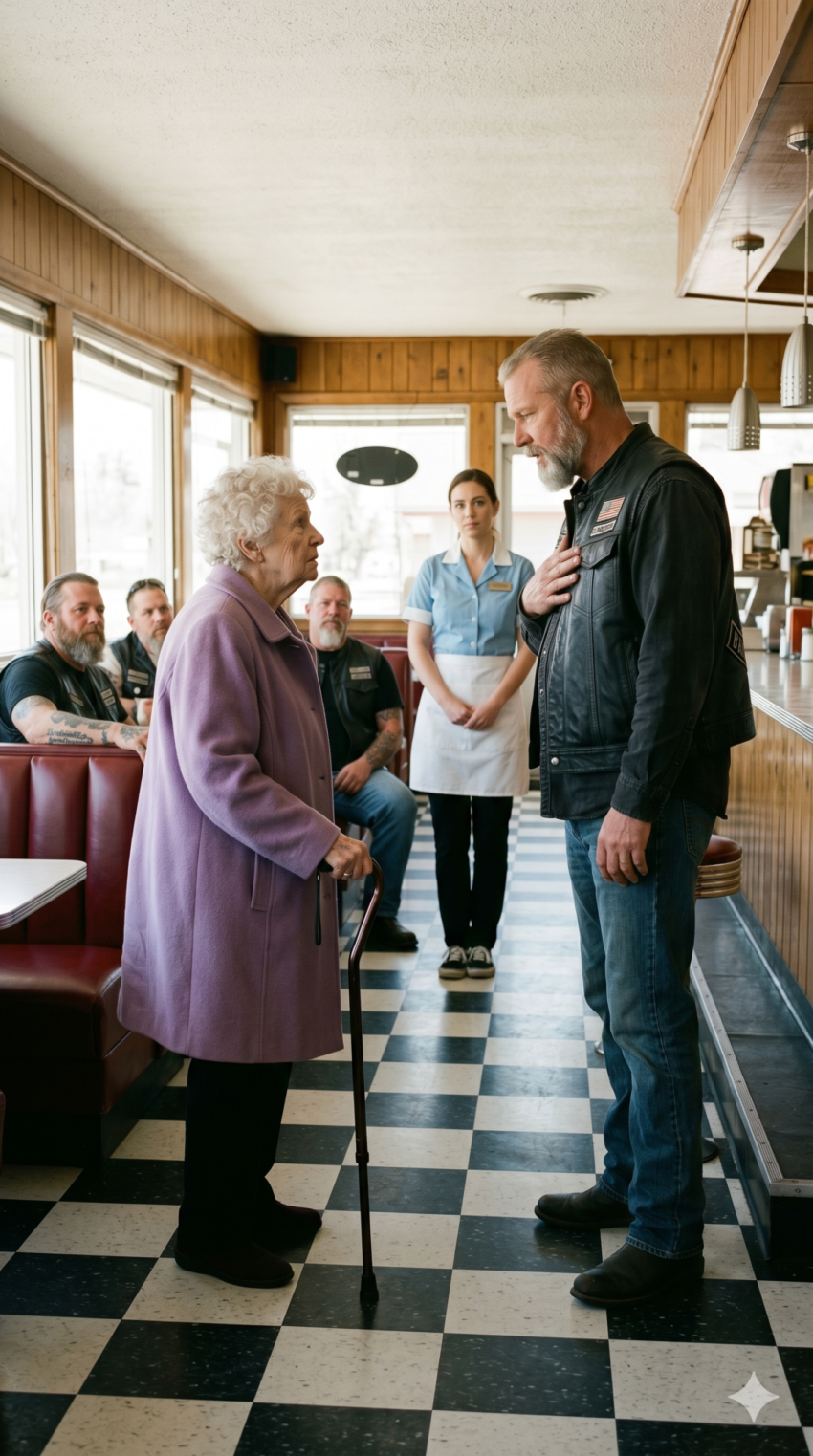
A woman stepped inside slowly, carefully, as though she had spent the whole drive there trying to decide whether to go through with what she had come to do.
She was elderly, slight, and dressed with a kind of old-fashioned care that made people stand up straighter without realizing why. Her pale blue coat was buttoned all the way to the collar. She held a cane in one hand and a small handbag in the other. Her hair was silver and neatly pinned back, though a few thin strands had fallen loose around her face. There was grief written all over her, not in drama, but in the quiet heaviness of someone who had not slept properly in days.
Her name was Lorraine Whitaker.
Six days earlier, her husband of sixty-six years, Stanley, had passed away in the living room of the modest white house they had shared for most of their married life. Since then, Lorraine had moved through her own home like a guest, touching familiar things that no longer felt steady. His reading glasses were still on the side table. His sweater still hung over the back of his favorite chair. His mug still sat by the sink as if he might walk in and ask whether there was any coffee left.
She paused just inside the doorway.
For a second, it looked like she might turn around and leave.
Then she lifted her chin, gripped her cane a little tighter, and made her way across the room.
A Request Too Fragile to Speak Aloud
The bikers noticed her first because she was walking toward them.
Wade set down his spoon and straightened slightly.
“Good afternoon, ma’am,” he said, his deep voice careful and respectful. “Can we help you with something?”
Lorraine stopped near their table. Up close, her hands were trembling. She looked at Wade, then at the other men, then back at the floor as though she were embarrassed to be standing there at all.
“I’m sorry to interrupt your meal,” she said softly. “I know this is unusual.”
One of the younger riders stood halfway, ready to pull out a chair for her, but she gave a faint shake of her head.
“You’re not interrupting anything,” Wade replied. “Please, take your time.”
Those five words nearly undid her.
Lorraine swallowed hard and drew in a shaky breath. “My husband passed away last Friday,” she said. “His name was Stanley Whitaker. We were married sixty-six years.”
At once, the mood at the table changed.
Caps came off. Shoulders lowered. Even the men at the counter stopped talking.
“I’m very sorry for your loss,” Wade said.
She nodded, but her face tightened as if the sympathy only made what she had come to say more difficult.
“His service is tomorrow morning,” she continued. “At New Mercy Chapel. Ten o’clock.” Her fingers tightened around the cane handle. “And I… I’m afraid hardly anyone will be there.”
No one interrupted her.
“Most of our family is gone,” she said. “The few friends we still have are too frail to travel, and some are not well enough to leave their homes. Stanley was a good man. A gentle man. He spent his life showing up for people. He fixed porches, lent tools, drove neighbors to doctor appointments, and never let a widow carry groceries alone if he happened to see her.”
Her voice cracked, and she pressed her lips together before forcing herself onward.
“I cannot bear the thought of him lying there in that church with empty pews.”
The room had gone so quiet that even the kitchen sounds seemed far away.
Lorraine looked at Wade with the kind of vulnerability that only comes when pride has been pushed aside by love.
“I only came to ask whether one of you might attend,” she whispered. “Just one person. So he won’t seem forgotten.”
The Man at the Corner Booth
Wade did not answer right away.
He studied the woman in front of him, the dignity she was trying to hold together, the deep ache in her voice, and the courage it must have taken for her to walk into a café full of strangers and ask for something so deeply personal.
He thought about his own mother.
He thought about funerals he had attended where good men had been sent off with too little witness. He thought about the quiet code he had lived by for decades, the one that mattered more than patches or miles or machines: if somebody is carrying more pain than they can hold, and you have the strength to lighten it, you do not look away.
He rose from the booth.
Standing, he seemed even larger, but there was nothing threatening in the way he looked at her. Only seriousness. Only care.
“What did you say your husband’s name was?” he asked.
“Stanley Whitaker,” Lorraine said.
“And the service is tomorrow at ten?”
“Yes.”
Wade nodded once. “Then Mr. Whitaker will not be alone.”
Lorraine blinked, as though she had not understood him the first time.
“You mean… one of you will come?”
A faint smile touched Wade’s face.
“Ma’am,” he said, “I mean your husband will be honored properly.”
She stared at him, stunned. Her eyes filled before she could stop them. She pressed a hand to her mouth, and for a moment she could not speak.
At last she managed, “I don’t know how to thank you.”
“You already did,” Wade answered gently. “You trusted us enough to ask.”
He motioned toward the waitress. “Marlene, could we get Mrs. Whitaker some tea?”
Lorraine started to protest, but Marlene was already moving.
For the next few minutes, Lorraine sat with them and told them a little more about Stanley. He had served in the Army when he was young. He had loved bluegrass music and black coffee and spring tomatoes from his own garden. He had once driven three hours through a rainstorm to help a cousin whose truck had broken down, then refused to take gas money on the way home. He had never been rich, but he had been dependable, and people built their lives around dependable men more often than they realized.
When Lorraine finally stood to leave, Wade walked her to the door.
“Mrs. Whitaker,” he said before she stepped outside, “tomorrow won’t look the way you’re expecting.”
She gave him a confused, tired smile. “After this week, I don’t think I know what to expect from anything anymore.”
“Fair enough,” he said. “But you should know this much. Your husband’s life mattered.”
Lorraine looked at him for a long moment, then nodded once and whispered, “Thank you.”
A Promise Carried Across the Night
The moment the door closed behind her, Wade pulled out his phone.
He opened the private message thread for the Iron Highway Brotherhood, a network of riders spread across Tennessee, Kentucky, Alabama, and beyond. Some were mechanics. Some were roofers, welders, linemen, veterans, delivery drivers, and fathers. A few were already retired. Some had been riding together for twenty years. Others had joined later, pulled in by the kind of loyalty that could still be found on the road if you were lucky enough to earn it.
Wade typed slowly, making sure every word said exactly what needed to be said.
“Widow in Willow Creek. Husband named Stanley Whitaker. Funeral tomorrow, 10 a.m., New Mercy Chapel. She asked if one person could come so he wouldn’t be sent off to empty pews. Let’s make sure she never has to wonder again.”
He hit send.
The responses began arriving almost immediately.
“I’m two hours out but I’m coming.”
“Bringing three.”
“Tell me where to park.”
“Wouldn’t miss it.”
“Rolling in before sunrise.”
One rider in Chattanooga wrote, “For a man who showed up for people? We show up.”
Another simply sent, “Say less.”
By nightfall, the message had spread farther than Wade expected. Men and women who had never met Stanley Whitaker were changing plans, fueling bikes, checking weather, setting alarms, and mapping routes through the dark. No one asked what they would get out of it. No one asked whether it was worth the trouble.
Some things do not need to be debated once a decent heart understands them.
Meanwhile, in her quiet little house, Lorraine laid out the navy dress she had chosen for the service and sat alone at the kitchen table with both hands wrapped around a cup of tea gone cold. She kept thinking about the biker’s promise and telling herself not to expect too much. Four riders would be more than kind. Two would still be enough. Even one would mean that Stanley had not been left completely unwitnessed.
Before going to bed, she stood in the doorway of the living room and looked at his chair.
“I tried, Stanley,” she whispered into the silence. “I really did.”
The Chapel at Daybreak
The next morning broke clear and cool.
Fog rested low over the fields outside Willow Creek, and the first sunlight spread slowly across the road leading to New Mercy Chapel, a small white church with a narrow steeple and flower beds that the ladies of the congregation tried to keep alive every season.
At seven-thirty, the first motorcycle arrived.
Then another.
Then three more.
By eight o’clock, the sound of approaching engines began to roll through the area in waves. Not loud in a reckless way. Not wild. It was steady, respectful, almost solemn. Bikes pulled in from both directions and lined the gravel shoulder with surprising order. Riders parked carefully, shut off engines, and stood quietly beside their machines.
By nine, the road was full.
There were men with gray beards and women with long braids tucked beneath helmets. There were riders in worn denim, others in clean black leather, and a few in plain jackets with no club markings at all. Some had driven through the night. Some had crossed state lines. Several carried folded American flags. One older woman brought a bouquet of white lilies because she said no funeral should feel bare.
When Lorraine’s taxi turned onto the church road, she leaned forward in confusion.
At first she thought there must be another event.
Then she saw the motorcycles. Dozens. Then more. Then so many that the chapel seemed held inside a corridor of stillness and chrome.
Her breath caught.
“Oh my,” she whispered.
The taxi slowed to a stop.
Outside, riders were already removing helmets and forming two quiet lines that stretched from the driveway entrance all the way to the church doors.
Wade Mercer stood at the front, dressed in a pressed white shirt beneath his vest, his expression calm.
He opened the taxi door and offered his hand.
“Good morning, Mrs. Whitaker.”
Lorraine took his hand, but she was barely looking at him. Her eyes were moving over the crowd, over the bowed heads, the hands resting over hearts, the flowers, the clean rows of bikes, the silence.
“They came,” she said, and her voice nearly disappeared on the words.
Wade gave a small nod. “Yes, ma’am.”
Tears rose so quickly she could not hide them.
“All of them?”
“More are still pulling in.”
She placed one shaking hand against her chest as if to steady her heart.
“For Stanley?”
Wade’s voice softened.
“For Stanley,” he said. “And for you.”
A Goodbye Surrounded by Witnesses
As Lorraine walked toward the chapel, Wade remained at her side, not rushing her, not speaking unless she did. The riders on either side lowered their heads as she passed. Some murmured, “Ma’am.” Others simply stood in silence, giving her the kind of respect that needs no performance.
Inside the church, the empty pews Lorraine had feared were no longer empty
They were full.
Not crowded in a careless way, but full in a way that made the room feel held. Leather vests sat beside church dresses. Weathered hands held hymnals carefully. Sunlight poured through the stained glass and touched bowed heads, polished wood, and the casket at the front of the sanctuary.
Stanley Whitaker was not alone.
Lorraine took her seat in the front row and cried openly for the first time all week. Not because her pain had lessened, but because it no longer felt like she had to carry it in an empty room.
When the pastor invited anyone who wished to say a few words, Lorraine stood slowly.
She looked out over the congregation, at faces she knew and many she did not, and she smiled through her tears.
“My husband would have been embarrassed by all this attention,” she said, and a soft ripple of warm laughter passed through the room. “But he would also have understood it, because he believed that kindness was never wasted.”
She spoke of Stanley’s hands, always busy fixing what someone else could not manage alone. She spoke of his old pickup truck, his habit of waving at every passing car, the way he sang hymns under his breath while trimming hedges, and how he had once spent an entire Christmas Eve repairing a neighbor’s furnace instead of sitting down to dinner on time.
“He was not a famous man,” Lorraine said. “He was not wealthy. But if you were in trouble, he came. If you were lonely, he stayed. If something needed doing, he found a way. I think a life like that deserves to be remembered.”
From the third pew, Wade lowered his head.
“It does,” he said quietly.
After the service, the line to pay respects stretched the length of the aisle. One by one, riders approached the casket. Some touched the polished wood gently with gloved fingers. Some paused for a silent moment. One older veteran removed his glasses and whispered, “Rest easy, sir.”
No one made the moment about themselves.
That was what made it beautiful.
What the Town Would Never Forget
At the cemetery, the riders remained.
They stood beneath a pale blue sky while the final prayer was spoken. A breeze moved through the trees. Somewhere in the distance, a bird called out and then all was still again.
When it was over, Lorraine expected everyone to leave quickly.
Instead, people came to her in a quiet stream.
A woman from Nashville hugged her and said, “My father was sent off with almost nobody there. I never forgot how that felt. I’m glad we could be here for yours.”
A younger rider pressed her cap to his chest and told her, “I never met Mr. Whitaker, but I know the kind of man he was. Good people leave a mark.”
An older man with deep lines in his face said, “Your husband’s name will ride with some of us for a long time.”
At last, Wade stepped forward and handed Lorraine a cream-colored envelope.
Inside was a card covered with signatures, short notes, and names from all over the region.
“From Memphis.”
“From Bowling Green.”
“From Knoxville.”
“From Birmingham.”
“For Stanley.”
“With respect.”
“You were not alone.”
At the bottom, written in Wade’s large careful handwriting, were the words:
“No decent soul should leave this world without company.”
Lorraine pressed the card to her heart and closed her eyes.
When she opened them again, the riders were beginning to return to their motorcycles, not in a rush, not loudly, but with the steady grace of people who knew they had come for one purpose and had fulfilled it.
As the engines came to life one by one, the sound rolled through the cemetery like a final salute.
Lorraine stood there until the last bike disappeared down the road.
The ache of losing Stanley remained. Nothing could remove that. But something inside her had shifted. The loneliness that had wrapped itself around her since his passing no longer felt absolute. The world, for one astonishing morning, had answered grief with presence.
And that made all the difference.
The Story That Lived On
In the weeks that followed, Willow Creek talked about little else.
People told the story at barber shops, grocery stores, Sunday lunches, and front porches. They spoke about the widow who had walked into a roadside café with more courage than she knew she possessed. They spoke about the biker who listened instead of dismissing her. They spoke about the long line of motorcycles outside the church and the way strangers filled the pews for a man they had never met because his life deserved witness.
Lorraine returned to New Mercy Chapel a month later with the signature card in her handbag.
She sat in the same front pew and thought about all the ways love survives after loss. Sometimes it remains in old sweaters and coffee mugs. Sometimes it lives in memory. And sometimes, when a heart is hurting enough to ask, it arrives in the form of strangers who decide that respect matters.
She no longer thought of that day as the day Stanley was buried.
She thought of it as the day the world reminded her that goodness had not disappeared.
And somewhere out on the highway, with the miles opening beneath them and the wind pressing against their shoulders, the riders carried the quiet satisfaction of having done one simple thing that many people overlook.
They showed up.
That was all.
And sometimes, that is everything.
Long messages and reflections:
In a world that often feels rushed, distracted, and emotionally distant, one of the greatest gifts a human being can offer another is simply presence, because showing up for someone in their most fragile hour can speak more deeply than any perfect speech ever could.
We often assume that meaningful kindness must be dramatic or expensive, yet this story reminds us that the most unforgettable acts of compassion are sometimes the quiet decisions people make when they choose not to let another person carry sorrow alone.
A life does not need fame, wealth, or public recognition to matter, because the true worth of a person is often written in the small mercies they gave, the steady help they offered, and the love they planted in ordinary days.
Grief becomes much heavier when loneliness is tied to it, which is why even one unexpected gesture of support can change the emotional weight of an unbearable day and give a hurting heart enough strength to keep moving forward.
There is something deeply powerful about being witnessed in pain, because when others stand beside us without judgment or hesitation, they remind us that sorrow does not erase dignity and that love still has companions in this world.
The kindness of strangers can feel almost unbelievable, yet many of the most healing moments in life come from people who had no obligation to care but chose to care anyway, proving that goodness is still alive in places we least expect.
Respecting someone’s final goodbye is not only an act of honor for the person who has passed, but also an act of mercy for the loved ones left behind, because it tells them that the life they cherished was seen and valued by others too.
Courage does not always look loud or fearless, because sometimes courage is an elderly widow walking into a room of strangers with a trembling voice and asking for help, trusting that decency may still be waiting on the other side of her fear.
Communities are not built only by blood ties or long histories, but also by moments when people decide that another person’s burden matters to them, and in those moments strangers can become a kind of family that grief never forgets.
If there is one lesson worth carrying from this story, it is that we should never underestimate the healing power of presence, because a single kept promise, offered with sincerity and compassion, can turn a day of heartbreak into a memory filled with grace.