At 2:27 A.M., My Sister-in-Law Tried to Have My 80-Year-Old Father Declared Mentally Unfit. She Never Expected His Daughter to Walk Into the Police Station With an FBI Badge.
The Night My Father Begged Me Not to Take Him Home
At 2:27 on a cold Thursday morning, I walked into a police station in Richmond, Virginia, and found my eighty-year-old father sitting alone beneath a flickering fluorescent light.
His hands were trembling. His gray sweater hung loosely from his shoulders, and his eyes were fixed on the floor.
Across the room, my sister-in-law, Meredith, was demanding that an officer arrange an emergency psychiatric evaluation.
“He isn’t safe anymore!” she insisted, holding a tissue against her cheek. “He’s confused, unpredictable, and increasingly aggressive. Someone needs to do something before this gets worse.”
My name is Rebecca Whitcomb. I was thirty-nine years old and had spent twelve years working as an FBI special agent investigating financial crimes.
But nothing in my career prepared me for what I saw that night.
I approached the desk and introduced myself to Officer Bennett, the officer handling the complaint.
“I’m his daughter,” I explained. “I’d like to understand what happened, and I’d appreciate it if all statements and available recordings were preserved.”
He looked exhausted.
“We’re still evaluating the situation, ma’am. Your sister-in-law claims your father became aggressive at home.”
I showed him my federal identification.
“I’m not here in an official capacity, and I respect your jurisdiction. I’m asking you to document what you find carefully.”
Then I walked toward my father.
“Dad? It’s Rebecca.”
He slowly lifted his head.
For a moment, he looked like a frightened child who had been waiting for someone familiar.
“You came,” he whispered.
When I reached for his hand, his sweater sleeve slipped upward.
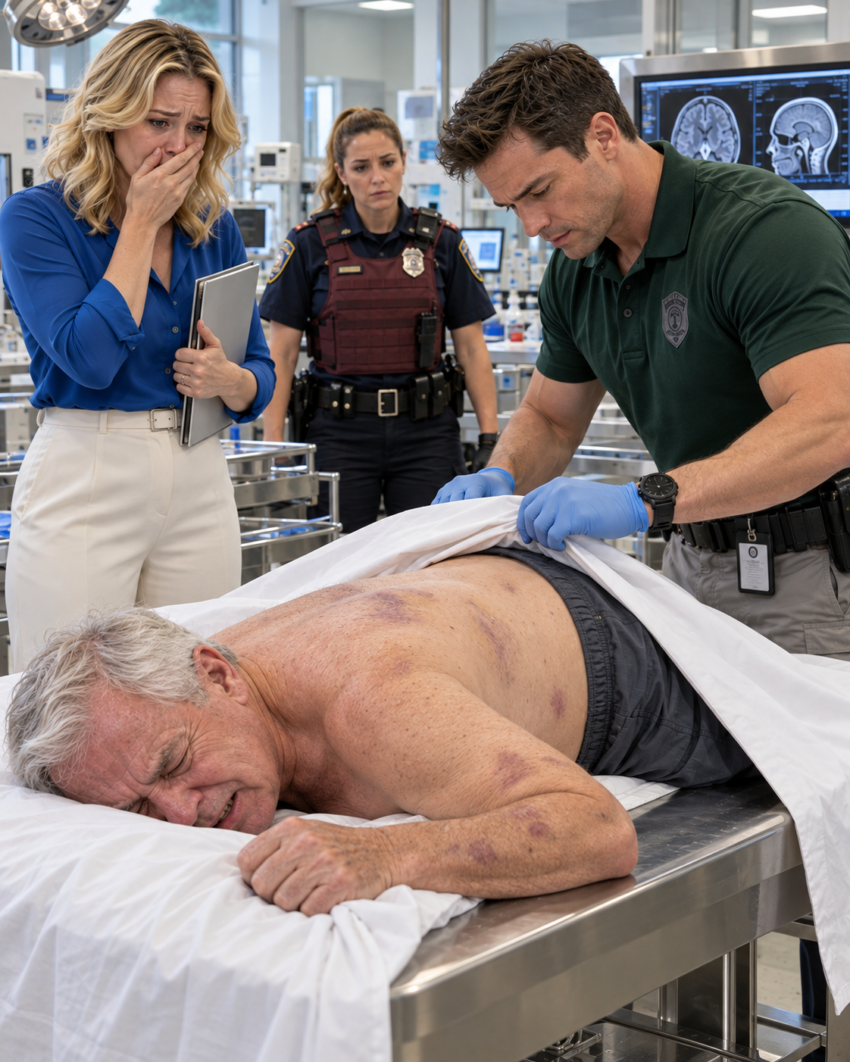
Dark bruises surrounded his wrist. Some were fresh, while others had already begun fading.
I had investigated enough cases involving vulnerable adults to recognize that those marks deserved immediate medical attention.
“Dad, what happened to your arm?”
He glanced toward Meredith before answering.
“Please don’t take me back to that house.”
My heart sank.
“You don’t have to go anywhere you don’t feel safe.”
His fingers tightened around mine.
“And don’t tell your brother where I am.”
My brother, Preston, had always been the responsible one. He was forty-five, worked as a financial adviser, and lived only fifteen minutes from Dad.
I had trusted him to look after our father.
Now Dad was afraid even to hear his name.
Before leaving, I requested medical assistance and spoke privately with the responding officers about the visible injuries.
Meredith watched from across the room.
For the first time that night, she stopped crying.
And when she noticed me examining Dad’s wrists, the confidence disappeared from her face.
The Eleven-Million-Dollar Secret
My father, Walter Whitcomb, had spent forty years building a successful commercial real estate business.
He wasn’t a billionaire, but he had managed his money carefully.
His estate was worth approximately eleven million dollars, including rental properties, investment accounts, retirement savings, and the home he owned outside Richmond.
Despite his age, Dad remained independent.
He paid his bills, followed the stock market, and could remember every birthday in our family.
That was why Meredith’s claims about sudden, severe memory loss troubled me.
I arranged for Dad to be admitted to a private hospital in Henrico County. The hospital restricted access to his information and coordinated with security after I explained the circumstances.
A physician documented injuries on his arms, shoulders, and back.
Some appeared recent. Others were older.
The doctor recommended further evaluation and contacted the appropriate adult protective services authorities.
When Dad finally felt comfortable talking, he told me something that changed everything.
“It started with the bank accounts.”
Six months earlier, he had noticed unfamiliar withdrawals from an investment account.
At first, the amounts were small.
Then they became larger.
When he questioned Preston, my brother insisted that the transactions were ordinary accounting adjustments.
Meredith began suggesting that Dad was becoming forgetful.
“She kept telling me I had misplaced things,” he explained. “My checkbook, my house keys, even the folder with my insurance papers. But Rebecca, I knew where I’d left them.”
“What happened when you confronted them?”
Dad looked away.
“Preston said I needed help managing my affairs. Meredith said I was embarrassing myself.”
Then a physician named Dr. Curtis Bell entered the picture.
Meredith had arranged several private appointments, claiming Dad needed an assessment for dementia.
Dad said the doctor asked unusual questions about aggression, paranoia, and his ability to manage money.
“He barely asked about my actual health,” Dad recalled. “He seemed more interested in proving I couldn’t make decisions.”
When Dad refused another appointment, Preston brought legal documents to the house.
“He wanted me to sign something giving him control of my finances. I told him I wanted my attorney to review it first.”
Dad’s voice cracked.
“That’s when everything changed.”
The Petition That Could Take Away His Independence
The following morning, I contacted Dad’s longtime estate attorney, Daniel Mercer.
Daniel had represented our family for nearly twenty years.
He sounded deeply concerned.
“Rebecca, I’ve been trying to reach Walter all week. Preston’s attorney has prepared an emergency petition asking the circuit court to appoint someone to manage your father’s personal and financial affairs.”
I gripped my phone.
“On what grounds?”
“They claim he’s experiencing serious cognitive decline and cannot protect himself financially.”
Daniel explained that the petition included a medical assessment signed by Dr. Bell and copies of documents supposedly bearing Dad’s signature.
One document appeared to grant Preston broad financial authority.
Another claimed Dad had agreed to certain arrangements without consulting his longtime attorney.
“Can they take control of everything immediately?” I asked.
“Not simply by filing paperwork,” Daniel replied. “A judge has to consider the evidence, and your father has legal rights. But they’re asking for temporary emergency authority, and we need to challenge these claims quickly.”
He had already begun preparing an objection and requesting an independent medical assessment.
Then he said something even more disturbing.
“Rebecca, one of the signatures doesn’t look right.”
I stared at the wall.
“You think it’s forged?”
“I think we need a qualified examiner to determine that.”
After hanging up, I looked through the hospital window at Dad sleeping peacefully.
Someone had spent months convincing an independent elderly man that he couldn’t trust his own mind.
And whoever was responsible had almost succeeded.
My Brother’s Unexpected Visit
That afternoon, Preston appeared at Daniel’s law office.
He looked exhausted, with dark circles beneath his eyes.
“Rebecca, thank God. I’ve been calling everywhere.”
I remained seated.
“Dad is safe. That’s all you need to know right now.”
Preston glanced toward Daniel.
“Meredith says Dad attacked her. She says you’ve taken him somewhere and won’t let anyone see him.”
“Dad asked me not to disclose his location.”
My brother lowered his voice.
“You don’t understand what Meredith is capable of.”
I watched him carefully.
“Then tell me.”
He hesitated.
“She’s been different lately. Secretive. Angry. She’s been asking questions about Mom’s old business cases.”
Our mother, Eleanor Whitcomb, had worked as a forensic accountant before passing away ten years earlier.
She had helped investigators uncover several major financial schemes.
“Why would Meredith care about Mom’s work?”
Preston rubbed his forehead.
“I don’t know. But I think she’s hiding something.”
I wanted to believe him.
Then I remembered Dad’s bruises.
“Did you know someone was hurting him?”
Preston went pale.
He didn’t answer.
That silence told me more than anything he could have said.
The Doctor Who Wanted to Talk
Two days later, Daniel received an unexpected call from Dr. Bell.
The physician claimed he had information about Meredith and wanted to speak with investigators.
He sounded frightened.
He also insisted that the conversation remain confidential.
I contacted my supervisor and explained the developing situation, including my personal connection.
Because I was a potential witness and the victim’s daughter, I was not assigned to lead the investigation.
Instead, a separate investigative team coordinated with local authorities and arranged a controlled interview with Dr. Bell.
During that meeting, the doctor admitted that Meredith had paid him to prepare misleading medical reports.
He had exaggerated Dad’s ordinary age-related forgetfulness and presented it as evidence of severe cognitive impairment.
“She told me her father-in-law was dangerous and that the family needed protection,” Bell explained.
“And you accepted money to support that claim?” an investigator asked.
Bell lowered his eyes.
“I made a terrible decision.”
He handed over copies of emails, payment records, and medical documents.
Then he opened a folder containing an old newspaper photograph.
The picture showed my mother outside a federal courthouse in Virginia.
Beside her stood a man being escorted by federal officers.
A teenage girl watched from the courthouse steps.
I recognized her face immediately.
Meredith.
Only the name printed beneath the photograph was different.
Cassandra Harlow.
The Woman Who Married Into Our Family for Revenge
Twenty years earlier, my mother had helped expose a fraudulent investment operation run by a businessman named Frederick Harlow.
His scheme had taken retirement savings from dozens of families.
After investigators uncovered the fraud, Frederick was convicted and sent to prison.
He later died while incarcerated.
His daughter, Cassandra, blamed my mother for everything.
Years passed.
Cassandra changed her name, moved to another state, and built a new identity.
Then she met Preston.
Their marriage had seemed ordinary.
She was charming, educated, and attentive.
She remembered birthdays, organized holiday dinners, and volunteered to help Dad after Mom passed away.
But the evidence suggested she had deliberately entered our family.
Her goal wasn’t simply to obtain money.
She wanted to destroy the family she believed had ruined hers.
The estate was an opportunity.
My brother’s financial problems gave her leverage.
And Dad’s age gave her a way to make her accusations sound believable.
Investigators discovered that Cassandra had also established several limited liability companies connected to questionable property transactions.
One company had purchased an old house outside Richmond.
When I saw the address, I felt cold.
It was the house where Preston and I had grown up.
Dad had sold it ten years earlier.
Or at least that was what we believed.
The Truth My Brother Had Hidden
That evening, Preston agreed to speak with investigators.
For nearly an hour, he denied knowing anything about Cassandra’s past.
Then they showed him the financial records.
His expression collapsed.
Preston admitted that he had improperly taken money from accounts belonging to several clients at his investment firm.
He had been trying to cover business losses and personal debts.
Cassandra discovered what he had done.
She threatened to expose him unless he helped persuade Dad to surrender control of his finances.
“I thought she just wanted the money,” Preston said, his voice shaking. “I never thought she’d go this far.”
I looked at him across the interview room.
“Dad was frightened in his own home, Preston. You saw what was happening.”
He covered his face.
“I kept telling myself I could fix it.”
“But you didn’t.”
He began crying.
For years, I had thought of my brother as dependable and honorable.
Now I was looking at someone whose fear of losing his reputation had allowed our father to suffer.
He agreed to cooperate.
He also revealed that Cassandra had recently purchased our childhood home through an LLC.
That information would soon become more important than any of us imagined.
The Hospital Alarm
The next morning, an alarm sounded in the hospital wing where Dad was recovering.
Staff began moving patients away from the affected area.
During the confusion, someone wearing clothing resembling that of a medical employee approached Dad’s room.
Hospital security later discovered that the visitor had used an unauthorized credential.
By the time the alarm was cleared, Dad was missing.
Security footage showed him being escorted toward a service exit.
The investigators were notified immediately.
Then my phone received a message from an unfamiliar number.
It contained a photograph of Dad sitting in a wooden chair.
Behind him was wallpaper I hadn’t seen since childhood.
Beneath the picture were six words.
“Come home, Rebecca. We need to talk.”
I recognized the room.
It was our old living room.
I forwarded the message to the investigative team and told them exactly where I believed Dad had been taken.
Within minutes, local officers and federal investigators began coordinating a response.
I wanted to rush there immediately.
Instead, I waited for instructions while the team worked to locate Dad and determine how to bring him out safely.
Then Cassandra called.
“I know you’re working with them,” she said calmly. “But your father wants to see you.”
“Let me speak to him.”
There was a pause.
Then I heard Dad’s weak voice.
“Rebecca, don’t do anything foolish.”
My eyes filled with tears.
“I’m going to get you home, Dad.”
Cassandra returned to the phone.
“Your mother took my family away. Now you’ll understand what that feels like.”
The House Where Everything Began
Investigators established a perimeter around the property.
Cassandra demanded to speak with me and refused to release Dad unless I came inside.
After assessing the situation, the response team allowed me to approach under a carefully coordinated plan while trained officers remained positioned nearby.
I entered the familiar hallway with my heart pounding.
The old family photographs were gone.
The living room furniture had been replaced.
But the hardwood floors were the same.
Dad sat near the fireplace, exhausted and frightened.
Cassandra stood beside him holding a small medical syringe.
A camera had been positioned across the room.
“You look just like your mother,” she said.
“Let Dad leave, Cassandra.”
She shook her head.
“Your mother destroyed my father’s life. Everyone treated her like a hero while my family lost everything.”
“Your father took money from people who trusted him. My mother helped uncover the truth.”
Cassandra’s expression hardened.
“You don’t get to tell me what happened to my family.”
She pointed toward the camera.
“You’re going to explain how you used your father’s money for illegal investments. You’re going to admit everything.”
I understood what she wanted.
She had created accounts using my stolen personal information.
Now she wanted a recorded statement that could damage my career and make me appear responsible for the missing funds.
I kept my voice steady.
“I’ll talk. But Dad needs medical attention. Let him go first.”
“After you tell the truth.”
I glanced at my father.
He was watching me with the same expression he used to wear when I was a little girl afraid of thunderstorms.
He was trying to be brave for me.
Even now.
The Brother Who Finally Made a Choice
Outside, Preston had been helping investigators identify the property’s layout.
He remembered a side entrance that led into a small utility room behind the kitchen.
He also knew the old house had a narrow hallway connecting that room to the living area.
Officers used that information while preparing their response.
Inside, Cassandra ordered me to face the camera.
“Tell everyone what you did.”
I took a slow breath.
“My name is Rebecca Whitcomb. I’m here because my father has been taken from his hospital room, and I want him returned safely.”
“That’s not what I told you to say!”
She stepped away from Dad.
At that moment, a voice came from the hallway.
“Meredith, stop.”
Preston stood near the kitchen entrance, with officers positioned behind him.
His face was pale.
“This is over. Please let Dad go.”
Cassandra stared at him.
“You promised you’d stay out of this.”
“I made enough mistakes already.”
“You helped me!”
Preston nodded, tears running down his face.
“I did. And I’ll answer for it. But I’m not letting you hurt him anymore.”
For a moment, Cassandra looked toward Preston instead of Dad.
The officers moved in when they had a safe opportunity.
Within seconds, they separated Cassandra from my father and secured the room.
A medical team entered immediately afterward.
I rushed to Dad and knelt beside his chair.
“It’s over. You’re safe.”
He reached for my hand.
Then he looked toward Preston.
“Son, what happened to us?”
My brother began crying.
“I’m sorry, Dad. I’m so sorry.”
Dad closed his eyes.
He didn’t offer forgiveness that day.
But he allowed Preston to hold his hand.
Justice Didn’t Erase the Pain
The investigation continued for six months.
Authorities uncovered evidence that Cassandra had participated in several schemes targeting elderly people with substantial assets.
Dr. Bell cooperated with prosecutors and provided records identifying other possible victims.
Financial investigators traced transfers through multiple companies and identified accounts opened using stolen personal information.
A grand jury eventually returned an indictment containing twenty-four criminal counts against Cassandra, including allegations involving financial fraud, identity theft, kidnapping, and other serious offenses.
Those were formal charges, not convictions.
The courts would determine the outcome.
Preston also faced criminal proceedings related to his clients’ money and his role in the scheme against Dad.
His cooperation was considered, but it did not erase his responsibility.
The disputed guardianship petition was withdrawn, and independent medical evaluations supported Dad’s ability to make his own decisions.
His financial accounts received additional safeguards, and Daniel helped him update his estate planning documents.
Dad eventually moved into a smaller house with a garden and a sunny front porch.
He began attending a community center twice a week.
He made new friends.
He even started teaching a neighbor how to grow tomatoes.
But some evenings, I still noticed him checking the locks twice.
Healing wasn’t as simple as closing a case.
The Letter My Mother Left Behind
One October afternoon, I visited Dad after work.
The trees around his house had turned red and gold.
He was sitting on the porch with two cups of coffee.
“Sit down, sweetheart. There’s something I want to show you.”
He handed me an envelope.
My name was written across the front in my mother’s handwriting.
Dad explained that he had found it in a safe-deposit box while organizing their old papers.
Inside was a letter Mom had written years before her death.
She hadn’t known what would happen to our family.
She had simply wanted to leave me something meaningful.
My dearest Rebecca,
You have always wanted to make things right for everyone. Even as a little girl, you couldn’t walk past someone who needed help.
But I hope you remember that being strong doesn’t mean carrying every burden alone.
People will disappoint you. Sometimes even the people you love most will make choices you cannot understand.
You can love someone without excusing what they’ve done.
You can forgive without pretending the past never happened.
And you can seek justice without letting anger become the center of your life.
Whatever happens, build a future that belongs to you.
Love, Mom.
I read the letter twice.
Then I rested my head against Dad’s shoulder.
For the first time in months, I cried without trying to hide it.
“I wish she were here,” I whispered.
Dad squeezed my hand.
“I do too, sweetheart.”
We sat quietly as the afternoon light faded.
Preston was still facing the consequences of his decisions, and rebuilding our relationship would take time.
But Dad was safe.
The truth had come out.
And Cassandra no longer controlled our family’s future.
I had spent twelve years believing that justice meant finding the person responsible and proving what they had done.
Now I understood something deeper.
Justice could protect people, but healing required patience, honesty, and the courage to begin again.
Cassandra had tried to turn my mother’s legacy into a reason for revenge.
Instead, her actions reminded me why Mom had spent her life protecting people who couldn’t always protect themselves.
The greatest inheritance she left our family wasn’t money, property, or a respected name.
It was the belief that doing what was right still mattered, even when doing so came at a personal cost.
And as Dad reached for my hand beneath the October sky, I finally understood that our family didn’t have to return to what it had once been.
We could build something different.
Something honest.
Something worth protecting.
1. Sometimes the people we trust most are the ones who disappoint us most deeply, but their choices should never convince us that kindness, loyalty, and genuine love no longer exist.
2. Growing older should never mean losing the right to make decisions, receive respect, or live with dignity, because every person deserves to feel safe and valued regardless of age.
3. A family isn’t truly protected by pretending everything is fine; real protection begins when someone finds the courage to acknowledge uncomfortable truths and take meaningful action.
4. Forgiveness doesn’t require us to excuse dishonesty or ignore the harm someone has caused, because genuine healing becomes possible only when accountability and compassion exist together.
5. Money can provide comfort and security, but it cannot replace the peace of knowing that the people around us care more about our well-being than what we own.
6. When someone repeatedly questions our memory, judgment, or independence for their own benefit, we should remember that love is supposed to strengthen our confidence rather than slowly take it away.
7. Even the strongest people sometimes need someone to stand beside them, and asking for help should never be mistaken for weakness when our safety or happiness is at stake.
8. The mistakes of one generation do not have to determine the future of the next, because we always have an opportunity to choose understanding, responsibility, and a different path forward.
9. Justice may reveal the truth and establish consequences, but rebuilding trust requires time, consistent actions, and the willingness to accept that some relationships will never look exactly the same again.
10. The most meaningful legacy we leave behind isn’t measured by the size of our bank accounts or the value of our possessions, but by the courage, integrity, and love that continue shaping the lives of those who remember us.