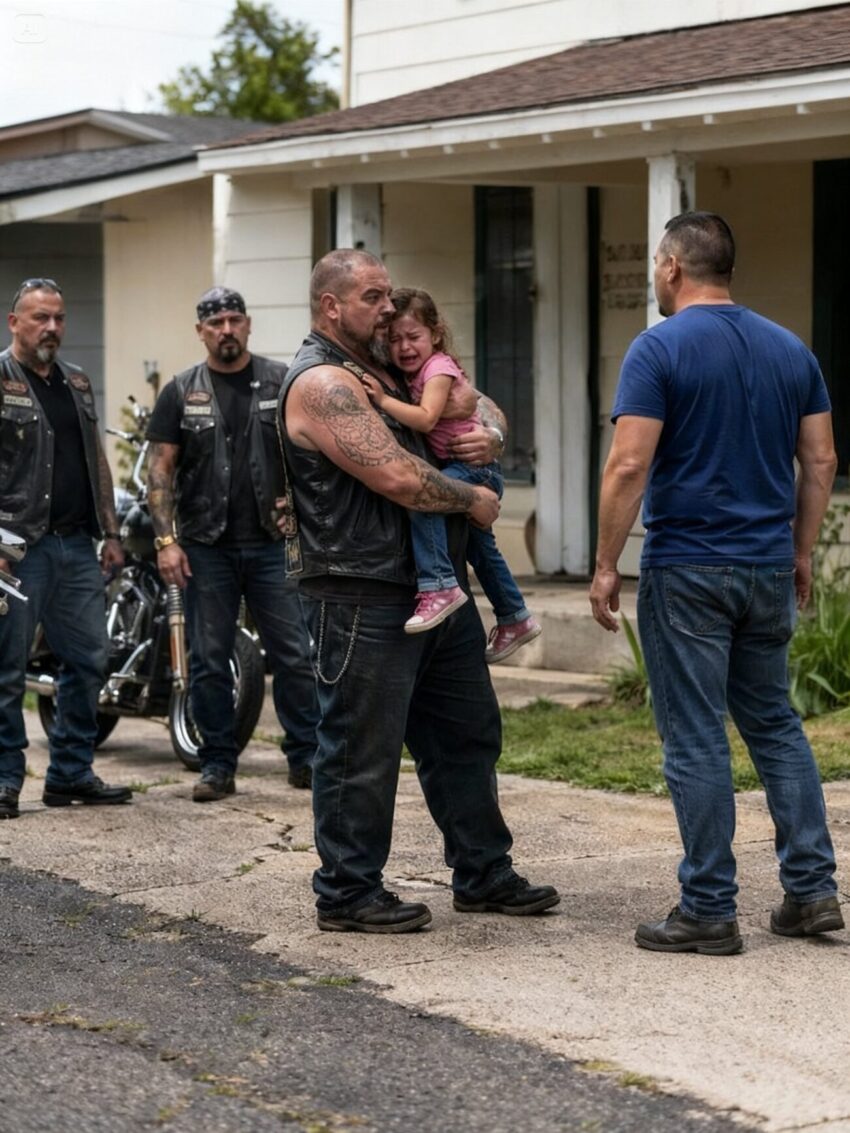
The little girl was not crying when Wyatt Callahan found her.
That was what stopped him cold.
Not the bruised skin under her eye.
Not the bare feet pressed against the cold gas station pavement.
Not even the fact that she was sitting alone at the far edge of a Tennessee parking lot close to midnight, small enough to be missed by anyone who had already decided not to look.
It was the silence.
A child that young should have been frightened enough to sob, call for her mother, or run toward the first adult who looked safe.
But this girl did none of that.
She sat on the curb beside the air pump with her knees pulled tight to her chest, wearing a thin pink shirt with a faded cartoon cat on the front and sweatpants that did nothing against the October cold.
Her hair hung in tangles around her pale face.
Her left eye was shadowed by a bruise that had turned purple at the center and green at the edges.
When Wyatt stopped in front of her, she looked up at all six feet two inches of him.
She saw the leather vest.
She saw the skull patches.
She saw the ink crawling over his arms and the death head tattoo on his neck.
Then she asked, in a voice so quiet it barely rose above the hum of the gas pumps, “Are you going to hurt me, too?”
Wyatt Callahan had not cried since he was nine years old.
He had buried his mother without crying in front of anyone.
He had taken beatings, arrests, funerals, and betrayals without giving the world the satisfaction of seeing him break.
But something in him cracked on that curb.
Not loudly.
Not cleanly.
It cracked like old ice over black water.
He lowered himself into a crouch so he would not tower over her.
His knees popped.
His boots scraped the pavement.
The girl did not flinch.
That made it worse.
“No,” he said.
His voice came out rougher than he wanted.
“I’m not going to hurt you.”
She studied him as if she had learned that words were only covers for what adults really meant.
Her gaze moved from his face to his hands.
Then to the tattoos on his forearms.
Then back to his eyes.
Wyatt stayed still.
He knew what he looked like.
Everyone in Clarksville knew what he looked like.
A big man in a Hells Angels vest did not need to raise his voice to make people cross the street.
He had lived inside that reaction for years.
He had stopped arguing with it.
But this girl was not looking at him like other people looked at him.
She was not disgusted.
She was not judging.
She was measuring danger.
And she was doing it like someone who had already been wrong before.
“My name is Wyatt,” he said.
She kept hugging her knees.
The night air moved across the parking lot, carrying the smell of gasoline, burnt coffee, cigarette smoke, and damp leaves from the edge of Craft Street.
The Sunoco sign buzzed above them in red and yellow light.
A man at pump three glanced over once, saw Wyatt’s vest, and looked away so quickly it was almost comic.
A woman inside the store shifted her eyes toward the window and then back down to the register.
Nobody stepped out.
Nobody asked why a little girl was sitting barefoot on the cold ground.
Nobody wanted to know.
That was the first thing Wyatt noticed.
The second was her feet.
They were dirty on the bottoms, pale on top, and curled slightly against the pavement.
Not because she was shy.
Because she was freezing.
“Are you here with someone?” he asked.
She shook her head once.
“Where do you live?”
She lifted one hand and pointed up the road.
“Mercer,” she said.
“The green house.”
Wyatt knew Mercer Street.
Three blocks west.
Older houses.
Narrow porches.
Chain-link fences.
A few places with old trucks in the yard and curtains that never opened.
“The green house on the corner?” he asked.
She nodded.
“Did you walk here?”
She swallowed.
“I ran.”
The answer was too simple.
Too clean.
No little girl ran barefoot through a cold neighborhood at night because she forgot her shoes.
No little girl sat alone at a gas station instead of going home unless home had become worse than the street.
Wyatt took off the flannel shirt he wore under his vest.
The cold hit his arms immediately through his white undershirt.
He held the shirt out to her, keeping his movement slow.
She stared at it.
Then she reached for it with both hands and wrapped it around her shoulders.
It swallowed her.
The hem nearly touched the pavement.
“Thank you,” she said.
The words were careful.
Too careful.
They had the polished sound of manners taught as survival.
“What is your name?” Wyatt asked.
She looked down.
Then up.
“Ruby,” she said.
“Ruby Simmons.”
Wyatt nodded as if she had entrusted him with something important.
Because she had.
“Ruby,” he said, letting the name settle.
“Is there somebody at home who knows you left?”
“My mom doesn’t.”
“Where is your mom?”
“At work.”
“What kind of work?”
“Cleaning at the hospital.”
She looked toward Mercer Street, though nothing could be seen from where they sat except black road, streetlights, and the dim porch fronts beyond the gas station.
“She works nights.”
Wyatt looked in that direction too.
Somewhere three blocks away, a green house held its mouth shut.
“Is someone else home?” he asked.
Ruby’s shoulders tightened under the flannel.
“Craig.”
The name came out with no feeling at all.
That made it worse too.
Children should say names with attachment, fear, anger, affection, something.
Ruby said Craig like she was naming a closed door.
“Who is Craig?”
“My stepfather.”
Wyatt felt something hard move behind his ribs.
“He moved in eight months ago,” Ruby said.
“Mom says he is good for us.”
She paused.
“She thinks he is.”
Wyatt did not ask everything at once.
He had learned in hard places that the fastest way to make someone close up was to act hungry for their pain.
So he said nothing.
Ruby looked at the hot glass doors of the store.
A reflection trembled there.
A small girl in a giant flannel.
A huge man crouched beside her.
A parking lot full of people who would later tell themselves they had not seen enough to get involved.
“He grabs me,” she said.
The words arrived so quietly he almost missed them.
“When Mom is gone.”
Wyatt kept his face still.
“How?”
“By my arm.”
She touched her right sleeve with the opposite hand.
“He squeezes hard.”
Her lips pressed together.
“He says I am ungrateful.”
Wyatt waited.
Ruby took in one shallow breath.
“Last week he…”
She stopped.
Her hand drifted toward the bruise under her eye, then froze before touching it.
“He said I fell.”
Wyatt’s jaw locked.
He looked at the pavement until he could trust his eyes again.
“He told me if I told Mom, she would not believe me,” Ruby said.
“He said she would be sad.”
Then the girl looked at him with an exhaustion that no seven-year-old should ever have to know.
“He said it would be my fault.”
The whole gas station seemed to go quiet around them.
The pumps clicked.
The sign buzzed.
A car passed on Craft Street.
Somewhere far off, a train horn dragged its lonely sound through the cold.
Wyatt had heard lies before.
He had told some himself.
He knew the taste of fear and manipulation.
But there was a special kind of cruelty in telling a child that her suffering would injure the person she loved most.
There was a special kind of cowardice in hiding behind a mother’s trust and a child’s silence.
“Ruby,” Wyatt said.
She watched him carefully.
“It is not your fault.”
Her eyes narrowed a little, as if the sentence was unfamiliar and suspicious.
“You don’t even know me.”
“Doesn’t matter.”
He said it plainly.
“A grown man hurting a child is wrong every time.”
She looked down at the sleeves of his flannel covering her hands.
“There is no version where it is your fault,” he said.
“That is just a fact.”
Ruby absorbed that in silence.
Not believing it completely.
Not rejecting it either.
Just holding it like something fragile and strange.
Then she said, “You have a lot of tattoos.”
Wyatt almost smiled.
“I do.”
“Are you in a gang?”
“A motorcycle club.”
“Is that the same thing?”
“Some people think so.”
She looked at the skull on his arm.
“Does it mean you are dangerous?”
Wyatt thought about lying.
He thought about giving her something soft and easy.
But Ruby had already had too many adults rearrange truth to suit themselves.
“Some people think that too,” he said.
Then he looked her in the eye.
“But not to little girls sitting alone in parking lots at midnight.”
The answer seemed to matter to her.
Maybe because he had not denied the frightening parts of himself.
Maybe because he had not asked her to pretend he looked harmless.
Maybe because, for once, an adult had not needed her to comfort him.
Wyatt stood slowly.
“I am going to get you something warm,” he said.
Her body tensed.
“Do you want to come inside where it is warmer, or would you rather wait here where you can see me?”
She looked surprised that he had asked.
“Inside,” she said after a moment.
“But near the window.”
“Near the window,” Wyatt said.
He walked beside her, not behind her.
Inside the Sunoco, the fluorescent lights made everything look harder and colder.
The floor was scuffed.
The coffee machine hissed.
The hot dog roller turned two gray sausages nobody should have trusted.
The woman behind the counter was in her fifties, hair pinned up tight, face lined by years of late shifts and people buying cigarettes with loose change.
Her name tag said Marla.
She looked at Ruby.
Then at Wyatt.
Then at the bruised eye.
Then at Wyatt’s vest.
Her expression shifted through concern, calculation, and retreat.
“She yours?” Marla asked.
“No,” Wyatt said.
“I found her outside.”
Marla’s hand paused over the register.
“Outside?”
“Barefoot.”
Ruby stood close to the magazine rack, wrapped in the flannel, eyes down.
Wyatt took a foam cup and filled it with hot chocolate from the machine.
It came out pale and watery, but it was warm.
He paid for it with a five-dollar bill.
“Can you make it hotter?” he asked Marla.
“Not too hot.”
Marla took the cup, stared at him another second, then ran it under the machine again.
She handed it back without another word.
Wyatt carried the cup to the little table bolted by the window.
Ruby sat opposite him.
She wrapped both hands around the cup and held it like a lantern.
For several minutes, neither of them spoke.
Wyatt let the silence do what it needed to do.
Most adults hated silence.
They rushed to fill it, explain it, control it, or break it.
But Wyatt knew silence could be shelter if nobody tried to turn it into a trap.
Ruby sipped the hot chocolate.
Her shoulders lowered by one inch.
That inch felt like a victory.
Outside, the parking lot kept receiving people who did not see them.
A truck came in.
A sedan left.
A teenager bought chips and laughed into his phone.
Life went on, loud and careless, while a child sat under a stranger’s flannel trying to decide whether this night had saved her or only moved the danger somewhere else.
Wyatt took out his phone.
Ruby’s eyes went to it immediately.
“Are you calling the police?” she asked.
Fear sharpened her voice for the first time.
“Please don’t.”
Wyatt set the phone down on the table instead of dialing.
“Tell me why.”
She looked toward the door.
“They will make me go back.”
“Maybe not.”
“He will say I am lying.”
“Ruby.”
“He will say I am difficult.”
Her breath trembled, but still no tears came.
“He says it all the time.”
Wyatt leaned back.
The law was a road he knew too well and trusted too little in moments that depended on who looked respectable.
He had no desire to make himself judge and jury.
He also had no intention of handing this child back to a man who had already trained her to fear being believed.
“Not the police yet,” he said.
“I need to call someone who knows what to do next.”
“Who?”
“A friend.”
“Is he like you?”
“Mostly.”
Ruby considered that.
“Does he have skulls too?”
“Probably less than me.”
That nearly pulled a smile from her.
Not quite.
But nearly.
“His name is Denny,” Wyatt said.
“He has daughters.”
Ruby looked at him in that measuring way again.
“Will he send me back?”
“No.”
Wyatt did not know exactly how the night would unfold.
But he knew that one word.
No.
He stood and stepped outside, keeping himself visible through the window.
Ruby watched him through the glass.
He called Denny Marsh.
Denny picked up on the second ring.
“This better be good,” Denny said.
Wyatt looked at Ruby through the window.
She was sitting upright with the hot chocolate between her hands, seven years old and braced like someone waiting for a verdict.
“I need you,” Wyatt said.
The line went quiet.
“Where?”
“Sunoco on Craft.”
“You in trouble?”
“No.”
Wyatt turned away from the window for a second and stared toward Mercer Street.
“A kid is.”
Denny did not ask for the full story.
That was why Wyatt had called him.
“Twenty minutes,” Denny said.
“Come alone,” Wyatt said.
“No colors.”
Another pause.
Then Denny’s voice changed.
“Understood.”
Wyatt ended the call and went back inside.
Ruby looked up.
“He is coming?”
“Yes.”
She nodded.
Then, after a long moment, she said, “Thank you for not driving away.”
Wyatt sat down across from her.
The words hit him harder than anything else had.
Not thank you for helping.
Not thank you for the drink.
Not thank you for the shirt.
Thank you for not driving away.
As if driving away was what people did.
As if driving away was the ordinary thing.
As if she had watched cars come and go and learned in those cold minutes that the world had places for gasoline, snacks, lottery tickets, and coffee, but not for one barefoot girl who had run from the green house on Mercer Street.
“Nobody should have left you out there,” Wyatt said.
Ruby nodded.
Not like she was comforted.
Like she had already known that too.
Denny arrived in seventeen minutes.
He came in a pickup instead of his bike.
He wore jeans, boots, and an old canvas jacket.
No vest.
No patches.
No loud entrance.
He opened the gas station door, took in Ruby’s bare feet, the bruise, Wyatt’s undershirt, the oversized flannel around the child, and the rigid look in Wyatt’s face.
Then he sat down without asking the stupid questions.
That was one of Denny’s gifts.
He understood when a room needed less noise.
“Hey there,” he said to Ruby.
“My name is Denny.”
Ruby looked at him cautiously.
“I have a daughter about your age,” he said.
“Her name is Madison.”
Ruby did not answer.
Denny held up both hands slightly.
“Not here to scare you.”
“Do you have tattoos too?” she asked.
Denny pushed up his sleeve and showed her a faded anchor.
“Got this in the Navy before I became thoroughly unrespectable.”
Ruby’s mouth twitched.
Wyatt saw it and felt something in his chest shift.
It was not a smile yet.
But it was the first sign that the night had not completely swallowed her.
Denny looked at Wyatt.
“Outside,” he said quietly.
Wyatt nodded.
“Ruby, we will be right by the door,” Wyatt said.
She looked alarmed.
“You can see us through the glass.”
She turned toward the window.
“Okay.”
Outside, the cold was sharper.
Denny stood beside the newspaper box and kept his voice low.
Wyatt told him what Ruby had said.
Not all of it.
Enough.
Denny’s face hardened in slow degrees.
He had three daughters.
That changed how a man heard certain things.
“Mother works nights,” Denny said.
“Stepfather at the house.”
“Craig,” Wyatt said.
“Craig what?”
“Didn’t get the last name yet.”
“Could call emergency services.”
Wyatt looked back through the glass.
Ruby had not moved.
“She thinks they will send her back tonight.”
Denny exhaled through his nose.
“Could happen.”
The honesty was grim.
Wyatt said nothing.
Denny rubbed one hand over his jaw.
“My sister Ellen.”
Wyatt looked at him.
“She still on the north side?”
“Yeah.”
“She still licensed?”
“Used to be.”
Denny glanced through the window too.
“She has taken emergency placements before.”
“Through the right channels.”
“Yes.”
Denny held Wyatt’s gaze.
“I am not saying we hide the kid.”
“Good.”
“I am saying we keep her safe for the night, get names, document everything, and make the calls in the morning with someone who knows the system sitting at the table.”
Wyatt looked toward Mercer Street again.
The green house was out there in the dark.
A man inside it might already be pacing.
Might be building his story.
Might be rehearsing worry in front of the bathroom mirror.
Wyatt had known men like that.
Men whose hands did one thing in private and whose faces did another in public.
Men who understood that clean clothes and calm voices were armor.
“Ellen will take her?” Wyatt asked.
Denny gave a bleak half smile.
“Ellen would take in a wounded raccoon if it looked at her sad enough.”
They went back inside.
Ruby was watching the door as if the seconds had teeth.
Denny sat where he had been.
“Ruby,” he said.
“I have a sister named Ellen.”
“Is she scary?”
“No.”
Denny seemed to consider this.
“She is scary if you are a grown man acting foolish.”
Ruby’s eyes moved to Wyatt.
“But she is very kind to kids,” Denny said.
“She has a warm house.”
“Will she ask a lot of questions?”
“Not tonight,” Wyatt said.
“Tonight you can get warm.”
Ruby held the cup tighter.
“Will I have to go back?”
“No,” Wyatt said.
It was a dangerous promise.
He made it anyway.
Ruby stared at him for a long moment.
Then she nodded once.
“Okay.”
They took Denny’s truck.
Wyatt sat in the passenger seat.
Ruby sat in the back, buckled in, still wrapped in his flannel.
The heater came on slow.
For the first few minutes, nobody talked.
Clarksville slipped past the windows in pieces.
Closed barber shop.
Pawn shop sign.
Church marquee.
Dark schoolyard.
Houses with porch lights on and curtains pulled.
October leaves skittered across the road ahead of them like small frightened things.
Wyatt kept seeing Ruby in the side mirror.
Her face reflected faintly against the glass.
Her eyes stayed open.
Not sleepy.
Watchful.
Denny drove north with both hands on the wheel.
At one stoplight, Ruby spoke.
“Will Craig be mad?”
Wyatt turned slightly but did not twist all the way around.
“Probably.”
“At me?”
“No.”
“He will be.”
“Then he can be mad from somewhere you are not.”
Denny’s jaw flexed, but he said nothing.
Ruby thought about that.
“Mom will be sad.”
“Yes,” Wyatt said.
“Maybe.”
Ruby’s voice got smaller.
“I don’t want her to be sad.”
Wyatt looked at the traffic light glowing red against the windshield.
“Ruby, sometimes people get sad because they finally know the truth.”
The light turned green.
Denny drove.
“That does not mean the truth was wrong,” Wyatt said.
Ruby did not answer.
But he saw her fingers loosen around the flannel.
Ellen Marsh lived in a white house on the north side with a wide porch, old rocking chairs, and wind chimes that clicked softly under the eaves.
A porch lamp burned yellow.
The yard smelled of damp leaves and wood smoke from somewhere down the block.
Denny knocked.
A light came on inside.
After a minute, Ellen opened the door in a robe, gray hair loose around her shoulders, glasses crooked from sleep.
She saw Denny first.
Then Wyatt.
Then Ruby.
Everything in her face changed without becoming dramatic.
She did not gasp.
She did not demand an explanation on the porch.
She simply opened the door wider.
“Come in, sweetheart,” she said.
Ruby stood very still.
Ellen looked at her bare feet.
“Kitchen first,” she said.
“I have soup.”
That was all.
No judgment.
No panic.
No stare at Wyatt’s vest.
Just soup.
Ruby stepped inside.
The house smelled of cinnamon, paper, old wood, and something savory warming on a stove.
Wyatt stayed on the porch while Denny went in and spoke to his sister in low tones.
Through the front window, he saw Ellen guide Ruby to a chair.
He saw her kneel, not towering over her, and offer a pair of thick socks.
Ruby looked at Wyatt’s flannel before taking them.
Then she pulled the socks onto her feet.
The sight of those socks almost undid him.
Such a small thing.
Such a normal thing.
The kind of thing a child should have been given before ever having to ask.
Wyatt leaned against the porch rail and breathed into the cold.
The two stayed with him.
Are you going to hurt me, too?
Not are you going to hurt me.
Too.
That word had history in it.
That word had a house in it.
That word had eight months of closing doors, night shifts, excuses, bruises, and a mother too tired to see the trap being built around her daughter.
Denny came out ten minutes later.
“Ellen says she can stay.”
“Good.”
“She also says you look half frozen.”
Wyatt looked down at his white undershirt.
“Fine.”
Denny gave him a look.
“She found Ruby some pajamas.”
“Good.”
“Kid asked if you were leaving.”
Wyatt looked toward the window.
Ruby sat at the kitchen table with a spoon in her hand.
She looked smaller under the house light than she had under the gas station sign.
“Tell her I will be right here until she goes to bed,” Wyatt said.
Denny nodded.
Then he added, “You understand tomorrow gets official.”
“Yes.”
“No cowboy nonsense.”
Wyatt gave him a flat look.
Denny shrugged.
“Had to say it.”
Inside, Ellen brought Wyatt coffee he did not ask for.
He stood in the front room with the mug warming his hands while Ruby ate soup in the kitchen.
She moved the spoon slowly, almost ceremonially, as if she was afraid eating too fast would offend someone.
Ellen noticed and pretended not to.
That was kindness too.
Later, when Ruby had changed into borrowed pajamas, she came to the living room doorway.
Wyatt stood near the bookshelf, too large for the delicate room.
His flannel was folded in her arms.
“I can give this back,” she said.
“You can keep it tonight.”
“It is yours.”
“I know.”
She looked down at it.
“Will you come back tomorrow?”
“Yes.”
Her eyes lifted.
“Promise?”
Wyatt had made few promises in his life and broken some.
This one he did not hesitate over.
“Promise.”
Ruby nodded and went upstairs with Ellen.
Denny watched her go.
When the upstairs door closed, the house seemed to exhale.
Denny said, “This is bad.”
“Yes.”
“Could get uglier before it gets better.”
“I know.”
Denny looked at him.
“You did right.”
Wyatt stared at the staircase.
“She asked if I was going to hurt her too.”
Denny’s face went still.
For a long moment, neither man spoke.
Then Denny said, “Tomorrow, we make sure he cannot answer that question ever again.”
The next morning came gray and cold.
Denny made the calls before Wyatt had finished his first coffee.
He spoke to child protective services.
He spoke to a police contact who owed him enough respect to listen before making assumptions.
He spoke to Ellen’s old licensing contact.
By nine, a social worker named Patricia Holley stood in Ellen’s kitchen with a yellow notepad, a plain navy coat, and eyes that looked like they had seen every lie a grown person could tell.
She was in her mid-forties, with tired lines at the corners of her mouth and the clipped calm of someone who had learned not to waste emotion where action was needed.
She shook Ellen’s hand.
She nodded to Denny.
Then she looked at Wyatt.
Not at his vest.
At him.
“You found her?” Patricia asked.
“Yes.”
“Where?”
“Sunoco on Craft.”
“What time?”
“A little before eleven.”
“Did you touch her?”
“Gave her my flannel.”
“Anything else?”
“Bought her hot chocolate.”
“Moved her here with Denny.”
“Did she tell you who hurt her?”
Wyatt glanced toward the kitchen doorway.
Ruby sat at the table with Ellen, turning a piece of toast into crumbs.
“Yes.”
Patricia followed his eyes.
“She can tell me herself.”
Wyatt nodded.
Patricia spoke to Ruby in the kitchen while the adults waited in the living room.
The wait lasted forty minutes.
It felt longer.
Denny sat with elbows on knees.
Ellen folded laundry that did not need folding.
Wyatt stood by the window and stared at the street.
A maple tree outside had lost most of its leaves.
The ones still clinging to the branches looked stubborn and doomed.
Every few minutes, Ruby’s voice drifted from the kitchen.
Too low to make out.
Once Patricia’s pen stopped scratching.
Then started again.
Wyatt had been in rooms before where people confessed things.
He had heard men brag, plead, lie, and break.
Nothing had prepared him for the quiet endurance of a child’s voice behind a kitchen wall.
When Patricia came out, she closed the kitchen door halfway behind her.
Her face had changed.
Not much.
Enough.
“We are not sending her back,” she said.
Ellen’s shoulders sank.
Denny closed his eyes briefly.
Wyatt looked at Patricia.
“Temporary placement stays here if Mrs. Marsh consents,” Patricia said.
Ellen did not hesitate.
“She stays as long as she needs.”
Patricia wrote that down.
“The mother?”
“Nicole Simmons,” Patricia said.
“At work during the night incident.”
“Does she know?” Wyatt asked.
“She will.”
The way Patricia said it made clear that knowing would become its own storm.
“Is she part of it?” Denny asked.
“Ruby says no.”
Patricia’s voice was firm.
“Ruby is protective of her mother, but not evasive.”
She looked at her notes.
“She describes the stepfather waiting until Nicole is gone.”
Wyatt felt the name before she said it.
“Craig Dunar,” Patricia said.
“Dunar,” Wyatt repeated.
The name sounded ordinary.
That was the trouble with it.
Ordinary names fit on mailboxes, utility bills, church potluck lists, and school pickup sheets.
Ordinary names could hide monsters better than any mask.
Patricia glanced at Wyatt again.
“Ruby says you were kind to her.”
Wyatt did not answer.
“She also said you looked scary, but you were not.”
Denny looked at the floor.
Ellen’s mouth pulled tight.
Patricia wrote something else.
“That matters.”
“Does it?” Wyatt asked.
“To her, yes.”
By early afternoon, the machinery of the situation had begun moving.
Calls.
Forms.
Names.
Timelines.
Permission.
Emergency placement.
Formal interviews.
Medical documentation.
A plan that sounded clean on paper, though nothing about the girl at the center of it was clean or simple.
Ruby stayed near Ellen most of the day.
She did not ask to go outside.
She did not ask to call her mother.
Once, she asked where Wyatt was.
He was on the porch.
She came to the screen door, opened it a few inches, and stood there.
“You said you would come back,” she said.
“I did.”
“You did.”
It was not gratitude.
It was verification.
Adults had promised things before.
She was learning whether this one meant it.
“Are you staying?” she asked.
“For a while.”
“Okay.”
She closed the door.
Wyatt sat in a rocking chair that complained under his weight and watched the street.
At two o’clock, the green house came to them.
Not the house itself.
The man from it.
Craig Dunar arrived in a charcoal sweater, dark jeans, and polished brown shoes.
He drove a silver Toyota Camry that looked recently washed.
He parked at the curb instead of in the driveway, a choice that made him look polite.
He stepped out with a face carefully arranged into worried concern.
Wyatt saw the performance before he heard a word.
Craig had medium-brown hair trimmed neatly, a clean shave, and the kind of ordinary build that disappeared in grocery lines.
He looked like a man who held doors open.
A man teachers trusted.
A man neighbors described as quiet and helpful.
A man who understood that the world handed credit to people who looked like they already had it.
He walked up the path with a folder under one arm.
Wyatt remained seated on the porch.
Craig slowed when he saw him.
His eyes landed on the vest.
Then on the tattoos.
Then on the death head inked into Wyatt’s neck.
The prepared worry on his face faltered.
Only for a heartbeat.
But Wyatt saw it.
Craig had expected a social worker.
Maybe an older woman.
Maybe a police officer with forms.
He had not expected the man from the parking lot.
“I am here for Ruby,” Craig said.
His voice was controlled.
“She is my stepdaughter.”
Wyatt did not move.
“She is not available.”
Craig blinked.
“Excuse me?”
“You heard me.”
A muscle moved in Craig’s jaw.
“I don’t know who you think you are, but this is a family matter.”
Wyatt stood.
Not fast.
Not threateningly.
He simply rose from the rocking chair until he was at full height, broad shouldered, sleeveless under the vest, arms marked with years of ink and work.
Craig took one involuntary half step back on the porch stair.
Then he caught himself.
“Ruby ran off because she was confused,” Craig said.
“She has been having behavioral issues.”
Wyatt looked down at him.
“Ruby Simmons is seven years old.”
Craig’s expression hardened.
“Yes, and she is a very imaginative child.”
“She ran three blocks barefoot in the cold because she was afraid to stay in her own house.”
“That is not what happened.”
“She has a bruise under her left eye.”
“She fell.”
“Three days old.”
Craig looked toward the door.
His eyes flickered.
Not with guilt exactly.
With calculation.
Behind the screen, Wyatt heard a board creak.
Patricia had come to the doorway.
Craig straightened, glad for an official audience.
“Are you the caseworker?” he asked, turning his voice warmer.
“I am Craig Dunar.”
“I know who you are,” Patricia said.
Her tone did not invite a handshake.
Craig’s smile held for one second too long.
“Then you understand I am here to pick up my stepdaughter.”
“No,” Patricia said.
The word was plain.
Craig’s face tightened.
“This is absurd.”
“An emergency case has been opened.”
“On what grounds?”
“On enough grounds.”
“I want to see Ruby.”
“No.”
“I want to speak to my wife.”
“Nicole has been contacted.”
That was the first moment Craig looked genuinely unsettled.
Only a flash.
But there it was.
He had not wanted Nicole reached before he could shape the story.
Wyatt understood that too.
Men like Craig liked to be first.
First to explain.
First to comfort.
First to say the child exaggerated.
First to say the mother was overworked, the household under stress, the little girl sensitive, the bruise accidental, the world complicated.
First lies often became foundations.
Patricia had denied him the foundation.
Craig turned back to Wyatt, anger now leaking through the sweater and polished shoes.
“You have no right to interfere.”
Wyatt’s voice stayed low.
“I did not interfere.”
“You took her.”
“I found her.”
“You should have called the police immediately.”
“I called people who made sure she did not go back to you.”
Craig’s eyes narrowed.
“Do you know how this looks?”
That almost made Wyatt laugh.
He knew better than anyone how things looked.
He knew how he looked on a witness statement.
He knew how a Hells Angel in a leather vest looked beside a clean-shaven man in a charcoal sweater.
He knew how quick people were to turn appearances into truth.
“Yes,” Wyatt said.
“I know exactly how this looks.”
Craig’s face shifted toward triumph, as if he thought Wyatt had admitted something useful.
Then Wyatt took one step closer to the edge of the porch.
“But I also know what I saw.”
The triumph vanished.
“I saw a bruised child sitting barefoot on concrete at night,” Wyatt said.
“I saw her look at me like pain had become something she expected from grown men.”
Craig’s mouth tightened.
“And I heard enough to know that if you came here thinking your sweater and your calm voice would carry the day, you badly misjudged the porch you stepped onto.”
Patricia said, “Mr. Callahan.”
It was not a warning exactly.
More of a reminder.
Wyatt stopped.
Craig swallowed.
The anger in him had become something else.
Fear maybe.
Not fear of violence.
Fear of being seen without his costume.
“You’re making a mistake,” Craig said.
“Children lie.”
Wyatt’s eyes went cold.
“Don’t you dare touch her.”
Craig froze.
The porch seemed to narrow around the words.
“Not now,” Wyatt said.
“Not ever again.”
Patricia opened the screen door.
“Mr. Dunar, leave the property.”
Craig looked from her to Wyatt.
Then toward the window.
For one second, through a gap in the curtain, Ruby’s face appeared.
Small.
Pale.
Watching.
Craig saw her.
Wyatt saw him see her.
The mask slipped.
It was not rage that showed first.
It was ownership.
A small ugly flash that said he still believed the child belonged to the house he had controlled.
Wyatt stepped between Craig and the window.
Craig’s eyes moved back to him.
Whatever he saw there made him turn away.
He walked down the steps.
At the bottom, he looked back once, as if searching for a final line that could restore his dignity.
None came.
He got into the Camry and drove away.
Patricia stood behind the screen door for a long breath.
Then she said, “I am going to pretend I did not hear some of that.”
“Fair enough,” Wyatt said.
She looked at him.
“But not all of it.”
Inside, Ruby had disappeared from the window.
Wyatt did not go in right away.
He sat back down in the rocking chair and stared at the empty street where the Camry had been.
His hands were steady.
That surprised him.
He had thought anger would make them shake.
Instead, the anger had gone deep.
Deep enough to become still.
The investigation took eleven days.
That was what people did not understand about rescue.
They imagined one dramatic moment.
A door opened.
A villain exposed.
A child saved.
But the real work came after the door.
Paperwork.
Interviews.
Phone calls.
Medical records.
Statements.
Teachers.
Neighbors.
Timelines.
People trying to remember what they had seen and why they had explained it away.
Patricia Holley worked like a woman who had turned outrage into a profession and then sharpened it into procedure.
She pulled Ruby’s medical records.
Fourteen months earlier, Ruby had been treated for a fractured wrist.
The paperwork said she had fallen from a bicycle.
No one had asked many questions then.
Children fell.
Wrists broke.
Mothers worried.
Men in clean shirts answered politely.
The system moved on.
Patricia spoke to Ruby’s teacher, Ms. Brandt.
Ms. Brandt cried once, Denny said later, then stopped herself and gave every detail she could remember.
Ruby had become quieter over several months.
She had worn long sleeves when the classroom was warm.
She had stopped racing other children to the playground.
She had asked once, in a sideways voice, what happened to kids whose parents did not keep them safe.
Ms. Brandt had filed a concern report.
The report had gone to the school counselor.
The counselor had called the home.
Craig had answered.
Warm.
Helpful.
Concerned.
He had said Ruby was sensitive.
He had said she struggled with adjustment.
He had said Nicole was exhausted and doing her best.
He had thanked the school for caring.
That thank-you had done more damage than anger might have.
People expected cruelty to sound cruel.
They were unprepared for it to sound cooperative.
The concern faded into a file.
The file closed.
Ruby went back to the green house.
Wyatt could not stop thinking about that.
Not because he blamed Ms. Brandt.
She had tried.
Ruby knew that too.
But because one normal voice on one phone call had been enough to cover a child’s fear.
One polite man had leaned into the world’s preference for tidy explanations, and the world had accepted his weight.
The green house on Mercer Street became a kind of symbol in Wyatt’s mind.
Not haunted in any supernatural way.
Worse.
Ordinary.
A narrow porch.
A trimmed hedge.
A curtain in the front room.
A mailbox with the numbers screwed on crooked.
Nothing about it announced what was happening inside.
That was the horror of it.
The house had hidden in plain sight, the way Craig had.
It had stood among other houses, collecting mail and utility bills, while Ruby learned where to stand, when to speak, how to move quietly, and how not to make her mother’s life harder.
A sealed place did not always have a lock.
Sometimes it had a polite man at the door.
During those eleven days, Ruby stayed with Ellen.
At first, she moved through the house like a guest who expected to be sent away if she took up too much room.
She asked permission for water.
She asked permission to use the bathroom.
She folded the blanket on the couch every morning so tightly it looked like a store display.
Ellen never made a fuss.
She simply unfolded the blanket again at night and said, “This house is for living in, sweetheart.”
Ruby did not seem convinced.
Not at first.
Wyatt came by after work most evenings.
He told himself the first visit was practical.
He wanted to make sure the placement was stable.
The second visit, he brought peanut butter crackers because Ruby had mentioned liking them at the gas station.
The third visit, he had no excuse.
He parked his bike in Ellen’s driveway and sat on the porch steps.
Ruby came out after five minutes and sat beside him with her homework on a clipboard.
“You can ask for help,” Wyatt said.
“I know.”
She worked silently for a while.
Then she held out the paper.
“Is this right?”
It was subtraction.
Wyatt looked at it carefully.
“Yes.”
She pulled it back.
“Are you sure?”
“No.”
That pulled the almost-smile again.
“Then why did you say yes?”
“Because it looked right.”
“That is not how math works.”
“Fair.”
She showed him the problem.
He did the subtraction on the back of an envelope from Ellen’s mail pile.
Ruby watched him, very serious.
“You are slow,” she said.
“I fix engines.”
“Engines have numbers.”
“Engines are more honest.”
“Than math?”
“Than people.”
Ruby considered that.
“Craig was not honest.”
“No.”
“Mom says honest is important.”
“Your mom is right.”
Ruby looked down at her pencil.
“Then why did she believe him?”
Wyatt did not answer quickly.
The easy answer would have been because he lied.
The truthful answer was harder.
“Because some people lie in ways that make you want to believe them,” he said.
Ruby pressed the pencil tip into the paper.
“Because it hurts less?”
Wyatt looked at her.
“Sometimes.”
Ruby nodded as if this made sense.
Then she went back to subtraction.
On the sixth day, she asked about his tattoos.
Not in the scattered way she had that first night.
This time with the full curiosity of a child who had decided he was no longer just a frightening shape.
He showed her the eagle on his forearm.
“Got that when I was twenty-two.”
“Why?”
“Thought freedom was the most important thing in the world.”
“Is it?”
Wyatt looked out at the street.
“It is up there.”
She touched the air above the eagle without touching his skin.
“What about the roses?”
“My mother grew roses.”
“Is she dead?”
“Yes.”
Ruby’s face softened.
“Did you miss her?”
“Still do.”
“Is that why you put flowers on your arm?”
Wyatt nodded.
“I did not know how to say it.”
“So you drew it?”
“Paid someone else to draw it.”
“But it means the same.”
“Yes.”
Ruby looked at the roses for a long time.
“I miss my mom.”
Wyatt turned slightly.
“You will see her.”
“I know.”
“Patricia said she did not know what Craig was doing.”
Ruby picked at the edge of her sleeve.
“She cried when they told her.”
Wyatt waited.
“I did not want her to cry.”
“I know.”
“She works so much.”
“Yes.”
“She was happy when Craig moved in.”
Ruby’s voice was small but steady.
“She thought we would not be alone anymore.”
That sentence sat between them.
A house could be lonely.
A mother could be tired.
A child could want her mother happy enough to ignore her own fear for too long.
Wyatt wished anger were simple.
He wished all of it could point in one direction.
But Nicole Simmons had not been a villain in Ruby’s telling.
She had been overworked, trusting, exhausted, and wrong.
That wrongness had consequences.
It had nearly swallowed her daughter.
But it was not the same wrongness as Craig’s.
Children understood those distinctions better than adults sometimes.
Ruby seemed to.
“Do you hate her?” Wyatt asked.
Ruby looked startled.
“No.”
Then she looked guilty for sounding so certain.
“I was mad.”
“You can be mad.”
“At Mom?”
“Yes.”
Ruby frowned.
“But I love her.”
“You can do both.”
That thought seemed to require more room than the porch had.
Ruby stared into the yard.
A squirrel moved along the fence like a thief.
Finally she said, “That seems hard.”
“It is.”
She nodded.
“Okay.”
On day nine, Craig Dunar was arrested.
Denny called Wyatt at the truck yard.
Wyatt was standing over a diesel engine, hands black with grease, knuckles split from a stubborn bolt.
The shop was loud around him.
Impact wrench.
Radio static.
Men shouting over machinery.
Denny’s voice cut through it.
“They got him.”
Wyatt turned away from the engine.
“Charges?”
“Enough.”
“Ruby okay?”
“With Ellen.”
“Nicole?”
“With Patricia.”
Wyatt closed his eyes once.
“Good.”
Denny was quiet for a second.
“You need anything?”
“No.”
“You sure?”
Wyatt looked at the engine, then at his hands.
The grease had settled into the lines of his skin, dark as old ink.
“I am sure.”
He hung up and went back to work.
The man in the next bay, Travis Young, glanced over.
Travis talked too much, too often, about things he barely understood.
“You okay?” Travis asked.
“Yes.”
“You look like…”
“I am fine, Travis.”
Travis raised both hands and turned back to his work.
Wyatt finished the shift.
He did not leave early.
He did not celebrate.
He did not punch a wall.
He tightened bolts, checked hoses, wiped tools, and logged the hours.
Only when the shop closed did he ride back to the Sunoco on Craft Street.
He did not need gas.
He stopped anyway.
He parked near the air pump and sat on his bike with one boot on the pavement.
The curb was empty.
Of course it was.
But in the cold light from the sign, he could still see her there.
Small.
Silent.
Barefoot.
He wondered how many people had passed through that lot before him.
A father buying milk.
A nurse after a late shift.
A college kid with headphones.
A man in a suit.
A woman in a minivan.
People with clean records and polite smiles and car seats and church decals.
People who would have looked safer than him in every possible way.
Maybe some had not seen her.
Maybe some had seen and doubted.
Maybe some had thought it was not their business.
Maybe some had looked at the bruise and decided the world was too complicated to enter at eleven o’clock on a Thursday night.
Wyatt did not know.
He only knew she had been there when he arrived.
And she had thanked him for not driving away.
He looked across Craft Street toward the direction of Mercer.
The green house was out of sight.
Craig was in custody.
Ruby was safe for now.
The world had shifted by inches.
Not enough.
But enough to matter.
Wyatt started his bike and rode home through the cold.
On Saturday, Nicole Simmons came to Ellen’s house.
She arrived earlier than expected in a small blue car with a cracked rear bumper and a hospital parking sticker in the window.
Wyatt was on the porch steps with coffee.
He had not intended to be there before her.
He had simply arrived and stayed.
Nicole got out of the car and stood beside it for a moment.
She was thirty-four, small and dark-haired like Ruby, with the exhausted posture of someone who had spent years holding a life together with both hands.
Her face was pale.
Her eyes were swollen, but dry.
She looked at Wyatt and took in the vest, the tattoos, the size of him.
He watched the old calculation start in her face.
Then he watched her stop it.
That mattered.
She walked up the path.
“You are Wyatt,” she said.
“Yes.”
“Ruby talks about you.”
He waited.
“A lot,” Nicole said.
“She is a good kid.”
Nicole’s lips pressed together.
“She is.”
A silence opened.
Not hostile.
Heavy.
Nicole looked at the front door, then back at him.
“I did not know,” she said.
Her voice barely held.
“I need you to know that.”
Wyatt believed her.
Not because belief was easy.
Because Ruby did.
“I know,” he said.
“Patricia said the same.”
Nicole nodded too quickly, like she had repeated this to herself all night and still could not make it enough.
“I should have known.”
Wyatt did not rescue her from that.
Some guilt had to be carried before it could become useful.
Nicole swallowed.
“I keep going back over things.”
Her eyes moved to the yard.
“The long sleeves.”
“The quiet.”
“The way she would ask when I was leaving for work.”
She looked at him with raw shame.
“I thought she missed me.”
“She probably did.”
Nicole flinched.
The kindness hurt worse than accusation.
“I brought him into our house.”
Wyatt said nothing.
“I thought I was making it better.”
Her voice shook then.
“I was so tired of doing everything alone.”
The front door opened behind them.
Ruby stood there in socks, hair brushed, wearing a sweater Ellen had found in a closet.
She saw her mother.
Everything stopped.
For a heartbeat, neither of them moved.
Then Nicole made a sound that was not quite a sob and not quite Ruby’s name.
Ruby walked into her arms.
Not ran.
Walked.
But when she reached Nicole, she folded into her mother so completely that Nicole had to drop to her knees to hold her.
“I am sorry,” Nicole said into her daughter’s hair.
“I am so sorry.”
Ruby’s hands gripped the back of her mother’s coat.
“You did not know,” Ruby said.
The words were muffled.
“I should have.”
“You did not.”
Nicole cried then.
So did Ruby.
Quietly at first.
Then with the kind of shaking that comes when a body finally accepts that danger is not standing in the doorway.
Wyatt looked out at the yard.
Ellen stood just inside the door, one hand over her mouth.
Denny arrived halfway through the visit and stayed in the kitchen.
Patricia came too, not as a friend, but not cold either.
The house became a place where painful truth moved carefully from person to person, never easy, but no longer buried.
Nicole did not demand that Ruby come home immediately.
That mattered too.
She listened.
She signed what needed signing.
She agreed not to return to the green house on Mercer Street.
She had already packed a bag and gone to her mother’s after Patricia called her.
The lease could rot.
The furniture could stay.
No object in that house was worth making Ruby cross its threshold again.
When Nicole left that afternoon, Ruby watched from the porch.
Nicole looked back three times before getting in the car.
Ruby waved once.
Then she sat beside Wyatt on the steps.
“She cried a lot,” Ruby said.
“Yes.”
“I cried too.”
“Yes.”
“I did not think I would.”
“Sometimes it waits.”
Ruby nodded.
“Can crying be good?”
“Sometimes.”
“Does it fix things?”
“No.”
She looked at him.
“Then why do people do it?”
Wyatt thought about that.
“Because sometimes the hurt has to leave somehow.”
Ruby looked at her hands.
“Did you cry when your mother died?”
“No.”
“Why not?”
“I did not know how.”
Ruby leaned back against the step.
“Maybe it waited.”
Wyatt looked at her.
“Maybe.”
The custody arrangement worked slowly, then all at once.
Nicole found a small apartment on the north side, ten minutes from Ellen’s.
It was not much.
Second floor.
Thin walls.
A kitchen with old cabinets.
A bedroom for Ruby with one window facing a brick wall and a slice of sky.
But it was theirs.
No Craig.
No green house.
No footsteps in the hall after Nicole left for work.
No adult male voice telling Ruby what would happen if she spoke.
Patricia inspected it.
Ellen helped find curtains.
Denny assembled a cheap bed frame and complained theatrically about the missing screws.
Wyatt carried boxes.
Ruby directed everyone with a seriousness that made Ellen hide a smile.
“That box goes by the bookshelf,” Ruby said.
“There is no bookshelf yet,” Denny said.
“There will be.”
“Is that so?”
“Yes.”
Denny looked at Wyatt.
“She has management potential.”
Ruby ignored him.
Nicole watched from the kitchen doorway, arms folded around herself.
She was smiling, but there was grief under it.
Starting over looked hopeful from the outside.
Inside, it was full of wreckage.
Wyatt set down a box marked Ruby – School.
Nicole came beside him.
“I don’t know how to thank all of you,” she said.
“Keep doing what you are doing.”
She looked toward Ruby.
“I am trying.”
“I know.”
Nicole lowered her voice.
“She asks if you can come by after school sometimes.”
Wyatt glanced at Ruby.
Ruby was arguing with Denny about whether the bed should face the window.
“That okay with you?”
Nicole gave a small tired laugh.
“Wyatt, you found my daughter on the worst night of her life and somehow made her feel safe.”
Her face grew serious.
“If she wants you in her life, and you are willing, I am not going to be foolish enough to stand in the way.”
Wyatt nodded.
“I will come by.”
Ruby pretended not to hear.
But her shoulders lifted slightly, like a held breath had left her.
Craig Dunar pleaded guilty eight weeks later.
The sentence was what Patricia called typical for the charge level and first conviction.
She said it in the dry language of someone who had wanted more and had learned not to let disappointment make her careless.
Wyatt did not ask for details in front of Ruby.
He did not need the exact number to understand the limits of systems.
The important thing was that Craig had been documented.
Convicted.
Named.
No longer just the helpful man in the charcoal sweater.
No longer only a pleasant voice on the phone.
His hidden truth had been pulled into daylight, written down, filed, signed, and made harder to deny.
It was not enough.
It was something.
Ruby heard the news from Nicole and Patricia together.
She did not react the way adults expected.
She did not cheer.
She did not collapse.
She asked, “Does that mean he cannot come here?”
Nicole said, “He cannot come here.”
Ruby asked, “Does that mean people know?”
Patricia said, “Yes.”
Ruby sat with that for a long time.
Then she said, “Good.”
That was all.
Later, on Ellen’s porch, she told Wyatt the same thing.
“People know now.”
“Yes.”
“He always said nobody would.”
Wyatt looked at the street.
“He was wrong.”
Ruby wrapped both hands around a mug of warm cider Ellen had made.
“He was wrong about a lot of things.”
“Yes.”
“He said I was difficult.”
Wyatt looked at her.
“You are difficult.”
Ruby’s eyes widened.
Then Wyatt added, “About math accuracy, furniture placement, and cake size.”
Her mouth twitched.
“I am not difficult.”
“You told Denny the bed was crooked seven times.”
“It was crooked.”
“See?”
This time she smiled.
A real smile, quick and startled, as if it had escaped before she gave it permission.
Wyatt did not point it out.
He just looked back at the street and drank his coffee.
By December, cold had settled over Clarksville in a harder way.
The trees were bare.
The river wore a dull pewter shine under low skies.
Christmas lights appeared on porches and in shop windows, some cheerful, some tired, some half burned out.
Ruby turned eight two months after the night at the gas station.
Nicole invited Wyatt to the party.
It was held in the back room of a small restaurant near the apartment, the kind with laminated menus, crayons for kids, and a birthday banner the staff reused for every child who came through.
Wyatt arrived in his truck instead of on his bike.
It was twenty-eight degrees, and for once he had no interest in making an entrance.
He wore a clean flannel.
No vest.
No patches.
The tattoos still showed at his wrists and neck, but softer, somehow, without the leather announcing him first.
Denny came.
Ellen came.
Patricia stopped by for ten minutes and stayed for forty.
Ms. Brandt, Ruby’s teacher, came too.
That surprised Wyatt until Ruby explained it.
“She tried,” Ruby said.
Even though it did not work.”
Nicole’s eyes filled when she heard that.
Ms. Brandt had to turn away and pretend to study the cake.
The party was loud in the ordinary way children’s parties are loud.
Paper plates.
Too much frosting.
A boy spilling lemonade.
Two girls arguing over a purple crayon.
Someone laughing with their whole body.
Ruby moved through it carefully at first.
She wore a blue dress and a paper crown that kept sliding to one side.
She watched the room as if part of her still expected happiness to have rules she had not learned yet.
Then a girl from school whispered something to her.
Ruby laughed.
Not politely.
Not cautiously.
A full laugh.
Light.
Uncompressed.
Nicole heard it from across the room and went still.
Wyatt saw her face.
There are sounds parents know they have been missing only when they hear them return.
Nicole pressed her fingers against her mouth.
Ellen touched her shoulder.
Nobody said anything.
They did not need to.
Later, Ruby found Wyatt standing near the wall with a paper cup of coffee.
“You are not eating cake,” she said.
“I was getting there.”
“You are standing by the wall.”
“I like walls.”
“These are nice people.”
“I know.”
“Then sit down.”
Wyatt looked at her.
The paper crown had slipped again.
There was frosting on her sleeve.
Her eyes were bright.
“You giving orders now?”
“Yes.”
She handed him a plate with an enormous piece of chocolate cake.
“Sit down, Wyatt.”
He sat.
Denny, already eating cake, grinned.
“She got you trained.”
Wyatt picked up his fork.
“Quiet.”
Ruby watched until he took a bite.
Then she nodded, satisfied, and returned to her friends.
Nicole slid into the chair across from him a few minutes later.
For the first time since he had met her, her smile reached her eyes.
“She told me she wants to be a mechanic,” Nicole said.
Wyatt looked across the room.
Ruby was showing another child how to twist two crayons together to make a darker line.
“She would be good.”
“She said you explained engines.”
“She asked.”
“She asks a lot now.”
“Good.”
Nicole looked at her daughter.
“Before, she was quiet in a way that had a sound to it.”
Wyatt understood immediately.
Nicole continued.
“Like something pressed down.”
Ruby laughed again, softer this time.
“Now she is still quiet,” Nicole said.
“But it is hers.”
Wyatt nodded.
“She did that.”
Nicole looked back at him.
“You helped.”
“I did not drive away.”
“That is not a small thing.”
Wyatt did not answer.
Across the table, Ruby lifted a forkful of cake and pointed at him with it.
A command.
Eat.
He ate.
She nodded again and turned back to the party.
On the drive home, Wyatt thought about surfaces.
He had spent years telling himself he did not care what people saw when they looked at him.
The vest.
The patches.
The skull.
The death head.
The size.
The silence.
The way mothers pulled children closer in grocery aisles.
The way neighbors found reasons to look at their mail instead of at his face.
He had made indifference into armor.
Some of it was real.
Some of it was pride.
Some of it was easier than admitting that being misread for long enough leaves marks even on men who claim not to bruise.
He thought about Craig’s charcoal sweater.
The clean car.
The polished shoes.
The calm voice on the school counselor’s phone.
He thought about the green house on Mercer Street, ordinary as a closed fist.
The world liked surfaces because surfaces were quick.
A vest meant danger.
A sweater meant trust.
Tattoos meant trouble.
A neat haircut meant stability.
A loud motorcycle meant threat.
A quiet family home meant safety.
It was efficient.
It saved people the trouble of looking harder.
It also failed a barefoot child on a cold curb.
Wyatt pulled into his cracked driveway on Glenwood Avenue.
His neighbor was outside getting something from his car.
For eleven years, they had lived twenty feet apart without a real conversation.
The man usually avoided eye contact.
That night, he looked up.
He hesitated.
Then he gave Wyatt a small uncertain nod.
Wyatt nodded back.
It was not redemption.
It was not friendship.
It was only a nod.
But sometimes a world that judges by surfaces shifts by inches too.
Wyatt went inside.
The house smelled of engine oil, old coffee, leather, and the faint cold that slipped under the door.
He hung his clean flannel over a chair.
For a moment, he stood in the quiet.
Then his phone buzzed.
A message from Nicole.
A photo.
Ruby sat at the birthday table with her paper crown crooked and chocolate frosting on her chin.
She was smiling.
Not almost smiling.
Smiling.
Under the photo, Nicole had written, She said to tell you the cake was acceptable.
Wyatt stared at the screen for a long time.
Then he typed back, High praise.
Three dots appeared.
Then Nicole replied, From her, yes.
Wyatt set the phone on the table.
Outside, the neighborhood was still.
Somewhere across town, the green house on Mercer Street sat empty.
Maybe its porch light was off.
Maybe mail was piling at the door.
Maybe people passed it without knowing what had happened inside.
That was fine.
The house did not need to tell its own story anymore.
Ruby had told it.
People had believed her.
Craig Dunar had lost the privilege of hiding behind normal.
And Wyatt Callahan, the man the world had already judged before he ever opened his mouth, had become the person a child looked for when she needed to know whether she was safe.
That did not make him a saint.
He knew better than that.
It did not erase his past.
It did not polish his name or turn leather into a halo.
But on one cold October night, at the edge of a gas station parking lot, the world had given him a choice.
Drive away.
Or stop.
He stopped.
And for Ruby Simmons, that was the moment the locked door inside her life finally opened.