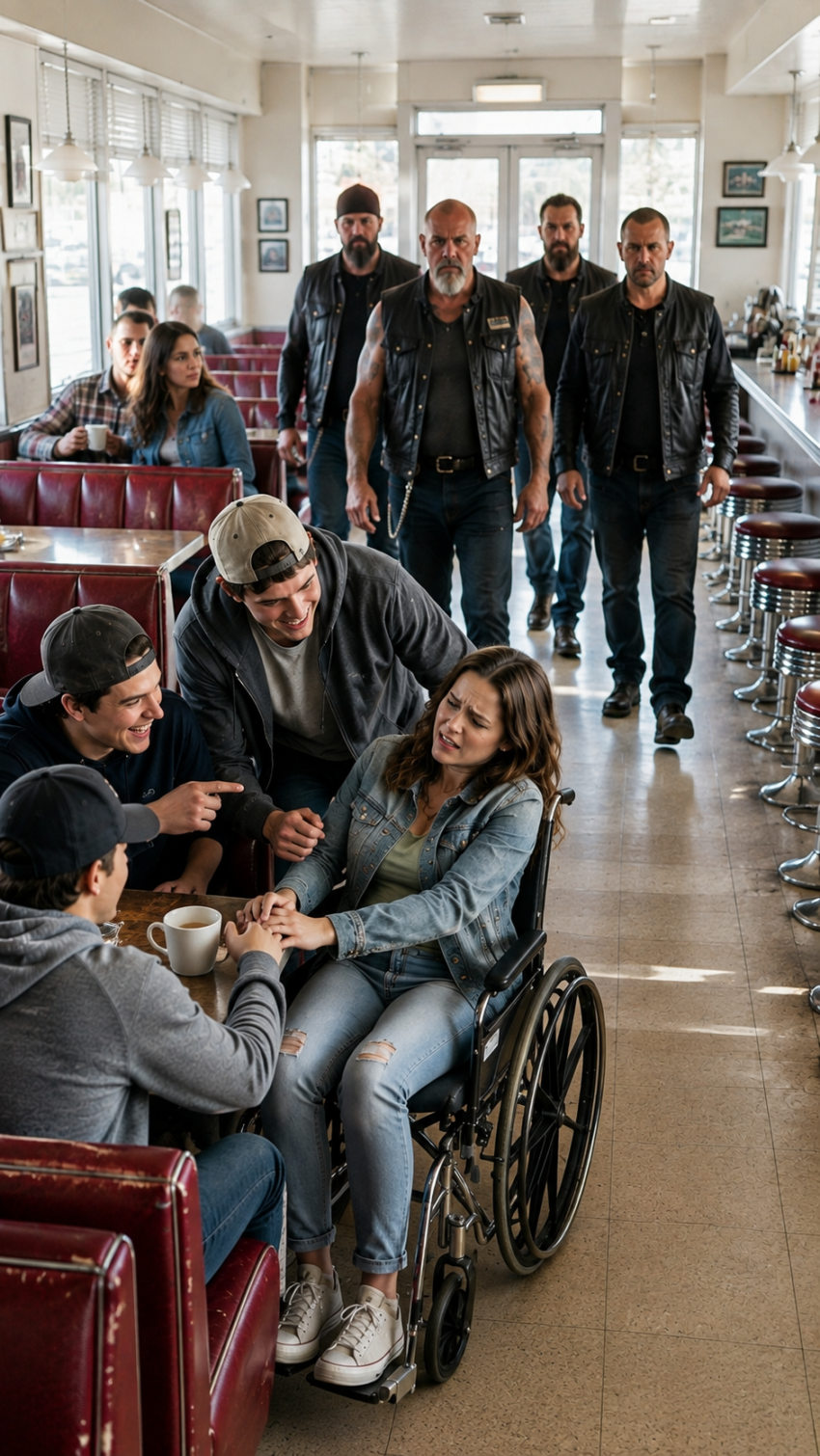
The Morning Evelyn Almost Left Without Breakfast
Morning light poured through the tall front windows of Willow Creek Café, a small family diner tucked beside a tree-lined road outside Madison, Wisconsin.
It was just after eight o’clock, and the place had already settled into its familiar rhythm.
Coffee cups clinked against saucers. A cook called out orders from behind the pass-through window. Two construction workers argued cheerfully about a baseball game while an older couple shared toast in the corner booth they had occupied every Friday for nearly fifteen years.
Nothing about the morning suggested that anyone inside would remember it for long.
Then Evelyn Mercer rolled through the front door.
She was twenty-seven, with shoulder-length chestnut hair, thoughtful gray-blue eyes, and the quiet expression of someone accustomed to noticing more than she said. A lightweight denim jacket covered her cream blouse, and a canvas bag hung neatly from the back of her wheelchair.
Evelyn had been born with a neurological condition that affected the strength and coordination in her legs. She had used a wheelchair since childhood, and over the years she had become skilled at navigating narrow hallways, awkward entrances, crowded sidewalks, and the occasional stranger who spoke to her as if physical disability had somehow changed her ability to understand ordinary conversation.
Most days, she handled those moments with patience.
That morning, however, she was tired.
She had been up since five finishing illustrations for a children’s book she had been working on for months. She had stopped at Willow Creek Café because she wanted coffee, pancakes, and twenty quiet minutes before meeting her editor downtown.
That was all she wanted.
A simple breakfast.
A normal morning.
The Booth Near the Window
A waitress named Denise guided Evelyn toward a spacious table near the front window.
“This one gives you a little more room,” Denise said warmly.
“Perfect. Thank you.”
Evelyn ordered blueberry pancakes, scrambled eggs, and coffee with cream.
While she waited, she opened her tablet and reviewed a sketch of a little fox standing beneath a huge oak tree.
For several peaceful minutes, she forgot about the room around her.
Then four teenage boys entered.
They looked to be sixteen or seventeen, probably high school students enjoying a late start or skipping something they were supposed to attend. They dropped into the booth behind Evelyn with the noisy confidence of teenagers who believed the whole room belonged to them.
At first, she barely noticed.
One complained about a chemistry test. Another talked about someone’s truck. Someone dropped a spoon and laughed much harder than the situation required.
Normal teenage noise.
Then one of them noticed Evelyn.
His voice lowered.
Another boy looked over his shoulder.
Then came the first laugh.
Evelyn kept her eyes on her screen.
She had heard that laugh before.
Not from those boys specifically, but from airports, shopping centers, college hallways, sidewalks, restaurants, and once, painfully, from a group of adults at a wedding.
It was the laugh people used when they wanted someone nearby to know they were being discussed without having the courage to say anything directly.
Evelyn took a slow sip of coffee.
She had learned not to react.
Usually, boredom defeated people faster than confrontation did.
A Joke That Wasn’t Funny
The boys kept whispering.
Their laughter grew less subtle.
One of them deliberately dragged his chair backward until it came unusually close to one wheel of Evelyn’s chair.
Another murmured something.
The table erupted again.
Evelyn stared at the fox drawing on her tablet, though she was no longer seeing it.
Her shoulders had tightened.
Denise arrived with breakfast and seemed to notice something was wrong.
“Everything okay, honey?”
Evelyn gave her a small smile.
“I’m alright.”
She wished that were true.
Denise walked away.
Evelyn poured syrup onto her pancakes and tried to focus on breakfast.
Then she heard a voice behind her.
“Hey, careful. Don’t block the traffic lane.”
The others laughed.
Evelyn turned slightly.
The boy speaking had sandy hair and a bright red sweatshirt. He looked pleased with himself.
“There’s plenty of room,” Evelyn replied calmly.
He shrugged.
“Just saying.”
She turned back toward her table.
Then she felt a small jolt behind her.
Someone had nudged the back of her wheelchair with a shoe.
It wasn’t enough to move her far.
But it was intentional.
Evelyn froze.
The Moment the Café Went Quiet
She turned around.
“Please don’t do that.”
Her voice was steady, but the room around her had begun to quiet.
The boy lifted both hands.
“Relax. I barely touched anything.”
One of his friends snickered.
Evelyn looked at him for several seconds.
“I asked you not to touch my chair.”
The boy rolled his eyes.
“Okay.”
For a moment, Evelyn believed that might end it.
Then another boy reached across the narrow space between the tables as though pretending to grab a napkin. His elbow bumped the edge of Evelyn’s plate.
The plate shifted.
A pancake slid halfway off before tipping onto the floor.
The syrup landed first.
Then the pancake.
The laughter behind her lasted only a second.
Because everyone else in the café had gone completely silent.
Evelyn stared at the floor.
Something about the ridiculous sight of a blueberry pancake lying beside her wheel made the moment worse.
Not because breakfast mattered.
Because dignity did.
And suddenly she was tired of pretending these things didn’t hurt.
The People Who Looked Away
Evelyn bent forward instinctively, reaching for a napkin.
Denise rushed over.
“No, no. Leave that. I’ve got it.”
Her voice sounded angry now, though not at Evelyn.
A middle-aged man at the counter turned fully around and stared at the teenagers.
A woman across the room whispered to her husband.
An older gentleman rose from his booth and walked toward Evelyn.
He had silver hair and wore a green flannel shirt beneath a brown work jacket.
He crouched beside the fallen plate and helped Denise clean the floor.
Then he looked at Evelyn.
“I’m sorry you were treated that way.”
Evelyn swallowed.
“Thank you.”
He glanced toward the boys.
“Someone should’ve spoken up sooner.”
That sentence stayed with her.
Someone should have.
Yet for several minutes, nobody had.
Everyone had seen what was happening.
Most people had simply hoped someone else would become responsible for stopping it.
Evelyn Refused to Leave
Denise offered to move Evelyn to another table.
Evelyn shook her head.
“No. I was here first.”
The answer surprised even her.
Denise studied her face, then nodded.
“Then you stay right here.”
She brought a fresh breakfast and refused to add it to the bill.
The boys grew quieter after that, although occasional whispers still drifted from their booth.
Evelyn ate slowly.
Her hands had stopped shaking, but humiliation lingered beneath her ribs like a heavy stone.
She considered calling her older brother, Grant.
Then she dismissed the idea.
Grant lived forty minutes away and would worry unnecessarily.
Besides, Evelyn didn’t want to become someone who needed a family member every time the world disappointed her.
What she didn’t know was that she wouldn’t have to call anyone.
Someone else had already made a phone call.
The silver-haired man in the flannel shirt had stepped outside several minutes earlier.
And he knew exactly who to contact.
The Sound From the Parking Lot
About forty-five minutes later, Evelyn was finishing her second cup of coffee when a low mechanical rumble reached the windows.
At first, nobody paid attention.
Then the sound multiplied.
One engine became several.
Several became many.
Heads turned toward the parking lot.
Denise stopped halfway through refilling a coffee mug.
Outside, a line of motorcycles began rolling into Willow Creek Café.
They arrived calmly, not in a rush, parking one after another along the far side of the lot.
The riders removed their helmets.
Most wore leather or heavy riding jackets over jeans and boots.
There were older men with gray beards, a woman with a silver braid, a broad man wearing glasses, and several riders who looked like they could have been teachers, mechanics, business owners, or retired military personnel.
Their presence was impressive, but not chaotic.
They didn’t shout.
They didn’t surround anyone.
They simply walked toward the diner together.
The teenagers behind Evelyn stopped talking completely.
The Man With the Weathered Jacket
The bell above the café door rang.
Four riders entered first.
The man leading them looked to be in his late fifties.
He was tall, broad through the shoulders, with a closely trimmed gray beard and a weathered black riding jacket covered in small patches from charity events and cross-country rides.
His name was Nolan Pierce.
Behind him came three others: Wes Callahan, a retired electrician; Marla Quinn, who owned a small auto repair shop; and Dean Foster, a former paramedic who now spent most weekends organizing fundraising rides for local families.
Nolan didn’t immediately look at the teenagers.
Instead, he scanned the room.
Then he saw Evelyn.
His expression changed.
Not into pity.
Into concern.
He crossed the diner and stopped beside her table.
Then, despite his size, he lowered himself until they were speaking at eye level.
“You Evelyn?”
She blinked.
“Yes.”
He nodded toward the older gentleman in the flannel shirt.
“Frank called us.”
Evelyn looked across the room.
The silver-haired man gave her a small nod.
Nolan spoke gently.
“He said somebody here was having a rough morning.”
Evelyn looked down at her coffee.
“I’m okay.”
Nolan waited.
Then he said something she would remember for years.
“You don’t have to tell people you’re okay just to make them comfortable.”
Why They Had Come
Evelyn looked up.
Behind Nolan, more riders had entered and quietly taken places near the entrance and along the counter.
None looked threatening.
If anything, they seemed unusually calm.
Nolan pointed to one of the patches on his jacket.
It read: Road Lanterns Community Riders.
“We mostly organize charity rides,” he explained. “Hospital bills, school supplies, veterans’ programs, kids who need adaptive equipment. Things like that.”
Evelyn glanced toward Frank.
“You called all of them?”
Frank smiled sheepishly.
“Nolan was already meeting the group for breakfast down the road.”
Nolan chuckled.
“Once everybody heard why Frank was upset, breakfast plans changed.”
For the first time that morning, Evelyn almost laughed.
Almost.
Then Nolan followed her gaze toward the teenagers.
They were suddenly fascinated by their phones.
No Shouting Was Necessary
Nolan stood.
He walked toward their booth, stopping several feet away.
Wes and Marla stayed near Evelyn.
Nolan’s voice never rose.
“Gentlemen.”
The boys looked up.
The one in the red sweatshirt tried to appear relaxed.
“Yeah?”
Nolan nodded toward Evelyn’s table.
“I heard someone thought bothering that young woman was entertaining.”
No one answered.
Nolan continued.
“I’m not interested in embarrassing anybody. I’m interested in whether you understand what happened here.”
One teenager mumbled, “It was just a joke.”
Nolan’s expression remained calm.
“A joke is something everyone can laugh at.”
Silence.
“When the only people laughing are the ones making someone uncomfortable, that’s usually something else.”
The boy in red shifted in his seat.
Nolan continued.
“You’re young. That means you still have time to decide what kind of men you’re going to become.”
No threat.
No intimidation.
Just a truth placed directly in front of them.
The Apology
For several seconds, nobody spoke.
Then the youngest-looking boy stood.
His face had turned red.
He looked toward Evelyn.
“I’m sorry.”
The others glanced at him.
He continued.
“I shouldn’t have laughed.”
Evelyn studied him.
His apology sounded awkward.
But genuine.
Another boy stood next.
“Me too.”
The teenager in the red sweatshirt remained seated.
Nolan said nothing.
He didn’t need to.
Finally, the boy pushed himself upright.
He looked uncomfortable, embarrassed, and far less confident than he had an hour earlier.
“I shouldn’t have touched your chair.”
Evelyn met his eyes.
“No. You shouldn’t have.”
He nodded.
“I’m sorry.”
She let the silence stretch another second.
Then she said, “I hope next time you see someone being treated differently, you remember how this felt.”
The boy looked down.
“I will.”
Maybe he meant it.
Maybe he didn’t.
But something in the room had changed.
Breakfast With Strangers
Nolan didn’t ask the teenagers to leave.
Instead, he returned to Evelyn’s table.
“Mind if we join you?”
Evelyn looked around at the growing number of riders.
“All of you?”
Marla laughed.
“Only if you have a very large table.”
The café relaxed.
Tables were pushed together.
Denise brought more coffee.
Several riders ordered pancakes just because Evelyn had complained hers were getting cold.
Within fifteen minutes, the strange, tense morning had transformed into one of the liveliest breakfasts Willow Creek Café had hosted in years.
Evelyn learned that Nolan had three daughters and five grandchildren.
Marla had once driven a motorcycle through forty-eight states.
Dean carried extra granola bars because he claimed every emergency in life could be improved slightly with food.
Wes admitted he had joined the riding group because retirement had become boring after six weeks.
Evelyn laughed more during that breakfast than she had in days.
The Jacket Around Her Shoulders
Eventually, Evelyn mentioned she needed to leave for her meeting.
Outside, the temperature had dropped slightly, and she realized she had left her warmer coat at home.
Nolan removed his riding jacket.
“Here.”
Evelyn shook her head.
“Absolutely not. You’ll freeze.”
“I have another layer underneath.”
“That thing probably weighs more than I do.”
He laughed.
“Then consider it temporary armor.”
He carefully placed the jacket around her shoulders.
It smelled faintly of leather, coffee, and cold morning air.
Evelyn touched one of the patches.
It showed a small lantern beside the words Keep the Road Bright.
“Why the lantern?” she asked.
Nolan’s smile softened.
“Because years ago, somebody helped me through a difficult season when they didn’t have to. I decided I’d spend the rest of my life trying to pass that light forward.”
Evelyn looked at the riders around her.
Then she looked at the café customers who had watched the entire morning unfold.
“I think you did.”
What Evelyn Remembered Most
A month later, Evelyn returned to Willow Creek Café.
The waitress recognized her immediately.
“Blueberry pancakes?” Denise asked.
Evelyn smiled.
“Absolutely.”
The teenagers weren’t there.
Neither were the riders.
It was just an ordinary Tuesday morning.
But something had changed inside Evelyn.
For weeks, people who heard the story focused on the motorcycles.
They talked about the sound of the engines, the sight of nearly two dozen riders entering the parking lot, and Nolan standing beside the boys without ever raising his voice.
But that wasn’t what Evelyn remembered most.
She remembered Frank standing up.
She remembered Denise refusing to let her move tables.
She remembered the first teenager finding enough courage to apologize.
She remembered Nolan kneeling so they could speak eye to eye.
And she remembered one sentence:
“You don’t have to tell people you’re okay just to make them comfortable.”
That sentence stayed with her because it gave her permission to stop minimizing her own feelings.
Evelyn had spent years believing strength meant absorbing discomfort without complaint.
That morning taught her something different.
Sometimes strength meant saying, “Please don’t treat me that way.”
Sometimes courage meant standing beside someone before you knew their story.
Sometimes dignity was restored not through dramatic gestures, but through ordinary people deciding that silence was no longer enough.
What Happened Afterward
A few weeks later, Nolan contacted Evelyn through Frank.
The Road Lanterns were organizing a community fundraiser for a local recreation center that needed better accessible entrances and adaptive playground equipment.
They wanted Evelyn to design the event poster.
She agreed.
Then she did something unexpected.
She asked whether she could attend the planning meeting.
That single meeting became many.
Within a year, Evelyn was helping the group create illustrated materials for accessibility projects throughout southern Wisconsin.
She designed guides for local businesses.
She helped raise money for adaptive sports equipment.
She spoke at two high schools about the difference between curiosity and disrespect.
And one afternoon, while finishing a presentation at a community center, a young man approached her.
It took Evelyn several seconds to recognize him.
The red sweatshirt was gone.
The nervous confidence was gone.
But it was him.
The teenager from the café.
His name was Tyler.
He stood several feet away, hands in his pockets.
“I don’t know if you remember me.”
Evelyn looked at him.
“I remember.”
He nodded slowly.
“I figured you would.”
There was a long pause.
Then he said, “I wanted you to know I joined the accessibility committee at school.”
Evelyn raised an eyebrow.
Tyler gave an embarrassed smile.
“Turns out our building has a lot of problems I never noticed before.”
She didn’t know what to say.
So he continued.
“That morning at the diner… I thought Nolan made me feel small.”
He looked toward the floor.
“Later I realized I’d already done that to you.”
Evelyn remained quiet.
Tyler looked back at her.
“I’m still sorry.”
This time, she smiled.
“Then do something good with what you learned.”
He nodded.
“I’m trying.”
And somehow, that mattered more than the apology.
Sometimes the strongest person in the room is not the one who speaks the loudest, but the one who quietly protects another person’s dignity when everyone else is waiting for somebody else to act.
We may never fully understand the challenges another person carries each day, which is why basic respect should never depend on whether we know their history, their struggles, or the reasons their life looks different from ours.
True kindness is more than feeling sorry after something unfair has happened; it is having the courage to step forward while it is happening and letting another person know they do not have to face the moment alone.
A person who uses a wheelchair, walks differently, communicates differently, or needs help with certain tasks does not need to be treated as fragile; they deserve the same dignity, independence, humor, choices, and ordinary human respect everyone else expects.
Young people will sometimes make careless choices, but a mistake does not have to become an identity when someone is willing to accept responsibility, listen without excuses, and change the way they treat others afterward.
There are moments when silence may feel easier because speaking up seems uncomfortable, yet the small discomfort of standing for someone can mean far less than the loneliness experienced by the person everyone else has chosen to ignore.
The people who change our lives are not always relatives, close friends, or people we have known for years; sometimes they are strangers who recognize an unfair moment and simply decide that walking past it is not acceptable.
Strength does not mean pretending nothing hurts, and dignity does not require a person to smile through every difficult situation; sometimes one of the bravest things we can say is simply, “That was not okay, and I deserved better.”
Respect becomes meaningful when it continues after the emotional moment has passed, turning apologies into better choices, lessons into action, and one difficult experience into a reason to make life easier for someone else.
A better community is rarely created through one enormous heroic act; more often, it is built through hundreds of ordinary decisions to notice people, include them, defend their dignity, and pass forward whatever kindness once helped us find our own way.