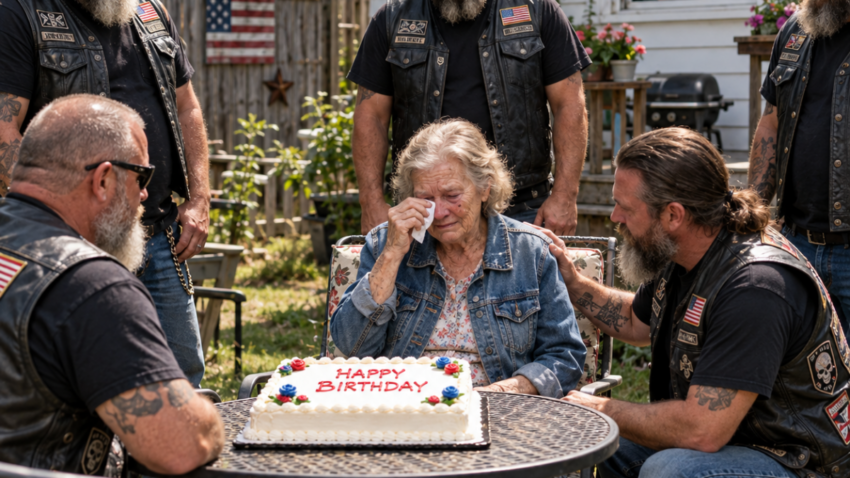
A79-Year-Old Woman Admitted She Had Never Had a Birthday Party in Her Life—Two Days Later, Dozens of Bikers Roared Onto Her Street at Noon.
For forty-three years, my house was quiet enough to hear myself disappear.
No birthday candles.
No singing.
No knock at the door.
By the time I turned seventy-nine, I had become so used to being unseen that when a tattooed biker broke down in front of my porch and asked my name, I almost forgot how to answer.
My name is Margaret Holloway.
I live in a little blue house on Sycamore Street, at the edge of a Montana town where the Bitterroot Mountains rise like old guards behind the rooftops. In winter, the wind rolls down from those mountains and slips through every crack in the walls. In summer, the dust settles on the porch rail no matter how often I wipe it away.
I am eighty years old now.
But when this story began, I was still seventy-nine.
And I was a ghost.
That is a strange thing to say when you still have a body. I still had hands that trembled when I buttoned my cardigan. I still had knees that ached when rain was coming. I still had a voice, though I used it less and less every year.
But people can disappear long before they die.
It happens slowly.
First, neighbors stop waving.
Then the cashier at the grocery store stops saying your name.
Then children ride past your house without knowing who lives inside it.
Then your mailbox becomes the only thing anyone checks on.
Eventually, you become part of the scenery.
The withered blue house.
The overgrown lilac bush.
The old woman on the porch.
Margaret Holloway.
Still breathing.
Barely noticed.
I was not always lonely because I lacked people around me.
I was lonely because I had spent my whole life being taught that wanting to be celebrated was shameful.
My father believed happiness made people foolish.
“Celebrations are for the vain, Margaret,” he used to say.
There were no birthday cakes in our house. No paper hats. No candles. No balloons. No little gifts wrapped in bright paper. My mother would make oatmeal on my birthday the same as any other morning. If I lingered by the calendar, hoping someone might remember, my father would clear his throat until I looked away.
When I married Gerald, I thought life might soften.
I thought marriage would be the doorway out of that cold house.
It was not.
Gerald was not cruel in the way people make movies about. He did not shout much. He did not hit. He paid bills on time, kept the lawn cut, and expected dinner at six.
But he had a way of making every small wish feel childish.
“We’re adults, Margaret,” he would say whenever I hinted at doing something for my birthday. “We don’t need parties.”
We.
That word did a lot of work in my marriage.
We did not need flowers.
We did not need music.
We did not need trips.
We did not need photographs.
We did not need anything soft enough to reveal what I wanted.
Gerald died fifteen years before the motorcycle came.
The house became quieter after that.
Not happier.
Just quieter.
At first, neighbors brought casseroles. They came to the door with covered dishes and solemn faces. They said, “Call if you need anything,” which is something people say when they hope you never will.
I did not call.
They stopped coming.
Years passed.
The casseroles became memories.
The memories became dust.
And in two days, on October 1st, I would turn eighty years old.
Eighty.
A whole lifetime.
And I knew the day would pass the way every birthday before it had passed.
No cake.
No song.
No one saying my name with joy inside it.
PART2:
That morning, I stood on my porch pulling my worn gray cardigan tighter around my shoulders. The mountain chill had settled into the floorboards. My hands hurt. My tea had gone cold on the little table beside me.
Across the street, Mrs. Leary was watering her flowers. She glanced in my direction, then looked away quickly, as if eye contact might require conversation.
A boy on a bicycle rode past and did not slow down.
I remember thinking, Not even the birds sound like they are speaking to me anymore.
That was when I heard it.
A low, guttural sound rolled into the street.
Not a car.
Not a truck.
Something heavier.
Meaner.
It started as a vibration in the road before it became a sound in the air. The windows trembled faintly behind me. Mrs. Leary froze with the garden hose in her hand.
Then a motorcycle turned onto Sycamore Street.
It was enormous.
Chrome and black metal.
A machine that looked less built than forged.
The man riding it was just as intimidating. Broad shoulders. Thick arms. Black leather vest. Tattoos down both arms—skulls, daggers, flames, names, dates, things I could not read from my porch. His beard was gray at the edges. His helmet was matte black.
He looked like everything my father had taught me to fear.
Then the engine popped.
Coughed.
And died directly in front of my house.
The sudden silence afterward felt almost rude.
The biker coasted the motorcycle to the curb and looked down at it.
I should have gone inside.
A proper old woman, the kind my mother had tried to raise, would have shut the door and locked it.
Instead, I stood there.
Maybe I was too tired to be afraid properly.
PART3:
Maybe I had been invisible for so long that danger seemed less frightening than another silent afternoon.
The man removed his helmet.
I expected a snarl.
I expected hard eyes.
Instead, I saw a weathered face, sun-browned skin, and eyes that were tired but kind.
He looked up at me and touched two fingers to his forehead.
“Morning, ma’am.”
His voice was deep enough to belong to the motorcycle.
I nodded because I could not think what else to do.
He glanced at my driveway.
“I’m Patrick Sullivan,” he said. “Looks like my girl picked a bad time to quit on me. Would you mind if I rolled her up there and took a look? I’ll stay out of your way.”
My first instinct was no.
Not because he had been rude.
Because I had said no to so little in my life that the word still felt like a locked cabinet.
But he waited.
He did not push.
He did not grin like he already knew I would agree.
He simply stood there with one hand resting on the dead motorcycle, asking permission like my answer mattered.
That was the first strange thing.
“Yes,” I heard myself say. “You can use the driveway.”
Patrick Sullivan rolled his motorcycle into my driveway with surprising gentleness for such a large man.
Mrs. Leary was still watching from across the street, pretending badly that she was inspecting her roses.
Patrick noticed.
He gave her a cheerful wave.
She dropped the hose.
I almost laughed.
I had not laughed before noon in a very long time.
He crouched beside the motorcycle and opened a leather tool pouch. Everything inside was arranged neatly. Wrenches. Cloth. Spark plug tool. Little metal pieces I did not recognize.
“You live alone, Mrs…?”
“Holloway,” I said. “Margaret Holloway.”
He looked up.
“Mrs. Holloway.”
Nobody had said my name that carefully in years.
Not Margaret like a duty.
Not Holloway like a label on mail.
Both together.
Like I was present.
He worked for a while without asking for anything. After ten minutes, I surprised myself again.
“Would you like coffee?”
He looked up as if I had offered him treasure.
“Ma’am, if it isn’t trouble, I’d be grateful.”
Trouble.
I had made coffee for Gerald for thirty-eight years. He never once called it trouble.
I went inside and poured two cups. My hands shook a little as I carried them out, but Patrick stood immediately and took one before it could spill.
“Thank you kindly.”
We sat on the porch steps.
Well, I sat in my chair.
Patrick sat on the steps because he said he did not trust his greasy hands near my cushions.
He drank the coffee black and told me he had been riding through on his way to visit a friend near Missoula. He said he belonged to a veterans motorcycle club called the Iron Saints.
“Sounds religious,” I said.
He laughed.
“Mostly it means we’re old enough to limp after long rides and stubborn enough to do them anyway.”
I smiled into my cup.
He asked how long I had lived in the blue house.
“Forty-three years.”
“That’s a long time to know a porch.”
“It is.”
“You like it here?”
No one had ever asked me that.
People asked how long I had lived here. Whether the roof had been repaired. Whether Gerald had left me the house outright. Whether I needed help with snow removal.
No one asked if I liked it.
I looked out at Sycamore Street.
The cracked sidewalks.
The maples already losing their yellow leaves.
The houses full of people who had somehow allowed me to fade between them.
“I don’t know anymore,” I said.
Patrick did not rush into comfort.
He waited.
That waiting undid me more than any question could have.
I do not know why I told him.
Maybe because he was a stranger.
Maybe because his motorcycle had broken down like the world itself had parked him in front of me.
Maybe because I was two days from eighty and had become too tired to protect people from the sadness of my own life.
I told him about my father.
About birthdays that passed like chores.
About Gerald.
About the way people disappeared from my porch after the funeral.
About how silence was not empty, not really.
Silence has weight.
It settles on a person.
It teaches them to stop expecting sound.
Patrick listened with his coffee cup between both hands.
No pity on his face.
That mattered.
Pity makes people smaller.
Listening makes them real.
Finally, he asked, “When’s your birthday?”
“In two days.”
He frowned.
“Big one?”
“Eighty.”
His eyes sharpened.
“Eighty.”
I nodded.
He stared at me for a moment.
“And you’ve never had a birthday party?”
I looked down at my hands.
The skin was thin, blue-veined, spotted with age.
“No.”
“Not one?”
“No.”
“Not as a kid?”
“No.”
“Not from your husband?”
I smiled faintly.
“Gerald did not believe in fuss.”
Patrick’s jaw moved once.
I thought he might curse.
Instead, he set the coffee down carefully, as if whatever he was about to say required both hands free.
“Mrs. Holloway,” he said, voice low, “that isn’t just a shame.”
He stood.
His shadow fell across the porch.
“That’s a crime.”
I blinked.
A crime.
The word was too large for my little life.
Before I could answer, Patrick walked back to his motorcycle, checked something near the engine, and tried the starter.
This time, it roared alive.
He put on his helmet.
Then he turned back and did something no one had ever done to me in my own driveway.
He saluted.
Not mockingly.
Not dramatically.
Like I deserved the gesture.
“I’ll see you soon, Margaret Holloway.”
Then he pulled onto Sycamore Street and disappeared around the corner, leaving the smell of gasoline, coffee, and something I had almost forgotten.
Possibility.
The next day passed strangely.
Nothing happened.
That should have made sense.
A biker had stopped, fixed his motorcycle, heard an old woman’s sad story, and ridden away. People make promises when they are moved. Life swallows them afterward. I knew that.
Still, I found myself dusting the living room.
Then washing the porch windows.
Then taking my blue dress out of the closet.
Not the navy one I wore to funerals.
The lighter blue.
The one with tiny white flowers at the collar.
I had not worn it in years.
It still fit, though not the way it once had.
At seventy-nine, soon eighty, nothing fits the way it once did.
I hung it on the wardrobe door and stared at it for a long time.
Then I put it away.
I would not make a fool of myself.
That night, I slept poorly.
At midnight, the house creaked.
At two, a car passed.
At three, the heater clicked on.
At four, I woke from a dream in which my mother was lighting candles and my father kept blowing them out.
October 1st arrived gray and cold.
I woke before sunrise.
For a moment, I forgot.
Then I remembered.
Eighty.
I lay in bed and listened.
No footsteps.
No voices.
No phone ringing.
The silence was familiar.
Almost comforting in its cruelty.
At least it had not lied to me.
I sat up slowly, put my feet into slippers, and whispered into the empty room, “Happy birthday, Margaret.”
My voice sounded small.
I made toast.
One slice.
Tea.
No sugar.
I sat at the kitchen table and watched light gather in the window.
Around nine, Mrs. Leary’s daughter dropped off groceries across the street. I watched them carry bags inside, laughing about something. At ten, a mail truck passed without stopping. At eleven, I took my cardigan from the chair and sat on the porch.
The blue dress remained in the closet.
At noon, the ground began to shake.
At first, I thought it was thunder.
But the sky was clear.
Then the sound grew.
Deep.
Rolling.
Many engines.
Not one motorcycle.
Dozens.
The vibration came up through the porch boards into my slippers. Windows rattled. Birds burst from the maple trees. Doors opened all along Sycamore Street.
Mrs. Leary came out holding a dish towel.
Mr. Benton stepped onto his porch with his newspaper still in hand.
Children appeared at windows.
And then they came.
Motorcycles poured onto Sycamore Street like a river of chrome and black leather.
One.
Five.
Ten.
Twenty.
More.
They filled the road from curb to curb, engines growling, sunlight catching mirrors and handlebars. Some riders had long gray beards. Some were women with braided hair and leather jackets covered in patches. Some rode with flags on the backs of their bikes. Some had tattoos. Some had scars. One had a bright pink helmet with a white skull on the side.
At the front was Patrick Sullivan.
He parked directly in front of my house.
The engines cut one by one until the street fell into a stunned silence.
Every neighbor was watching now.
Not pretending.
Watching.
Patrick removed his helmet and walked up my path carrying a bouquet of bright sunflowers.
Behind him, two men unloaded a professional grill from a truck I had not noticed. Three women carried bags of food. Someone else carried folding tables. A tall man with a white beard brought a cooler. A woman in boots carried what looked like decorations.
Patrick stopped at the bottom of my porch steps.
“Happy eightieth birthday, Margaret Holloway.”
I could not speak.
He held out the sunflowers.
My hands trembled so hard he had to help me take them.
“What is this?” I whispered.
Patrick looked back at the street full of riders.
Then at the neighbors staring from their lawns.
“This,” he said, “is a reckoning.”
Within minutes, my front yard transformed into something I did not know houses like mine were allowed to hold.
Tables opened.
A grill fired up.
Music played from a speaker somewhere—old rock and roll, bright and loud enough to make Mrs. Leary clutch her pearls.
Balloons appeared.
Yellow.
Blue.
White.
Someone tied them to the porch rail.
Another rider hung a banner between the lilac bush and the mailbox.
HAPPY 80TH, MARGARET.
My name.
In big letters.
Across my own yard.
I touched my mouth.
Patrick noticed.
“You all right?”
“I don’t know,” I said honestly.
He smiled gently.
“That’s fair.”
Then Mrs. Leary came across the street.
Not because she wanted to apologize yet.
Because she was angry.
“What exactly is going on here?” she demanded.
Patrick turned around.
“Birthday party, ma’am.”
“This is a quiet neighborhood.”
“It was.”
Several bikers laughed.
Mrs. Leary stiffened.
Patrick did not raise his voice.
“Mrs. Holloway is eighty today,” he said. “Since none of you noticed for forty years, we’re helping you out.”
The words hit the street like a slap.
Mrs. Leary’s face went red.
Mr. Benton looked down at his newspaper.
A young mother next door pulled her child closer, then loosened her grip as the child stared at the balloons.
I wanted to disappear.
That old instinct rose fast.
Apologize.
Make it smaller.
Tell them it was fine.
Tell Patrick to stop.
Tell everyone I did not need this.
But Patrick glanced back at me.
His eyes said, Do not shrink now.
So I did not.
For once in my life, I stayed seated on my own porch while the world adjusted to my existence.
The bikers were not what the neighbors expected.
That made the whole thing worse for them at first.
A woman named Jo, who had silver braids down her back, set plates and napkins on a table with military precision. A huge man called Tiny gently helped Mrs. Leary’s little grandson pick a balloon. Another rider fixed the loose hinge on my gate without asking for credit. A tattooed woman named Carla brought me lemonade and called me “birthday queen.”
By one o’clock, the smell of searing steak and burgers had filled the air.
By one-thirty, children had migrated across lawns like cautious little birds.
By two, someone had convinced Mr. Benton to accept a hot dog.
By two-fifteen, Mrs. Leary was still pretending not to want food while standing six inches from the potato salad.
Patrick handed her a plate.
She took it.
That was how forgiveness began on Sycamore Street.
Not with a speech.
With potato salad and shame.
Neighbors drifted over one by one.
Awkwardly.
Slowly.
Like people approaching a door they had walked past for years and only just realized was unlocked.
Mrs. Leary came first.
She stood beside my porch with the plate in both hands.
“Margaret,” she said.
I looked at her.
I could not remember the last time she had said my first name.
“I didn’t know,” she said.
I wanted to be gracious.
I wanted to say it was all right.
But Patrick had taught me something with three words.
That’s a crime.
Not because my neighbors owed me a party.
But because a whole street had let an old woman vanish in plain sight.
So instead of saying it was fine, I said, “You could have.”
Mrs. Leary’s eyes filled.
“Yes,” she whispered. “I could have.”
She sat beside me.
After that, others came.
Mr. Benton, who had lived across from me for seventeen years, admitted he had not known Gerald had died fifteen years ago. He thought it had been “a few years back.”
A young woman named Allison confessed she had always wanted to ask if I needed help with the leaves but worried it would seem rude.
“You know what’s ruder?” Patrick said from the grill. “Watching a seventy-nine-year-old rake alone and calling your silence polite.”
Allison accepted that without arguing.
A boy named Caleb brought me a drawing of my house with balloons over it. He had used too much yellow, and the roof leaned sideways, and it was the most beautiful picture anyone had ever given me.
Children asked how old I was.
When I said eighty, one of them gasped as if I had survived a war.
Maybe I had.
The bikers laughed, cooked, told stories, and somehow made every person feel both embarrassed and welcome.
That was their gift.
They did not let the neighbors pretend they had done nothing wrong.
But they also did not shut them out when they tried to do better.
I watched people who had lived near one another for years finally speak like they were more than mailboxes and property lines.
A widow from the next block told me she had eaten dinner alone every night since her sister died.
A young father admitted he did not know how to help his elderly neighbor without making it awkward.
Patrick said, “Awkward help beats comfortable neglect.”
Nobody argued with that either.
The party grew.
Someone called someone.
Someone brought folding chairs.
Someone found a tablecloth.
A teenager set up lights along the fence.
By sunset, my little blue house glowed.
I had never seen it like that.
Not even when Gerald was alive.
Maybe especially not then.
It looked like a place where life was allowed.
Then Patrick disappeared into the crowd.
For a moment, I thought he had left.
A small, old fear touched my chest.
People leave at the best part.
But then the music lowered.
The crowd shifted.
And Patrick returned carrying a cake.
Not a grocery-store sheet cake.
A real cake.
Round.
White frosting.
Sunflowers piped around the edges.
Eighty candles flickered across the top.
So much light.
So much impossible light.
The bikers gathered behind him.
The neighbors filled the yard.
Children climbed onto porch steps.
Someone started singing.
Happy birthday to you.
The first notes were uneven.
Then stronger.
Then loud.
Bikers.
Neighbors.
Children.
Widows.
Men who had not known my name that morning.
Women who had watched me carry groceries and said nothing.
Patrick Sullivan with his leather vest and kind eyes.
All of them singing my name.
Happy birthday, dear Margaret.
My hand went to my chest.
For a moment, I was not eighty.
I was eight.
Twelve.
Twenty.
Forty.
Sixty-five.
Every version of me who had waited for a candle and never received one stood inside that song.
My father’s voice was gone.
Gerald’s scoff was gone.
The long kitchen silences were gone.
The empty birthdays were not erased.
Nothing can erase them.
But the song reached back somehow.
It found the girl who had learned not to ask.
It found the wife who had stopped hoping.
It found the widow who had mistaken silence for what she deserved.
The last line rang out across Sycamore Street.
Happy birthday to you.
Patrick set the cake before me.
“Make a wish, Margaret.”
I looked at the candles.
Eighty little flames shaking in the evening air.
“What should I wish for?” I asked.
Patrick smiled.
“Something selfish.”
I closed my eyes.
At first, nothing came.
Then one wish rose clear and quiet.
Let me not disappear again.
I blew.
The crowd cheered as the candles went out.
Not polite cheering.
Real cheering.
Wild cheering.
The kind that shakes loose things hidden in the ribs.
I cried then.
Not gracefully.
Not the way women in old movies cry, with one tear and a trembling chin.
I cried with my shoulders, with my hands over my face, with eighty years of unsung birthdays finally leaving my body.
Patrick knelt beside my chair and wrapped his arms around me.
He smelled like leather, smoke, engine oil, and vanilla frosting.
“You aren’t a ghost, Margaret,” he whispered.
I held onto his vest.
“You’re a legend.”
The bikers stayed until the stars came out.
They cleaned more than they cooked.
They packed leftovers into containers and made sure I kept the biggest piece of cake. Tiny fixed the porch step that had wobbled for three years. Jo wrote down her phone number in large clear letters and taped it to my refrigerator.
“If you need anything,” she said, “you call. And I mean call. Don’t do that polite old lady thing where you nearly die changing a lightbulb.”
“I have never nearly died changing a lightbulb,” I said.
Patrick looked at my ceiling fixture.
“That bulb’s been out a while.”
I did not answer.
He grinned.
“I knew it.”
At ten o’clock, the motorcycles lined up again.
The engines came alive one after another, but now the sound did not frighten me.
It sounded like thunder with a heartbeat.
Patrick stood beside his bike.
Mrs. Leary surprised everyone by hugging him.
He looked startled, then patted her back carefully.
“Check on her,” he told my neighbors.
Not as a suggestion.
As a command.
“We will,” Mrs. Leary said.
Patrick looked at me.
I stood on the porch in my blue dress with a cardigan over my shoulders and cake frosting on one sleeve.
He saluted again.
This time, I saluted back.
The Iron Saints rode away beneath the streetlights, one by one, until the last red taillight disappeared around the corner.
The street did not fall silent immediately.
That was the miracle.
Neighbors stayed.
They folded chairs.
Gathered cups.
Took down trash bags.
Allison washed serving spoons in my kitchen without acting like being in my house was an intrusion. Mr. Benton carried leftover burgers to my refrigerator. Mrs. Leary asked whether she could come by for tea the next afternoon.
I almost said she did not have to.
Then I stopped myself.
“I would like that,” I said.
She smiled.
“So would I.”
By eleven, the house was quiet again.
But not the old quiet.
Not the heavy, suffocating blanket I had worn for forty-three years.
This quiet was soft.
Warm.
Full.
The way a room feels after music ends but the memory of it remains in the walls.
I stood in my living room, looking at the sunflowers on the table.
The banner folded neatly on the chair.
The drawing from Caleb on the mantel.
The cake box in the kitchen.
My name had been sung in my own yard.
That mattered.
Do not let anyone tell you being seen does not matter.
It does.
Especially after a lifetime of being told your wanting is too much.
The next morning, the doorbell rang at nine.
I opened it to find Mrs. Leary standing there with a basket of muffins and eyes red from crying.
“I am early,” she said.
I thought of my father.
Early is not rude when someone is lonely.
“Come in,” I said.
She did.
That was how my eighty-first year began.
Not with silence.
With tea.
The week after the party, people kept coming.
Not all at once.
Not in a way that overwhelmed me.
But steadily.
Mr. Benton brought my newspaper to the porch instead of throwing it near the hedge.
Allison’s children asked if they could help water the lilacs.
Mrs. Leary came for tea every Wednesday and gradually admitted she had been lonely too.
“Loneliness makes people selfish,” she said one afternoon.
I stirred sugar into my cup.
“Sometimes it makes them blind.”
She nodded.
“Yes. That too.”
Patrick called every Sunday.
Sometimes from Montana.
Sometimes Idaho.
Once from Wyoming, where he said the wind was trying to remove his face.
The Iron Saints returned the next spring to repair my porch rail.
They said they were passing through.
They were not passing through.
They spent six hours sanding, painting, fixing, laughing, and arguing over whether burgers or ribs were better for lunch.
Patrick brought a small cupcake with one candle.
“It’s not your birthday,” I said.
He shrugged.
“Practice.”
So I made a wish anyway.
The year I turned eighty-one, Sycamore Street held a block party.
Not for me.
For everyone.
But Patrick came, and someone brought sunflowers, and when the children sang badly around a karaoke machine, I sang too.
Softly at first.
Then louder.
At eighty-two, I attended Caleb’s school concert because he asked me to.
At eighty-three, Allison’s daughter came to my kitchen to learn how to make pie crust.
At eighty-four, Mrs. Leary and I took a bus trip to see tulips in bloom.
At eighty-five, Patrick wheeled his motorcycle into my driveway and told me it was time I sat on it.
I said absolutely not.
Then I did.
There is a photograph somewhere of me on that enormous black motorcycle, cardigan buttoned wrong, helmet too big, grinning like a runaway girl.
Patrick framed it.
On the back, he wrote:
Margaret Holloway. Legend. First ride at eighty-five.
I keep it beside Caleb’s drawing.
People sometimes ask what changed my life.
They expect me to say the party.
Or the bikers.
Or Patrick.
And yes, all of that changed me.
But the true answer is smaller.
A stranger broke down in front of my house and asked permission to enter my driveway.
Then he asked my name.
Then he listened long enough to believe my loneliness mattered.
That was the beginning.
The motorcycles were only the thunder afterward.
I am eighty now in the story people like to tell.
The old woman with no birthday parties.
The biker with tattoos.
The roaring engines.
The cake.
The song.
The neighbors shamed into kindness.
It is a good story.
But I want people to understand what made it good.
It was not that bikers were secretly kind, though they were.
It was not that neighbors were secretly ashamed, though they were.
It was that someone noticed a silence everyone else had accepted.
That is what I think about most.
How many people live inside silences we walk past?
The widow whose lights go off early every night.
The veteran who sits alone at the diner.
The cashier whose hands shake when she counts change.
The old man whose yard used to be perfect and now grows wild.
The child who watches other children get picked up first.
The neighbor you have not waved to in years because not waving became easier than starting again.
People do not always need rescuing in dramatic ways.
Sometimes they need a birthday cake.
A phone call.
A chair pulled closer.
A question asked sincerely.
A name remembered.
Sometimes they need someone to say, “This silence is not acceptable,” and mean it.
On the night of my eightieth birthday, after everyone left, I stood in my kitchen with one hand on the sunflower bouquet.
The house was quiet.
Peaceful quiet.
Happy quiet.
Mine.
I looked around at the walls that had held forty-three years of absence and whispered, “I am Margaret Holloway.”
My voice did not sound small anymore.
“I am eighty years old.”
The flowers glowed gold under the kitchen light.