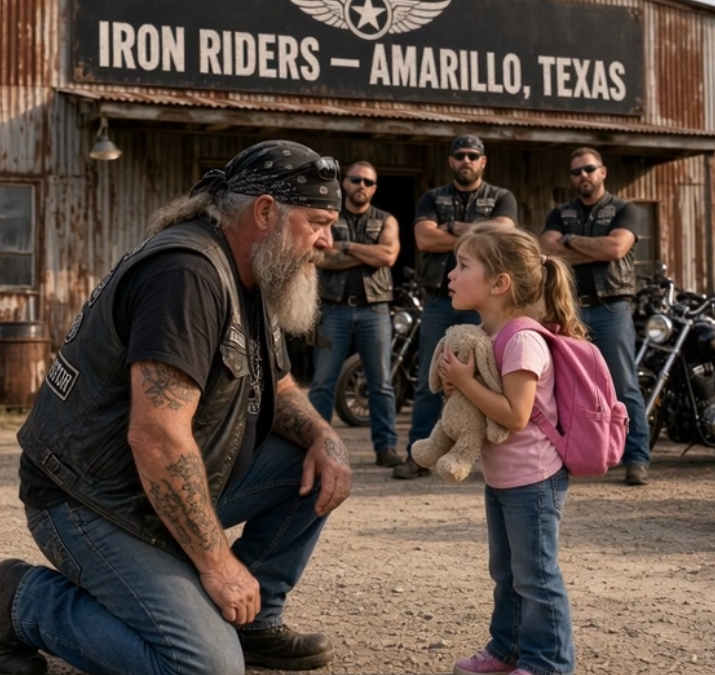
PART3:
Even the mechanics inside the garage seemed to freeze.
For a moment, Garrett thought he had heard wrong.
Heat shimmered behind the girl.
A motorcycle ticked as its engine cooled.
Somebody near the soda cooler whispered, “What did she say?”
Garrett slowly set the wrench down.
“What was that, sweetheart?”
The girl shifted the rabbit higher against her chest.
“I said, do you know anybody who needs a daughter?”
Her voice remained steady.
Almost too steady.
Garrett had heard that kind of voice before.
In grown men outside courtrooms.
In veterans at gas stations.
In women sitting in broken-down cars pretending they were not afraid.
In people who had practiced saying terrible things without letting the terrible show.
He crouched so he could meet her at eye level.
“What’s your name?”
“Madison Brooks.”
“How old are you, Madison?”
“Seven.”
She answered as if those facts had been requested from her a hundred times by strangers behind desks.
Garrett noticed how tightly she held the rabbit.
He noticed the tired circles under her eyes.
He noticed the dirt on her socks.
Most of all, he noticed that she was not acting like a child who expected help.
She was acting like a child who had already prepared herself for disappointment and was only checking one last place before giving up.
“Where are your people?” Garrett asked.
Madison looked past him into the garage.
There were bikes on lifts, tool cabinets, men in leather, a calendar on the wall, an old vending machine humming by the office door.
She seemed to be deciding whether any of it was trustworthy.
“I don’t really have any,” she said.
The words were quiet.
They did not sound dramatic.
That made them worse.
Garrett looked over his shoulder.
“Ray.”
A man near the office door straightened.
Raymond Pike was forty-eight, bald, built like a refrigerator, and gentle with children because he had five daughters and had lost every argument in his house since 2004.
“Yeah?”
“Get water.”
Ray was already moving.
“Tommy.”
A younger mechanic looked up.
“Call Marla. Tell her I need Eleanor Grant’s number now.”
The little girl shifted her weight.
“I’m not in trouble.”
Garrett looked back at her.
“No, sweetheart. I don’t believe you are.”
She studied him with careful suspicion.
“People say that before they call the police.”
“Sometimes police need calling.”
“I didn’t steal anything.”
“I didn’t say you did.”
“I left a note.”
Garrett went still.
“A note where?”
“At the house.”
“What house?”
She looked down at the rabbit.
“The latest one.”
That was how she said it.
Not my house.
Not home.
The latest one.
Garrett felt something tighten behind his ribs.
Ray returned with a cold bottle of water. He held it out, then hesitated, suddenly unsure if reaching too fast would scare her.
Madison took it politely.
“Thank you.”
Her manners hit every man in that lot harder than tears would have.
A hungry, dusty child with a backpack and a stuffed rabbit, thanking a stranger because somebody had taught her politeness survived even when protection failed.
Garrett stood slowly.
“Let’s get you out of the sun.”
She did not move.
“I have to ask first.”
“Ask what?”
She held the rabbit tighter.
“If I sit down, does that mean I have to stay?”
Garrett swallowed.
“No. Sitting down just means you sit down.”
“For how long?”
“As long as you want.”
She considered that.
Then she nodded once.
He guided her to a shaded picnic table behind the garage.
Nobody crowded her.
That was not an accident.
One look from Garrett sent every man in the lot into silent formation. Bikers were good at looking casual while forming a perimeter. Most people never noticed until they needed one.
Ray brought crackers from the vending machine.
Tommy found an apple in his lunch bag.
Someone set a paper plate on the table.
Madison thanked each person by looking directly at them, as if filing their kindness carefully but not spending it yet.
Then she ate.
Slowly.
Carefully.
Not like a kid enjoying a snack.
Like a child who knew food could be interrupted.
She took one bite of cracker.
Waited.
Another bite.
A sip of water.
She broke the apple slice in half and placed one half on the table beside the rabbit.
Garrett sat across from her.
“What’s his name?” he asked, nodding toward the rabbit.
Madison touched the toy’s worn head.
“Mr. Patches.”
“Good name.”
“He used to be Miss Bunny. Then his ear got fixed with a patch, so now he’s Mr. Patches.”
“Fair.”
She looked at the garage.
“Do girls come here?”
“Sometimes.”
“Do daughters?”
The question was small.
Garrett had no answer ready.
Ray turned away near the soda cooler.
Garrett folded his hands.
“Madison, can you tell me where you came from today?”
She looked down at her crackers.
“I heard them talking.”
“Who?”
“The lady and her sister.”
“What lady?”
“The foster lady.”
Garrett kept his face still.
He had learned, over many hard years, that anger made children stop talking even when anger was on their behalf.
“What did they say?”
Madison pressed one thumb into the table’s wood grain.
“She said she didn’t want me there anymore.”
No one moved.
“She said I was difficult. She said I watched people too much. She said she hoped they could move me before school started because she didn’t want another year of meetings.”
Garrett’s jaw tightened.
Madison continued without looking up.
“I’m not difficult on purpose.”
“I know.”
“I just ask where things are.”
“What things?”
“Food. Bathroom. Flashlight. Doors. Medicine. The phone.”
Garrett felt every word like a nail.
“She said I make the house feel like a prison.”
Madison lifted one shoulder in a tiny shrug.
“So I thought it would be easier if I left first.”
Garrett had to look at the far fence for a second.
Behind him, someone muttered a curse.
He did not turn to see who.
“Did you walk all the way here by yourself?”
Madison nodded.
“How far?”
“I don’t know.”
“How long?”
“Since after lunch.”
It was nearly five.
Garrett leaned forward.
“Madison, did anyone hurt you?”
She shook her head quickly.
“No.”
“Did anyone touch you in a way they shouldn’t?”
“No.”
“Did anyone tell you to leave?”
“No.”
“Then why come here?”
For the first time, her face changed.
Not much.
But enough.
“I saw your sign.”
“What sign?”
She pointed toward the front of the garage.
On the wall near the office door hung an old painted board from a charity ride years earlier.
THUNDER RIDGE MOTORCYCLE GARAGE
VETERAN OWNED
FAMILY FUNDRAISERS
KIDS RIDE FREE AT CHRISTMAS
Under that was a smaller sticker from an event Garrett barely remembered.
Nobody rides alone.
Madison said, “It said kids.”
Garrett looked at the sign.
Then back at her.
“I thought maybe somebody here had extra family,” she said.
Ray made a sound behind him and walked into the garage.
Garrett nodded slowly.
“Madison, are you running away?”
Her eyes came up.
“I wasn’t running away.”
“No?”
“Running away means somebody would come looking for you.”
The sentence landed so hard the whole table seemed to shake.
Nobody spoke.
Because sometimes the saddest things are spoken in the calmest voice.
Garrett stood.
“I need to make a call.”
Madison’s hand tightened around Mr. Patches.
“Are you calling the foster lady?”
“Not first.”
“Police?”
“Not first.”
“Who then?”
“Someone who knows how to make adults behave.”
That earned the smallest crease between her eyebrows.
“Is she mean?”
Garrett almost smiled.
“When necessary.”
He stepped away and pulled out his phone.
There was only one person he trusted with a situation like this.
Eleanor Grant.
She operated a nonprofit legal advocacy office in downtown Amarillo and had spent three decades helping vulnerable children, foster families, elderly people, veterans, and anyone else who got chewed up by systems polite society preferred not to examine too closely.
Eleanor was sixty-six, sharp as broken glass, and had once made a county commissioner apologize in public using nothing but a folder, a microphone, and eye contact.
She answered on the third ring.
“Garrett, if this is about another parking dispute, I’m hanging up immediately.”
“I found a little girl.”
Silence.
Then her voice changed.
“Explain.”
He did.
Every detail.
The backpack.
The rabbit.
The question.
The latest house.
The overheard phone call.
No one coming.
Eleanor did not interrupt once.
When he finished, she said, “Is she safe right now?”
“Yes.”
“Fed?”
“Some.”
“Water?”
“Yes.”
“Injured?”
“Not that I can see.”
“Do not question her like an investigator. Do not make promises you cannot legally keep. Do not let anyone take her from that garage unless I know who they are and under what authority. I’m on my way.”
“Should I call police?”
“I will call the right number while driving.”
“Eleanor.”
“What?”
“She asked if anyone needed a daughter.”
The line went quiet.
When Eleanor spoke again, the sharpness was still there, but something beneath it had cracked.
“I’ll be there in twenty minutes.”
By evening, Eleanor Grant walked into Thunder Ridge Motorcycle Garage carrying a legal folder under one arm and a grocery bag under the other.
She was small, Black, silver-haired, dressed in a navy pantsuit despite the heat, and moving with the kind of purpose that made grown men step aside before they understood why.
She walked directly to Madison.
Madison sat at the picnic table with Mr. Patches in her lap. Someone had found a coloring book, but she had only colored one corner of one page in careful blue lines.
Eleanor placed the grocery bag on the table.
“I brought peanut butter cookies.”
Madison blinked.
“For me?”
Eleanor glanced at the stuffed rabbit.
“Unless your rabbit plans on eating them first.”
Madison looked at Mr. Patches.
“He doesn’t have a mouth.”
“That makes him easier to share with.”
Madison studied her.
“You’re the mean lady?”
Garrett covered his mouth and turned away.
Eleanor’s eyebrows rose.
“Depends who you ask.”
“Mr. Garrett said you make adults behave.”
“Then yes,” Eleanor said. “I suppose I am the mean lady.”
Madison accepted this.
“Okay.”
Eleanor sat across from her.
“I am going to tell you the truth, Madison. Some adults are worried about you right now. Some should have been worried sooner. I’m going to help sort out which is which.”
Madison opened the cookie bag slowly.
“Do I have to go back?”
“That is not a question I can answer in one sentence.”
“I like one sentence answers.”
“Most people do. They are rarely the useful kind.”
Madison took one cookie.
Eleanor continued.
“I cannot promise you that you will stay here tonight. This is a motorcycle garage, not a licensed foster home.”
Madison looked toward Garrett.
He looked down.
“But,” Eleanor said, and Madison’s eyes returned to her, “I can promise that you will not be treated like a lost backpack. You will be heard. Your note will be read. Your placement will be reviewed. And nobody at this table is going to pretend a seven-year-old walking across town asking strangers for a family is normal.”
Madison did not cry.
She took a bite of cookie.
Then she said, “Okay.”
By then, Eleanor had already made calls.
The first troubling detail came fast.
No official missing-child report had been filed.
The foster placement had called the agency, yes.
But not police.
Not emergency services.
The foster mother had said Madison “had a pattern of attention-seeking behavior” and would “likely return when she realized no one was chasing her.”
Eleanor’s face when she heard that should have been registered as a weapon.
Garrett stood near the office doorway while she spoke on the phone.
“No,” she said into the receiver. “You are not understanding me. I am standing in front of the child right now. She walked across Amarillo in ninety-degree heat with a backpack and a stuffed rabbit because an adult responsible for her care made her believe removal was inevitable and absence would be more convenient.”
Pause.
“I do not care if your supervisor is at dinner.”
Pause.
“Then interrupt dessert.”
By eight o’clock, a police officer arrived.
A real one, not some swaggering fool looking to make a situation worse.
Officer Bethany Rios had been in and out of the garage for charity events before. She knew Garrett. She knew Eleanor. Most importantly, she knew how to crouch when speaking to children.
She took Madison’s information gently.
Eleanor stayed close.
Garrett stood twenty feet away because Eleanor had told him not to hover, and Garrett had survived enough of life to obey terrifying women when they were right.
A child welfare emergency worker arrived after nine.
Her name was Tessa Moore.
She looked tired enough to fall asleep standing, but she brought a clean sweatshirt, a case file, and a stuffed dinosaur she said lived in her car “for emergencies involving people under four feet tall.”
Madison accepted the sweatshirt.
Declined the dinosaur.
Mr. Patches, apparently, did not tolerate rivals.
By ten-thirty, Madison was placed in emergency respite care for the night with a licensed foster family Eleanor personally knew through advocacy work.
Madison did not want to go.
She also did not fight.
That was almost worse.
She stood beside Garrett near the garage entrance, backpack on, rabbit under her arm.
“Do you need a daughter?” she asked quietly.
The question was different now.
Not public.
Not brave.
Just small.
Garrett crouched.
He had faced down drunk men with knives, angry ex-club members, cops with bad information, and doctors giving bad news.
Nothing in his life prepared him for that question from that child.
“I don’t know how to answer that yet,” he said honestly.
Madison’s face closed a little.
“But I know this,” he added quickly. “I don’t want you walking around alone asking strangers anymore.”
She looked at him.
“Then what do I do?”
“You let Miss Eleanor do what she does. You let Officer Rios know if anybody scares you. You let Tessa take you somewhere safe tonight. And you let me show up tomorrow.”
“Tomorrow?”
“Yes.”
“People say tomorrow.”
“I know.”
“Then they forget.”
“I won’t.”
She stared at him.
“Promise?”
Garrett almost said yes automatically.
Then stopped.
He had learned from Eleanor already: do not make promises lightly to children who count broken ones.
“I promise I will do everything in my power to show up tomorrow,” he said.
Madison thought about it.
“That’s a lawyer answer.”
Eleanor, nearby, smiled despite herself.
Garrett nodded.
“Maybe I’ve been spending too much time with the mean lady.”
Madison held out Mr. Patches.
Garrett froze.
“You want me to hold him?”
“Just for tonight.”
Her voice stayed steady.
But her hand shook.
“If you have him, you have to come tomorrow.”
Garrett looked at the rabbit.
Then at her.
He took Mr. Patches carefully, like a sacred object.
“I’ll guard him.”
“Don’t let the oil get on him.”
“I won’t.”
“Don’t put him near sparks.”
“Never.”
“And he doesn’t like being upside down.”
“I’ll remember.”
Madison nodded once.
Then she walked with Tessa to the car.
When they drove away, Garrett stood in the parking lot holding a worn stuffed rabbit against his chest while half a dozen bikers pretended not to see tears in his beard.
Ray finally said, “Stone.”
Garrett looked over.
“You okay?”
“No.”
“Good.”
Garrett looked at Mr. Patches.
“I think I’m in trouble.”
Ray nodded.
“Yeah. Big trouble.”
The next morning, Garrett showed up.
He arrived at the respite home at nine with Eleanor, because Eleanor said he was not going anywhere near a foster home alone like some leather-clad misunderstanding waiting to happen.
Madison opened the door before the foster mother finished calling her name.
Her eyes went straight to his hands.
Garrett held out Mr. Patches.
“Kept him upright all night.”
She took the rabbit and inspected him.
“No oil.”
“No sparks either.”
Madison hugged the rabbit hard.
Then she looked up.
“You came.”
Garrett nodded.
“I said I would.”
“You said you’d do everything in your power.”
“That included coming.”
She accepted this.
That first visit lasted twenty minutes.
The second lasted thirty.
The third, one hour at Eleanor’s office, where Madison drew a picture of a motorcycle with a rabbit in the sidecar.
Garrett taped it inside his toolbox.
Within a week, the first foster placement was under review.
Within two weeks, it was closed to new placements pending investigation.
Within three weeks, Eleanor had learned more of Madison’s story.
Her mother, Lila Brooks, had struggled with addiction and untreated mental illness. Her father was unknown. Madison had entered care at five after being found alone in an apartment with no food but a box of crackers and no working phone. She had been in three placements before the one she walked away from. None had been physically abusive. All had been temporary. All had failed in the slow ordinary ways that do not always make headlines but teach children not to unpack.
She hoarded snacks.
She asked where exits were.
She memorized adult moods.
She slept with her shoes beside the bed.
She had learned that being “good” meant being low-maintenance, and being low-maintenance meant needing nothing loudly enough to bother anyone.
Garrett learned these things from case meetings he was not technically part of at first, from Eleanor’s careful summaries, and from Madison herself in tiny pieces.
She did not tell stories in order.
Children rarely do when the story has hurt them.
She would say, “One house had a dog named Pepper, but he wasn’t allowed in bedrooms.”
Or, “If you put cereal in a cup, you can take it under blankets.”
Or, “Sometimes people say forever when they mean until Friday.”
Garrett wrote things down.
Not because he planned to forget.
Because Madison noticed when adults recorded important information.
He bought a small black notebook and wrote in it during visits.
Favorite food: peanut butter cookies, chicken noodle soup, red apples not green.
Doesn’t like: yelling, closed doors, adults whispering, oatmeal with raisins, being called “kiddo” by strangers.
Needs: night-light, warning before plans change, space for Mr. Patches, snacks visible.
At the fourth visit, Madison asked, “What are you writing?”
“Things I don’t want to forget.”
“About me?”
“Yes.”
She considered this.
“Write that I like pancakes, but not if they’re burned.”
He wrote it down.
“Also, I don’t like when people say we’ll see.”
He wrote that too.
At first, Garrett had no intention of becoming anything official.
He told himself he was simply helping.
Showing up.
Being a safe adult.
A sponsor, maybe.
A friend.
A mechanic with a soft spot and a terrifying lawyer in his phone.
Then Madison came to the garage for a supervised visit.
Tessa brought her on a Wednesday afternoon.
Eleanor sat in the office doing paperwork and pretending she was not watching every breath Garrett took.
Madison stood in the main bay wearing new sneakers and holding Mr. Patches.
The garage had never been cleaner.
Every tool put away.
Every chemical locked.
Every questionable poster removed after Eleanor walked through and said, “Absolutely not,” while pointing at a calendar from 1997.
Ray had painted a small wooden stool pink because Madison had once mentioned liking that color.
Big Tony, who did not even work there, arrived with cupcakes and then panicked because he did not know if she liked cupcakes.
Madison walked slowly around the garage.
“What happens here?”
“We fix motorcycles,” Garrett said.
“All of them?”
“Not all. Some are too far gone. But most just need the right parts and patience.”
She touched the stool.
“Is this for me?”
“If you want.”
“What if I don’t?”
“Then it’s just a pink stool in a motorcycle garage, and Ray has to live with his choices.”
Madison looked at Ray.
Ray nodded gravely.
“I accept responsibility.”
She climbed onto the stool.
For the first time since he met her, Garrett saw her swing her feet like a child with no urgent escape plan.
That night, he went home to a house that had been quiet for sixteen years and felt the silence differently.
Garrett’s house sat on a half-acre outside town. Two bedrooms. One bathroom. A kitchen that had seen more takeout than cooking. A living room with a leather couch, a television too large for the wall, and framed photographs of rides, veterans’ escorts, charity events, and men he had buried.
The second bedroom was storage.
Boxes of old club shirts.
Spare helmets.
Motorcycle parts.
A weight bench no one had touched since 2011.
A fishing pole still in plastic.
He stood in the doorway for a long time.
Then he turned on the light.
Dust rose.
He imagined a bed.
A night-light.
A shelf for a rabbit.
The thought scared him so badly he shut the door and walked away.
The next morning, he called Eleanor.
“I’m thinking something stupid.”
“That has rarely stopped you.”
“I’m serious.”
“So am I.”
He rubbed one hand over his face.
“What would it take for me to foster Madison?”
The line went quiet.
Then Eleanor said, “It would take more than feeling.”
“I know.”
“More than wanting to rescue her.”
“I know.”
“More than a clean room and a soft heart you pretend not to have.”
“Eleanor.”
“You would need licensing. Training. Background checks. Home study. References. Safety inspections. Financial review. Firearms locked according to regulation. Medication locked. Emergency contacts. Transportation plan. Discipline plan. Trauma training. Patience beyond anything motorcycles ever taught you. And even then, no guarantee.”
Garrett stared at the closed bedroom door.
“What else?”
“A willingness to be told no by people half your age with clipboards.”
“I can survive clipboards.”
“You once threatened to set one on fire at a zoning meeting.”
“I’ve grown.”
“No, you’ve aged. Growth remains under review.”
He smiled despite himself.
Then Eleanor’s voice softened.
“Garrett, do not start this unless you mean it beyond heartbreak. Madison does not need another adult moved by a moment. She needs someone who will still be steady when she pushes, tests, hides food, lies badly to avoid disappointment, rejects birthday gifts because liking them feels dangerous, and asks you every day without words whether you are still there.”
Garrett closed his eyes.
“I know.”
“No,” Eleanor said. “You don’t. But you can learn.”
He opened the bedroom door again.
“Then tell me where to start.”
He started with classes.
Foster parent training on Tuesday and Thursday nights in a beige county building where the coffee was terrible and the chairs seemed designed by enemies of the spine.
He sat among young couples, grandparents, single women, one retired teacher, and a pastor with kind eyes. More than once, people looked at his leather jacket and then at the door, as if wondering whether he was in the wrong room.
Garrett ignored them.
He learned about trauma responses.
Food insecurity.
Attachment.
Mandatory reporting.
Court timelines.
De-escalation.
Normalcy plans.
Medication logs.
Cultural sensitivity.
Educational rights.
Visitation.
Grief.
Loss.
The difference between defiance and fear wearing armor.
One instructor said, “A child who asks the same question twenty times may not be trying to annoy you. They may be checking if the answer stays the same.”
Garrett wrote that down.
Another said, “Children who have lost control over their lives often seek control in small ways. Clothing. Food. Seating. Doors. Bedtime routines. These are not battles to win. These are places to return dignity.”
He wrote that down too.
At the first break, a woman in the class asked, “Are you here for kinship placement?”
“No.”
“Grandchild?”
“No.”
She looked confused.
“Then…?”
Garrett took a sip of terrible coffee.
“A girl asked if anybody needed a daughter.”
The woman did not ask anything else.
The home study was worse than any engine rebuild.
Eleanor came over before the official inspection and walked through the house with a legal pad.
“This railing needs tightening.”
“I’ve been meaning to—”
“No.”
Garrett got a screwdriver.
“Cleaning supplies locked.”
“They’re under the sink.”
“Locked.”
“Who is going to drink bleach?”
“Children who have been neglected do things you do not expect. Locked.”
He installed cabinet locks.
“Firearms?”
“Safe.”
“Show me.”
He did.
“Medication?”
“Bathroom cabinet.”
“Locked.”
He bought a lockbox.
“What is this?”
“A carburetor.”
“Why is it in the hallway?”
“It’s a good carburetor.”
“It is now a garage carburetor.”
By the time Eleanor finished, Garrett’s house looked less like a bachelor bunker and more like a man preparing for an inspector who had already judged him spiritually.
Ray helped clear the second bedroom.
They carried out boxes, helmets, shirts, broken parts, and the weight bench.
Under one stack of old towels, Ray found a framed photograph of Garrett’s younger brother, Lucas.
Garrett went still.
Ray held it carefully.
“You keeping this in here?”
Garrett took the frame.
Lucas had died at nineteen, long before Garrett became Stone to anyone. Motorcycle wreck, though not one of Garrett’s bikes. Their father had blamed Garrett anyway because blame needs somewhere to park.
Lucas was smiling in the picture, sun in his eyes, one arm thrown over Garrett’s shoulders.
Madison would eventually ask who he was.
Garrett knew that.
He also knew the room should not hide every ghost.
He placed the frame on the living room shelf.
Ray watched him.
“That’s new.”
“Yeah.”
“Good.”
“Don’t make it a moment.”
“Too late.”
For Madison’s room, Garrett chose soft gray walls because Eleanor told him not to assume pink just because the backpack was pink.
He bought a white bed frame.
Purple sheets.
Yellow curtains.
A night-light shaped like a moon.
A shelf low enough for a child to reach.
A small desk.
A bulletin board.
And, after standing in the toy aisle for twenty minutes like a man negotiating a hostage crisis, he bought a second stuffed rabbit.
Then he panicked and returned it.
“You can’t replace Mr. Patches,” he told the cashier, who had not asked.
The cashier nodded as if this happened often.
Madison’s first visit to the house came after the initial inspection.
Supervised.
Two hours.
Eleanor sat in the kitchen reading a file upside down because she was absolutely listening.
Madison stood in the doorway of the bedroom.
Garrett stood behind her, hands at his sides.
“You don’t have to like it,” he said.
She walked in slowly.
Touched the bedspread.
Opened the closet.
Checked under the bed.
Looked behind the curtains.
Garrett said nothing.
She looked at the shelf.
“For Mr. Patches?”
“Yes.”
She placed him there.
Then immediately picked him back up.
“Does the door close?”
“Yes.”
“Does it lock?”
“No.”
“Why?”
“Because I need to be able to help you if there’s an emergency. But no one comes in without knocking unless there’s danger.”
“People say that.”
“I know.”
He went to the door and knocked on the frame.
“Like this.”
She watched him.
“Even if you’re mad?”
“Yes.”
“Even if I’m in trouble?”
“Yes.”
“What if I don’t answer?”
“Then I’ll ask if you’re safe.”
“What if I still don’t answer?”
“Then I’ll tell you I’m opening the door before I do.”
She studied him.
“Write it down.”
Garrett found paper.
They wrote it together.
ROOM RULES
Knock first.
No coming in without warning unless danger.
Madison can say “I need quiet.”
Garrett can say “I need to know you’re safe.”
Mr. Patches gets shelf space.
Madison taped it to the wall.
Eleanor pretended not to cry into her file.
The process took months.
Real things do.
There were delays.
A missing form.
A rescheduled inspection.
A background check slowed by an old charge from Garrett’s youth that had been dismissed but still required explanation.
A committee review.
A therapist’s recommendation.
A transition plan.
Visits increased.
Garage visits.
Library visits.
House visits.
Dinner visits.
Overnight visits.
The first overnight, Madison slept with her backpack on the bed and shoes beside the door.
Garrett did not comment.
At 2:13 a.m., he heard the bedroom door open.
He sat up on the couch where he had decided to sleep because his room felt too far away the first night.
Madison stood in the hallway holding Mr. Patches.
“Do you have crackers?”
“Yes.”
“Where?”
“Pantry. Second shelf. In the blue bin.”
“Can I see?”
He got up.
Together they went to the kitchen.
He opened the pantry and pointed.
Blue bin.
Crackers.
Granola bars.
Applesauce.
Peanut butter.
A label Eleanor had suggested read: MADISON CAN ASK FOR SNACKS.
Madison stared at it.
“Can I take one?”
“Yes.”
“What if it’s not snack time?”
“Still yes.”
“What if I already had one?”
“Still yes. Your body is learning food stays. We can work on stomachaches later.”
She took one pack of crackers and held it like evidence.
“Can I keep it in my room?”
“Yes.”
“In case?”
“In case.”
She went back to bed.
The next morning, Garrett found six cracker packs hidden under the pillow.
He did not scold.
He replaced them with a small basket labeled ROOM SNACKS and told her he would refill it every Sunday.
For three weeks, she counted.
Every Sunday night.
Then one Sunday, she forgot.
Garrett refilled it anyway.
Trust did not arrive as a grand speech.
It came as crackers remaining where they belonged.
As knocking before entering.
As Garrett showing up to school meetings.
As a night-light staying on.
As pancakes not burned.
As Mr. Patches never being washed without permission.
The first time Madison called him Dad was an accident.
It happened at the garage.
She was sitting on the pink stool, wearing safety goggles too big for her face, watching Garrett show her how to check tire pressure on a bike that was not running.
Ray asked, “Madison, you want a soda?”
She said, “Ask my dad.”
The whole garage froze.
Madison froze too.
Garrett did not look at her.
That was the hardest and kindest thing he could have done.
He kept his eyes on the tire gauge and said, “Her dad says water first, then soda.”
Ray nodded.
“Smart dad.”
Madison slid off the stool and walked into the office without a word.
Eleanor, who happened to be there reviewing paperwork, followed her after a minute.
Garrett stood holding the tire gauge, unable to breathe.
Ray walked over.
“You okay?”
“No.”
“Good no or bad no?”
Garrett swallowed.
“Yes.”
Madison did not say Dad again for two months.
Garrett did not ask her to.
Then one night, after a hard visit with her birth mother that left Madison quiet and small in the back seat, Garrett pulled into the driveway and turned off the truck.
Madison did not move.
“I don’t know how to feel,” she said.
Garrett kept both hands on the steering wheel.
“You don’t have to know tonight.”
“She cried.”
“I know.”
“She said she loves me.”
“I believe she does.”
“Then why can’t I go home with her?”
Garrett closed his eyes briefly.
“Love and safe are not always the same thing.”
Madison began to cry.
Not loud.
Just silent tears running down her face.
“I don’t want her to be sad.”
“I know.”
“I don’t want you to be sad.”
“I know.”
“I don’t want me to be sad.”
Garrett turned toward her.
“Come here.”
She climbed across the console and into his arms, all knees, rabbit, seat belt straps, and grief.
He held her carefully.
She pressed her face into his vest.
“Dad,” she whispered.
This time, he let himself close his eyes.
“I’m here.”
The adoption became possible after a year.
Not because Madison’s birth mother did not love her.
That was the complicated truth.
Lila Brooks did love her daughter.
But love did not make her stable.
Love did not keep appointments.
Love did not pass drug screens.
Love did not complete treatment plans.
Love did not create a safe home by wanting one badly enough.
The court gave Lila time.
Then more time.
Then final chances with official names.
Eleanor explained everything to Garrett before each hearing.
“She is not a villain,” she said.
“I know.”
“Madison may grieve her even while wanting to stay with you.”
“I know.”
“Do not speak of her mother with contempt.”
“I won’t.”
“You will be tempted.”
“I know.”
Madison drew pictures for her mother sometimes.
Garrett mailed them through the proper channels.
When Lila missed Madison’s eighth birthday visit, Garrett found Madison under her bed holding Mr. Patches.
He lay on the floor outside the room.
Did not reach in.
Did not ask her to come out.
Just lay there, sixty-year-old biker on hardwood, shoulder pressed to the wall.
After a while, Madison said, “She forgot.”
Garrett said, “She missed it.”
“That’s the same.”
“No. Forgetting means it didn’t matter. Missing means she couldn’t do what mattered. It still hurts the same.”
Madison was quiet.
Then she said, “Can we have cake anyway?”
“Yes.”
“Can I be mad while eating it?”
“Yes.”
“Can I have two pieces?”
“Yes.”
“Because I’m sad?”
“Because it’s your birthday.”
She came out.
They ate cake on the kitchen floor.
The adoption hearing happened on a Thursday in March.
By then, Madison was eight and a half.
She wore a blue dress she picked herself, purple sneakers because “court shoes look pinchy,” and a small silver necklace Eleanor gave her with a charm shaped like a key.
Garrett wore a suit.
Nobody had seen him in a suit except at funerals, and even then rarely.
The jacket fit badly at the shoulders.
Ray said he looked like a bouncer at a bank.
Garrett told him to shut up.
The entire garage came.
Not inside the courtroom at first. There were too many of them. But they filled the hallway: mechanics, riders, wives, girlfriends, grown daughters, one retired schoolteacher, two veterans, Big Tony with flowers, and Eleanor Grant looking like she planned to personally cross-examine God if anything went wrong.
Madison held Garrett’s hand as they entered.
Her palm was sweaty.
So was his.
Judge Evelyn Ramirez presided.
She had kind eyes and did not waste words.
She reviewed the file.
Garrett’s licensing.
Placement history.
Reports.
School adjustment.
Therapy notes.
Madison’s statement.
Birth parent status.
Adoption petition.
The legal language was careful and dry.
But everybody in that room understood the wet, living thing beneath it.
A child had walked into a motorcycle garage and asked for a daughter-shaped space in the world.
A man had opened a room.
A town had been forced to see what happens when nobody files the right report because they assume a child will return on her own.
A rabbit had slept on a biker’s dresser.
A garage had removed every inappropriate calendar and gained a pink stool.
A man called Stone had learned pancakes, trauma responses, hair detangler, school forms, and the sacred importance of not washing a stuffed rabbit without consent.
Judge Ramirez looked at Madison.
“Madison, do you understand what is happening today?”
Madison nodded.
“Can you tell me?”
“If you say yes, Garrett is my dad for real.”
The judge’s face softened.
“For real legally, yes. Though I suspect he has been doing the job for some time.”
Garrett looked down fast.
The judge turned to him.
“Mr. Calloway, do you understand that adoption is permanent? That Madison will have the same legal rights as any child born to you? That you accept full parental responsibility for her care, support, education, medical needs, safety, and well-being?”
Garrett’s voice came out rough.
“Yes, Your Honor.”
“And you understand this is not symbolic?”
“Yes.”
“This is not charity?”
“No, ma’am.”
“This is not a temporary act of kindness?”
“No.”
“What is it, then?”
Garrett looked at Madison.
She looked up at him.
“It’s my life,” he said.
The courtroom went silent.
Judge Ramirez nodded once.
Then she looked at Madison.
“Do you wish to say anything before I rule?”
Madison held Mr. Patches in her lap.
Yes, he had come to court.
No one dared object.
She stood.
“I asked him if he needed a daughter,” she said.
A few people laughed softly, already crying.
“He didn’t say yes right away.”
Garrett wiped one hand over his face.
“He said he didn’t know how to answer. That was okay because mostly people say yes to things and then don’t do them.”
Judge Ramirez listened carefully.
“But he came back with my rabbit. And he knocks. And he writes stuff down. And he doesn’t get mad when I hide crackers. And he says my mom loves me but isn’t safe, which is better than saying bad things about her.”
Eleanor lowered her head.
Madison took a breath.
“I think maybe he didn’t need a daughter before. But he does now.”
Garrett broke.
Not loudly.
Just one hand over his eyes, shoulders shaking once.
The judge took off her glasses.
“I think that is a very good answer.”
She signed the order.
“In the matter of the adoption of Madison Brooks, the petition is granted. From this day forward, her legal name shall be Madison Brooks Calloway.”
Madison turned to Garrett.
“Is that me?”
He crouched in front of her.
“That’s you.”
“Say it.”
“Madison Brooks Calloway.”
She smiled then.
Not politely.
Not carefully.
A real child’s smile.
The kind that rearranged every face in the courtroom around it.
Outside, the hallway erupted.
Big Tony cried so hard Madison asked if he needed a cookie.
Ray lifted Garrett off his feet, which no one had done since 1985 and survived only because Garrett was too emotional to fight.
Eleanor hugged Madison carefully and whispered something that made the girl hold her tighter.
Officer Rios stopped by on her lunch break just to see the order signed.
Tessa Moore came too and brought a small photo album filled with pictures from Madison’s transition visits: the pink stool, the bedroom, the first pancake breakfast, Madison asleep on the garage couch with Mr. Patches tucked under her chin.
Back at Thunder Ridge, the crew had decorated the office with paper streamers and a handmade banner.
WELCOME HOME, MADISON.
Underneath, someone had added:
NO REFUNDS. GARRETT IS YOURS NOW.
Madison read it and laughed so hard she hiccupped.
That night, Garrett tucked her into bed.
He knocked first, even though the door was open.
Madison sat under the yellow blanket with Mr. Patches beside her and the adoption certificate photocopy on the nightstand because she wanted proof nearby.
Garrett leaned against the doorway.
“You okay?”
She nodded.
Then shook her head.
Then shrugged.
“Big day.”
“Yeah.”
“What if I wake up and it’s different?”
“It’ll still be true.”
“What if the paper gets lost?”
“The court has copies. Eleanor has copies. I have copies. Ray probably made copies without permission.”
Madison looked relieved.
“What if I do something bad?”
“Then we deal with it.”
“What if I’m difficult?”
Garrett’s jaw tightened, but his voice stayed gentle.
“Then I learn what the hard thing is underneath.”
She picked at the blanket.
“Do daughters stay if they’re difficult?”
“Mine does.”
She looked at him.
“Do dads?”
He stepped into the room slowly and sat on the edge of the bed.
“This one does.”
Madison leaned against him.
He wrapped one arm around her shoulders.
For a long time, neither spoke.
Then she whispered, “I think I needed a dad.”
Garrett kissed the top of her head.
“I think I needed a daughter.”
Years later, people in Amarillo still tell the story.
They tell it in different ways.
Some say the toughest biker in town adopted a runaway foster kid.
That is not quite right.
Madison was not running away.
She said so herself.
Running away means somebody would come looking.
She was looking for someone first.
Some say Garrett saved her.
That is too simple.
Madison saved parts of Garrett he had buried so deep beneath leather, chrome, grief, and old road dust that he had forgotten they could still breathe.
Some say Eleanor Grant forced the system to do the right thing.
That is closer.
Eleanor would say the system did what it was supposed to do only after being watched, questioned, documented, and threatened with professional consequences.
That is her idea of optimism.
The pink stool is still in the garage.
Madison is older now.
Tall, sharp-eyed, still too observant, though now she uses it to notice when someone else needs help. She does homework in the office after school, knows which drawer has snacks, and can identify more motorcycle parts than most grown men who walk through the door pretending expertise.
Mr. Patches lives on a shelf in her room.
Retired, but respected.
The sign outside the garage changed too.
Under Thunder Ridge Motorcycle Garage, below Veteran Owned and Family Fundraisers, Garrett added one more line in hand-painted letters.
Nobody rides alone.
People ask about it.
Garrett tells them.
Not always the whole story.
Some parts belong to Madison.
But he tells enough.
Enough that when a kid walks into the garage now, nobody laughs.
Nobody asks whose child they are before offering water.
Nobody assumes quiet means fine.
And every year, on the anniversary of the day Madison first appeared with dusty sneakers and a rabbit in her arms, the garage hosts a fundraiser for foster youth aging out of care.
Suitcases, not trash bags.
Backpacks.
Hygiene kits.
Gas cards.
Legal aid.
Emergency hotel vouchers.
College application fees.
Work boots.
Things people need when the world expects them to become adults without giving them enough childhood first.
Madison runs the cookie table.
Peanut butter, always.
Sometimes a child will stand near the entrance, uncertain.
Garrett will see them.
He always does.
He will crouch if they are small.
Offer water.
Ask their name.
And listen like the answer matters.
Because he knows now that a single question can split a life open.
Do you know anybody who needs a daughter?
It sounded impossible that day.
Like heartbreak wearing a pink backpack.
But sometimes impossible questions are not asking for fantasy.
Sometimes they are asking whether one person in the world is brave enough to make room.
Garrett Calloway did not know he needed a daughter when Madison Brooks walked into his garage.
He only knew a child had asked the kind of question no child should ever have to ask.
So he called the meanest lawyer he knew.
He guarded a stuffed rabbit.
He opened the closed room.
He learned to knock.
He wrote things down.
He stayed.
And months later, when Judge Ramirez read the name Madison Brooks Calloway into the record, the toughest biker in Amarillo finally understood the answer he should have given that first day.
Yes.
Somebody needed a daughter.