The first time I saw my nine-year-old daughter ride past a custom motorcycle shop on a bicycle she had turned into a fake Harley with cardboard, duct tape, beer cans, and a Popsicle-stick flag, I laughed because I thought it was the kind of wild, harmless imagination a child gets before the world teaches her to be embarrassed. Two weeks later, when the man who owned that shop knocked on our front door with something hidden under a tarp in the back of his truck, my daughter stood so still I thought, for one terrified second, that she had forgotten how to breathe.
Her name is Marigold, but no one calls her that unless she is in trouble, and even then it feels too fancy for a child who comes home from school with dirt on her knees and motor oil videos open on my phone. Everyone calls her Goldie. She is nine years old, small and thin and fearless in the way children are fearless before life starts collecting pieces of them. She has my dark brown hair, cut unevenly at our kitchen table because the cheapest children’s haircut in Lakeland costs twenty-two dollars, and she has her father’s hazel eyes, even though her father is somewhere in Georgia and has not sent child support since the spring of 2019.
I am thirty-four years old, and I have been tired in a way that is difficult to explain to anyone who has never calculated groceries by the dollar while standing in a fluorescent aisle. I work as a checker at a Publix on South Florida Avenue and as a hostess at a Cracker Barrel off I-4 on weekends. I drive a 1999 Toyota Camry with one hundred and ninety-four thousand miles on it, a cracked dashboard, and a registration that was three months overdue on the day this story began. I have never owned a motorcycle, never dated a man with a motorcycle, and never had a relative who rode one.
Goldie has been obsessed with motorcycles since she was four.
I do not know where it started. I only know that one day she was a little girl stacking plastic cups on our kitchen floor, and the next she was pointing at a Harley rumbling through traffic with the kind of wonder some children reserve for ponies or princesses. She collected motorcycle pictures from old magazines I brought home from waiting rooms. She watched YouTube videos about restorations and engine sounds on the school library computers. She could identify a Sportster from a Road King at fifty feet, and she once corrected a grown man at a gas station when he called an Evo engine a Shovelhead.
When she was seven, she asked me when she would be allowed to buy a Harley.
I told her, trying not to smile, that Harleys cost more money than we had.
She went quiet for a moment, then came back the next day with a notebook page covered in math. Her allowance was four dollars a week for emptying the dishwasher, and she had calculated that if she saved every dollar, she could have one thousand dollars in twenty-eight years. She showed me the number with absolute seriousness, as if twenty-eight years were a reasonable waiting period for a child whose whole body vibrated every time a motorcycle passed our street.
By her calculation, she would be thirty-seven years old when she could buy her first Harley.
Goldie did not want to wait.
On the first Saturday in June, she dragged a large brown Amazon box out of our recycling bin and carried it into the kitchen like she had discovered buried treasure. She spread it flat across the table, grabbed my scissors, two Sharpies, a roll of duct tape, and a small bottle of red poster paint she had bought with three weeks of allowance at the Dollar Tree on Combee Road. I was folding laundry on the couch, listening to the scrape of cardboard and the serious little sighs she made when a line did not come out right.
By eleven in the morning, she had built herself a Harley-Davidson gas tank.
It was cardboard, of course, cut in a rounded shape and painted red with black trim. Across the top, in white block letters, she had written HARLEY-DAVIDSON, and in the center she had copied a tiny bar-and-shield logo from a YouTube thumbnail. The paint had dried unevenly in some places, and one side was slightly higher than the other, but she looked at it as if she had fabricated it in a professional shop. She duct-taped it to the crossbar of her old 2002 Schwinn ten-speed, the bike I had found used through a church Facebook group two summers earlier.
Then she went back to the recycling bin.
She pulled out two empty Budweiser cans I had not noticed her saving and zip-tied them near the rear wheel as exhaust pipes. From the garage of our neighbor Mr. Hutchinson, she had been given an old busted handlebar grip, and she peeled off the black foam cover and glued it over her right grip because, in her words, “a Harley needs a throttle.” She made a small American flag out of a Popsicle stick and a Sharpie and taped it to the rear rack.
At eleven fifteen, she rolled the bike down our driveway.
She swung one leg over the seat, kicked up the kickstand, and began pedaling down the cul-de-sac.
Then she made the vroom sound.
It was loud enough to be heard three houses away. It was not a shy sound, not a silly little hum meant only for herself. It came from somewhere deep inside her chest, a rough little imitation of power, pride, and longing. She rounded the curve of the cul-de-sac with her chin up, one hand steady on the bars, the cardboard gas tank bouncing slightly with every bump in the pavement.
I sat on the porch with a glass of tap water sweating in my hand and watched her ride in slow loops for two hours.
The fourth house from ours on the left side was not really a house anymore. It was a small white concrete-block building with a two-car garage bay that stayed open from seven in the morning until six at night, six days a week. Above the bay door hung red metal letters the owner had welded himself: GUNNER CUSTOMS.
The owner’s name was Gunner Wallace.
He was fifty years old, six foot one, two hundred and twenty pounds, with a shaved head and a gray beard thick enough to reach the third button of his work shirt. Both arms were sleeved in old blue-black tattoos, the kind that had softened with age but still made people look twice. He built custom Harleys in that garage, and the back of his work shirts said MASTER BUILDER under the shop name. My own mother, when we moved into that cul-de-sac in 2021, told me not to let Goldie wave at him.
Goldie had been waving at Gunner every day for three years.
She waved at everyone, but with Gunner it had become a ritual. If he was outside, she lifted her hand. If he was under a bike with only his boots visible, she waved anyway. Sometimes he saw her and lifted a hand back without smiling. Sometimes he only nodded. That was enough for Goldie, who treated every acknowledgment from him like a blessing handed down from the world of real motorcycles.
On that first Saturday in June, she rode past his open garage bay at eleven twenty, her cardboard Harley rattling beneath her.
She lifted her free left hand and waved.
Gunner was sitting on a small folding stool at the front of his shop with a coffee cup in one enormous tattooed hand. He looked up, saw her, and raised his hand back. Then he set his coffee on the concrete, stood, and watched my daughter ride her fake Harley around our cul-de-sac.
He did not laugh.
He did not call anyone over.
He did not make a joke about the cardboard tank or the beer-can exhaust pipes.
He just watched her for two hours, quiet and still, as if something had reached out from the street and gripped him by the ribs.
I did not know then that his real name was Garrett Wallace. I did not know he had been called Gunner since he was nineteen, after a stretch of his life that began in 1992 and ended in 1996 behind the fence of a Florida correctional facility. I did not know he had done four years for a charge involving another man, a bar parking lot in Tampa, and a baseball bat he should not have been holding. I only knew the shape of him from across the cul-de-sac: big, rough, quiet, and impossible not to notice.
I learned later that he walked out of prison at twenty-three and never went back. He started building bikes with one credit card and a MIG welder in a one-car garage off Crystal Lake Drive, then moved his work into the small white building on our street in 2010. By the time Goldie rode past him on her cardboard Harley, he had built more than a hundred custom bikes, most of them for wealthy men from Tampa, Sarasota, Coral Gables, and places where lake houses came with garages bigger than my rental.
Those men paid amounts of money I could not say out loud without feeling foolish. They bought custom Harleys for the feeling of owning something rare, then rode them three times a year. Gunner built the bikes anyway because building was what his hands knew how to do. Steel, chrome, leather, paint, sound — that was his language.
But there was another part of him I did not know.
Gunner and his wife Cheryl had once had a daughter named Hazel.
Hazel had dark hair and hazel eyes. She had been born with a heart that did not work the way it should. By the time she was four, she had already survived three open-heart surgeries. She had also, somehow, become obsessed with motorcycles. Cheryl told me much later that Hazel could stand in Gunner’s garage at six years old and tell the difference between a Twin Cam and an Evo engine by listening to the idle from across the parking lot.
Hazel wanted a Harley when she grew up.
A 1998 Heritage Softail in Sequoia Yellow Pearl, with black trim and a two-tone seat.
She never grew big enough to ride one.
She passed in August of 2014, seven years old, after complications from heart surgery at Lakeland Regional Health. For eleven years after that, Gunner did not build anything for a child. He did not make scaled-down motorcycles for the sons of rich customers. He did not let himself imagine a little girl’s hands on handlebars. He kept building expensive dreams for grown men and did not look too long at the empty place inside his own.
Then Goldie rode past him on a cardboard Harley and waved.
The second Saturday of June was hotter than the first. Florida heat sat heavy on the pavement before noon, and the air smelled like cut grass, gasoline, and rain that had not yet decided whether to fall. Goldie had upgraded the bike during the week. The cardboard gas tank now had a small painted skull on one side, copied from a magazine photo, and she had added a second Popsicle-stick flag to the rear rack. Her vroom sound had changed too, because she had spent several evenings listening to V-twin engines on YouTube and adjusting the shape of her mouth until she felt it was closer to accurate.
She came past Gunner’s garage at eleven twenty-two.
She waved.
He was standing in the open bay door with coffee in his right hand.
He waved back, then stepped out to the edge of his driveway.
I was sitting on the porch again, though not by accident. I watched Goldie whenever she rode in the street because I am a single mother and because fear becomes part of your daily posture when you are the only adult responsible for keeping a child alive. I also watched because for three years I had been measuring every interaction between my daughter and Gunner Wallace against my mother’s warning. Do not let her wave at him, she had said. And for three years, I had been trying to decide whether the warning belonged to wisdom or fear.
Gunner held up his hand when Goldie circled back.
She braked hard on the old Schwinn’s pedal-back brakes and stopped at the curb. The cardboard tank gave a soft thump against the frame. She looked up at him, squinting in the sun, her face flushed from riding.
Gunner crouched down on his haunches so he was eye level with her. He set his coffee cup on the asphalt beside him and pointed at the cardboard gas tank.
Gunner’s voice was low and careful. “That’s a nice piece of work, kid.”
Goldie sat straighter on the seat. “Thanks. I made it myself.”
“I can see that.” He tilted his head, studying the painted side. “What year is this Harley supposed to be?”
Goldie did not hesitate.
“1998 Heritage Softail. Sequoia Yellow Pearl with black trim. Two-tone leather seat. The one in Cycle World July issue 2003.”
Gunner looked at her.
Then he looked at the bicycle.
Then he looked back at her, and something in his face changed so quickly I almost missed it. His expression did not break, exactly, but it loosened around the eyes, like a door inside him had opened against his will.
“Kid,” he said quietly. “What’s your name?”
“Marigold. People call me Goldie. I’m nine.”
“Goldie,” he said. “You ever sat on a real Harley?”
She shook her head.
“You wanna?”
She nodded. She did not speak. She only nodded, because sometimes wanting something too badly makes words feel dangerous.
Gunner stood. “Wait here.”
He walked back into the garage. Sixty seconds later, he rolled a motorcycle out into the sunlight.
Even from my porch, I knew it was expensive. It gleamed like something made for a magazine cover, Sequoia Yellow Pearl paint glowing warm and deep, chrome catching flashes of white sun. It had a two-tone leather seat, broad handlebars, and a weight to it that made Goldie’s cardboard bike look even smaller beside the curb. Later, I learned it was a custom 2018 Heritage Softail, finished for a customer in Tampa and scheduled for delivery that afternoon.
Gunner parked it at the curb in front of my daughter.
“Goldie,” he said. “Hop on. I’m not gonna start it. Just sit.”
She got off her Schwinn and laid it carefully on the grass strip between the sidewalk and the curb, as if even the cardboard Harley deserved respect. Then she approached the real bike with the reverence of a child entering a church. She put one foot on the left peg, swung her leg over the seat the way she had watched riders do it for years, and settled onto the leather.
Her hands closed around the handlebars.
She closed her eyes.
For four seconds, she made the vroom sound with her mouth.
It was softer this time. Smaller. More private.
When she opened her eyes, they were shining.
“Mister Gunner,” she said, barely above a whisper. “Thank you. That was the best thing that ever happened in my whole life.”
She climbed off carefully, checking the paint as if afraid her joy might have scratched it. Then she picked up her cardboard Harley, got back on, and began pedaling again. This time, when she made the vroom sound, it had changed. It carried some new ingredient, something she had imagined but never touched until that moment.
Gunner watched her ride away.
Then he picked up his coffee cup and went back into his garage.
He did not come out again for three hours.
That afternoon, a child’s make-believe motorcycle became the blueprint for something a grieving man had refused to build for eleven years.
Cheryl told me later what happened in that garage between Saturday, June 8th, and Saturday, June 22nd.
Gunner did not deliver the Heritage Softail to its customer that day. He texted the man, a heart surgeon in Tampa, and said there was a fabrication issue that needed correcting. The customer, who was apparently patient and rich enough not to be bothered by waiting two more days for a custom motorcycle, told him that was fine.
Then Gunner drove to a Goodwill on Memorial Boulevard and bought a used twenty-four-inch BMX-style bicycle frame for eleven dollars.
The next morning, he went to the Lakeland Harley-Davidson dealership, where he had done business for years, and bought two used parts from the backroom inventory: a genuine fuel-tank emblem from a 1998 Heritage Softail that had been parted out after an insurance claim, and a small section of chrome exhaust pipe from the same bike. He bought one quart of Sequoia Yellow Pearl factory Harley paint at full price.
By Sunday afternoon, the BMX frame was stripped to bare metal in his shop.
He welded a custom crossbar plate to hold a hand-cut steel gas-tank cover shaped like a Heritage Softail tank, scaled down to fit a child’s bicycle. He cut the cover from sheet steel with a plasma cutter, hand-welded the seams, and ground them smooth until they looked like they had always belonged there. He primed the metal Sunday night and laid down the yellow pearl paint in thin coats over the next several evenings, letting each layer cure before touching the next.
Cheryl told me he worked with the kind of concentration she had not seen in years. He came into the kitchen after midnight with paint on his fingers and steel dust on his shirt. He slept four hours, sometimes less. He ate standing up. He measured, cut, rewelded, sanded, and started over when a line did not match the shape in his head.
On Friday night, under a desk lamp at the kitchen table, he hand-painted the black pinstriping with a small brush while Cheryl sat on the couch pretending to read. She said his hands shook once, not from age or exhaustion, but because of something he would not say.
He mounted the genuine Harley-Davidson fuel-tank emblem onto the steel cover. He cut the chrome exhaust pipe into two short sections and fitted them near the rear wheel, not functional, of course, but real enough to shine like Goldie’s dream. He hand-stitched a small leather seat from real Harley-brand seat leather he had kept in the shop, with a two-tone insert that matched the bike she had sat on.
He had not hand-stitched a seat for a paying customer in four years.
He did this one himself.
He made two small leather saddlebags from the same material, sized to hold schoolbooks. He cut down a set of mini ape-hanger handlebars from a parts bin, chromed them himself, and installed real Harley grips. Every piece had a purpose. Every detail answered something Goldie had made first out of cardboard, duct tape, or hope.
By the night of Friday, June 21st, the bicycle was finished.
It weighed thirty-one pounds.
It was a working twenty-four-inch BMX bicycle.
It looked like a forty-percent-scale 1998 Harley-Davidson Heritage Softail.
It had cost Gunner Wallace four hundred and twelve dollars in parts and sixty-two hours of labor.
But that is not really what it cost him.
On Saturday, June 22nd, he loaded it into the bed of his truck under a tarp. At six-fifteen in the evening, he drove four houses up the cul-de-sac and pulled into our driveway. At six-eighteen, he knocked on our front door.
Goldie answered.
She was already in pajamas because we had eaten dinner early, and because Saturday evenings in our house were not glamorous. Her hair was in two short, crooked pigtails she had tied herself. She had been watching a motorcycle restoration video on my phone with her knees tucked under her on the couch. When she opened the door and saw Gunner Wallace standing on our porch in a clean black T-shirt, dark jeans, heavy engineer boots, and his cut, she blinked as if a character from one of her videos had stepped into real life.
He held up one finger.
“Goldie,” he said. “Step out on the porch.”
She looked back at me.
I nodded, though my stomach tightened because I did not understand what was happening.
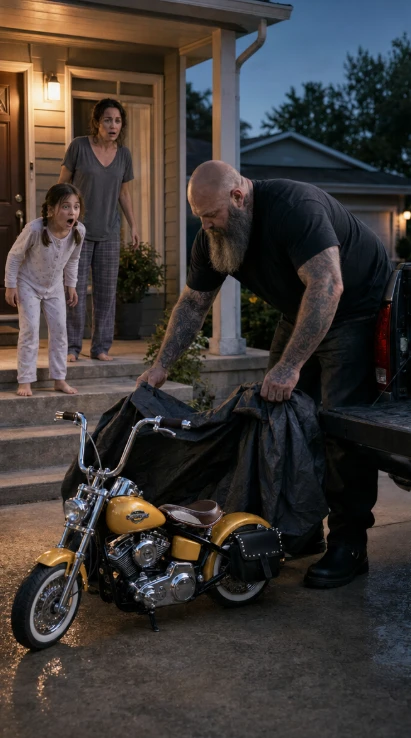
She stepped out barefoot onto the concrete porch. Gunner walked down the steps and moved toward the bed of his truck. The evening light had gone soft, and the porch lamp had just flickered on. He reached for the tarp, paused for half a second, and pulled it back.
Then he lifted the small custom Harley bicycle out of the truck.
He set it down in our driveway beneath the porch light.
The Sequoia Yellow Pearl paint caught the warm glow and seemed to hold it. The chrome exhaust pieces flashed. The two-tone leather seat sat low and perfect against the frame. The small genuine Harley-Davidson emblem on the hand-fabricated steel tank cover reflected the light like a tiny piece of impossible treasure.
Goldie stood on the porch.
She did not move.
She did not speak.
For ten full seconds, my daughter looked at that bicycle with her mouth slightly open and her hazel eyes wide. I had never seen her silent for ten seconds in her entire life. Not when she was asleep, not when she was sick, not when she was mad at me. She was a child made of sound and motion, and yet there she stood, perfectly still, as if the world had handed her something so close to her dream that her body needed time to believe it.
At the eleven-second mark, she opened her mouth all the way.
“THAT’S MY HARLEY!”
She ran down the porch steps in her bare feet.
She did not climb onto it right away. That is the part I remember most. She circled it slowly three times, like a serious old man at a car show. She crouched to inspect the welds beneath the tank cover. She touched the chrome exhaust with one finger. She traced the Harley-Davidson emblem like she was reading braille. She squeezed the real grip on the right handlebar with a gentleness that made my throat close.
Then she stood and walked over to Gunner.
“Mister Gunner,” she asked, looking up at him. “Did you make this for me?”
Gunner’s voice sounded different than I had ever heard it. “Goldie. I made it for you.”
“How did you know what year?”
“Kid,” he said. “You told me.”
“Can I ride it?”
“It’s yours,” he said. “You can ride it anywhere you want.”
She wrapped her arms around his right leg.
He was six foot one. She was four foot two. Her arms barely reached around his thigh, but she held on like she was anchoring herself to the moment. Gunner froze for half a breath, then placed one enormous calloused tattooed hand on the top of her head.
My daughter hugged the man my mother had warned me about, and in that instant I understood that fear had almost made me teach her the wrong lesson.
I walked down the porch steps because I suddenly remembered the world we lived in, the bills on my kitchen counter, the overdue registration, the fact that beautiful things are almost never free.
“Gunner,” I said, my voice already unsteady. “I can’t afford that bike.”
He looked at me.
I forced myself to continue. “Even a piece of it. I can’t afford a piece of it. Please tell me what it cost.”
Goldie still had her arms around his leg. Gunner looked down at her, then back at me, and his face settled into something firm.
“Ma’am,” he said, “I’m not charging you. I’ve been building custom Harleys for sixteen years. Every one of them goes to a grown man with money who’s gonna ride it three times a year.” He swallowed once. “This is the first bike I’ve built for someone who actually wants to ride one. The bike was free, ma’am. The work was the gift.”
I started crying before I could stop myself.
I am not a woman who cries in front of strangers. I had not cried in front of a man in my driveway since 2018. But there I was, standing barefoot on my own concrete, one hand pressed to my mouth, trying to hold myself together while my daughter clung to a biker’s leg and the most beautiful bicycle I had ever seen gleamed under our porch light.
Gunner did not make me feel embarrassed for crying.
He looked toward the porch instead.
“I’m gonna leave the helmet by the door tomorrow,” he said. “A real one. DOT certified. I sized it off photos Cheryl took when Goldie waved at me last week.”
He patted Goldie’s head once more, carefully freed himself from her arms, and walked back to his truck.
Then he drove four houses down the cul-de-sac and disappeared into his garage.
The next morning, Cheryl Wallace came over with banana bread in a small Tupperware container.
She had the red-eyed, careful face of a woman who had cried the night before and did not want anyone to mention it too quickly. I invited her in, and she sat at my kitchen table while Goldie slept late from the emotional exhaustion of joy. I poured coffee into two mugs, apologizing for the mismatched cups and the clutter on the counter, but Cheryl only shook her head.
Then she told me about Hazel.
She told me that Hazel Wallace had been born in 2007 and diagnosed at three days old with hypoplastic left heart syndrome. She told me the names of the surgeries — Norwood, Glenn, Fontan — like words carved into her bones. She told me Hazel had been tiny and fierce, with dark hair and hazel eyes, and that by the age of six she could identify engines by sound. She told me Hazel spent Saturday mornings in Gunner’s garage, standing too close to whatever he was working on until he made her move back for safety.
Hazel had wanted a 1998 Heritage Softail in Sequoia Yellow Pearl.
Black trim.
Two-tone leather seat.
The same year and color Goldie had named at the curb.
I sat very still while Cheryl spoke, because suddenly the gift in my driveway had more weight than steel, chrome, leather, and paint.
Cheryl told me Hazel had picked that bike from an old Cycle World magazine. She had told Gunner on her sixth birthday that when she got big enough, she was going to ride one. She never got big enough. Fourteen months later, in August of 2014, she was gone.
For eleven years, Cheryl said, Gunner had refused to build anything for a child. Wealthy customers sometimes asked for novelty bikes, little showpieces, mini versions for their kids to park in big garages beside real machines. Gunner always said no. He never explained much, and most people did not push him. Cheryl knew the reason without needing to ask.
Then Goldie rode past the shop on a cardboard Harley.
Cheryl had been at the garage on the second Saturday of June, bringing Gunner a sandwich, when he asked Goldie what year her cardboard Harley was supposed to be. She had heard my daughter answer from inside the bay. She saw Gunner walk back into the shop afterward and stand in the middle of the concrete floor with his back turned for almost two minutes.
He did not move.
He did not speak.
Then he turned around.
“Cheryl,” he said. “I need to build a bike. I’m gonna take a couple weeks off the Petrosian job. Can you cover the front office?”
Cheryl looked at him and understood everything.
“Garrett,” she said. “Yes.”
She did not ask what kind of bike.
She did not ask who it was for.
She already knew.
Gunner had not built Goldie a bicycle because she reminded him of what he lost; he built it because, for the first time in eleven years, grief had found somewhere gentle to go.
Goldie rode the bike for the first time that Sunday afternoon, wearing the black open-face helmet Gunner left by our door. It had a custom flame decal on one side, hand-painted red and yellow, with GOLDIE written in red script. She touched the letters at least a dozen times before putting it on.
The first ride was slow. She was careful with the weight, careful with the handlebars, careful with the fact that it was real. Gunner stood at the end of his driveway, pretending to wipe down a wrench while watching her out of the corner of his eye. Cheryl stood beside him with her arms folded. I stood on my porch with both hands gripping the railing.
Goldie made one loop around the cul-de-sac.
Then another.
By the third loop, the vroom sound came back.
It was louder than before.
Not because the bike was louder — it was still a bicycle, still powered by small legs and wild imagination — but because something in my daughter had been confirmed. She had shown the world what she loved, even when all she had to build it from was trash and tape, and instead of laughing, someone had listened. Someone had seen the exact shape of her longing and answered it with his hands.
By the end of that first week, she had learned how to ride it with schoolbooks in the leather saddlebags. By the end of the month, she knew how to polish the chrome pieces with a microfiber cloth Gunner gave her. By the end of the summer, she was spending an hour every Saturday morning at the edge of his garage while he explained tools she was not allowed to touch yet and engines she was not old enough to fully understand. He never talked down to her. He used the real words. He made her repeat safety rules before anything else.
Once, I heard him tell her, “A real rider respects the machine before she ever touches the throttle.”
Goldie nodded like he had handed her scripture.
I also noticed changes in Gunner.
Before, his shop had seemed like a place that swallowed him whole. He worked long hours, moved heavily, and carried his silence like a second leather vest. After Goldie started riding the little Heritage Softail bicycle, the garage door seemed to open wider. Cheryl came by more often. Sometimes, in the late afternoon, I saw Gunner sitting on his folding stool with no tool in his hand, just waiting.
Not for customers.
For the school bus.
Every weekday at four-thirty, Goldie came home, dropped her backpack inside, buckled on her helmet, loaded her schoolbooks into the saddlebags, and rode down the cul-de-sac. She passed Gunner’s garage the same way every time, chin lifted, small hands firm on the chrome grips, vroom sound rumbling from her mouth with increasing accuracy. She had refined it over months, listening to idle recordings, adjusting pitch and rhythm like a musician tuning an instrument.
Gunner sat at the front of his bay with coffee in his right hand.
When she passed, he raised two fingers.
Not a wave like neighbors give each other while pretending to be friendly. Not the big cheerful wave adults give children. It was the low two-finger acknowledgment one biker gives another on a Florida highway, quick and deliberate, as if saying: I see you. You belong out here too.
Goldie lifted her left hand from the handlebar.
Two fingers out.
Three tucked in.
She nodded.
He nodded back.
Then she rode on.
That small exchange became part of the day’s architecture. The mail truck came. The sprinklers clicked on. Someone’s dog barked behind a fence. At four-thirty, Goldie rode past Gunner Customs and received the biker wave from a man who had once shut a whole part of himself away because opening it hurt too much.
Fourteen months have passed since the night he brought the bike to our driveway.
Goldie is taller now. Her hair is still uneven sometimes because I still cut it at the kitchen table, though she has started asking me to leave it longer in the back because she says it looks better under a helmet. The Camry is still old, though I did manage to catch up the registration after working extra shifts. Her father is still somewhere in Georgia. The world is still expensive. I still count groceries by the dollar.
But every afternoon, my daughter rides a hand-built little Harley bicycle past the open garage of Gunner Customs with her schoolbooks in real leather saddlebags and a flame-painted helmet on her head.
People in the neighborhood know the bike now. Delivery drivers slow down to stare. Kids ask her if it is electric, and she tells them, with great dignity, that it is not. Once, a man in a pickup rolled down his window and asked where her parents bought it. Goldie pointed down the cul-de-sac.
“Mister Gunner built it,” she said. “It’s a 1998 Heritage Softail.”
The man laughed, but not meanly. He looked toward the shop, then back at her, and nodded like he understood he had been given the only answer that mattered.
There are moments when I think about what might have happened if I had listened to my mother in the narrowest way. If I had told Goldie not to wave. If I had taught her that rough-looking people are always dangerous, that tattoos tell the whole story of a person, that a man’s worst chapter is the only one worth reading. I think about how close I came to shrinking her world in the name of protecting her.
I do not blame my mother for being afraid. She grew up in a world that taught women to survive by noticing risk before anyone else did. I understand that kind of fear. I live with it. But I also know now that fear, if left alone too long, starts mistaking locked doors for wisdom.
Gunner Wallace was not safe because he looked safe.
He was safe because he chose tenderness when no one required it of him.
He saw a child riding a cardboard dream past his garage and did not mock her. He did not offer her pity. He did not treat her poverty like something embarrassing or her imagination like something cute and disposable. He listened to the year, the paint color, the black trim, the two-tone seat. He remembered. Then he gave sixty-two hours of his life to build a dream small enough for her legs to pedal.
The most expensive part of that bicycle was not the Harley emblem, the leather, the chrome, or the paint; it was the part of Gunner’s heart he had to reopen in order to make it.
I have tried several times to write this story down. I stopped each time. There was always some part where I could not continue: Goldie silent on the porch, Gunner’s hand on her head, Cheryl saying Hazel’s name in my kitchen, the two-finger wave at four-thirty. I think I was afraid that writing it would make it smaller, that putting words around it would turn it into one of those sentimental stories people share for a day and forget.
But yesterday afternoon, I stood at the kitchen sink washing a plate while Goldie rode past Gunner’s garage. I saw him lift two fingers from his coffee cup. I saw her return the wave with perfect seriousness. I saw the sunlight catch the Sequoia Yellow Pearl paint on that little steel tank cover, and for one second, it looked less like a bicycle and more like a bridge between two children — one who got to keep riding, and one who never grew big enough.
Goldie circled back toward our driveway, vrooming under her breath, her helmet slightly crooked, her cheeks red from the heat.
When she parked the bike, she patted the tank the way riders pat real machines in videos. Then she looked toward Gunner’s garage and grinned.
I thought of Hazel then, though I never met her. I thought of a fierce little girl with hazel eyes standing in that same garage, naming engines by sound, dreaming of a yellow Harley she would never ride. I thought of Gunner, eleven years later, hearing my daughter say the exact year and color, and how grief must have rushed through him so hard it knocked the air from his lungs.
Then I thought of Goldie at seven years old, writing numbers in a notebook, believing she could save four dollars a week for twenty-eight years.
She will not have to wait twenty-eight years to learn that her dreams matter.
A man four houses down taught her that with steel and paint and leather and time.
And every afternoon at four-thirty, when she rides past his garage and they exchange that quiet two-finger wave, I understand something I did not understand before: sometimes the thing that saves a child’s confidence is not a speech, or money, or a perfect life. Sometimes it is one adult who takes her cardboard dream seriously enough to build it back stronger.
Goldie still makes the vroom sound with her mouth.
Gunner still nods when she passes.
And on a small cul-de-sac in Lakeland, Florida, a nine-year-old girl rides her Harley home from school like she has already been welcomed into the world she loves.