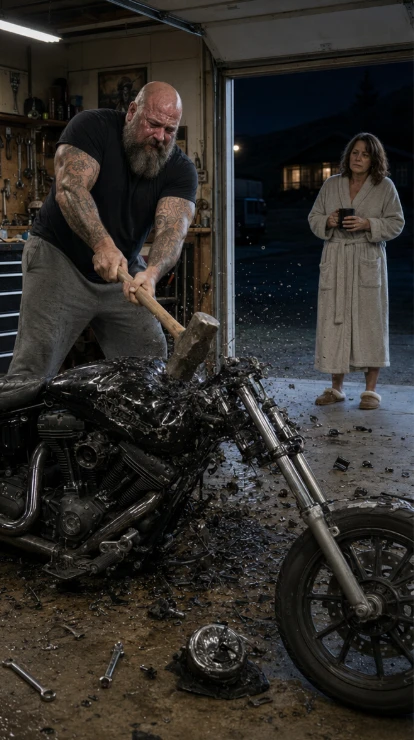
I want you to picture him first.
His name is Frank. He is fifty-three years old. He is six foot four. He weighs two hundred and seventy pounds. He has spent thirty-four years on a Harley and looks like every single one of those miles is welded to his frame somewhere underneath the leather. Shaved head — he started shaving it at forty-one when the gray came in too fast for him to keep up with. A full salt-and-pepper beard down to the fourth button of his cut. Both arms sleeved in old prison-style tattoos he got in his twenties when he was a different man than the one he became — flames, a Saint Christopher on his right shoulder, my name in cursive on the inside of his left bicep that he got two weeks after we got married in 1996, and one tattoo across his chest that he only ever lets me see.
He has been a patched brother in an independent motorcycle charter that rides out of Bozeman, Montana, for twenty-six years. The cut on his back has every patch the rougher half of this state knows how to read. He is the kind of man strangers in gas stations relocate around without thinking about why.
I have been married to him for twenty-nine years.
I have seen him cry exactly twice in those twenty-nine years.
Both times were before the morning I am writing about.
Our son was named Cole. He was twenty-two years old. He was a sophomore at Montana State majoring in mechanical engineering. He was six foot four like his father. He had his father’s hands. He had my eyes. He had been begging his father to teach him to ride a Harley since he was eleven years old, and Frank had refused to teach him until Cole was nineteen, which was the age Frank had told him from the time he was twelve that he would teach him on his nineteenth birthday and not one day before.
Frank taught him for three years.
He taught him every weekend in the gravel lot behind a Conoco off I-90 outside Three Forks. He taught him the throttle. He taught him countersteering. He taught him to look through the corner, not at it. He taught him to assume every car at every intersection was about to do the worst thing a car can do, and to ride accordingly.
For Cole’s twenty-second birthday in May, Frank co-signed on a 2018 Harley-Davidson Street Bob in Vivid Black. Cole paid for it with his summer money from working at Frank’s auto-body shop. He picked it up at the dealership in Bozeman on a Tuesday in June. He rode it home on the I-90 with his father riding wingman on his Road King in the rear quarter position, the way Frank had ridden behind Cole on every ride for three years.
Cole died on a Saturday afternoon in late August.
A pickup truck pulling a horse trailer crossed the centerline at sixty-two miles an hour on Highway 287 outside Townsend, on a stretch of road Cole had ridden a hundred times. The driver of the pickup was sober. There was no alcohol involved. There was no speed involved on Cole’s end. The accident report said Cole was wearing a helmet. The accident report said he died instantly at the scene at four-eighteen in the afternoon.
He had been twenty-two years old for three months and eleven days.
Frank went to identify him at the morgue in Helena. He drove the truck. He did not take a brother with him. He came home at one in the morning and he sat on the back porch and he did not speak for nine hours.
We buried Cole on the following Wednesday.
Frank picked up the wrecked Street Bob from the impound lot in Townsend on Thursday. He hauled it home on a flatbed. He pushed it into our garage. He shut the garage door.
He did not come back inside until eleven o’clock that night, at which point he came into the kitchen, put both his enormous tattooed hands flat on the kitchen counter, looked at me, and said — in a voice I did not recognize as his voice —
“Linda. Tomorrow night. I am going to need you to leave me alone in the garage.”
I said: “For how long?”
He said: “Until I’m done.”
I said: “Frank. What are you going to do?”
He said: “I don’t know yet.”
He found out at six fifteen the next evening, when he went into the garage with a twelve-pound sledgehammer he had bought that afternoon at the Ace Hardware on Main Street.
He came out at nine forty-three.
The Street Bob did not exist anymore.
What I saw when he opened the garage door at midnight to let me bring him a glass of water — and what he did the next morning at six a.m. when he came back downstairs in his t-shirt and his sweatpants — is the part of this story I have not written down for six years because I did not, until this fall, have the words.
Part 2: My Husband Spent Three Hours With A Sledgehammer Destroying Our Dead Son’s Harley In The Garage — The Next Morning He Knelt Down And Started Rebuilding It Piece By Piece
PART 2
I want to tell you who Cole was before I tell you who his father became.
Cole Anderson was born in March of 2001 in the same hospital in Bozeman where I had been born in 1972 and where Frank had been delivered, by accident, on the kitchen floor of his mother’s apartment in 1971 because the snow that February was bad enough that the ambulance did not get there in time.
Cole was a quiet kid. He read books his entire childhood. He took apart his bicycle when he was nine and reassembled it correctly. He took apart the carburetor on Frank’s Sportster when he was twelve, with permission, and reassembled it correctly. He could tell you, by the time he was fourteen, what year a Harley was within five years just by listening to the idle from across a parking lot.
He wanted to be a mechanical engineer. He wanted to design motorcycles.
He had been accepted to a master’s program at Cal Poly that he was supposed to start in the fall of 2024.
He did not get to start it.
The Harley Frank co-signed for him in May was, by Cole’s own description in the texts he sent me from the dealership the day he picked it up, “the most beautiful thing I have ever owned, Mom. Tell Dad I’m gonna pay him back every dime by Christmas.”
He paid Frank back forty-three hundred dollars in two months from his summer wages at the auto-body shop.
He had nine hundred left to go.
The check Frank wrote to himself out of Cole’s college account two weeks after the funeral — for nine hundred dollars even, in Cole’s name — sits in Frank’s wallet to this day. Frank has never cashed it. He keeps it in the back behind his driver’s license. He has told me, once, that the check is the last piece of paper in the world that has Cole’s handwriting and Frank’s handwriting both on the same page.
The day Frank picked up the wrecked Street Bob from the Townsend impound lot, he did not let me see the bike when he came in the driveway. He pushed the flatbed straight into the garage. He shut the door. I did not ask. I had been married to him for twenty-nine years. I knew, from twenty-nine years of watching this man manage hard things, that there were doors he was going to open in his own time and doors I was not allowed to open for him.
I also knew, from twenty-nine years of watching this man manage hard things, that one of the doors he was going to open in his own time was the door to letting himself break.
He had been holding the line for two weeks. Two weeks of identifying his son in a morgue. Two weeks of writing a eulogy he could not get through and finally asked his charter President Reverend to read for him at the funeral. Two weeks of greeting the men in his charter who had ridden in from four states — sixty-three Harleys in our driveway for the wake — and not letting a single one of them see him fall apart.
The garage was the place he was going to fall apart.
The sledgehammer was the way.
I knew it before he knew it.
PART 3
I want to tell you what those three hours sounded like from the kitchen.
I sat at the kitchen table with my coffee getting cold for the first hour. Then I sat in the living room for the second. Then I sat on the bottom step of the stairs with my forehead against the bannister for the third, because the bannister was load-bearing and I was not, by then, sure that I was.
What I heard, through the wall:
The first ten minutes were quiet. I think he was just standing there.
Then the first impact.
I jumped a foot off the chair when it landed. The sound was not a smash. It was a deep, dull, low-frequency thud that I felt in my sternum more than I heard with my ears. He was hitting the gas tank first. The gas tank gave way on the seventh hit.
Then he moved to the headlight assembly.
Then the front fender.
Then the handlebars, which he tore off with his bare hands after the sledgehammer loosened the welds — I know because I went out the side door of the kitchen at one point and looked through the small window in the garage door, and Frank was on his knees with the bent handlebars in both his enormous tattooed hands, twisting them back and forth like a man wringing out a towel, and his face was completely silent and completely focused and there were tears coming down his face that he was not wiping away because both his hands were full.
I did not open the door.
I stepped back into the kitchen.
For three hours my husband swung a twelve-pound sledgehammer at the only physical object on this earth that had been holding our son’s weight at the moment our son went away. He smashed the gas tank. He smashed the tail light. He smashed the seat off its mounting bolts. He took the engine apart with the sledgehammer and a pry bar and a torque wrench. He did not, at any point in those three hours, hit anything that was not the bike. He did not punch the wall. He did not throw anything. He did not break anything that was not the Street Bob.
He destroyed his son’s Harley with the focused precision of a mechanic disassembling an engine that he was, in some unspoken way, going to need to reassemble later.
At nine forty-three the sledgehammer stopped.
I waited.
He did not come out.
I went to the side door at midnight with a glass of water.
I opened it.
Frank was sitting in the middle of the garage floor on the concrete with the sledgehammer across his lap. The Street Bob was scattered around him in pieces. The pieces covered an area about twelve feet by twelve feet. There were small pieces. There were big pieces. There was the gas tank, dented and torn, lying on its side against the workbench. There was the headlight assembly in three pieces against the wall. There was the front wheel, still intact, leaning against the workbench because — I would find out later — Frank had not been able to bring himself to hit the front wheel because the front wheel was the part Cole had been most proud of when he picked up the bike.
Frank looked up at me when I opened the door.
His eyes were wet. His face was streaked with motor oil and tears and the dust of three hours of swinging a sledgehammer.
He said, in a voice that was barely there: “Linda. I don’t know what I did.”
I walked across the garage. I sat down on the concrete next to my husband. I put my arm around his shoulders. He put his head on my shoulder.
We stayed there until two in the morning.
I did not bring up the pieces on the floor.
I did not bring up the bike.
I just held him.
PART 4
What I want to tell you next is what happened at six fifteen on Saturday morning.
I woke up at five fifty. Frank’s side of the bed was already empty. I had been sleeping in our bedroom since the funeral. Frank had been sleeping on the couch in the living room because he had not, for fourteen straight nights, been able to lie down flat in a bed without his chest doing something that he was not able to ride out lying down.
I came downstairs at six. The coffee maker was running. Frank was sitting at the kitchen table in his t-shirt and sweatpants with both hands wrapped around a mug.
He looked up at me.
He said: “Linda. I need to ask you something.”
I said: “Okay.”
He said: “I’m going back out to the garage. I’m not going to swing the sledgehammer this time. I’m gonna pick everything up. I’m gonna lay it out on the workbench. I’m gonna see what I have.”
He paused.
He said: “I think I need to put it back together. I don’t know if I can. But I think I need to try.”
I looked at my husband.
I said: “Frank. Why?”
He took a long time to answer.
He said: “Because he loved that bike. And I broke it. And he can’t fix it now. Somebody has to.”
I said: “Okay, baby.”
He stood up. He kissed me on the top of the head. He walked out the kitchen side door into the garage.
He did not come back inside that day until ten p.m., except to eat.
He worked on the bike every single evening for the next eight months.
After dinner. After his shifts at the auto-body shop. He worked from seven to ten every night. Saturday mornings he worked from six a.m. to noon. He ordered parts from a Harley-Davidson dealership in Billings that knew his name and started cutting him deals because the parts manager — a man named Wally, fifty-six years old, who had buried his own son in 2014 — Wally understood exactly what Frank was building.
The gas tank Frank had dented and torn with a sledgehammer on the night his son had been buried for two weeks — Frank pulled out every dent with a stud welder and a slide hammer. He filled the small tears with TIG-welded patches he ground down to invisible. He sanded the tank with progressively finer grits over three weekends. He painted it Vivid Black, the same factory color Cole had picked at the dealership, in eight thin coats with a cure between each one.
When he was done with the bike, eight months and three days after he had started, the 2018 Street Bob in our garage was shinier than it had been the day Cole rode it out of the dealership.
He rolled it out into the driveway on a Saturday morning in May of 2019.
He did not start it.
He looked at it for a long time.
Then he took it back into the garage and parked it in the spot it has occupied for the last six years.
He has not ridden it.
He has not let anybody else ride it either.
Until last May.
PART 5
I want to tell you what is engraved on the gas tank.
Frank had it engraved at a small custom shop in Belgrade two days after he finished the rebuild. He took the gas tank in himself, without telling me, and he came home that evening with the tank under his arm and a small piece of paper with eight words on it that he had handed to the engraver.
The eight words are in small clean serif font, in the lower right corner of the tank, where you have to be close to the bike to read them.
They say:
HE RODE. I REBUILD. I WAIT.
He bolted the tank back onto the bike that night.
He never told me what the eight words meant out loud.
But I knew. I had been married to him for twenty-nine years. I knew that he rode meant Cole, and that I rebuild meant the eight months, and that I wait meant something Frank was not ready to put a name on yet.
He was waiting for something.
He did not know what.
He found out five years and four months later.
Our nephew Cody is the son of Frank’s younger brother Eddie. Cody was thirteen years old when Cole died. He had idolized his older cousin. He had been at the funeral. He had sat in the front pew between his father and his mother and he had not, in five years, ridden a motorcycle of any kind because his mother had told him, the night of the funeral, that if any son of hers ever climbed onto a Harley she would, in her words, “haul his ass off it with a tow strap.”
Cody turned eighteen in April of 2024.
In May of 2024, Cody came over to our house on a Sunday afternoon. He stood in our kitchen. He looked at his uncle Frank — the man who had taught his cousin Cole to ride a Harley — and he said the sentence I do not think Frank had been preparing himself to hear.
He said: “Uncle Frank. I turned eighteen. I want to learn to ride. I want to learn from you.”
Frank did not say anything for almost a full minute.
He looked at the kitchen table.
He looked at his hands.
He looked at me.
He said, very quietly: “Cody. I can’t.”
Cody said: “Why?”
Frank said: “Son. I taught Cole. Look what happened.”
Cody said: “Uncle Frank. That was a pickup truck. That wasn’t you.”
Frank shook his head.
Cody left at four that afternoon.
Frank sat on the back porch until ten at night.
That night, in our bedroom, with the lights off, with Frank on his back staring at the ceiling and me on my side watching him do it — that night I said to my husband the sentence I had not been planning to say.
I said: “Frank. You have to.”
He said: “Linda. I can’t.”
I said: “You have to. Because if you don’t teach him, somebody else will. And that is the way you keep Cole alive. Through the next one. You taught Cole everything Cole knew. You knew enough to keep him alive for three years on the roads of this state. The pickup truck was the pickup truck. That wasn’t you. You have something to give. You give it to Cody. That is how Cole rides for the rest of our lives.”
Frank did not say anything.
He turned his face toward me.
In the dark, I saw his eyes wet.
He said: “Linda. The bike in the garage.”
I said: “Yeah, baby.”
He said: “That’s the bike I rebuilt for this.”
He did not know it until that night.
But he had known it the whole time.
That was what I wait meant.
PART 6
Cody started taking lessons from Frank in June.
They met every Saturday morning in the gravel lot behind the Conoco off I-90 outside Three Forks — the same gravel lot where Frank had taught Cole. Frank brought the rebuilt Street Bob out of the garage on a flatbed for every lesson. He had not started it once in five years. Cody started it for the first time on the second Saturday of June. The engine caught on the first push of the button. The exhaust note was the same exhaust note it had been in May of 2018 on a Tuesday in Bozeman.
Frank stood at the back of the gravel lot with both hands in the pockets of his cut and he listened to his nephew start his dead son’s motorcycle.
He did not cry.
He has not cried in front of anybody but me since the night of the garage.
But I was there. I had driven out to bring them lunch. I saw his shoulders do the thing his shoulders do.
Cody passed his Montana motorcycle endorsement on the second Tuesday of August.
He rode the Street Bob — Cole’s Street Bob, rebuilt by his father over eight months in our garage, sitting unridden for five years — Cody rode that bike out of our driveway on a Sunday afternoon in late August, with Frank standing at the end of our driveway watching him go, and Frank’s right hand was raised in the air at half a wave the way Frank’s right hand had been raised at Cole on every Sunday afternoon for three years.
Cody rode down our road. He turned around at the stop sign. He rode back.
He pulled up to where his uncle was standing.
He cut the engine.
He took off his helmet.
He looked at Frank.
He said: “Uncle Frank. This bike is something else.”
Frank put one massive tattooed hand on the gas tank.
He pointed at the eight engraved words in the lower right corner.
He said: “Cody. This was your cousin’s bike.”
Cody read the engraving.
He read it twice.
He looked up at Frank.
He did not say anything for about fifteen seconds.
Then he got off the bike. He walked around it. He stood in front of his uncle. He wrapped both arms around the biggest man in our family. And Cody Anderson — eighteen years old, six foot one, freshman year of college at Montana State the next month, the cousin who had idolized his older cousin Cole for thirteen years — Cody cried into his uncle’s chest in our driveway in the late August sun while Frank held him with one enormous tattooed hand on the back of his head.
I watched from the front porch.
I did not interrupt.
PART 7
The bike rides every weekend now.
Cody rides it. Frank rides next to him on the Road King. They take the same routes Frank used to ride with Cole — out the 287 toward Townsend, down the I-90 toward Three Forks, up the 89 toward Livingston. Frank rides wingman in the right rear quarter the way he rode wingman for Cole.
He never rides the Street Bob himself.
He has told me, once, on the back porch, that the Street Bob is not his to ride. The Street Bob is Cole’s. The Street Bob is for the next one.
Cody is the next one.
The eight words on the gas tank still say what they say.
HE RODE. I REBUILD. I WAIT.
I asked Frank, last fall, what he is waiting for now.
He thought about it for a while.
He said: “Linda. For the one after Cody.”
The bike has two lives now.
It will have more.