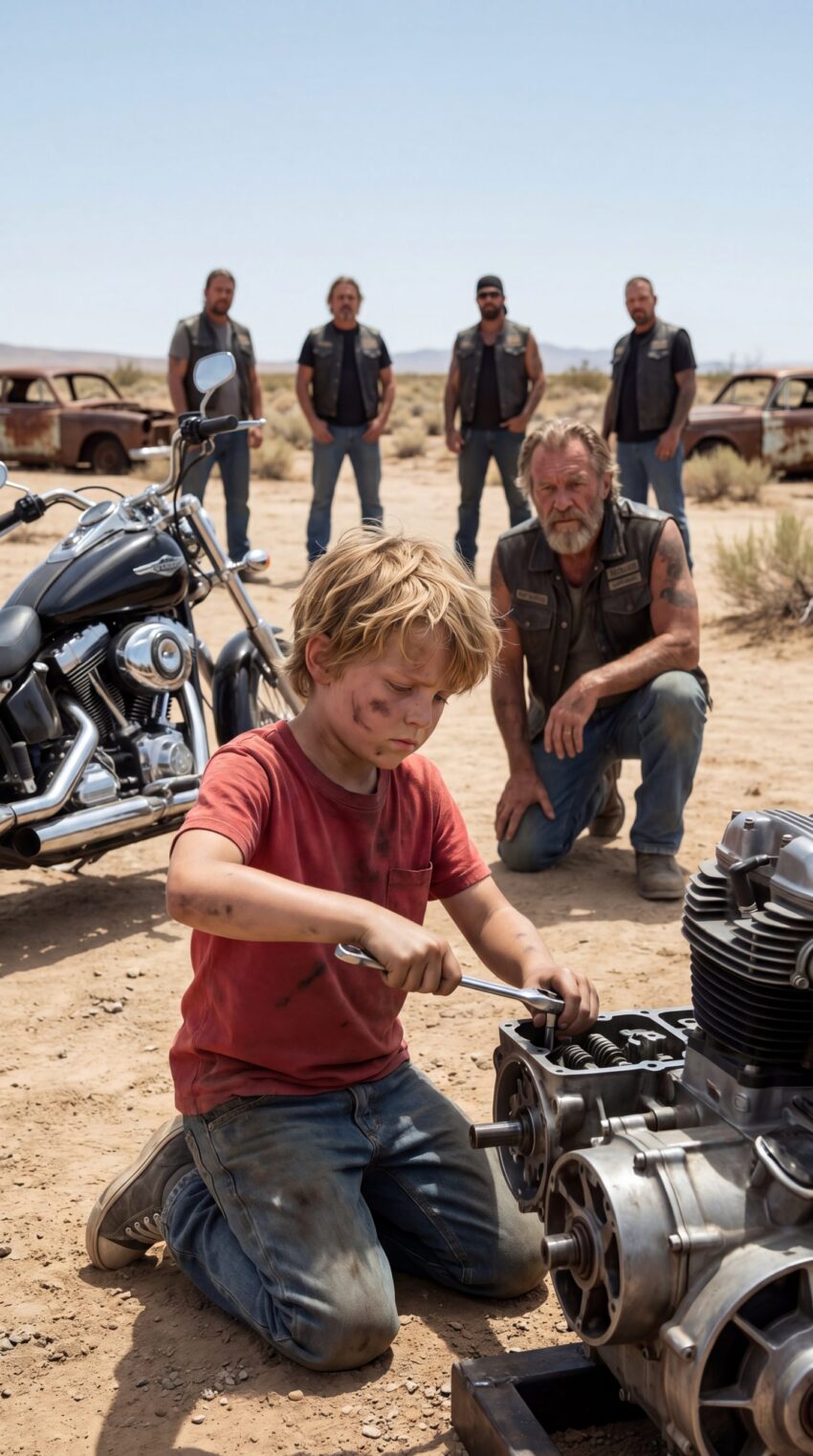
The Tuesday Everything Changed
The first hard lesson Noah Mercer ever learned came on a Tuesday.
He remembered the day for a reason most children never should have to understand. Tuesday was the day the assistance check arrived. Tuesday was the day there might be bread in the cabinet, soup in a pot, and maybe enough money left to buy one small bottle of medicine. In the faded trailer at the edge of Silver Rock, Arizona, that was what counted as hope.
Noah was eight years old, small for his age, all sharp elbows and dusty sneakers, with pale blond hair his mother trimmed herself over the kitchen sink. His eyes were bright blue, the kind of blue that looked strange against so much desert brown, as if they belonged to some other life waiting for him somewhere far beyond the highway.
That morning, he stood in the doorway of their narrow kitchen and watched his mother trying not to cry.
Elena Mercer sat at the little table beside the window, a chipped coffee mug trembling in her hand. The trailer was quiet except for the weak rattle of the air conditioner and the distant groan of a truck down the road. Her shoulders looked too thin beneath her old sweater. When she raised the cup to her lips, Noah saw her fingers shaking.
“Mama, why is your hand doing that?”
She looked up too quickly and tried to smile.
“It’s not doing anything, sweetheart. Mama’s just tired.”
“It is too,” he said softly. “It’s shaking the coffee.”
She set the mug down before it spilled. For a moment, she stared at the table like she had forgotten where she was. Then she held out her hand to him.
“Come sit with me.”
He crossed the small room and climbed into the chair across from her. The cabinet behind him was nearly empty. He already knew that without checking. He knew where everything was in that kitchen because there was never much to remember.
“Is the medicine gone again?” he asked.
She did not answer right away. That was answer enough.
“Mama?”
“Eat something first.”
“There’s almost nothing left.”
Her eyes closed for one brief second. She pressed her fingers against her lips as if she could stop the ache inside herself by sheer will. When she pulled her hand away, Noah caught sight of a dark stain she tried to hide against her apron.
His chest tightened.
“Mama, you’re sick again.”
“Noah.”
“I saw it.”
She leaned forward and took both of his hands in hers. Her palms felt warm, but too light, as if there was less and less of her left each week. Her voice changed then. It turned gentle in that way it always did when she needed him to be stronger than a boy should ever have to be.
“Listen to me, baby. I’m going to be all right. I just need rest. But I need your help today.”
He nodded before she even asked.
“Can you go down to Wilkes Auto Salvage and see if Mr. Wilkes needs anything done? Even a few hours. Just something small.”
“Yes, ma’am.”
A tired smile touched her mouth.
“That’s my brave boy.”
He stood, leaned over, and kissed her cheek. Her skin felt warm and dry. When he stepped back, he saw the fear she was trying so hard to keep hidden from him. He did not say anything about it. He just grabbed his cap from the counter and headed out into the Arizona heat.
He already knew the price of her medicine. Forty-three dollars and eight cents.
He had memorized it the way other kids memorized baseball scores or cartoon jingles.
The Boy at the Salvage Yard
Wilkes Auto Salvage sat two miles down a blistered stretch of road, surrounded by stacked tires, twisted metal, and sun-faded vehicles that looked like they had given up years ago. The yard smelled like hot iron, oil, and dust. Noah walked through the gate with dirt on his ankles and determination in every step.
Earl Wilkes saw him from across the lot and muttered under his breath before the child even reached him.
Earl was one of those old desert men who seemed built out of weather and stubbornness. His neck was leathery, his beard mostly gray, and an unlit cigar hung from the corner of his mouth like it belonged there.
“No,” Earl called out.
Noah kept walking.
“Mr. Wilkes.”
“I said no, son. I’m not running a camp for children.”
“I’ll work for less.”
The old man gave him a long look.
“Less than what?”
“Whatever you pay a grown man.”
“That would still be more than I ought to give an eight-year-old.”
“Then give me half.”
Earl took the cigar out of his mouth.
“How old did you say you were?”
“Eight, sir.”
The old mechanic let out a rough breath that might have been a laugh if life had been kinder to him.
“You know what I was doing at eight?”
Noah shook his head.
“Getting yelled at for stealing candy from a store. Not bargaining for labor.”
Noah stood his ground.
“I’m not bargaining, sir. I’m trying.”
Something in that answer made Earl go quiet. He studied the boy more closely then. The worn shirt. The knees gone white in his jeans. The face that still held the shape of childhood but carried the expression of someone much older.
Finally, Earl jerked his head toward the back lot.
“You can sort copper wire for two hours. Slow and careful. If you cut yourself, I’m blaming your mama.”
Relief moved through Noah so fast he almost smiled.
“Yes, sir. Thank you, sir.”
Earl pointed a grease-stained finger at him.
“Don’t thank me yet. You still have to work.”
So Noah worked.
He sorted wire. He swept sand from the floor of the open shed. He stacked bolts into coffee cans. He dragged smaller parts into neat piles under the shade. The heat was relentless, and the air seemed to shimmer above the scrap heaps, but he never complained. Every minute had a price in his mind. Every task moved him closer to medicine.
By midafternoon, his hands were filthy and scraped raw. Earl handed him a bottle of warm water without a word. Noah drank it in careful little swallows.
Then, near the far end of the yard, he saw it.
The Motorcycle No One Touched
It sat half-covered beneath a weathered tarp behind the trailer office, as if it had been hidden there on purpose. Even buried in dust, the motorcycle carried a certain presence. It was an old touring bike, black paint dulled by sun and time, chrome worn soft, leather seat cracked from heat. One side panel hung loose. A tool pouch rested nearby as if someone had meant to come back to it and never had.
Noah stopped working and stared.
He had always loved machines, though he had never owned one and barely understood how people afforded them. But he knew enough to recognize when something had once mattered to somebody. This bike did not look abandoned. It looked paused.
Earl noticed the direction of his gaze.
“Leave that one alone.”
“It looks fixable,” Noah said.
“I said leave it.”
Noah nodded and went back to sorting wire, but the motorcycle stayed in the corner of his vision like a question he could not stop hearing.
An hour later, Earl got a phone call and disappeared into the office. Noah kept working until a gust of wind flipped the tarp back farther, exposing the engine.
He did not mean to do much. Only look.
But one loose cable turned into a closer inspection. A disconnected line turned into noticing the fuel flow issue. Then he found a jammed fitting, wiped it clean with a rag, tightened one bolt, then another. The work felt natural in his hands, almost like listening. Machines made sense to him in a way life often didn’t. They told the truth if you paid attention.
He scraped his knuckles on a metal edge and hissed through his teeth. A thin line of red ran across his hand, but he barely noticed. He adjusted the choke, checked the line again, and gently tried the ignition.
The engine coughed.
Then it turned.
A low, rough thunder rolled out across the salvage yard.
Earl came flying out of the office like he had seen a ghost.
“Turn that off!”
Noah jumped, killed the engine, and stepped back.
The old mechanic stared at the motorcycle, then at the boy, then back at the motorcycle again. His face had gone pale beneath the sunburn.
“What did you do?” he whispered.
Noah swallowed.
“I just fixed the line, sir. It wasn’t a big thing.”
Earl took two slow steps toward him.
“Son… you don’t understand what you just touched.”
The desert wind picked up, slapping the loose tarp against the bike.
“That motorcycle belonged to a man named Rusty Vale,” Earl said quietly. “Best rider I ever knew. He passed on two years ago. His brothers left that bike here because none of them could bring themselves to move it. Nobody’s gotten it running since the day he was gone.”
Noah looked back at the motorcycle, suddenly unsure what to say.
“I didn’t know.”
Earl’s voice dropped even lower.
“That’s the problem. You didn’t know. Because if that engine just came alive after all this time, somebody’s already heard about it. And if word reaches that club…”
He stopped and looked toward the highway.
Far off in the distance, there was a sound too deep to be thunder.
The Sound Coming Down the Road
At first, Noah thought it might be weather, though the sky above Silver Rock was cloudless and white with heat. But the sound kept growing. It was steady, layered, rolling across the earth in waves. Earl Wilkes stood absolutely still, eyes fixed on the road beyond the yard fence.
Then he said, almost to himself, “They’re coming.”
Noah turned toward the highway. Dust was beginning to rise in long pale streaks beyond the ridge.
“Who?”
Earl ran a hand over his face.
“Rusty’s people. Riders from all over. Not troublemakers looking for a fight. Men who loved one of their own and never forgot him. They hear that engine turned over, they’ll think something impossible happened.”
Noah’s heart pounded.
“Did I do something wrong?”
The old mechanic looked at the child, really looked at him, and something softened in his expression.
“No, boy. Not wrong. Maybe the exact opposite. But big things don’t always feel gentle when they first arrive.”
The rumble grew louder until it seemed to move through the metal piles and rattle the windows of the trailer office. Noah should have been scared, and part of him was, but another part of him kept drifting back to the same thought.
Mama is still at home.
The medicine still isn’t there.
None of this fixes that.
He took one step backward.
“I need to go.”
Earl caught his arm lightly.
“Stay here a minute.”
“My mama’s waiting.”
Something changed in the old man’s face again.
“She’s that bad?”
Noah lowered his eyes.
“She needs her medicine.”
Earl looked down at the boy’s bleeding hand, the dusty shirt, the fierce little jaw trying not to tremble. Then he looked at the motorcycle.
“All right,” he said. “Then when they get here, you tell the truth. Every bit of it. Don’t make yourself smaller. Don’t act tougher than you are either. Just tell the truth.”
Noah nodded.
The ground nearly seemed to hum as the first line of motorcycles pulled off the highway.
Then another line.
And another.
They came in a long storm of chrome, black leather, road dust, and sun glare. Dozens became hundreds. Bikes lined the road, rolled into the yard, and cut their engines one by one until the silence afterward felt enormous.
At the center of them all rode a broad-shouldered man in his sixties with a white beard and deep lines carved by time and weather. He swung off his bike and looked straight at the old motorcycle near the trailer.
Then he looked at Noah.
The Boy Who Told the Truth
Nobody spoke for a moment.
The white-bearded rider stepped forward slowly, as if he were approaching a memory he did not trust.
“Who started it?” he asked.
His voice was calm, but it carried weight.
Earl cleared his throat.
“The boy.”
A hundred sets of eyes shifted toward Noah.
His throat went dry. His small scraped hand tightened around the wrench he still hadn’t realized he was holding. Then he remembered what Earl had told him.
Tell the truth.
So he did.
“I wasn’t trying to cause trouble, sir,” Noah said. “I saw the line was stuck. I cleaned it. I tightened two things. It started. I’m sorry if I touched something I shouldn’t have.”
The older man studied him.
“What’s your name, son?”
“Noah Mercer.”
“How old are you, Noah Mercer?”
“Eight.”
A ripple passed through the gathered riders. Not laughter. Not disbelief exactly. Something closer to stunned respect.
The bearded man glanced at Earl.
“This true?”
“Every word,” Earl said. “And for the record, the kid worked all day before he ever laid a hand on that bike.”
The older rider crouched down so he and Noah were at eye level.
“Do you know whose motorcycle that is?”
“Mr. Wilkes told me after.”
“And why were you here working?”
Noah tried to answer normally. He really did. But the whole day had been sitting heavy inside him, and the words came out softer than he intended.
“My mom needs medicine.”
The rider did not move.
“How much?”
“Forty-three dollars and eight cents.”
The man’s expression changed then. Not dramatically. Just enough for Noah to see that something had landed.
“And you came out here alone to earn it?”
“Yes, sir.”
“Because she asked you to?”
Noah hesitated, then shook his head.
“Because she needed me to.”
No one in the yard said a word.
The older rider rose slowly to his feet and turned toward the others.
“Rusty used to say a person’s heart shows up first in their hands,” he said. “Looks like he was right.”
Then he faced Noah again.
“Take us to your mother.”
The House at the Edge of Town
Noah had never seen anything like it.
The ride back to the trailer looked like a parade built out of thunder. Motorcycles stretched down the road in both directions, sunlight flashing off chrome, dust curling behind them in great pale clouds. Earl drove behind them in his old truck. Noah sat in the front seat, silent, trying to understand what was happening.
By the time they reached the trailer at the edge of town, neighbors had already come out onto porches to stare.
Elena Mercer was sitting where Noah had left her, though she looked weaker now, one hand braced against the table. When the first bike pulled in, her face filled with alarm. When dozens followed, alarm turned into pure confusion.
Noah jumped from the truck and ran inside.
“Mama, it’s okay,” he said quickly. “Please don’t be scared.”
She looked past him through the screen door.
“Noah… what is all this?”
The older rider removed his sunglasses before stepping up onto the porch. He took off his gloves and held them in one hand, suddenly looking less like a storm and more like a tired man trying to do something right.
“Ma’am,” he said gently, “my name is Wade Turner. One of our brothers left a motorcycle in Mr. Wilkes’s care a long while back. Your son brought that bike back to life today.”
Elena blinked, trying to keep up.
“I’m sorry, what?”
Noah looked down.
“I fixed it a little.”
For the first time all day, she almost smiled.
Wade glanced toward the men gathered across the yard.
“We came because that meant something to us. But then we learned why he was working.”
Earl stepped forward and placed folded bills on the table just inside the door.
“That’s for today’s work,” he said gruffly. “And for tomorrow, in case he decides to unionize.”
A few of the riders laughed softly.
Then another man stepped forward and added more cash.
Then another.
Then another.
Noah watched the pile grow, his eyes wide.
Elena covered her mouth with trembling fingers.
“You don’t have to do this.”
Wade’s answer was simple.
“Maybe not. But we want to.”
One of the women who had ridden with the group, a nurse from Flagstaff, asked quietly if she could come inside and take a look at Elena. Another rider made a phone call. Another headed into town for groceries. Someone else brought bottled water. Within minutes, the tiny trailer that had felt forgotten for so long was full of movement, care, and purpose.
Noah stood in the middle of it all, overwhelmed.
Wade rested a hand on his shoulder.
“You didn’t just fix a machine today, son.”
Noah looked up at him.
“What did I fix?”
The older man smiled sadly.
“A piece of grief that had been sitting still too long.”
What Stayed After the Thunder
The riders stayed until evening.
Not all of them crowded the trailer. Most stood outside in loose circles, speaking quietly, giving space, waiting in that patient way people do when they understand something sacred is happening. The nurse helped arrange an urgent clinic visit for Elena the next morning. Earl drove Noah to the pharmacy before sunset and made him carry the medicine himself.
On the ride back, the boy held the little paper bag in both hands like it was made of glass.
When they returned, Wade Turner was standing beside Rusty Vale’s old motorcycle, now loaded carefully into a trailer.
“We’re taking her home,” he said.
Noah nodded.
“Will she run okay now?”
Wade looked at him and smiled.
“She already does.”
Before the riders left, Wade reached into his vest pocket and pulled out a small metal pin shaped like a winged wheel. It was old and worn smooth.
“This belonged to Rusty,” he said. “He gave it to any kid he thought had more courage than sense. I think he’d have liked you.”
He placed it in Noah’s hand.
Noah closed his fingers around it.
“Thank you, sir.”
Wade shook his head.
“No. Thank you.”
That night, after the last motorcycle disappeared into the dark and the trailer finally fell quiet again, Noah sat beside his mother’s bed and listened to her breathing grow steadier. She reached for his hand in the dim light.
“You were very brave today,” she whispered.
He thought about the heat, the yard, the old bike, the roar on the highway, and the hundreds of strangers who had arrived like a storm and left behind mercy.
Then he leaned his head gently against the mattress.
“I was scared,” he admitted.
Her fingers tightened around his.
“Brave doesn’t mean you weren’t scared.”
He thought about that for a long time.
Outside, the desert wind moved softly around the trailer. Somewhere far away, a motorcycle engine echoed once and faded into the night.
And for the first time in a very long while, the little home at the edge of town did not feel quite so alone.
The next Tuesday still came.
But this time, hope got there first.
One small act of love can travel farther than we imagine, because even the quietest kindness has a way of reaching people who still remember what it means to show up.
A child who carries responsibility too early should never be ignored, because beneath that small voice there is often a strength and sorrow the world has failed to notice.
People sometimes believe they are only fixing a machine, completing a task, or surviving one more day, but in truth they may be reopening a door that grief, time, and silence had nearly closed forever.
The world can feel cold when bills are due, medicine runs out, and no help seems near, yet the hardest days often reveal that compassion is still alive in places we never expected to find it.
Dignity matters, especially for those who have very little, and sometimes the greatest gift is not pity but being seen fully, heard honestly, and answered with respect.
There are moments when truth, spoken plainly and without performance, becomes more powerful than fear, and those are often the moments that change a life’s direction.
The strongest communities are not always formed by blood or background, but by the choice to stand beside someone in their most fragile hour and remind them they have not been forgotten.
A person’s heart often reveals itself long before their story is fully known, and when we learn to recognize courage in unexpected places, we begin to understand humanity more deeply.
Even those who arrive with the sound of thunder may carry gentleness in their hands, because appearances often hide histories of loyalty, grief, memory, and grace.
No act of sincere effort is ever truly wasted, because when love is the reason behind it, even the smallest hands can set something broken back into motion.