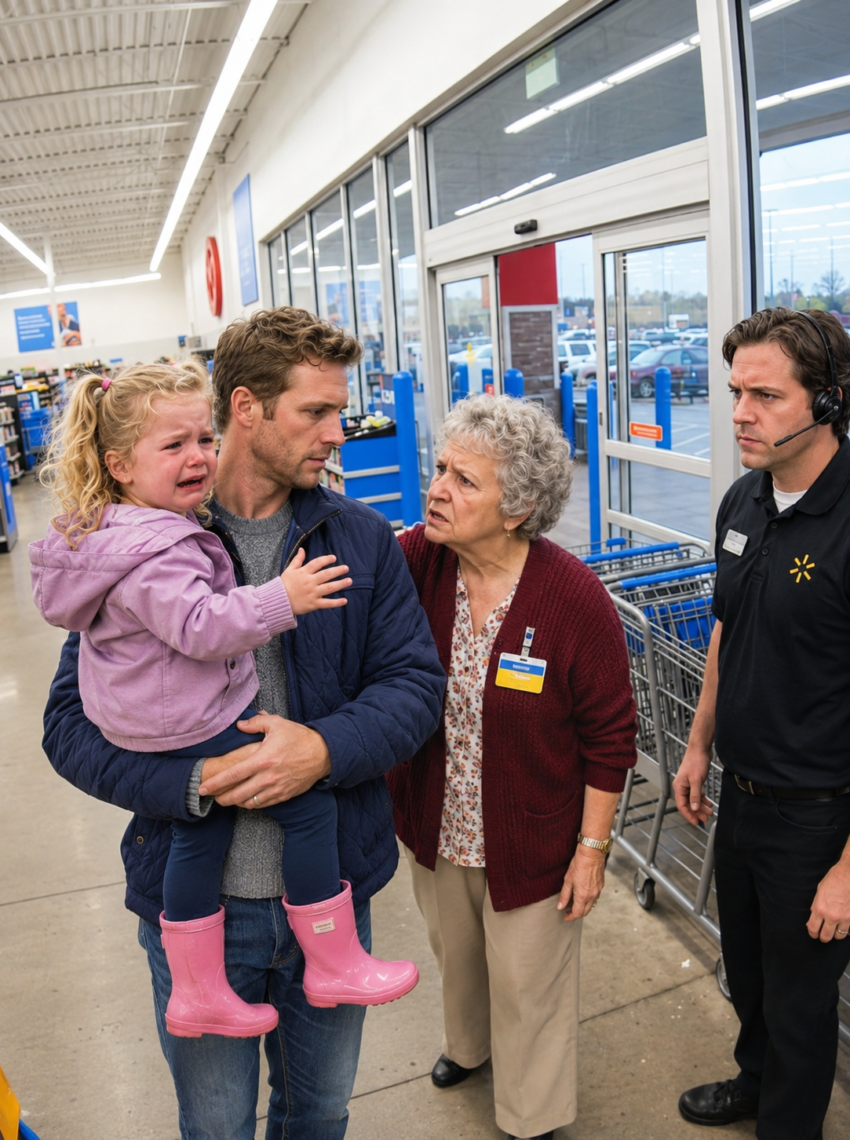
Chapter 1: The Day Everyone Turned Around
The entire courtroom fell silent when the doors opened behind us.
I had been sitting beside my legal aid attorney, trying to keep my hands from shaking. Across the aisle, the man who had brought me to court sat confidently in an expensive gray suit.
His name was Russell Whitcomb.
Three months earlier, I had stopped him from leaving a grocery store with a little girl who kept insisting he wasn’t her father.
Now he was suing me for interfering with his parental rights and damaging his reputation.
I was sixty-seven years old, worked part-time at a grocery store, and had barely enough savings to cover an unexpected car repair.
Russell had money, an attorney, and a polished explanation for everything.
Until the courtroom doors opened.
A young woman stepped inside carrying a little girl in a lavender sweater and pink sneakers.
The child looked around curiously.
Then she spotted me.
Her entire face brightened.
“Sticker lady!”
She stretched out her little hand and pointed directly at me.
Russell turned in his seat.
The confident expression he had worn all morning disappeared.
For the first time since this nightmare began, he looked genuinely frightened.
I didn’t understand why.
Not yet.
My name is Dorothy Pritchard, and I had spent nearly forty years working with the public in different jobs around Wichita, Kansas.
I had never imagined that a simple decision during an ordinary afternoon shift would bring me into a courtroom.
But sometimes the smallest moments reveal the biggest truths.
And sometimes doing the right thing means refusing to move, even when everyone around you tells you to step aside.
Chapter 2: A Little Girl Who Needed Someone to Listen
It happened on March 14, shortly after three in the afternoon.
I was working near the front entrance of a neighborhood grocery store in Wichita.
My duties were simple. I greeted customers, helped with shopping carts, answered questions, and handed colorful stickers to children.
The stickers were my favorite part of the job.
I kept little rolls of smiling faces, stars, and cartoon animals in my vest pocket.
Children loved them.
One little girl, however, would remember me for an entirely different reason.
That afternoon, I noticed a man walking quickly toward the automatic doors.
He was holding the hand of a little girl who looked about four years old.
She wore a yellow jacket and carried a small stuffed rabbit.
At first, nothing seemed unusual.
Then I heard her speak.
“I want my mommy.”
The man kept walking.
“We’re going to see her soon, sweetheart.”
His voice sounded calm, but his grip on her hand seemed unusually firm.
The little girl pulled back slightly.
“You’re not my daddy.”
Those words made me look up.
The man immediately glanced around, as though checking who had heard her.
He smiled when he noticed me watching.
“She’s having a difficult afternoon. You know how children can be.”
I had raised three children and helped care for five grandchildren.
I understood tantrums.
But something about this little girl’s expression bothered me.
She wasn’t angry about being denied candy or a toy.
She looked uncertain and frightened.
I stepped closer and offered her a smile.
“Hello, sweetheart. Would you like a sticker?”
She hesitated.
Then she nodded.
I peeled a yellow smiling face from the roll and handed it to her.
“There you go. What’s your name?”
She looked at the man before answering.
“Sadie.”
“That’s a beautiful name. Are you having a good day, Sadie?”
Her lower lip trembled.
“I want my mommy.”
The man gave a short, impatient laugh.
“We really need to go.”
I looked at him.
“Of course. Is everything all right?”
He straightened his shoulders.
“I’m her father. She’s just upset.”
I nodded slowly.
Then I asked Sadie another question.
“Sweetheart, is this your daddy?”
She shook her head.
“No. I want Mommy.”
That was the moment I knew I couldn’t simply smile and wave goodbye.
Chapter 3: The Woman Who Wouldn’t Step Aside
I moved a little closer to the entrance.
I didn’t touch the man or try to take the child away.
I simply positioned myself where I could continue speaking to them.
“Sir, would you mind waiting a moment while we clear this up?”
His smile vanished.
“There’s nothing to clear up.”
“I understand. But the little girl seems worried, and I’d feel better if we checked.”
He reached into his pocket and pulled out his wallet.
“Here. My driver’s license. Russell Whitcomb. I’m her father.”
I glanced at the identification.
His name and photograph matched the person standing in front of me.
But a driver’s license couldn’t tell me whether he was allowed to take that particular child.
“Thank you, sir. I’ll just ask my manager to come over.”
His expression hardened.
“Are you seriously questioning me in front of my daughter?”
I kept my voice gentle.
“I’m only trying to make sure she’s safe.”
He stepped forward.
“Move out of my way.”
Sadie tightened her grip around her stuffed rabbit.
“Please, I want my mommy.”
I looked down at her.
“It’s okay, honey. We’re going to make sure everything is all right.”
By then, my store manager, Glenn Mercer, had noticed the conversation.
He hurried over.
“Dorothy, what’s happening?”
Russell answered before I could speak.
“Your employee is refusing to let me leave with my own daughter.”
Glenn looked embarrassed.
“Dorothy, if he has identification, we shouldn’t interfere.”
I turned toward him.
“Glenn, the little girl keeps saying he isn’t her daddy.”
“Children say things when they’re upset.”
“I know. But what if she’s telling us something important?”
Russell took another step toward the door.
“I’m leaving now.”
I felt my heart pounding.
I wasn’t a security officer.
I had no authority to settle a family dispute.
But I knew there was one thing I could do.
“Glenn, please call the police and ask them to check. If everything is fine, this will only take a little time.”
Russell stared at me.
“You’re going to regret this.”
I swallowed.
“I hope everything turns out well, sir. But I’m not comfortable ignoring what this child is saying.”
A customer nearby offered to call the authorities.
Russell suddenly changed his tone.
“Fine. I’ll wait outside.”
He started toward the parking lot with Sadie.
I asked Glenn to keep watching them while I gave the customer the details needed for the call.
As Russell reached his vehicle, the customer discreetly photographed his license plate.
Another customer had already captured a clear image of him near the entrance.
I didn’t know it then, but those two photographs would become extremely important.
Chapter 4: The Consequences of Speaking Up
Russell left before officers arrived.
The little girl was still with him.
I stood near the automatic doors, watching his vehicle disappear onto the road.
For several minutes, I felt sick with worry.
Had I done enough?
Should I have acted differently?
Had I misunderstood the situation?
Glenn approached me with a stern expression.
“Dorothy, come into my office.”
I followed him down the hallway.
He closed the door.
“You created a serious problem today.”
“Glenn, the child was asking for her mother.”
“And the man showed you identification.”
“That doesn’t prove he had permission to take her.”
He rubbed his forehead.
“Corporate takes customer complaints seriously. We cannot have employees confronting families without evidence.”
I sat quietly.
I understood his concerns about the store.
But I couldn’t stop thinking about Sadie’s frightened face.
“I didn’t accuse him of anything. I only asked for someone to check.”
Glenn sighed.
“I’m sending you home while we review what happened.”
I removed my name tag and placed it on his desk.
That evening, I sat alone at my kitchen table, staring at my untouched dinner.
My husband had passed away six years earlier.
Since then, I had learned to manage life on my own.
But losing my job at sixty-seven was a frightening possibility.
I needed the income.
I needed the health insurance.
And, perhaps more than I liked admitting, I needed the familiar faces and daily routine.
Still, I kept remembering the little girl.
“You’re not my daddy.”
I heard those words over and over.
Two days later, Glenn called.
Corporate had decided to end my employment.
He sounded uncomfortable delivering the news.
“I’m sorry, Dorothy. They believe you exercised poor judgment.”
I looked at the stack of bills beside my telephone.
“Did anyone find out what happened to the little girl?”
There was a pause.
“I haven’t heard anything.”
That answer hurt more than losing my job.
Chapter 5: The Letter That Changed Everything
Nearly six weeks passed.
I applied for other jobs, but most employers seemed uninterested in hiring someone my age.
I began cutting expenses.
I stopped buying flowers for my porch.
I postponed a dental appointment.
And I tried not to worry about the future.
Then one afternoon, a certified letter arrived.
It came from a law firm.
Russell Whitcomb was suing me.
He claimed I had publicly embarrassed him, interfered with his relationship with his daughter, and caused emotional and professional harm.
The amount he demanded was more money than I had earned in several years.
I read the letter three times.
My hands shook so badly that I could barely put it back into the envelope.
I called my oldest daughter, Bethany.
“Mom, you need a lawyer.”
“Honey, I can’t afford one.”
“Then we’ll find someone who can help.”
Bethany contacted a local legal aid organization.
A few days later, I met attorney Felicity Warren.
She was in her early forties, with a calm voice and an organized desk covered in case files.
She listened carefully as I described what happened.
When I finished, she asked an unexpected question.
“Dorothy, did the little girl ever clearly say that the man wasn’t her father?”
“Yes. More than once.”
“And did you physically stop him from leaving?”
“No. I stood near the entrance and asked for help. He walked out with her.”
Felicity made several notes.
“Did you provide the police with a statement?”
“Yes. They called me that evening.”
She looked up.
“Then we need to find out what happened after he left that parking lot.”
For the first time in weeks, I felt a small measure of hope.
But Felicity warned me that the case might take time.
“People sometimes file lawsuits because they believe the other person will be too frightened or financially exhausted to defend themselves.”
I looked at her.
“Do you think that’s what he’s doing?”
She closed her notebook.
“I don’t know yet. But we’re going to look carefully at the facts.”
Chapter 6: A Courtroom Full of Questions
The hearing took place in a county courthouse in Wichita.
I wore a navy cardigan, a cream blouse, and the sensible black shoes I had worn to work for years.
Bethany sat behind me.
Before the hearing began, she squeezed my shoulder.
“Mom, just tell the truth.”
I nodded.
Across the aisle, Russell looked completely different from the impatient man I remembered.
He wore a tailored suit.
His hair was neatly combed.
He spoke politely to his attorney.
When the judge entered, he stood with an expression of quiet confidence.
His lawyer described me as an overzealous employee who had made an unreasonable assumption about a father and his child.
He suggested that I had humiliated Russell in front of customers and damaged his reputation.
I listened in disbelief.
It sounded as though we were discussing an entirely different afternoon.
Then I was asked to explain what happened.
I spoke slowly.
I described the yellow jacket, the stuffed rabbit, and the little girl who repeatedly asked for her mother.
I explained that Russell had shown me his identification.
I also explained why that hadn’t answered my concern.
“Your Honor, I didn’t know whether he was her father. I only knew the child was telling us she didn’t want to go with him. I thought someone needed to listen.”
The judge studied me.
“Did you intend to embarrass Mr. Whitcomb?”
“No, ma’am. I wanted someone qualified to check on the little girl.”
“And why didn’t you simply let him leave without asking questions?”
I hesitated.
Then I answered as plainly as I could.
“Because if she needed help, I didn’t want to be another adult who pretended not to hear her.”
The courtroom became very quiet.
Russell shifted in his chair.
His attorney began asking another question.
But before he could finish, the courtroom doors opened.
A young woman stepped inside carrying a little girl.
The child wore a lavender sweater.
And when she saw me, she smiled.
“Sticker lady!”
Chapter 7: The Mother Who Finally Found Me
The judge asked the young woman to identify herself.
Her name was Natalie Kessler.
She was twenty-eight years old and worked as a nursing assistant at a rehabilitation center.
The little girl in her arms was her daughter, Sadie.
Natalie looked exhausted, but her expression was determined.
“Your Honor, I believe I can explain what happened that afternoon.”
The judge allowed her to speak.
Natalie glanced briefly toward Russell.
Then she looked away.
“Mr. Whitcomb is Sadie’s biological father. He lost custody when she was very young because of serious concerns about our safety. A court order has restricted his contact with us for the past two years.”
I felt my chest tighten.
Natalie continued.
“On March 14, he went to my daughter’s home daycare. He told the provider there was a family emergency and that I had asked him to pick Sadie up.”
She paused to steady herself.
“The provider didn’t know about the court order. By the time she contacted me, he had already left with my daughter.”
The judge asked what happened next.
“I called the police immediately. They began searching for Sadie and issued a child abduction alert.”
Natalie’s voice trembled.
“I thought I might never see her again.”
Sadie rested her head against her mother’s shoulder.
Natalie gently kissed her hair.
“But someone at a grocery store had already called about a little girl who said the man with her wasn’t her daddy.”
I stared at her.
“The witnesses provided photographs and a license plate number. Those details helped officers identify his vehicle and locate him.”
Natalie turned toward me.
Her eyes filled with tears.
“That woman was Dorothy Pritchard.”
I covered my mouth.
For weeks, I had wondered whether Sadie had made it home.
Now she was standing only a few feet away.
Safe.
Healthy.
Smiling.
And holding the same little stuffed rabbit.
Chapter 8: The Truth Russell Tried to Hide
Natalie explained that state troopers had located Russell’s vehicle on the interstate approximately ninety minutes after he left the grocery store.
He had been driving toward the Oklahoma border.
Sadie was asleep in the back seat.
She wasn’t secured in an appropriate child safety seat.
Officers returned her safely to her mother.
Russell was arrested and later released on bond while his criminal case proceeded.
The courtroom was silent as Natalie finished speaking.
The judge turned toward Russell’s attorney.
“Were you aware of the existing custody order and the pending criminal proceedings?”
The attorney hesitated.
“Your Honor, I was informed that there was a family disagreement, but I did not have all the records now being discussed.”
The judge requested the relevant documents.
Felicity stood beside me.
“Your Honor, we have also obtained the police report and the witness statements from the grocery store.”
She presented the documents to the court.
The photographs, timestamps, and official records supported Natalie’s account.
I watched Russell stare down at the table.
The confidence he had displayed earlier was gone.
Then I remembered something Felicity had told me.
Sometimes people use lawsuits to frighten others into silence.
I leaned toward her.
“He wanted me to change my statement, didn’t he?”
She looked at me carefully.
“That possibility deserves serious attention.”
The judge reviewed the documents.
When she finally spoke, her voice was firm.
“The court finds no sufficient basis for allowing this civil claim to proceed.”
She dismissed Russell’s lawsuit with prejudice.
Felicity whispered that this meant he couldn’t bring the same claim again.
The judge also directed that the circumstances surrounding the lawsuit be referred to the appropriate authorities for review.
Whether the legal action had been used to pressure a witness would be a separate matter for investigators to examine.
Russell sat motionless.
For months, he had expected me to be frightened into silence.
Instead, the truth had finally reached the courtroom.
Chapter 9: The Little Girl With the Smiling-Face Sticker
After the hearing, I stood in the courthouse hallway trying to understand everything that had happened.
Natalie approached me with Sadie on her hip.
For a moment, neither of us spoke.
Then she reached for my hand.
“I’ve wanted to meet you for weeks.”
I shook my head.
“I didn’t do very much.”
Natalie’s eyes filled with tears.
“You listened when my daughter was trying to tell someone something important. That mattered more than you know.”
I looked at Sadie.
“Hello again, sweetheart.”
She smiled shyly.
“Do you have stickers?”
I laughed for the first time in what felt like months.
“I’m afraid I didn’t bring any today.”
Sadie considered that answer very seriously.
Then she reached into the pocket of her sweater.
She pulled out a slightly wrinkled yellow smiling-face sticker.
“I saved this one.”
I recognized it immediately.
It was the same kind I had handed her at the grocery store.
Natalie smiled.
“She kept asking about the lady who gave her a sticker. When we learned your name, she wanted to see you.”
Sadie held the sticker toward me.
“This is for you.”
I took it carefully.
“Thank you, honey. I’ll keep it somewhere special.”
She nodded, satisfied.
Natalie hugged me.
I held her for a moment, feeling the weight of all the worry I had carried since that afternoon.
I had lost my job.
I had been threatened with a lawsuit.
I had spent countless nights wondering whether I’d made a terrible mistake.
But standing in that hallway, with a little girl smiling up at me, I finally knew that speaking up had been the right decision.
Chapter 10: An Apology I Never Expected
A week after the lawsuit was dismissed, my telephone rang.
The caller introduced herself as a regional vice president for the grocery company.
Her name was Cynthia Rowland.
She sounded nervous.
“Mrs. Pritchard, I’m calling because our company owes you an apology.”
I sat down at my kitchen table.
She explained that corporate leadership had reviewed the incident, the police reports, and the court proceedings.
“We failed to recognize the seriousness of the child’s statements, and we failed to support you when you raised a reasonable concern.”
I listened quietly.
For weeks, I had been made to feel as though caring about a frightened child was somehow unprofessional.
Now someone was finally acknowledging what had happened.
Cynthia continued.
“We would like to offer you your position back, with an increase in pay.”
I looked toward the window.
Outside, the flowers I had stopped buying had been replaced by the wild daisies growing beside my porch.
“Before I answer, may I ask something?”
“Of course.”
“What happens the next time a child tells one of your employees that the adult with them isn’t their parent?”
There was a pause.
Then Cynthia explained that the company was introducing new child-safety procedures across its regional stores.
Employees would be instructed to take such statements seriously, notify management, and contact law enforcement promptly when there was a possible safety concern.
Staff would also receive training on how to respond calmly without placing a child or employee in unnecessary danger.
I felt a weight lift from my shoulders.
“That’s what matters most to me.”
Cynthia asked whether I would consider returning.
I thought about it.
I missed the regular customers.
I missed my coworkers.
And I missed giving children their stickers.
“Yes,” I said. “I’d like that very much.”
Chapter 11: The Day I Came Back
I returned to work on a Saturday morning.
The store looked exactly as I remembered.
Shopping carts rattled across the entrance.
The bakery smelled of fresh bread.
A young cashier waved when she saw me.
“Dorothy! You’re back!”
I smiled.
“I certainly am.”
Glenn met me near the front counter.
He looked uncomfortable.
“Dorothy, I owe you an apology.”
I waited.
“I should have listened more carefully that day. I was worried about complaints and store policies, and I overlooked what you were trying to tell me.”
I studied his face.
He seemed sincere.
“Glenn, I understand that you had a difficult decision to make. I just hope we’ll all handle things differently if something like that ever happens again.”
He nodded.
“We will.”
He showed me the new training materials.
Then he handed me a fresh name tag.
I pinned it to my vest.
It felt surprisingly good to be back.
At ten o’clock, the automatic doors opened.
A little girl in bright pink rain boots came running inside.
Behind her walked a familiar young woman.
“Sticker lady!”
I turned.
Sadie was racing toward me, her stuffed rabbit tucked under one arm.
Natalie followed with a warm smile.
I bent down carefully.
“Well, look who’s here!”
Sadie held out her hand.
“Can I have a smiley face?”
I reached into my vest pocket and pulled out a brand-new roll of stickers.
“Of course you can.”
I gave her one.
Then another.
Then, because I couldn’t help myself, I handed her the entire roll.
She gasped.
“All of them?”
“Every single one.”
Natalie laughed.
“Dorothy, you’re going to spoil her.”
“I think she’ll survive a few extra stickers.”
Sadie peeled one from the roll.
Then she reached toward my vest.
With great concentration, she pressed the little yellow smiling face directly above my name tag.
“Now you have one too.”
I looked down at it.
Such a tiny thing.
A circle of yellow paper with two black eyes and a curved smile.
But it meant more to me than any award or certificate ever could.
“Thank you, Sadie.”
She grinned.
“You’re welcome, sticker lady.”
Chapter 12: What Happened Afterward
Russell’s criminal case continued through the following months.
In December, he was convicted on charges related to taking Sadie without lawful permission and violating the existing court order.
He received a twelve-year prison sentence.
Natalie told me the news over the telephone.
She sounded relieved, although I could hear how exhausted the entire experience had left her.
“We’re finally beginning to feel normal again,” she said.
I was glad.
More than anything, I wanted Sadie to grow up surrounded by people who made her feel safe.
The company continued rolling out its updated child-safety training.
Glenn was reassigned after completing additional management training.
Other employees began approaching me with questions about what had happened.
Some asked how I had known something was wrong.
I always gave them the same answer.
“I didn’t know everything. I just knew the child was asking for help, and I didn’t want to ignore her.”
That was the truth.
I wasn’t especially brave.
I hadn’t planned to become involved in a court case.
I was an older woman working an ordinary job, trying to earn enough money to keep my household running.
But when a little girl spoke, I listened.
Sometimes people imagine courage as something dramatic.
They picture someone making a grand speech or taking an extraordinary risk.
But courage can be much quieter than that.
It can be asking one more question.
It can be calling someone qualified to help.
It can be staying calm when another person becomes angry.
And sometimes, it can be refusing to dismiss a child’s words simply because an adult has a more convincing explanation.
I still work at the grocery store.
I still keep stickers in my pocket.
And whenever a child walks through those automatic doors, I try to greet them with the same kindness I would want someone to show my own grandchildren.
The yellow smiling-face sticker Sadie gave me is now tucked inside a small frame on my kitchen shelf.
Every morning, I see it while making coffee.
It reminds me of a frightened little girl who needed someone to pay attention.
It reminds me of a mother who never stopped searching for her daughter.
And it reminds me that even an ordinary person can make an extraordinary difference by choosing to care.
I don’t know whether Sadie will remember every detail of that afternoon when she’s older.
I hope she doesn’t have to.
I hope her childhood is filled with happier memories.
Birthday parties.
School plays.
Summer afternoons.
And plenty of colorful stickers.
But if she ever asks why an elderly grocery store employee became such an important part of her family’s story, I hope Natalie tells her something simple.
“Because you spoke up, sweetheart, and someone believed you.”
THE END.
10 Heartfelt Messages to Remember
Sometimes the greatest act of kindness is not offering comforting words but having the courage to notice when someone is frightened, ask the questions others avoid, and make sure their concerns are taken seriously.
A child’s voice may be small, but their feelings and words deserve our attention, because listening carefully can make an enormous difference in moments when they cannot fully explain what is happening around them.
Doing the right thing does not always bring immediate appreciation, and there may be times when others question your judgment, but compassion guided by common sense and responsible action is never something to regret.
True courage is not the absence of fear; it is the decision to remain thoughtful, calm, and responsible even when speaking up might bring criticism, inconvenience, or unexpected challenges into your own life.
We should never assume that an adult’s confidence, appearance, or explanation automatically tells the whole story, especially when a child is expressing fear or asking for help in a way that deserves careful attention.
Growing older does not diminish a person’s ability to make a meaningful difference, because wisdom, patience, and a lifetime of experience can become powerful gifts when someone else needs understanding and support.
A workplace should never value avoiding complaints more than protecting people, and organizations become stronger when they acknowledge mistakes, improve their procedures, and support employees who raise reasonable safety concerns.
One thoughtful decision may seem insignificant at the time, yet its influence can reach far beyond that moment, bringing reassurance to a family, encouraging others to act responsibly, and helping prevent similar situations in the future.
The most meaningful rewards in life are not always financial or public, because sometimes a child’s genuine smile, a parent’s heartfelt gratitude, or the knowledge that someone is safe can mean more than any recognition.
And above all, remember that kindness is not always quiet agreement or stepping aside to avoid conflict; sometimes kindness means standing firm with patience and respect, trusting that every vulnerable person deserves to be heard, protected, and treated with dignity.