The Afternoon When the Road Fell Silent
No one ever really notices the exact moment when unease enters a place, because it rarely arrives with noise or urgency. Instead, it slips in quietly, like a subtle shift in the air, changing the way people sit, the way they pause mid-sentence, the way they glance toward the door without knowing why. That was how it began on a pale afternoon just outside a quiet stretch of highway in western Kansas, where a weathered roadside diner stood between long miles of open road.
The traffic had been steady, nothing unusual, just the familiar rhythm of passing cars and distant engines. Then, gradually, another sound replaced it—the deep, steady hum of motorcycles approaching together, not rushed, not chaotic, but controlled.
Inside the diner, conversations softened without anyone meaning to. A fork paused halfway to someone’s mouth. A waitress hesitated near the counter. And when the door finally opened, the bell above it rang louder than it should have, as if the room itself had taken notice.
Twelve bikers stepped inside.
They didn’t speak loudly. They didn’t try to draw attention. But their presence filled the space anyway, not because of who they were, but because people often expect something before they understand it.
The Man Who Chose His Words Carefully
The first to enter removed his helmet slowly, revealing a face marked not by harshness, but by years of quiet endurance. His name was Caleb Rourke. His dark hair carried threads of gray, and his eyes held a calm that didn’t need to prove itself.
He paused just long enough to take in the room—not scanning for trouble, but reading it the way someone reads a familiar story.
Then he spoke, his voice steady and respectful.
“We’ll take the booths in the back, if that works. Coffee for everyone.”
It wasn’t a demand. It wasn’t a test. It was simply a statement offered with courtesy.
And somehow, that changed everything.
The tension didn’t disappear, but it softened. A few customers returned to their meals. Someone let out a breath they hadn’t realized they were holding. The room remembered itself.
The Diner That Refused to Change
The place was called Mason’s Stop, a diner that seemed untouched by time. The red vinyl booths were cracked but clean. The counter carried years of quiet conversations. A jukebox in the corner still played songs from another era, as if the world outside had moved on but this place had chosen not to.
Behind the counter stood a young woman named Lila Hart.
Her name tag was slightly faded, the letters worn from time and use, but her smile remained steady. It was the kind of smile built from habit, practiced enough to feel natural, yet careful enough to keep distance.
She moved with efficiency, pouring coffee, carrying plates, checking orders.
But Caleb noticed something others didn’t.
The way she shifted her weight slightly when she walked.
The way her shoulders remained tense even when she smiled.
The way her eyes moved—not freely, but cautiously, as if always aware of something just outside the frame.
The Signals That Go Unnoticed

The bikers settled in, their conversations low and easy. They spoke about the road, about weather, about nothing in particular. Laughter came and went, light and unforced.
But Caleb’s attention remained quiet and focused.
When Lila approached their table with coffee, her hands were steady—but only just. There was a slight tremor, barely visible, something most people would miss unless they knew to look for it.
As she leaned forward to set down a mug, her sleeve slipped back for a brief second.
A faint discoloration marked her wrist.
Not fresh. Not dramatic. But not accidental either.
Their eyes met.
Just for a moment.
And in that instant, something unspoken passed between them—recognition, quickly hidden.
She pulled her sleeve down almost immediately, her movements smooth, practiced.
Too practiced.
The Sound That Changed Everything
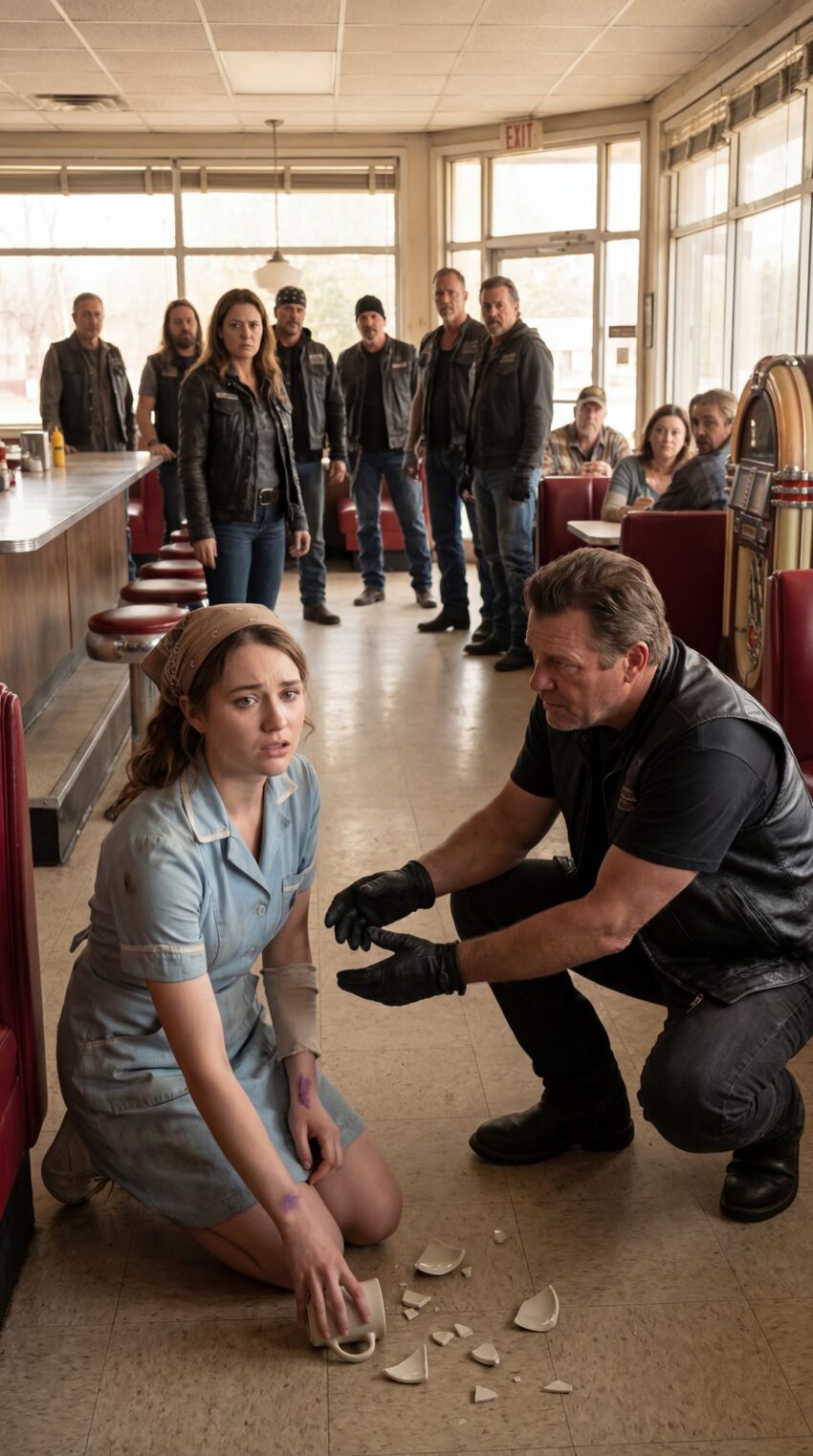
The mug slipped only seconds later.
It hit the floor with a sharp crack, shattering into pieces that scattered across the tiles. The sound cut through the room, louder than it should have been.
Lila dropped to her knees quickly.
“I’m so sorry, I’ll clean it up right away,” she said, her voice bright, too quick, too controlled.
Her hands moved fast, reaching for broken pieces without hesitation, even as they could easily cut her skin.
Caleb didn’t move.
He had seen that reaction before.
Not the mistake—but the fear behind it.
From the kitchen, an older man stepped out. His name was Frank Delaney, the cook who had worked there longer than anyone could remember.
“You okay, Lila?” he asked, already grabbing a broom.
“Yes, I’m fine. Just a little clumsy today,” she replied.
The word clumsy lingered in the air, heavier than it should have been.
A Memory That Refused to Stay Buried
Caleb sat back, his coffee untouched now.
There were things people carry from their past that never fully leave them. Small details. Reactions. Silences.
He recognized them in her.
Not because he wanted to.
But because he couldn’t ignore them.
When the time came for his group to leave, he placed cash on the table—more than necessary—and stood.
As Lila approached to clear the dishes, he looked at her, not intensely, not in a way that demanded anything.
Just long enough.
“Take care of yourself,” he said.
Simple words.
But they weren’t casual.
They were acknowledgment.
She hesitated for half a second, then nodded.
“I will.”But her voice didn’t sound certain.
The Moment That Didn’t Feel Right
Outside, the sky had begun to dim slightly, the light stretching long shadows across the gravel lot.
Caleb reached for his gloves.
That’s when he noticed them.
Three motorcycles parked at the far edge.
Not new arrivals.
Waiting.
Through the window, he saw Lila freeze.
Her posture changed instantly. The calm she had been holding onto disappeared. Her hand tightened around the edge of the counter.
Then something slipped from her grasp.
A small piece of paper.
It fell to the floor unnoticed by everyone except him.
Caleb didn’t react.
Not yet.
He started his bike and led his group back onto the road.
Because some moments aren’t meant to be rushed.
The Return Under Quiet Rain
The rain came later that evening.
Soft at first, then steady enough to blur reflections on glass and pavement.
Only four of them returned.
They parked further away this time, their presence hidden by darkness and rain.
Inside, the diner looked the same.
But it didn’t feel the same.
The three men had arrived.
They didn’t rush. They didn’t raise their voices. But the way they moved carried something heavier than words.
One of them stepped closer to Lila.
Too close.
His hand reached out, closing around her wrist—not aggressively, not dramatically, but with a familiarity that didn’t belong.
Caleb’s jaw tightened.
Before he could step forward, Frank moved first.He held a bat low at his side.
Not raised.
Not threatening.
But clear.
A line drawn without being spoken.
The man released her slowly.
He smiled—but it wasn’t friendly.
It was a promise.
“We’ll talk later,” he said quietly.
Then they left.
Strength That Didn’t Need to Be Loud
Caleb didn’t follow.
Not that night.
Because some situations don’t change with confrontation.
They change with patience.
Over the following days, he and his crew returned in small numbers, at different times. They watched. They listened. They noticed patterns.
They spoke to the right people—not loudly, not publicly, but carefully.
Information moved quietly.
Pressure shifted.
And slowly, the situation began to unravel—not with chaos, but with precision.
A Space to Breathe Again
Weeks passed.
Lila didn’t notice the changes at first.
Just small things.
The absence of certain faces.
The way the air felt lighter.
The way her shoulders no longer tensed every time the door opened.
One afternoon, Caleb returned alone.
She recognized him immediately.
But this time, her posture was different.
Steadier.
She approached his table with a real smile—not practiced, not forced.
“Coffee?” she asked.
“Yeah,” he replied softly.
When she placed the cup down, her hands didn’t shake.
Not even slightly.
Before leaving, Caleb placed something on the table.
A small silver keychain.
A feather.
Engraved with one word.
Freedom.
She looked at it for a long moment.
Then back at him.
“Thank you,” she said.
Not loudly.
Not dramatically.
But with certainty.
Messages That Stay Long After the Story Ends
Sometimes the most powerful actions are the ones that don’t ask for attention, because real change often begins in quiet decisions made when no one is watching.
There are moments when choosing patience instead of reaction can protect more than immediate action ever could, especially when someone needs time and space to stand on their own again.
True strength is not about control or dominance, but about recognizing when to step in gently and when to step back with respect.
Helping someone does not always mean taking over their struggle, because sometimes the greatest gift is giving them the chance to rediscover their own voice.
The smallest signs—a glance, a pause, a subtle shift—can carry deeper meaning than loud expressions, if someone is willing to notice them.
Kindness becomes powerful when it is offered without expectation, without pressure, and without the need for recognition.
There is a difference between saving someone and supporting them, and understanding that difference can change the outcome of a life.
Courage is often quiet, appearing in moments where someone chooses to stay aware instead of looking away.
When people act with intention instead of impulse, they create solutions that last longer than temporary reactions.
And sometimes, all it takes to change the direction of someone’s life is one person who sees clearly, stays steady, and refuses to ignore what others overlook.
Stronger.