The Space He Couldn’t Reach Alone
The handicap parking space near the memorial plaza was never just about convenience for Harold Mercer. At eighty-two years old, every extra step felt like carrying a backpack full of stones. His knees had long ago stopped cooperating with him, and the sharp ache in his lower back followed him like an old shadow that refused to disappear.
That afternoon in Lexington, Kentucky, the sky was clear and bright, and Harold had only one goal in mind.
He wanted to visit the memorial wall before sunset.
It was something he did every year.
He parked his aging silver sedan near the front entrance of the veterans memorial lot, his disabled veteran license plate reflecting under the afternoon sun. But the moment he turned into the final row, his shoulders slowly sank.
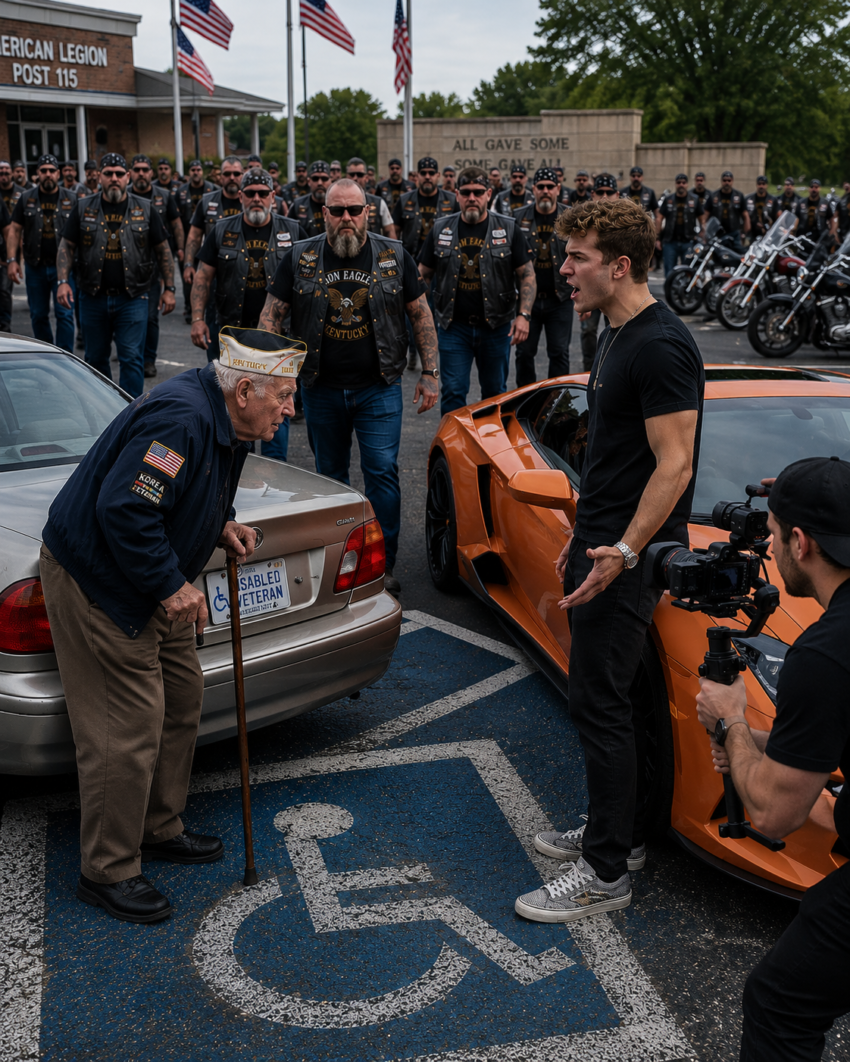
A bright orange luxury sports car was stretched across the only handicap space available.
The driver, a twenty-three-year-old internet personality named Chase Holloway, leaned casually against the hood while adjusting his designer sunglasses. Beside him stood a cameraman holding a stabilizer rig and portable lights.
They were filming another “public reaction challenge” for social media.
Harold lowered his window carefully.
“Excuse me, son,” he said politely. “I have a permit for that spot. My legs aren’t doing too well today.”
Chase barely looked up.
“There are more spots in the back, Grandpa.”
“That one is reserved for disabled veterans and people who need it.”
Chase smirked while glancing toward the camera lens.
“Relax. We’ll only be here a few minutes.”
Harold tightened his grip on the steering wheel.
“Young man, rules exist for a reason.”
The cameraman quietly chuckled.
Chase suddenly saw an opportunity for more dramatic footage.
He stepped closer to Harold’s car window with exaggerated confidence.
“You trying to lecture me on camera?”
Harold slowly opened the door and stepped out with the help of his dark walnut cane.
His body moved carefully, cautiously, like someone whose bones remembered every difficult year he had survived.
“I’m not trying to argue,” Harold replied softly. “I’m only asking for respect.”
Chase rolled his eyes dramatically toward the camera.
“Respect isn’t automatic anymore, old timer.”
Then, in one careless moment fueled by arrogance and attention-seeking behavior, Chase shoved Harold backward.
It wasn’t hard enough to send him flying, but it was enough.
Harold lost balance instantly.
His cane slipped across the pavement, and his hearing aid fell loose onto the asphalt beside the curb. He caught himself against the side of the sports car before collapsing completely, but his lip split slightly against the metal edge.
The cameraman’s laughter faded immediately.
The situation no longer felt funny.
For several seconds, the entire parking lot went silent.
The Men Inside the Legion Hall
Across the lot stood the old American Legion building.
Inside, a group of bikers from the Iron Saints Motorcycle Club had gathered for their monthly veterans charity meeting. The room smelled of strong coffee, leather jackets, and old wood polish.
At the far table sat a massive man named Boone Keller.
Boone was nearly sixty years old, broad-shouldered, heavily tattooed, and carried himself with the calm confidence of someone who no longer needed to prove anything to anyone.
He noticed movement through the front window.
He saw Harold stumble.
The room changed instantly.
Boone slowly stood up.
The sound of dozens of leather jackets shifting at once filled the hall like distant thunder.
Nobody asked questions.
Nobody hesitated.
Nearly forty bikers quietly rose from their chairs and walked toward the parking lot together.
Outside, Chase was still pretending to laugh off the situation.
“Come on, man, it was just a joke.”
But then the sunlight behind him dimmed.
One by one, the members of the Iron Saints crossed the asphalt in complete silence.
Heavy boots echoed across the pavement in slow rhythm.
The cameraman lowered his equipment immediately.
His hands began trembling.
Boone reached Harold first.
He bent down carefully and picked up the fallen cane before placing a steady hand on Harold’s shoulder.
“Easy there, brother,” Boone said gently. “We’ve got you.”
Another biker named Travis retrieved the hearing aid from beside the curb and cleaned it carefully with a soft cloth before handing it back respectfully.
Then Travis looked directly at Chase.
Not with rage.
Not with shouting.
Just disappointment.
And somehow that felt far worse.
“Do you even know who this man is?” Travis asked quietly.
Chase swallowed hard.
“Look, we were just filming content—”
Boone interrupted him calmly.
“That man fought in Korea before your father was even born.”
Silence swallowed the parking lot again.
Boone continued.
“Harold Mercer carried wounded soldiers through freezing mountains when he was barely older than you.”
Harold lowered his eyes modestly.
He clearly hated attention.
But the bikers surrounding him stood straighter with every word.
A Lesson No Camera Could Control
Chase’s confidence slowly disappeared.
The camera that had once made him feel powerful suddenly felt like evidence.
His voice cracked slightly.
“We were going to edit the video later.”
Boone stared at him for several seconds before responding.
“You can edit footage,” he said quietly. “But you can’t edit character.”
The words landed harder than anyone expected.
Even the cameraman looked ashamed now.
Harold slowly straightened himself and wiped the corner of his lip.
Then he looked directly at Chase.
There was no hatred in his expression.
Only exhaustion.
And sadness.
“I lost my best friend overseas,” Harold said softly. “He was nineteen years old.”
Nobody moved.
Nobody interrupted.
“He spent his final moments asking me to keep going because he believed people back home deserved peace.”
Harold glanced toward the memorial wall visible in the distance.
“None of those boys gave everything they had so people could treat each other without kindness.”
The parking lot became completely silent.
Even nearby traffic noise seemed distant now.
Chase looked away first.
The Arrival of the Police
Someone inside the Legion hall had already contacted local police.
When the officers arrived, they quickly understood the situation after speaking with witnesses and reviewing the camera footage.
Chase’s hands shook as one officer calmly explained the consequences of physical harassment against an elderly disabled veteran.
The same audience Chase had hoped would admire him online now watched in complete silence as he was escorted toward the patrol vehicle.
Several people nearby recorded the moment on their phones.
But nobody was cheering.
Nobody was laughing.
The mood had changed completely.
The cameraman quietly sat on the curb with his head lowered, looking like he regretted being there at all.
Before entering the vehicle, Chase glanced back toward Harold.
For the first time all afternoon, his voice sounded real.
“Sir… I’m sorry.”
Harold studied him carefully for a long moment.
Then he nodded once.
“Learn from this,” he replied calmly. “That apology will matter more if you become better afterward.”
The officer gently closed the patrol car door.
And just like that, the performance was over.
The Walk to the Wall
After the police left, the bikers did not immediately return inside.
Instead, they walked beside Harold toward the memorial wall.
The late afternoon sunlight stretched across the polished black stone.
Names covered the surface endlessly.
Thousands of them.
Harold stopped in front of one particular engraving.
Daniel Whitaker.
His hand rested quietly against the name.
For several seconds, nobody spoke.
The bikers respectfully removed their sunglasses and lowered their heads.
Harold smiled faintly.
A tired but warm smile.
“I brought some good men with me today, Danny,” he whispered.
Boone looked away for a moment, giving the old veteran privacy.
Some of the younger bikers suddenly understood why their older members always defended veterans so fiercely.
It wasn’t politics.
It wasn’t image.
It was gratitude.
The Ride Home
As evening approached, Harold slowly returned to his vehicle.
This time, the handicap space was completely clear.
Boone opened the car door for him.
“Thank you, boys,” Harold said quietly. “You’ve already done more than enough.”
Boone smiled beneath his gray beard.
Then he swung one leg over his Harley-Davidson motorcycle.
The engine roared to life with deep thunder.
“With respect, sir,” Boone replied, “heroes don’t drive home alone.”
One by one, motorcycles started around the parking lot.
Chrome reflected the orange evening sky.
Within minutes, nearly forty bikers surrounded Harold’s sedan in formation.
Six rode ahead.
Several guarded the rear.
Others spread alongside the vehicle like a moving shield of respect and loyalty.
People along the streets of Lexington stopped and stared as the procession slowly passed through town.
Drivers lowered their windows.
Some placed hands over their hearts.
Others simply watched quietly, understanding that they were witnessing something meaningful.
Harold sat behind the wheel with tears gathering in his tired eyes.
Not because he felt weak.
But because after all these years, people still remembered.
The Video That Changed Everything
Ironically, the video Chase tried filming eventually spread across the internet anyway.
But not for the reasons he expected.
The footage of Harold struggling beside the handicap space upset thousands of viewers.
The moment the Iron Saints arrived became the emotional turning point everyone talked about.
Comments flooded social media.
People praised the bikers for protecting the elderly veteran without unnecessary aggression.
Others shared stories about grandparents who had served in the military.
Even several veterans organizations publicly thanked the Iron Saints for standing beside Harold that day.
Meanwhile, Chase disappeared from social media for a long time.
People eventually moved on from the scandal.
Internet outrage always fades eventually.
But in Lexington, Kentucky, residents continued talking about that afternoon for years afterward.
Not because of the argument.
Not because of the cameras.
But because an old veteran who once felt forgotten was reminded that respect still existed in the world.
And because a group of rough-looking bikers quietly showed an entire town what honor actually looked like.
Sometimes real strength is not found in power, money, or popularity.
Sometimes it is found in the people willing to stand beside someone who can no longer stand alone.
Life becomes better when we choose kindness before pride and respect before attention.
Never underestimate the quiet sacrifices older generations carried long before we arrived.
A person’s value should never be measured by age, appearance, or physical weakness.
The loudest people in the room are not always the strongest ones.
True character reveals itself most clearly in how someone treats vulnerable people.
Even small acts of compassion can restore dignity to someone who feels invisible.
Respect for veterans should not exist only during ceremonies or holidays but in everyday actions.
The people who seek attention online often fade quickly, but genuine kindness leaves permanent memories.
Strength without empathy creates fear, while strength guided by compassion creates safety.
Every generation has a responsibility to protect human decency before selfishness becomes normal.
Sometimes the greatest way to honor heroes is simply refusing to let them feel forgotten.