A 13-Year-Old Boy Stole His Biker Neighbor’s Prized Harley and Wrecked It Within Minutes — The Entire Neighborhood Expected the Tattooed Biker to Call the Police, But His Unexpected Three-Month Demand Changed the Boy’s Future in a Way No One Saw Coming
The Night The Motorcycle Disappeared
Just after midnight, a thirteen-year-old boy named Elijah Brooks pushed his neighbor’s motorcycle out of a garage in a quiet working-class neighborhood outside Toledo, Ohio.
He did not get far.
Two blocks later, the heavy black motorcycle slid against the curb, scraping chrome, bending metal, and leaving a long pale mark across the side of the tank. By sunrise, everyone on Wilton Street knew what had happened. They also knew who owned that motorcycle.
Roy “Bear” Whitaker.
Roy was fifty-eight years old, tall, broad-shouldered, white American, and covered in the kind of old tattoos that made strangers cross parking lots to avoid walking too close to him. He had a gray beard, rough hands, deep lines around his eyes, and a black leather vest he wore almost every day, even when he was only mowing the lawn or carrying groceries inside.
People respected him.
Some people feared him.
But everyone knew he loved that motorcycle.
It was a black Harley-Davidson Road King, polished so clean that porch lights reflected off it like moonlight on water. Roy had bought it after years of overtime, small repair jobs, and skipped vacations. It was not just transportation. It was the one thing in his life that still looked exactly the way he wanted something to look.
So when the bike came back scratched, dented, and wounded, most of the neighborhood expected one thing.
Police.
A report.
A record.
A punishment that would follow Elijah for years.
But Roy did not call anyone.
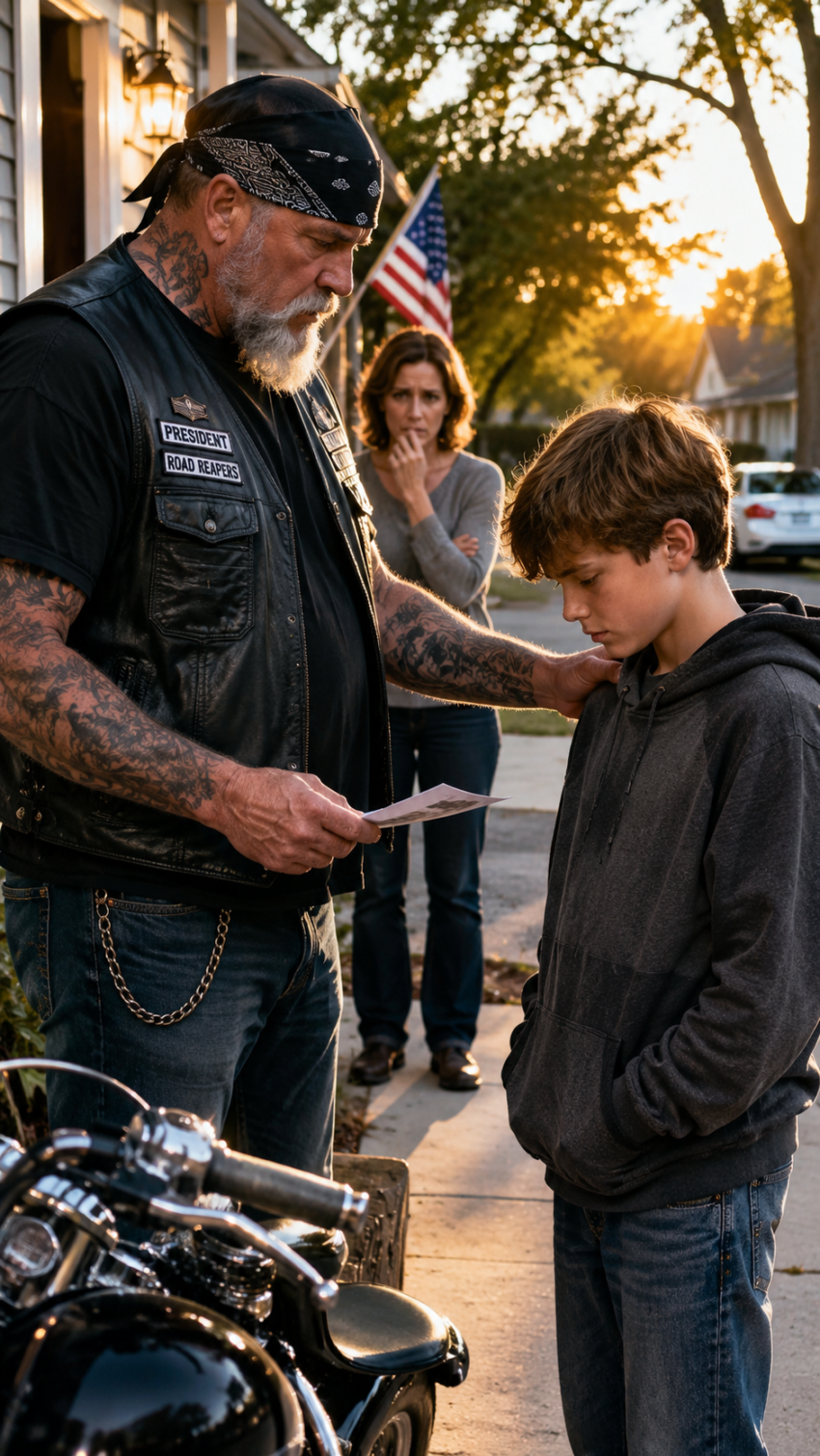
He printed one blurry image from his garage camera, folded it once, crossed the street, and knocked on Elijah’s front door.
The Boy Behind The Door
Elijah lived with his mother, Denise Brooks, in a small blue house with peeling paint around the porch rails and a broken mailbox she kept meaning to replace.
Denise was thirty-five, Black American, and exhausted in the way only a mother working too many hours can be. She cleaned offices in the evening, worked breakfast shifts at a diner, and sometimes picked up weekend hours at a senior care home. She loved her son with everything she had, but love did not always put her at the kitchen table when school ended.
Elijah had learned how to be alone too early.
He was not a bad child.
He was a lonely one.
He had quick eyes, restless hands, and a way of acting tough whenever he felt ashamed. For months, he had watched Roy work in the garage. He watched him clean the Harley, adjust parts, polish chrome, and line up tools like every wrench had a proper home.
Sometimes Roy noticed him standing near the driveway.
Sometimes he would say, “Hand me that socket, kid.”
And Elijah would pretend not to care while stepping closer.
To Elijah, that garage looked like another world.
Orderly.
Quiet.
Steady.
Everything his own life was not.
That night, curiosity, pride, and loneliness became a terrible decision. He took the spare key Roy had hidden too carelessly, pushed the motorcycle into the street, and started it with shaking hands.
For a few seconds, he felt powerful.
Then the weight of what he had taken became bigger than he was.
The Knock At Sunrise
When Denise opened the door and saw Roy standing there, her face changed before he spoke.
Elijah stood behind her in the hallway with a bandage on one elbow and his head lowered. His whole body looked like it was waiting for thunder.
Denise whispered, “Mr. Whitaker, I’m so sorry. I’ll pay you back. I don’t know how yet, but I will.”
Roy looked past her at the boy.
Then he looked at the tired mother in her diner uniform, with dark circles under her eyes and fear already sitting on her shoulders.
He unfolded the camera image.
Elijah swallowed hard.
Roy said, “I don’t want your money.”
The Night The Motorcycle Disappeared
Just after midnight, a thirteen-year-old boy named Elijah Brooks pushed his neighbor’s motorcycle out of a garage in a quiet working-class neighborhood outside Toledo, Ohio.
He did not get far.
Two blocks later, the heavy black motorcycle slid against the curb, scraping chrome, bending metal, and leaving a long pale mark across the side of the tank. By sunrise, everyone on Wilton Street knew what had happened. They also knew who owned that motorcycle.
Roy “Bear” Whitaker.
Roy was fifty-eight years old, tall, broad-shouldered, white American, and covered in the kind of old tattoos that made strangers cross parking lots to avoid walking too close to him. He had a gray beard, rough hands, deep lines around his eyes, and a black leather vest he wore almost every day, even when he was only mowing the lawn or carrying groceries inside.
People respected him.
Advertisements
Some people feared him.
But everyone knew he loved that motorcycle.
It was a black Harley-Davidson Road King, polished so clean that porch lights reflected off it like moonlight on water. Roy had bought it after years of overtime, small repair jobs, and skipped vacations. It was not just transportation. It was the one thing in his life that still looked exactly the way he wanted something to look.
So when the bike came back scratched, dented, and wounded, most of the neighborhood expected one thing.
Police.
A report.
A record.
A punishment that would follow Elijah for years.
But Roy did not call anyone.
He printed one blurry image from his garage camera, folded it once, crossed the street, and knocked on Elijah’s front door.
The Boy Behind The Door
Elijah lived with his mother, Denise Brooks, in a small blue house with peeling paint around the porch rails and a broken mailbox she kept meaning to replace.
Denise was thirty-five, Black American, and exhausted in the way only a mother working too many hours can be. She cleaned offices in the evening, worked breakfast shifts at a diner, and sometimes picked up weekend hours at a senior care home. She loved her son with everything she had, but love did not always put her at the kitchen table when school ended.
Elijah had learned how to be alone too early.
He was not a bad child.
He was a lonely one.
He had quick eyes, restless hands, and a way of acting tough whenever he felt ashamed. For months, he had watched Roy work in the garage. He watched him clean the Harley, adjust parts, polish chrome, and line up tools like every wrench had a proper home.
Sometimes Roy noticed him standing near the driveway.
Sometimes he would say, “Hand me that socket, kid.”
And Elijah would pretend not to care while stepping closer.
To Elijah, that garage looked like another world.
Orderly.
Quiet.
Steady.
Everything his own life was not.
That night, curiosity, pride, and loneliness became a terrible decision. He took the spare key Roy had hidden too carelessly, pushed the motorcycle into the street, and started it with shaking hands.
For a few seconds, he felt powerful.
Then the weight of what he had taken became bigger than he was.
The Knock At Sunrise
When Denise opened the door and saw Roy standing there, her face changed before he spoke.
Elijah stood behind her in the hallway with a bandage on one elbow and his head lowered. His whole body looked like it was waiting for thunder.
Denise whispered, “Mr. Whitaker, I’m so sorry. I’ll pay you back. I don’t know how yet, but I will.”
Roy looked past her at the boy.
Then he looked at the tired mother in her diner uniform, with dark circles under her eyes and fear already sitting on her shoulders.
He unfolded the camera image.
Elijah swallowed hard.
Roy said, “I don’t want your money.”
Denise blinked.
Roy’s voice was rough, but it was not cruel.
“I want him in my garage after school for three months.”
Denise stepped slightly in front of Elijah.
Roy lifted both hands.
“Not like that. He damaged my bike in less than five minutes. Now he’s going to spend three months learning what it takes to repair something he had no right to touch.”
Elijah looked up.
Roy held his gaze.
“No police. No shouting. No shortcuts. Just work.”
The hallway became silent.
For the first time since the crash, Elijah looked more confused than afraid.
The First Lesson
The next afternoon, Elijah crossed the street with his backpack still hanging from one shoulder and a scowl on his face.
Roy was waiting in the open garage. The Harley sat under bright shop lights, and every mark showed clearly.
The scraped saddlebag.
The bent crash bar.
The scratched tank.
The damaged signal cover.
Roy pointed to a stool.
“Sit down.”
Elijah sat.
Roy placed a notebook and pencil on the workbench.
“Write down every part you damaged.”
Elijah frowned. “I thought I was fixing it.”
Roy nodded toward the motorcycle.
“You can’t fix what you refuse to look at.”
That was the first lesson.
For nearly an hour, Elijah walked around the bike while Roy named each damaged part. Elijah wrote them down slowly, messy at first, then more carefully after Roy made him start over.
When they finished, Elijah asked quietly, “How much did I ruin?”
Roy wrote the amount on the paper.
Elijah’s face went pale.
Roy did not smile.
“Things cost money because somebody traded time for them. Remember that.”
Elijah stared at the number.
For the first time, the motorcycle did not look like something shiny.
It looked like years.
Breaking Is Fast
The first week was mostly silence.
Elijah arrived after school, washed his hands because Roy required clean hands near tools, and stood beside the motorcycle like he expected to be mocked.
Roy did not mock him.
He gave instructions.
Elijah followed them badly.
Roy corrected him.
Elijah rolled his eyes.
Roy made him do it again.
There were no long speeches. No public shame. No dramatic demand for an apology he was not ready to mean.
That confused Elijah more than yelling would have.
One afternoon, while cleaning chrome, Elijah looked at an old photo on the wall. It showed Roy as a young man beside a beat-up motorcycle, smiling like someone who had not yet learned how heavy life could become.
Elijah asked, “You ever do something stupid when you were a kid?”
Roy kept working.
“Plenty.”
“Like stealing?”
Roy paused.
“Tools. Gas. Once, a watch from a man who treated me better than I deserved.”
Elijah looked surprised.
“What happened?”
Advertisements
Roy handed him a cloth.
“He made me work it off.”
Elijah looked around the garage.
“Is that why you’re doing this?”
Roy answered quietly, “Partly.”
“What’s the other part?”
Roy looked at him for a long moment.
“You remind me of a boy who almost disappeared.”
Elijah did not ask who.
Maybe he already understood.
The Garage Became A Door
By the third week, Elijah stopped arriving late.
By the fourth, he started arriving early.
Not by much.
Five minutes at first.
Then ten.
He began asking questions. Why did paint need primer? Why did bolts have to be labeled? Why couldn’t he rush sanding? Why did Roy cover the Harley even when he rode it every weekend?
Roy answered every question like it mattered.
One afternoon, Elijah brought a bottle of soda from the corner store and placed it on the bench.
Roy looked at it.
“You pay for that?”
Elijah’s eyes snapped up.
“Yeah.”
Roy held out his hand.
Elijah pulled a receipt from his pocket and dropped it on the bench.
Roy nodded once.
“Good.”
It was not a big moment.
But Elijah remembered it.
That was when he learned trust was not something people handed over because you wanted it. Trust was built in small, boring, honest pieces.
His mother noticed the change before anyone else did.
Denise began standing near the driveway after work, watching her son under the garage lights. At first, she looked nervous. Then tired. Then almost relieved.
One chilly evening, Roy offered her coffee.
She refused.
The next week, she accepted.
When the hot cup touched her hands, her eyes filled before she could stop them.
“I don’t know how to thank you,” she said.
Roy shrugged.
“Don’t thank me yet. He still hates sanding.”
Denise laughed.
Elijah looked over and saw his mother smiling.
Something inside him softened.
Sometimes children do not know they are allowed to feel safe until they see the person who protects them finally rest.
The Hardest Repair
The scratch on the tank took three tries.
From the street, it had looked like a simple mark. Under Roy’s lights, it looked deeper, longer, and more honest. It became the part Elijah hated most because it showed exactly where his bad choice had landed.
Roy could have fixed it himself in less time.
Instead, he made Elijah learn.
Surface prep.
Masking.
Primer.
Sanding.
Waiting.
Trying again.
The first paint pass ran.
Elijah stepped back, panicked.
“I messed it up.”
Roy nodded.
“You did.”
Elijah’s face tightened. “That’s all you’re gonna say?”
Roy lowered the spray gun.
“What do you want me to do, throw something? You made a mistake. Now you learn how to repair the repair.”
Elijah stared at him.
“Repair the repair?”
Roy nodded.
“That’s most of life.”
The second attempt came out uneven.
The third finally blended.
When Roy showed Elijah how to buff the tank after the paint cured, Elijah held the tool carefully with both hands. He moved slowly. He listened. He stopped rushing.
Then the shine began to return.
For the first time, Elijah could see his own face reflected in the tank.
Not perfectly.
But enough.
Roy noticed.
“That’s what work does,” he said.
Elijah glanced at him.
“What?”
“It lets you see yourself differently.”
Elijah swallowed and kept polishing.
What It Really Costs
By the end of the third month, the Harley looked whole again.
The saddlebag was smooth. The crash bar was straight. The signal cover had been replaced. The chrome shone. The tank reflected the evening sky so clearly that even the neighbors had to admit they could barely find the old scratch.
But the bigger repair was not on the motorcycle.
It was in Elijah.
His hands became calmer.
His words became fewer but more honest.
He stopped touching tools without permission. He wiped them before putting them back. He showed up when he said he would. He stopped acting bored when he was really afraid of caring.
On the final Thursday, Roy rolled the Harley into the driveway just before sunset.
Denise stood near the mailbox in her work shoes.
Elijah stood beside the bike, wiping his hands on a clean rag, unsure what to do now that the work was finished.
Roy walked into the garage and returned with the keys.
Elijah’s eyes widened.
Denise stepped forward, but Roy gently raised one hand.
He placed the keys in Elijah’s palm.
The boy froze.
Advertisements
For three months, those keys had represented everything he had taken without understanding. Now they felt heavy for a different reason.
Roy pointed at the motorcycle.
“You fixed it.”
Elijah nodded slowly.
Roy asked, “You know what it’s worth now?”
Elijah looked at the bike.
Then at the keys.
“Yes, sir.”
“Still want to steal it?”
Elijah shook his head immediately.
“No.”
“Why?”
Elijah’s mouth tightened.
“Because it’s yours.”
Roy waited.
Elijah looked down again.
“And because now I know what it costs.”
That was the answer Roy had been waiting for.
He took the keys back quietly.
“When you’re eighteen, if your mother says you’re still worth putting up with, I’ll teach you to ride.”
Denise laughed and cried at the same time.
Elijah tried to smile, but his face folded before he could manage it. He turned away, embarrassed.
Roy pretended not to notice.
That was another kindness.
Not every tear needs an audience.
The Boy Came Back
The next afternoon, everyone expected Elijah to stay home.
The debt was paid.
The motorcycle was fixed.
The punishment, if anyone could still call it that, was over.
But at 3:40, Elijah crossed the street with his backpack and stopped at the garage door.
Roy was changing oil on an old pickup.
Elijah asked, “You got something for me to do?”
Roy looked over the hood.
“You done stealing motorcycles?”
Elijah nodded. “Yeah.”
“You done learning?”
Elijah shook his head.
Roy tossed him a rag.
“Then wash your hands.”
And just like that, the boy stayed.
Years passed.
Elijah grew taller. His voice changed. His hands, once quick for the wrong reasons, became steady enough to rebuild an engine under Roy’s watchful eye. He got a part-time job at a repair shop when he was sixteen. He kept his grades up because Roy checked them every Friday and called lazy excuses “cheap fuel.”
On Elijah’s eighteenth birthday, Denise, Roy, and half the block stood in the driveway while Roy uncovered the same black Harley.
It was older now.
So was Roy.
But the chrome still shone.
Roy held up the keys.
“Remember the deal?”
Elijah smiled.
“When I’m eighteen, you teach me to ride.”
Denise folded her arms.
“Parking lot only.”
Roy and Elijah answered at the same time.
“Yes, ma’am.”
That day, Elijah learned clutch, balance, throttle, brake, and respect. He stalled again and again. Roy made him start again every time.
At the end, Elijah sat on the bike with both feet on the ground, helmet on, breathing hard, smiling like the boy he used to be and the man he was becoming.
The Last Set Of Keys
Years later, Elijah became a mechanic.
A good one.
The kind customers trusted because he explained the problem before talking about money. In the corner of his own shop, he kept an old photo of Roy’s Harley with one sentence written underneath:
Breaking is fast. Fixing takes time. Fixing is worth it.
Roy passed away when Elijah was twenty-seven.
At the funeral, Denise sat beside her son and held his hand the way she had when he was little. Outside the chapel, the black Harley stood polished one last time by the boy who had once damaged it and the man who had learned its value by repairing every scar.
Roy left the motorcycle to Elijah.
Not because Elijah had stolen it once.
Because Elijah had come back every day after that.
Because he had learned the cost of another person’s work.
Because he had become the kind of man who would never take lightly what someone else had built with years of sacrifice.
When the keys were placed in his hand, Elijah cried so hard he had to sit down.
Then he held them against his chest and whispered, “I know what it costs.”
That was Roy’s real lesson.
Not fear.
Not shame.
Not punishment.
Repair.
Sometimes the right consequence is not the one that destroys a young person’s future, but the one that forces them to face the damage, understand the cost, and become responsible enough to repair what they broke.
A child who makes a serious mistake is not always a lost cause; sometimes that child is standing at the edge of becoming better, waiting for one steady adult to show them a different road.
Real discipline is not always loud, angry, or public; sometimes it looks like a garage light staying on after school and a patient man teaching a boy how to use his hands for something good.
The fastest choices often create the longest repairs, and every person eventually learns that breaking trust, breaking property, or breaking someone’s heart is much easier than rebuilding it.
Many children act careless when they are really lonely, and many of them test the world not because they want to be thrown away, but because they are afraid no one would come looking if they disappeared.
A single mother may be doing everything she can and still need a community strong enough to help her child stand when life pulls him toward the wrong direction.
Trust is not restored by one apology, one promise, or one emotional moment; it is rebuilt through small honest actions repeated long after everyone else has stopped watching.
The people we judge the fastest may be carrying stories we have never heard, and sometimes the person who looks the most intimidating becomes the safest person in a child’s life.
Repair teaches humility because it forces a person to slow down, look closely, admit the truth, and understand that every scar has a cost someone must be willing to face.
The greatest gift Roy gave Elijah was not a motorcycle, a skill, or even a second chance; it was the belief that a person can do wrong, make it right, and still grow into someone worthy of trust.