I had my phone in my hand, thumb hovering over the call button, already imagining the sirens cutting through the silence of 3 AM. Across the street, shadows moved with purpose inside the dog shelter, and everything about it screamed wrong—until I saw what they were carrying out…
It wasn’t money. It wasn’t equipment. It wasn’t anything that made sense.
They were carrying dogs.
At first, my mind refused to process it. One by one, crate by crate, six massive men in leather vests moved through the shelter like ghosts, their silhouettes framed by flickering fluorescent lights. The street was empty except for their motorcycles—lined up like a metallic wall, chrome gleaming under the amber glow of the streetlights.
The animals were trembling, some whimpering softly, others too exhausted to make a sound. But the men… the men weren’t rough. They weren’t hurried. They moved slowly, deliberately, like each dog mattered more than time itself.
One of them held a tiny puppy against his chest, his large, tattooed hands shielding it like armor. Another crouched beside an older dog, letting it sniff his fingers before gently lifting it into his arms. His voice was low, steady, calming.
Dog fighters didn’t do that.
And yet, everything about this looked like a crime.
My chest tightened. I had seen the stories. The headlines. The horror behind stolen shelter animals. My finger hovered again over the screen, ready to dial.
But something inside me refused to let me stay still.
I grabbed my jacket and ran downstairs, my heart pounding harder with every step. The cold air hit my face as I crossed the street, adrenaline sharpening every sound—the rumble of engines, the soft clink of metal, the uneasy shifting of dogs inside crates.
“Hey!” My voice cut through the night before I could stop it. “What the hell are you doing?”
Everything froze.
Six men turned toward me at once. Six pairs of eyes, hardened by life, locked onto me. For a split second, I realized how small I was compared to them, how easily this could go wrong.
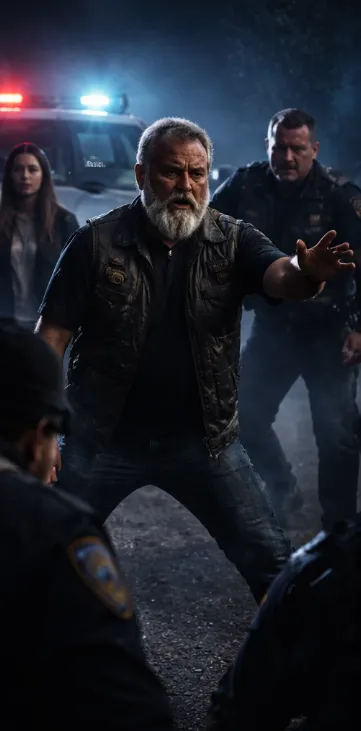
The largest of them stepped forward. His beard was gray and thick, reaching down his chest, his arms covered in faded tattoos that told stories I couldn’t begin to understand. A patch on his vest read: Road Captain.
“Ma’am,” he said, his voice deep but controlled. “I need you to stay calm and let me explain.”
“Explain what?” I shot back, my voice shaking despite myself. “You’re stealing dogs!”
He raised both hands slightly, palms open. “We’re not stealing them. We’re trying to—”
The screech of tires cut him off.
A police car skidded into view, red and blue lights exploding across the scene, turning everything into chaos. My breath caught as the doors flew open and two officers stepped out, hands already near their holsters.
And then something happened that made no sense.
The bikers didn’t run.
They rushed toward the police.
“Don’t shoot!” the Road Captain shouted, his voice booming like thunder across the street. “Turn off the engine! Don’t use the radio!”
The officers stiffened, instantly on edge.
“Get back!” one of them barked. “Hands where I can see them!”
The biker stopped a few feet away, his chest rising and falling hard, eyes wide with urgency.
“Listen to me,” he said, his voice dropping but somehow more intense. “Do you smell it?”
There was a pause. A strange, heavy pause.
The officer frowned and sniffed the air.
I did too.
At first, there was nothing but damp asphalt and engine fumes—but then it hit me.
A sharp, rotten-egg stench.
Sulfur.
It was thick. Heavy. Wrong.
“There’s a main gas line rupture inside,” the biker said. “The whole building is a bomb. One spark—one gunshot—and this entire block goes up.”
The words settled like ice in my veins.
The officer’s hand slowly dropped from his weapon.
“We were riding past and caught the smell,” the biker continued, breathless. “We called 911. They said the fire department was ten minutes out. These dogs didn’t have ten minutes. They’re in cages in the basement—the gas sinks. They were suffocating.”
My stomach twisted violently as everything snapped into place.
They weren’t stealing anything.
They were saving them.
“Is everyone out?” the officer asked quickly, already reaching for his radio.
The Road Captain turned back toward the shelter, his expression shifting—and then draining of color.
His voice, when it came, was barely a whisper.
“The old one… the blind retriever in the back office. We missed him.”
Time stopped.
Before anyone could react, he turned and ran.
“Hey! Stop!” the officer shouted. “It’s too dangerous!”
But the man didn’t even hesitate.
He slammed through the front door and disappeared into the darkness.
I couldn’t breathe.
The gas smell was stronger now, creeping into my lungs, making each inhale feel heavier than the last. The other bikers stood frozen, their tough exteriors cracking, eyes locked on the doorway like it might swallow him whole.
Seconds stretched.
Then minutes.
No one spoke.
One of the bikers gripped his handlebars so tightly his knuckles turned white. “Come on, brother,” he muttered under his breath.
The silence was unbearable.
And then—
Movement.
A shadow stumbled out of the doorway, swallowed by smoke and flickering light.
It was him.
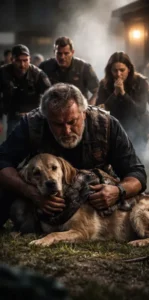
He staggered forward, coughing violently, barely able to stay upright. Wrapped in his leather vest, clutched tightly against his chest, was a golden retriever—its eyes cloudy, its body limp.
He collapsed onto the grass.
But he never let go.
“Come on, buddy,” he rasped, his hands trembling as they moved to the dog’s chest. “Breathe. Don’t you quit on me.”
The world narrowed to that moment.
The dog didn’t move.
Didn’t react.
Didn’t breathe.
My heart slammed against my ribs.
Then—
A weak cough.
A soft, broken whine.
And then, barely noticeable at first, a small wag of its tail.
The tension shattered.
A cheer erupted from the bikers, raw and unfiltered. Even the officers let out breaths they’d been holding. I felt my knees weaken, relief crashing through me like a wave.
The dog was alive.
The fire department arrived minutes later, sealing the leak, their faces grim as they assessed the damage. One of them muttered that if the gas had built for another ten minutes, the entire building would have gone up from a single spark.
Ten minutes.
That was all it would have taken.
The shelter owner showed up not long after, pale and shaken, admitting under pressure that he’d ignored a maintenance warning weeks ago to save money. His words barely registered as I stood there, watching the scene unfold in the pale light of dawn.
The men I had almost called criminals sat quietly on the curb now, sharing water bottles with the very dogs they had just risked their lives to save.
The Road Captain—Bear, I overheard someone call him—sat with the blind retriever resting against his knee, the animal finally calm, its breathing steady as it drifted into sleep.
I walked toward him slowly, my chest tight with something I couldn’t quite name.
“I’m sorry,” I said, my voice softer than I expected. “I thought… I judged you.”
He looked up at me, his face smeared with soot, and smiled.
It wasn’t defensive. It wasn’t bitter.
It was warm.
“It’s alright, ma’am,” he said. “People see the leather, the bikes… they assume the worst. We’re used to it.”
He scratched gently behind the dog’s ear.
“We’re the Rescue Riders,” he added. “We help transport animals across states—get them out of kill shelters, give them a second chance. We don’t usually break in…” He paused, glancing at the building. “But tonight didn’t give us a choice.”
I swallowed hard, looking at the dogs scattered around us, each one alive because of them.
“You saved them,” I whispered.
He shook his head slightly, his gaze shifting to the other bikers.
“No,” he said quietly. “We just gave them a ride.”
His hand rested gently on the retriever’s back.
“They saved us a long time ago.”
The words stayed with me longer than anything else that night.
I looked down at the dog, its cloudy eyes half-closed, its body relaxed for the first time since I’d seen it.
“What about him?” I asked. “He needs a home.”
Bear glanced at the dog, then back at me, something thoughtful passing through his expression.
“Well,” he said slowly, “the shelter’s going to be closed for a while.”
He leaned back slightly, one hand resting on his motorcycle parked nearby.
“My passenger seat’s empty,” he added. “And I think he might like the wind.”
I smiled, even as my eyes stung.
Six months later, I was stopped at a red light when the low, thunderous roar of engines rolled through the street beside me.
I turned my head instinctively.
And there they were.
The Rescue Riders.
But this time, something was different.
At the front of the group, attached to Bear’s motorcycle, was a custom sidecar. Inside it sat a familiar golden retriever, its fur shining in the sunlight, a pair of snug “doggles” covering its cloudy eyes.
It wore a tiny leather vest.
Its head was lifted high, nose catching the wind, ears fluttering as if it understood freedom in a way words could never capture.
Bear glanced over and recognized me instantly.
He gave me a thumbs-up.
I laughed, waving back, a warmth spreading through my chest that lingered long after they disappeared down the road.
And as the light turned green, one thought settled quietly, firmly, into place.
Heroes don’t always look the way we expect them to. Sometimes, they wear leather, break the rules, and ride into the night—just to make sure a blind dog gets to feel the wind on his face one more time.