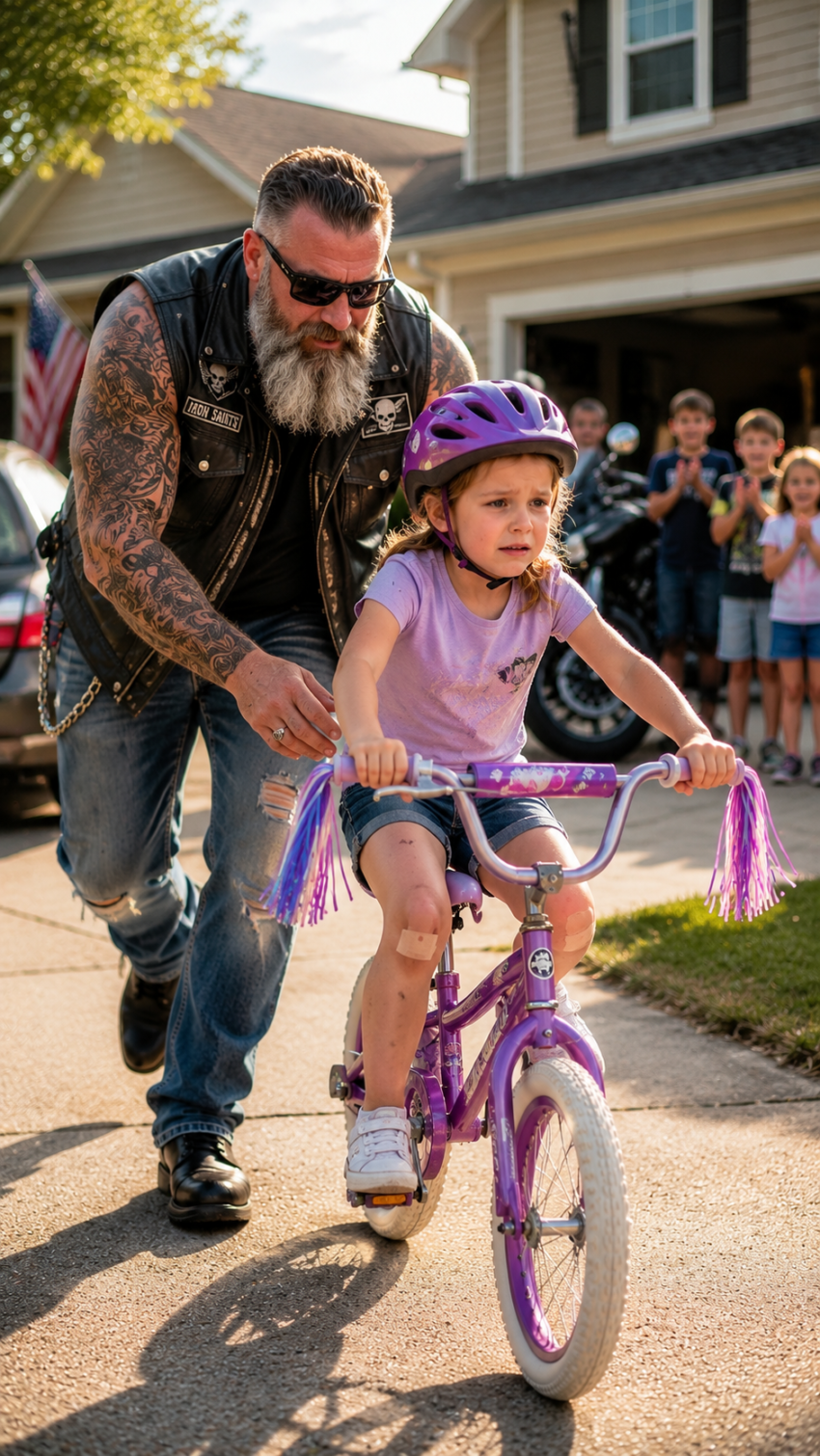
The Entire Neighborhood Feared The 290-Pound Tattooed Biker Next Door — Until He Spent Six Hours Running Behind My 7-Year-Old Daughter’s Bicycle, Caught Her After 30 Falls, Then Broke Down In Tears As She Finally Rode On Her Own And Revealed A Secret He Had Carried For 14 Years
The Man Everyone Misjudged
The heavyset biker caught my eight-year-old daughter one more time before her little blue bicycle could tip sideways into the grass.
He lowered the bike gently, as if it were something fragile, then crouched in front of her with both hands resting on his knees.
“The scary part isn’t falling, sweetheart,” he said in a low voice. “The scary part is hearing you talk like you already decided you can’t win.”
I heard him from the end of our driveway.
My name is Audrey Miller, and I had just come home after working two long shifts at a senior care center outside Cedar Rapids, Iowa. My legs hurt, my uniform was wrinkled, and my mind was full of all the things I had promised my daughter and failed to do.
Then I saw her.
Piper was sitting on the grass with tears on her cheeks. Her blonde hair had slipped out of its ponytail, her little pink gloves were dusty, and both knees were covered with fresh bandages.
Beside her stood our neighbor, Hank Madsen.
Most people on our street called him “Anchor,” though almost nobody said it to his face. He was fifty-six years old, broad-shouldered, tattooed, gray-bearded, and always dressed in a black motorcycle vest. His Harley was loud enough to wake the block, and when his biker friends visited, several neighbors suddenly remembered to close their curtains.
People judged him before they knew him.
I had, too.
But that afternoon, the man everyone avoided had spent hours running behind my little girl.
The Promise I Kept Breaking
Piper’s bicycle had been sitting in our garage for almost a year.
It was bright blue with white handlebars, a silver bell, and a basket she had picked out herself. I bought it after saving tips, skipping small comforts, and telling myself that every child deserved one summer memory that felt simple and happy.
The day I brought it home, Piper wrapped her arms around me and whispered, “Mom, will you teach me?”
I said yes.
I meant it.
But life did not care what I meant.
The next Saturday, my supervisor called because someone could not make their shift.
The following Sunday, my car needed a repair I could not ignore.
One evening after school, I promised we would practice before dinner, but I came home so tired that I fell asleep in my chair while Piper quietly covered me with a blanket.
After a while, she stopped asking.
Her friends learned to ride. They circled the neighborhood, laughing as their tires rolled over the smooth pavement. Piper watched from the porch with a box of chalk beside her, pretending she liked drawing better.
But mothers notice what children try to hide.
I noticed the way her smile faded whenever she heard bike bells outside.
I noticed how she touched the handlebars in the garage, then walked away.
I noticed all of it.
And I hated that I still could not seem to make time.
The Cry Behind The Fence
That Saturday morning, my younger cousin Dana was watching Piper while I worked.
Hank had been in his open garage, fixing something on his motorcycle, when he heard Piper crying near the fence.
She was not crying loudly.
She was crying in that quiet way children do when they believe nobody is coming.
“Everyone can do it except me,” she said. “Maybe I’m just bad at things.”
Hank later told me those words made him put down his wrench.
He did not walk into our yard. He did not scare her. He went to the front door, knocked, and asked Dana if it would be all right for him to help Piper practice in the street where everyone could see them.
Dana called me, but I missed the call because I was helping a resident.
So she said yes.
Hank started by checking the bicycle. The seat was too high. The tires needed air. One brake was too tight. The handlebars were slightly crooked.
“No wonder this thing keeps arguing with you,” he told Piper.
She sniffed. “Bikes don’t argue.”
“This one does,” he said. “But we’re going to teach it manners.”
That was the first time she smiled.
Thirty Falls And One More Try
Hank found a child-sized helmet in his garage. It was pale yellow and looked almost new, though the inside foam was old. He cleaned it carefully, adjusted the straps, and placed it on Piper’s head
The Man Everyone Misjudged
The heavyset biker caught my eight-year-old daughter one more time before her little blue bicycle could tip sideways into the grass.
He lowered the bike gently, as if it were something fragile, then crouched in front of her with both hands resting on his knees.
“The scary part isn’t falling, sweetheart,” he said in a low voice. “The scary part is hearing you talk like you already decided you can’t win.”
I heard him from the end of our driveway.
My name is Audrey Miller, and I had just come home after working two long shifts at a senior care center outside Cedar Rapids, Iowa. My legs hurt, my uniform was wrinkled, and my mind was full of all the things I had promised my daughter and failed to do.
Then I saw her.
Advertisements
Piper was sitting on the grass with tears on her cheeks. Her blonde hair had slipped out of its ponytail, her little pink gloves were dusty, and both knees were covered with fresh bandages.
Beside her stood our neighbor, Hank Madsen.
Most people on our street called him “Anchor,” though almost nobody said it to his face. He was fifty-six years old, broad-shouldered, tattooed, gray-bearded, and always dressed in a black motorcycle vest. His Harley was loud enough to wake the block, and when his biker friends visited, several neighbors suddenly remembered to close their curtains.
People judged him before they knew him.
I had, too.
But that afternoon, the man everyone avoided had spent hours running behind my little girl.
The Promise I Kept Breaking
Piper’s bicycle had been sitting in our garage for almost a year.
It was bright blue with white handlebars, a silver bell, and a basket she had picked out herself. I bought it after saving tips, skipping small comforts, and telling myself that every child deserved one summer memory that felt simple and happy.
The day I brought it home, Piper wrapped her arms around me and whispered, “Mom, will you teach me?”
I said yes.
I meant it.
But life did not care what I meant.
The next Saturday, my supervisor called because someone could not make their shift.
The following Sunday, my car needed a repair I could not ignore.
One evening after school, I promised we would practice before dinner, but I came home so tired that I fell asleep in my chair while Piper quietly covered me with a blanket.
After a while, she stopped asking.
Her friends learned to ride. They circled the neighborhood, laughing as their tires rolled over the smooth pavement. Piper watched from the porch with a box of chalk beside her, pretending she liked drawing better.
But mothers notice what children try to hide.
I noticed the way her smile faded whenever she heard bike bells outside.
I noticed how she touched the handlebars in the garage, then walked away.
I noticed all of it.
And I hated that I still could not seem to make time.
The Cry Behind The Fence
That Saturday morning, my younger cousin Dana was watching Piper while I worked.
Hank had been in his open garage, fixing something on his motorcycle, when he heard Piper crying near the fence.
She was not crying loudly.
She was crying in that quiet way children do when they believe nobody is coming.
“Everyone can do it except me,” she said. “Maybe I’m just bad at things.”
Hank later told me those words made him put down his wrench.
He did not walk into our yard. He did not scare her. He went to the front door, knocked, and asked Dana if it would be all right for him to help Piper practice in the street where everyone could see them.
Dana called me, but I missed the call because I was helping a resident.
So she said yes.
Hank started by checking the bicycle. The seat was too high. The tires needed air. One brake was too tight. The handlebars were slightly crooked.
“No wonder this thing keeps arguing with you,” he told Piper.
She sniffed. “Bikes don’t argue.”
“This one does,” he said. “But we’re going to teach it manners.”
That was the first time she smiled.
Thirty Falls And One More Try
Hank found a child-sized helmet in his garage. It was pale yellow and looked almost new, though the inside foam was old. He cleaned it carefully, adjusted the straps, and placed it on Piper’s head.
Then he took the pedals off the bike.
Piper frowned. “That’s not how bikes work.”
“It is today,” he replied. “First, you learn balance. Speed can wait.”
For the first hour, she pushed herself down the quiet street with both feet. She complained. She wobbled. She almost tipped over. Hank walked beside her every step.
For the second hour, he put the pedals back on.
That was when the falling began.
Once near the mailbox.
Once beside the curb.
Once when she looked down at her own shoes.
Once when an older boy across the street laughed.
Hank did not scold the boy. He only knelt beside Piper and brushed grass from her sleeve.
“Do you know why people laugh when someone else is learning?”
Piper wiped her nose. “Because I look silly.”
“No,” Hank said. “Because trying reminds them of the times they were scared, too.”
By the time I drove home, Piper had fallen more times than I could count.
Hank counted every one.
Not to embarrass her.
To prove something.
When I asked how many times she had gone down, he looked toward the chalk marks on the curb.
“Thirty,” he said.
Piper lifted her chin. “Thirty-one if you count the bush.”
Hank nodded seriously. “The bush participated. That was a team event.”
Piper tried not to laugh, but she did.
Try Scared
I looked at Hank more closely.
His shirt was soaked with sweat. His hands were scratched. His knees were dirty from kneeling on pavement. One boot was dragging slightly, like his ankle had begun to ache.
A man who looked like he could lift a motorcycle had spent an entire afternoon chasing a child’s bicycle because my daughter had started believing she was being left behind.
I felt ashamed.
“You didn’t have to do all this,” I said.
Hank looked at Piper, not at me.
“She wasn’t finished yet.”
Piper crossed her arms. “I said I was finished six times.”
Advertisements
“No,” he said gently. “You said you were scared six times. That’s not the same thing.”
She looked down at the bicycle.
“I’m going to fall again.”
“Maybe.”
Her eyes grew wide. “You’re supposed to tell me I won’t.”
Hank shook his head.
“I won’t lie to you. You might fall. But I can promise you this—you won’t fall by yourself.”
Something in Piper changed.
It was small at first. A breath. A blink. A little straightening of her shoulders.
Then she climbed back onto the bicycle.
Hank placed one huge hand under the back of the seat.
“Where do you look?” he asked.
Piper swallowed. “Where I want to go.”
“And what do brave people do when they’re scared?”
She held the handlebars tighter.
“They try scared.”
The Moment He Let Go
Hank started running.
The bicycle shook from side to side. Piper’s elbows locked. Her face was serious, frightened, and hopeful all at once.
Five feet.
Ten feet.
Then fifteen.
Hank stayed beside her, breathing hard, one hand steadying the seat.
The other children in the neighborhood began to gather. At first, they watched silently. Then one little girl whispered, “Go, Piper.”
Piper did not hear her.
She was too focused on the road ahead.
Hank released the seat.
He did not announce it. He did not make a big show of it. He simply opened his hand and let her move forward.
Piper kept pedaling.
For one beautiful moment, she did not know she was doing it alone.
Then she passed the mailbox, crossed the chalk line, and rolled halfway around the circle before looking back.
Hank was standing in the middle of the road.
He was no longer holding her.
Piper’s mouth opened.
“MOM!” she shouted. “I’M DOING IT! MOM, LOOK! I’M REALLY DOING IT!”
The children cheered.
Dana cried from the porch.
I covered my mouth with both hands because my heart felt too full for my chest.
Hank turned away.
At first, I thought he was only trying to catch his breath.
Then I saw him wipe his eyes with the back of one rough hand.
The Helmet In His Garage
Later, when Piper was still circling the street with a smile so bright it almost hurt to look at, I asked Hank if he was all right.
He nodded, but his voice was quiet.
“I never had kids,” he said. “For a few hours today, I understood why a father keeps running even when his legs are done.”
I did not know what to say.
A week later, I learned about the helmet.
Piper wanted to add star stickers to it, so Hank brought it out to his workbench. That was when I saw an old price tag tucked beneath the strap.
“Was this for a niece?” I asked.
Hank looked at it for a long time.
“No,” he said.
Years earlier, he and his wife, Marlene, had planned to become foster parents. They had taken classes, prepared paperwork, and turned his spare room into a child’s bedroom. Hank bought the helmet because he imagined teaching a child to ride a bike one day.
But before everything was finished, Marlene became very sick.
Their plans stopped.
The little bedroom stayed closed.
After she passed away, Hank could not bring himself to open that door or throw the helmet away. So he packed it, moved it, and kept it hidden on a shelf for years.
Then one Saturday, he heard my daughter crying behind the fence.
“Why didn’t you tell Piper?” I asked.
He ran his thumb along the helmet strap.
“Children shouldn’t have to carry grown-up sadness before they’re ready.”
A Different Kind Of Family
After that day, Piper practiced with Hank almost every evening.
He taught her how to turn without panicking, how to use the brake gently, how to check the tires, and how to wave thank-you when a car slowed down.
He never called himself her father.
Piper never asked him to.
But something steady grew between them.
She began running next door when her bike chain slipped.
He began keeping juice boxes in his garage refrigerator.
She drew stars on his driveway with chalk.
He taught her the names of tools.
On hard days, when I came home exhausted and guilty, I would find them sitting on the curb, talking like old friends.
One evening, I heard Piper ask, “Do you think people can have more than one kind of family?”
Hank was quiet for a moment.
Advertisements
Then he said, “I think family is anyone who keeps showing up when it would be easier not to.”
Piper nodded like that made perfect sense.
To her, it did.
The Saturday Ride Club
The little video Dana recorded of Piper riding for the first time somehow ended up on our neighborhood page.
People shared it.
At first, Hank hated the attention.
“I helped one kid ride a bike,” he grumbled. “That doesn’t make me special.”
But the comments told a different story.
Single parents wrote that they had bikes sitting unused in garages.
Grandparents said they were too nervous to teach children how to ride.
Foster parents asked where they could find helmets.
So Hank talked to the men in his motorcycle group.
The next month, twelve bikers arrived at the elementary school parking lot with air pumps, tools, spare helmets, knee pads, water bottles, and more patience than anyone expected.
They called it Saturday Ride Club.
Big tattooed men jogged behind tiny bicycles while children shouted opposite instructions.
“Don’t let go!”
“Let go!”
“Run faster!”
“Stop running so close!”
Hank gave every volunteer one rule.
“Never promise a kid they won’t fall. Promise they won’t fall alone.”
By the end of the summer, dozens of children had learned to ride.
Piper helped draw chalk finish lines.
Every time a child crossed one, Hank clapped the loudest.
Six Years Later
Six years have passed since that afternoon.
Piper is fourteen now. She is taller, louder, and far too grown-up in the way children become when they think nobody is watching.
The little blue bicycle hangs in Hank’s garage.
The paint is scratched. The basket is bent. Along the lower frame, Hank painted thirty tiny white marks—one for every fall he counted that first day.
Piper rides a bigger bike now.
She also helps younger children learn.
Last spring, a small boy moved into the house at the corner with his grandmother. He had a red bicycle, but he never rode it. One day, Piper heard him crying near the sidewalk.
She looked at Hank.
Hank looked at the garage.
Then Piper reached for the old yellow helmet.
“I’ll help him,” she said.
Hank raised an eyebrow. “You got six hours?”
Piper smiled.
“I’ll make time.”
The boy fell twice before reaching the mailbox. After the second fall, he wanted to quit.
Piper sat beside him on the curb, just like Hank had once sat beside her.
“You can stop if you’re really finished,” she told him. “But if you’re only scared, we can try scared.”
Hank stood by the fence, listening.
His eyes filled again.
This time, he did not turn away.
That evening, Piper slipped her hand into his large tattooed one and said, “You know you’re basically my bonus dad, right?”
Hank looked at me, as if he still needed permission to believe something that good could belong to him.
I nodded.
He closed his hand gently around hers.
“Bonus dad,” he whispered. “I think I can live with that.”
Some fathers are there from the beginning.
Others arrive later, wearing old leather, carrying quiet grief, and hearing a child cry behind a wooden fence.
And sometimes, they run beside her for six hours, catch her every time she falls, and teach her that love is not always about holding on.
Sometimes love is knowing when to let go and still stay close enough to catch her if she needs you.
A child does not always need perfect parents, but every child needs at least one steady person who notices when their confidence begins to disappear.
Sometimes the people we judge from a distance are quietly carrying the kindest hearts on the whole street.
A broken promise can hurt a child deeply, but one patient act of love can begin repairing what guilt alone never could.
Real courage is not the absence of fear; it is a trembling child climbing back onto the bicycle because someone safe is standing beside her.
The best teachers do not laugh when we fall; they kneel beside us, help us understand what happened, and remind us we are not finished yet.
Many people know how to hold on, but only the truly loving ones know how to let go at the right moment.
Family is not always built by blood, paperwork, or last names; sometimes it is built by showing up again and again when someone feels left behind.
One small act of kindness can wake up a part of someone’s heart they thought had been closed forever.
Children remember who ran beside them when they were scared, who believed in them before they believed in themselves, and who stayed after everyone else got tired.
Never underestimate the power of one afternoon, one patient neighbor, one old helmet, and one sentence that tells a child, “You may fall, but you will never fall alone.”