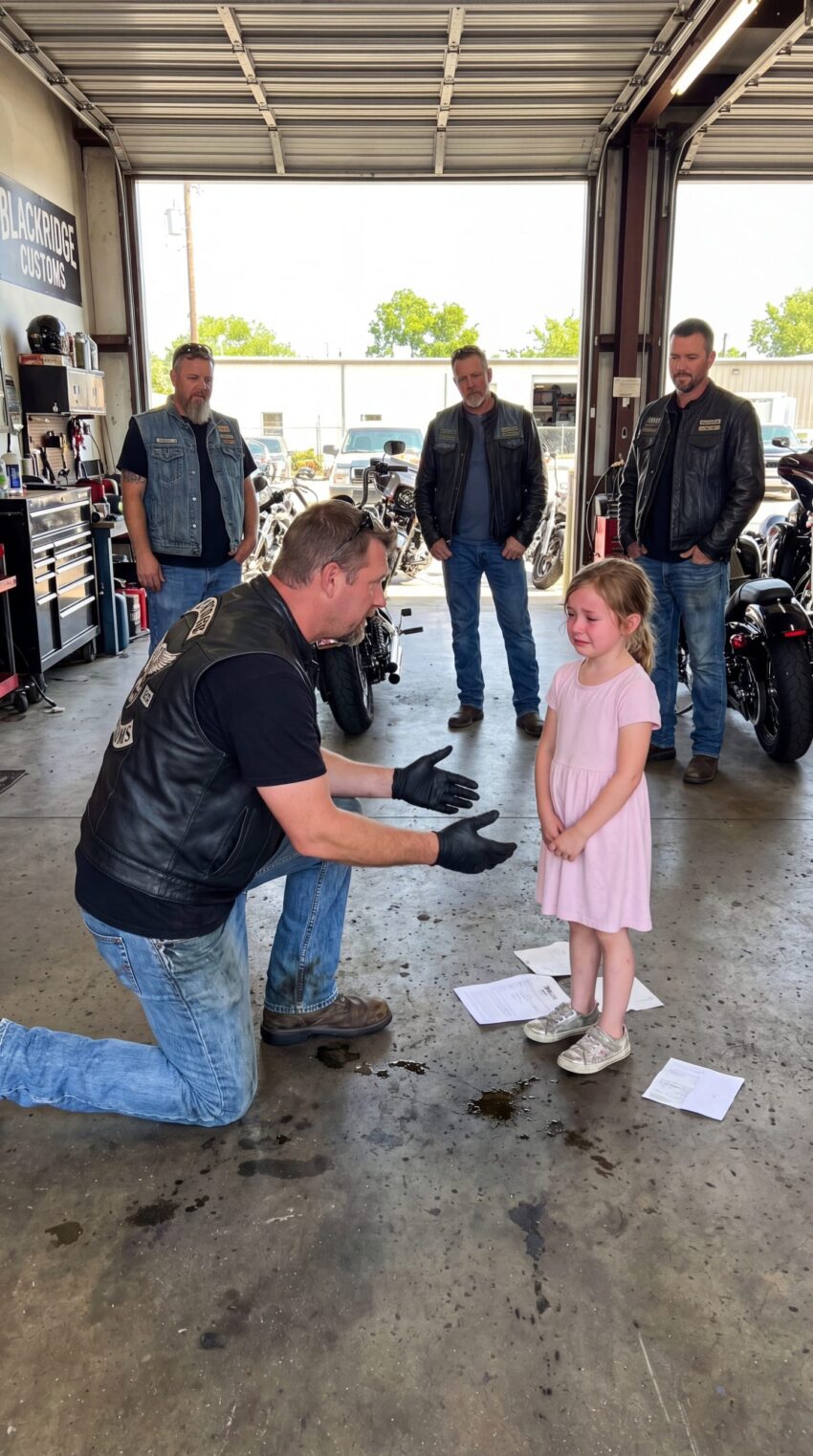
The Girl Outside Blackridge Customs
By the time someone truly noticed her, she had already been standing there for several minutes at the edge of the open service bay of Blackridge Customs, a biker garage on the west side of Cedar Hollow, Tennessee. It was the kind of place where the smell of gasoline, old leather, and warm metal usually covered everything else. Loud engines, rattling tools, and rough laughter filled most afternoons, making it easy for small things to disappear into the background.
But this child did not belong in the background.
She looked about seven years old, maybe a little younger if you only saw how small she was. Her sneakers were dusty, the white rubber edges scraped gray from hard use. A stack of school papers had slipped from her hands and scattered across the stained concrete in front of her. She tried to bend and gather them, but her arms barely moved. They hung stiffly at her sides as if they had been pushed beyond what they could handle. Her shoulders trembled with effort. Her lips quivered. Tears slid down her cheeks without sound.
At first, her voice was so faint it nearly disappeared beneath the low growl of an idling motorcycle.
“I can’t lift my arms.”
No one answered right away, not because they did not care, but because the words were so soft they almost felt imagined.
Then she tried again, louder this time, and the fear in her voice carried farther than the sentence itself.
“I really can’t lift them.”
That was when Mason Crowe looked up.
The Man Who Heard More Than Words
Mason had been standing beside his bike with a ratchet in one hand, tightening a loose piece of chrome near the rear frame. He was not the kind of man who startled easily. At forty-one, with years of hard roads behind him and enough silence in his life to know what pain sounded like before it was explained, he had trained himself to catch tone before language. The sound of that little girl’s voice reached him like a thread pulled from some older wound he rarely touched.
The tool slipped from his hand and struck the concrete with a sharp metallic crack.
Heads turned inside the garage. Two men near the lift stopped talking. Another one looked up from a workbench covered in parts. The whole place went oddly still, as if the room itself had paused.
Mason straightened slowly and fixed his eyes on the child standing in the sunlight just beyond the service bay. She was trying very hard not to cry harder than she already was. That alone told him more than most people would notice.
He wiped his hands on an old shop rag and walked toward her, careful to keep his pace steady and unthreatening. When he got close enough to see how red her eyes were, he stopped and lowered himself into a crouch so he would not tower over her.
“Hey,” he said softly. “You’re okay right now. Nobody here is upset with you.”
The girl flinched anyway and took half a step back.
Mason immediately lifted both hands where she could see them.
“I’m not going to grab you, sweetheart,” he said. “I just want to understand what happened.”
She stared at him with the kind of caution children only learn when they have had to read the room too often.
A Name Spoken Like a Secret
For a few seconds, she said nothing. Her gaze shifted past Mason into the garage where three other bikers now stood completely quiet, watching with more concern than she probably expected to see on faces like theirs. The silence stretched. Her breathing shook.
Then, very softly, she answered.
“My name is Sadie Whitmore.”
She said it as if her own name might cause trouble if it was spoken too loudly.
Mason nodded gently.
“Sadie is a beautiful name.” He pointed behind him one by one, making the introductions simple and calm. “I’m Mason. The guy by the workbench is Cole Mercer. The one near the lift is Grant Duvall. And that man coming over with the medic bag is Ben Hart.”
Ben was the first to reach them. He had once worked in emergency care before life took him down a different road, and some of that old steadiness still lived in the way he moved. He knelt nearby, keeping a little distance.
Mason glanced back at Sadie.
“Can you tell me what’s wrong with your arms?”
Her eyes fell to the papers on the ground. A math worksheet. A spelling quiz. A note from school folded in half. She swallowed so hard it seemed to hurt.
“They stopped working right,” she whispered. “I tried to pick up my papers, but they won’t listen.”
Then the rest broke loose. Her face crumpled, and the tears came faster.
“My teacher said I have to take my test home and bring it back signed. If I don’t bring it signed, Heather is going to be mad.”
The name came out suddenly, and the instant she said it, fear flashed across her face. She clamped her lips shut as though she had opened a door she was never supposed to touch.
The Man Who Knew the Signs
Ben’s expression changed in the smallest way, but Mason saw it.
Ben spoke gently, his voice low and even.
“Sadie, I used to help people when they got hurt. I’m not going to do anything unless you say yes, but I need to check if you can move a little for me. Is that okay?”
She hesitated, then gave a tiny nod.
Ben lifted one hand, demonstrating the motion first.
“Can you try raising your right arm?”
Sadie tried. The effort tightened her whole face. Her arm rose only a few inches before dropping again. Her breath caught.
“Okay,” Ben said carefully. “Now the left.”
The result was no better. Her shoulders shook, and a cry slipped out before she could stop it.
“They hurt,” she said. “I had to hold the boxes up on the shelf until she came back, and she didn’t come back for a long time. When I let them fall, she said I had to do it again because I ruin everything.”
The air inside the garage changed.
Cole looked away and dragged a hand over his beard. Grant’s jaw set hard enough to show through the stubble along his cheek. Mason stayed still, but a heaviness settled in his chest.
He did not ask the next question quickly. Children in fear deserved care, not pressure.
When he finally spoke, his voice was almost a whisper.
“Who made you do that, Sadie?”
She shook her head so fast that strands of hair stuck to her wet face.
“I’m not supposed to say.”
“Why?” Mason asked.
Her answer came small and broken.
“Because it gets worse when I talk too much.”
When Quiet Feels Safer
Those words hit each man differently.
Cole, who had spent part of his own childhood learning when silence felt safer than honesty, took one slow step forward. He kept his tone rough but kind.
“I know what that feels like,” he said. “But your little arms should never hurt like this.”
Sadie looked at him, surprised by the softness in a man who seemed built like a wall.
Ben leaned back a little, careful not to crowd her.
“She’s overstrained them badly,” he said quietly to Mason. “Maybe not permanent, but serious enough. This didn’t happen from normal play. She’s been made to hold weight longer than a child her size should ever have to.”
Mason pressed his lips together. He had seen hard things in places far from home, in corners of the world where children learned to hide discomfort behind silence. He had hoped never to recognize that same look on a child standing outside a garage in Tennessee.
But there it was.
He turned back to Sadie.
“Where do you live?”
She sniffled and shifted her feet.
“Maple Run. The blue house with the porch swing.”
Then, with terrible urgency, she added, “But I can’t go back without the paper signed. Please. Can one of you sign it? It doesn’t even have to be real. She just wants it signed.”
Mason felt something crack quietly inside him. A little girl with trembling arms was not asking for rescue. She was asking for the smallest possible version of relief because she had learned not to expect anything bigger.
A Promise Given With Care
Grant Duvall, the oldest among them, had once worked in family outreach before his life shifted course. He understood the danger of rushing in without a plan. He also understood the danger of walking away.
He crouched on Sadie’s other side, his weathered face calm.
“Who is Heather?” he asked.
Sadie rubbed her cheek against her shoulder because lifting a hand was too hard.
“My dad’s girlfriend,” she said. “My mom moved away a long time ago. Dad drives long routes, so Heather stays with me when he’s gone.”
She looked down again, ashamed in a way no child should ever feel.
“She says I make everything harder.”
No one spoke for a moment.
Then Mason said, “We’ll walk you home.”
Sadie’s head snapped up, panic rising instantly in her eyes.
“No. She’ll know something’s wrong.”
Mason softened his voice even more.
“We won’t go to the door if you don’t want us to. We can stay nearby. We just need to make sure you get there safely.”
She looked from one face to another, searching for mockery, anger, or impatience. She found none of it.
At last, she nodded.
“Okay. But please don’t say anything yet.”
“Not until we know how to protect you the right way,” Grant said.
The House That Looked Fine From the Street
They walked with her down two side roads and across a neighborhood where trimmed hedges, painted mailboxes, and neat driveways made everything look ordinary. The afternoon light laid itself gently across the houses, and from a distance the street felt peaceful in the way many places do when people have learned to keep their curtains closed.
Sadie walked in the middle of the group. Her arms hung stiffly. Every few steps, she winced.
At the entrance to Maple Run, Mason slowed.
“Which house?”
She pointed with her chin.
A blue two-story home stood halfway down the block with white shutters, flowerpots by the steps, and a porch swing moving slightly in the breeze. It was the kind of house people passed without thinking twice. It looked cared for. It looked normal. It looked like the sort of place where school papers got signed at the kitchen table.
Mason had learned long ago that appearances were often the most polished where truth was least welcome.
They stopped at the curb.
“We’ll stay here,” he told her.
Sadie took several slow steps toward the house, then turned back. Her face was small and pale against the afternoon light.
“Thank you,” she whispered.
Before she reached the porch, the door opened.
A woman stepped out with bright makeup, tidy clothes, and a smile that appeared quickly but did not warm her eyes. She said something from the doorway that the men could not hear. Sadie’s posture immediately shrank. The child hurried inside. The door closed behind her.
The porch swing kept moving.
Watching Became a Decision
Mason took out his phone and snapped a photo of the house. Cole exhaled hard.
“We’re not leaving this alone.”
Grant nodded. “We report it first. We do it carefully. And we stay close.”
Ben had already started making notes. The condition of Sadie’s arms. Her statements. The visible pain. The request for a forged signature. The fear attached to one adult’s name. Everything mattered.
They made the call.
The response was professional, but slower than anyone standing on that quiet street wanted to hear. There were procedures. Intake. Evaluation. Timing. Follow-up. The situation would be assigned, reviewed, processed.
Mason ended the call with his face set in hard restraint.
“Then until someone moves faster,” he said, “we keep our eyes open.”
That was how the next several days began.
The Street Started Speaking Without Words
Mason parked down the block the first evening just after sunset. Cedar Hollow cooled quickly at night, and the porch lights along Maple Run flickered on one by one. From a distance, the Whitmore house glowed with soft yellow light, giving off every sign of ordinary domestic life. A television flickered in the front room. A shadow crossed the kitchen. The porch swing had stopped moving.
Then a tall man came out with an overnight bag, locked the front door, and drove away in a long-haul freight truck parked at the curb.
Sadie’s father, Mason guessed.
He watched until the truck disappeared around the corner.
Later that night, movement passed across the upstairs window. One shadow tall. One small. The larger figure moved sharply. The smaller one recoiled.
Mason’s hands tightened on the steering wheel.
His phone vibrated. It was Ben checking in.
Mason answered quietly, “I’m still here.”
Ben did not ask what Mason was seeing. He only said, “Do the right thing, not the fast thing.”
Mason looked at the upstairs window for a long time.
“I know,” he said. “I just wish the right thing moved faster.”
The Child Who Came Back
On the eighth morning, Sadie returned to Blackridge Customs.
She did not come running. She did not smile. She simply appeared again at the edge of the garage as if some invisible thread had pulled her there. This time she held a folded piece of drawing paper against her chest.
Mason saw her first and crossed the floor immediately.
“Hey, sweetheart.”
She held out the paper. He unfolded it carefully.
It was a child’s drawing in crayon. One tall figure with a hard mouth. One smaller figure with tears. Thick red lines filled the space around them, not as blood or anything graphic, but as anger, noise, fear—whatever word a child cannot quite name but still knows how to color. At the top, in careful uneven letters, she had written:
Help me please.
Mason knelt in front of her.
“You did the brave thing coming here.”
Sadie looked exhausted, like someone who had been carrying a weight too big for far too long.
“I’ve tried to be good,” she said. “I do everything I can think of, but it never stays good for long.”
No one in that garage pretended not to understand.
Grant stepped closer and spoke with quiet certainty.
“Listen to me, Sadie. None of this is because of you. Grown-ups are supposed to make children feel safe, not scared. What is happening in your house is not your fault.”
Her chin trembled.
“Then why does she keep saying it is?”
Grant’s face broke in a way only Sadie would ever see.
“Because some people put their own darkness onto whoever is nearest. But that darkness still belongs to them. Not to you.”
The Moment the Truth Could Not Be Hidden
This time the report moved differently.
The drawing helped. Ben’s notes helped. Sadie’s physical condition helped. A teacher, once asked the right questions, quietly admitted that Sadie had shown up tired, withdrawn, and unable to fully lift her arms in class. A neighbor, once directly approached, acknowledged hearing raised voices more than once and seeing the child standing outside alone for long stretches.
The pattern, once named, stopped blending into the wallpaper of daily life.
When the visit finally happened, it was not loud in the way stories often make such moments. There were no dramatic speeches on the front lawn. No crowd gathered in the street. Just trained people at the door, measured voices, careful questions, a child being asked what she needed, and a woman who realized too late that the version of the truth she had relied on was no longer the only one in the room.
Mason and the others stayed nearby, not because they were needed to speak, but because Sadie needed to know someone she trusted had not disappeared.
At one point, Sadie looked toward the window and saw Mason standing by his bike at the curb. He did not wave. He just nodded once.
It was enough.
Sirens came later, distant at first and then closer.
So did relief.
Not the loud kind. Not the triumphant kind. The quieter kind that arrives when a child’s shoulders drop half an inch because she realizes she may not have to manage everything alone anymore.
After the Door Finally Opened
The weeks that followed did not turn perfect overnight.
Healing never does.
Sadie stayed with relatives while her father’s absence, the home situation, and everything surrounding Heather were sorted out properly. She began seeing people who knew how to help children carry what should never have been theirs. Her teacher started leaving gentle notes on her desk instead of warnings. Her arms improved with rest and care. Sleep came easier. Tears came less often. Smiles stopped looking borrowed.
Almost a month later, she walked back into Blackridge Customs on a bright Saturday morning wearing a yellow cardigan and holding a new sheet of paper in both hands.
Both hands.
Ben noticed first.
“Look at that,” he said with a grin. “Those arms are working a whole lot better.”
Sadie lifted them high above her head, laughing a little at the surprise on their faces.
“They don’t hurt anymore.”
Cole wiped his hands on a rag and shook his head as if he had dust in his eyes.
“Best news I’ve heard all week.”
Mason crouched in front of her again, the same way he had on the day they met.
“How about the fear?” he asked.
She thought about it seriously, because children who have had to grow up too fast do not waste words.
Then she smiled.
“It’s not the biggest thing in the room anymore.”
She handed him the drawing.
This one was full of color too, but different. Four bikers stood around a little girl in the middle of the page. Nobody was looming. Nobody was shrinking. The figures were close together, and above them, in careful letters, she had written:
Thank you for listening.
Mason looked at the page for a long moment.
Some people imagine help arriving in grand ways, dramatic ways, angelic ways that can be easily recognized from a distance. But real help often looks ordinary at first. It looks like a man putting down a wrench. It looks like someone kneeling instead of towering. It looks like the choice to believe a quiet voice before it is forced to scream.
And sometimes, when the world has looked away too long, help shows up on two wheels, with oil on its hands and enough patience to listen until the truth can stand in the light.
Sometimes the most important thing you can offer another person is not a perfect solution in the first moment, but the steady presence that tells them their pain is real, their voice matters, and they no longer have to face everything alone.
Children rarely explain hardship in polished language, which is why adults must learn to hear fear in pauses, exhaustion in posture, and quiet distress in the small details most of the world rushes past without noticing.
A home can look neat from the sidewalk, a smile can appear convincing at the door, and a family can seem ordinary to outsiders, but none of those things should ever matter more than what a child’s eyes, body, and trembling voice are trying to say.
The people who make the greatest difference are often not the loudest or the most powerful, but the ones willing to slow down, pay attention, and respond with patience when someone vulnerable gathers the courage to whisper the truth.
There are moments when a child does not need to hear a speech or a promise about the distant future, but simply needs one calm adult to say, with honesty and warmth, that what is happening is not their fault and that they deserve safety without having to earn it.
Compassion becomes far more powerful when it is paired with wisdom, because caring deeply is important, but caring in a way that protects, documents, follows through, and refuses to disappear is what truly changes lives.
Too many people pass by suffering because it does not arrive in a form they recognize, yet real awareness begins when we stop expecting pain to look dramatic and start understanding that sometimes it appears as silence, stiffness, fear, and a child asking for far less than they truly need.
Healing is rarely instant, and it does not erase what came before, but each gentle response, each trusted conversation, and each safe day that follows can slowly teach a wounded heart that fear does not have to remain the center of its world.
The strongest kind of kindness is not soft because it avoids hard truths, but because it faces them with courage, tenderness, and a refusal to let shame stay where it never belonged in the first place.
If this story leaves anything behind, let it be the reminder that listening can become protection, attention can become rescue, and one sincere act of care can begin to rebuild a life that had almost forgotten what safety felt like.