The Night They Got Him Wrong
The fellowship hall in Spokane, Washington still carried the smell of floor cleaner, paper cups, and reheated casseroles when the doors opened for the evening meal. Volunteers had done their best to make the place feel gentle. Round tables were covered in bright plastic cloths. Handmade decorations in warm colors hung on the walls. Someone had placed battery candles in the center of each table, as if a little soft light could make a hard season easier to bear.
It was not a formal event. No speeches were planned. No cameras had been invited. It was simply a quiet dinner for families who had recently lost too much in an apartment fire on the east side of the city. People came because food felt easier than silence, and because sitting near others who understood was sometimes the only comfort they could manage.
Many of the guests spoke in low voices. Some kept glancing toward the exits. A few children stayed close to their parents, as if distance itself no longer felt safe.
Then a man stepped in from the cold, and the room changed.
He was tall and broad through the shoulders, dressed in scuffed boots, dark jeans, and a worn black riding vest under a plain jacket. But what drew every eye was not his size. It was the helmet still covering his head.
He had not removed it.
Not at the door. Not under the bright indoor lights. Not even when a volunteer smiled nervously and motioned toward the coat rack.
He gave a polite nod, said nothing, and walked to a quiet table near the back wall. He sat down alone, folded his hands, and kept his attention lowered. He did not act aggressive. He did not try to take over the room. If anything, he seemed like a man trying very hard not to disturb anyone.
But when people are already carrying fear, silence can look like danger.
A volunteer named Brooke Ellis stood near the sign-in table holding her clipboard a little too tightly. Two parents at the buffet line exchanged uneasy glances. One woman leaned toward another and whispered something behind her hand. A father shifted his chair so his little boy sat farther from the stranger in the helmet.
No one knew that the man was not trying to hide from them.
He was trying to protect them from himself.
The Little Girl Who Noticed What Others Avoided
At a table near the middle of the room sat a little girl between her parents. Her name was Eliza Wren. She was eight years old, slight and pale, with tired eyes that made her look older when she was quiet. A soft hood covered part of her hair even though the room was warm.
Her mother, Nora, kept smoothing the sleeve of Eliza’s sweatshirt as though that small motion could settle something deeper. Her father, Owen, stared at his plate without much appetite. They had both learned how to speak in careful voices since the fire. They had also learned that children notice every careful voice.
Eliza noticed the man in the helmet right away.
She watched him the way children watch the one thing adults are pretending not to see. He did not scare her in the same way he seemed to scare everyone else. To her, he looked lonely. He looked like someone who had already decided he should sit far from the center of things.
She slid from her chair before either parent fully realized what she was doing.
“Lizzie—” Nora whispered, reaching for her.
But Eliza was already crossing the room with small, determined steps.
The sound of conversation faded. Chairs stopped moving. Even the clink of silverware seemed to disappear.
She stopped in front of the man and looked up at him. For a moment, he did not move. Then he slowly raised his eyes to hers through the visor.
Eliza swallowed and asked the question no adult in the room would have dared to ask.
“My mom says I hide my face now because I don’t want people staring. Is that why you hide yours too?”
The silence after those words felt almost sacred.
No one breathed comfortably. No one looked away.
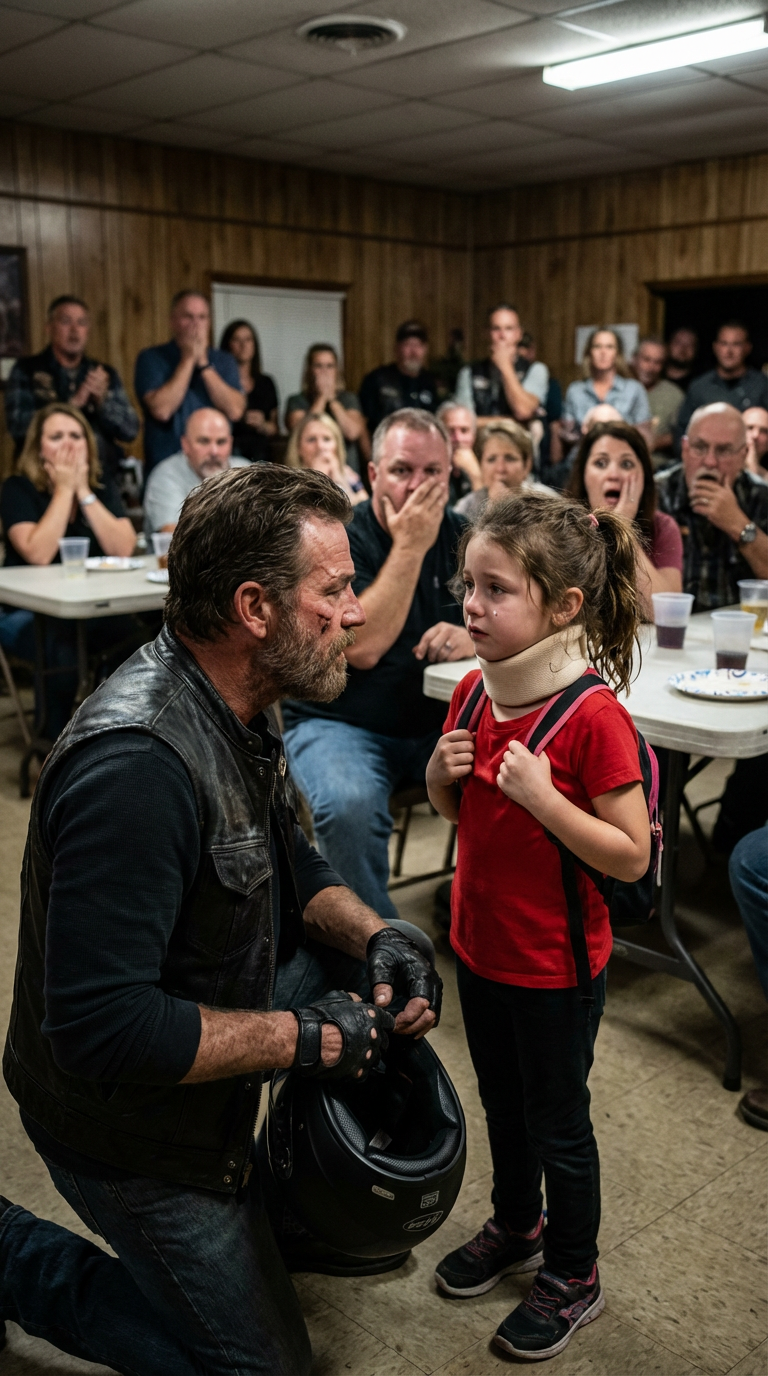
The man stared at her for one long second, then another. And then, very slowly, he rose from his chair and lowered himself to one knee so he would not tower over her.
His gloved hand moved to the strap beneath his chin.
There was a faint click.
He took off the helmet carefully, as if he were lifting away something heavy that he had gotten used to carrying.
A quiet shock moved through the room.
One side of his face carried the lasting marks of an old fire. The skin along his jaw and temple had healed unevenly. It was not a face anyone had expected. But it was not frightening in the way fear had invented. It was simply the face of a man who had lived through something hard and had kept going afterward.
He set the helmet down beside his boot and looked at Eliza with gentleness that reached her before his words did.
Two People Telling the Same Truth
Eliza did not pull back.
She did not gasp. She did not stare in the cruel way adults sometimes imagine children will. Instead, she reached up with careful fingers and pulled her own hood down.
Bandages framed one side of her neck and part of her cheek. The skin around them was new and tender, still bright from healing. She had been covering it because other people did not know how to look at her without looking sorry.
Her voice turned smaller then.
“Does it stop hurting?” she asked.
The man’s expression softened at once. There was no pity in it. Only recognition.
“The sharp part fades,” he said gently. “Some days are easier than others. But little by little, your body remembers how to rest again.”
Eliza studied his face as if she trusted him more than anyone else who had promised comfort.
“Do people stop staring?”
A faint smile touched his mouth. It was not a polished smile, only an honest one.
“Some do,” he said. “And some need time. But the important part is that you learn you don’t have to disappear just because other people are unsure.”
Eliza glanced at the empty chair near him.
“Can I sit with you?”
He looked at the chair, then back at her.
“Yeah,” he answered softly. “I’d like that.”
He stood, picked up the helmet, and for the first time since entering the hall, he walked without it. He pulled out the chair for Eliza and waited until she climbed up before taking his own seat beside her.
Across the room, Brooke wiped quickly at her eyes. Nora covered her mouth, overcome by a mix of relief and shame. Owen straightened in his seat like a man waking from a fog.
The room had been judging him a few moments earlier.
Now it was learning.
Cocoa, Names, and the First Small Smile
Brooke came over carrying two cups of hot cocoa with unsteady hands. She set one in front of Eliza and one in front of the man.
“These are for anyone who needs something warm,” she said.
He looked up at her and gave a grateful nod.
“Thank you.”
She hesitated, then spoke the apology she clearly needed to say.
“I thought the wrong thing when you walked in.”
He did not embarrass her for it.
“Most people do when they don’t know the whole story,” he replied.
Eliza wrapped both hands around her cup and looked up at him. “What’s your name?”
“Gideon Vale,” he said.
She repeated it quietly, as if testing whether it belonged to someone safe. “I’m Eliza.”
“I know,” he said with a smile. “You seem like the kind of person who says brave things before anyone else does.”
That finally brought a tiny smile to her face.
Nora and Owen approached slowly, unsure whether to interrupt. Gideon stood when they reached the table.
Nora’s eyes were still damp. “Thank you,” she said. “She hasn’t talked that openly in weeks.”
Gideon shook his head once. “She did the hard part herself.”
Owen pulled out a chair and sat down across from them. “You came here for the same fire?”
Gideon nodded. “A different one. Years ago. But I heard about this dinner from a friend who volunteers. I thought maybe I could help stock supplies or just listen. Then I realized some people here might not be ready to see…” He briefly touched the side of his face. “So I kept the helmet on.”
Nora exhaled slowly, as though that answer broke her heart a little.
“You were trying to protect everyone.”
“That was the idea,” Gideon said.
Eliza lifted her cocoa slightly like she was making a toast.
“You don’t have to hide from me,” she said.
Gideon raised his own cup to hers.
“Deal.”
Their cups touched lightly, and something in the room relaxed all at once.
When Fear Learned to Use Polite Words
The next week, Nora brought Eliza to a children’s recovery group at a neighborhood clinic. The room was bright, with shelves of books, colored pencils, and soft chairs arranged in a circle. It should have felt welcoming. Instead, that morning it felt uncertain.
Dr. Maren Holt, the therapist who led the group, spoke with patience and calm. She talked about healing, about nightmares, about learning to live inside a body that still remembered fear. Eliza listened without saying much, though her hood remained down.
After the session ended, Dr. Holt asked Nora to stay behind for a private word.
Her tone was careful.
“I need to let you know some parents heard about the man at the dinner,” she said. “A few are raising concerns.”
Nora felt heat rise in her chest. “Concerns about what?”
Dr. Holt gave a small, tired sigh. “They’re calling it safety. But I think it’s mostly discomfort dressed up in polite language.”
Nora looked toward the play corner where Eliza sat drawing. “He was kind to my daughter.”
“I know,” Dr. Holt said. “But fear spreads fast when people think they can make it sound reasonable.”
That evening, the complaints appeared online.
A post in a neighborhood parent group asked whether anyone knew why a biker had been allowed near children at a recovery dinner. The wording was cautious, but the meaning was not. Comment after comment followed. Some came from people who had not been there. Some came from people who had been there and still preferred suspicion over truth.
Owen read over Nora’s shoulder and muttered, “This is ridiculous.”
Nora shook her head. “No. It’s worse than ridiculous. It teaches children who already feel different that they should keep hiding so other people don’t feel uncomfortable.”
She sat down, took a breath, and wrote her own reply. She explained that Gideon had worn the helmet to avoid startling families already shaken by loss. She wrote that he had shown Eliza more understanding in one conversation than some adults had shown in weeks. She wrote that dignity mattered too, and that using the word safety to excuse judgment did not make the judgment kinder.
Then she posted it.
Her hands trembled afterward, but her back remained straight.
The Meeting That Changed Its Own Purpose
A few days later, the clinic arranged a community meeting in the same fellowship hall where the dinner had been held. The chairs were lined up in rows this time. A poster near the front read SUPPORT, HEALING, AND COMMUNITY in cheerful marker letters.
Nora sat near the back with Owen and Eliza. Eliza leaned against her mother’s side, quieter than usual but alert.
Brooke Ellis stood up front beside Dr. Holt. Several parents in the front row looked prepared for a confrontation they would later call concern.
One man in a polo shirt with the neighborhood association logo stood first.
“We all want what’s best for our children,” he began smoothly. “And I think it’s fair to ask questions about who is being allowed into these spaces.”
Brooke answered with more courage than she had shown at the sign-in table that first night.
“No one threatened anyone at that dinner,” she said. “A lot of assumptions were made, and most of them were wrong.”
The man folded his arms. “We’re just asking for appropriate caution.”
Before anyone else could speak, the back door opened.
Every head turned.
Gideon walked in without a helmet.
No dramatic entrance. No anger in his posture. Just a man choosing not to let other people tell his story for him. He wore a dark button-up shirt beneath a simple jacket. His scars were visible. His hands were empty.
He stopped near the front but did not step behind the podium.
“You want to talk about caution,” he said evenly. “Let’s do that honestly.”
The room stilled.
“You heard one word about me and decided the rest yourselves,” he continued. “You heard biker and imagined trouble. You saw a helmet and assumed arrogance. But what actually made this room unsafe wasn’t me. It was how quickly people turned uncertainty into judgment.”
The man in the polo shirt shifted but said nothing.
Gideon looked toward Eliza.
“I kept that helmet on because I didn’t want children who had just lived through fire to be surprised by a face they weren’t prepared to see. I thought that was the gentlest choice I could make.”
A silence fell that no one wanted to interrupt.
Dr. Holt stepped forward then, voice clear and steady.
“Children do not learn cruelty from scars,” she said. “They learn it from adults who treat visible differences like a problem.”
A father in the second row lifted his hand halfway, then let it fall.
“My son stared the other night,” he admitted. “I told him to stop, but I didn’t tell him what to do instead.”
Gideon nodded once.
“Tell him to look with kindness,” he said. “Not with fear. Not with shame. Just kindness.”
Then, from the back of the room, Eliza stood up.
Her voice shook, but it carried.
“He looked at me like I was still me,” she said. “Not like I was something sad.”
No one moved.
Eliza kept going.
“If you really want kids to feel safe, then stop making us feel like we have to cover up for everybody else.”
That was the moment the meeting stopped being about suspicion and became what it should have been all along: a lesson in honesty.
The Promise He Kept
Gideon did not turn into a public hero after that. He did not speak at every event. He did not make himself the center of anyone’s recovery. But he stayed present in quiet ways that mattered.
Once a week, a small box arrived at the clinic with useful things inside—soft scarves, skin cream, children’s pajamas without tags, snack cards for tired parents, notebooks for kids who needed somewhere safe to put their thoughts. No speech came with any of it.
Once a month, Eliza received a note in large block letters.
Keep drinking water. Healing needs help.
Bad nights do not erase good progress.
You are allowed to be seen exactly as you are.
She kept every one of them in a shoebox beside her bed.
Before a difficult treatment a few weeks later, Eliza asked a question that surprised even her parents.
“Can Gideon come with us?”
So he came.
He sat in the waiting room in a plain jacket, no helmet, no attempt to make himself less visible. When Eliza spotted him, her whole face changed. She moved toward him quickly, then slowed, remembering all the rules adults teach children about distance.
Gideon crouched down to her eye level.
“Hey, kid.”
“I’m scared,” she whispered.
He nodded as if fear deserved respect.
“That makes sense,” he said. “I still get scared too.”
She blinked. “Even now?”
“Even now.”
“What do you do?”
He thought for a moment before answering.
“I touch something real,” he said. “A chair arm, a wall, the edge of a table. Something that reminds me I’m here and not back in the hardest moment.”
Eliza held up her stuffed rabbit.
“I use Clover.”
Gideon smiled. “That’s a very good plan.”
When the nurse called her name, Eliza looked at him anxiously.
“Will you stay?”
He pointed to a chair directly across from the treatment room door.
“Right there,” he promised. “So when you come out, you’ll see me first.”
And that was exactly what he did.
The Picture That Gave Her Back to Herself
Not long after that, school picture day arrived.
Eliza had nearly decided not to go. She had already missed enough school to know how quickly other children notice changes. Nora was brushing her hair that morning with the kind of tenderness that comes from trying not to cry in front of your child.
Then the doorbell rang.
Gideon stood on the porch, rain on his shoulders, hands in his jacket pockets.
Eliza’s eyes widened. “You remembered.”
“I told you I would,” he said.
At school, a few parents stared. A few looked away too quickly. But Nora lifted her chin and kept walking. Eliza held her stuffed rabbit in one hand and her mother’s hand in the other until they reached the picture room.
Then she looked back at Gideon.
He gave her the same calm expression he had worn at the dinner, in the meeting, in the clinic waiting room.
“You don’t have to do anything all at once,” he told her. “Just one brave step.”
Eliza took that step.
The camera flashed.
A week later, the printed photo came home in a thin envelope.
Nora opened it slowly. Owen leaned in beside her. Eliza stood between them, nervous and curious.
There she was.
No hood. No attempt to vanish. No apology in her posture.
Just Eliza Wren, looking quietly serious and beautifully herself.
She stared at the picture for a long moment before whispering, “I don’t look scary.”
Nora knelt and pulled her close.
“No, sweetheart,” she said, voice breaking. “You never did.”
Eliza looked toward the shoebox of notes in her room later that night, and for the first time in months, she slept without covering her face.
A Few Gentle Truths to Carry Forward
If life has taught you to shrink yourself so other people can stay comfortable, please remember that your healing is not a burden, your presence is not a mistake, and you do not owe invisibility to anyone who has not learned how to look at another person with grace.
There are seasons when recovery feels painfully slow, but slow progress is still progress, and the days when your heart feels tired do not cancel the quiet, brave work your spirit has already done.
Sometimes the kindest thing a person can offer is not a solution or a speech, but simple, steady presence that says without fanfare, “You do not have to stand in this hard place by yourself.”
Children often understand dignity faster than adults do, because they have not yet mastered the habit of disguising fear as judgment, and there is deep wisdom in that kind of honest sight.
When people stare at what has changed in you, it does not mean you have become less worthy of love; it only means some hearts are still learning what compassion is supposed to look like.
Real safety is never built by shaming people into silence, because silence may keep a room comfortable for a moment, but only kindness makes it truly safe for someone to breathe freely inside it.
The marks left by painful seasons do not erase your beauty; they simply prove that your story did not end in the hardest chapter, and that survival itself can carry a quiet kind of radiance.
You do not need to become fearless in order to move forward, because courage is often nothing more than choosing honesty, choosing trust, and choosing one small next step while your hands are still shaking.
A gentle voice spoken at the right moment can undo weeks of loneliness, which is why we should never underestimate the healing power of being the person who looks at someone fully and still stays.
No matter how long you have hidden, there is still a future in which you lift your head, let yourself be seen, and discover that your life is far bigger, warmer, and more hopeful than the moment that once made you believe you had to disappear.
←