The Bark Behind the Glass
My hand was shaking over the emergency call button when something outside my kitchen window made me stop breathing for a second.
At first, all I saw was a huge man hanging from the railing of the third-floor balcony across from mine. He was covered in tattoos, broad as a doorway, and built like someone most people would avoid on instinct. My first thought was that he was trying to force his way into the vacant apartment.
Then I looked closer.
He was holding out a small plastic bowl with both hands as carefully as if it were made of glass. And the dog on that balcony—a weak German Shepherd that had been wasting away in front of the whole building—was dragging itself toward him like it had no strength left for fear.
That was the moment I realized he was not the danger.
He was the only person who had come to help.
The Dog Everyone Heard but No One Could Reach
My name is April Mercer, and I lived in a tired apartment complex in Dayton, Ohio, where people mostly kept to themselves. We shared walls, parking spaces, and thin ceilings, but not much else. You learned to mind your business. You learned not to ask too many questions. And most of all, you learned how often people could hear suffering and still keep walking.
For six days, that dog had been crying from the third-floor balcony of Unit 307.
The tenant had been removed from the building almost a week earlier. He had carried out lamps, trash bags full of clothes, a television, and even a cheap folding chair. He had taken everything that mattered to him.
He had left the dog behind.
The Shepherd had been strong once. Even from my window, I could tell. There was something noble in the way he held his head, even when he was fading. But day by day, he became thinner, quieter, and harder to look at. At first, he barked constantly. By the fourth day, the bark had turned rough and broken. By the sixth, it had become a faint whimper that seemed to float through the walls and settle into everyone’s chest.
I called animal services four times.
Every time, I heard the same polished answer. Without legal approval, they could not enter the unit. I called the police and got redirected. I called the property office and got a speech about procedures, risk, and liability. Every person sounded sorry in the way people do when they want to sound compassionate without doing anything meaningful.
Meanwhile, the dog stood out there in the cold spring wind, with an empty bowl, no water, and no one coming.
The whole building knew.
Some neighbors complained about the sound. Some closed their curtains tighter. Others turned up the television as if volume could silence guilt. But no one forgot that cry. No one could.
I know I didn’t.
The Sound of a Motorcycle
On the seventh morning, a deep rumble rolled through the parking lot and shook the glass in my kitchen window.
I stepped over with my coffee still in my hand and saw a black motorcycle pulling into a space near the sidewalk. The rider cut the engine and sat still for a moment, staring up at the building.
He was the kind of man you noticed immediately. Late forties, maybe. Heavy shoulders. Thick beard with gray starting to show. Black leather vest weathered by years on the road. His arms were covered in ink, but there was nothing wild about him. He stood with a kind of stillness that felt controlled, focused.
He looked up toward the balcony.
The dog, who had barely moved that morning, lifted his head.
Then, somehow, he pulled himself forward.
The rider didn’t wave. He didn’t call out. He just stood there, looking at the animal with an expression I couldn’t quite read from that distance. It wasn’t pity. It was something steadier than that.
Decision.
A minute later, he walked straight into the building.
A Man Who Refused to Walk Away
About twenty minutes later, raised voices echoed through the hallway outside my apartment.
I opened my door just enough to see what was happening.
The biker was standing in front of our building manager, a nervous man named Curtis Bell who had spent the last week explaining why nothing could be done. Curtis kept adjusting his tie and looking around, hoping someone else would take over the conversation.
“That dog is barely hanging on,” the biker said. His voice was low, but it carried. “I’m not here to debate paperwork. I’m here to get him out.”
Curtis swallowed hard. “Sir, you cannot enter that apartment. It does not belong to you. If you force your way in, I’ll have to call the police.”
The biker didn’t step closer. He didn’t raise his voice. Somehow, that made him seem even more certain.
“Then call them,” he said. “But that dog is not staying up there another hour.”
Something shifted in the hallway after that.
Maybe it was because someone had finally spoken out loud what the rest of us had been thinking. Maybe it was because his voice carried none of the excuses we had all been hearing for days. Or maybe it was because there are moments when a single person’s refusal to look away makes everyone else realize how small they have been.
Curtis muttered something about consequences.
The biker turned and walked away.
I rushed back to my window.
The Climb No One Expected
From above, I watched him circle the building like he was studying a problem. He looked up at the balconies, the drainpipe, the spacing between railings. Then he pulled off his gloves, flexed his hands, and grabbed the first ledge.
And he started climbing.
I forgot to breathe.
He moved carefully, not recklessly. Every shift of weight was measured. Every handhold was tested before he trusted it. But it was still terrifying to watch. He was climbing three stories with no safety line, no backup, and no promise that the frightened dog would even let him get close.
My phone was in my hand again. My thumb hovered over the screen.
If someone had walked into my kitchen at that moment, they would have said the same thing I had thought at first: a stranger was scaling a building. It looked dangerous. It looked wrong.
But my heart told me something else.
This was what help looked like when the proper channels had already failed.
He swung himself over the third-floor railing in one clean motion and landed on the balcony.
The dog flinched instantly, dragging his weak body into the corner. A faint growl rose from his chest, more fear than warning.
The biker did the smartest thing he could have done.
He sat down.
Right there on the cold concrete, cross-legged and still, like he had all the time in the world.
Then he slowly pulled a bottle of water and a small plastic container from inside his vest. He filled the bowl little by little and slid it across the balcony, not forcing anything, not rushing.
The dog stared.
Then he began to crawl.
When he reached the bowl, he drank with desperate, trembling gulps.
I covered my mouth and started crying before I even realized it.
“I Got You, Buddy”
The biker stayed where he was, leaving space between himself and the dog. After a while, he pulled out strips of food wrapped in foil and gently tossed one piece at a time.
The Shepherd snapped it up.
Then another.
Then another.
The man’s voice drifted upward to my open window, soft in a way I never would have expected from someone who looked like him.
“Easy now,” he said. “You’re okay. I got you, buddy. I got you.”
The dog’s whole body shook as he ate. But it was different now. Before, he had trembled from weakness and fear. Now there was something else mixed in.
Relief.
Down below, sirens began to cut through the parking lot.
Two police cars pulled in fast. Officers stepped out, looking up, trying to understand what they were seeing.
One of them called up, “Sir, stay where you are and keep your movements slow!”
The biker glanced down but didn’t argue. He kept his attention on the dog.
And then something happened that I will never forget for the rest of my life.
The German Shepherd, who had spent days alone, hungry, confused, and frightened, slowly leaned forward and collapsed against the biker’s chest.
The man wrapped both arms around him with astonishing gentleness.
For the first time all week, the dog stopped trembling.
Breaking the Door for Mercy
A minute later, the biker looked down and shouted, “I’m coming inside with him. He needs help now.”
Then, instead of climbing back down with an exhausted dog in his arms, he turned toward the sliding balcony door. He braced himself, kicked near the lock, and the old frame gave way with a loud crack.
The glass rattled, but it didn’t shatter completely. He disappeared into the apartment with the dog held close against him.
I ran out of my unit and down the stairs so fast I almost missed a step.
By the time I reached the entrance, the officers were waiting near the front doors, the building manager behind them, flushed and agitated.
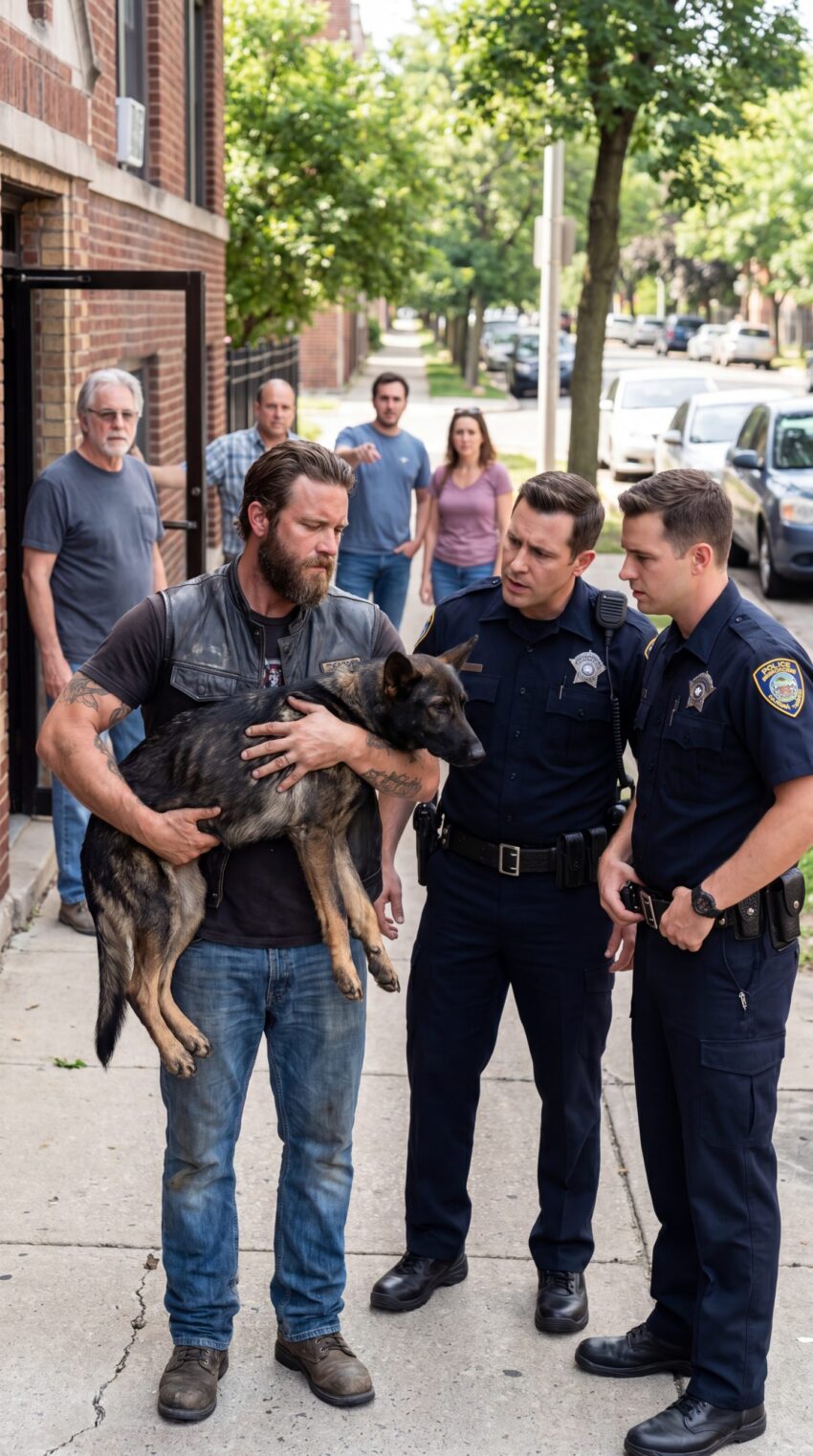
When the biker emerged, the dog looked even smaller in his arms than he had on the balcony. Up close, it was heartbreaking. His ribs showed sharply through his coat. His eyes were tired and crusted at the corners. His breathing was shallow and uneven.
Curtis pointed and burst out, “That’s him! He broke into the apartment! That is still a crime!”
The biker walked forward without hesitation.
He stopped in front of the oldest officer, a square-faced man with tired eyes and the kind of calm that comes from seeing too much of the world.
“If you need to take me in, take me in,” the biker said. “But look at him first. Please make sure he gets to a vet.”
The officer looked at the dog.
Then he looked up at the balcony.
Then he turned slowly toward Curtis.
“You called us,” he said, his voice clipped and cool, “because a man stepped in when that animal had been left there to suffer?”
Curtis started talking about policy again, but his words sounded weak now.
The officer lifted a hand and cut him off.
“Enough.”
Then he looked back at the biker.
“Technically, you damaged property,” he said.
The biker gave one small nod.
“I know,” he replied. “Do what you need to do. Just don’t let him wait any longer.”
There was a pause that seemed to stretch across the whole parking lot.
Then the officer reached into his pocket.
Curtis straightened, expecting handcuffs.
But the officer only pulled out his car keys and signaled to a younger officer beside him.
“Call emergency veterinary intake,” he said. “And start a report on the abandonment case.”
Then he looked at the biker again.
“As for what happened here,” he said quietly, “what I saw was a citizen responding to an urgent situation.”
I saw Curtis’s face fall.
And I saw something else too.
The moment when compassion finally outweighed procedure.
The Patch on His Back
Once the dog was safely in the back of the police SUV with blankets and water, the tension in the lot eased. A small crowd of neighbors had gathered by then, all of us trying to act like we had not spent a week feeling helpless from behind our windows.
The biker sat down on the curb while we waited for transport. He tore food into tiny pieces and fed the dog slowly, making sure he didn’t eat too fast.Up close, he looked tired. His face was lined by weather and road miles. But his eyes were kind, and that kindness made everything else about him look different.
I stepped toward him.
“I’m April,” I said. “I’m in 308. I saw everything.”
He nodded politely and kept one hand on the dog’s neck.
“He’s a strong one,” he said. “Just got left with nobody.”
“Why did you come?” I asked. “You didn’t even know him.”
He stood, adjusted his vest, and I finally saw the patch stitched across the back.
A paw print inside a motorcycle wheel.
Below it were the words: SECOND CHANCE RIDERS.
He offered me his hand.
“Cade Holloway,” he said. “Somebody sent me a post about the dog this morning. Our group shows up when animals get ignored too long.”
I looked at the Shepherd.
“You saved his life.”
Cade glanced down at the dog and gently scratched behind one ear.
“No,” he said. “He held on long enough for somebody to get there.”
A Different Kind of Return
Two weeks later, I heard the same motorcycle rumble into the parking lot.
This time, I ran to the window smiling.
Cade was back.
And beside his bike was a custom sidecar.
Inside it sat the German Shepherd.
Only now, he looked like a completely different animal.
His coat was fuller and clean. His eyes were alert. He sat tall, wearing a ridiculous little pair of protective goggles that somehow made him look proud instead of silly. When Cade parked and turned off the engine, the dog let out one deep bark that echoed across the lot like a declaration.
A real bark.
Strong. Certain. Alive.
I hurried downstairs.
Cade laughed when he saw me. “Thought you might want to meet him properly,” he said.
The dog leaned toward me, tail thumping.
“What’s his name?” I asked.
“Bruno,” Cade said. “The rescue team wanted something noble. He seems to like it.”
I reached out slowly, and Bruno pressed his head into my palm.
There was no trace left of the frightened animal who had collapsed on a balcony floor.
Cade clipped the sidecar strap into place and smiled.
“We’re heading to a charity ride,” he said. “Turns out he loves the road.”
Bruno barked again, louder this time, ears up, eyes bright.
As they pulled away, Bruno turned his head once toward the building that had nearly become the place where his story ended.
Then he faced forward.
Toward the open street. Toward the wind. Toward the life waiting for him.
And I stood there for a long time after the sound of the motorcycle faded.
Because some moments divide your life into before and after.
Before, I thought compassion mostly lived in polite voices, official channels, and proper systems.
After, I knew better.
Sometimes help arrives loud enough to shake your windows. Sometimes it wears leather, carries scars, and looks nothing like softness from a distance. And sometimes the person everyone is quickest to fear turns out to be the one brave enough to climb three stories for a life that cannot ask for mercy in words.
Real kindness is not proven by how gently people speak about doing the right thing, but by whether they are willing to act when comfort, rules, and convenience make it easier to stand still and let suffering continue.
Too often, the world teaches us to trust appearances before actions, yet again and again it is the rough-looking stranger, the unexpected voice, or the person others underestimate who shows the deepest heart when it matters most.
A life does not become less valuable because it is quiet, forgotten, inconvenient, or unable to explain its pain, and the way we respond to the weakest among us reveals far more about our character than any title, policy, or polished excuse ever could.
There are moments when waiting for the perfect permission becomes its own kind of failure, and while wisdom matters, so does the courage to recognize when mercy can no longer afford another delay.
The saddest part of neglect is not always the cruelty itself, but the number of people who witness it, feel disturbed by it, and still convince themselves that concern without action is somehow enough.
Sometimes one determined person changes everything simply by refusing to participate in the silence, and that kind of courage has a way of waking up the conscience of everyone standing nearby.
We should never forget that healing often begins with something very small—a bowl of water, a calm voice, a patient hand, a moment of safety—and for someone who has suffered too long, those simple things can feel as life-changing as a miracle.
The world becomes better not only through grand speeches or perfect systems, but through ordinary people who decide that another living being will not be abandoned while they still have strength left to help.
It is easy to admire compassion when it looks neat and respectable, but the truest compassion is often inconvenient, messy, risky, and unafraid of being misunderstood if it means protecting a life that needs a defender.
Whenever you begin to believe that goodness has become too rare or too weak to matter, remember that sometimes all it takes is one person with a steady heart to step forward, and that single act of courage can carry another soul all the way back from the edge.