The Night the Patch Meant Something More
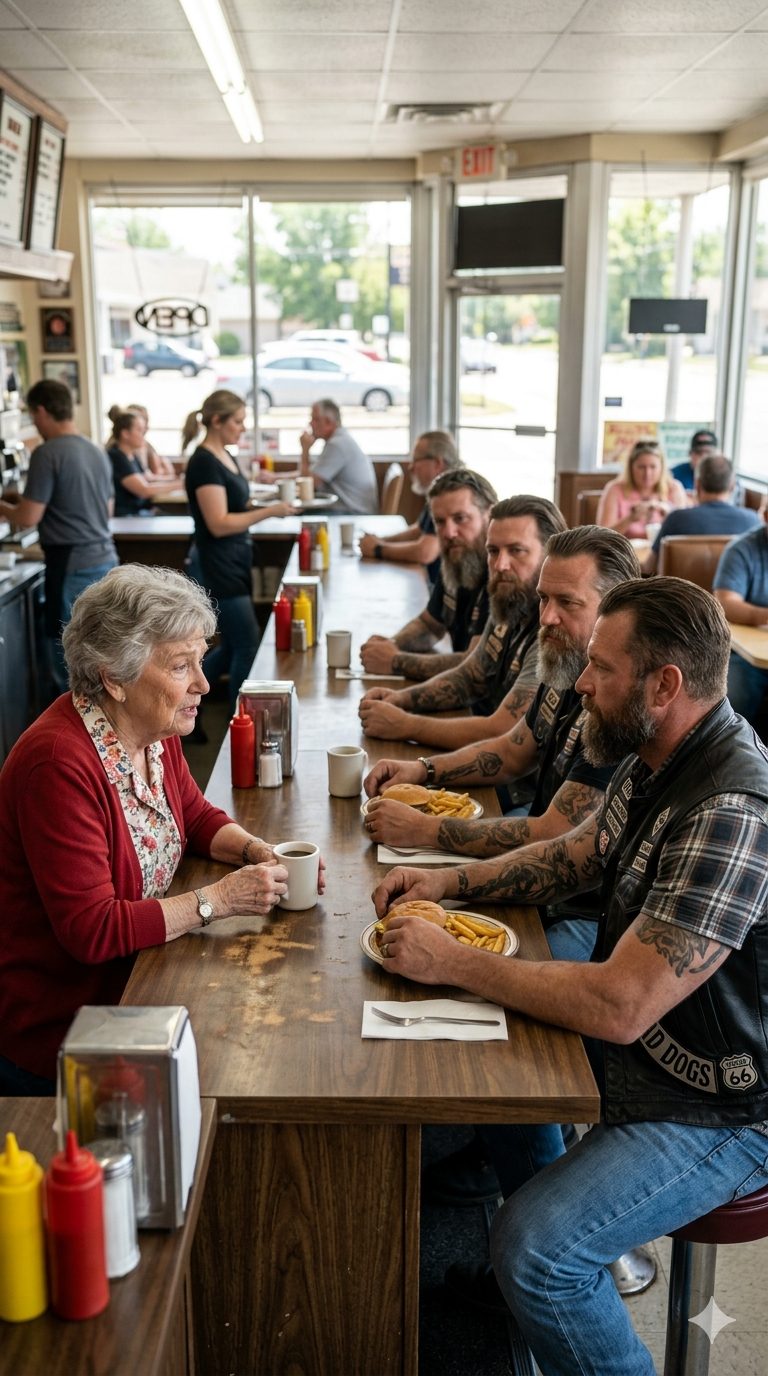
The diner off Route 89 had never been the kind of place people talked about in postcards or travel magazines. It sat at the edge of a small Arizona town called Red Hollow, where the wind carried dust across the parking lot and the neon sign in the front window flickered like it was always one bad night away from going dark for good. Most evenings, the place was filled with the same familiar rhythm: the low hum of conversation, the clink of forks against chipped plates, the smell of coffee that had been warming too long, and the tired comfort of people who came not because it was special, but because it was there.
That night had started the same way.
A young couple sat near the counter sharing fries without saying much. A truck driver leaned over a bowl of chili with his cap pulled low. Two older women in the corner spoke softly over slices of pie, pausing every now and then to look out at the highway through the glass. Behind the register, a waitress named Marcy refilled mugs and moved from table to table with the speed of someone who had worked too many double shifts to waste a single step.
Then the front door opened, and the whole room changed.
Six men stepped inside, one after another, bringing with them the smell of the road, leather, and cold night air. Their boots struck the floor in a slow, steady pattern that seemed louder than it should have been. Their vests were worn and faded in places, the fabric soft from years of sun, rain, and miles. Chains shifted quietly. Rings caught the light. They did not raise their voices. They did not need to.
Every conversation in the diner stopped.
Marcy froze with the coffee pot tilted halfway over a mug. The truck driver straightened in his seat. One of the women by the pie display reached for her purse without meaning to. No one said anything. No one wanted to be the first.
And then, from a booth near the window, a gentle older voice cut through the silence.
“Excuse me, sir,” the woman said. “My daughter has the same mark as you.”
Every head turned at once.
Not toward the six riders, but toward the woman who had spoken.
The Woman by the Window
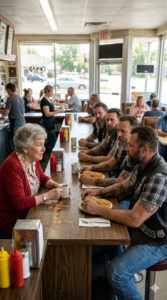
She sat alone beneath the dull yellow glow of a hanging lamp, her back straight and her hands folded neatly on the table beside a half-finished cup of tea. She looked to be in her early seventies, maybe a little older, with silver hair pinned back carefully and a pale blue cardigan buttoned all the way to the top. She was not shaking. She was not apologizing for interrupting. She was simply looking at the man at the front of the group as if she had asked him the most ordinary question in the world.
The man stopped walking.
He was broad-shouldered and tall, with a weathered face, a close gray beard, and the kind of eyes that looked like they had spent years learning how not to trust easy things. His name was Rowan Keene, though no one in that diner knew it yet. The others behind him paused too, their attention shifting from the room to the woman in the booth.
Rowan turned toward her fully.
“Would you say that again?” he asked.
His voice was low and rough, but it held no threat. It carried something heavier than anger. Something closer to disbelief.
The woman gave a small nod.
“My daughter has a mark just like the one on your vest,” she said. “I noticed it the moment you came in.”
Rowan’s hand moved almost without thought to the emblem stitched onto the front of his leather. Most people would have seen only a winged skull framed in dark thread, a club patch like so many others. But hidden within the lines was a small variation, one most eyes would miss unless they knew what they were looking for.
He took a step toward her.
“What is your daughter’s name?”
The woman answered immediately.
“Eliza Hartwell.”
The name struck him like a sudden drop in the road.
For a long moment, Rowan did not breathe.
A Name He Had Not Forgotten
There are names a person hears once and carries forever.
Eliza Hartwell was one of those names.
Twelve years earlier, Rowan had been younger, faster to react, slower to think, and far more certain that strength alone could carry a man through anything. That was before the desert highway, before the night that left two of his brothers broken and nearly took his own life with them. Before an ordinary woman in a sun-faded sedan stopped where others would have kept driving.
In the diner, the people around them still sat in stunned silence, but the feeling in the room had changed. The first fear was still there, though softer now. In its place came curiosity, confusion, and the strange sense that something deeply personal had just stepped into public view.
The woman extended a hand across the table.
“My name is Della Hartwell,” she said with quiet dignity. “I’m her mother.”
Rowan looked at her hand for a moment, then took it carefully, as if it carried more meaning than a handshake should.
“Where is Eliza now?” he asked.
For the first time, Della’s calm expression shifted. The worry she had been holding back rose to the surface all at once.
“She called me about an hour ago,” Della said. “Her car broke down north of town on an empty stretch of road. I was on my way to her, but I stopped here because I was feeling lightheaded and needed tea before I got back behind the wheel.”
One of the riders near the door was already pulling out his phone. Another glanced toward the parking lot. Rowan slid into the booth across from Della, moving slowly so he would not alarm her.
“Ma’am,” he said, “your daughter once did something for me that I have never forgotten.”
Della blinked in confusion.
“Eliza works at a clinic,” she said softly. “She helps people because that is who she has always been. But she never told me she knew you.”
Rowan gave a faint, almost sad smile.
“She probably never thought she needed to.”
The Day the Desert Changed Everything
It happened outside a place called Coyote Pass, miles beyond the last gas station and far from anything that could be called help. Late summer heat rose from the highway in waves, and the air felt so dry it burned the throat. Rowan and two men from his chapter had been riding west under a white sky that gave no hint of mercy.
The road had been empty until it wasn’t.
A dark SUV came up too fast behind them, then swerved with deliberate force. One rider lost control immediately and went down across the pavement in a terrible slide of sparks and dust. Another was pushed hard off the shoulder into stone and scrub. Rowan hit the road with enough force to leave the world ringing around him.
When he tried to move, pain shot through his side and shoulder like fire.
The SUV doors opened.
Men stepped out.
They were not there to help.
Even now, Rowan rarely spoke of those minutes in detail. He did not need to. It was enough to remember the heat, the confusion, the taste of dirt in his mouth, and the certainty that if no one came, none of them were getting back up.
Then, against every bit of logic, a faded tan sedan pulled to a stop nearby.
A woman jumped out.
She was alone. No weapon. No backup. No reason to get involved. But she ran forward anyway, shouting with the kind of command that makes people hesitate even when they should not.
Those few seconds changed everything.
They gave Rowan just enough time to fight through the blur in his head, to grab the first heavy object his hand found, to force space between himself and the men closing in. They gave one of his brothers enough time to crawl toward cover. They turned certain loss into a slim chance.
The woman knelt beside Rowan when the danger passed.
Her hands were steady. Her breathing was not.
“Stay with me,” she told him. “You’re not alone. Stay with me.”
That woman was Eliza Hartwell.
At the time, she had just finished a long shift assisting at a medical outreach clinic two towns over. She could have kept driving and told herself it was too risky to stop. Instead, she tore fabric for pressure, improvised support for injuries, called for help from a stretch of road where signals came and went, and stayed until Rowan was carried into safer hands.
She did not ask for money. She did not ask for gratitude. She simply disappeared back into her own life when she knew the men she had helped would live.
But Rowan had never forgotten her face.
And he had never forgotten the promise he made afterward.
The Meaning of the Mark
Once he recovered, Rowan had the club symbol altered in one small, private way. He worked with an artist he trusted and added a hidden line within the design, subtle enough that most people would miss it. To outsiders, it was only thread and ink. To Rowan and his brothers, it meant something else.
It meant this:
If Eliza Hartwell ever needed help, they would show up.
No questions asked. No hesitation. No waiting until morning.
Not because she belonged to them. Not because she owed them anything. But because some acts of kindness leave a debt that can only be honored by being ready when the world turns uncertain again.
Over the years, that story became something close to sacred among the men who knew it. Newer brothers heard it in quiet conversations at the edge of campfires and in garages late at night. They knew the name. They knew the promise. Most assumed they would never be called to keep it.
Until that night in Red Hollow.
The Call That Brought the Past Back
Della’s hands trembled around her teacup now.
“She said someone had slowed down near her car,” Della admitted. “Not doing anything obvious, but enough to make her uneasy. She tried not to frighten me when she called, but I know my daughter’s voice.”
Rowan stood at once.
The other men needed no explanation.
One rider had already found the likely location from details Della gave. Another was checking side roads and mile markers. Marcy, still standing at the counter as if the scene in front of her had stepped out of another life, finally found her voice.
“Do you want me to call the sheriff?” she asked.
Rowan looked at her and nodded once.
“Yes, ma’am. Tell them a woman is stranded north of Red Hollow near mile marker forty-one. Tell them help is on the way, but she still needs an officer sent out.”
Della rose from the booth too quickly, and Rowan steadied the table with one hand.
“I’m going with you,” she said.
“You are,” Rowan replied, “but you’re riding where it’s safe.”
A few minutes later, the parking lot outside the diner lit up with engines and headlights. Della climbed carefully onto the back of Rowan’s motorcycle, wrapping both hands around the sides of his vest with the uncertainty of someone doing something she never imagined she would do at her age.
Before he pulled away, Rowan glanced back at her.
“We’ll get to her,” he said. “I give you my word.”
The Highway, the Dark, and the Waiting
Eliza sat inside her car with the doors locked and the interior lights off.
The highway stretch where she had stalled was one of those lonely roads that felt wider after sunset, as if the dark itself pushed everything farther apart. Her phone had almost no signal. Her battery was low. The desert beyond the shoulder was little more than shadow and shape.
She had already called her mother once and regretted it only because she heard the worry in Della’s silence.
A pickup had slowed down fifteen minutes earlier. Then it had rolled on.
Then it came back.
It stayed farther behind this time, parked on the shoulder with its lights dimmed. Whoever was inside did not get out right away. That made it worse. Eliza kept both hands tight around her phone and tried to slow her breathing.
“Come on,” she whispered to no one. “Please, just keep driving.”
Instead, one door opened.
A man stepped out and started toward her car.
Not fast. Not running. Just close enough to make every instinct in her body pull tight.
He lifted a hand as if to wave.
Eliza did not respond. She stared straight ahead and reached for the horn.
Then, in the distance, she heard a sound she knew before she understood why she knew it.
Engines.
More than one.
Growing louder.
The Promise Kept
The motorcycles appeared over the rise like a line of moving lights, their beams cutting through the dark in a clean, unmistakable formation. The man near Eliza’s car turned at once. Whatever confidence had brought him forward a moment earlier faded as six bikes rolled in and surrounded the shoulder space around her vehicle.
The engines shut off one by one.
Silence dropped again, but this time it felt different. Not heavy. Not threatening. Certain.
Rowan stepped off first, then helped Della down from the back seat.
The moment Eliza saw her mother, she pushed open the car door and hurried toward her. Della reached her halfway and wrapped both arms around her daughter with the full force of delayed fear.
“You’re all right,” Della whispered, voice breaking. “You’re all right, sweetheart.”
Eliza held her tightly.
“Mom, what are you doing here?”
“Finding you,” Della said, and then pulled back just enough to touch her face. “And apparently arriving with people who know more about you than I do.”
By then, the man from the pickup had already backed away. Rowan faced him with a calm expression that somehow made the message clearer than shouting ever could.
“This road is no place to linger tonight,” Rowan said. “It would be best for you to leave.”
The man looked from Rowan to the other riders, then back toward his truck. A second later, he turned around, got in, and drove off without another word.
Only when the taillights vanished did Eliza finally look closely at Rowan.
And then her face changed.
Recognition moved across it slowly, then all at once.
“Wait,” she said. “I know you.”
Rowan opened his vest just enough to show the mark beneath.
“You do,” he said.
Her hand rose to her mouth.
“You were the man from the desert highway.”
He gave a small nod.
“And you were the woman who stopped.”
For a moment, none of them spoke. The years between then and now seemed to fold inward until they no longer mattered.
Finally, Rowan reached into his pocket and placed a small worn metal token in Eliza’s hand. It was smooth from age and engraved with the same hidden variation that marked his patch.
“You gave help when you had no reason to risk yourself for strangers,” he said. “We never forgot. If you ever need us again, you won’t have to wonder whether anyone is coming.”
Eliza looked down at the token, then back at him, her eyes shining with emotion.
“I didn’t save you for this,” she said softly.
“I know,” Rowan replied. “That’s exactly why it mattered.”
What the Town Remembered
By morning, word had begun to spread the way stories always do in small towns. People at the gas station spoke about the older woman in the diner who stopped a room with one sentence. Marcy told the breakfast crowd that the men in leather had been quieter and kinder than half the people who wore ties through her door. Someone else said they heard a stranded woman had been found safe because a promise made years earlier had not been forgotten.
Of course, details changed depending on who told it.
But the heart of the story stayed the same.
A mother had recognized a mark.
A daughter’s kindness had come back for her.
And a group of men most people feared on sight had turned out to be the ones who arrived when it counted.
Della would later say that what stayed with her most was not the sound of the motorcycles or the sight of Rowan Keene standing under the desert night. It was the realization that people are often far deeper than the first story we tell ourselves about them. A face can look hard while carrying loyalty. A rough voice can deliver comfort. A stranger can become the answer to a prayer simply because, years before, someone chose to do the decent thing.
And Eliza, whenever she drove that stretch of road again, no longer thought first about the dark.
She thought about the promise.
True kindness does not announce itself loudly, because the deepest kind of goodness usually appears in ordinary moments when someone quietly decides that another person’s safety matters more than their own comfort.
We should be careful about judging people too quickly by their clothes, their silence, or the stories others tell about them, because some of the most loyal hearts in this world are hidden behind faces that life has made look hard.
A single act of courage can travel farther than we imagine, and what feels like one small decision to help someone in trouble may become the very reason hope returns to us years later when we need it most.
The world often teaches people to stay out of difficult situations, but compassion has always belonged to those rare souls who are willing to stop, step closer, and say, “You will not face this alone.”
Not every promise is spoken in a room where everyone can hear it, because some of the strongest promises are carried quietly in memory and honored one day through action rather than words.
There is something deeply powerful about being remembered not for status, wealth, or influence, but for the simple fact that when another human being was in pain, you chose not to turn away.
Many people spend their lives hoping for proof that goodness still exists, yet sometimes that proof is already around them in the form of strangers who keep old debts of gratitude alive with remarkable faithfulness.
Family is not always limited to the people we are born beside, because sometimes life brings us unexpected protectors who stand near us in hard moments and prove that loyalty can grow in places we never expected.
The kindness we offer today may feel small and easily forgotten, but kindness has a quiet way of surviving time, crossing distance, and returning with greater strength than we ever thought possible.
In a world that often rewards noise, speed, and appearances, we should never underestimate the life-changing force of steady compassion, quiet bravery, and the people who show up exactly when they are needed most