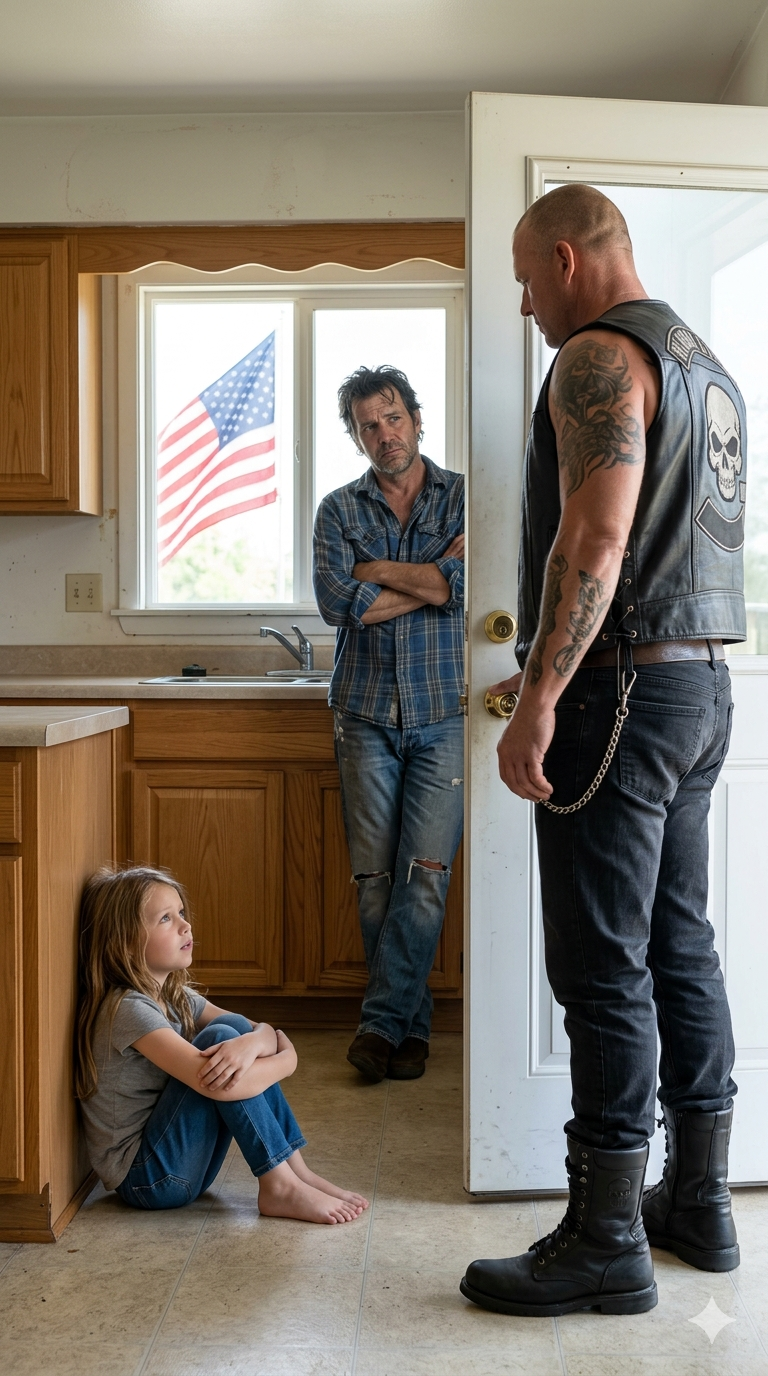
The Night a Stranger Chose to Step In
Iris Bennett had learned to read her husband’s mood before he even opened the door.
She knew the sound of his truck in the driveway. She knew the heavy pause before his key turned in the lock. She knew when to keep dinner warm, when to keep the television low, and when to guide her five-year-old daughter, Nora, into her bedroom before the house became too tense.
For years, Iris told herself she was managing things.
But she was not managing a marriage.
She was surviving one.
Nora was small, bright-eyed, and gentle. She loved plastic dinosaurs, yellow markers, and a stuffed bear named Sunny. She asked questions about everything, but at home, she had already learned when not to speak.
That truth hurt Iris more than anything.
One rainy Tuesday evening in Knoxville, Tennessee, Nora spilled a cup of juice at the dinner table.
It should have been nothing.
A towel. A sigh. Maybe a small reminder to be careful.
But Grant Bennett stared at the spreading juice like it was a personal insult.
Nora’s little face changed first. Her smile disappeared. Her shoulders lifted. Her hands froze in her lap.
Iris reached for the towel quickly.
“It’s okay, sweetheart. Accidents happen.”
Grant’s chair scraped back.
“Did I ask you to fix it?”
Iris kept her voice low.
“Grant, she didn’t mean anything by it.”
Nora started to cry softly. Not loudly. Not dramatically. Just the quiet broken sound of a child trying to stop herself.
Grant hated crying.
He pushed away from the table, and Iris stepped between them without thinking.
“Please,” she said. “Let me clean it up.”
For one second, everything went still.
Then Grant moved toward Nora.
Iris tried to block him.
The next moments blurred into noise, fear, and the awful feeling of being too late. Iris fell against the cabinet, pain cutting through her side. Nora curled near the table, covering her head with both hands, no longer crying at all.
That silence frightened Iris more than the shouting.
Then the front door burst open.
Not opened.
Burst open.
The frame cracked. Cold rain swept into the hallway. A tall man in a black leather vest stepped inside, his boots wet, his gray beard damp, his expression calm in a way that felt more powerful than anger.
He looked at Iris.
Then at Nora.
Then at Grant.
His voice was low.
“Step away from the child.”
Grant turned, stunned.
“Who are you?”
The man walked forward slowly.
“Your neighbor.”
Iris had heard a motorcycle next door a few times over the past month, but she had never met the man who lived there. Grant had called him trouble. A biker. Someone not worth knowing.
Now that same stranger stood between Grant and Nora like a wall.
Grant tried to sound bold.
“You broke into my house.”
The biker did not blink.
“Call the police. Tell them what was happening when I arrived.”
Grant’s face lost color.
For the first time in years, Iris saw something unfamiliar in her husband’s eyes.
Fear.
The Man Next Door
The biker’s name was Silas Mercer.
He did not shout. He did not make a show of himself. He simply pointed toward the chair.
“Sit down.”
Grant stared at him.
Silas took one step closer.
“I said sit.”
Grant sat.
Iris would remember that for the rest of her life. Her husband had ignored love, ignored patience, ignored every quiet plea she had ever made. But he obeyed the voice of a stranger because that stranger made consequences feel immediate.
Silas turned toward Iris.
His face softened, but he kept his distance.
“Can you move?”
Iris pressed one hand to her ribs.
“I need my daughter.”
“I know.”
He crouched several feet from Nora, careful not to touch her.
“Hey, little one. Nobody is going to grab you. Your mom is right here.”
Nora opened one eye. She looked at his leather vest, his broad shoulders, his tattooed arms, and the rain shining on his boots.
Then she looked for Iris.
Iris crawled to her and gathered her carefully into her arms.
“It’s Mama, baby. I’ve got you.”
Nora trembled so hard her teeth clicked.
Silas pulled out his phone and called 911.
“Family emergency,” he said clearly. “A woman and child need medical help. The man responsible is still here, and he is sitting down.”
Grant glared at him.
“You don’t know anything about my family.”
Silas looked at him once.
“I know enough.”
When the officers arrived, Grant changed instantly. His voice became smooth. His face became wounded. He said it was a misunderstanding. He said Iris was emotional. He said Nora had been acting out.
Then a female officer knelt beside Nora and saw the fear in the child’s face.
The room changed.
Iris began to speak.
At first, the words came slowly. Then they came all at once.
She told them about the shouting. The control. The money. The way Grant took her phone when arguments got worse. The way Nora watched the door every evening. The way Iris had stopped inviting people over because she was afraid of what they might hear.
Grant tried to interrupt.
Silas did not move.
One officer raised a hand.
“Sir, you need to stay quiet.”
Grant looked at Iris with the old warning in his eyes.
But this time, there would be no later.
They led him out in handcuffs.
As he passed her, he spoke quietly.
“You can’t do this without me, Iris.”
Iris held Nora tighter.
For the first time, she did not answer him.
The Hospital Hallway
At Eastbrook Medical Center, the lights were bright and cold.
A doctor examined Nora with gentle hands. A nurse gave Iris something for the pain in her ribs. A social worker arrived with a folder, a kind voice, and questions Iris was finally ready to answer.
Nora did not speak.
That was what scared Iris most.
Her daughter, who usually asked why birds hopped and why clouds moved, sat silently with Sunny the bear pressed against her chest.
When the doctor asked if he could look at her arm, Nora only stared at his badge.
Iris felt guilt rise in her throat.
“She used to talk all the time,” Iris whispered.
The doctor nodded gently.
“She may need time. Right now, quiet might be how she feels safe.”
At nearly two in the morning, Iris stepped into the hallway because the room felt too small for her grief.
Silas was still there.
He sat in a plastic chair near a vending machine, his hands folded, his leather vest still damp from the rain.
Iris stopped.
“You stayed.”
He looked up.
“Yeah.”
“Why?”
Silas was quiet for a long moment.
“Because after nights like this, people shouldn’t have to sit alone.”
Iris lowered herself into the chair beside him.
“Thank you.”
He shook his head.
“Don’t thank me like I did something amazing. I heard enough before tonight. I should have knocked sooner.”
She looked at him.
“You heard us?”
“Through the wall,” he said. “Not every word. Enough.”
His jaw tightened.
“Tonight I heard the little girl cry. Then I heard her stop. That silence told me I was out of time.”
Iris covered her mouth.
Silas looked down at his hands.
“My father was like him,” he said. “My mother tried to protect me too. Neighbors heard plenty. Nobody came.”
The hallway seemed to go still around them.
“So I made myself a promise,” Silas continued. “If I ever heard that kind of silence again, I wouldn’t be the neighbor who looked away.”
That was when Iris began to cry.
Silas did not touch her. He did not tell her to calm down. He simply stayed beside her until the crying passed.
Sometimes safety did not arrive with perfect words.
Sometimes it arrived as someone refusing to leave.
Practical Help
The next morning, Silas returned with coffee, clean clothes, and three members of his motorcycle club.
Iris stiffened when she saw them at first.
They looked rough. Leather vests, heavy boots, weathered faces, strong voices.
But they moved gently around Nora.
The club president, Vernon Pike, was a large man with a white beard and kind eyes that missed nothing. Beside him was Tessa Monroe, a woman in her fifties who carried a notebook full of shelter contacts, legal numbers, and names of people who helped women start over. The third was Caroline Hayes, a sharp attorney with a calm voice and a blazer over jeans.
Caroline sat across from Iris and opened her folder.
“We are going to make a plan,” she said. “Not a perfect plan. A practical one.”
That word became the beginning of everything.
Practical.
Not brave.
Not dramatic.
Practical.
They helped Iris file for an emergency protective order. They helped her speak with a victim advocate. They helped her open a separate bank account. They found a small apartment above a bakery owned by a woman who did not ask too many questions.
Vernon sent two club members to collect Nora’s clothes, toys, and favorite blanket while Grant was still being held.
They brought Nora’s dinosaur box first.
That small kindness nearly broke Iris.
When Nora saw the box, she reached inside slowly and pulled out her favorite yellow dinosaur.
Her lips moved.
No sound came out.
Silas crouched near the doorway, keeping his hands visible.
“That one looks tough,” he said softly.
Nora stared at him.
Then, in a tiny voice, she whispered, “He’s a T-Rex.”
Iris froze.
It was the first thing Nora had said since the hospital.
Silas swallowed hard.
“Best kind,” he replied.
Nora looked down at the toy.
“Nobody scares T-Rex.”
Silas nodded once.
“Then T-Rex can stay on guard.”
A New Door
The new apartment was small, but it had a lock Iris controlled.
That mattered.
The kitchen window faced the bakery sign below. In the mornings, the air smelled like bread instead of fear. Nora slept in a little room with soft blue curtains. Iris slept badly at first, waking at every sound, but no footsteps came down the hall. No voice demanded an answer. No one took her phone.
Healing did not feel beautiful.
It felt like paperwork, court dates, therapy appointments, and learning how to breathe without waiting for something to go wrong.
Nora met with a child therapist named Dr. June Keller. Dr. Keller used crayons, dolls, toy animals, and patient silence. She never pushed Nora to say more than she was ready to say.
One afternoon, Iris asked quietly, “Will she ever be the same?”
Dr. Keller answered with care.
“She will not go backward. But she can move forward. Children do heal when safety becomes consistent.”
Safety became a routine.
Vernon fixed a broken shelf.
Tessa dropped off groceries.
Caroline handled the court filings.
Silas changed the oil in Iris’s old car, repaired a loose cabinet door, and always knocked before entering.
Always.
Even after the night he had broken down her door to save them, he treated every doorway like it belonged to Iris now.
One evening, he stood outside with a small paper bag.
“For Nora,” he said.
Inside was a plastic green dinosaur.
Nora took it carefully.
“Another T-Rex?”
Silas looked nervous.
“The lady at the store said kids like this one.”
Nora studied it.
“He can be the guard for the kitchen.”
Silas smiled faintly.
“That sounds like an important job.”
“It is,” Nora said.
For the first time in months, Iris laughed.
It came out small and shaky, but it was real.
The Truth in Court
Grant tried to explain himself in court.
He said Iris exaggerated. He said Silas had no right to interfere. He said he was a hardworking husband pushed too far by stress.
But Caroline had records.
Hospital reports. Photos of damage inside the old house. Messages Iris had saved. Statements from neighbors who finally admitted they had heard shouting. Notes from Nora’s therapist. And Silas had recordings of the sounds through the shared wall from nights when he had become worried enough to document what he heard.
The judge listened.
Grant’s performance grew weaker with every fact.
At one point, he looked back at Iris as if the old fear might still work.
It did not.
Iris sat beside Caroline with her hands folded in her lap. Nora was not in the courtroom. Iris had promised herself her daughter would not be used as a weapon in that room.
When the judge granted Iris full custody and extended the protective order, Iris did not cheer.
She only closed her eyes.
It was not a happy ending.
Not yet.
It was a door opening.
Grant was ordered to stay away. Any future contact with Nora would depend on professional recommendations and the court’s approval.
Nora’s therapist did not recommend it.
When Iris later explained in simple words that the court wanted to know if Nora felt ready to see her father someday, Nora climbed into her mother’s lap and whispered, “No thank you.”
So Iris held her and answered, “Then no one will force you.”
The Sound of Her Voice
Months passed.
Nora began kindergarten. She still startled at loud sounds. She still had nights when she woke up crying. But she also began to sing again in the bathtub. She asked questions again. She corrected Silas when he called a stegosaurus a triceratops.
“That is not even close,” she told him one Saturday.
Silas looked offended.
“I’m trying my best here.”
Nora giggled.
Iris stood in the kitchen doorway and cried silently into a dish towel.
Not because she was sad.
Because her daughter’s laughter felt like sunlight entering a room that had been dark for years.
Silas never tried to become something he had not been invited to be. He was not a replacement. He was not a hero demanding praise. He was simply there.
He brought groceries when money was tight. He checked the tires before winter. He sat on the porch with coffee and listened when Iris needed to talk. He left when she needed quiet.
One day, Nora walked up to him holding the green T-Rex.
“This is yours now,” she said.
Silas looked at the toy.
“That’s your favorite.”
“I know.”
“Then I can’t take it.”
Nora frowned.
“You have to. He’s strong. And you came when the house was scary.”
Silas’s face changed. He took the dinosaur with both hands, careful as if it were made of glass.
“I’ll keep him safe,” he said.
Nora nodded.
“I know. That’s why I picked you.”
After that, the green T-Rex rode in the cup holder of Silas’s truck.
Always facing forward.
Always on guard.
What Stayed Behind
A year later, Iris no longer lived like every sound was a warning.
She had a better job at a preschool office. Nora had a bright bedroom, new books, and a small night-light shaped like the moon. Their home was not fancy, but it was peaceful.
Peace was not quiet because everyone was afraid.
Peace was Nora laughing too loudly during cartoons.
Peace was Iris singing while cooking dinner.
Peace was a door that stayed closed unless someone was invited in.
Sometimes Iris still thought about that rainy night. The broken frame. The cold air. The stranger in leather standing in her hallway.
People liked to say Silas saved them.
He did.
But he also did something more lasting.
He showed Iris that help could arrive without taking control. That strength could protect without owning. That a rough-looking stranger could carry more gentleness than the man who had once promised to love her.
One evening, Nora asked from the back seat of the car, “Mom, why did Mr. Silas break our old door?”
Iris looked at her in the mirror.
“Because sometimes a door is keeping people unsafe instead of safe.”
Nora thought about that.
“So he broke the wrong door.”
Iris smiled through sudden tears.
“Yes, baby. He broke the wrong door so we could find the right one.”
Nora hugged Sunny the bear to her chest.
“I like our new door.”
Iris reached back and squeezed her daughter’s hand.
“Me too.”
And for the first time in a very long time, she believed the future was not something waiting to hurt them.
It was something waiting to be built.
Some people arrive in your life not to take your pain away in one grand moment, but to stand beside you while you slowly remember that pain was never supposed to be your home.
A child’s silence should never be mistaken for peace, because sometimes the quietest child in the room is carrying the loudest story no one has been brave enough to hear.
Real strength is not shown by controlling a family through fear, but by protecting the vulnerable without demanding anything in return.
Sometimes the person who looks rough on the outside is the only one gentle enough to understand what safety truly means.
Leaving a painful home is not one single act of courage; it is a hundred small choices made while your hands are shaking and your heart is still learning how to trust the ground beneath you.
The first safe door after years of fear may look ordinary to others, but to someone starting over, it can feel like the beginning of an entirely new life.
Healing does not always sound like a speech or a celebration; sometimes it sounds like a child laughing again, a mother sleeping through the night, or a quiet knock from someone who respects your space.
No one should have to become brave just to survive inside their own home, but when they finally step toward safety, every small step deserves honor.
A stranger’s kindness can become the bridge between the life someone escaped and the life they are finally strong enough to build.
And sometimes the greatest rescue is not only the night someone comes through the door, but every day afterward when they help you believe that the world can still hold good people.