The Morning the Engines Rolled Into Willow Creek
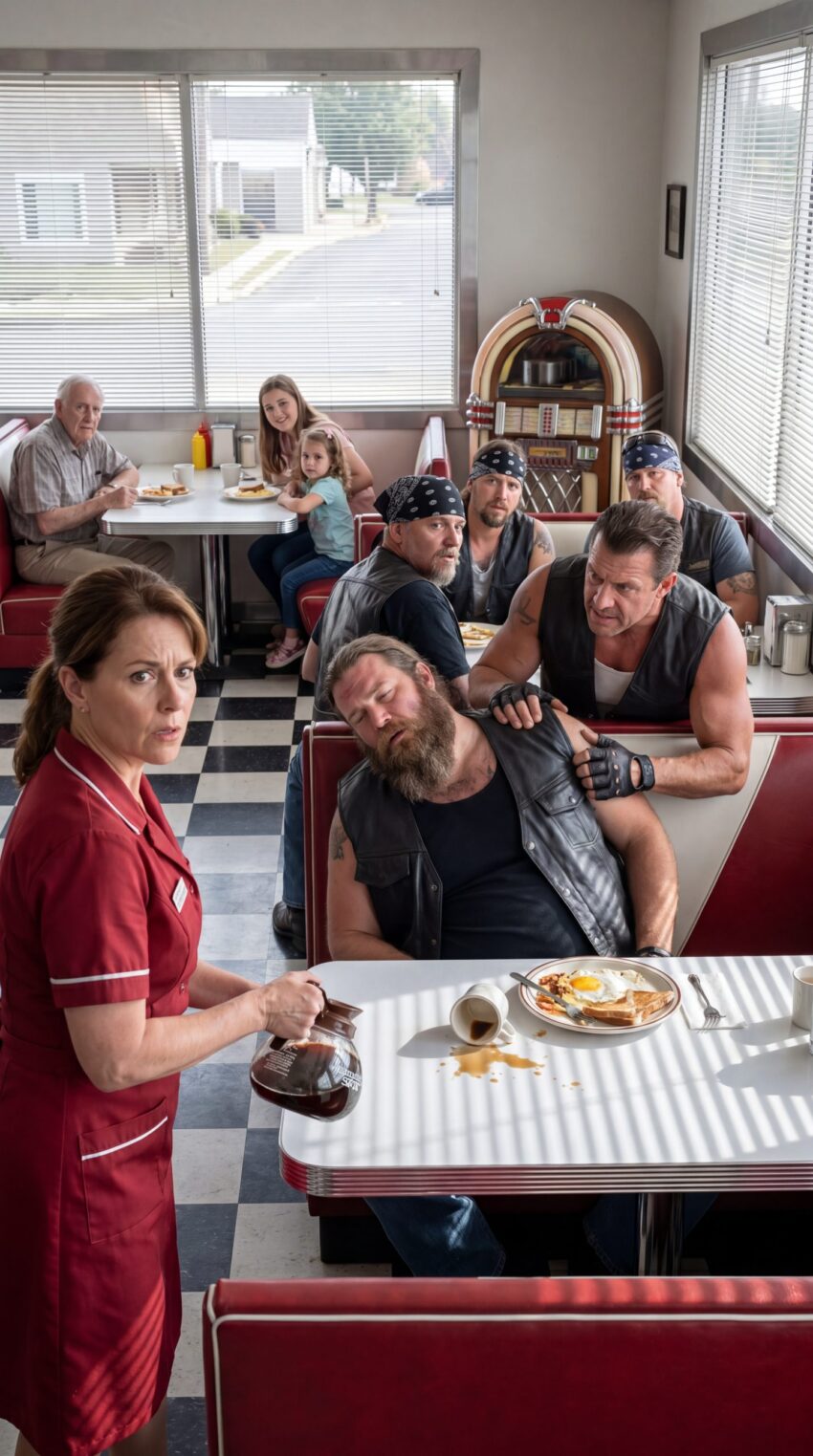
The diner on the corner of Maple and Third had carried the name Bennett’s Table for longer than most people in Willow Creek, Nebraska, could remember. The red neon sign above the door buzzed more than it glowed, and the metal trim along the windows had long since faded into a dull gray. But inside, nothing truly changed. The coffee stayed hot, the pancakes came out just right, and the worn booths held stories that had never been spoken out loud anywhere else.
My name is Clara Bennett, and for twenty-four years, I had started my mornings the same way—tying on a faded apron before sunrise, pouring coffee into thick mugs, and quietly reading people before they ever spoke. In a town like ours, a diner wasn’t just a place to eat. It was where people came to sit with their thoughts, to share what they couldn’t say at home, or simply to feel like they belonged somewhere.
That Tuesday began like any other.
Farmers filled the stools along the counter. A retired teacher read the newspaper out loud like it still mattered. Two teenagers argued softly about a game they didn’t expect to win.
Then the floor trembled.
It wasn’t loud at first. Just a soft vibration underfoot, like something far away was slowly getting closer. The coffee pot rattled slightly in my hand, and without knowing why, my body tensed.
Some sounds don’t belong in ordinary mornings.
Then the engines came.
Not just one.
Many.
Deep, steady, and moving together like they shared the same heartbeat.
Outside, the sound rolled across the gravel lot and seemed to settle into the walls themselves. Conversations stopped. Forks paused midair. Someone near the window whispered, “That doesn’t sound good.”
The door chimed.
And they walked in.
The Arrival No One Expected
Leather jackets. Heavy boots. Faces that had seen more road than rest.
A group of riders filled the doorway, their presence shifting the room before a single word was spoken. The patches on their vests showed a coiled emblem—something sharp, deliberate, and unfamiliar to most of us.
They didn’t wait to be seated.
They moved straight toward the largest booth in the back, the one usually reserved for church groups and family gatherings. Helmets were placed on the table. Chairs scraped against the floor. Their voices were louder than necessary, but not aggressive—just confident, like they were used to taking up space.
The regulars pretended not to look.
I wiped my hands on my apron, picked up the coffee pot, and walked over.
Up close, the smell shifted—fuel, leather, and something tense beneath it all.
At the head of the table sat a man who didn’t need to raise his voice to be in charge. Broad shoulders. Dark jacket without any visible markings. The others glanced at him without making it obvious, waiting for small cues before speaking.
They called him Rowan.
But something wasn’t right.
The Detail No One Noticed
Under the bright diner lights, Rowan’s face looked pale—too pale. His right hand rested near his plate, trembling in a slow, uneven rhythm. When someone next to him made a joke, he tried to respond, but his words came out slurred, like they were struggling to find their way.
I felt it immediately.
Years ago, I had watched my older brother ignore small warning signs that didn’t seem urgent—until suddenly, they were. By the time help arrived, everything had already changed.
I poured coffee into Rowan’s cup.
“How are you feeling today?” I asked, keeping my voice calm.
He looked at me, but his eyes took a second too long to focus.
“I’m fine,” he said, though the words didn’t come out clearly.
A few of the men chuckled when his fork slipped from his hand and clattered against the table.
They thought it was nothing.
I knew it wasn’t.
The Moment That Changed Everything
I didn’t hesitate.
I stepped closer.
“Sir, can you smile for me?” I asked gently.
The booth fell silent.
One of the riders, a tall man with a tense expression, grabbed my wrist.
“Hey, that’s enough,” he said.
I met his eyes without pulling away.
“If you care about him, let go.”
Rowan tried to lift his arm. It barely rose before dropping again. His speech became more tangled, more distant.
My voice sharpened, steady and clear.
“He needs help right now.”
The room shifted.
Confusion turned into concern.
The man holding my wrist hesitated—then slowly released me.
“Call for help,” I said firmly. “Don’t wait.”
This time, someone moved.
A phone appeared. A call was made.
Rowan’s head tilted slightly, his expression clouded, as if he were trying to hold onto something that kept slipping away.
I leaned closer, keeping my voice steady.
“Stay with me. Look at me. You’re not alone.”
When Strength Turns Quiet
The paramedics arrived quickly, their presence cutting through the tension like a breath of clarity.
For a brief moment, I worried pride might get in the way.
But it didn’t.
The riders stepped back.
They didn’t argue. They didn’t resist. Instead, they formed a quiet space around their leader, giving room for the people who knew what to do.
Rowan was carefully lifted onto a stretcher.
For all his size, for all the presence he carried, he suddenly looked fragile—like anyone else would in that moment.
One of the riders—later I would learn his name was Cole—stood near the door as they prepared to leave.
He looked at me, his expression tight but sincere.
“You helped him,” he said.
I shook my head gently.
“I just paid attention.”
He nodded once, as if that answer meant more than anything else.
Then they were gone.
The Silence After
The diner slowly returned to its rhythm.
Plates were cleared. Coffee was poured. Conversations picked up again, though quieter than before.
But something had changed.
The tension that had filled the room earlier had softened into something else—something thoughtful.
For days, people talked.
Some said I had been brave. Others said I had taken a risk. A few wondered if it had been wise to step in at all.
But I didn’t think about any of that.
I kept thinking about how easily that moment could have been missed.
How close we had come to simply laughing it off and moving on.
The Return No One Saw Coming
A week later, the sound came back.
This time, it was softer.
More controlled.
Three motorcycles pulled into the lot instead of many.
The door chimed again, and the same riders stepped inside—but they felt different now. Less like a storm, more like something steady.
They removed their helmets right away.
Cole approached the counter.
“He’s recovering,” he said simply.
Relief settled into my chest before I even realized I’d been holding my breath.
“That’s good,” I said.
He placed something on the counter between us—a small wooden carving, shaped like a coiled serpent with wings extended.
It was detailed. Careful. Made by someone who had taken their time.
“He made it,” Cole said. “Said it belongs here.”
I ran my fingers lightly over the carved lines.
“Why?” I asked.
Cole’s expression softened.
“Because you saw what others didn’t.”
A Different Kind of Conversation
A few months later, I received a handwritten note.
It invited me to visit Rowan at a small cabin outside town.
When I arrived, he was sitting on the porch, a cup of coffee in his hands. He looked stronger—still recovering, but steady.
We talked for a long time.
He told me about the road. About the years he had spent moving from place to place.
Then he said something that stayed with me.
“I used to help people,” he said quietly. “Before I chose a different life.”
I listened.
“I thought I left that part of me behind,” he continued. “But maybe it never really left.”
I smiled gently.
“You don’t lose who you are,” I said. “Sometimes you just forget it’s still there.”
He nodded slowly, as if that truth had been waiting for him.
The Change That Stayed
When the riders came back to the diner months later, they weren’t trying to be noticed.
They didn’t fill the room with noise.
They sat, ordered their food, and spoke quietly among themselves.
Rowan moved more carefully now. He listened more than he spoke. And when he did speak, people listened—not because they were afraid, but because there was something calm in his voice.
They paid. They thanked me.
And they left.
The wooden carving stayed on the shelf behind the counter, near the old jukebox.
A small reminder.
That people are never just one thing.
The Lesson That Remained
That morning could have been remembered for the noise, for the fear, for the assumptions people made the moment those engines arrived.
But that’s not what stayed.
What stayed was something quieter.
A reminder that not everything is what it seems.
That sometimes, the most important moment is the one that doesn’t look dramatic at all—the one hidden behind hesitation, behind small details others ignore.
Because what changed that day wasn’t just one man’s outcome.
It was how an entire room learned to see.
And sometimes, seeing is the difference between stepping back… and stepping forward when it matters most.
Messages and Reflections
Real strength is not shown in how loudly someone enters a room, but in how gently they respond when another person quietly needs help, even if no one else has noticed yet.
The moments that truly define us are rarely the ones we prepare for, but the ones that arrive unexpectedly, asking whether we are willing to act instead of simply watch.
It is easy to judge people based on appearance or reputation, but it takes patience and awareness to understand that every person carries a story far deeper than what can be seen on the surface.
Courage does not always look bold or dramatic; sometimes it is as simple as asking one honest question when everyone else chooses silence.
Fear has a way of narrowing our perspective, but compassion opens it, allowing us to recognize what truly matters even in uncertain situations.
Communities grow stronger not when everyone is the same, but when people choose to look beyond differences and respond to each other with understanding.
A single moment of attention can change the direction of someone’s life, proving that small actions often carry more weight than we realize.
We often think strength means handling everything alone, but true strength lies in accepting help and trusting others when we need it most.
The stories we hear about others are never complete, and it is only through patience and empathy that we begin to understand who they truly are.
If we learn to pause, observe, and respond with care instead of assumption, we may discover that the moment we almost ignored was the very moment that mattered most.