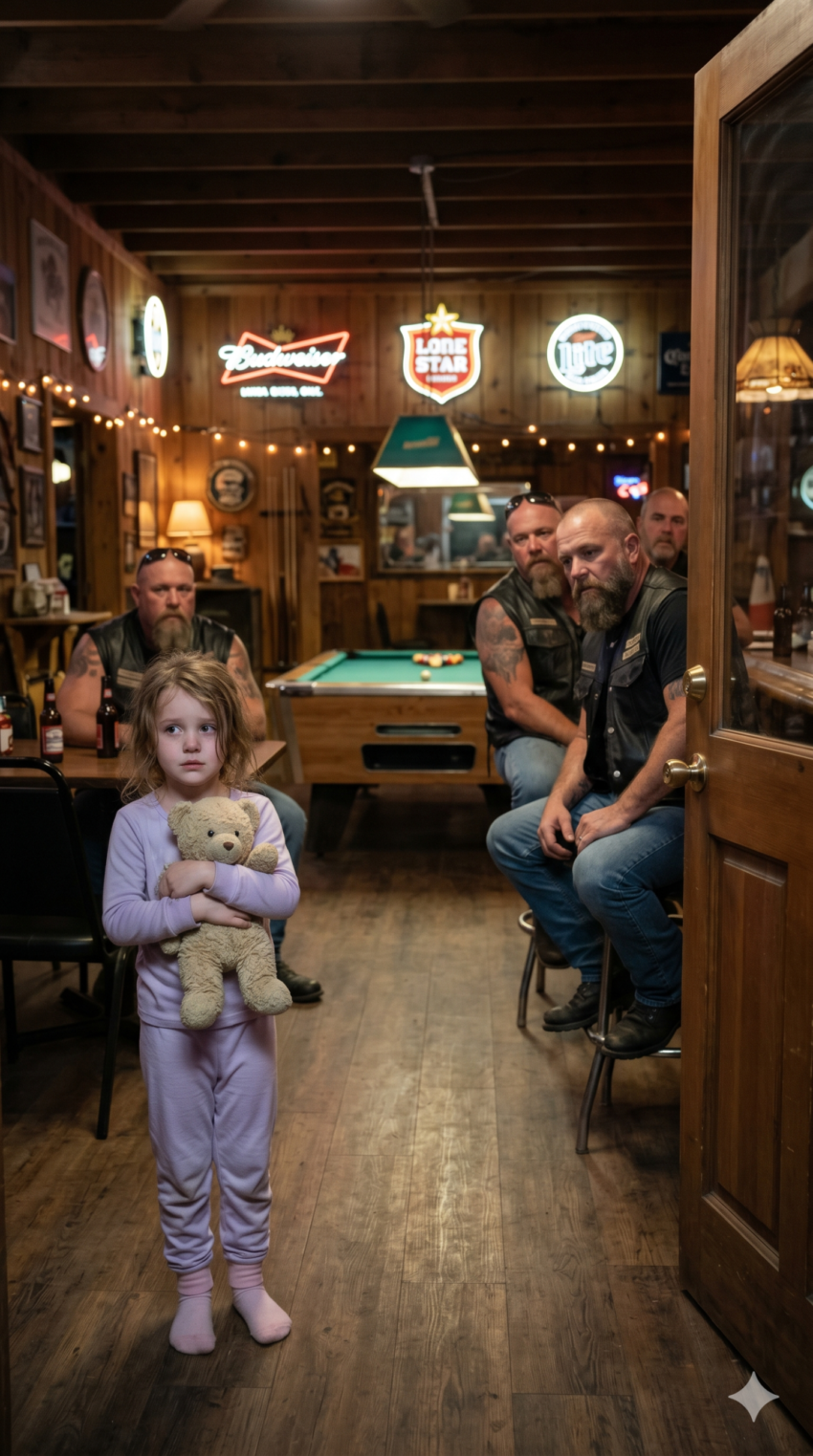
The Night a Little Girl Chose the Bikers
The front door of the Red Oak Riders clubhouse almost never opened after midnight.
Most people in Fort Wayne, Indiana, knew better than to walk into a biker clubhouse without a reason. The building sat beside an old auto shop near the edge of town, with rows of motorcycles parked under yellow porch lights and a faded American flag moving gently above the door.
Inside, the room was quiet.
A few men were playing cards. Someone was fixing the jukebox. Cade Mercer, the president of the Red Oak Riders, sat near the counter with a cup of coffee gone cold in his hand.
Then the door opened.
Every head turned.
A little girl stood there in pink pajamas, one slipper missing, holding a stuffed rabbit against her chest. Her hair was messy, her face pale, and her eyes looked too tired for a child.
Cade stood slowly.
No one moved too fast.
He lowered himself to one knee several feet away from her, keeping his voice calm.
“Hey, sweetheart,” he said softly. “Are you lost?”
The girl’s lips trembled.
For a second, she looked around the room like she was deciding whether she had made a terrible mistake.
Then she ran straight to Cade and grabbed the front of his leather vest.
“Please,” she whispered. “My mom needs help.”
The room changed instantly.
No shouting. No chaos. Just silence.
Cade gently placed one hand near her shoulder, careful not to frighten her.
“What’s your name?”
“Molly,” she said. “Molly Pierce.”
Mama June, the clubhouse owner and a retired nurse, came from the back room with a blanket before anyone asked. She wrapped it around the girl and guided her to a chair.
“Small breaths, baby,” Mama June said. “You’re safe in this room.”
Molly looked at Cade with wet eyes.
“My mom said if I couldn’t call anyone, I should come here.”
Cade’s expression stayed calm, but his jaw tightened.
“Where is your mom now?”
Molly swallowed hard.
“At home. Downstairs. She can’t get out by herself.”
A few bikers looked at one another.
Cade held up one hand, silently telling them to stay steady.
“Who else is in the house?”
Molly hugged the rabbit tighter.
“Ryan. He wears a badge.”
Nobody spoke for several seconds.
Cade did not curse. He did not slam his fist on the table. He simply took out his phone and called the one person he trusted for nights like this.
The Call That Kept Everything Clean
Attorney Maren Brooks answered on the third ring.
She had worked with the Red Oak Riders before, mostly on charity rides, community events, and legal aid fundraisers. She also knew Cade well enough to understand when his voice got quiet, the situation was serious.
“Maren,” Cade said, “we have a child here. She says her mother is trapped in an unsafe situation. The man involved may be a local officer.”
Maren’s voice sharpened.
“Do not confront him. Do not touch him. Call 911 now and keep the child safe. I’m calling a judge and a supervisor I trust.”
Cade nodded even though she could not see him.
“Understood.”
He ended the call and turned to the room.
“Listen carefully,” he said. “We are not going there as heroes. We are going there as witnesses. We record from public space, we wait for emergency services, and we protect this child by doing everything clean.”
Brick, a broad-shouldered rider with gray in his beard, nodded.
“No cowboy stuff.”
“Exactly,” Cade said. “No cowboy stuff.”
Mama June stayed with Molly while Cade called 911. He gave the address Molly remembered, the child’s condition, and the concern that her mother might need medical help.
Molly cried when Cade stood to leave.
“Please don’t let him know I told,” she whispered.
Cade crouched again.
“You did the right thing,” he said. “And we’re going to make sure the right people know the truth.”
“Will my mom be mad?”
His face softened.
“No, sweetheart. Your mom will be proud that you were brave enough to find help.”
The House on Birchwood Court
Birchwood Court was the kind of street people described as quiet.
Clean lawns. Porch lights. Basketball hoops in driveways. Houses that looked peaceful from the outside.
That was the part Cade hated most.
Sometimes trouble did not look loud. Sometimes it looked like fresh paint, trimmed hedges, and neighbors who never asked why one family had stopped coming outside.
The Red Oak Riders parked at the corner and stayed near the sidewalk. Cade kept his phone recording. Brick did the same. Two other riders stood back, visible but calm.
Within minutes, a patrol car arrived.
Then another.
Maren Brooks pulled up behind them in a dark sedan, hair tied back, coat thrown over jeans as if she had dressed in a hurry.
She walked straight to the responding sergeant.
“There is a minor at the clubhouse who came seeking help,” Maren said. “We need this handled by people outside the suspect’s unit.”
The sergeant’s face tightened at the name Ryan Kell. He did not argue.
Soon, the front door opened.
A man stepped onto the porch wearing jeans, a gray T-shirt, and the cold confidence of someone used to being believed.
“What is this?” Ryan demanded. “Why are these bikers outside my house?”
Cade stayed silent.
The sergeant spoke instead.
“We received a welfare call. We need to check on everyone inside.”
Ryan laughed once.
“My girlfriend is resting. Her daughter is dramatic. This is ridiculous.”
Maren looked at Cade’s phone, then back at Ryan.
“Then a quick check should clear everything up.”
Ryan’s face changed for half a second.
That was when Cade knew Molly had told the truth.
Sarah Finally Reaches the Door
The officers entered the house with the sergeant leading.
Cade and the riders stayed outside, exactly where Maren told them to stay.
Minutes passed.
Then the side door opened.
A woman appeared between two emergency responders, wrapped in a blanket. She was weak, unsteady, and blinking at the porch light like she had not seen fresh air in too long.
Cade knew before anyone said her name.
This was Molly’s mother.
Sarah Pierce.
Her eyes moved across the yard, searching.
“Molly?” she whispered.
Maren stepped closer.
“Your daughter is safe. She’s with Mama June at the Red Oak clubhouse.”
Sarah’s knees almost gave out.
One responder caught her gently.
“She made it?” Sarah asked.
“She made it,” Maren said. “She got help.”
A second officer came out carrying a small backpack and a child’s jacket. His expression was grim.
Ryan stood on the porch, his voice rising.
“She’s confused. She does this. You don’t know what you’re dealing with.”
The sergeant turned to him.
“Ryan, stop talking.”
That sentence landed harder than shouting would have.
For the first time, Ryan looked unsure.
The Evidence Nobody Could Ignore
Sarah had done something quiet and smart.
For months, she had kept notes. Dates. Photos. Messages. Names. Small pieces of truth hidden where Ryan would not think to look.
Not because she wanted revenge.
Because she wanted someone to believe her.
Maren sat beside Sarah at the hospital later that night while Molly slept in a chair with her head on Mama June’s lap.
“You don’t have to tell everything at once,” Maren said. “Only what you can manage.”
Sarah stared at her hands.
“He always said nobody would believe me.”
Cade stood near the doorway, far enough away to give her space.
“Molly believed you,” he said quietly.
Sarah looked up.
Her eyes filled.
“I told her to find the bikers because you helped my neighbor last year when her car broke down,” Sarah said. “I didn’t know where else she could go.”
Cade swallowed.
“Then she came to the right door.”
Maren opened her notebook.
“Sarah, this will take time. But tonight, you and Molly are safe. That is the first step.”
Sarah nodded slowly.
For the first time all night, she breathed like the air belonged to her.
The Badge No Longer Protected Him
By morning, Ryan Kell was on administrative leave.
By the end of the week, the investigation had moved beyond one household. Other complaints surfaced. Quiet reports that had been ignored. Old concerns that suddenly made sense.
The Red Oak Riders did not post videos online.
They did not chase attention.
They gave their recordings to Maren and the investigators, then stepped back.
Cade made that rule clear.
“This isn’t about making us look good,” he told the club. “This is about making sure Sarah and Molly don’t have to keep proving they deserve safety.”
Brick nodded.
“Best thing we can do is stay useful and stay quiet.”
Months later, the courtroom was full.
Ryan’s lawyer tried to suggest Sarah had misunderstood things. He tried to make the bikers look unreliable. He tried to make Molly seem like a scared child with an active imagination.
But the evidence was steady.
The 911 call.
The responding officers’ report.
The hidden notes.
The medical records.
The recordings from outside the home.
And Sarah’s voice.
Calm. Clear. Tired, but not broken.
When Maren asked why she had not gone to the police sooner, Sarah looked toward the jury.
“Because the person I was afraid of knew how the system worked,” she said. “And I didn’t know who would hear me.”
The courtroom went still.
Molly’s Smallest Sentence
Molly did not have to stand in the courtroom.
She spoke from a child-friendly room with a support advocate beside her. A camera carried her words to the judge and attorneys.
Maren’s voice was gentle.
“Molly, why did you go to the Red Oak Riders?”
Molly twisted the sleeve of her sweater.
“Because my mom said they help people when nobody else knows what to do.”
“Were you scared?”
Molly nodded.
“Yes.”
“What happened when you got there?”
Molly looked down at her stuffed rabbit.
“They didn’t yell. They gave me a blanket. And Mr. Cade said my mom would be proud.”
Cade sat in the back row with his hands folded.
He looked down when she said that.
The judge listened without expression, but everyone in the room felt the weight of it.
A child had run into a biker clubhouse because it felt safer than staying silent.
That truth did not need dramatic music.
It spoke for itself.
The Day the Room Finally Changed
When the verdict came, Sarah held Molly’s hand.
Ryan Kell was found guilty on multiple charges connected to unlawful confinement, intimidation, and misuse of authority. The wording was formal, legal, and careful.
But Sarah understood what it meant.
It meant he could not walk back through her door.
It meant Molly could sleep without listening for footsteps.
It meant the badge he once used to scare people no longer belonged to him.
At sentencing, the judge looked directly at Ryan.
“A position of public trust is not a shield for private wrongdoing,” the judge said. “It is a responsibility. You violated that responsibility.”
Sarah closed her eyes.
Molly leaned into her side.
Cade sat behind them with Brick, Mama June, and several riders. No leather vests today. Just clean shirts, folded hands, and quiet respect.
When the sentence was read, Sarah did not cheer.
She simply covered her mouth and cried.
Maren put a hand on her shoulder.
“It’s done,” she whispered.
Sarah shook her head softly.
“No,” she said. “Now we start.”
A New Apartment With No Downstairs Room
Three months later, Sarah signed a lease on a small apartment near a school with a playground.
It was not fancy.
The kitchen cabinets stuck. The living room window had a crack in the corner. The hallway light flickered when the washing machine ran.
But Molly loved it immediately.
She walked through every room, opened every closet, and checked behind every door.
Then she turned to Sarah with serious eyes.
“There’s no downstairs room.”
Sarah laughed and cried at the same time.
“No,” she said. “There isn’t.”
Mama June arrived with groceries.
Brick carried in a secondhand couch.
Cade fixed the loose kitchen cabinet without being asked.
Molly placed her stuffed rabbit on the windowsill like it was guarding the home.
That evening, Sarah stood in the doorway and watched her daughter eat pizza on the floor with the bikers who had become something more than strangers.
They were not perfect men.
They were not polished men.
But when a child had opened their door at midnight, they had chosen patience, law, and protection.
That mattered.
The Tiara on the Toughest Man
On the first Sunday of spring, Sarah and Molly returned to the clubhouse for dinner.
This time, Molly did not run inside crying.
She marched in with a paper bag and a secret smile.
Cade was standing near the porch, wiping dust from his motorcycle.
“Mr. Cade,” Molly said, “close your eyes.”
Cade raised an eyebrow.
“That sounds dangerous.”
Mama June called from inside.
“Do what the child says.”
Cade sighed and closed his eyes.
A moment later, something light and plastic settled on his head.
“Okay,” Molly said. “Open.”
Cade looked at his reflection in the clubhouse window.
A sparkly purple tiara sat crooked on his head.
The porch went silent.
Then Cade adjusted it carefully until it was straight.
“How do I look?” he asked.
Molly burst into laughter.
Sarah stood at the bottom of the steps, one hand over her heart, watching her daughter laugh without fear.
Cade looked at Sarah.
“She sounds better,” he said quietly.
Sarah nodded.
“She is better.”
Molly ran inside, calling for Mama June.
Sarah stayed on the porch for one extra second.
“Thank you for doing it the right way,” she said. “You could have made it worse. You didn’t.”
Cade tapped the tiara like it was a badge.
“Your daughter trusted us,” he said. “We had to be worthy of that.”
Inside, dinner was loud, messy, and ordinary.
And for Sarah, ordinary felt like a miracle.
Sometimes the strongest people are not the ones who make the most noise, but the ones who stay calm long enough to protect someone without turning their pain into a public show.
A child’s fear should never be ignored, because even the smallest voice can carry the truth that an entire room of adults has been too afraid to say out loud.
Real protection is not about anger, revenge, or proving who is stronger; it is about making careful choices that keep the vulnerable person safe after the moment has passed.
Sarah’s freedom began when one person believed her, but her healing began when a whole community showed her she no longer had to carry the fear alone.
The Red Oak Riders did not become heroes because they wore leather or rode motorcycles; they became important because they chose patience, evidence, and responsibility when emotion could have taken over.
Molly’s courage was not loud or perfect, but it was enough to open the right door, reach the right people, and change the future of her family.
A home is not made safe by walls, locks, or a good address; it becomes safe when the people inside are allowed to breathe, speak, rest, and live without fear.
Justice does not erase the past, but it can give a family enough ground to stand on while they begin building a life that no longer belongs to the person who hurt them.
The most powerful ending was not the courtroom sentence, but the quiet Sunday dinner where a little girl laughed again and her mother finally believed peace could stay.
When someone escapes a place where they were made to feel small, the kindest thing a community can do is not ask them to explain every scar, but help them remember they still deserve joy.