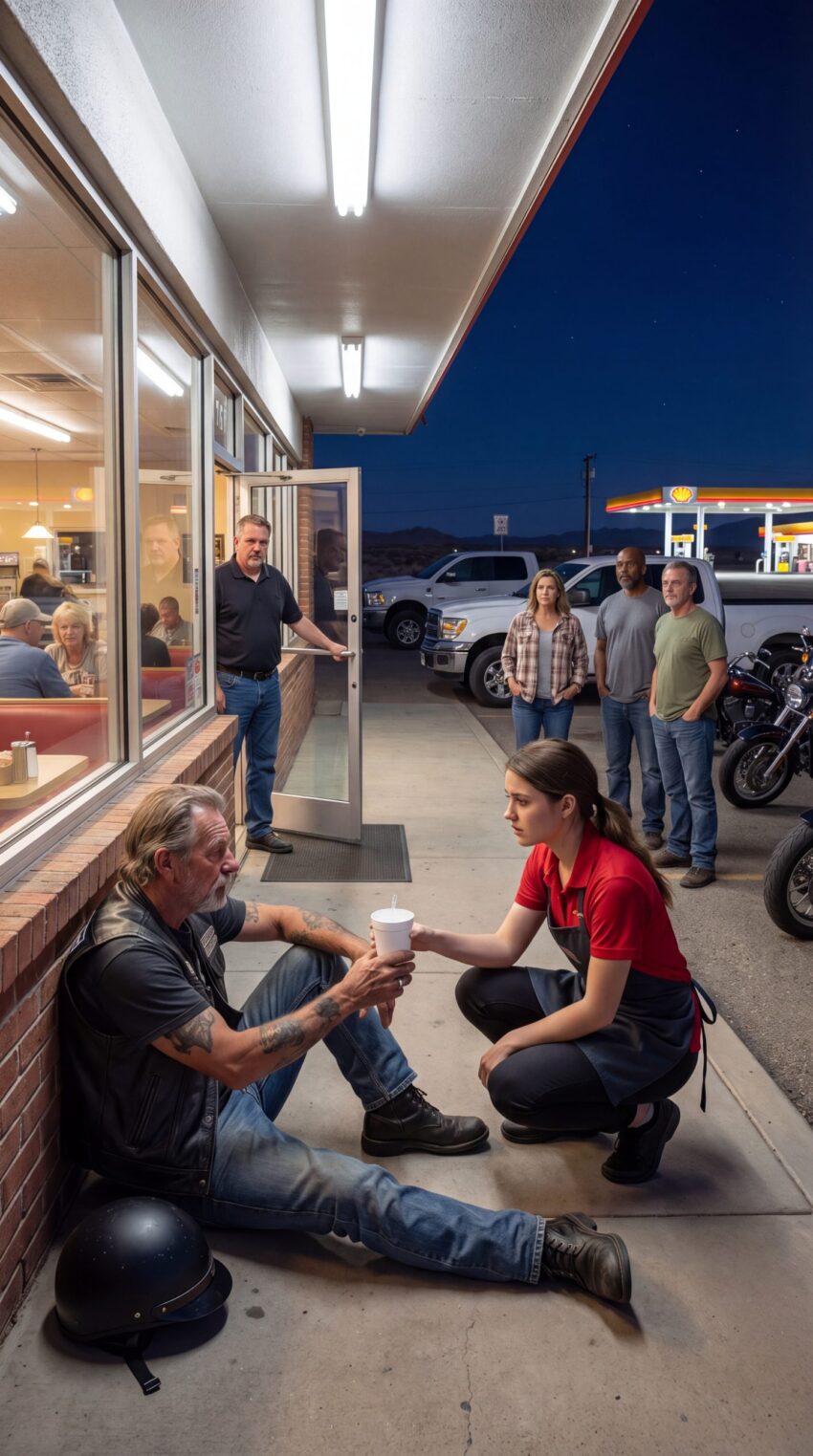
She Lost Her Job for Offering a Cup of Water
By the time the coffee machine stopped humming that morning, Tessa Rowan had already been told to take off her apron and leave.
The words came so fast that they barely felt real. One minute she was wiping down the counter and checking lids for the breakfast rush, and the next she was standing in the middle of the café with her hands trembling, trying to understand how five minutes of simple human kindness had somehow turned into the worst moment of her working life.
The café sat beside Highway 93 outside Kingman, Arizona, where the desert stretched wide and dry beyond the parking lot and eighteen-wheelers rolled past like clockwork. It was the kind of place people stopped at without remembering it later. Travelers wanted coffee. Locals wanted speed. Nobody came there looking for a story.
Tessa had only been working there for three weeks. She was twenty-three, new to town, and careful in the way people are when they need a job badly enough to be grateful for every shift. She learned regular customers’ orders before they introduced themselves. She refilled napkin holders without being asked. She stayed a few extra minutes at closing because she hated leaving things unfinished.
She had come to Arizona for a fresh start after a year that had taken more out of her than she liked to admit. She was not looking for attention. She was looking for stability. A paycheck. A routine. A reason to believe life could still be rebuilt one ordinary day at a time.
That morning had started like any other. The smell of roasted beans floated through the café. The fryer clicked in the kitchen. A delivery truck reversed somewhere out back. Tessa was carrying a stack of clean cups when she noticed someone outside the front window.
At first, she thought the man was only pausing by the railing.
Then she saw the way his hand slipped.
He did not collapse with noise or drama. There was no shout, no crash, no desperate wave for help. He staggered once, caught himself against the metal rail, then slowly sank down against the brick wall by the entrance as though his body had quietly decided it had reached its limit.
Tessa stopped moving.
Outside, cars kept pulling into the lot. The drive-thru line kept inching forward. Someone passing the entrance glanced toward the man, then kept walking without slowing down.
Her manager, Craig Denson, followed her gaze.
“Leave it,” he said immediately.
Tessa looked at him. “He doesn’t look well.”
Craig’s expression hardened. “That’s not our problem. We don’t get involved with people like that.”
People like that.
Tessa looked back through the glass. The man was large, broad across the shoulders, wearing a faded leather vest over a dark T-shirt. Tattoos ran along both arms. A motorcycle helmet rested near one boot. He looked strong even sitting there, but his breathing was uneven, too shallow, too measured, as if he was trying not to let pain show on his face.
A biker, Tessa thought.
Then she saw something else.
He was trying not to worry anyone.
That, more than anything, made her move.
Without answering Craig, she grabbed a cup of water from the station, pushed open the door, and hurried outside.
A Moment That Was Meant to Stay Small
The heat had already started rising off the pavement, even though the morning was still young. Tessa crouched beside the man and held out the cup.
“Hey,” she said softly. “Are you okay?”
He lifted his head. Up close, he looked older than she had first thought, maybe late fifties, with silver at his temples and the kind of face that had spent years in sun and wind without complaint. His eyes were sharp, though tired.
“Just need a minute,” he said.
His voice was steady, but too steady. Like someone holding himself together on purpose.
“You sure?” Tessa asked. “I can call someone.”
He took the water and nodded once. “Appreciate it.”
She stayed there because leaving felt wrong. He drank only a little, then lowered the cup, his jaw tightening as a wave of discomfort passed over him.
“You shouldn’t be out here alone if you’re feeling like this,” she said.
A faint smile touched one corner of his mouth. “Wouldn’t be the first stubborn decision I’ve made.”
Tessa almost smiled back, but before she could answer, the café door flew open hard enough to strike the stopper.
Craig stormed outside.
“What are you doing?” he snapped. “I told you not to get involved.”
Tessa stood up too quickly. “He just needs a minute.”
Craig looked at the man, then at the vest, the helmet, the tattoos, and whatever story he wanted to tell himself was already written across them.
“No,” Craig said sharply. “He needs to leave. And you need to get back inside.”
The man tried to rise then, maybe to end the scene before it got worse. He pushed one hand against the wall, made it halfway up, and faltered. Tessa reached out instinctively to steady him.
That was the moment everything changed.
From inside the café, heads turned. A woman near the pastry case pressed a hand to her chest. Someone murmured something about calling the police. A man in line lifted his phone.
Craig’s voice got louder, harsher, more public.
“That’s enough,” he barked. “Clock out. You’re done here.”
Tessa stared at him as if she had misheard. “What?”
“You heard me. Grab your things and go.”
For one stunned second she could not process the sentence. She had expected anger, maybe a warning, maybe an argument after the rush. She had not expected to lose her job in front of customers for handing water to someone who looked unwell.
The man straightened as much as he could and looked from her to Craig. His expression changed. Not with anger. With disappointment.
“She was helping,” he said quietly.
Craig pointed toward the lot. “You need to leave this property now.”
The man raised both hands slightly, calm and open, not threatening anyone. But by then, the scene no longer belonged to facts. It belonged to fear, assumption, and the speed with which people decide what kind of story they are watching.
The Story Everyone Else Chose to Believe
Tessa could feel every pair of eyes on her. Her face burned with humiliation. Her throat ached with the effort of not crying.
The man stepped just slightly in front of her, not in a dramatic way, not like someone preparing for conflict, but like a person trying to take responsibility for a mess he had not created.
“Don’t take this out on her,” he said.
It should have helped. Instead, it only made the crowd more nervous.
A security guard from the neighboring gas station had crossed over by then, called by someone who liked uniforms more than context. He planted himself near the entrance and said, “Sir, step back.”
The man did not argue. He did not raise his voice. He simply stayed where he was.
Tessa’s heart pounded. “I didn’t do anything wrong,” she said, her voice shaking. “He looked like he needed help.”
Craig gave a short, bitter laugh. “You don’t even know who he is.”
That was true. She did not know his name. She did not know where he came from. She did not know why he had nearly gone down outside the door.
But she knew what she had seen.
A person struggling.
A room full of people choosing distance.
A moment that asked for compassion and got suspicion instead.
The biker looked down at her, and for the first time there was something deeply weary in his expression.
“Go get your bag,” he told her. “You don’t need to stand here for this.”
Tessa shook her head immediately. “I’m not leaving you out here alone.”
Something flickered in his face then. Not surprise exactly. Something gentler. Something almost sad.
“You shouldn’t have to pay for being decent,” he said.
Before anyone could respond, he reached into his vest pocket.
Several people gasped.
A man near the window took two quick steps back.
The biker pulled out a phone.
He typed a number, turned slightly away from the group, and made a call.
“It’s Silas,” he said. “I’m at the Ridge Cup off the highway. I’m all right. I just need someone here.”
He ended the call and slid the phone away.
Craig folded his arms. “Who exactly do you think you’re calling?”
The man met his eyes. “People who know better than to decide first and ask later.”
No one seemed to know what to do with that.
Then the police arrived.
The Sound That Changed the Air
The patrol car rolled into the lot without sirens, red and blue lights turning lazily across the café windows. Officer Lena Pritchard stepped out, one hand near her belt, eyes alert but careful.
She listened to Craig first because loud people always speak before truthful ones get the chance.
Craig described a threatening man. A terminated employee. Customers who felt unsafe. A refusal to leave private property.
Officer Pritchard then turned to Tessa. “Is that what happened?”
Tessa opened her mouth, but words failed for a second because the version of events hanging in the air already sounded so complete. How could the truth compete with something everyone had decided to believe together?
Before she could answer, the man spoke.
“This isn’t on her,” he said. “I’m leaving.”
Officer Pritchard held up a hand. “Not yet, sir. I need everyone to stay where they are.”
He nodded once and complied.
That should have calmed the scene. Instead, it made it stranger. He was too composed. Too respectful. Too controlled for the role people had assigned him.
Tessa could hear her own breathing.
Then, from somewhere beyond the road, came a low familiar rumble.
One engine.
Then another.
Then several more.
Every head turned toward the entrance to the parking lot.
The motorcycles did not rush in like a storm. They came in slowly, in formation, measured and deliberate. Men and women in worn riding vests guided their bikes into a neat line and cut their engines almost together. The sudden silence that followed felt larger than the noise had been.
No one shouted.
No one pushed forward.
No one tried to intimidate anyone.
They simply arrived.
One rider removed her helmet and stepped a few feet ahead of the others. She had deep lines around her mouth, steady eyes, and the quiet posture of someone who did not need to prove anything.
“Officer,” she said politely, “we’re not here to interfere. We’re here because our friend needed us, and because someone here showed him kindness.”
Her eyes moved to Tessa.
So did everyone else’s.
Tessa felt as if the ground beneath her had tilted.
The man beside her straightened fully now, looking stronger just from no longer having to handle the moment alone.
Officer Pritchard studied him carefully. “Sir, I’m going to ask again. Who are you?”
He hesitated only briefly, as if names and titles were not things he liked using unless necessary.
Then he reached into his vest once more, slowly, and withdrew a worn leather card holder.
He handed over an ID.
The Truth Arrives Quietly
Officer Pritchard looked at the card once, then again, and something in her face changed. Not fear. Recognition.
She returned it with both hands.
“Mr. Boone,” she said, her voice noticeably lower now. “I didn’t realize.”
Craig stared between them. “Realize what?”
Silas Boone tucked the card away without drama. He looked embarrassed more than proud.
Officer Pritchard answered for him.
“Retired emergency response captain,” she said. “Volunteer search-and-rescue coordinator for three counties. He’s worked with departments across northern Arizona for years.”
No one spoke.
The only sound was a truck growling past on the highway beyond the lot.
Officer Pritchard continued, more firmly now. “And unless I’m missing something important, the employee gave water to a man who was unwell and remained with him until help arrived. That is not a public safety issue.”
Craig’s certainty cracked so visibly it was almost painful to watch.
“He refused to leave,” he muttered.
Silas finally answered. “I was trying not to pass out in your parking lot.”
The words were plain, but not cruel.
The woman rider who had spoken earlier stepped up just enough to add context. “He’s been pushing too hard the last few weeks. Didn’t tell any of us he felt off this morning. We came because he doesn’t ask for help unless he truly needs it.”
Officer Pritchard glanced at Tessa. “And she’s the one who stayed?”
Silas answered immediately. “Yes.”
A long, uncomfortable silence followed.
Truth does not usually arrive with fireworks. Most of the time, it comes in small pieces that make people feel ashamed of how quickly they judged.
Craig cleared his throat. “Well, maybe we acted a little fast.”
Tessa looked at him, and in that moment she realized how often people used words like maybe and little when they wanted to shrink the harm they had caused.
Officer Pritchard turned toward him. “You may want to reconsider how this was handled.”
Craig shifted his weight. His voice lost all its earlier force. “Her termination can be… reviewed.”
Silas looked at Tessa instead of Craig.
“You should never have been put in this position,” he said.
For reasons she could not explain, that was the sentence that nearly made her cry.
What Was Restored Could Not Be Fully Repaired
By the end of the morning, Craig had walked back the firing. By the end of the afternoon, he told Tessa she could return to her schedule as though the day had simply gone sideways and then corrected itself.
But some things do not return to where they were just because someone says never mind.
After the officer left and the crowd drifted back to coffee cups and errands, the parking lot slowly emptied. The other riders stayed near their motorcycles, giving Silas space but watching him with the concern of people who had known him a long time.
Tessa stepped outside again, her bag hanging from one shoulder.
Silas was leaning lightly against his bike now, color better in his face than before. Up close, he looked less intimidating than tired, like a man carrying years nobody else could see.
“Are you okay?” she asked.
He nodded. “A little rest and an argument with my doctor, and I’ll be fine.”
That drew a small laugh from her.
Then silence settled between them, not awkward, only honest.
“I’m sorry,” she said finally. “Not because I helped. I’m not sorry for that. I just… I didn’t know it would turn into this.”
Silas gave a faint smile. “Neither did I.”
He reached into his pocket and placed a folded bill on the outdoor table.
“For the water,” he said.
Tessa immediately pushed it back toward him. “No. That wasn’t why I did it.”
“I know,” he said gently. “That’s exactly why I offered.”
She left the money where it was for a moment, then shook her head and tucked it back into his hand.
“Then buy yourself something cold later,” she said. “And maybe listen to the doctor before your friends form a motorcycle parade again.”
A real smile appeared then, brief but warm enough to change his whole face.
“That sounds fair.”
One of the riders called out, “You ready, Silas?”
He answered without looking away from Tessa. “Yeah. Coming.”
Before he turned, he said one more thing.
“Most people want kindness to feel safe and convenient,” he told her. “But the kind that matters usually shows up before anybody knows how the story ends.”
Then he climbed onto his bike.
The others waited until he was settled before starting their engines. The sound rose again across the lot, but now it felt less like noise and more like loyalty made audible. They pulled out one by one and headed back toward the highway, sunlight catching on chrome, then disappearing into the bright Arizona distance.
Tessa stood there long after they were gone.
She knew she would remember the embarrassment. The fear. The awful helplessness of being judged in front of strangers.
But those were not the parts that stayed with her most.
What stayed was the moment she chose to step outside.
The moment she offered water to someone everyone else had already decided to avoid.
The moment she learned that doing the right thing does not always protect you from consequences, but it still matters because of who it protects you from becoming.
What Stayed With Her Afterward
Some people move through life believing character is revealed in grand moments, but more often it is exposed in quiet decisions when no one is clapping and no outcome is guaranteed.
Kindness is easiest when it is aimed at someone familiar, polite, and easy to explain, yet its truest form often begins when another person looks inconvenient, misunderstood, or impossible to categorize.
The world becomes colder every time people choose comfort over compassion, and it becomes gentler again whenever one ordinary person decides that another human being should not suffer alone.
There are moments when doing what is right will cost you reputation, ease, or even security for a little while, but losing those things is still better than losing the part of yourself that knows how to care.
Judgment is fast because it requires so little courage, while understanding is slower because it asks us to look beyond fear and admit we may have been wrong at first glance.
Some of the strongest people in the world are not the ones who appear fearless, but the ones who keep showing tenderness after life has given them every excuse to become hard.
We should be careful about the stories we build from appearances, because the person we dismiss in a single second may carry years of service, sacrifice, wisdom, and quiet goodness we never bothered to imagine.
Real dignity is not proven by titles, uniforms, or public praise; it reveals itself in the way a person speaks when they are misjudged and in the way they protect someone weaker even while they are struggling themselves.
A decent act is never wasted, even when it is misunderstood at first, because truth has a way of catching up to false assumptions and giving light back to what was unfairly shadowed.
And perhaps the most important thing of all is this: when life gives you one small chance to be human in a world that is rushing past pain, choose humanity first, because long after fear fades and noise disappears, that choice will still be the part of your story worth keeping.