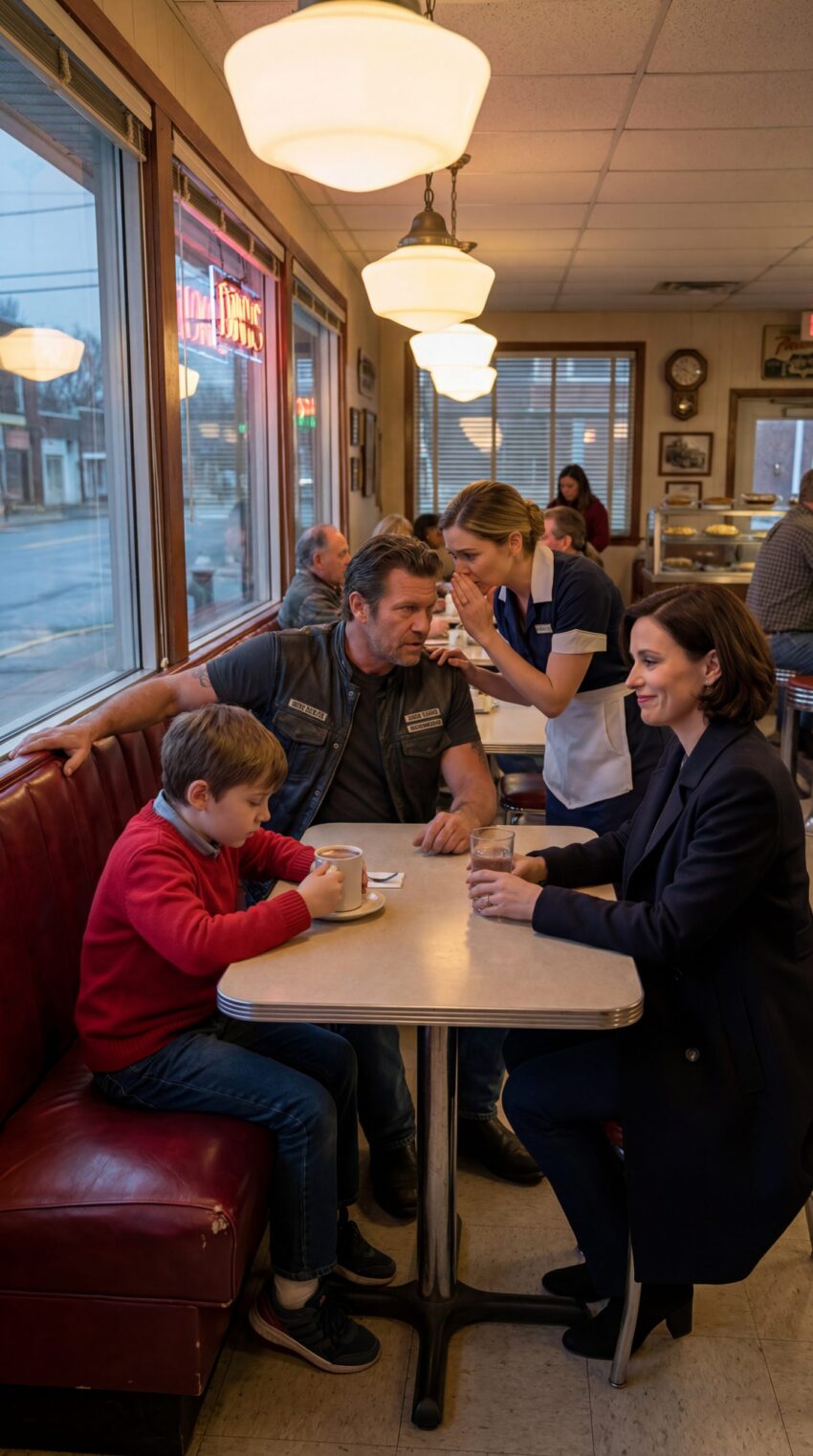
The Booth by the Window
For most people, Thursday night at Maple Turn Diner in Ashbridge, Ohio, felt ordinary in the best possible way.
The coffee stayed hot. The pie case stayed half full until closing. Truckers came in tired and left quieter. Couples shared fries they pretended not to want. The old neon sign buzzed softly above the front window, and the sound of forks against plates blended into the kind of background music only small-town places ever seemed to create.
Naomi Whitaker had worked there long enough to read a room before anyone said a word.
She knew the difference between a family having a rough week and a family falling apart. She knew how hunger looked when it came from a missed lunch, and how it looked when it had been living inside someone much longer than that. She knew when people wanted conversation, and she knew when they wanted to be left alone with their thoughts.
And for nearly eight weeks, every Thursday night, she had watched the same man and the same boy take the same booth by the window.
The father was impossible to miss. He was tall, broad-shouldered, and worn in the way some men became after too many miles and too many years of carrying more than they ever talked about. His leather vest, faded at the edges, bore patches that made strangers glance and then quickly look away. But Naomi had never been afraid of appearances. She had spent fifteen years serving everybody from pastors to mechanics to bikers to grieving widowers who only came in for coffee because they could not bear their empty kitchens.
The boy across from him was what kept drawing her attention.
He was small for his age, with light brown hair that always looked freshly combed, as if someone at home cared how he appeared in public. But there was a fragility to him that felt wrong. His shoulders stayed tense even while sitting still. His smile, when it came, lasted only a second. And every week, sometime after the drinks arrived, the color seemed to leave his face a little more.
Naomi did not know his story yet.
She only knew that something inside her refused to settle.
A Pattern Too Precise to Ignore
At first she told herself she might be reading too much into it.
Children got stomachaches. Some were shy. Some barely ate. Some families carried stress in ways outsiders could not understand. Naomi had raised two sons of her own, both grown now, and motherhood had taught her to be careful with assumptions. Still, instincts had a language all their own, and hers had started whispering before the second Thursday had even ended.
The father, whose card receipts identified him as Grant Mercer, treated the boy with real tenderness. Naomi noticed that immediately. He cut the child’s pancakes into smaller bites without being asked. He let him choose the booth side with the better view. He always asked, softly, “You want the chicken soup tonight, buddy, or grilled cheese?”
The boy, Eli, usually answered in little more than a murmur.
“Soup, please.”
Grant would nod as though the answer mattered.
There was no harshness in the man. No threat hanging around him. If anything, he seemed tired and worried, like someone trying hard to hold life together with hands already full.
The stepmother was different.
Vanessa Mercer rarely stayed the whole meal. She arrived polished and smiling, wearing fitted coats, neat boots, and the expression of someone used to being admired for looking composed. She always had a reason to leave early. A work call. A friend waiting. An errand across town. Her excuses changed, but her rhythm did not.
Before leaving, she always leaned over the table and did one small thing that Naomi eventually realized was the center of her unease.
She touched Eli’s drink.
Sometimes it was a little packet. Sometimes a bottle so small it disappeared into her palm. She would add something quickly, stir once, and say it with practiced sweetness.
“This will help your stomach, sweetheart.”
Every time, Eli’s eyes dimmed before he even lifted the glass.
Every time, within fifteen or twenty minutes, his appetite vanished.
By the sixth Thursday, Naomi had stopped calling it a coincidence in her own mind.
By the eighth, she knew she could not keep pretending she had seen nothing at all.
The Night Everything Shifted
That Thursday began like the others, but Naomi sensed a heaviness in the booth before she even walked over.
Grant looked rougher than usual, his beard not fully trimmed, his face marked by the kind of exhaustion that came from long weeks and bad sleep. Eli sat stiffly beside the window instead of relaxing into the seat. He wore a navy sweatshirt that hung loose around his wrists, and when Naomi set down the menu, she noticed how thin those wrists had become.
“Same hot chocolate?” she asked gently.
Eli nodded.
“Yes, ma’am.”
Grant managed a tired smile. “And coffee for me. Thanks, Naomi.”
Vanessa arrived ten minutes later and slid into the booth as if nothing in the world could ever rush her. Her lipstick was perfect. Her tone was light. She asked Eli whether he had finished his school packet, whether he had remembered his reading log, whether he had thanked his father for bringing him out.
The questions sounded normal.
The boy’s posture did not.
Naomi was wiping down the counter when Vanessa reached into her purse. The movement was smooth, casual, almost elegant. But Naomi saw the tiny amber bottle in her hand. She saw the quick tilt above the boy’s hot chocolate. She saw Eli notice it too.
He did not protest.
He only looked down.
Naomi’s stomach dropped.
A few minutes later, Eli pushed his spoon away from his soup. His face had gone pale.
“Dad,” he whispered, pressing a hand lightly to his stomach, “it’s happening again.”
Grant set down his fork immediately. “Again? Since when?”
Eli shrugged, and that small, helpless gesture nearly broke Naomi’s heart.
Vanessa touched Grant’s arm as if this were nothing new. “He’s just having one of his episodes. The specialist said stress can do this.”
Naomi stood still behind the counter, her rag clenched in one hand.
She could feel the exact moment when worry became decision.
The Question Naomi Could Not Keep to Herself
Walking toward that booth was one of the hardest things Naomi had done in years.
Not because she doubted what she had seen, but because she understood what speaking up could cost. Grant Mercer was a biker with the kind of presence that made most people step carefully. Vanessa was polished, articulate, and the type of woman others tended to believe first. Naomi was just a waitress in a roadside diner, carrying a coffee pot and an instinct she could not prove with certainty.
But a child was getting weaker right in front of her.
And silence had stopped feeling safe.
She approached the table with a refill as cover, her hands steadier than she felt.
“Grant,” she said quietly, setting the pot down, “I need a word with you. Alone, if you can spare a minute.”
Vanessa looked up first. “About what?”
Naomi kept her eyes on Grant. “About your son.”
Something in her tone must have reached him, because he stood without another question. He followed her two steps away, near the pie display where the hum of the refrigerators softened their voices.
Naomi swallowed once.
Then she said it plainly.
“Your boy is not getting sick by accident.”Grant stared at her, expression unreadable.
She continued before fear could stop her.
“I’ve watched the pattern for weeks. It happens after something is added to his drink. Every single time.”
For a second he said nothing at all, and that silence frightened her more than anger would have.
Then, very carefully, he asked, “Are you sure?”
Naomi took out her phone. Her fingers trembled now, but she forced them to keep moving. Over the last few weeks, driven by a discomfort she had not known how to explain, she had taken time-stamped pictures whenever Vanessa reached for Eli’s cup. She had also written notes in a locked memo app: Thursday, 7:14 p.m., Vanessa added something to hot chocolate. Eli stopped eating by 7:31. Thursday, 6:58 p.m., same bottle, same result.
She held the screen up.
“I started documenting it because I knew one day I might need to show someone,” she said. “I prayed I was wrong. I don’t think I am.”
Grant looked at the photos, then at Eli sitting weakly in the booth, then back at Naomi.
When he finally spoke, his voice was low and strained.
“Doctors keep telling me they can’t find the reason. They say his tests are confusing. They say maybe it’s anxiety, maybe something autoimmune, maybe food intolerance.”
Naomi shook her head. “Maybe none of that. Maybe someone is making him unwell little by little.”
Grant closed his eyes for one long second.
When he opened them again, the disbelief was still there, but something else had entered with it.
Resolve.
A Father Begins to See the Missing Pieces
Grant did not explode. He did not storm back to the booth. He did not accuse Vanessa in public.
That was what convinced Naomi even more that she had trusted the right person.
He returned to the table with control so tight it looked painful. Vanessa announced that she needed to head out. She kissed Eli’s hair, said she would see them at home, and left without noticing how Grant watched every movement of her hand.
The second the diner door closed behind her, Grant slid into the seat beside his son instead of across from him.
“Eli,” he said softly, “I need you to tell me something, and I need you to be honest even if you think it’ll upset me.”
The boy looked frightened at once. “Am I in trouble?”
Grant’s whole face changed. He cupped the back of Eli’s head gently.
“No. Never for telling me the truth.”
Eli stared into his untouched drink.
“Does your stomach hurt after things Vanessa gives you at home too?”
The child hesitated so long Naomi felt her own throat tighten.
Then Eli nodded.
“Sometimes after juice,” he whispered. “Sometimes after tea. She says it’s medicine and that I shouldn’t tell you because you worry too much.”
Grant looked like all the air had been knocked out of him.
“How long?”
Eli’s eyes filled. “I don’t know. A lot of weeks.”
Grant bowed his head for a moment, pressing his lips together. Naomi turned away enough to give them a shred of privacy, but not so far that they felt abandoned.
When he lifted his face again, there was grief in it, and guilt, and a kind of heartbreak that had no room left for denial.
“Listen to me,” he told his son. “You did nothing wrong. You hear me? Nothing. And from this moment on, I’m going to make sure you’re safe.”
Eli’s lower lip trembled.
“Promise?”
Grant did not answer lightly.
“With everything I have.”
The Brotherhood That Chose Quiet Over Noise
That night did not turn into chaos. It turned into careful action.
Grant made calls from the parking lot while Eli sat inside the diner office with a blanket Naomi kept for cold-weather deliveries. The men who arrived were not reckless strangers, nor were they there to frighten anyone. They were longtime friends who understood that real loyalty sometimes looked like patience, paperwork, and keeping a child calm.
One was Nolan Pierce, a former paramedic who now ran a motorcycle repair shop outside town. Another was Caleb Dorsey, who had once worked as an investigator for an insurance firm before leaving city life behind. The third was Pastor Micah Boone, a chaplain who had known Grant for years and had the rare gift of making frightened people feel safe without asking too many questions too soon.
Together, they helped Grant do what panic never could.
Nolan arranged for Eli to be seen at a children’s hospital in Columbus that very night, not with vague descriptions but with a full timeline of symptoms. Caleb helped preserve Naomi’s photos, notes, and dates so they would hold up if authorities needed them. Micah sat with Eli in the waiting room, talking about baseball, comic books, and old dogs until the boy stopped shaking.
No one raised their voice.
No one made threats.
No one confused anger with justice.
What they built that night was something far more useful.
A path toward truth.
What Eli Finally Said Out Loud
At the hospital, under clean lights and careful questions, pieces of the story began to come together.
The doctors ran more specific tests than the family had previously been given. A pediatric specialist listened longer. A nurse practitioner with kind eyes asked Eli whether anything at home ever made him nervous.
This time, with Grant right beside him and no one telling him to keep secrets, the boy spoke more fully.
“She says it helps me settle down,” Eli murmured. “But sometimes I feel sleepy after, and sometimes my stomach twists, and sometimes I don’t want breakfast the next day. I thought maybe I was just weak.”
Grant made a sound Naomi would remember later—not loud, not dramatic, just the quiet sound of a father realizing how much his child had carried alone.
The doctors found enough cause for immediate concern to keep Eli for observation.
By morning, the early findings suggested repeated exposure to substances that should never have been casually mixed into a child’s drinks without strict medical direction. The details were handled by professionals after that, with the seriousness such a situation required. Records were requested. Prior prescriptions were reviewed. Home items were photographed and logged. Search histories and purchase patterns were examined.
Piece by piece, the confusion that had ruled Grant’s life gave way to clarity.
It was painful clarity.
But it was the truth.
The Home That No Longer Felt Like Home
When officials later entered the Mercer house with proper authorization, they found a place that looked perfect from the outside.
Fresh flowers by the kitchen sink. Cushions arranged neatly in the living room. School papers pinned carefully to the refrigerator.
But beneath that polished surface were details that told a different story. Small containers hidden where Eli could not reach them. Notes about his moods and meals written with an unsettling level of control. Timelines that matched the nights he became ill. Online searches that mirrored symptoms too closely to dismiss as coincidence.
Grant stood in the doorway of his own kitchen feeling like a stranger inside his life.
He did not rant. He did not smash anything. He simply leaned one hand against the wall and let the truth land where it had to.
Micah stood nearby and said quietly, “You did not fail because someone deceived you. But you do have the chance now to protect him the way he needs.”
Grant nodded once. It was all he could manage.
Vanessa was removed from the home through the proper legal process, with authorities handling every step. There was no spectacle at the house, no scene for Eli to witness, no unnecessary cruelty added to an already heavy situation.
Grant insisted on that.
The boy had seen enough.
Learning What Safety Feels Like Again
Recovery was not immediate, because healing rarely is.
Eli spent the next several weeks between medical appointments, therapy sessions, and quiet afternoons at Grant’s sister’s farmhouse outside Millbrook, where there were chickens in the yard and enough open sky to make breathing feel easier. His body slowly began to respond to care instead of confusion. His color returned. His appetite came back. He started asking for second helpings of macaroni and peaches. He laughed more often, first in little bursts and then with his whole face.
Grant changed too.
He stopped pretending his son’s pain would solve itself if he just kept working harder. He attended every appointment. He asked better questions. He learned to listen when Eli hesitated instead of waiting only for full answers. He apologized for the moments he had missed, and he did it without making his child comfort him for it.
One morning, a month after that Thursday at the diner, Eli woke up, padded into the kitchen in socks, and said something so simple Grant nearly cried.
“Dad, my stomach doesn’t hurt today.”
Grant turned from the stove and smiled in a way that looked fragile but real.
“That’s how it should have been all along, buddy.”
Eli thought about that, then wrapped both arms around his father’s waist.
For a moment, neither of them moved.
The Return to the Diner
It was nearly four months before Grant and Eli went back to Maple Turn Diner.
Naomi noticed them the second they walked in.
The same booth by the window was open, but everything about them felt different. Grant still looked weathered, still carried the same steady presence, but some of the helplessness had left his face. Eli looked stronger. Not dramatically bigger, not suddenly transformed, just more like a child who had room again to be one.
Naomi came over with menus she knew they would not need.
“Well,” she said with a smile, “look who finally came back.”
Eli smiled too, shy but genuine.
“Hi, Ms. Naomi.”
She tilted her head. “You look taller.”
He grinned. “I feel better.”
Grant stood when she reached the table. For a second Naomi thought he might only thank her, but instead he said, “I don’t know how to put into words what you did for my son.”
Naomi shook her head at once. “I just paid attention.”
Grant’s eyes softened.
“Most people don’t.”
After they ordered, Eli pulled something folded from his jacket pocket and handed it to her. It was a handwritten note on lined paper, each letter formed with careful effort.
Thank you for noticing me.
Thank you for helping my dad know.
Thank you for not being scared to say something.
Naomi read it twice before looking up.
Her eyes shone, but she only smiled and tucked the note into her apron pocket near her heart.
That night she brought them a slice of apple pie on the house.
No one argued.
What Quiet Courage Can Change
Some stories do not begin with sirens or headlines.
Some begin with a waitress noticing a pattern no one else wanted to see. With a boy who thought being sick was somehow his own fault. With a father who looked tough enough to intimidate a room but still carried the ordinary heartbreak of not understanding why his child kept fading in front of him. With a few people choosing restraint, truth, and care over noise.
In time, the legal matters moved through the system the way such matters should—carefully, thoroughly, with documentation stronger than rumor. But that was not the part Naomi carried with her most.
What stayed with her was something smaller and greater at once.
It was the memory of Eli’s face the first night he returned to the diner and finished his meal.
It was the sound of Grant laughing softly when his son asked for pie before the plates were even cleared.
It was the understanding that quiet suffering often survives because it learns how to hide inside normal routines.
And it was the reminder that sometimes the most important people in a story are not the loudest or the most powerful.
Sometimes they are simply the ones who refuse to look away.
The booth by the window was just a booth again after that.
But Naomi never passed it without remembering that one Thursday night when speaking up changed the direction of a child’s life.
And maybe that was the lesson beneath everything else:
Not every act of courage looks dramatic.
Not every rescue begins with certainty.
Sometimes love is just attention, sharpened by compassion and brave enough to become action.
There are moments in life when doing the right thing does not begin with confidence, but with discomfort, because our hearts notice what our minds are still trying to explain away, and in those moments, choosing compassion over convenience can become the very thing that protects someone who does not yet know how to protect themselves.
Quiet pain is often the hardest pain to recognize, because it does not always come with loud cries or obvious signs, which is why the people who truly care must learn to pay attention to patterns, pauses, body language, and the small changes that tell a deeper story words may not yet be ready to reveal.
Children should never have to carry confusion, fear, or illness in silence while the adults around them dismiss what they feel, and every child deserves at least one person who listens closely enough to understand that unusual suffering is not stubbornness, weakness, or imagination.
Real strength is not found in being the loudest person in the room, but in having enough patience, humility, and love to slow down, observe carefully, and act with wisdom when someone vulnerable needs protection more than they need spectacle.
Sometimes the people who seem ordinary from a distance are the very ones who change lives forever, because courage does not belong only to heroes in headlines, but also to servers, neighbors, teachers, nurses, and strangers who trust their instincts when something feels deeply wrong.
A loving parent is not a parent who never misses anything, but a parent who is willing to face painful truth, correct what must be corrected, and stand beside their child with honesty and consistency until trust begins to grow back where fear once lived.
Healing rarely arrives all at once, and that is why gentleness matters so much, because recovery is often built through repeated safe mornings, honest conversations, nourishing meals, patient reassurance, and the slow return of a child’s belief that tomorrow does not have to hurt like yesterday.
Speaking up can feel frightening when the situation is unclear, when the people involved seem intimidating, or when the cost of being wrong feels heavy, yet silence can become its own kind of harm when it allows suffering to continue in plain sight.
The world becomes kinder and safer when people stop assuming that someone else will notice, someone else will ask, or someone else will step in, because responsibility often begins in the private decision to care enough not to turn away.
In the end, the most meaningful thing we can offer one another is not perfection, status, or polished appearances, but presence, because when a hurting person is finally seen, believed, and protected, that moment can become the beginning of a life they never thought they would be allowed to have.