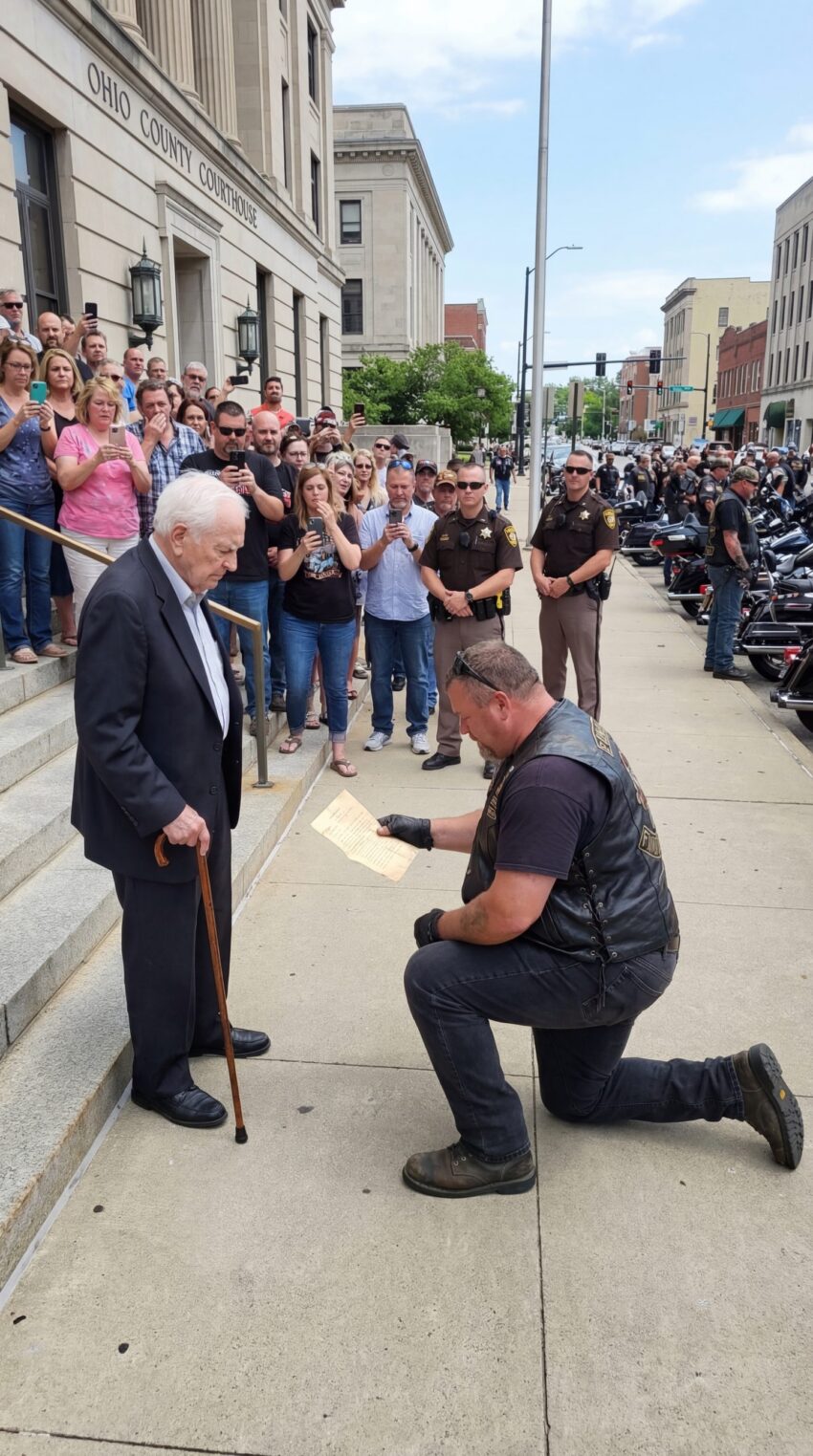
The Day He Knelt on the Courthouse Steps
A Cold Morning in Downtown Columbus
At 11:42 a.m., the steps of the Franklin County Courthouse looked like they always did in late autumn—gray stone, pale sunlight, and a wind that cut through coats as if they were made of paper. People hurried past with coffee cups and folders tucked under their arms. A few stopped to check their phones beneath the tall columns, waiting for someone, waiting for time to move faster.
But that morning had one detail that didn’t belong.
Fifteen motorcycles lined the curb in a neat row, chrome catching the light, engines already quiet but still warm enough to tick softly. At the base of the stairs stood a small line of riders. Not loud. Not rowdy. Just still. Leather vests. Heavy boots. Faces shaped by time—some with gray in their beards, some with old scars that looked like history written on skin.
People noticed. Of course they did.
A woman near the sidewalk whispered to her friend, “Why are they here?”
A man in a suit frowned and pulled his briefcase closer. Someone else lifted a phone, not even pretending they weren’t filming.
Advertisements
And then a local reporter, holding a small microphone, leaned toward a cameraman and muttered, “This could be something.”
The riders didn’t react. They just waited.
The Judge Who Used to Fill a Room With Silence
When the courthouse doors finally opened, the crowd’s quiet curiosity tightened into something sharper.
A retired judge stepped outside, moving slowly, his posture careful. He was around eighty now, thin in the shoulders, his hair white as winter salt. A cane tapped the stone with each step, steady and practiced. He paused at the top of the stairs as if letting his eyes adjust to the brightness.
His name was Judge Walter Kline.
Even if you’d never met him, you could tell he had once been the kind of man whose voice didn’t need to rise. The kind of judge who could calm a room just by looking up from the bench. Back in the 1990s, he had been known for firm sentences and strict courtroom order. People still spoke about him the way they talk about storms—respectful, a little afraid, and always remembering what it felt like when he passed through.
As soon as someone recognized him, the atmosphere changed.
A murmur ran through the crowd like wind through dry leaves.
“What are the bikers doing here?”
“Is this a protest?”
“Did something happen?”
Judge Kline took one more careful step forward, his cane making a soft click against the stone.
And that was when I moved.
A Leather Vest and a Thousand Assumptions
I stepped out from the line and started toward him.
My boots echoed in a way that sounded louder than it should have, the courthouse turning each footstep into an announcement. I could feel cameras pivoting, people shifting for a better angle. I didn’t rush, but I didn’t hesitate either.
From the outside, I understood how it looked.
A man in a leather vest walking straight toward a retired judge on the courthouse steps. A crowd that didn’t know my story. Deputies standing near the doors who were trained to look for danger first.
Judge Kline watched me with a calm expression, but his eyes narrowed slightly—not angry, just measuring.
He didn’t recognize me.
Not yet.
And then, when I reached him, I did the one thing no one expected.
I dropped to one knee.
The reaction came instantly.
A sharp inhale rippled through the crowd. Someone gasped loud enough for others to hear. Another person blurted, “Is he threatening him?”
A woman near the sidewalk said, “Call security.”
Phones lifted higher like the crowd wanted proof, wanted a video they could post with a dramatic caption.
I stayed on one knee.
Not because I was trying to scare him.
Not because I was asking for anything.
But because I was remembering.
“Do I Know You?”
A pair of deputies stepped forward from the courthouse doors. They didn’t run, but their movement had purpose. One rested his hand near his radio. Another scanned the line of bikers behind me as if he expected them to surge up the steps at any moment.
The riders behind me did nothing.
That silence made people even more nervous.
Judge Kline looked down at me, his face puzzled, his jaw slightly tightened in that familiar courtroom way—firm, controlled, used to authority.
“Stand up,” one deputy said, trying to keep his voice polite. “Sir, you’re going to need to stand up.”
I didn’t move.
Judge Kline raised one hand, just slightly, the gesture quiet but commanding.
“Wait,” he said.
The deputy stopped, not because he wanted to, but because something about the judge’s tone still carried weight.
Judge Kline leaned forward a fraction, studying my face like he was searching through old files in his mind.
Then he asked the question everyone else was thinking.
“Do I know you?”
The crowd leaned in like a single body.
People love confrontation, especially when they think it’s about to happen between two men who represent opposite worlds.
The Sentence That Sounded Like a Curse
I lifted my eyes to his and spoke carefully, keeping my voice low, steady.
“You told me something when you sentenced me.”
Judge Kline’s brows pulled together. “Did I?”
“Yes, sir.”
He glanced at my vest, then at the scar near my eyebrow, as if the shape of my face might unlock a memory.
“What did I say?” he asked, and his voice wasn’t harsh—just cautious.
The memory hit me all at once.
A courtroom smelling like old wood and stale air.
My mother crying behind me.
The heavy sound of chains when I turned.
The way the judge had leaned forward that day and spoken words that felt like a door slamming shut.
I repeated them slowly, exactly as I’d carried them for two decades.
“You said jail might be the only place left that could save my life.”
The crowd went quiet, confused by the softness of it.
The deputies paused.
Judge Kline stared, and something shifted in his expression—not full recognition yet, but the first flicker of it, like a light trying to come on.
Still, the crowd held onto its favorite story.
Revenge.
Intimidation.
A score being settled.
Because it fit the picture they thought they were seeing.
The Weight of Being Misunderstood Again
For a few seconds, no one spoke. Even the wind seemed to soften, as if the city itself was listening.
Then a voice in the crowd snapped the tension back into place.
“Yeah right,” someone scoffed. “He’s lying.”
A man in a business suit stepped closer and called up the steps, “Judge, you don’t have to stand here and take this.”
Advertisements
Another voice said, “Throw him out!”
Then the word people had been holding in their mouths finally rolled free.
“This is intimidation.”
The deputies shifted again. One took a step closer and reached toward his radio.
I felt something rise in my chest.
Not anger—not the old kind that used to control me.
It was something heavier.
The familiar ache of being judged by strangers who only see the surface.
Twenty years ago, a courtroom full of people had decided who I was before I ever opened my mouth.
Now it was happening again.
Different day, same assumption.
Judge Kline’s voice cut through the murmurs.
“What was your name?” he asked quietly.
I swallowed.
“Ethan Cole.”
The moment the name left my mouth, the judge’s face changed.
Not dramatically, not like a movie.
Just a slow shift, like a door unlocking in his mind.
“Ethan…” he murmured, tasting the memory.
The crowd didn’t notice. They were too focused on the deputies and the kneeling biker and the story they’d already chosen.
The Old Letter in My Pocket
I knew I had to show him.
And the moment I moved my hand toward my vest pocket, the deputies reacted.
“Hands where we can see them,” one barked.
Phones jerked upward.
Someone shouted, “He’s got something!”
I kept my motion slow, careful, like I was handling glass.
I pulled out a folded piece of paper, yellowed at the edges, creased like it had been opened and closed a thousand times.
I held it up.
“It’s just a letter,” I said.
Judge Kline hesitated, then reached out and took it.
He unfolded it carefully, the wind lifting a corner as he read.
And as his eyes moved across the page, his posture changed.
He wasn’t a judge on a public step anymore.
He looked like an old man reading something he never expected to see again.
The crowd couldn’t read the words.
But the judge could.
The Sound That Turned Heads
As the judge stared at the paper, a low rumble began to grow somewhere down the street.
At first it was faint, almost mistaken for distant traffic.
Then it deepened, layered, unmistakable.
Motorcycle engines—multiple, moving together.
People turned their heads. Deputies glanced toward the intersection. The reporter swung his camera around, hungry for a bigger headline.
The rumble grew closer.
Then the first bike appeared—black, older, chrome bright in the sunlight.
Then another.
Then another.
Within seconds, a long line of motorcycles turned onto the courthouse street, moving slowly in formation. Not speeding. Not weaving. Not aggressive.
Disciplined.
Intentional.
They parked along the curb one by one, engines shutting off until the street fell silent again.
But this silence was different.
It wasn’t fear anymore.
It was attention.
The riders climbed off their bikes—men and women, older and younger, faces serious, movements calm. Every vest carried the same simple patch.
Second Mile Riders.
Most people in the crowd had never heard the name.
Judge Kline lifted his eyes from the letter, and suddenly he looked like he had stepped back into a memory.
His voice came out softer.
“Is this… about the program?” he asked.
I nodded once.
“Yes, sir.”
The Truth Finally Finds the Light
The riders from the street approached the steps calmly, boots steady on stone. No shouting. No grand gestures. Just presence.
The crowd stepped back without being asked, because the scene no longer fit the revenge story.
A woman whispered, “They’re not here to fight…”Another person said, “Then why are they here?”
One of the older riders stopped beside me. His beard was white, his eyes clear.
He looked at the judge and spoke simply.
“We’re here for Ethan.”
Judge Kline’s hands tightened slightly on the paper.
He looked back at me, and his voice dropped even lower, like he didn’t want the moment to break.
Advertisements
“You kept it,” he said.
“Every day,” I answered.
He nodded, as if that single sentence explained twenty years of distance.
Then he spoke again, pulling the memory fully into the open.
“You were twenty-three,” he said. “Angry. Drinking too much. Fighting every weekend.”
The crowd’s expressions changed—confusion replacing suspicion.
Judge Kline continued, his voice steady.
“You stood in front of me after your third serious charge in two years.”
He paused.
“And I told you something because I didn’t want to read your name in an obituary.”
I finished the sentence quietly.
“You said if you didn’t send me away, someone would bury me within five years.”
Judge Kline nodded once.
“That’s what I said.”
The courthouse steps fell still.
I rose from my knee slowly, my leg stiff from the cold, my heart tight in a way that surprised me.
Cameras were still pointed at us, but the story they expected had slipped out of their hands.
What Prison Gave Me That the Streets Never Did
I looked at the crowd, then back at the judge.
“Two guys I used to run with are gone,” I said carefully. “One never made it past thirty.”
A few people lowered their phones, their faces suddenly uneasy, like they hadn’t planned to feel anything today.
I kept my voice steady.
“Another didn’t survive the winter he turned his life into a joke.”
I avoided details. I didn’t need them. The truth was heavy enough without naming every dark corner.
Then I gestured toward the riders behind me.
“The only reason I’m not a story people shake their heads at… is because you put me in a place where I had time to stop being that man.”
Judge Kline listened like he was holding a fragile thing.
I continued.
“Inside, I met a chaplain who ran a workshop.”
“He taught us how to fix engines. How to build something instead of breaking things.”
The older rider beside me added quietly, “We kept it going when he passed. We turned it into a garage when Ethan came home.”
I nodded.
“That garage turned into training.”
“Training turned into a brotherhood.”
I touched the patch on my vest.
Second Mile Riders.
“We help men and women coming out of prison learn a trade, find steady work, and stay close to people who won’t drag them backward.”
The crowd looked different now. People who had come for drama were stuck with something they didn’t expect—grace, responsibility, change.
A Handshake Instead of a Headline
I stepped forward, slow, careful, respectful.
Then I reached out my hand.
Judge Kline hesitated only for a heartbeat before placing his hand in mine.
His grip was thinner than I remembered, but still steady.
“Thank you,” I said.
And I meant it in a way that made my throat tighten.
Judge Kline held my hand longer than I expected.
His eyes shone in the cold light.
Then he said something so quietly that only a few of us heard it.
“I hoped you would survive.”
For a moment, the courthouse steps didn’t feel like a place of judgment.
They felt like a place where something was finally set down.
I stepped back.
The riders behind me began turning toward their bikes.
Engines started one by one, that deep rumble rolling through the street like thunder that doesn’t threaten—only reminds you it exists.
As I swung my leg over my motorcycle, I looked once more at Judge Kline.
He stood there holding the old letter, watching us like he was watching proof that a hard decision long ago had meant something.
The crowd, still gathered, didn’t cheer.
They didn’t clap.
They just stood quiet, as if they’d been shown a story they couldn’t reduce to a simple label.
And when we rode away, the cold air filled the space behind us.
Not with fear.
But with a question that lingered in the minds of everyone who had watched:
What if the thing you call punishment… is sometimes the start of someone’s return?
Change rarely happens in one dramatic moment; it happens when a person finally decides they are tired of living the same day over and over in different clothing.
The world is quick to label people by their worst chapter, but real courage is choosing to become someone new when no one is clapping for you yet.
Sometimes the strictest boundary is the one that saves a life, because it forces a person to stop running and finally face what they’ve been avoiding.
If you’ve ever been misunderstood, remember that your quiet consistency can rewrite a story louder than any rumor ever could.
The people who believe in you before you believe in yourself are rare, so when you find them—hold on, learn, and then become that kind of person for someone else.
There is no shame in starting over; the shame is only in refusing to grow when life keeps offering you a better way.
A second chance is not a gift you receive and waste—it is a responsibility you carry, proving with your choices that the future can be different.
Forgiveness doesn’t always mean forgetting; sometimes it means honoring the hard lessons that kept you alive long enough to change.
Even the strongest people need structure, guidance, and community, because healing is rarely a solo ride.
And if you’re still here today, still breathing and still trying, then your story is not over—it may be waiting for the moment you finally choose to walk the next mile with purpose.