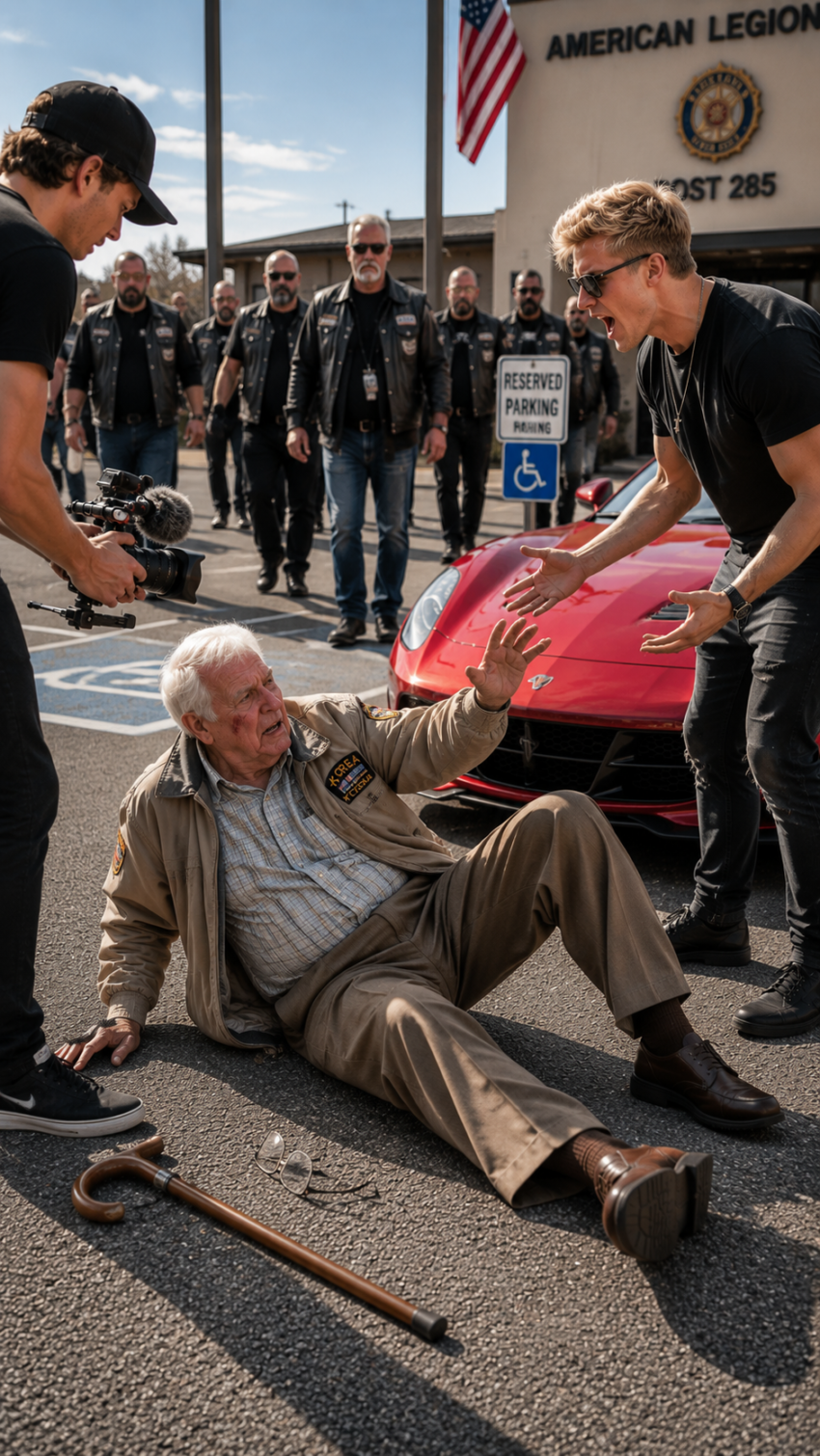
A Young Influencer Mocked An 84-Year-Old Disabled Veteran And Refused To Leave The Accessible Parking Space… Then Nearly Forty Bikers Walked Out Of A Nearby Building, And His Smile Disappeared Before Anyone Said A Single Word
The Place He Could Not Reach By Himself
For eighty-four-year-old Arthur Langford, the accessible parking space near the Riverside Veterans Memorial was never about comfort.
It was about whether he could make it there at all.
Every step had become harder over the years. His knees moved slowly. His back ached when the weather changed. His right hand trembled just enough that he always carried a polished oak cane with him, the same cane his late wife had bought him after his second surgery.
That Saturday afternoon in Knoxville, Tennessee, the sky was bright and blue. The late sunlight touched the memorial grounds in a soft golden glow.
Arthur had only one wish.
He wanted to visit the wall before sunset.
He did it every year.
He parked his old gray Buick near the front of the memorial lot and looked toward the row closest to the entrance. His disabled veteran plate caught the sunlight as he turned carefully into the lane.
Then his heart sank.
A shiny red sports car sat sideways across the only open accessible space.
A young man in expensive sneakers leaned against the hood, smiling into a camera. Beside him stood another young man holding a filming rig and a small light.
They were making a video.
Arthur lowered his window.
“Excuse me, young man,” he said gently. “I have a permit for that space. I can’t walk very far today.”
The young man glanced at him, then looked back at the camera.
His name was Ryder Bellamy. He was twenty-four, popular online, and far too used to people moving out of his way.
“There are other spots back there, sir,” Ryder said, pointing lazily toward the far end of the lot.
Arthur looked in that direction. The distance was not impossible for most people.
For him, it felt like a hill.
“That space is marked for people who need it,” Arthur replied. “I’m asking politely.”
Ryder smiled wider, as if the situation had suddenly become entertaining.
“We’re filming something. We’ll be done soon.”
Arthur opened his door slowly and placed his cane on the pavement. His movements were careful, patient, and tired. He had learned long ago not to rush a body that no longer trusted itself.
“Rules matter,” Arthur said. “Especially when they protect people who cannot simply walk farther.”
The cameraman gave a small laugh.
Ryder stepped closer, his confidence growing because the camera was still pointed at him.
“Are you really going to lecture me in my own video?”Arthur looked at the young man’s face and saw no real anger there.
Only pride.
Only attention.
“I’m not trying to embarrass you,” Arthur said quietly. “I’m only asking you to show some respect.”
Ryder rolled his eyes.
“Respect isn’t something you get just because you’re old.”
Then he made a careless move.
He stepped forward and bumped Arthur with his shoulder, not hard enough to look dramatic on camera, but hard enough for an elderly man with weak legs.
Arthur stumbled.
His cane slid away across the pavement. His glasses fell near the curb. He caught himself against the side of the red car, but his mouth touched the metal edge and a thin line of red appeared at his lip.
The cameraman stopped laughing.
The parking lot went silent.
The Men Across The Lot
Across the street from the memorial stood a low brick building with an American flag moving softly in the breeze.
It belonged to a local veterans group, but on weekends it also welcomed the Granite Riders Motorcycle Club for charity meetings. Most of the men looked rough from a distance. Leather vests. Gray beards. Heavy boots. Old tattoos. Loud motorcycles parked in a neat row outside.
Inside, they were drinking coffee and planning a fundraiser for veterans’ families.
At the head table sat Malcolm “Hawk” Dempsey, a broad-shouldered man in his early sixties with silver hair, kind eyes, and a face that looked like it had weathered many hard years without losing its humanity.
Hawk saw Arthur stumble through the front window.
He did not shout.
He simply stood.
Chairs moved behind him.
One by one, nearly forty bikers rose from their seats.
Nobody needed an explanation.
Nobody asked whether it was their business.
Some things become your business the moment you see them.
The men walked out together.
Their boots hit the pavement in slow, steady rhythm.
Ryder was still trying to act calm when he noticed the shadows moving toward him.
“Come on,” he said nervously. “It was just a joke.”
But no one laughed.
Hawk reached Arthur first. He picked up the cane, placed it carefully back into Arthur’s hand, then touched the older man’s shoulder with surprising gentleness.
“Easy, sir,” Hawk said. “We’ve got you.”
The Place He Could Not Reach By Himself
For eighty-four-year-old Arthur Langford, the accessible parking space near the Riverside Veterans Memorial was never about comfort.
It was about whether he could make it there at all.
Every step had become harder over the years. His knees moved slowly. His back ached when the weather changed. His right hand trembled just enough that he always carried a polished oak cane with him, the same cane his late wife had bought him after his second surgery.
That Saturday afternoon in Knoxville, Tennessee, the sky was bright and blue. The late sunlight touched the memorial grounds in a soft golden glow.
Arthur had only one wish.
He wanted to visit the wall before sunset.
Advertisements
He did it every year.
He parked his old gray Buick near the front of the memorial lot and looked toward the row closest to the entrance. His disabled veteran plate caught the sunlight as he turned carefully into the lane.
Then his heart sank.
A shiny red sports car sat sideways across the only open accessible space.
A young man in expensive sneakers leaned against the hood, smiling into a camera. Beside him stood another young man holding a filming rig and a small light.
They were making a video.
Arthur lowered his window.
“Excuse me, young man,” he said gently. “I have a permit for that space. I can’t walk very far today.”
The young man glanced at him, then looked back at the camera.
His name was Ryder Bellamy. He was twenty-four, popular online, and far too used to people moving out of his way.
“There are other spots back there, sir,” Ryder said, pointing lazily toward the far end of the lot.
Arthur looked in that direction. The distance was not impossible for most people.
For him, it felt like a hill.
“That space is marked for people who need it,” Arthur replied. “I’m asking politely.”
Ryder smiled wider, as if the situation had suddenly become entertaining.
“We’re filming something. We’ll be done soon.”
Arthur opened his door slowly and placed his cane on the pavement. His movements were careful, patient, and tired. He had learned long ago not to rush a body that no longer trusted itself.
“Rules matter,” Arthur said. “Especially when they protect people who cannot simply walk farther.”
The cameraman gave a small laugh.
Ryder stepped closer, his confidence growing because the camera was still pointed at him.
“Are you really going to lecture me in my own video?”
Arthur looked at the young man’s face and saw no real anger there.
Only pride.
Only attention.
“I’m not trying to embarrass you,” Arthur said quietly. “I’m only asking you to show some respect.”
Ryder rolled his eyes.
“Respect isn’t something you get just because you’re old.”
Then he made a careless move.
He stepped forward and bumped Arthur with his shoulder, not hard enough to look dramatic on camera, but hard enough for an elderly man with weak legs.
Arthur stumbled.
His cane slid away across the pavement. His glasses fell near the curb. He caught himself against the side of the red car, but his mouth touched the metal edge and a thin line of red appeared at his lip.
The cameraman stopped laughing.
The parking lot went silent.
The Men Across The Lot
Across the street from the memorial stood a low brick building with an American flag moving softly in the breeze.
It belonged to a local veterans group, but on weekends it also welcomed the Granite Riders Motorcycle Club for charity meetings. Most of the men looked rough from a distance. Leather vests. Gray beards. Heavy boots. Old tattoos. Loud motorcycles parked in a neat row outside.
Inside, they were drinking coffee and planning a fundraiser for veterans’ families.
At the head table sat Malcolm “Hawk” Dempsey, a broad-shouldered man in his early sixties with silver hair, kind eyes, and a face that looked like it had weathered many hard years without losing its humanity.
Hawk saw Arthur stumble through the front window.
He did not shout.
He simply stood.
Chairs moved behind him.
One by one, nearly forty bikers rose from their seats.
Nobody needed an explanation.
Nobody asked whether it was their business.
Some things become your business the moment you see them.
The men walked out together.
Their boots hit the pavement in slow, steady rhythm.
Ryder was still trying to act calm when he noticed the shadows moving toward him.
“Come on,” he said nervously. “It was just a joke.”
But no one laughed.
Hawk reached Arthur first. He picked up the cane, placed it carefully back into Arthur’s hand, then touched the older man’s shoulder with surprising gentleness.
“Easy, sir,” Hawk said. “We’ve got you.”
Another biker, a quiet man named Cal Voss, picked up Arthur’s glasses from near the curb. He wiped them clean with a folded cloth and handed them back with both hands.
“Here you go, Mr. Langford.”
Arthur blinked in surprise.
“You know me?”
Cal nodded.
“My father used to talk about you. He said you helped bring him home when he was hurt overseas.”
Arthur lowered his eyes.
He never knew what to do with praise.
Hawk turned toward Ryder.
His voice stayed calm, which somehow made it heavier.
“Do you understand who you just treated like a problem?”
Ryder swallowed.
“Look, I didn’t know he was—”
“A person?” Hawk asked. “You didn’t know he was a person?”
The words struck the air harder than shouting ever could.
Ryder looked away.
The Lesson The Camera Could Not Edit
The camera was still recording, but no one was performing anymore.
Advertisements
Ryder’s friend slowly lowered the equipment. The light that had made everything look polished now felt uncomfortable and false.
Arthur wiped his lip with a handkerchief.
Hawk glanced at him.
“Do you need medical help, sir?”
Arthur shook his head.
“I’ll be all right. I’ve had worse days.”
The bikers stood around him, not as a threat, but as a wall of protection.
Ryder shifted nervously.
“I said it was a joke.”
Arthur looked at him then.
There was no hatred in his face.
That made Ryder feel smaller than anger would have.
“Young man,” Arthur said, “a joke that takes away someone’s dignity is not a joke. It is only cruelty wearing a smile.”
Ryder’s face changed.
For the first time, he had no clever answer.
Arthur looked toward the memorial wall in the distance.
“My closest friend was twenty years old when he never came home,” he said softly. “He believed this country would remember kindness. He believed people would take care of one another.”
The bikers lowered their heads.
Arthur’s voice trembled, but he kept speaking.
“He did not give his tomorrow so strangers could become colder to each other today.”
The entire lot grew still.
Even Ryder’s cameraman looked ashamed.
Hawk took one step closer to Ryder.
“You can cut a video,” he said quietly. “You can add music. You can change the title. But you cannot edit what kind of man you were when no one forced you to be decent.”
Ryder stared at the ground.
The red car no longer looked impressive.
It looked like a mistake.
When The Officers Arrived
Someone from the building had already called local officers after seeing Arthur stumble.
When the patrol car arrived, two officers stepped out and spoke calmly with everyone there. They reviewed the footage. They spoke with witnesses. They listened to Arthur.
Nobody shouted.
Nobody needed to.
Ryder stood beside his car with his hands shaking.
One officer explained the seriousness of blocking an accessible space and putting an elderly disabled man at risk. Ryder’s confident online personality disappeared completely.
The cameraman sat on the curb, silent, holding the filming rig in his lap like it had become too heavy.
Before Ryder was led away to answer for what happened, he turned back toward Arthur.
His voice was quiet now.
Real.
“Sir… I’m sorry.”
Arthur studied him for a long moment.
Then he nodded once.
“Being sorry is a beginning,” Arthur said. “Becoming better is the part that matters.”
Ryder’s eyes lowered.
The officer guided him away.
And with that, the video ended in a way he had never planned.
The Walk To The Memorial Wall
After the officers left, Arthur looked toward the memorial.
The wall was still waiting.
Hawk noticed the way he stared at it.
“You still want to go?”
Arthur gave a faint smile.
“That is why I came.”
Hawk nodded.
“Then we’re walking with you.”
Arthur wanted to say they did not have to.
But before he could speak, Cal stepped to one side of him and Hawk stepped to the other. The rest of the bikers followed behind, slowly and respectfully.
They did not rush him.
They did not make him feel weak.
They matched his pace.
The black stone wall reflected the late afternoon sun. Names stretched across it in clean rows, each one carrying a life, a family, a story, and a silence that never fully went away.
Arthur stopped in front of one name.
Samuel Price.
His hand lifted slowly and rested against the letters.
For a long time, he said nothing.
Then he whispered,
“I brought company this year, Sam.”
Hawk removed his sunglasses.
So did every biker behind him.
Arthur smiled through tears he did not try to hide.
“Good men,” he added softly. “The kind you would have liked.”
No one interrupted him.
Advertisements
For the younger bikers, that moment changed something. They understood that respect was not a speech, not a post, not a holiday slogan.
It was standing quietly beside someone when memory became too heavy to carry alone.
The Ride Home
When evening began to settle over Knoxville, Arthur returned to the parking lot.
This time, the accessible space was open.
Hawk opened the Buick’s door for him.
Arthur eased himself into the driver’s seat and looked at the men gathered around him.
“Thank you,” he said. “You boys have already done more than enough.”
Hawk smiled under his gray beard.
“With respect, Mr. Langford,” he replied, “a man like you doesn’t drive home alone.”
One motorcycle started.
Then another.
Then another.
The sound rolled through the parking lot like deep thunder, but there was nothing wild about it. It felt organized. Protective. Honorable.
Within minutes, the Granite Riders surrounded Arthur’s old Buick.
Several rode in front.
Several rode behind.
Others stayed along both sides like a moving shield.
People on sidewalks stopped to watch as the small procession moved through town.
Some drivers lowered their windows.
A few placed their hands over their hearts.
Arthur drove slowly, both hands on the wheel, tears shining in his tired eyes.
He was not crying because he felt helpless.
He was crying because he felt remembered.
And after so many years of carrying memories alone, that feeling was almost too much.
The Video That Became Something Else
The video Ryder wanted to make eventually appeared online.
But not the way he imagined.
People did not admire his confidence.
They saw Arthur’s shaking hands. They saw the blocked space. They saw an old veteran asking politely for basic respect.
And then they saw the bikers arrive.
That was the part everyone remembered.
Not because they shouted.
Not because they acted tough.
But because they stood still, spoke calmly, and protected a man without trying to turn him into entertainment.
Thousands of people shared the clip.
Veterans’ groups thanked the Granite Riders.
Families wrote about their fathers, grandfathers, uncles, and neighbors who had served quietly and asked for very little in return.
Ryder disappeared from social media for a while.
The internet moved on, as it always does.
But in Knoxville, people kept telling the story.
They told it in diners.
They told it at church breakfasts.
They told it at motorcycle fundraisers and veterans’ meetings.
They did not tell it because of the young man with the expensive car.
They told it because of Arthur Langford.
They told it because one elderly man came to honor a friend and found himself honored too.
They told it because a group of rough-looking bikers reminded a whole town that kindness can still be strong.
Sometimes strength is not the loudest voice in the parking lot.
Sometimes strength is a hand picking up a fallen cane.
Sometimes it is a group of men walking slowly so one old veteran does not have to walk alone.
Sometimes it is refusing to let someone’s dignity be treated like content.
And sometimes the most powerful lesson in the world is simple.
Respect people before life has to teach you why they deserved it.
A person’s worth should never be measured by their age, their strength, their money, or how slowly they move through the world.
True respect is not shown only in public ceremonies; it is proven in ordinary moments when no reward is waiting.
The people who once carried heavy burdens for others should never have to beg for basic kindness.
A camera can capture behavior, but it can never hide the truth of someone’s character.
Real strength does not need cruelty to look powerful; real strength becomes powerful because it protects.
Older people are not obstacles in our way; they are living libraries of sacrifice, memory, and lessons we still need.
A careless moment can hurt someone deeply, but a sincere change afterward can become the beginning of a better life.
Kindness is not weakness; it is the quiet courage to choose humanity when pride would be easier.
The world becomes safer when strong people stand beside those who feel forgotten, instead of looking away.
Sometimes the best way to honor someone’s past is to make sure they are treated with dignity in the present.