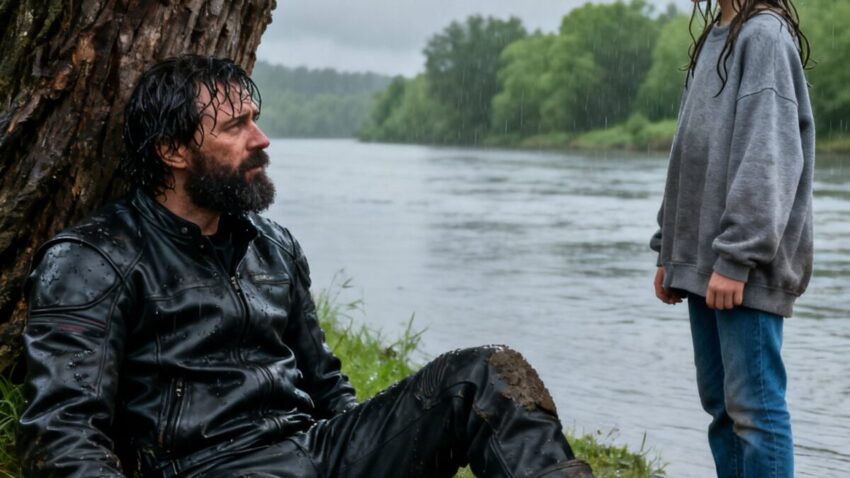
The river was taking him inch by inch.
Rain hammered the mud so hard it looked like the whole bank was breathing.
A man in black leather lay face down at the edge of the water, one arm twisted beneath him, his boots still caught in the current.
He was enormous to her.
Too heavy.
Too still.
Too far from help.
Ren Sullivan was only nine years old, standing in shoes that leaked and a gray sweatshirt big enough to swallow her hands.
Every adult in her life had warned her about men like him.
Men on motorcycles.
Men in leather.
Men with patches on their backs and voices that sounded like engines.
She had been taught to move away from them, to lower her eyes, to cross streets, to find a grown-up, to stay safe.
But there was no grown-up.
There was only rain.
There was only river.
There was only the terrifying quiet of a man who would die if she obeyed everything she had ever been told.
So Ren stepped into the mud.
She grabbed the soaked leather at the back of his vest.
And with a sound that tore out of her small chest like something wild, she pulled.
At first he did not move.
Not even a little.
The river tugged him the other way, patient and merciless, as if it had all night to win.
Ren did not.
She planted her thin sneakers deeper into the mud, leaned back until her arms shook, and pulled again.
The man slid maybe an inch.
Then another.
Then the current caught his boots and dragged him back half of what she had gained.
Ren tasted rain and fear and river grit on her lips.
Her hands burned.
Her shoulders screamed.
But she kept pulling.
Because nobody else was coming.
Because even at nine years old, she understood something most grown people spent their lives avoiding.
If you see someone drowning and walk away, the river does not care why.
Paducah, Kentucky was the kind of town where water shaped everything.
Two rivers pressed close to it, the Ohio and the Tennessee, folding into each other like old secrets that had never quite finished speaking.
Barges groaned at night.
Fog gathered low over the levee.
People measured storms by how fast the water rose and how long it took to leave.
Ren Sullivan had grown up believing the river was the only honest thing in her life.
It rose when it rained.
It fell when the sky dried.
It never smiled at you while hiding a judgment.
It never pretended not to notice your donated shoes.
It never called your sweatshirt nice when everyone knew it meant poor.
It simply moved.
That was why Ren went there after school.
Not to fish.
Not to skip stones.
Not even to play.
She went because the river did not ask questions.
It did not ask why her mother worked two jobs and still counted coins at the kitchen table.
It did not ask why the heater in their rented shotgun house clicked on and off like it was losing an argument.
It did not ask why Ren had learned to be quiet before most children learned to be proud.
The house where Ren lived stood three streets back from the levee.
It had peeling paint along the eaves, a porch step that bowed when anyone heavier than a child stepped on it, and a window on the north side patched with cardboard and duct tape.
In the back bedroom, an old brown water stain had spread across the ceiling for so long that Ren no longer remembered when it had been small.
Her mother, Renee Sullivan, called it manageable.
Ren knew better.
Manageable was a word adults used when they were frightened and did not want their children to hear it.
Renee worked mornings changing sheets at the Riverview Motel.
In the evenings, she poured coffee at Dot’s Diner, balancing plates with swollen hands and smiling at customers who never wondered if the woman refilling their mugs had eaten dinner herself.
Between those shifts, she slept sitting up in the recliner.
Not deeply.
Not comfortably.
Just enough to keep moving.
Ren had once asked her why she did not lie down in bed.
Renee had smiled without looking at her and said she might not get back up.
After that, Ren stopped asking.
School was another place where Ren learned silence.
At Briarwood Elementary, she sat in the back row of Mrs Calendarer’s fourth grade classroom.
The radiator clanked beside her.
The window looked out on the parking lot.
From there, she could see parents waiting in cars with warm seats and clean windshields, mothers waving through glass, fathers stepping out to open doors, children climbing into lives that seemed sealed against the cold.
Ren was good at reading.
She was careful not to show it too much.
She was even better at math, but good grades in donated clothes brought attention, and attention almost always turned into something sharp.
Tyler Mercer was the kind of boy who had never wondered whether the lights would stay on.
His father sat on the city council.
His mother hosted school fundraisers.
His sneakers were always new.
He had a way of saying, “Nice shirt, Sullivan,” that made other children laugh before they knew why.
Ren never answered him.
Answering gave people something to hold.
Silence gave them nothing.
But silence also made a lonely little room inside her, and by late October that room had grown so crowded she could hardly breathe.
That Thursday, the sky had been gray since lunchtime.
Not storm gray.
Not dramatic gray.
Just the flat dishwater gray of a Kentucky autumn that had settled in and refused to leave.
By the time the final bell rang, rain had begun falling in thin cold lines.
Ren pulled her hood over her hair and chose the long way home.
The short way passed the Mercer house, and she did not have enough strength left that day to walk past it pretending not to hear anything.
So she took the river road.
Mud sucked at her shoes.
Rain slid down the back of her neck.
Her empty stomach twisted now and then, not loudly enough to matter, but enough to remind her that lunch had been hours ago and dinner depended on how tired her mother was when she came home.
She was halfway past the old grain elevator when she heard the motorcycle.
The sound rolled across the wet road and down toward the water, deep and steady.
Ren looked up.
She could not see the bike at first, only the bend in the county road above the bluff and the black shine of rain on asphalt.
Then came another sound.
A skid.
A violent scrape of metal.
A sickening thud somewhere below the road.
Then nothing.
The kind of nothing that makes a child forget she is cold.
Ren froze.
The rain kept falling.
Somewhere in the trees, a deer stood motionless, ears high, its brown body tense against the wet brush.
For three seconds Ren did exactly what every warning in her life had taught her to do.
She stayed back.
She listened.
She thought of men in leather and mothers whispering caution and teachers lowering their voices when motorcycle clubs came up in conversation.
Then she saw the skid marks.
They curved across the road like a black wound.
They went over the shoulder.
They disappeared down the muddy slope toward the river.
Ren began to climb.
She slipped twice before she reached the top.
Her palms hit gravel.
Her knees soaked through.
The deer vanished into the trees as if it had never been there.
Down below, near the water, she saw the motorcycle first.
It lay half submerged about twenty feet from shore, one wheel turning slowly in the current.
Then she saw him.
The man.
He was face down in the mud and shallows, soaked black leather clinging to his wide back.
A patch on his vest read Ridgeline Riders in curved letters.
Blood ran from his temple, thinning pink as the rain washed it toward the water.
His chest moved.
Barely.
But it moved.
“Mister,” Ren called.
Her voice was tiny against the rain.
He did not answer.
She stepped closer.
“Mister, wake up.”
The river tugged at his boots.
His body shifted another inch toward the deeper channel.
That was the moment Ren understood there was no safe choice.
If she ran for help, he might be gone before she got back.
If she stayed, she might not be strong enough.
If she did nothing, the river would finish what the crash had started.
She was four feet two inches tall.
She weighed sixty one pounds.
Her fingers were already numb from cold.
But she reached for him anyway.
The leather was slick.
She grabbed higher, bunching the collar of his vest in both fists.
Then she pulled.
Nothing.
She pulled again.
Still nothing.
A panic rose in her throat, but Ren forced it down.
Panic wasted air.
She dug her heels into the mud and leaned back until her whole body became a trembling line between the man and the river.
This time, he moved.
Not much.
Just enough to make the mud release a wet sucking sound.
Ren screamed.
Not for help.
Not exactly.
She screamed because the effort needed somewhere to go.
She screamed because the river was stronger than her and she hated it for that.
She screamed because this stranger’s life had somehow become the heaviest thing she had ever been trusted to hold.
She dragged him one inch at a time.
His shoulder rose out of the water.
Then part of his chest.
Then the current caught his legs again and turned him sideways.
Ren fell backward, landing hard in the mud.
For one terrible second his head dipped toward the water.
“No,” she said.
It came out low and fierce.
She crawled back to him.
This time she grabbed his belt and the side seam of his vest together.
She pulled until her arms felt like they were coming loose.
She pulled until her shoes slid out from under her and she went down again.
She pulled until the man’s face turned just enough that his mouth was no longer in the water.
Then she scrambled up the bank toward the road, slipping and sobbing without tears, waving both arms when the first headlights appeared through the rain.
The pickup almost passed her.
Ren stepped into the road.
The driver slammed the brakes so hard the truck fishtailed.
A man leaned out the window, angry at first, until he saw her face.
“Call 911,” Ren shouted.
“There’s a man in the river.”
Then she ran back down before he could stop her.
By the time the ambulance arrived, Ren was kneeling in the mud with both hands under the biker’s jaw, keeping his head above the waterline every time the current tried to roll him.
Her sleeves were soaked.
Her lips were blue.
Her small body shook so hard the paramedic thought at first she had been injured too.
But Ren only pointed at the man.
“Help him,” she said.
Then she backed away as if she had done something wrong by being noticed.
Dean Hastings woke up in a hospital bed at McCracken County with six stitches over his eyebrow and a headache that rang through his skull like church bells struck too hard.
A nurse told him he was lucky.
He did not feel lucky.
He felt like a man who had gone down on a rain-slick curve he had ridden past thousands of times.
He felt like a man who had swerved to miss a deer and lost to wet asphalt.
He felt like a man who should have known better.
Then the nurse told him the part he could not make fit inside his head.
“A little girl pulled you out.”
Dean stared at her.
“What girl?”
“Nine years old.”
The nurse’s mouth softened.
“Walking home from school.”
Dean closed his eyes.
The last thing he remembered was the road sliding out from beneath him and the hard black rush of the embankment.
He remembered water.
He remembered pressure in his chest.
He remembered the cold closing over his cheek.
But a child?
That made no sense.
He weighed nearly two hundred and eighty pounds in wet gear.
His vest alone felt like a soaked saddle when it took rain.
A child could not have moved him.
“She flagged down a truck too,” the nurse said.
“Then she went back and kept your head out of the water until the ambulance got there.”
Dean turned his face toward the window.
Rain streaked the glass.
Beyond it, the parking lot blurred into gray.
He had been riding for thirty one years.
He had pulled brothers from wrecks on two-lane highways.
He had held pressure on wounds until sirens came.
He had watched strong men go silent on shoulders of roads while engines cooled nearby.
He knew what it meant to owe a life.
He had never imagined owing his to a girl who barely reached his belt buckle.
Her name was Ren Sullivan.
He learned it from the police report.
He learned it again from Earl Boone, who arrived forty minutes after the Ridgeline Riders’ phone tree lit up.
Earl came into the room in wet boots and a leather cut darkened by rain.
He was older than Dean by eleven years, with a gray beard, steady eyes, and the patient heaviness of a man who could carry bad news without dropping it on the floor.
Dean looked at him and tried to sit up.
Earl pointed one thick finger at the bed.
“Don’t.”
Dean sank back.
“Tell me.”
Earl pulled a chair close.
“The girl who pulled you out is at Briarwood.”
Dean’s brow tightened.
“Fourth grade?”
“Fourth grade.”
Dean stared at the blanket.
Briarwood Elementary was not just a school to him.
For four years, he had taught a small engines club there every Thursday afternoon.
Unpaid.
Mostly unnoticed.
He brought lawnmower engines, old go-kart motors, carburetors, socket sets, and boxes of parts into the back room near the maintenance bay.
The district had almost cut the program twice.
Dean had kept it alive from his own garage because some kids needed something to do with their hands besides get in trouble.
And because after his wife Carol died, Dean had needed somewhere to be that was not his silent kitchen table.
He did not know every child in the school.
But he noticed the quiet ones.
The hungry ones.
The ones who hovered near the after-school snack table longer than the engines.
“Small kid,” Dean said slowly.
“Dark hair.”
“Sweatshirt too big.”
“Doesn’t talk much.”
Earl nodded.
“That’s her.”
The words landed harder than the wreck.
Dean remembered seeing her.
Not clearly.
Not the way he wished he had.
A small figure in the hallway.
Eyes down.
Sleeves pulled over her hands.
The kind of child adults call well-behaved when what they mean is invisible.
He had walked past her a dozen times and never learned her name.
Now her name was the reason he was breathing.
Dean was discharged two days later with instructions to rest, avoid strain, and stay away from motorcycles until his concussion symptoms eased.
He ignored all of that within the hour.
He did not ride the wrecked bike.
That one was still in a shop being assessed.
He rode his backup to the Riverview Motel, where Earl had learned Renee Sullivan worked the morning shift.
He found her behind the front desk, folding receipts with the mechanical precision of someone keeping her hands busy so her mind would not collapse.
Renee looked younger than her exhaustion made her seem.
Her hair was tied back.
Her eyes were tired.
Her posture had the hard, careful shape of a woman who had spent too long carrying more than anyone could see.
Dean took off his hat before he spoke.
“Renee Sullivan?”
Her eyes moved from his face to the stitches over his eyebrow.
Then to the leather vest.
She went still.
“You’re the man from the river.”
“I am.”
Dean’s voice lowered.
“And I understand I owe your daughter my life.”
Something moved across Renee’s face.
Pride first.
Then fear.
Then a guardedness so old and automatic it looked almost like pain.
“I’d like to thank her properly,” Dean said.
“Only if that’s all right with you.”
Renee looked toward the lobby window as if the answer might be outside in the rain.
“She won’t want attention.”
“I figured that.”
“She doesn’t like people looking at her.”
Dean nodded.
“I noticed that at school.”
Renee looked back at him sharply.
“At school?”
“Briarwood.”
He shifted his weight.
“I run the small engines club on Thursdays.”
Her expression changed.
Not softened.
Not yet.
But recalculated.
“The club with the motors.”
“Yes, ma’am.”
“Ren talks about it sometimes.”
Dean felt something ache behind his ribs.
“She does?”
“Not much.”
Renee gave a tired half smile that vanished quickly.
“She doesn’t talk much about anything.”
Dean looked down at the counter.
“I’ve probably walked past her a dozen times without knowing who she was.”
“That’s not your fault.”
“It feels like it is today.”
Renee did not invite him home.
Not then.
She was polite.
Careful.
Grateful in the way a proud person is grateful when gratitude feels dangerously close to debt.
But she agreed he could stop by Sunday afternoon to thank Ren.
When Dean arrived at the Sullivan house, he understood in one glance why Renee had hesitated.
The place was not just worn.
It was losing an argument with time.
A tarp lay across part of the roof, weighted down with cinder blocks.
The porch step sagged in the middle.
The north window was patched with cardboard and silver duct tape.
Rainwater stains streaked the siding.
Through the thin front door, Dean could hear a space heater cycling on and off, working too hard against air that would not stay warm.
Ren answered his knock.
She wore the same gray sweatshirt.
When she saw him, she stepped back.
He could not blame her.
At the river, he had been nearly dead.
Now he was upright, huge, bruised, stitched, and leather-clad in her doorway.
Dean crouched slowly so he did not tower over her.
“Hi, Ren.”
She stared at him.
“You’re the biker from the news.”
Dean smiled gently.
“I’m the man you pulled out of a river.”
She chewed the edge of her sleeve.
“The bike’s just something you ride?”
“Exactly.”
Her shoulders dropped half an inch.
Not trust.
Not yet.
But the first crack in fear.
Renee stood behind her in the narrow hallway, arms folded.
Dean saw how she placed herself slightly in front of the rooms beyond, as if protecting the house from his eyes.
He saw the cardboard window behind them.
He saw a bucket in the hallway.
He saw the old wobble in the kitchen table leg.
He saw too much.
So he said very little.
He thanked Ren.
He told her she had done something most adults would have been too frightened to do.
Ren looked at the floor.
“I just didn’t want you to drown.”
Dean swallowed.
“That makes you braver than most people I’ve known.”
Her eyes flicked up at him then.
Only for a second.
But long enough for Dean to see how little praise she trusted.
Before he left, he handed Renee a card from his repair shop.
His cell number was written on the back.
“If something needs fixing,” he said, “call me.”
Renee’s fingers tightened around the card.
“We’re managing.”
Dean nodded once.
“I believe you are.”
Then he looked at the porch step.
“I also know managing isn’t the same as safe.”
Renee’s face closed.
Dean did not push.
Pride was not arrogance when it was the last wall a person had left.
He had learned that after Carol died.
People brought food.
People offered help.
People said call if you need anything.
And every offer had made him feel more exposed, as if grief had stripped the roof from his life and neighbors were peering in through the rafters.
So Dean rode back to the clubhouse without forcing the issue.
But he told Earl what he had seen.
The Ridgeline Riders clubhouse sat behind an old machine shop on the edge of town.
It was not pretty.
It smelled faintly of coffee, motor oil, wet leather, and whatever chili someone had forgotten on the stove.
To outsiders, it looked like a place to avoid.
To Dean, it was where men and women who had been misread by the world came when the world got too heavy.
Earl listened from across the table, turning a chipped mug between his palms.
Dean described the roof.
The window.
The step.
The heater.
The bucket.
The mother who would rather freeze than admit she needed a hand.
When he finished, Earl was quiet for a long time.
Finally he said, “Sounds like good people.”
“They are.”
“And she won’t ask.”
“No.”
“Won’t accept if you offer.”
“Probably not.”
Earl set the mug down.
“Then we don’t ask her to accept.”
Dean looked up.
Earl leaned back.
“We give the girl what she earned in front of everybody who looked down on her.”
Dean’s jaw tightened.
“You want to make a spectacle out of a kid who hates attention?”
“No.”
Earl’s voice stayed calm.
“I want to make sure the town understands who the spectacle really is.”
Dean said nothing.
“The child saved your life.”
Earl pointed toward the window, beyond which rain still darkened the gravel.
“People are already talking.”
“They’re always talking.”
“They’re saying we want something.”
Dean’s eyes hardened.
“From a nine-year-old?”
“From her mother.”
Earl’s mouth tightened.
“People can make kindness sound dirty when it comes from someone they already decided to hate.”
Dean looked away.
He knew it was true.
By Monday, the story of Ren and the river had spread through Paducah faster than floodwater.
Local news mentioned it.
Parents whispered in the Briarwood pickup line.
Teachers gave Ren careful smiles that made her wish she could disappear into her sweatshirt.
Some children treated her like a hero.
That was strange enough.
Others treated her like she had done something suspicious.
That was easier to understand.
At recess, Tyler Mercer found her near the four square court.
He had an audience, which meant he had courage.
“I heard those motorcycle people came to your house.”
Ren looked at the pavement.
“My mom said that club’s trouble.”
Ren kept her hands inside her sleeves.
“They’re not trouble.”
Tyler laughed.
“Then why is a grown man showing up at your door?”
She did not answer.
“My dad says people like that don’t do favors for free.”
Ren’s stomach tightened.
“Nobody asked them for anything.”
“Maybe that’s the point.”
Tyler stepped closer.
“Maybe they want your mom to owe them.”
The words struck harder because they were not entirely new.
Ren had wondered it herself in the dark, listening to the heater click and fail and click again.
Dean had seemed kind.
But people could seem kind.
Her father had seemed kind once too, before he left Renee with bills and silence and a daughter who learned not to ask when he was coming back.
Ren did not cry at school.
She never cried at school.
She saved it for the walk home, where the river could hear and not tell anyone.
By the time she reached the porch, her eyes were dry.
Renee noticed anyway.
Mothers usually do.
“Somebody bothering you?”
Ren shrugged.
“It’s fine.”
Renee pulled out a chair at the kitchen table.
“Fine usually means it isn’t.”
Ren picked at a thread on her sleeve.
“Tyler says the bikers want something.”
Renee’s face changed very slightly.
“He said nobody does something for nothing.”
For once, Renee did not rush to comfort her.
She wanted to say that was not true.
She wanted to say kindness could be clean.
But two years of making rent on a housekeeper’s wage had made her careful with promises.
She had turned down casseroles from church ladies because she could feel pity baked into the foil pans.
She had refused offers from neighbors because sometimes help came with eyes that looked around too long.
She had smiled through exhaustion because admitting need felt too close to handing someone a weapon.
“I don’t know,” Renee said.
Ren looked up.
That honesty hurt more than a lie might have.
“But I know this,” Renee continued.
“You saw a person in danger, and you did not walk away.”
Ren’s eyes filled.
“Even if he was one of them?”
Renee reached across the table and covered her daughter’s hand.
“Especially then.”
The roof failed two nights later.
Not all of it.
Just enough.
At two in the morning, Renee woke to the sound of water hitting the floor in the back bedroom.
Not a drip.
A steady patter.
She stumbled in and found the ceiling stain spreading, dark and swollen, with water falling through in three places.
She moved buckets.
Then pots.
Then a plastic storage bin with a cracked corner.
Ren slept in the front room, curled under two blankets, unaware that the house was surrendering behind her.
Renee stood barefoot in the hallway, listening to water land in metal and plastic.
She wanted to scream.
Instead, she called the landlord at seven.
He answered on the fifth ring, voice thick with sleep and annoyance.
“I’ll get to it when I get to it.”
Renee looked at the water line on the wall.
“When?”
“When I can.”
The call ended.
She stood in the kitchen with the phone in her hand and the electric bill beside the rent notice.
She did the math once.
Then again.
Then a third time, slower, as if numbers might show mercy if approached politely.
They did not.
Dean called that Thursday.
He told himself it was about the small engines club.
Technically, it was.
He asked if Ren still wanted to come.
Renee said she did.
Then Dean paused.
“Did anyone look at that porch step?”
Renee’s voice went flat.
“We’re managing.”
“I believe you’re managing.”
There was no pity in his tone.
Only the blunt steadiness of a mechanic naming a failing part.
“I didn’t ask if you were managing.”
Silence.
“I asked if the step got fixed.”
Renee closed her eyes.
For one dangerous moment, the truth rose in her throat.
The roof.
The buckets.
The electric bill.
The fear that one bad week could knock their whole life sideways.
Then the old wall came back.
The wall had kept her standing when her husband left.
It had kept her polite at the motel and smiling at the diner.
It had kept Ren from seeing too much.
“We’ll handle it.”
Dean heard the break she tried to hide.
“Renee.”
“Thank you.”
Then she hung up.
Dean sat in the back office of his shop with the phone still in his hand.
Earl sat across from him, pretending to review a ride schedule and not pretending very well.
“She won’t take help,” Dean said.
Earl nodded.
“Too proud.”
“Too scared.”
“Those are cousins.”
Dean rubbed a hand over his face.
“I don’t want to corner her.”
“You don’t corner her.”
Earl folded the schedule.
“You honor the girl.”
Dean looked at him.
“At the school.”
“Yes.”
“Publicly.”
“Yes.”
Dean’s face tightened.
“That sounds like pressure.”
“It is a doorway.”
Earl’s voice was firm now.
“A proud woman cannot take charity.”
He tapped the table.
“But she can accept gratitude for her daughter.”
Dean sat back.
Earl continued.
“That child did not ask for reward.”
“No.”
“That’s why one is owed.”
Dean looked toward the garage bay, where an old engine sat stripped on a bench.
He thought of Ren’s small hands gripping wet leather.
He thought of her knees in the mud.
He thought of the way Renee had clutched his business card like it might burn her.
“Not halfway,” Dean said.
Earl’s mouth twitched.
“No?”
“If we do this, we do it so big nobody in this town ever calls that girl invisible again.”
Earl smiled.
“Now you’re talking like a man who owes somebody his life.”
Principal Margery Doyle had run Briarwood Elementary for eleven years.
In that time, she had learned that a school was not a building.
It was a nerve center.
Every rumor passed through it.
Every fear found a hallway.
Every parent had an opinion, and some arrived before facts did.
When Dean Hastings sat across from her desk and asked to bring the Ridgeline Riders to school, she removed her glasses very slowly.
“You want to bring your motorcycle club here on a Monday morning?”
“Yes, ma’am.”
“How many?”
Dean hesitated only because the number sounded worse aloud.
“Three hundred, give or take.”
Mrs Doyle stared at him.
“Three hundred riders.”
“They’ll park offsite.”
“That was not my only concern.”
Dean nodded.
“It wouldn’t be mine either.”
Mrs Doyle leaned back.
She knew Dean.
That mattered.
For four years, he had shown up every Thursday afternoon with engines, tools, and patience.
He had taught children who struggled to sit still how to take something apart without destroying it.
He had given quiet kids a reason to raise their hands.
He had signed in every time, cleaned up every time, and asked for nothing.
But three hundred riders in leather was not Dean alone.
“I’ve had parents call,” she said.
“I know.”
“Several.”
“I figured.”
“One used the phrase biker gang.”
Dean’s eyes darkened, but his voice stayed even.
“Her phrase or yours?”
“Hers.”
“Good.”
Mrs Doyle almost smiled.
Almost.
Dean leaned forward.
“Mrs Doyle, a fourth grader at your school saved my life.”
“I know she did.”
“And half this town is making her feel ashamed of who she saved.”
Mrs Doyle’s face changed.
That, more than anything, struck her.
Dean continued.
“I do not want noise.”
“No engines in the bus lane.”
“Agreed.”
“No revving.”
“Agreed.”
“No frightening the kindergarteners.”
“Agreed.”
“No one steps out of line.”
“My word.”
Mrs Doyle held his gaze.
“Your word covers three hundred people?”
Dean did not blink.
“On this day, yes.”
She looked past him toward the hallway, where student artwork hung in uneven rows.
Crayon houses.
Paper leaves.
Handprints turned into turkeys.
A building full of children learning what adults taught them without always meaning to.
She thought of Ren Sullivan, small and silent in the back row.
She thought of Tyler Mercer’s mother calling with that clipped tone that people use when they are sure judgment is the same thing as concern.
Then she put her glasses back on.
“You park at the fairgrounds.”
Dean exhaled.
“You walk in.”
“Yes, ma’am.”
“Ten minutes in the gym.”
“Yes, ma’am.”
“And Dean?”
“Yes?”
“If this becomes a circus, I stop it.”
Dean stood.
“If it becomes a circus, I will help you stop it.”
The Riders came on a cold Monday in November.
Paducah heard them long before it saw them, not because they were loud, but because so many engines gathering in one place creates a pulse in the air.
They arrived from six counties and two neighboring states.
Some came before sunrise.
Some had ridden through the night, faces red from cold, gloves stiff, shoulders wet with fog.
They filled the gravel overflow lot at the fairgrounds half a mile from Briarwood.
Then, at Earl’s command, they shut the engines down.
All at once, the thunder died.
What followed was almost more powerful.
Silence.
Three hundred riders dismounted.
Three hundred helmets came off.
Three hundred men and women adjusted their cuts, checked on each other, and formed a column at the edge of the lot.
Earl walked the line.
“No engines.”
A murmur of agreement.
“No shouting.”
More nods.
“No showing off.”
A few smiles.
“No one gives that child a reason to be afraid.”
The smiles vanished.
Earl’s voice dropped.
“She pulled one of ours out of the river when the river wanted him.”
He looked from face to face.
“Today we walk like people who remember that.”
So they walked.
Two blocks of leather and denim moving down Jefferson Street in the morning cold.
No roaring bikes.
No raised fists.
No spectacle beyond the impossible sight of them.
A few curtains moved in nearby houses.
A delivery driver stopped with one hand still on his open van door.
At the corner, Tyler Mercer’s mother slowed her car so sharply the driver behind her honked.
She saw the column of riders heading toward Briarwood and reached instinctively for her phone.
Then she saw Principal Doyle standing outside the school doors.
Waiting.
Watching.
Not afraid.
Inside the gymnasium, the fourth grade had been told only that there would be a special assembly.
Ren sat between Mrs Calendarer and Priya Shah, a girl who sometimes shared crayons without making a performance of it.
Ren chewed her sleeve.
Something felt wrong.
Teachers whispered near the wall.
The principal had her serious face on.
Tyler Mercer sat three rows back, leaning toward his friend until the gym doors opened.
Dean entered first.
The sight of him made Ren’s heart jump.
He wore his Ridgeline cut over a dark shirt.
The stitches over his eyebrow had been removed, but the healing mark remained like a pale reminder of the river.
Behind him came Earl.
Then Sawyer Pruitt.
Then rider after rider after rider.
They did not swarm.
They filed in along the walls, quiet as a church procession.
The gym seemed to shrink with every person who entered.
Children whispered.
A kindergarten teacher gently gathered her class closer.
Mrs Doyle stood near the back doors with both hands folded in front of her, watching every detail.
Ren could not breathe properly.
She did not know whether to be scared or embarrassed or both.
Tyler Mercer, who had always known what to say, said nothing.
Dean stepped onto the small stage.
The microphone gave a soft squeal before settling.
He looked out over four hundred children, dozens of teachers, a handful of parents, and three hundred riders who had come to stand in silence for a child.
“Three weeks ago,” he began, “I went off the river road above the levee.”
His voice filled the gym.
“I hit my head.”
He touched the healing cut near his eyebrow.
“I landed at the edge of the river.”
The children were silent.
“I would have drowned in about eight inches of water.”
A few adults shifted.
Dean smiled faintly.
“Which is a foolish way for a grown man to go.”
A ripple of nervous laughter moved through the room.
Dean let it pass.
“Rivers don’t care about dignity.”
Then his voice changed.
“But one of your classmates cared.”
Ren’s sleeve went still between her teeth.
Dean searched the rows until he found her.
“A student at this school saw me there.”
He looked at the children now, not the adults.
“She had every reason to run for help and not come back.”
Ren stared at the floor.
“She had every reason to be afraid of a man who looked like me.”
The gym grew quieter.
“But she came down that bank in the rain.”
Dean’s voice roughened.
“She grabbed my vest.”
Ren’s hands curled in her lap.
“And she pulled.”
Behind him, Earl lowered his head.
“She pulled me far enough that the river could not finish taking me.”
A teacher near the wall wiped her cheek.
“Then she stopped a truck, made sure 911 was called, and went back to keep my head out of the water until the ambulance came.”
Dean paused.
“When people talk about courage, they usually make it sound loud.”
His eyes returned to Ren.
“But sometimes courage is a hungry child in wet shoes deciding a stranger’s life is worth the weight.”
Ren looked up then.
Her face had gone pale.
Dean held out his hand.
“Ren Sullivan, would you come up here?”
Every eye turned.
Ren’s body locked.
Being watched was worse than being mocked in some ways.
Mocking at least had edges.
This was softer, and that made it harder to understand.
Mrs Calendarer placed a gentle hand on Ren’s shoulder.
“You don’t have to hurry.”
Ren stood.
The walk to the stage felt longer than the riverbank.
She passed rows of children.
She passed Tyler, whose mouth was slightly open.
She passed riders in leather who did not move, did not whisper, did not smile too broadly, did not reach for her.
They simply watched her with an attention so careful it felt almost like protection.
Dean stepped down from the stage so she would not have to climb alone.
When Ren reached him, he crouched again.
Just as he had at her door.
Just as he had promised without saying so that he would not make himself larger than she needed him to be.
“This is Ren Sullivan,” Dean said into the microphone.
The applause began before he could continue, but Earl lifted one hand.
The riders stopped instantly.
The school noticed.
So did Mrs Doyle.
Dean looked at Ren.
“Three hundred people came here today because of you.”
Ren whispered, “I didn’t do anything.”
The microphone caught it.
The whole gym heard.
Dean shook his head.
“That’s where you’re wrong.”
Ren’s face tightened, as if she might cry and was furious with herself for it.
Dean turned back to the crowd.
“The size of a person’s courage has nothing to do with the size of the person.”
This time, nobody laughed.
Nobody shifted.
Even the youngest children seemed to understand that something important was happening.
Earl stepped forward with an envelope in both hands.
He did not wave it around.
He did not announce an amount.
He did not make charity look like a prize.
He knelt in front of Ren and offered it to her.
“This isn’t for you to open.”
His voice was low, but the microphone caught enough.
“It’s for your mama.”
Ren took it carefully.
Earl’s eyes were kind.
“Tell her Earl said the house isn’t going to fix itself.”
A murmur moved through the adults.
“And neither is pride.”
Ren blinked.
Earl smiled gently.
“Today both of those stopped being her problem alone.”
Behind them, Dean signaled to Sawyer.
The projector screen lit up.
At first, Ren did not understand what she was seeing.
Then she recognized the narrow shape of her house.
The porch.
The north wall.
The roofline.
But the drawing showed it changed.
Straightened.
Repaired.
Made whole.
New boards where the porch sagged.
Clean glass where cardboard had been.
Fresh shingles where the tarp lay.
Ren stared at it, confused and frightened and hopeful all at once.
Dean spoke again.
“We know what people think when they see us coming.”
He looked over the room.
“Loud.”
“Rough.”
“Trouble.”
Some parents lowered their eyes.
“For one morning, we’d like the record to show something different.”
Earl stood.
Then all three hundred riders began to applaud.
Not wild.
Not rowdy.
Not like thunder meant to frighten.
Like thunder finally allowed to be gentle.
The sound filled the gym and rolled over Ren until she could feel it in her bones.
Mrs Doyle stood at the back with tears in her eyes.
Tyler Mercer’s mother, who had arrived ready to monitor disaster, stood beside her with a tissue pressed to her mouth.
And Tyler Mercer stared at Ren as if he was seeing her for the first time.
Not as a poor girl in a big sweatshirt.
Not as an easy target.
As someone who had done what he could not imagine doing.
Renee Sullivan was changing sheets in room twelve at the Riverview Motel when the front desk called her.
“The school needs you.”
Her body went cold.
Nobody calls a working mother out of a shift for good news.
She drove to Briarwood with both hands locked on the wheel, imagining a fall, a fight, an ambulance, Ren sitting in the office with a broken wrist or a split lip or worse.
But when she reached the school, Mrs Doyle met her outside.
“Ren is all right.”
Renee nearly staggered from relief.
“What happened?”
Mrs Doyle’s eyes were red.
“I think you should go home.”
That frightened Renee more.
She drove too fast.
At the edge of her street, she hit the brakes.
Motorcycles lined both sides of the road.
Not a few.
Not a dozen.
Blocks of them.
Chrome and black paint and leather saddlebags shining in the cold sun.
People stood in her yard.
People stood on ladders.
People carried boards, shingles, glass, tools, bags of groceries, paint cans, boxes, extension cords, and coffee cups.
For one dizzy second Renee thought she had the wrong house.
Because the porch was not sagging.
The porch was new.
Squared.
Level.
Painted a soft gray blue that made her throat close.
Months earlier, at Dot’s Diner, she had refilled coffee for a woman wearing a Ridgeline jacket.
The woman had mentioned repainting her own porch.
Renee, half exhausted and barely thinking, had said she had always liked gray blue on old houses.
She had not known anyone listened to tired women saying small wishes out loud.
Now that color was on her porch.
The cardboard window was gone.
In its place was clean glass in a fresh frame.
On the roof, three riders worked the last line of shingles where the tarp had been.
Another man hauled away warped boards.
Someone she did not know carried a broken section of gutter to a truck.
A woman in a leather vest came out of the house with Renee’s old space heater in her arms.
She saw Renee and stopped.
“Ma’am.”
Renee could not speak.
Sawyer Pruitt came down the walk with a tool belt around his waist and sawdust in his hair.
He removed his cap.
“Before you say anything,” he said, “nobody is here to make you feel small.”
Renee stared at him.
“We’ve been at this since six this morning.”
Her eyes filled against her will.
“Why?”
Sawyer looked toward the roof.
“Because your daughter did something for one of ours that a check could never repay.”
He met her eyes.
“And this was the only currency we had that felt close to fair.”
Renee’s first instinct was to say no.
It rose automatically, sharp and panicked.
No, this is too much.
No, I cannot accept this.
No, I do not know what you expect from me.
No, I cannot owe three hundred strangers anything.
But the words would not leave her mouth.
Because behind Sawyer, her house stood straighter than it had in two years.
Because the place where rain had entered her daughter’s life was being sealed.
Because the window that had let cold slip in at night was whole.
Because for the first time in longer than she could remember, the house looked less like something she was failing to save.
Then Ren came running down the sidewalk from the school bus.
Earl had arranged for her to be brought straight home.
She carried the envelope against her chest.
When she saw her mother, she ran harder.
“Mama.”
Renee dropped to her knees just in time to catch her.
Ren’s arms went around her neck.
“They fixed the roof.”
Her voice broke.
“They fixed the window.”
Renee held her so tight the envelope crumpled between them.
“Baby.”
“Mr Dean said it was because I did something brave.”
Ren pulled back, frantic now, needing her mother to understand.
“I told him I didn’t do it to get anything.”
Renee touched her daughter’s face with both hands.
“I know.”
“And he said that’s exactly why we get to have it.”
Something inside Renee gave way.
Not loudly.
Not dramatically.
Just one old support beam in her chest finally cracking under the weight of relief.
For two years she had built a life out of refusal.
No, I do not need help.
No, we are managing.
No, it is not that bad.
No, I am not scared.
No, my daughter does not know.
But Ren knew.
Of course Ren knew.
Children always know the shape of the worry in a house, even when nobody names it.
Renee pulled her close again.
“You didn’t do anything wrong.”
Ren cried then, quietly into her mother’s coat.
“You don’t owe anybody an explanation for being brave.”
Renee looked over Ren’s shoulder at Dean, who stood near his bike at the curb, keeping his distance as if afraid to intrude on a moment he had helped create.
Then Renee said, more to herself than anyone else, “And I suppose I don’t owe anybody an explanation for needing help either.”
Dean saw her wave him over.
He crossed the yard slowly.
For once, Renee looked at him without that hard layer of suspicion between them.
“I don’t know how to thank three hundred people.”
Dean shook his head.
“You don’t have to.”
Renee gave a wet laugh.
“That seems unlikely.”
“Ren already did the hard part.”
Dean glanced at the house.
“All we did was show up.”
Earl appeared behind him with a clipboard.
“Water heater’s in.”
Renee blinked.
“What?”
Dean winced slightly, as if expecting protest.
“The old one was past done.”
Sawyer called from the porch, “Wiring in the back bedroom was original.”
Renee turned.
He lifted one hand.
“Forty years old, maybe more.”
Another rider added, “Should have started a fire by now.”
Renee went pale.
Dean’s voice softened.
“It didn’t.”
He let that settle.
“And now it won’t.”
Renee covered her mouth.
“There are groceries in the kitchen,” Dean said.
“I’m not apologizing for those.”
For the first time all day, Renee laughed properly.
Not because anything was funny.
Because something stuck inside her finally moved.
Dean looked at Ren.
“And whenever you’re ready, Thursday small engines is still free.”
Ren wiped her face with her sleeve.
“Can I work on the lawnmower engine?”
Dean pretended to think.
“Only if you promise not to make the fifth graders look too bad.”
Ren almost smiled.
Almost.
But this time it reached her eyes.
By early afternoon, most of the riders had gone back to the fairgrounds lot.
They left quietly, the way they had arrived.
No revving.
No victory lap.
No performance.
Just men and women pulling away in small groups, satisfied with work done well.
A smaller crew stayed behind to finish trim, clean up the yard, check the roofline, and load debris.
Mrs Doyle stopped by after school.
She stood on the sidewalk looking at the house and shook her head in wonder.
“I’ve been in education thirty years,” she said.
“I thought I understood assemblies.”
Earl chuckled.
“Most don’t involve roofing.”
“No.”
She glanced at Ren.
“Most don’t teach the adults more than the children.”
That evening, Tyler Mercer’s mother came to the new porch.
Renee saw her through the clean front window and almost did not answer.
Then she looked at Ren, who sat at the kitchen table examining the envelope that still had not been opened.
Renee opened the door.
Mrs Mercer stood with her arms folded, then seemed to realize how that looked and let them fall.
“I owe you an apology.”
The words were stiff.
Unpracticed.
Costly.
Renee waited.
“I said things I should not have said.”
Mrs Mercer looked toward the street where the last motorcycles had vanished.
“And I taught my son to repeat them.”
Renee leaned against the doorframe.
“You were afraid.”
“I was judgmental.”
The honesty surprised them both.
Renee looked back into the house.
Ren was pretending not to listen.
“Sometimes people call it concern because it sounds nicer.”
Mrs Mercer’s face flushed.
“Yes.”
For a moment the two women stood on a porch built by hands neither of them had expected to trust.
Finally Renee said, “Apology accepted.”
Mrs Mercer’s shoulders dropped.
“Thank you.”
“Don’t thank me yet.”
Renee looked her in the eye.
“Talk to your son.”
Mrs Mercer nodded.
“I will.”
At school the following week, Tyler did not say “Nice shirt.”
He did not mention bikers.
He did not ask what people wanted from Ren’s mother.
He mostly watched her from across the classroom with an expression that had not decided what it was yet.
That was fine with Ren.
Uncertainty was quieter than cruelty.
During reading time, Mrs Calendarer asked for volunteers.
Ren’s hand rose before she could stop it.
The whole class turned.
Her heart kicked.
For a second, she almost lowered her arm.
Then she remembered three hundred riders standing silent along the walls of the gym.
She remembered Dean saying courage was not always loud.
She kept her hand up.
Mrs Calendarer smiled.
“Ren.”
Ren read the passage clearly.
Her voice shook only once.
No one laughed.
That afternoon, she went to small engines club.
Dean had saved a place near the front workbench.
Not because she was special.
Because she had earned it.
A lawnmower engine sat in pieces before her, neat and greasy and complicated.
Dean watched her study the parts.
“Want me to show you where to start?”
Ren touched the carburetor.
“Is this why it won’t stay running?”
Dean raised his eyebrows.
“Could be.”
She leaned closer.
“Then I want to take this apart first.”
A fifth grade boy groaned.
Dean grinned.
“Looks like we have a mechanic.”
Ren did not hide her smile this time.
News traveled beyond Paducah.
First it was a local segment.
Then a regional paper.
Then a wire story that made strangers from three states write letters to the Ridgeline Riders clubhouse.
Some included checks.
Some included tools.
Some included stories about children who had been overlooked until one moment forced the world to see them.
Earl opened every envelope at the clubhouse table.
Dean wanted the money to go directly to Ren and Renee.
Renee refused that part.
Not with the old wall this time.
With something steadier.
“The house is safe,” she said.
“My daughter is warm.”
She looked around the room at the riders who had gathered to hear her answer.
“If people want to help, then help the next child who needs tools, or a field trip, or a place to go after school where nobody looks at their shoes first.”
So the club started a fund.
Dean objected when Earl suggested the name.
“No.”
Earl ignored him.
Renee laughed.
Ren stared at the floor, embarrassed and proud.
They called it the Ren Sullivan Fund.
It paid for tools.
It paid for field trips.
It paid for winter coats once, though Earl insisted that fell under educational equipment if anyone asked.
By January, ice thickened along the Ohio.
Cold pressed against the windows of the Sullivan house and failed to get in.
The new heater worked.
The roof held.
The porch did not dip beneath Renee’s feet when she came home from the diner after midnight.
Sometimes she stood in the front room before turning off the light and listened.
No dripping.
No clicking space heater.
No wind sliding around cardboard.
Just a quiet house.
Whole.
Ren changed too, though not all at once.
She still wore the gray sweatshirt.
It was hers, after all.
But she stopped chewing the collar as much.
She sat closer to the front.
She spoke when she knew an answer.
She learned how to clean a carburetor, how to check spark, how to hear when an engine coughed because it wanted fuel and when it coughed because it wanted air.
Dean learned to let her try before stepping in.
That was harder than it sounded.
Adults always wanted to rescue children from struggle.
Ren did not need rescuing from struggle.
She needed proof that trying would not be taken from her.
One Thursday, weeks after the assembly, Dean found her standing by the garage door after club ended.
Most of the children had gone.
The winter light outside was thin and blue.
“You waiting on your mom?”
Ren nodded.
Dean wiped his hands on a rag.
“You all right?”
She thought about it.
Ren had learned from her mother that automatic answers could become cages.
So she did not say fine.
Instead she said, “People still look at me.”
Dean leaned against the workbench.
“That bother you?”
“Sometimes.”
He nodded.
“Being seen takes practice.”
Ren looked at him.
“You like it?”
Dean almost laughed.
“No.”
“Then why do you wear that?”
She pointed to the Ridgeline patch.
Dean looked down at his vest.
“Because sometimes being seen wrong is better than hiding who stood beside you.”
Ren considered that.
“People thought you were bad.”
“Some still do.”
“But you’re not.”
Dean smiled faintly.
“I’ve been bad at plenty of things.”
“Like what?”
“Resting when doctors tell me to.”
Ren gave him a look so much like Renee that Dean laughed.
Then she said, “Tyler’s mom apologized.”
“I heard.”
“Tyler didn’t.”
“Maybe he doesn’t know how yet.”
Ren kicked lightly at the leg of the workbench.
“Do I have to forgive him?”
Dean’s answer came slowly.
“No.”
She looked surprised.
“You don’t?”
“You don’t owe forgiveness on somebody else’s schedule.”
He folded the rag.
“But you can leave the door unlocked in case they learn how to knock.”
Ren thought about that all the way home.
Spring came eventually.
The river fell back from its winter rise.
Grass pushed through mud near the bend where Dean had gone down.
The old skid marks faded from the road, softened by rain and tires and time.
But Ren remembered exactly where they had been.
One afternoon, she walked there with Renee.
Not because she needed the river.
Because she wanted to show her mother the place.
They stood under the sycamores, where roots twisted into the bank like old hands.
The water moved quietly below.
Ren pointed.
“He was there.”
Renee’s hand tightened around hers.
“And you were where?”
“Here.”
Ren stepped toward the mud.
Renee pulled her back instinctively.
“Not that close.”
Ren smiled.
“I know.”
For a while, neither spoke.
Renee looked at the current and imagined what her daughter had seen.
A huge man.
Blood.
Rain.
Water pulling.
No adult.
No guarantee.
Just a decision too big for a child and a child who made it anyway.
“I was scared after,” Ren said.
Renee looked down.
“After saving him?”
“After people talked.”
Renee nodded.
“I know.”
“I thought maybe Tyler was right.”
“About Dean wanting something?”
Ren nodded.
Renee looked across the water.
“I thought that too for a while.”
Ren studied her mother.
“Do you still?”
“No.”
“Why?”
Renee took her time.
“Because some people give to own you.”
She squeezed Ren’s hand.
“And some people give because someone once pulled them out of a river too.”
Ren frowned.
“Dean didn’t pull them out.”
“Not that kind of river.”
The child accepted that in the quiet way children accept truths they will understand later.
The next school year, the small engines club had a waiting list.
Parents who once whispered about leather vests now asked Dean whether their children could join.
Mrs Doyle added a second afternoon.
Earl claimed he was too old to supervise children and then arrived every week with doughnuts.
Sawyer taught basic wiring with such seriousness that fifth graders began checking extension cords at home and alarming their parents.
The Ridgeline Riders became regulars at school fundraisers, though they still parked offsite when asked.
Not because they had to.
Because respect, once given, became a habit.
Ren grew taller.
The gray sweatshirt finally became too small, though she kept it folded in her drawer.
She said it was because old clothes made good shop rags.
Renee did not argue.
Mothers know when a child is keeping a piece of who she survived being.
Dean kept the wrecked motorcycle’s damaged front fender mounted on the wall of his shop.
Beneath it, Earl hung a small plaque without asking.
It read, “Pulled from the river by courage.”
Dean complained that it was sentimental.
Nobody believed him.
Sometimes, when new riders visited the clubhouse, they asked about it.
Dean would tell them the short version if the room was crowded.
Rain.
A deer.
A crash.
A girl.
But if the night was quiet and the coffee was fresh, he told the whole story.
He told them about Ren’s thin shoes in the mud.
He told them about Renee’s cardboard window.
He told them about three hundred riders walking in silence because a child had shown them what their reputation was worth.
He told them about the assembly, the applause, the new porch, and the way a whole town had been forced to look again.
And always, at the end, he said the same thing.
“She did not know me.”
That was the part that mattered most to him.
Ren had not saved a friend.
She had not saved a hero.
She had not saved someone whose goodness had already been proven to her.
She had saved a frightening stranger in a leather vest because his face was in the water and she could not look away.
That was the thing Paducah had needed to learn.
Not that bikers could be kind.
Not that poor children could be brave.
Those truths had always been there.
The town had simply refused to see them.
What Ren revealed was more uncomfortable.
People were wrong every day because being wrong was easy.
It was easy to look at a cut and see danger.
Easy to look at a patched window and see failure.
Easy to look at a silent child and see nothing at all.
Easy to mistake pride for ungratefulness.
Easy to mistake help for control.
Easy to mistake fear for wisdom.
But the river had stripped all that away.
The river did not care about patches, money, rumors, council seats, school fundraisers, donated shoes, or what anyone’s mother whispered in a pickup line.
It had offered one question.
Will you help?
Ren had answered.
By the time summer returned, she no longer walked to the river every day.
She still went sometimes.
On days when the world felt loud.
On days when memory tugged at her.
On days when she needed the steady company of water that did not pretend.
But she had other places now.
The garage bay.
The front row.
The new porch where Renee sometimes sat with coffee in the evening, her shoulders lower than they had been in years.
The clubhouse picnic where riders treated Ren not like a mascot, not like a miracle, but like a kid who could hold a wrench properly and should be trusted with one.
One Saturday, Dean let her start a rebuilt go-kart engine for the first time.
The thing coughed twice, sputtered, then roared alive.
Ren jumped back, laughing.
The sound startled everyone.
Not because it was loud.
Because it was free.
Dean looked at Renee across the driveway.
Renee wiped her eyes and pretended it was dust.
Earl leaned close to Dean.
“That right there.”
Dean nodded.
“Yes.”
The go-kart rattled on the stand.
Ren stood before it with grease on her cheek and joy on her face.
No one in that moment saw a poor girl.
No one saw donated shoes.
No one saw the child who sat in the back row hoping not to be noticed.
They saw Ren Sullivan.
The girl who had pulled a man out of a river.
The girl who had pulled a town out of its own judgment.
The girl who had taught three hundred riders that gratitude could be a roof, a window, a porch, a fund, a classroom, a second look, a changed mind.
The girl who had nothing left to give that day and gave everything anyway.
Years later, people in Paducah still told the story.
Like all stories told often, it changed at the edges.
Some said there were four hundred riders.
Some said six hundred.
Some said they came to the hospital before dawn.
Some said they filled every street around Briarwood.
Some remembered rain heavier than it was.
Some remembered Ren smaller than she had been.
But the heart of it stayed true in every telling.
A child saw a man dying in the water.
She had been warned to fear him.
She saved him anyway.
And when the people who loved him learned what she had done, they did not send flowers.
They did not send a thank-you card and move on.
They came quietly, powerfully, together.
They walked into her school.
They stood before the children who had mocked her and the adults who had misjudged them.
Then they repaired more than a house.
They repaired a story people had been telling wrong for years.
The river kept moving.
It always did.
Past the sycamores.
Past the old grain elevator.
Past the place where black rubber once marked the road.
It carried leaves, driftwood, stormwater, secrets, and reflections of passing clouds.
It did not remember Dean Hastings.
It did not remember Ren Sullivan.
Rivers do not keep gratitude.
People do.
And in one small Kentucky town, whenever engines rolled low through the streets and children looked up from playground fences, the sound no longer meant trouble first.
It meant someone might be coming to help.
It meant leather could carry gentleness.
It meant courage could wear a sweatshirt three sizes too big.