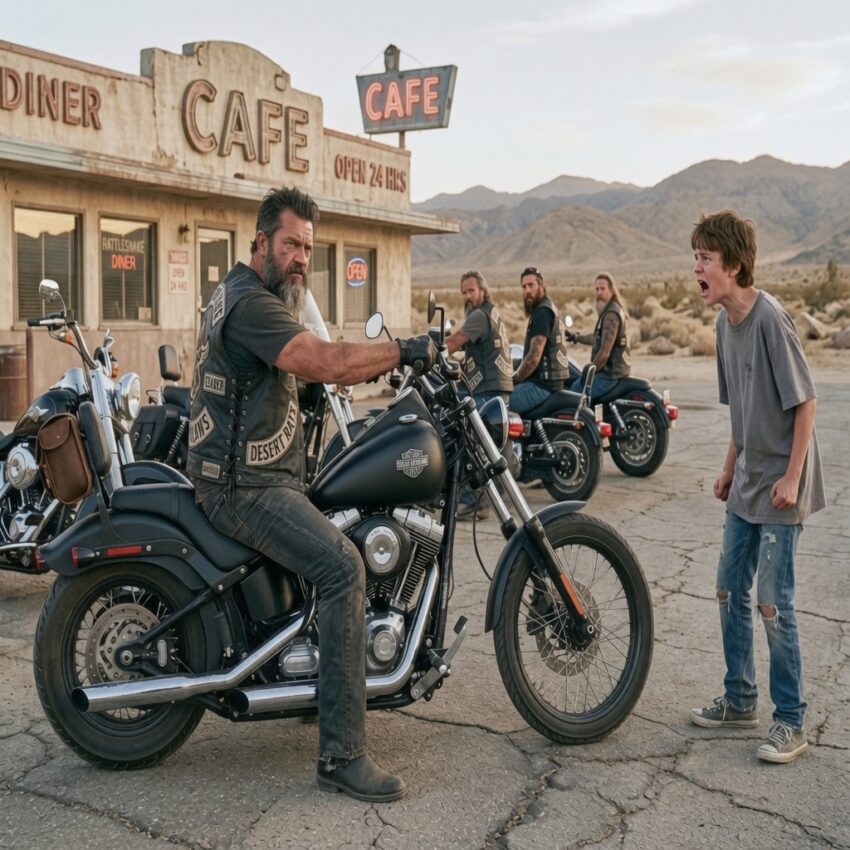
Sweat dripped onto chrome. Nine men in leather, nursing hangovers and bad moods, threw their legs over nine custom engines. Thumbs hovered over ignitions.
Then a squeaky voice sliced through the Mojave silence.
“Don’t.”
If they had turned those keys, what was hidden inside would have haunted them forever.
Heat radiated off the cracked asphalt of the diner parking lot like an open oven door, baking the smell of stale beer and cheap tobacco straight into Silas’s pores. His head throbbed. A heavy, rhythmic pounding sat directly behind his eyes. A souvenir from a three-day bender in Reno that had ended with busted knuckles and an empty wallet.
He spat a thick wad of phlegm onto the yellow parking line, watching the saliva instantly sizzle and evaporate against the scorching pavement. Around him, the rest of the club moved with the sluggish, irritable grace of men who had slept too little and drank too much.
Lenny was grumbling about the burnt coffee they’d just been served, his voice a low, gravelly drone that grated against Silas’s nerves. Ford was silent as usual, his massive shoulders hunched beneath a faded leather cut that smelled of old sweat and road grime.
They were not good men, and they didn’t pretend to be. They were tired, they were broke, and they had 300 miles of desert to cross before nightfall.
Silas stopped beside his bike. The custom chopper was a monstrous assembly of polished chrome and matte black steel. Normally the sight of it grounded him, but today it was just another heavy thing he had to manage. The metal ticked and pinged as it settled under the unforgiving sun.
He ran a calloused, greased thumb over the leather of his seat, feeling the blistering heat radiating from the material. With a low groan that he tried to swallow, Silas swung his heavy boot over the saddle. His left knee popped—a sharp, sickening crack that made him wince. He settled his weight, the stiff leather of his jeans biting into his thighs.
Down the line, the other eight men did the same. Boots scraped against gravel. Zippers clinked. The heavy metallic slaps of kickstands snapping upward echoed like gunshots in the dead, dry air.
Silas reached down, his thick fingers gripping the cold brass of his ignition key. He didn’t want to ride. He wanted a dark room, a cold rag, and silence, but the road didn’t care. He exhaled a long, ragged breath, tasting the copper tang of dehydration in his own mouth. He pushed the key in. His thumb drifted toward the starter switch.
“Don’t.”
The voice was thin, squeaky. It cracked sharply, severing the heavy, masculine silence of the parking lot.
Silas froze. He didn’t jump. Men in his line of work learned early that flinching could get you killed. Instead, his muscles coiled tight, his thumb freezing an eighth of an inch from the starter button. His right hand dropped, moving with instinctual, terrifying speed toward the heavy iron tucked into the waistband of his jeans.
He turned his head slowly, the leather of his collar scraping against the thick stubble on his neck.
Standing 10 feet away, trembling violently, was a boy. He couldn’t have been older than eight. He was painfully scrawny, his collarbones jutting out against the fabric of a faded, oversized t-shirt that hung off his narrow frame like a dirty curtain. His jeans were frayed at the hems, dragging in the dust, and one of his sneakers was missing a lace, the tongue flopping open like a dead dog’s mouth.
Dirt was streaked across his face, mixed with dried snot and fresh sweat. Silas stared at him. The sheer audacity of it irritated him. Kids usually ran from the club. Mothers pulled their children to the other side of the street, shielding their eyes from the patches on their backs.
“Beat it, kid!” Lenny snarled from two bikes down. The sound was harsh, vicious. “Before you get tire tracks on that ugly shirt.”
The boy flinched, his bony shoulders jerking upward, but he didn’t retreat. His small fists clenched at his sides. His knuckles were white. He was terrified, chest heaving so hard Silas could see his ribs expanding against the thin cotton of his shirt. Yet his feet remained planted in the hot dust.
“I said, ‘Don’t start it,’” the boy repeated. His voice shook worse this time, the bravado completely draining away, leaving only a raw, desperate panic. “Please, you can’t.”
Silas’s annoyance flared into genuine anger. His head was pounding. The sun was burning the back of his neck. He didn’t have the patience to deal with a stray kid playing chicken in a diner parking lot. He uncurled his hand from his waistband, resting it heavily on his thigh instead.
“Give me one good reason, half-pint,” Silas rasped, his voice low and devoid of warmth. “Before I step off this bike and teach you why you don’t interrupt grown men.”
The boy swallowed hard. His throat bobbed. He didn’t look at Silas’s face. He wasn’t looking at Lenny or Ford. His wide, bloodshot eyes were fixed dead on the rear wheel of Silas’s chopper.
“She put it in there,” the boy whispered, pointing a trembling, dirt-caked finger toward the heavy studded leather saddlebags draped over the rear fender of Silas’s bike. “She was crying real hard. She ran out of the rusty truck by the dumpster. She shoved something in your bag. The bag above the hot pipes. Then she ran away.”
Ford laughed, a harsh barking sound. “Kids hallucinating from the heat. Turn the key, Silas. Let’s go.”
But Silas didn’t turn the key. He stared at the tight space between his left saddlebag and the dual exhaust pipes. The pipes that, upon ignition, would reach 300 degrees in a matter of seconds. The gap was shadowed, narrow.
A heavy, unsettling dread began to pool in the pit of Silas’s stomach. It was a cold sensation, entirely at odds with the suffocating desert heat. He looked at the boy again. The kid wasn’t lying. A liar’s eyes dart. The boy’s eyes were locked on the saddlebag as if it were a live grenade.
Silas killed the ignition and slowly pulled the key free. He swung his leg back over the seat, his boots hitting the asphalt with a heavy, deliberate thud. The sound made the boy flinch again, taking a tiny half-step backward, but he still didn’t run.
“Silas! Come on, man!” Lenny complained, wiping a greasy forearm across his sweating forehead. “We ain’t got time for campfire stories. It’s just a trash rat making up lies.”
“Shut up, Lenny,” Silas said softly. He didn’t raise his voice, but the absolute flat deadness of his tone made Lenny snap his mouth shut.
The silence in the parking lot suddenly felt heavier. The ambient noise of a distant highway drone fading into the background. Silas walked toward the rear of his bike. The air coming off the pavement was shimmering, distorting the lines of his custom fenders. He crouched down.
His bad knee protested with a sharp, stabbing pain, but he ignored it. The asphalt burned right through the knees of his denim jeans. He peered into the shadow between the thick studded leather of the saddlebag and the gleaming chrome of the exhaust pipe. At first, he saw nothing but grease and dust. Then, as his eyes adjusted to the contrast between the blinding sun and the dark recess, he saw it.
It was a bag—not his. It was a small, faded green canvas tote, the kind you get for free at a cheap grocery store. It was shoved violently into the gap, wedged so tightly against the metal frame that the canvas was already stretching. The bottom of the tote was resting directly against the exhaust pipe.
Silas’s breath hitched. A cold sweat broke out across his shoulder blades, prickling beneath his heavy leather cut. If he had started the bike, the exhaust would have heated up instantly. Within a minute, that thin canvas would have scorched, melted, and caught fire. Whatever was inside would have been subjected to deafening, vibrating noise and lethal, blistering heat.
“Watch the perimeter,” Silas murmured to Ford without looking back. He heard the creak of Ford’s leather as the big man shifted, suddenly alert. The club’s paranoia was instinctual. If a rival charter or a desperate junkie had planted a pipe bomb or a stash of fentanyl in his rig, they needed to be ready for an ambush.
Silas reached a hand into the tight gap. His knuckles scraped against the sharp edge of a zip tie holding a brake line. He ignored the sting. His thick fingers closed around the handle of the canvas tote. The fabric was coarse, frayed, and smelled faintly of sour milk and old pennies.
He pulled. It was stuck. He gritted his teeth and tugged harder, feeling the canvas tear slightly against a bolt head. With a sudden jerk, the bag came free, nearly sending Silas tumbling backward onto the hot pavement. He caught himself, balancing on his heels, the green bag resting heavily in his hands.
It wasn’t light. It had mass—a shifting, unsettling mass.
“What is it?” Lenny asked, his voice entirely stripped of its earlier bravado. Boon could hear boots crunching on gravel as the rest of the club slowly dismounted, forming a tight, silent semicircle behind him.
Silas didn’t answer. He couldn’t. His throat had suddenly gone bone dry. He set the bag on the sunbaked asphalt. The zipper was cheap nylon, half-busted and stuck. Silas dug his thumb under the metal clasp and forced it open. The teeth ripped apart with a harsh synthetic tear that sounded far too loud in the quiet lot. Silas pulled the sides of the canvas apart.
For three agonizing seconds, his brain refused to process the visual information. It tried to categorize it as laundry, a bundled-up jacket, a discarded doll. It was a towel—a dingy, threadbare motel towel with faded blue stripes, stained with patches of dark, rust-colored blood.
And the towel was breathing.
Silas’s large, scarred hands began to shake. He reached down, his fingers clumsy and numb, and gently peeled back the edge of the stiff, stained terry cloth. A face appeared. It was tiny, unfathomably small. The skin was mottled, a chaotic mix of angry purple and deep crimson, covered in a thin layer of milky white fluid and drying blood. The baby’s eyes were sealed shut, swollen and bruised. Its little chest rose and fell in shallow, jerky, terrifyingly silent staccato rhythms.
There was no crying. There was just a weak, pathetic wheeze escaping from parted, blue-tinged lips.
The child had been roasting inside the canvas bag, deprived of air, baking in the suffocating desert heat, even before the engine had a chance to start. Silas stared at it. A massive, suffocating wave of nausea crashed over him so violently he had to swallow back bile.
He looked at his hands—hands that had broken jaws, hands that had wielded iron and steel with brutal efficiency. Hands that 60 seconds ago were fully prepared to turn a key and flood this exhaust pipe with explosive fire.
If the boy hadn’t screamed, if Silas had dismissed him as a pest, he would have ridden down the highway. He wouldn’t have heard the muffled screams over the roar of a 103 cubic inch V-twin engine. He wouldn’t have smelled burning fabric over the scent of gasoline. He would have ridden for hours, ignorant of the atrocity taking place inches from his boot.
“Sweet, merciful Jesus,” Ford whispered from above him. The giant man took a staggering step backward, his heavy boot scuffing the dirt. Lenny let out a strangled gasp, ripping his aviator sunglasses off his face as if they were blinding him.
Silas didn’t look at them. He reached into the bag, slipping his massive hands beneath the tiny, fragile bundle. The baby weighed nothing. It felt like holding a handful of dry leaves. He lifted the infant out of the stifling canvas, cradling it against his chest, right over the heavy leather and the terrifying patches of his cut.
The baby felt unnaturally hot. Too hot. The skin was burning up. Silas looked up, finding the scrawny boy still standing there, tears streaming down his dirty face, his jaw trembling.
“You saved…” Silas started to say, but his voice broke. A sharp, jagged lump formed in his throat, choking off the words. The cynical, violent biker vanished, entirely eclipsed by the raw, primal terror of holding a life so desperately close to the edge of death.
“Water!” Silas roared, his voice suddenly exploding across the parking lot, startling a flock of crows off the diner roof. He didn’t sound angry; he sounded panicked. “Get me water. Get a wet rag. Call a goddamn ambulance right now.”
The parking lot erupted into chaos. Heavy boots sprinted toward the diner doors. Curses filled the air, not out of anger, but out of absolute, unadulterated fear. Nine rough men who feared no gang, no law, and no man were entirely brought to their knees by a silent bundle of bloody terry cloth.
Silas dropped to his knees. The impact sent a jolt of fire up his bad leg, but the pain barely registered. He kept his elbows tucked tight against his ribs, shielding the tiny, roasting infant from the brutal glare of the sun. The baby felt less like a human being and more like a dying ember plucked straight from a fire.
“Don’t crowd him,” Silas barked, his voice cracking. “Give him air.”
The other eight men instantly staggered back, forming a wide, defensive perimeter. It was a surreal sight. Nine heavily tattooed outlaws, men with rap sheets as long as their arms, acting as a makeshift barricade against the indifferent Mojave Desert.
The diner door banged open. Ford emerged, moving with terrifying speed for a man pushing 300 pounds. He held a plastic pitcher sloshing with water and a stack of brown paper napkins. Behind him, the diner’s line cook, a greasy teenager with terrified eyes, hovered in the doorway, holding a phone to his ear.
“Ambulance is 20 minutes out,” the kid yelled, his voice squeaking. “Dispatch says don’t use ice. Room temperature water. Cool him down slow.”
“Give it here,” Silas ordered, snatching the pitcher from Ford’s massive hands.
His hands, usually so steady, betrayed him. The water sloshed over the rim, splashing onto the hot asphalt where it hissed and vanished. Silas soaked a wad of napkins and gently squeezed them over the baby’s mottled purple chest. The infant didn’t react. The shallow, jerky wheezing continued, a terrible mechanical sound that belonged nowhere near a child.
“Come on,” Silas whispered. It wasn’t a prayer. Silas didn’t believe in God. It was a threat. “Breathe, you tough little bastard. Breathe.”
He wiped the wet paper across the infant’s sticky forehead, washing away a thick layer of dried blood and vernix. The baby’s skin was frighteningly translucent, the delicate blue veins pulsing frantically beneath the surface. With every drop of water that landed on its lips, the tiny mouth would twitch, instinctively searching for moisture it couldn’t swallow.
Lenny, pacing frantically behind Silas, pulled off his heavy leather cut. The silver zippers and heavy brass buckles clattered against the pavement. He threw the thick vest over the handlebars of Silas’s bike, using it to cast a long, dark shadow over the space where Silas knelt.
“Who does this?” Lenny muttered, his hands violently running through his thinning, greasy hair. “Who takes a newborn and shoves it in a saddlebag over straight pipes? I’ll kill him. I swear to Christ, I’ll find him and peel him.”
“Shut up and watch the road,” Ford rumbled. His eyes were scanning the empty highway, his hand resting casually on his hip, an inch from a concealed blade.
Silas ignored them. His entire universe had shrunk to the eight inches of terry cloth in his hands. He continued to dab the tepid water over the infant’s skin. Slowly, agonizingly, the terrifying purple hue began to fade into a raw, angry red. The baby’s chest heaved slightly deeper. A tiny, claw-like hand twitched, the fingers curling around a thread of the bloodstained towel.
A soft scrape of rubber on gravel made Silas look up. The scrawny boy was still there. He had edged closer, his dirty sneakers stopping just short of the wet patch of asphalt where Silas knelt. The kid was gnawing nervously on his thumbnail, his eyes glued to the baby.
“You did good, kid,” Silas said. His voice was raspy, completely stripped of the menace it had held 10 minutes ago.
The boy didn’t smile. He swallowed hard. “She was crying,” he repeated softly. “The lady—she was bleeding out of her nose, and her shirt was ripped.”
Silas’s eyes narrowed, but he kept his hands moving, soaking fresh napkins. “What lady, son? What did she look like?”
“Blonde,” the boy said, his voice a frail whisper. “She had a blue dress. It was dirty. She parked that rusty truck by the dumpsters. She ran out, shoved the green bag in your motorcycle, and then another car came.”
Silas paused. A cold shiver cascaded down his spine. “Another car? A black one?”
The boy nodded, his eyes wide and haunted. “Big windows, dark. A man got out. He grabbed her by the hair. She was screaming, but not loud. He threw her in the back seat, and they drove away fast towards the city.”
Ford stepped closer, his heavy shadow falling over the boy. “When was this?”
“Right before you came out of the diner,” the boy said, shrinking back slightly from Ford’s massive bulk. “I was looking for cans in the trash. I saw it. I wanted to tell her she dropped her bag, but then the man grabbed her.”
Silas looked down at the tiny, fragile life in his hands. This wasn’t an abandonment. It was a desperate, panicked act of preservation. The woman knew she was being taken. She knew the infant wouldn’t survive whoever was chasing her. She had seen a row of heavy, intimidating motorcycles and made a split-second, impossible choice. She gave her child to monsters, hoping they were better than the monster hunting her.
A distant wail pierced the heavy desert air. Sirens.
Within minutes, an ambulance tore into the parking lot, its tires screaming against the asphalt. Two paramedics bolted from the back before the rig even came to a full stop.
Silas didn’t want to let go. As the paramedic, a no-nonsense woman with sharp eyes, reached down to take the bundle, Silas’s calloused fingers tightened around the bloody towel. For a brief, irrational second, every instinct in his body screamed at him to pull the child back, to protect it himself.
“I’ve got him, sir,” the paramedic said firmly, her tone leaving no room for argument.
Silas slowly uncurled his fingers. The absence of the baby’s slight weight left a strange, hollow ache in his chest. He watched, numb and silent, as they loaded the infant into the bright, sterile box of the ambulance, hooked up tiny tubes, and sped away, the sirens fading back into the desolate desert silence.
The local police arrived shortly after the ambulance. Four cruisers boxed in the line of choppers, their light bars flashing a harsh, strobing rhythm against the sunbaked diner walls. For the next two hours, the nine men of the charter stood in the suffocating heat, enduring questions they despised answering. The cops were deeply suspicious. Bikers with a bloody newborn found in a saddlebag wasn’t a standard Tuesday call.
They checked IDs. They ran plates. They patted down Lenny twice, finding nothing but an oversized pocket knife.
Silas sat on the curb, staring blankly at the wet patch of asphalt where he had knelt. He gave his statement in short, clipped sentences. He didn’t mention the black car. He didn’t mention the blonde woman. When the cops pressed him, he simply pointed to the scrawny boy who was now sitting safely on the tailgate of a cruiser, eating a melted candy bar a deputy had given him.
“Kid saw it,” Silas grunted, staring straight through a sweaty sheriff’s deputy. “Ask him. I just found the bag.”
He didn’t trust the police. It wasn’t just criminal paranoia. It was a bone-deep certainty that the law was slow, clumsy, and often corrupt. If this black car had snatched a woman off a public lot in broad daylight, there were locals involved—people who knew the blind spots.
Eventually, the cops ran out of questions. The plates were clean. The bikes were legal. The boy’s story matched the bare bones of Silas’s account. With a final stern warning to stay in the state for the next 48 hours, the sheriff waved them off. The cruisers pulled away, leaving the club alone in the parking lot once again.
The late afternoon sun was beginning to dip, casting long, bruised shadows across the pavement.
“We need to ride, Silas,” Lenny said quietly, breaking the heavy silence. “We’re exposed here. It’s getting dark.”
Silas didn’t move. He reached into his pocket and pulled out a cigarette, lighting it with a cupped hand. He took a deep, dragging pull, letting the acrid smoke fill his lungs.
“Ford,” Silas called out, his voice rough.
The giant man stepped forward. “Yeah, brother.”
“Where’s the bag?”
Ford frowned. “Cops took it, logged it as evidence.”
“I know they took the towel,” Silas said, his eyes narrowing through the smoke. “I asked about the bag—the green canvas.”
Ford’s expression shifted. He glanced over his shoulder toward his own bike. Without a word, he walked over, opened his heavy leather saddlebag, and pulled out the crumpled, torn green grocery tote.
“Slipped it under my jacket when they were talking to Lenny,” Ford rumbled, tossing it onto the hood of a rusted-out truck parked near the edge of the lot. “Figured the cops didn’t need our trash.”
Silas stood up, his bad knee protesting with a dull, throbbing ache. He walked over to the truck and stared at the cheap canvas. It was stained with a mixture of grease from his exhaust pipe and dark, dried blood.
“Dump it out,” Silas ordered.
Lenny stepped up, pulling a switchblade from his pocket. He didn’t bother unzipping the busted nylon. He just drove the blade into the fabric and sliced it open from top to bottom. A few items tumbled out onto the rusted metal hood: a half-empty pack of diapers, a cheap plastic pacifier, a tube of diaper rash cream.
“Just baby junk,” Lenny muttered, disappointed.
Silas reached out. His thick fingers sifted through the items. He picked up the pacifier, staring at the cheap plastic. Then he noticed something else. The bottom of the canvas tote was unusually thick. The material was stiff, layered. He took Lenny’s knife. With a quick, precise motion, Silas slit the interior lining of the bag.
A heavy rectangular object slid out, hitting the metal hood with a solid thud. It was a thick, leather-bound notebook. It looked old, the edges frayed and heavily taped. Tucked under the elastic band holding it closed was a single glossy photograph.
Silas pulled the photograph free. The rest of the club crowded in close, peering over his broad shoulders.
It was a picture of a man and a woman. The woman was the blonde the boy had described. Even in the photo, she looked terrified—her smile forced, a faint yellow bruise visible beneath heavy makeup on her jawline. The man standing next to her had his arm wrapped tightly, almost violently, around her waist. He was smiling warmly for the camera. He wore a crisp tailored suit.
“You got to be kidding me,” Ford whispered, his voice suddenly dropping an octave.
Silas felt the blood drain from his face, his stomach twisting into a cold, hard knot. He didn’t just recognize the man in the photo. Every single biker in the state recognized him.
It was the district attorney of the neighboring county, a man currently running a vicious, highly publicized “tough on crime” campaign targeting organized motorcycle clubs—a man who had just sentenced three of Silas’s brothers to 20 years in federal prison.
Silas slipped the knife under the elastic band of the notebook and popped it open. The pages weren’t filled with journal entries. They were filled with numbers, bank accounts, dates, names of judges, names of cartel drop-offs. It was a complete handwritten ledger of bribes, extortion, and trafficking. And tucked in the margins, written in frantic, shaky handwriting, was a note: *If anything happens to me, he took us. He will kill the baby. He can’t let anyone know it’s his.*
Silas closed the book. The silence among the nine men was deafening. The wind howled softly across the asphalt, kicking up a fine spray of sand. They weren’t just holding evidence. They were holding a death warrant.
Silas looked at his men. They were tired, broke, and angry. They just wanted to go home. But as Silas looked down at the blood staining his hands—the blood of a child born into a war—the fatigue vanished. The cynical biker faded away, replaced by something much older and infinitely more dangerous.
“Lenny,” Silas said softly. The absolute calm in his voice made the hair on the back of Lenny’s neck stand up.
“Yeah, Silas.”
“Gas up the bikes.”
Silas slipped the ledger inside his heavy leather cut, pressing it flat against his chest. He looked out toward the highway, toward the city where a black car had disappeared.
“We aren’t going home.”
The Mojave Desert does not cool down gracefully. When the sun drops behind the jagged horizon, the heat simply falls away, replaced instantly by a biting, hollow chill. Silas felt the temperature plunge as they tore down the two-lane blacktop. The cold cut right through his denim, settling into the metal plates in his bad knee, turning the joint into a throbbing anchor of pain. He ignored it.
He leaned forward, burying his face behind the small wind deflector, letting the deafening roar of the 103 cubic-inch V-twin engine vibrate straight through his chest cavity. Nine heavy choppers rode in a staggered diamond formation. They were a single mechanical beast tearing through the dark, their high beams cutting jagged cones of yellow light out of the absolute black. The air smelled of sagebrush, raw gasoline, and hot oil.
There was no conversation. They didn’t use headsets or hand signals. They just rode, fueled by a collective, unspoken rage.
An hour outside the city limits, the landscape shifted. The scrub brush gave way to irrigated soil and tall wrought-iron fences. Silas downshifted, the exhaust popping like distant gunfire, and the pack slowed.
They found the property at the end of a long, unlit private road. It was an extravagant, isolated estate, surrounded by a 10-foot security wall, and parked on the crushed limestone driveway, barely illuminated by the pale moonlight, was a heavy black sedan with tinted windows.
Silas cut his engine. The other eight followed instantly. The sudden silence was heavy, ringing in their ears. Silas swung his leg over the saddle, biting the inside of his cheek to keep from grunting as his knee gave a sharp, grinding protest. He reached into his saddlebag and pulled out a heavy steel tire iron.
Ford joined him, wordlessly, sliding a pair of industrial bolt cutters from his tool roll. The air here smelled different—wet grass and expensive mulch. It made Silas’s stomach turn.
They approached the heavy security gate on foot. A chain held the two iron halves together. Ford stepped up, hooked the massive jaws of the cutters over the hardened steel padlock, and threw his entire 300-pound weight onto the handles. The metal shrieked, then snapped with a sound like a dry bone breaking.
The gate swung inward. The gravel crunched under nine pairs of heavy boots. They didn’t try to hide. They weren’t ghosts. They were a storm.
A man in a tactical jacket stepped out from the shadows of the front porch, a heavy flashlight in one hand and his other reaching for his hip. “Hey, stop right—”
Lenny didn’t break stride. He closed the gap in three violently fast steps, swinging a leather sap in a short, brutal arc. The heavy lead weight caught the guard on the jawline. The impact sounded like a wet melon hitting concrete. The guard crumpled instantly, his flashlight rolling uselessly into the manicured flower beds.
Ford kicked the front door. He didn’t aim for the lock. He aimed for the wood frame. His heavy boot shattered the mahogany near the hinges. A second kick sent the door violently inward, the brass deadbolt tearing completely out of the frame.
The interior of the house was aggressively sterile, smelling of lemon polish and expensive air conditioning. Silas led the way down the wide hallway, the tire iron hanging loose in his right hand.
They found him in the study. The district attorney was standing behind a heavy oak desk, a crystal glass of amber bourbon halfway to his mouth. His suit jacket was off, his tie loosened. He froze, his eyes widening in pure shock as nine filthy, leather-clad men filed into his pristine sanctuary.
In the corner of the room, strapped to a heavy wooden chair with zip ties, was the blonde woman. Her dress was torn at the shoulder. A fresh dark bruise bloomed across her cheekbone, and her lip was split—a thin line of drying blood trickling down her chin. She flinched violently when the door gave way, squeezing her eyes shut as if expecting a bullet.
“What is the meaning of this?” the DA stammered, his voice cracking. He tried to puff out his chest, attempting to summon the authority he wielded in the courtroom. “Do you have any idea who I am? I’ll have every single one of you rotting in Pelican Bay.”
Silas didn’t let him finish. He closed the distance, grabbed the front of the DA’s expensive dress shirt, and drove his skull forward. Silas’s forehead smashed into the bridge of the DA’s nose. Bone crunched. Blood instantly exploded from the man’s nostrils, spraying across Silas’s leather cut.
The DA shrieked—a high, pathetic sound—and collapsed backward, knocking his crystal glass onto the hardwood floor where it shattered. The man scrambled against the floorboards, clutching his ruined face, sobbing and spitting blood. The facade of the powerful, untouchable politician vanished in a fraction of a second, leaving behind nothing but a terrified, weak animal.
Silas stood over him, breathing heavily. He tasted copper in his own mouth. He reached into his cut, pulled out the thick taped ledger, and dropped it heavily onto the DA’s chest.
“Federal marshals are on their way to your office right now,” Silas lied, his voice a low, gravelly rasp. “And a copy of those pages is going to the cartel guys you ripped off. You’re done.”
The DA stared at the ledger through a mask of his own blood, his eyes widening in absolute, horrifying realization. He knew the bikers wouldn’t kill him. They didn’t have to.
Silas turned away, the anger draining out of him, replaced by a deep, hollow exhaustion. He walked over to the corner of the room and dropped to one knee beside the woman. She was hyperventilating, her chest heaving against the tight plastic restraints. She smelled of stale sweat and sheer terror.
Silas pulled a switchblade from his pocket. The woman whimpered, pulling her head away.
“Easy,” Silas whispered, his voice impossibly gentle. “Hold still.”
He slid the blade under the thick plastic bands, twisting his wrist to snap them without nicking her pale skin. Her arms fell uselessly to her sides. She didn’t try to run. She just slumped forward, shivering uncontrollably.
“My baby,” she choked out, a ragged, broken sob tearing its way out of her throat. “He was going to kill my baby. I didn’t know what to do.”
Silas reached out. His large, heavily calloused hand, stained with grease and fresh blood, hesitated before resting softly on her trembling shoulder.
“He’s alive,” Silas said.
The woman froze. She slowly raised her head, her swollen, bruised eyes locking onto Silas’s.
“Paramedics got him,” Silas continued, his voice steady and grounding. “He was breathing. He’s at the county hospital.”
For a second, the woman just stared. Then the realization hit her, breaking through the shock. A guttural, agonizing wail of pure relief ripped from her chest. She slumped forward, burying her face into Silas’s heavy leather vest, her hands grasping desperately at his lapels.
She wept. It wasn’t a pretty, cinematic cry. It was messy, loud, and choked with mucus and tears. Silas didn’t pull away. He let her hold on, feeling the damp heat of her tears seeping through the heavy cowhide. He looked over her shoulder at Ford and Lenny.
“Get her to the hospital,” Silas ordered softly. “Stay out of sight. Just drop her at the doors.”
Ford nodded, moving forward to gently help the woman to her feet. Silas stood up, his knee screaming in protest. He didn’t look at the DA again. The man was still curled on the floor, bleeding onto his expensive rug, waiting for a storm he couldn’t stop.
Silas walked out of the house, stepping over the shattered front door and back out into the freezing Mojave night. He swung his leg over his bike, turning the brass ignition key. He hit the starter switch. The massive engine roared to life, shaking the frame loud enough to drown out the world. Silas pulled the clutch, kicked it into gear, and rode out into the dark.