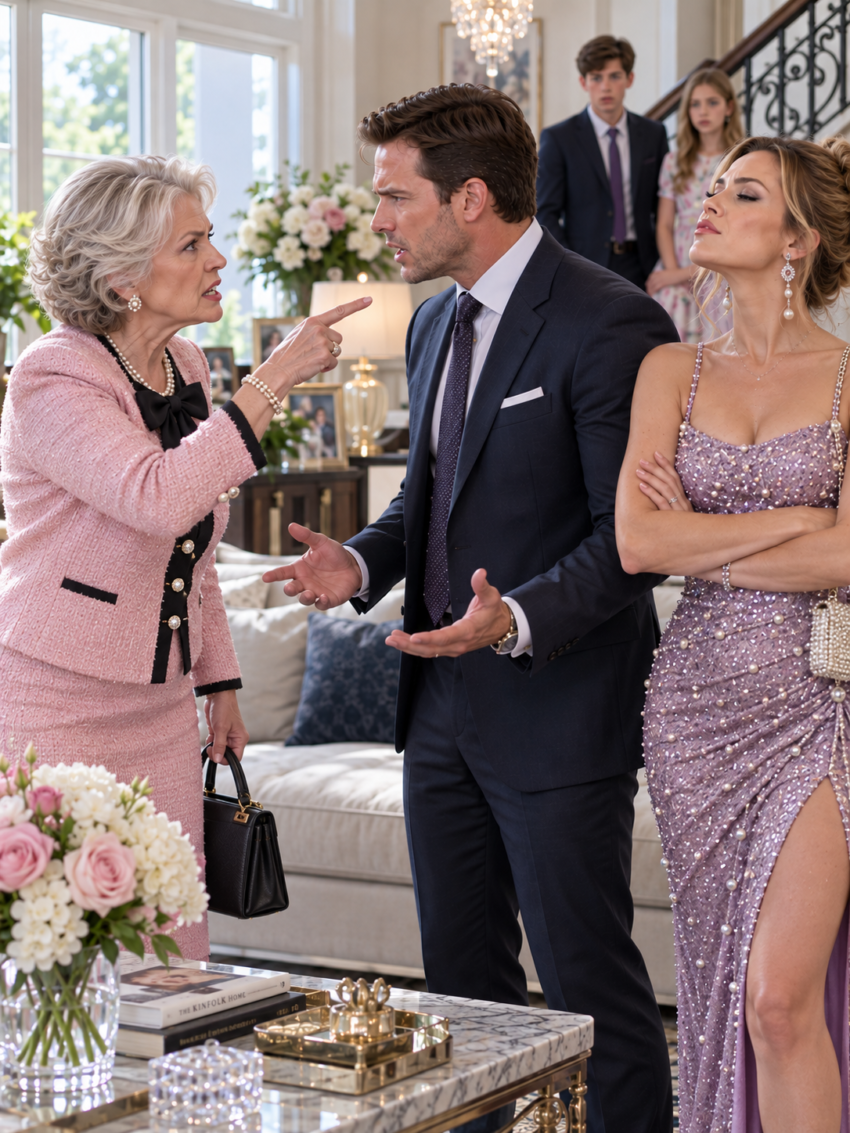
“You can’t sell this place. Dad left it to me.”
My son said it while standing beside the dining table where his father used to do the Sunday crossword.
I was holding the real estate agent’s folder in one hand. Ryan was staring at the FOR SALE paperwork as if I had been caught signing away something that belonged to him.
“Your father left the apartment to me,” I said.
Ryan’s wife, Megan, shifted her purse higher onto her shoulder.
“Linda, nobody’s saying it isn’t technically yours.”
Technically.
That word stayed with me.
Ryan walked to the window overlooking the tree-lined street below. He was forty-one years old, but from behind, with one hand shoved into his pocket, he looked enough like Daniel that I had to look away.
“What are you supposed to do in Asheville by yourself?” he asked.
“Live there.”
“You’re sixty-seven.”
“I’m aware.”
He turned around. “You have family here.”
“And I’ll still have family after I move.”
Megan gave Ryan a look that I recognized. Married couples develop private signals over time. Daniel and I had plenty of them.
This one meant: Don’t lose your temper.
Ryan ignored it.
“Dad wanted this apartment kept in the family.”
I put the folder down.
“Did he tell you that?”
Ryan hesitated.
Only for a second.
“Of course he did.”
That was the first thing that bothered me.
The second came about five minutes later.
Daniel had been dead for three years. We’d lived in that apartment outside Philadelphia for twenty-eight years, and after he died, I kept almost everything exactly where he’d left it. His coffee mug stayed in the cabinet. His old leather slippers remained beneath the bed until the soles began cracking from age.
But three years was enough.
I didn’t want to spend the rest of my life maintaining a museum.
I’d found a small house outside Asheville with a screened porch, two bedrooms and enough backyard for tomatoes. I’d already spoken to an agent.
I expected Ryan to be surprised.
I didn’t expect him to behave as though I’d sold his house.
“What happens to the money?” he asked.
There it was.
I looked at him.
“What money?”
“From the sale.”
“It becomes my money.”
Megan stared at the floor.
Ryan rubbed his jaw.
“Mom, come on. You know what I mean. Between this place and everything Dad left, we’re talking about millions.”
The room became very quiet.
I hadn’t told Ryan that.
Daniel hadn’t discussed the full value of our estate with our children either. We’d been comfortable, certainly, but Daniel had been private about money.
I folded my hands over the real estate folder.
“How many millions?”
Ryan’s face changed.
“What?”
“You said millions. How much do you think your father left?”
“I don’t know. It was just a figure of speech.”
“Millions isn’t a figure of speech.”
Megan stepped forward. “Maybe everybody should cool down.”
I kept looking at my son.
“Where did you get that number?”
Ryan picked up his jacket from the chair.
“This is ridiculous.”
“Then answer me.”
He didn’t.
He left.
And that evening, before I packed a single box for Asheville, I called the attorney who had prepared my will.
The Will I Changed Before I Packed a Box
Her name was Susan Bell, and she had handled Daniel’s estate after his death.
I met her the next morning.
“Are you sure?” she asked after I explained what I wanted.
“Yes.”
Until then, my will had been simple. Ryan received most of what remained after my death. There were smaller gifts to Noah and Sophie, his children, but eventually almost everything would have passed to him.
I changed that.
A substantial portion would now go into trusts for Noah and Sophie, with distributions controlled until they were older.
Ryan would still receive something.
But he would no longer be able to look around my home and quietly calculate when it might become his.
Susan took off her glasses.
“Did something happen?”
“He called my home his inheritance.”
She waited.
I added, “And he knows something about Daniel’s finances that I never told him.”
That afternoon, Ryan called four times.
I didn’t answer.
At six, my granddaughter Sophie called.
She was fourteen and usually contacted me when she needed help with a school project or wanted the banana bread recipe Daniel used to make.
“Grandma, is Dad mad at you?”
“He’ll get over it.”
She was quiet.
Then she said, “Is it because you’re selling Grandpa’s apartment?”
I looked around the living room.
“It’s my apartment too, sweetheart.”
“I know. Dad just always said Grandpa promised it to him.”
I stopped folding the sweater in my lap.
“When did he say that?”
“A lot.”
“Did Grandpa ever say it in front of you?”
“No.”
Sophie lowered her voice.
“Dad said Grandpa told him privately because you wouldn’t understand.”
After we hung up, I went into Daniel’s old office.
I had barely touched it in three years.
His desk still contained yellow legal pads, dried-out pens and receipts for things we no longer owned. I spent nearly two hours opening drawers and sorting folders.
Then I remembered something Daniel had said during his final month.
He’d been weak by then, sleeping downstairs because climbing steps exhausted him.
One afternoon, he pointed toward his office.
“There’s an envelope behind the bottom drawer.”
I’d thought he meant insurance paperwork.
“For what?”
He’d closed his eyes.
“Probably nothing. But if Ryan ever tells you I promised him the apartment, find it.”
At the time, I’d almost laughed.
Ryan and Daniel had been close.
Why would our son lie about something like that?
Now I removed the bottom drawer.
Behind it was a yellow envelope.
My name was written across the front.
LINDA.
Inside were seven pages.
The first sentence was short.
If you’re reading this because Ryan says I promised him the apartment, I didn’t.
I sat on the carpet.
Daniel explained that, about eight months before he died, Ryan had come to him asking for $400,000.
An investment had gone bad.
Daniel refused.
Ryan came back with another proposal: use our apartment as collateral so he could borrow against it.
Daniel refused again.
Then came the part that made me reread the page.
Ryan had produced preliminary loan documents carrying Daniel’s signature.
Except Daniel hadn’t signed them.
My husband had confronted him.
Ryan claimed it had been a misunderstanding and that the papers were never formally submitted. Daniel didn’t report him because Ryan was his son and because, as he wrote, I was dying, Linda. I didn’t have the strength to spend whatever time I had left fighting our child.
Behind the letter was a photocopy of the document.
I recognized Daniel’s signature immediately.
It was almost perfect.
Almost.
Daniel always connected the D in his first name to the a.
Whoever had copied it hadn’t known that.
I sat on the office floor until the light outside the window disappeared.
Then I photographed every page and sent the copies to Susan.
For the first time since deciding to move, I wasn’t thinking about Asheville.
I was wondering what else my son believed belonged to him.
Daniel Had Left Me One More Door to Open
Susan called the following morning.
“Don’t confront Ryan yet.”
“Why?”
“Because there’s something else.”
Daniel’s old records showed that our apartment had once been connected to a family holding company Daniel had created decades earlier.
I knew the company existed. I thought it was an old bookkeeping arrangement.
It wasn’t.
The company still owned two commercial properties.
Together, they were worth roughly $4.6 million.
That explained Ryan’s use of the word millions.
It did not explain how he knew.
Susan helped me obtain access to Daniel’s safe-deposit box.
Inside were ordinary things first: our marriage certificate, property records, a copy of his will, two old watches and a photograph of Ryan holding his first baseball glove.
Beneath them was another envelope.
This one said:
For Linda, if the properties ever need to be settled.
Inside was a photograph of a woman I’d never seen.
On the back Daniel had written:
Evelyn Marsh, 1976.
There were letters too.
Daniel had loved Evelyn before he met me.
That alone didn’t upset me. Daniel had lived twenty-nine years before our first date. I had never expected those years to be empty.
But Evelyn had become pregnant.
According to the letters, Daniel believed she’d given birth to a son named Thomas.
For years, Evelyn kept Daniel away from him. Eventually Daniel managed to establish limited contact with Thomas as an adult, but the relationship was complicated and distant.
Thomas later had a daughter named Claire.
When Thomas died, Daniel quietly decided that the two commercial properties should eventually benefit Claire.
I read the papers twice.
My husband had apparently spent years believing he had another child.
And he had never told me.
I went home angry.
Not jealous.
Angry.
Thirty-eight years of marriage, and he’d carried something that large alone.
Two days later, someone knocked on my door.
The woman standing there looked about thirty-five. She had brown hair pulled into a loose ponytail and held her phone with both hands.
“Mrs. Parker?”
“Yes?”
“I’m Claire Bennett.”
I didn’t invite her inside immediately.
She noticed.
“I know how this looks. I’m sorry. I wouldn’t have come, except Ryan contacted me again this morning.”
I opened the door.
Claire sat at my kitchen table while I made coffee neither of us drank.
“How do you know Ryan?” I asked.
She unlocked her phone.
“I don’t. Not really.”
She showed me the messages.
Ryan had first contacted her six months after Daniel died.
He knew her full name.
He knew about Thomas.
He knew about the commercial properties.
And he had told Claire that Daniel’s estate had been mishandled.
One message read:
Those properties were built with Parker family money. Whatever Daniel told you, they belong with his actual family.
I looked up.
“Did he ask you to sign anything?”
Claire nodded.
“Twice.”
She had refused.
Then she showed me an email Ryan had sent only three weeks earlier.
He wanted her to acknowledge that she had no legal claim to the properties.
I forwarded everything to Susan.
That evening Ryan came to my apartment.
I opened the door but didn’t step aside.
“Why were you contacting Claire Bennett?”
His face went still.
“Who?”
“Don’t.”
He looked past me into the apartment.
“She contacted you?”
That answer was enough.
I held up Daniel’s photocopied loan document.
Ryan stared at it.
“Where did you get that?”
“Your father kept it.”
He looked away.
“Mom, that was years ago.”
“You forged his signature.”
“Nothing happened.”
“Because he caught it.”
Ryan rubbed both hands over his face.
“I was in trouble.”
“You asked him for four hundred thousand dollars.”
“And he had it.”
I stared at my son.
He seemed to hear himself only after the words were out.
“That’s what this has always been about?” I asked.
“No.”
“Then tell me what it’s about.”
He pointed past me toward the living room.
“Dad spent his whole life building something. Now you’re selling everything, giving money away and running to North Carolina like none of it matters.”
“It matters to you.”
“It should matter to you too.”
I stepped back and closed the door.
Ryan put his palm against it before it shut.
“Mom.”
I looked at his hand.
He slowly removed it.
“Go home, Ryan.”
I closed the door.
That was the first time in his forty-one years that I didn’t follow him afterward and try to make things easier.
The Name in the Adoption File Was My Mother’s
I thought Claire was Daniel’s granddaughter.
So did Claire.
So, apparently, had Daniel.
The truth came from an old packet of documents stored beneath Evelyn’s letters.
Evelyn had lied.
Thomas wasn’t Daniel’s biological son.
At first, that seemed almost crueler. Daniel had spent decades carrying guilt over a child who wasn’t his.
Then I found a copy of a birth record.
Evelyn had given birth to Daniel’s son in 1977.
But that baby had been adopted.
The adoption had been private, and the records Daniel eventually obtained were incomplete.
There was a note listing the adoptive parents.
I read the names.
Then I read them again.
Robert and Helen Parker.
My parents.
I sat there holding the paper while the room seemed to become strangely distant.
My parents had adopted one child.
My younger brother.
Michael.
I was nineteen when they brought him home. I remembered my mother standing in the kitchen with a baby against her shoulder, telling me that he’d had a difficult beginning and needed us to make him feel as if he’d always belonged there.
He did.
Michael grew into a skinny kid with dirty sneakers, a loud laugh and an obsession with motorcycles that terrified our mother.
He died at twenty-seven.
Motorcycle accident.
Daniel had known Michael for years.
Not as his son.
As my little brother.
The realization came in pieces because my mind kept rejecting the whole thing.
Daniel taught Michael how to change brake pads.
Michael helped Daniel rebuild the old Ford in our garage.
When Michael was twenty-three and broke up with his girlfriend, he slept on our couch for almost a month.
Daniel took him fishing.
They watched football together.
They argued about carburetors.
At Michael’s funeral, Daniel stood beside me with one arm around my mother while I could barely remain upright.
Neither of them knew.
I called Susan.
Then Claire.
We eventually confirmed enough of the history to understand what had happened. Evelyn had apparently allowed Daniel to believe Thomas was his while hiding the adoption of Daniel’s actual biological child.
Claire wasn’t Daniel’s biological granddaughter.
Michael had been Daniel’s son.
My brother had also been my husband’s child.
There was no neat emotional category for that.
For several days, I barely packed.
I kept finding photographs.
Michael leaning over Daniel’s car.
Daniel handing Michael a wrench.
Michael asleep in our recliner while Daniel watched television beside him.
I had spent years thinking Daniel had lost the child he once searched for.
He hadn’t.
The boy had somehow walked back into his life.
Neither of them had known what to call it.
But they’d had it anyway.
Ryan Thought the DNA Result Had Solved His Problem
Ryan learned Claire wasn’t biologically related to Daniel before I told him.
I never found out exactly how.
He called me the same afternoon Susan received the final confirmation.
His voice sounded almost cheerful.
“So Claire isn’t Dad’s granddaughter.”
I stood among half-packed moving boxes.
“Correct.”
“Then this whole thing is over.”
“What whole thing?”
He paused.
“The properties.”
“What about them?”
“They stay in the family.”
I sat down.
“Which family?”
“Mom, don’t do this.”
“I’m asking.”
“Dad’s family. Us.”
I looked at the photograph on my coffee table.
Daniel and Michael were standing beside the old Ford, both covered in grease.
“Michael was Daniel’s son.”
Silence.
“Uncle Michael?”
“Yes.”
Ryan didn’t speak for several seconds.
Then he said something I don’t think I’ll ever forget.
“But he’s dead.”
Not How is that possible?
Not Dad had a son?
Not even Did Dad know?
But he’s dead.
I put the photograph facedown.
“Come here tomorrow at eleven.”
Ryan arrived with Megan.
Susan was already sitting at my dining table.
I had asked Claire to come too.
Ryan stopped when he saw her.
“Why is she here?”
“Because you involved her.”
He looked at Megan.
Megan looked confused.
That told me something too.
Ryan hadn’t told his wife everything.
I placed three things on the table: Daniel’s letter, the forged loan document and printouts of Ryan’s messages to Claire.
Ryan remained standing.
“Sit down,” I said.
He did.
Susan explained the financial part simply. The apartment belonged to me. Ryan had no ownership interest in it. The commercial properties were also under my legal control through Daniel’s estate arrangements.
Daniel’s wishes concerning Claire mattered deeply to me, but the newly discovered family history meant there were questions he himself had never been able to understand correctly.
Ryan leaned forward.
“Exactly. So the properties revert to the estate.”
Susan glanced at me.
I answered.
“They aren’t reverting anywhere.”
Ryan’s expression tightened.
I pushed Daniel’s letter toward him.
“Your father knew what you tried to do.”
He didn’t touch it.
“I already explained that.”
“No. You minimized it.”
“I made a mistake.”
“Then you spent three years trying to profit from the fact that he was dead.”
Megan turned toward him.
“Three years?”
Ryan’s jaw tightened.
“Megan, don’t.”
She picked up the printed emails.
“You told me you were dealing with old tax records.”
He reached for them.
She moved them away.
Claire had been silent until then.
“You told me Mrs. Parker was confused and didn’t understand the company.”
Ryan looked at her.
“I was trying to protect my father’s assets.”
“Your father’s?” I asked.
Ryan closed his eyes briefly.
“You know what I mean.”
“I do now.”
I told him I had changed my will.
His face went pale.
I told him Noah and Sophie would be protected directly.
Then I told him what would happen to the commercial properties.
Daniel had believed those buildings should serve a branch of his family he’d failed to protect.
Now I knew the person he’d actually lost had been Michael.
So I created the Michael Parker Foundation.
The properties would fund it.
The foundation would provide scholarships and practical grants to people over fifty-five who were trying to start again after bereavement, divorce, job loss or another major life disruption.
Ryan stared at me.
“You’re giving away millions of dollars?”
“I’m deciding what my property is for.”
“Dad would never agree to this.”
I looked at Daniel’s letter.
“Your father left that decision to me.”
Ryan pushed his chair back.
“What about me?”
It was such a simple question.
For years, it would have worked.
I would have heard the frightened boy underneath it. I would have remembered the fever at age nine, the college tuition bill, the first apartment deposit Daniel and I helped him pay.
I still remembered those things.
I simply didn’t confuse remembering them with owing him everything I owned.
“You’re forty-one years old, Ryan.”
He stared at me.
“You’re my son. I love you. But you are not my retirement plan, my estate plan or the owner of whatever is left when I die.”
Nobody spoke.
Ryan stood and walked out.
Megan stayed seated for another ten seconds before quietly following him.
Claire remained at the table.
She looked at Daniel’s photograph.
“So he wasn’t my grandfather.”
“No.”
She nodded.
Then she touched the edge of the photograph.
“He thought he was.”
“Yes.”
That mattered too.
The Last Box I Opened in Asheville
I sold the apartment six weeks later.
On my final morning there, the rooms sounded different without furniture.
I walked through Daniel’s office one last time.
The bottom drawer was empty.
The yellow envelope was in my suitcase.
Ryan didn’t help me move.
I didn’t ask him to.
Noah and Sophie came over the night before I left. Sophie hugged me so tightly that I had to remind her I wasn’t moving to another planet.
“Can we visit?”
“You’d better.”
“Dad says Asheville is full of hippies.”
I laughed.
“Then I’ll fit right in.”
Three months after I moved, Ryan called.
I was sitting on the screened porch with coffee.
“Mom?”
“Hi.”
His voice was different.
Quieter.
“I’ve been thinking.”
I waited.
“I treated Dad’s money like it was already mine.”
I didn’t rescue him from the silence.
Eventually he continued.
“And I treated yours the same way.”
“Yes.”
“I’m sorry.”
I looked out at the yard.
“I hope you mean that.”
“I do.”
“Good.”
He seemed to expect something else.
Maybe forgiveness.
Maybe reassurance that the will would change again.
Maybe the old version of me saying, We’re family. Let’s forget it.
I didn’t.
We talked for another five minutes.
Then I told him I had to go.
A week later, while unpacking the final box from the apartment, I found Daniel’s old crossword dictionary.
A folded piece of paper fell from inside.
I recognized his handwriting before I opened it.
Linda—
If you’re reading this, I’m probably not there to annoy you about leaving coffee cups everywhere.
I laughed.
Then I kept reading.
I know you. You’ll think staying sad is a way of staying loyal.
It isn’t.
If life gives you a beautiful morning after I’m gone, don’t waste it proving you loved me.
Go outside.
That was all.
I carried the note onto the porch.
For a long time, I’d been angry that Daniel never discovered the truth about Michael.
Then I thought about the years they actually had.
Daniel teaching him to change brake pads.
Michael stealing the good chair during football games.
The two of them standing beside that ridiculous Ford, grinning with grease on their faces.
Daniel had spent years looking for a son.
Michael had grown up never knowing his biological father.
Somehow, without either of them understanding what had happened, they found each other anyway.
I placed Daniel’s note beside my coffee.
The morning was clear, and the mountains were visible beyond the trees.
For once, there was nothing I needed to prove, preserve or leave behind.
So I went outside.