She Pulled It From Her Shoe
“Daddy put something in my sister’s belly.”
The girl who said it was seven years old.
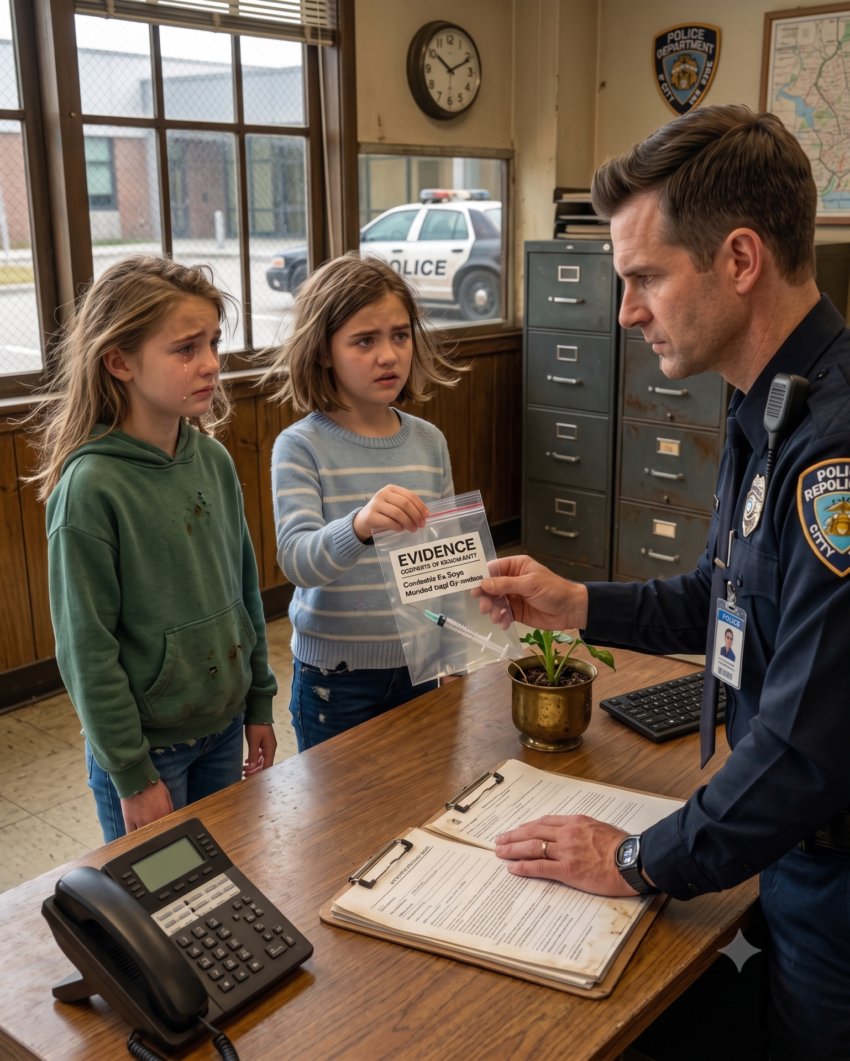
She stood on the other side of my desk with rain dripping from the ends of her brown hair, one hand wrapped around her twin sister’s wrist. Her sister was bent slightly at the waist, her face pale and her eyes heavy enough that she kept blinking as if she might fall asleep standing up.
I pushed my chair back.
“What do you mean he put something in her belly?”
The girl looked at her sister before answering.
“He made her swallow it.”
Her sister pressed both hands against her stomach.
“It tasted bad.”
That was when I stopped treating the situation like two children who had wandered away from home.
My name is Daniel Reed. I had been a patrol officer for twelve years, and that rainy Tuesday afternoon I was finishing a parking report at the front desk because our civilian clerk had gone home sick. The station smelled like wet jackets and old coffee. A box fan rattled behind me even though September had already started cooling down.
The girls had walked in alone.
No coats. Damp sneakers. No adult following them.
I came around the desk slowly.
“What are your names?”
“Emma Carter. She’s Olivia. We’re twins.”
Olivia leaned against the counter.
I pulled a chair toward her.
“Sit down for me, Olivia.”
She obeyed without arguing.
Emma stayed standing.
“Where’s your mom?” I asked.
The two girls looked at each other.
Emma answered.
“She doesn’t live with us anymore.”
“Who do you live with?”
“Daddy.”
I crouched so I wasn’t towering over them.
“Emma, what did your dad give Olivia?”
“I don’t know.”
“Was it medicine?”
She hesitated.
“He said it was.”
Olivia whispered, “I didn’t want it.”
That distinction mattered.
I reached for the desk phone and signaled to Officer Marcus Hill, who was walking past the hallway behind me. He took one look at my face and came over.
I asked him to call EMS.
Emma immediately grabbed my sleeve.
“Are we in trouble?”
“No.”
“Is Olivia?”
“No. We just want someone to make sure she’s okay.”
She watched me for several seconds before releasing my sleeve.
Then she sat on the floor.
Before I could ask why, Emma untied her right sneaker.
She pulled it off, removed her sock, and worked two fingers beneath the thin foam liner inside the shoe. Something plastic clicked against the tile.
She held it out to me.
An empty oral medicine syringe.
No needle. Just the kind used to measure liquid medication for children.
There was a faint cloudy residue inside.
“I washed it a little,” Emma said. “Because it was sticky.”
Marcus stopped dialing for half a second.
I took an evidence bag from the cabinet behind the desk.
“Where did you get this?”
“Kitchen trash.”
“Today?”
She nodded.
“Why did you put it in your shoe?”
Emma glanced toward the station doors before answering.
“Daddy checks our pockets.”
I sealed the syringe in the bag.
“Why?”
“When we go outside.”
“Does he check your backpack?”
“Yes.”
“Your coat?”
Another nod.
Then she looked down at the wet sneaker in her lap.
“He doesn’t check under there.”
The ambulance arrived six minutes later.
By then, I had stopped working on the parking report.
Their Father Had Already Called Us
One of the paramedics examined Olivia while Emma refused to move more than a few feet away from her. Olivia could answer questions, but slowly. She said her stomach hurt and she felt tired.
When the paramedic asked what she had taken, Olivia looked at Emma.
Emma shook her head.
“We don’t know.”
The paramedic looked at me.
I held up the sealed evidence bag.
“We’re working on that.”
There was a partial pharmacy code printed near the base of the syringe. It wasn’t enough to identify a medication, but it was enough to give us somewhere to start.
While Marcus stayed with the girls, I went behind the front counter and searched our incoming-call log.
The Carter name was already there.
I read the entry twice.
Michael Carter had called less than forty minutes earlier to report his daughters missing.
According to the dispatcher’s notes, Michael said his daughters had become upset after refusing their medication and had left the house without permission.
I looked through the glass partition at Olivia.
She was sitting under a gray emergency blanket while a paramedic checked her pulse.
Emma was putting her wet sock back on.
I called dispatch.
“Pull the Carter missing-person call for me. Preserve the audio.”
The dispatcher paused.
“The twins?”
“Yes.”
“Father’s been calling back.”
“Don’t give him anything beyond the standard response.”
I hung up and contacted the pharmacy using the information we had.
The pharmacist couldn’t discuss much over the phone without the proper process, which I expected. But the transaction information attached to the visible code confirmed one detail that changed the temperature in the room.
The account information was connected to Michael Carter.
I wrote down the time.
Then I requested that the relevant pharmacy records be preserved.
After that, I saved the station’s front-camera footage from the moment Emma and Olivia entered the building.
Marcus watched me from across the room.
“Daniel?”
I walked over.
“Their father reported them missing.”
Emma heard me.
Her head snapped up.
“Is he coming?”
I didn’t answer immediately.
That frightened her more than any answer would have.
She stood.
“He’s coming.”
“Emma, listen to me. You’re inside a police station.”
She stared toward the glass doors.
“He’ll say Olivia asked for it.”
I felt Marcus looking at me.
“Did she?”
Emma shook her head hard.
Olivia spoke from beneath the blanket.
“No.”
Her voice was quiet, but there was no hesitation.
“I said I didn’t want it.”
The paramedic asked Olivia another question, and I stepped away to call my supervisor.
Before I finished explaining the situation, headlights swept across the wet parking lot outside.
A dark SUV pulled hard into a space near the entrance.
Emma saw it.
Her entire body stiffened.
“That’s Daddy.”
I ended the call.
Then I walked to the front doors and locked them.
Michael Carter Brought the Backpack With Him
Michael Carter crossed the parking lot without an umbrella.
He looked like plenty of worried parents I had met before—khaki pants, blue button-down shirt, car keys in one hand. His hair was wet from the rain. He wasn’t yelling.
At first.
He pulled the door handle and found it locked.
Then he saw his daughters.
He knocked hard on the glass.
“Emma. Olivia.”
Emma moved behind Marcus.
Michael looked at me.
“Open the door.”
I stepped into the vestibule but kept the interior security door between us.
“Mr. Carter?”
“Yes. Those are my daughters. I reported them missing.”
“I know.”
“Then open the door.”
“Olivia is being evaluated by paramedics.”
His expression changed slightly.
Not panic.
Irritation.
“Because she has a stomachache?”
I hadn’t told him she had a stomachache.
I kept my voice even.
“What medication did you give her today?”
He stared at me.
“Her regular medicine.”
“What regular medicine?”
“I don’t have the bottle memorized.”
Behind me, Emma spoke.
“He does.”
Michael’s eyes moved past my shoulder.
“Emma, stop.”
She went quiet immediately.
That bothered me more than if he had shouted.
I looked at the backpack hanging from his left hand. Purple fabric. Two cartoon key chains attached to the zipper.
“Whose backpack is that?”
“Olivia’s.”
Emma stepped around Marcus.
“No. Mine.”
Michael tightened his grip on it.
“They look the same.”
Emma stared at the bag.
Then at me.
“There’s another one.”
“Another what?”
She pointed at the backpack.
“Syringe. Front pocket.”
Michael’s hand moved over the pocket.
Only for a second.
But I saw it.
So did Marcus.
I asked Michael to set the backpack down.
“Absolutely not. I came here to get my children.”
“Set the bag down, Michael.”
His face tightened.
“You’re treating me like I did something wrong because a seven-year-old told you a story.”
I didn’t argue with him.
I called my supervisor back.
The paramedics prepared Olivia for transport while Michael remained separated from the girls. With the circumstances now documented and the bag secured as part of the investigation, we examined its contents under the proper procedure.
Emma had been right.
Inside the front pocket was another oral syringe.
Beside it was a torn piece of a pharmacy label.
The transaction number matched the information connected to the first syringe.
But the patient information did not belong to Olivia.
It belonged to an adult.
I looked through the glass at Michael.
He was watching me.
I held the torn label where he could see it.
For the first time since arriving, he stopped demanding that I open the door.
That was the first moment the balance shifted.
“The Pharmacy Must Have Mixed It Up”
Olivia left for the hospital with a paramedic crew while another officer accompanied her. Emma was allowed to remain close under the child-protection procedures being arranged, and she kept asking the same question.
“Can I stay with Olivia?”
Every time, I gave her the same answer.
“We’re working to keep you together.”
Michael sat in an interview room.
His explanation changed before the first hour was over.
First, he said the pharmacy must have put the wrong label on the medication.
“That happens,” he told me. “People make mistakes.”
“Then why was the label torn?”
“I don’t know.”
“Why was the syringe in Emma’s backpack?”
“I was cleaning up.”
I placed a copy of his missing-person report on the table.
“You told dispatch the girls ran away because they refused their medication.”
He leaned back.
“That’s basically what happened.”
“Emma says Olivia didn’t know what she was being given.”
“Emma is seven.”
“Olivia says the same thing.”
He rubbed both hands over his face.
“Olivia gets dramatic when she doesn’t feel well.”
I waited.
People often fill silence when they want control of a conversation.
Michael did.
“Look, I know what a safe amount is.”
I looked at him.
“A safe amount of what?”
He stopped.
The room stayed quiet.
Then he shook his head.
“That’s not what I meant.”
I wrote down his exact words.
By evening, the hospital confirmed that Olivia was stable and expected to recover with observation and supportive care. That was the first good news we had gotten all day.
The second came from the pharmacy.
The official records were being preserved.
The transaction tied to the torn label involved medication issued under an adult patient’s profile, not Olivia Carter’s.
Michael’s next explanation was that the syringes had been mixed up at home.
Later, he said Olivia had asked him for something because her stomach hurt.
Then he suggested Emma had invented the story because he had disciplined her earlier that week.
None of those explanations fit together.
More importantly, none explained the shoe.
Emma Had Handed Me the Syringe Before She Knew Anything
The girls were interviewed separately by trained professionals.
I did not sit beside them feeding them questions. I didn’t need to.
Their accounts matched on the important details.
Olivia had not wanted to drink the liquid.
Michael had insisted.
He had told them not to talk about it.
Emma had taken the empty syringe from the trash afterward.
She had hidden it beneath the liner of her sneaker because she believed her father would find it anywhere else.
And she knew about the second syringe in the backpack.
The strongest piece of evidence, however, was sitting on our own station server.
I watched the lobby footage again.
3:42 p.m.
Emma and Olivia entered through the front doors.
3:44.
Emma told me her father had made Olivia swallow something.
3:46.
She removed her shoe.
3:47.
She handed me the syringe.
Only later did I search the call log and learn Michael Carter had already reported them missing. Only after that did we connect the pharmacy information to him.
Emma had produced the physical evidence before she knew we would find anything connected to her father.
I watched that section twice.
Then Marcus leaned against the desk beside me.
“She planned that.”
I looked through the hallway window.
Emma was sitting with a child-services worker, wearing borrowed socks because her sneakers were still damp.
“She’s seven,” I said.
Marcus nodded.
“That’s what I mean.”
The pharmacy’s camera records added another piece. The transaction information, timing, and preserved footage supported the sequence investigators were already building from the physical evidence and the girls’ statements.
There was no single dramatic confession.
There didn’t need to be.
There were two syringes.
A torn label.
A pharmacy record.
A missing-person call that didn’t match what the children said.
And a seven-year-old girl who had thought far enough ahead to hide one small piece of plastic beneath her foot.
Michael Changed His Story Again
Michael kept trying to make each new fact fit a different explanation.
When the pharmacy information became harder to dismiss, he said the wrong syringe had been used accidentally.
When investigators asked why Olivia said she had refused it, he said she had actually requested medicine.
When Emma’s statement contradicted that, he said Emma was angry because she had recently been punished.
“Kids say things,” he told us.
But the children had not simply said things.
Emma had brought something.
And Michael had brought the rest of it with him.
An emergency no-contact order was issued while the investigation continued. The twins were placed somewhere safe together, which had been Emma’s main concern from the moment the ambulance arrived.
I saw them briefly before they left.
Olivia was tired but sitting upright. Emma had changed into dry clothes someone had brought for her.
Her sneakers were beside her chair.
One of the liners was still partly pulled out.
I crouched in front of her.
“You did exactly what you were supposed to do when you came here.”
Emma frowned.
“But I took the syringe.”
“I know.”
“Daddy says taking things is stealing.”
I considered my answer.
“You brought us something because you were worried about your sister.”
She looked toward Olivia.
“Are we going back tonight?”
“No.”
Her shoulders dropped.
Not dramatically. She didn’t cry.
She just leaned back against the chair.
Olivia reached over and took her hand.
That was all.
The case moved forward through the evidence already collected: the girls’ recorded statements, prescription and pharmacy records, the two syringes, the torn label, the emergency medical documentation, the missing-person call, and our station footage.
I was called later to confirm what had happened at the desk and when each piece of information became known to us.
Michael’s explanations continued to change.
The timestamps did not.
The Picture Emma Brought Back
Several months passed before I saw the twins again.
It was another afternoon shift, though this time there was no rain. I was standing behind the same front desk arguing with our printer when the lobby door opened.
I recognized Emma first.
She had grown her hair a little longer.
Olivia walked beside her.
Straight-backed this time.
A woman accompanying them spoke with the desk officer while the girls looked around the station.
Then Emma saw me.
“Officer Daniel.”
I came around the counter.
“Hey.”
Olivia smiled.
“Hi.”
I looked at her.
“How are you feeling?”
“Better.”
“Good.”
Emma was holding a piece of construction paper against her chest.
She handed it to me.
It was a drawing done in colored pencil.
Two little girls stood behind a large glass door. Outside was a dark SUV. Between the vehicle and the girls, she had drawn a police officer with arms stretched ridiculously wide, almost from one side of the page to the other.
At the top, in uneven purple letters, she had written:
WE TOLD.
I had to look at it for a few seconds before I trusted myself to speak.
“Is this me?”
Emma nodded.
“Your arms aren’t really that long.”
Olivia laughed.
“I figured.”
Emma looked down.
She was wearing new sneakers.
I remembered the wet gray shoe on our station floor, the foam liner peeled back, and the little plastic syringe she had hidden underneath because she believed the truth was safest where nobody could see it.
I pointed toward her shoes.
“Still keeping secret evidence in there?”
Emma shook her head.
Then she smiled.
“I don’t hide things in there anymore.”
I put her drawing behind the front desk where everyone could see it.