PART2:
The boy nodded as if that answer made perfect sense.
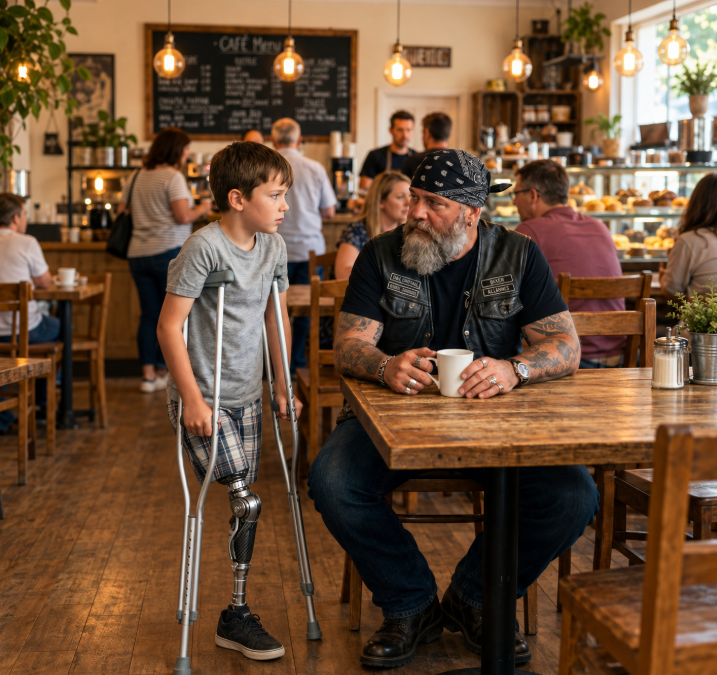
He moved to another table where two college guys had their backpacks dumped onto empty chairs. One of them saw him coming and pulled the backpack closer to himself, not to free the chair, but to block it more completely.
“Can I sit here for a little while?” the boy asked.
The taller one glanced at the prosthetic, then away.
“We’re waiting for people.”
They were not.
The boy nodded again.
“Okay.”
He turned.
A man in business casual sat near the counter, reading emails on a tablet. Two empty chairs faced him. The boy hesitated, then approached.
“Sir?”
The man looked up with a tight smile that had been built specifically to keep strangers away.
“Sorry, buddy. I’m in a meeting.”
There was no meeting.
Only the tablet.
Only the need not to be involved.
At the middle table, the mother with the little girl saw the boy glance toward the empty chair beside them. Before he could speak, she placed her hand over the back of it.
“We’re using that,” she said quickly.
The little girl stared openly at the boy’s leg.
Her mother leaned down and whispered something into her ear.
The girl looked away.
The boy nodded a fourth time.
Every nod took something from him.
Not enough for anyone to notice.
Enough for him to feel.
In the far back corner sat the one man most people had already decided to avoid before the boy ever walked in.
Dylan “Duke” Callahan was built like a wall.
Broad shoulders stretched the seams of a faded gray Henley. His arms were covered in old tattoos, the ink softened by years but still dark enough to suggest stories people did not ask about in polite cafés. A jagged scar traced from the corner of his jaw down beneath a beard streaked with early silver. A black leather vest hung open over his chest. His worn motorcycle helmet rested on the floor beside one boot.
His coffee had gone cold.
An old paperback sat open in his hands.
No one in Harper’s Corner knew that Duke had read the same paragraph six times without absorbing a word.
No one knew he had parked his motorcycle three blocks away instead of out front because the sound of the engine sometimes made people stare.
No one knew he had spent twelve years as an Army combat medic, three tours overseas, and another decade afterward trying to stop seeing blood in places where there was only spilled coffee.
No one knew he rode with a volunteer biker group called Iron Mercy, hauling food, blankets, medication, and emergency supplies to rural communities where snow closed roads and poverty hid behind mountain views.
To everyone in the café, he was just a big, tattooed biker with scarred hands and a face that looked like trouble.
People had given him space.
He had not asked for it.
The boy stopped beside his table last.
Duke looked up slowly.
The boy swallowed.
“Sir,” he said, “can I sit here for a little while? I won’t be loud.”
Duke saw a dozen things in one second.
Not because he was suspicious.
Because he had spent half his adult life reading bodies faster than words.
He saw the boy’s weight leaning off the prosthetic, favoring the other leg too much. He saw dried mud on the hem of the jeans, though the sidewalks outside were clean. He saw the boy’s left hand tucked deep into the hoodie sleeve even though the café was warm. He saw the way his eyes flicked toward exits, windows, adults, then down.
He saw a child prepared for rejection before it arrived.
Duke hooked the leg of the empty chair with his boot and nudged it out.
“Seat’s not doing anything,” he said. “Go ahead.”
Relief washed over the boy’s face so suddenly it almost looked like pain.
“Thank you,” he whispered.
As he tried to sit, his prosthetic caught against the chair leg.
He wobbled.
Duke’s hand shot out instantly.
Not grabbing.
Not startling.
Just steady.
“Got you.”
The boy froze.
Duke felt the flinch before he saw it.
A full-body flash of fear under the skin.
He let go immediately.
“Easy,” Duke said. “Chair’s got bad manners.”
The boy lowered himself carefully into the seat.
That was when Duke saw his arm.
The sleeve had pulled back just enough.
Bruises.
Not playground bruises.
Not the random little purple and yellow marks kids collect from bikes, tree roots, and furniture corners.
These were fingerprints.
Dark oval marks along the forearm.
Yellowing ones near the wrist.
A line of older discoloration half-hidden beneath the cuff.
Layers of hurt at different stages of healing.
Duke’s stomach went tight.
But his face did not change.
That was training too.
If you showed horror too soon, children learned they were frightening.
He closed the paperback slowly.
“What’s your name, kid?”
The boy’s fingers twisted in the hem of his hoodie.
“Caleb.”
“Dylan,” Duke said. “Most people call me Duke.”
Caleb nodded once, as if storing the information carefully.
“You here with someone, Caleb?”
The boy looked toward the front window.
A pause.
Too long.
“Yeah.”
Duke heard everything inside that pause.
“Who?”
Caleb’s mouth opened.
Before he could answer, a chair scraped violently across the tile.
The sound cut through the café.
Conversations dropped.
The espresso machine hissed on.
Duke looked up.
A man had stood near the counter so fast his table rattled.
He was everything Duke was not.
Clean-shaven. Crisp blue polo tucked into khaki pants. Brown leather belt. Polished shoes. Smartwatch gleaming on his wrist. Short hair combed neatly to one side. The kind of man who looked like he coached Little League, mowed his lawn at eight on Saturdays, and waved at neighbors with the same hand he used to close blinds before becoming someone else.
Respectable.
That was the word people would have used.
Duke had learned long ago that respectable was not the same as safe.
The man’s eyes locked on Caleb.
Cold.
Flat.
Furious.
“Caleb,” he said.
The boy shrank so quickly it was almost like watching a light turn off.
The man walked across the café.
Every step was controlled.
Not rushed.
Not chaotic.
Controlled anger frightened Duke more than shouting ever had.
The man stopped at the table and ignored Duke completely.
“I told you to wait in the car.”
Caleb folded inward.
“I needed to sit down,” he whispered. “My leg hurts.”
The man smiled.
Not kindly.
A public smile. A smile meant for witnesses.
“Your leg hurts because you are careless.”
Caleb’s eyes dropped.
The man reached for him.
“Come on. We’re leaving.”
His hand clamped around Caleb’s upper arm.
Right over the bruises.
Caleb gasped.
A sharp, ragged sound.
The café froze.
Before the man could pull the boy up, Duke’s hand closed around his wrist.
It was not a strike.
It was an anchor.
Duke had not even stood yet, but the force of his grip stopped the man completely.
“Let go,” Duke said.
Not loud.
Not emotional.
A command.
The man blinked down at the tattooed hand wrapped around his wrist, then up into Duke’s scarred face.
His cheeks flushed.
“Excuse me?”
“Let go of him.”
“This is none of your business.” The man tried to yank free.
He could not.
His anger sharpened into embarrassment.
“This is my stepson,” he snapped. “Take your hands off me.”
Duke’s eyes did not move.
“Take yours off him first.”
The room remained silent.
Caleb’s breath came quick and shallow.
The man looked around, searching for support.
He expected to find it.
At first, he nearly did.
The woman with sunglasses frowned at Duke.
The business man shifted in his chair, uncomfortable.
One college student lifted his phone, not calling anyone yet, just ready to record if the scary biker became the problem everyone already suspected he might be.
That was how the world worked.
It saw leather before bruises.
Tattoos before fear.
A scar before a child’s flinch.
The man sensed the room’s hesitation and leaned into it.
“Are you people seeing this?” he said, raising his voice. “This man is assaulting me. I’m trying to discipline my child.”
Child.
The word made Caleb flinch again.
Duke released the wrist.
The man jerked back, rubbing his skin dramatically.
But before he could reach for Caleb again, Duke stood.
All six feet four inches of him unfolded from the corner chair.
The café seemed to get smaller.
The man took one involuntary step back.
Duke placed his body between Caleb and the man.
“What’s your name?” Duke asked.
The man sneered.
“You first.”
“Dylan Callahan.”
“Of course.” The man laughed once, brittle and performative. “Dylan Callahan. You look exactly like the kind of person who thinks he can intimidate decent people in coffee shops.”
Duke said nothing.
The man turned to the room.
“My name is Ray Whitaker. I’m a contractor. I live three blocks from here. My wife and I are raising this boy, and he has behavioral issues. He wanders. He lies. He makes scenes. He uses the leg when he wants sympathy.”
Caleb stared at the tabletop.
His face had gone pale.
Duke felt something inside him become very still.
Combat had taught him that rage was useless if it moved faster than discipline.
He kept his voice calm.
“Caleb,” he said, not looking back, “pull up your sleeve.”
Ray’s head snapped toward him.
“Don’t you dare.”
Caleb did not move.
Duke softened his tone.
“Kid, listen to my voice. You don’t have to look at him. Just pull up your sleeve.”
Ray stepped forward.
Duke did not move, but the space between them vanished.
Ray stopped.
“This is harassment,” Ray hissed. “You have no right.”
Duke looked at him then.
“I was a combat medic for twelve years. I have held pressure on wounds while men screamed for their mothers. I have seen broken bones, shrapnel, falls, burns, accidents, panic, fear, and lies people told because they thought nobody could read the body after the mouth stopped talking.”
His voice lowered.
“So yes, Ray. I know what accidental injuries look like.”
Behind him, Caleb slowly pulled up his sleeve.
The woman with sunglasses gasped.
The sound moved through the café like a match catching paper.
The bruises were undeniable.
Finger marks.
Layered.
Human.
The mother at the center table covered her daughter’s eyes too late. The business man stood halfway, then sat again, then stood fully. One of the college guys whispered, “Dude.”
Ray’s face hardened.
“He bruises easily,” he said.
Duke turned slightly, just enough to see Caleb’s arm without taking his eyes fully off Ray.
“That why the marks match a hand?”
“He falls.”
“Both wrists?”
“He has a prosthetic. He’s unstable.”
“You grabbed him right over the fresh ones.”
“I am his parent.”
“You are hurting him.”
Ray’s mask cracked.
For one second, the clean suburban man vanished, and something ugly showed underneath.
“You don’t know anything about this kid,” he snapped. “He is manipulative. His mother dumped him on us. He breaks things. He steals. He makes my wife cry. You sit there in your biker vest pretending to be noble because you saw one mark? Try living with him.”
Caleb made the smallest sound.
Not a cry.
Worse.
An apology trying not to be heard.
Duke’s fists curled at his sides.
He saw other things now.
The prosthetic that did not fit.
The too-big hoodie.
The hunger in Caleb’s face.
The practiced way he had accepted every rejection in the café.
Duke knew neglect when it walked on a child’s bones.
“You didn’t want him sitting,” Duke said, “because his leg hurt.”
Ray’s jaw clenched.
“You didn’t want him in here because you didn’t want people to see what you do when nobody’s looking.”
“I’m calling the police,” a voice rang out.
Everyone turned.
It was the woman with sunglasses.
She was standing now, phone pressed to her ear, perfect red nails shaking.
“Yes,” she said into the phone. “Harper’s Corner Café. There’s a man here hurting a child. We need an officer.”
Ray panicked.
It happened fast.
His eyes flicked to the door.
Then to Duke.
Then to Caleb.
“Caleb,” he barked. “Get up.”
Caleb did not move.
For the first time, he did not move.
Ray stepped around Duke toward him.
Duke shifted sideways and blocked him.
Ray tried the other side.
The two college guys suddenly stood and moved near the door.
Not brave exactly.
Ashamed into bravery.
The business man crossed his arms and stood near the hallway leading to the bathrooms.
The mother pulled her daughter close, but she did not look away this time.
The community that had failed Caleb five minutes earlier was waking up.
Late.
But waking.
Ray pointed at Duke.
“You’re going to regret this.”
Duke’s voice stayed quiet.
“Get in line.”
Police arrived in under four minutes.
Two officers entered first, one older, one young. Their hands hovered near their belts because a room full of tense people and a giant tattooed biker standing between a clean-cut man and a bruised child did not tell a simple story at first glance.
Ray knew that.
He used it.
“Officers,” he said, stepping toward them with both palms up. “Thank God. This man assaulted me. I was trying to take my stepson home, and he—”
“He grabbed the boy first,” the woman with sunglasses interrupted.
The older officer looked at her.
She swallowed.
“I saw it.”
“So did I,” said the business man.
One college guy lifted his phone.
“I recorded after it started. Not everything, but enough.”
Ray’s face twisted.
The young officer looked at Caleb.
Caleb sat frozen at the table, sleeve still pushed up, bruises visible, eyes locked on the floor.
Everything changed in the officers’ faces.
Not enough to be dramatic.
Enough.
The older officer approached slowly and crouched near Caleb.
“Hey, son. I’m Officer Martinez. Is it okay if I talk to you?”
Caleb’s eyes flicked to Ray.
Duke saw.
Officer Martinez saw too.
“Ray,” the younger officer said, “why don’t you step outside with me?”
“I’m not leaving him with that man.”
“You are stepping outside with me.”
The officer’s voice left no space.
Ray looked around the café one last time for allies.
He found none.
Outside, through the front windows, everyone watched the young officer speak to Ray. At first, Ray gestured dramatically. Then angrily. Then he pointed through the glass at Duke. Then the officer’s posture changed after something came across his radio.
Background checks have a way of stripping polish off a man.
Ray Whitaker, it turned out, had a record.
Not the kind his neighbors knew.
Domestic disturbance calls from another county. A restraining order filed and withdrawn. A charge reduced after a witness stopped cooperating. A complaint from a school nurse three years earlier after Caleb came in with a swollen cheek and said he fell down basement stairs.
Case closed.
Family declined services.
Insufficient evidence.
The usual language used to bury children while they were still breathing.
Inside, a female officer named Brooks sat across from Caleb.
She kept her voice gentle.
“Is Ray your stepfather?”
Caleb nodded.
“Where is your mother?”
“At home.”
“Is she safe?”
Caleb hesitated.
That hesitation said no more than any answer.
Duke stayed seated beside him now, far enough not to crowd, close enough for Caleb to feel the wall of him.
Officer Brooks noticed.
“Do you want Mr. Callahan to stay while we talk?”
Caleb looked at Duke.
Duke gave one small nod.
Not pressure.
Permission.
Caleb whispered, “Yes.”
So Duke stayed.
The café changed around them.
The barista with pink hair brought over a hot chocolate piled high with whipped cream and chocolate shavings. Her hands trembled as she set it down.
“On the house,” she said.
Then she placed a fresh black coffee in front of Duke.
“For you too.”
Duke looked at her.
She looked ashamed.
“I’m sorry,” she whispered, so softly only he heard.
“For what?”
She glanced toward Caleb.
“For seeing him come in and hoping someone else would deal with it.”
Duke took the coffee.
“Now you’re dealing with it.”
Her eyes filled.
She nodded.
Outside, Ray was placed in handcuffs.
Not gently.
Not violently.
Just finally.
Caleb watched through the window.
His face did not change.
That frightened Duke more than tears would have.
“Is he going to come back?” Caleb asked.
Duke looked at Officer Brooks, because he would not lie to a child about systems he did not control.
Officer Brooks leaned forward.
“Not today,” she said. “And we are going to work very hard to keep you safe after today.”
Caleb’s hand shook around the mug.
“That means maybe.”
Duke looked at him.
The kid was smart.
Too smart in the way hurt children become smart.
Duke said, “Then we work harder.”
Caleb looked up at him.
“We?”
Duke lifted his coffee and tapped it gently against Caleb’s hot chocolate.
“Seat’s still not doing anything,” he said. “I might as well stay.”
Caleb’s mouth trembled.
For the first time since he entered the café, his shoulders dropped.
Not all the way.
Just enough.
That afternoon split the town open.
At first, the story moved through whispers.
A child abuse arrest at Harper’s Corner.
A biker stopped it.
No, a Hells Angel.
No, not Hells Angels. Iron Mercy. Those charity bikers.
The boy had one leg.
No, a prosthetic.
The stepfather looked normal.
The stepfather always looked normal.
By evening, local news had a headline.
TATTOOED BIKER INTERVENES AFTER FINDING BRUISES ON CHILD IN SUBURBAN CAFÉ.
Someone had filmed Duke standing between Caleb and Ray.
Someone else had filmed the police walking Ray out.
The videos spread fast.
People posted comments.
Some called Duke a hero.
Some said people should not judge Ray until facts came out.
Some asked why nobody helped the boy sooner.
That last question bothered everyone most.
Because it was not just about Ray.
It was about the woman who said the seat was taken.
The college guys who pulled backpacks closer.
The business man who smiled no.
The mother who whispered to her daughter.
The barista who watched.
The whole café that had seen a limping child ask for a chair and had silently agreed he was someone else’s problem.
Duke did not watch the videos.
He had other things to do.
Caleb and his mother, Natalie, were taken to a family services office that evening. Natalie arrived with a split lip hidden beneath makeup and a fear so deep it made her movements mechanical. She was only thirty-two, but she looked worn thin by years of explaining bruises as accidents and cruelty as stress.
The first time she saw Caleb, she broke.
Not elegantly.
Not like people cry in movies.
She folded around him, sobbing into his hair, saying, “I’m sorry, I’m sorry, I’m sorry,” until Officer Brooks gently touched her shoulder and reminded her Caleb needed air.
Caleb did not hug her back at first.
Duke saw that.
He also saw Natalie notice it.
Her face crumpled again, but she did not demand comfort from the child she had failed to protect. That mattered.
Family services placed them that night in an emergency domestic violence shelter under confidentiality protection. Ray stayed in custody pending charges.
Duke went home to his small rental house outside town and sat on the edge of his bed until sunrise.
He should have felt good.
People told him he had saved a kid.
But Duke knew rescue was never that clean.
He had seen men pulled from explosions who died two days later from infection. He had seen soldiers survive battle and lose themselves at home. He had seen children removed from houses only to be returned because paperwork, funding, testimony, fear, and systems all had sharp corners.
Stopping Ray in a café was one moment.
Keeping Caleb safe would be war by inches.
At 6:15 a.m., Duke’s phone rang.
It was Officer Brooks.
“Mr. Callahan?”
“Duke.”
“Duke. Caleb asked if I could call you.”
He stood.
“Is he okay?”
“He is safe. He and his mother are in shelter placement. But he asked whether you were real.”
Duke closed his eyes.
“What?”
“He said sometimes people help once and disappear. He wanted to know if you were going to disappear.”
The question hit Duke harder than he expected.
He looked toward the corner of his bedroom where an old Army duffel sat untouched, still carrying things he had never fully unpacked.
“No,” Duke said. “Tell him I’m not disappearing.”
There was a pause.
Officer Brooks’s voice softened.
“I was hoping you’d say that.”
Duke visited the shelter three days later, after background checks, permission forms, and a long conversation with a social worker who looked at his tattoos like each one needed its own reference letter.
He did not blame her.
Children had been hurt by men who looked respectable.
They had also been hurt by men who looked like him.
Caution was not insult.
It was duty.
Caleb sat in a common room near a window, drawing on a clipboard. His hoodie had been replaced by a clean blue sweatshirt from the shelter closet. The sleeves still swallowed his hands. His prosthetic leaned awkwardly against the chair while his residual limb rested on a pillow.
Duke noticed that immediately.
“Leg off today?” he asked.
Caleb looked up, surprised.
“It hurts.”
“Socket too tight?”
Caleb blinked.
“You know about that?”
“I was a medic. Worked with amputees after the service too.”
Caleb looked down at his drawing.
“Ray said it only hurt because I didn’t walk right.”
Duke sat across from him.
“Ray’s an idiot.”
A tiny laugh escaped Caleb before he could stop it.
Then he looked guilty.
Duke pretended not to notice.
“What are you drawing?”
Caleb turned the clipboard slightly.
It was the café.
Not the warm Edison bulbs or local art or hanging plants.
The tables.
The exits.
The chair where he sat.
The space Duke had stood.
Duke’s throat tightened.
“That’s good,” he said.
“It’s not finished.”
“Most things aren’t.”
Caleb studied him.
“Are you in a gang?”
“No.”
“You look like you are.”
“I get that a lot.”
“What’s Iron Mercy?”
“A riding group. Mostly veterans. Some mechanics. Some nurses. A retired teacher who scares everybody. We deliver supplies to people who need them.”
“Why?”
Duke shrugged.
“Because people need them.”
Caleb seemed to consider whether this answer was too simple to trust.
“My mom says people don’t do things for free.”
“Your mom met the wrong people.”
Caleb’s face closed a little.
Duke caught it too late.
“I didn’t mean that how it sounded,” he said.
Caleb looked up.
Duke leaned forward, forearms on knees.
“Your mother was surviving too. Surviving can make the world look smaller than it is.”
Caleb stared at him.
“She didn’t stop him.”
“No.”
The truth sat between them.
Duke did not try to soften it.
Caleb’s fingers tightened around the pencil.
“I used to think if I got better at walking, he’d stop being mad.”
Duke felt a familiar old pain behind his ribs.
“And?”
“I got better.”
His voice dropped.
“He stayed mad.”
Duke nodded slowly.
“Because it was never about how you walked.”
Caleb’s eyes filled.
Duke let the silence stay.
The next weeks became a strange new rhythm.
Court hearings.
Medical appointments.
Shelter rules.
School planning.
Therapy intake.
Police interviews.
Ray’s attorney tried to paint Caleb as troubled, dishonest, attention-seeking. That ended badly when the café video, medical exam, prior school nurse complaint, and Natalie’s eventual statement lined up like stones in a wall.
Natalie filed for divorce.
Then a protective order.
Then she did something Duke respected more than he could say.
She told the truth even when it made her look bad.
In a closed hearing, she admitted she had minimized Caleb’s injuries. She admitted she had stayed because she was afraid and financially trapped and ashamed. She admitted she had told Caleb to be careful around Ray instead of telling Ray to stop.
“I failed my son,” she said.
Ray’s attorney objected to something.
The judge overruled it.
Natalie kept going.
“I can spend the rest of my life explaining why I was scared,” she said, voice shaking, “but fear does not erase what Caleb lived through. I am not asking him to forgive me so I feel better. I am asking the court to help me become safe enough that forgiveness is his choice someday, not his job.”
Duke sat in the back row, hands clasped, eyes on the floor.
That was accountability.
Ugly.
Necessary.
Rare.
Caleb heard about it later from Officer Brooks and did not speak for ten minutes.
Then he asked, “Did she cry?”
“Yes,” Officer Brooks said.
“Did Ray?”
“No.”
Caleb nodded like that confirmed something.
Ray remained in custody after violating a no-contact order by trying to send messages through his sister. More charges followed when investigators searched the house and found evidence that the abuse had been longer, broader, and more deliberate than anyone wanted to believe.
Neighbors gave interviews.
Most said the same thing.
He seemed nice.
They seemed normal.
We never knew.
Duke hated that phrase.
We never knew.
Sometimes it was true.
Often it meant, We noticed pieces and decided comfort was more important than curiosity.
Harper’s Corner Café changed too.
The owner, Melissa Harper, called Duke two weeks after the incident.
“I want to do something,” she said.
“About what?”
There was a pause.
“About the fact that a child with bruises had to ask four tables for a chair before someone said yes.”
Duke respected that she did not excuse herself.
“What kind of something?”
“I don’t know yet. Training maybe. A fundraiser. A policy. I don’t want it to be performative.”
“Then don’t make it about looking good.”
“That’s why I called you.”
Duke almost said no.
Public attention made his skin crawl.
But he thought of Caleb asking whether he was real.
He thought of the chair.
He thought of every person who had looked away because looking closer might cost them something.
“Start with the staff,” he said. “Teach them signs. Who to call. How to intervene without making it worse.”
“Will you help?”
“I’m not a trainer.”
“You’re the reason he’s alive.”
“No,” Duke said. “I’m the reason Ray didn’t drag him out that door. Those are different things.”
Melissa was quiet.
Then she said, “Will you help anyway?”
So he did.
Iron Mercy connected Harper’s Corner with a child advocacy center. The café hosted training sessions after hours. Not dramatic ones. Practical ones. How to recognize signs of abuse. How to respond when a child seems afraid of a caregiver. How to document. How to call. How not to turn suspicion into confrontation unless immediate harm is happening. How to make space without making spectacle.
The woman with sunglasses attended the first session.
Her name was Victoria Lang.
She sat in the front row, no sunglasses, nails unpainted.
When the trainer asked why people had come, Victoria raised her hand.
“I lied to a child,” she said. “I said a chair was taken because I did not want to deal with whatever his presence might require of me.”
The room went quiet.
“My chair was empty,” she continued. “I need to understand why I thought keeping it empty was safer than letting him sit.”
No one comforted her.
That was good.
Guilt can become useful if no one rushes to rescue it.
The two college guys came too.
So did the business man.
So did the mother from the center table, who brought her daughter. At the end of the session, the little girl asked if she could make cards for Caleb.
Duke checked with the shelter first.
Caleb accepted the cards.
He did not read them all at once.
Trust came slowly.
So did healing.
Caleb got a new prosthetic socket in November.
The appointment was at a pediatric rehab clinic two towns over. Duke drove him and Natalie because their car was still tied up in Ray’s name and because buses turned a two-hour appointment into an all-day ordeal.
Caleb sat in the backseat, quiet.
Natalie sat beside him instead of up front.
Duke noticed.
She was learning not to leave distance where closeness was needed.
At the clinic, the prosthetist, a cheerful man named Omar, examined Caleb’s old socket and frowned.
“How long has this been hurting?”
Caleb shrugged.
“A while.”
Omar looked at Natalie.
Her face went pale.
“I didn’t know how bad,” she whispered.
Caleb looked away.
Omar did not pile on. He simply said, “We’ll fix what we can from here.”
The new socket took adjustments, molds, fittings. Caleb had to walk between parallel bars while adults watched. His face burned with embarrassment.
Duke stood near the wall, arms crossed.
After one painful pass, Caleb snapped, “Stop staring.”
Everyone froze.
Duke pointed to himself.
“Me?”
Caleb’s eyes flashed.
“Yes, you.”
Duke nodded.
“Fair.”
He turned around and faced the wall.
Omar looked startled.
Natalie almost laughed.
Caleb walked again.
Click.
Step.
Click.
Step.
Better.
Not perfect.
Better.
When they stopped for lunch afterward, Caleb ate half a burger, then pushed the plate away.
“You can finish it,” Natalie said.
“I’m full.”
Duke saw the lie.
So did Natalie.
But instead of urging, she asked, “Do you want to take it home?”
Caleb hesitated.
“For later?”
“Yes.”
“You won’t be mad?”
Natalie closed her eyes briefly.
“No, honey.”
He nodded.
“Then yeah.”
At Christmas, Iron Mercy held its annual toy and supply ride through the mountain towns.
Caleb wanted to go.
Natalie worried about crowds.
Duke worried about cold on Caleb’s leg.
Caleb folded his arms and said, “I’m not made of glass.”
Duke looked at him.
“No. You’re made of stubborn.”
“I learned from you.”
Natalie laughed so hard she had to sit down.
They compromised. Caleb rode in the support truck with blankets, snacks, and a thermos of hot chocolate. Duke rode his motorcycle at the front, black vest over layers, helmet reflecting winter sun.
At each stop, families came out for boxes of groceries, coats, toys, medical supplies, diapers, batteries, and pet food. Caleb helped hand out items from the truck. At first, he stayed quiet. Then he saw a little boy staring at his prosthetic.
Old shame rose automatically.
But before he could hide it, the boy asked, “Are you a robot?”
Caleb blinked.
Duke, standing nearby, coughed into his glove.
Caleb looked at the boy.
“Partly.”
The boy’s eyes widened.
“Cool.”
Caleb smiled.
For the rest of the day, he walked taller.
By spring, Ray accepted a plea deal.
Long prison sentence.
Mandatory admission of abuse.
Termination of any custodial rights.
Restitution for medical costs, though nobody expected him to pay much.
At sentencing, Caleb chose to read a statement.
Natalie worried it would hurt him.
His therapist said it might help if Caleb understood he did not owe the court bravery.
Duke said, “Your voice belongs to you. Use it or don’t. Either way, it’s yours.”
Caleb used it.
He stood at a podium too tall for him while Duke, Natalie, Officer Brooks, and half of Harper’s Corner Café sat behind him.
Ray sat at the defense table in a suit.
He looked smaller than Caleb remembered.
That made Caleb angry.
Monsters should not get to become ordinary in daylight.
Caleb unfolded his paper.
“My name is Caleb Whitaker,” he began, then stopped.
He looked at Ray.
“No,” he said softly.
The judge leaned forward.
Caleb took a breath.
“My name is Caleb Morris.”
Natalie’s maiden name.
Natalie covered her mouth.
Duke looked down, blinking hard.
Caleb continued.
“For a long time, I thought if I was quieter, better, faster, less clumsy, less hungry, less annoying, you would stop hurting me. I thought I was the problem because you said I was.”
Ray stared at the table.
“You were wrong,” Caleb said.
His voice shook but did not break.
“My leg was not the problem. My body was not the problem. My asking for help was not the problem. You were.”
The courtroom was silent.
“I used to think nobody saw. But now I know some people did not know how to look. And some people did. Mr. Duke looked. Officer Brooks looked. My mom is looking now. Other people are looking now too.”
He gripped the paper.
“I am still scared sometimes. I still wake up thinking I have to ask permission to eat. I still say sorry when someone walks too fast behind me. But I am not yours anymore.”
Natalie sobbed once.
Caleb looked at the judge.
“That’s all.”
It was enough.
Ray received twenty-two years.
No one cheered.
That would have made it too much like victory.
But outside the courthouse, Natalie knelt in front of Caleb and asked, “Can I hug you?”
He hesitated.
Then nodded.
She held him carefully, like someone holding a thing she had once dropped and was now learning how not to break.
“I’m proud of you,” she whispered.
Caleb’s arms slowly came up around her.
Duke turned away and pretended to check his phone.
Officer Brooks handed him a tissue without looking.
He took it.
Summer came bright and green.
Caleb and Natalie moved into a small apartment above a florist shop. It had squeaky floors, a kitchen window that stuck, and two locks on the front door that Natalie checked every night until Caleb finally said, “Mom, I think it’s locked.”
Mom.
The first time he called her that again, she cried in the laundry room where he could hear her anyway.
Duke came over every Thursday.
At first, it was because Caleb needed rides to appointments.
Then because the sink clogged.
Then because Natalie did not know how to assemble a bookshelf.
Then because Caleb asked if Duke wanted to see the model motorcycle he built.
Then because some routines become family before anyone names them.
One Thursday, Caleb asked, “Do you have kids?”
Duke was tightening a loose screw on the kitchen chair.
“No.”
“Why not?”
“Life.”
“That’s not an answer.”
“It’s the only one I’ve got.”
Caleb watched him.
“Did you want them?”
Duke stopped turning the screwdriver.
There were wounds people could see and wounds that sat under the ribs for decades.
“Once,” he said.
“What happened?”
Duke leaned back.
“My wife died before we got there.”
Caleb went still.
“You had a wife?”
“Long time ago.”
“What was her name?”
“Sarah.”
“What happened?”
“Cancer.”
Caleb absorbed this.
“Is that why you help people?”
Duke looked at him.
“Nobody could save her. For a while I thought that meant saving anybody else was pointless.”
“What changed?”
Duke tightened the screw again.
“I got tired of being useless.”
Caleb nodded like that made sense.
After a while, he said, “I’m glad you were at the café.”
Duke’s throat tightened.
“Me too.”
“I’m glad everyone else was mean.”
Duke looked up sharply.
“What?”
“If they’d let me sit, I wouldn’t have sat with you.”
Duke stared at him.
“That doesn’t make what they did okay.”
“I know.” Caleb shrugged. “But it still happened that way.”
Duke looked at the boy—stronger now, cheeks fuller, eyes still too old but less empty—and felt the strange, painful math of grace.
Good does not excuse harm.
But sometimes good grows through the cracks harm leaves behind.
The one-year anniversary of the café incident arrived quietly.
Harper’s Corner closed early that day for a private gathering.
No news cameras.
No speeches from officials.
Just the people who had been there, the people who had changed, and the people still trying.
Melissa had placed a small brass plaque on the back corner table.
It read:
RESERVED FOR ANYONE WHO NEEDS A SEAT.
Below it, smaller:
In honor of Caleb.
Caleb hated it at first.
Then a girl from school, who had recently started using a wheelchair after surgery, came into the café two weeks later and rolled directly to that table because she knew no one would ask her to move.
After that, Caleb decided the plaque was okay.
At the anniversary gathering, Victoria sat near Natalie and apologized without asking for forgiveness. The college guys, whose names were Matt and Eli, brought donated backpacks for the child advocacy center. The business man, Mr. Greene, admitted he had avoided testifying at first because he “didn’t want to get dragged into it,” then looked Caleb in the eye and said, “That was cowardice. I’m sorry.”
Caleb nodded.
Not absolution.
Acknowledgment.
The little girl who had stared at his leg gave him a drawing of a superhero with one robot leg and a motorcycle cape.
Duke said the cape was impractical.
Caleb said Duke lacked imagination.
The café laughed.
Near the end, Melissa placed two drinks on the back corner table.
Hot chocolate with whipped cream.
Black coffee.
Caleb and Duke sat down together.
The room moved around them, warm and alive.
Caleb touched the mug with both hands.
“Duke?”
“Yeah?”
“Why did you let me sit?”
Duke looked at him like the answer was obvious.
“Because the chair was empty.”
Caleb shook his head.
“Everyone else had empty chairs too.”
Duke looked across the café.
At the window table.
At the center table.
At the counter.
At all the places where people had learned, too late but not too late forever.
Then he looked back at Caleb.
“I know.”
Caleb waited.
Duke took a slow breath.
“Because I know what it is to walk into a room and have people decide what you are before you open your mouth.”
Caleb studied his tattoos, his scar, his leather vest.
“Because you look scary?”
Duke smiled faintly.
“Because sometimes I was scary. Sometimes I still am. But people are lazy. They look once and think the looking is done.”
Caleb nodded.
“They did that to me too.”
“They did.”
“But you didn’t.”
Duke’s voice softened.
“I almost did.”
Caleb frowned.
“No, you didn’t.”
“Yes,” Duke said. “I was reading my book. Drinking bad coffee. Minding my business. You walked in, and I saw people turn away. Part of me wanted to keep my head down too.”
“Why didn’t you?”
Duke looked at the plaque.
Reserved for anyone who needs a seat.
“Because someone should have given me a seat once.”
Caleb understood enough not to ask more.
He lifted his hot chocolate.
Duke lifted his coffee.
They tapped mugs gently.
“Anytime, kid,” Duke said.
Caleb smiled.
“Anytime.”
Years later, Caleb would still remember that Sunday morning in strange pieces.
Not the whole thing at once.
The bell above the door.
The smell of vanilla syrup.
The woman saying yes, sorry to an empty chair.
The click of his prosthetic on tile.
Ray’s hand on his bruised arm.
Duke’s voice saying, Let go.
Hot chocolate piled with whipped cream.
The first time someone sat beside him without asking what he had done to deserve pain.
He would grow taller.
He would outgrow the old prosthetic, then another, then another.
He would run one day—not far, not fast, not gracefully, but laughing so hard Natalie cried into her hands at the track.
He would graduate.
Duke would be there in the bleachers, arms crossed, pretending not to be emotional while Iron Mercy whooped loud enough to embarrass everyone within fifty feet.
Natalie would sit beside him, healed enough to smile without looking like she was asking permission.
Officer Brooks would send a card.
Ms. Harris from the child advocacy center—not the teacher, but the counselor who helped him name nightmares—would send a book.
Melissa from Harper’s Corner would cater the graduation party and refuse payment.
Caleb would become a physical therapist for children with limb differences because pain, when cared for properly, can turn into direction.
He would keep a photo on his desk.
A faded picture taken at Harper’s Corner one year after everything changed.
A boy with a prosthetic leg holding hot chocolate.
A tattooed biker holding black coffee.
Both of them sitting at the back corner table.
Under the photo, Caleb would tape a sentence Duke once said without realizing it would become a life philosophy:
People are lazy. They look once and think the looking is done.
Caleb would teach his patients the opposite.
Look again.
At the child who says he fell.
At the woman who smiles too fast.
At the man everyone avoids because he looks dangerous.
At the clean-cut father whose anger hides behind respectability.
At the empty chair you pretend is taken.
Look again.
Because sometimes rescue does not begin with a dramatic act.
Sometimes it begins with making room.
Sometimes justice starts when someone stops believing the easiest version of the story.
Sometimes the person everyone fears is the only one gentle enough to notice pain.
And sometimes a child’s whole life changes because one scarred man in the back of a café looks up from his cold coffee, sees a boy searching for permission to exist, and says: