PART2:
Years became a silence so thick I no longer knew how to cut through it without bleeding all over everyone.
Every charity ride after that carried a strange punishment inside it. I could ride four hundred miles to help children I would never meet, but I had not crossed one state line to knock on my own daughter’s door.
I carried that under my vest like a wound nobody could see.
On the day I met Hadley Mercer, I was leading the formation into the Desert Ridge Fuel Stop outside Kingman. We had five hundred riders stretched behind us, the kind of line that made traffic slow down just to stare.
I lifted my hand.
The formation peeled off the interstate.
Motorcycles rolled into the gas station in controlled waves.
Pump lanes filled first.
Then parking spaces.
Then the edge of the access road.
Engines rumbled against the low building until the convenience store windows seemed to vibrate.
Carl Brennan, the old man behind the counter, stared through the glass like he was trying to decide whether his insurance covered this much leather at one time.
I cut my engine.
Around me, bikes shut down one by one until the roar broke into pockets of laughter, boots scraping pavement, riders calling for water, someone complaining about needing sunscreen, someone else yelling that real men burn evenly.
I pulled off my gloves.
Rolled my shoulders.
And felt the old restlessness crawl up my back.
Long rides did that to me. They pulled memories loose. The open sky gave your regrets too much room to move around.
I needed one minute away from the crowd.
So I walked around the side of the gas station, past an ice machine, a sun-faded propane sign, and a cracked air pump that looked like it had last worked during the Clinton administration.
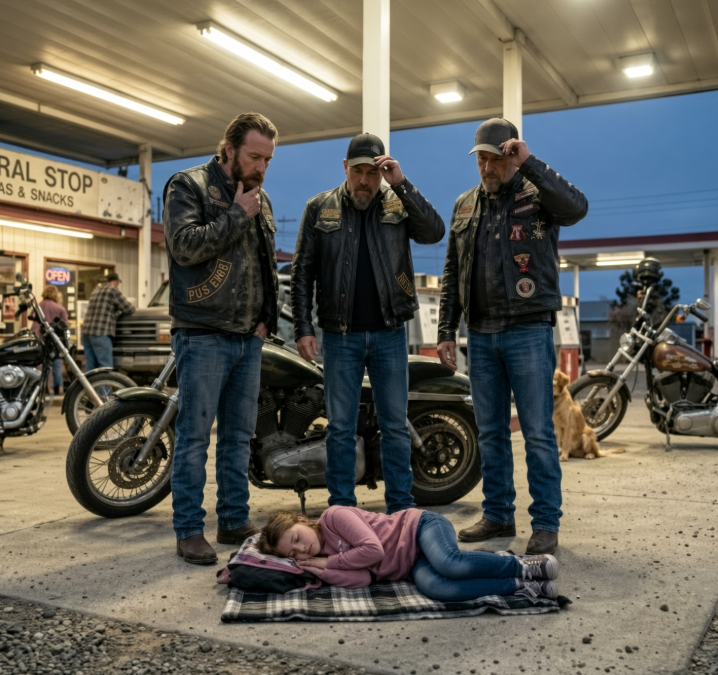
That was when I saw her.
A little girl stood near the pump.
Pink backpack at her feet.
Dirty sneakers.
Dust on both knees.
Small hands hanging at her sides.
Eyes closed.
She was asleep standing up.
I stopped so fast that Clutch nearly walked into my back.
Darren Whitfield, known everywhere as Clutch, was fifty-two, shaved bald, bearded to his chest, a former Army medic, and the only man I knew who could repair a clutch cable with wire, a pocketknife, and language strong enough to frighten machinery into obedience.
He was also the unofficial conscience of the Desert Wolves.
“Wyatt?” he said.
I did not answer.
The girl swayed forward.
Her knees buckled.
Then she jerked upright, eyes still closed, like her body had shut down but fear was forcing it to stay on duty.
I moved without thinking.
Fast at first.
Then slower.
A child alone in a place like that does not need a big man in a leather vest charging toward her.
I stopped several feet away and crouched, hands open.
“Hey,” I said softly. “Sweetheart?”
Her eyes snapped open.
Not sleepy.
Wild.
She stumbled back, one hand grabbing at the air until she found her backpack strap. Her green eyes jumped from my face to my vest, then to Clutch behind me, then to the sea of motorcycles beyond the corner of the building.
Her breathing went fast and shallow.
I stayed still.
“My name is Wyatt,” I said. “That big guy behind me is Clutch. We’re not going to hurt you.”
She said nothing.
Her lips were cracked.
Her cheeks were flushed from heat.
Her shirt was wrinkled and dusty, too big at one shoulder.
“What’s your name?” I asked.
She swallowed.
“Hadley.”
“Hadley,” I repeated gently. “That’s a beautiful name.”
She blinked like beauty was not something she expected anyone to connect to her.
“Are you here with somebody?” I asked.
Her lower lip trembled.
I saw her fight it.
Saw the way her face tightened with the effort of not crying.
Six years old and already ashamed of tears.
“She’s in the car,” Hadley whispered.
“Who is?”
“Mommy.”
My chest tightened.
“Where’s the car?”
Hadley pointed toward a row of skinny mesquite trees behind the station.
“She won’t wake up.”
Clutch’s entire face changed.
“Tommy!” he shouted over his shoulder.
I stood.
“Hadley, I’m going to look at your mom. You stay right here with Clutch, okay?”
She grabbed her backpack and took one step after me.
“I have to come.”
I turned back.
“You can come, but you stay behind me. If something scares you, you tell me.”
“I’m not scared,” she said.
The lie was so brave it nearly broke me.
We found the car half hidden in the dirt behind the building.
A faded blue Chevrolet Malibu.
Cracked windshield.
Low rear tire.
Bumper held on with a zip tie.
Nose angled toward the service road like whoever parked it had wanted to be near help without being seen.
I understood that immediately.
People running from someone do not always choose the brightest place.
The driver’s door hung slightly open.
Jolene Mercer lay across the front seat.
She was twenty-nine, maybe, but the desert made her look older. Dark hair stuck damply to her temples. Lips pale. Skin clammy. Her shirt clung to her from sweat. One arm hung toward the floorboard. Her breathing came in uneven pulls, too shallow and too far apart.
I pressed two fingers to her neck.
Pulse.
Weak.
But there.
Hadley stood behind me, both arms wrapped around her backpack.
“I tried to wake her,” she said. “I tried really hard.”
“I know,” I said.
Tommy Sutter arrived at a jog with a first aid kit in one hand.
Tommy was thirty-eight, lean, red-haired, and calm in the way only former paramedics can be calm when everyone else wants to panic. He dropped to his knees beside Jolene and checked her airway, pulse, pupils, skin, breathing.
“Talk to me,” he said.
I handed him the orange prescription bottle I had found on the passenger seat.
Tommy read the label.
“Insulin lispro. Type 1 diabetic.”
“It’s empty,” I said.
His jaw tightened.
He looked at Hadley.
“How long has your mom been like this, honey?”
Hadley hugged the bag harder.
“Since dark.”
“Last night?”
She nodded.
Tommy closed his eyes for half a second, then opened them with the focus of a man choosing action over rage.
“Hypoglycemic crisis, dehydration, heat exposure. We need glucose now and an ambulance.”
I pulled out my phone.
No signal.
Clutch checked his.
Nothing.
“Station landline,” I said.
Clutch was already moving.
Tommy dug through his kit and came out with glucose gel.
“Hadley,” he said, “I’m going to help your mom swallow a little sugar medicine. It’s not going to hurt her.”
Hadley’s eyes filled.
“Kevin said sugar makes her sick.”
Tommy paused.
“Kevin is wrong about this.”
Hadley stared at him.
The way she reacted to that name told me more than any explanation could have.
“Who’s Kevin?” I asked quietly.
Hadley looked at the dirt.
“Mommy’s boyfriend.”
Tommy met my eyes.
There was a story there.
A dark one.
Clutch came back from the station at a run.
“Carl’s calling 911. Nearest ambulance is tied up east of Seligman. Dispatch says twenty-five minutes, maybe more.”
“Hospital is twenty-six miles,” Tommy said.
“Can we move her?”
“We may have to. I can stabilize her enough for transport, but she needs IV dextrose and monitoring.”
I looked toward the highway.
The desert shimmered.
Twenty-six miles.
A woman unconscious since last night.
A child who had stayed standing because she believed she was the only signal flare her mother had left.
I turned to Clutch.
“Bring the formation quiet.”
Clutch nodded once and walked back around the building.
A minute later, the entire gas station fell silent.
Not normal silence.
Not casual quiet.
Five hundred conversations died one by one as Clutch stepped into the middle of the lot and raised his hand.
“Listen up,” he called.
The riders turned.
“We’ve got a woman behind the building in a diabetic crisis. Her little girl has been standing out here since morning because she was afraid if she sat down, nobody would see her.”
A murmur moved through the crowd.
Then stopped.
“She’s six,” Clutch added.
Something changed in the air.
Men who had been laughing minutes before went still.
Women removed sunglasses.
A young rider with his daughter’s name tattooed on his wrist looked down at the pavement like the sight of his own boots was the only thing holding him together.
“Tommy says hospital now,” Clutch continued. “We need a driver for the Malibu, escort front and rear, and somebody to stay with the girl.”
Hands went up.
All of them.
Every rider in that lot raised a hand.
I looked across the sea of leather, denim, gray hair, scars, tattoos, sunburned faces, hard eyes suddenly wet.
This was the part the world never saw.
No speech.
No committee.
No judgment about why Jolene had been driving through the desert with no insulin.
No questions about her choices.
No debate about whether the mother was responsible, whether the child was dirty, whether the car was legal, whether it was our business.
A child had been standing alone.
That was enough.
Carl Brennan came out of the convenience store carrying a paper plate covered in plastic wrap.
He was nearly seventy, thin as a fence rail, with sunspots on his hands and worry carved deep around his mouth.
“I made a sandwich,” he said, holding it toward Hadley. “Turkey and cheese. Apple too. You don’t have to pay.”
Hadley looked at me first.
That small glance, asking permission from a man she had known for ten minutes because the world had taught her food came with consequences, almost made me turn away.
I nodded.
She took the plate.
“Thank you,” she whispered.
Carl’s eyes reddened.
“You’re welcome, sweetheart.”
Hadley ate like a child who had not trusted a full meal in days.
Fast at first.
Then suddenly slow when she noticed me watching.
She lowered the sandwich.
“It’s okay,” I said. “You can eat.”
“I’m not supposed to eat too fast.”
“Says who?”
She looked toward the car.
“Kevin.”
My hand curled into a fist.
Then opened.
Not here.
Not in front of her.
Tommy stabilized Jolene enough to move. Drew Pemberton volunteered to drive the Malibu because he was the rare biker who admitted he was better in cars than on anything with two wheels. Tommy climbed into the passenger seat with his kit, glucose gel ready, one hand monitoring Jolene.
Hadley refused at first.
“I want to sit by Mommy.”
I crouched beside her.
“Tommy needs space to help her. But you can sit right behind her, and I’ll ride where you can see me.”
“What if you go away?”
“I won’t.”
She searched my face.
“You promise?”
I had made promises before.
Broken the ones that mattered most.
This time, I let the word come slowly.
With the full weight of what it meant.
“I promise.”
Hadley climbed into the back seat, buckled herself in, and hugged Bun-Bun beneath her chin.
I mounted my Harley.
Twenty bikes formed in front of the Malibu.
Twenty behind.
The remaining riders followed in a long column, controlled, steady, lawful, headlights burning in the afternoon sun.
When we pulled onto Interstate 40, cars moved aside.
Not because anyone threatened them.
Because five hundred motorcycles moving with purpose looked like weather.
I rode at the front, eyes scanning pavement, mirrors, exits, shoulders. My body knew the work. My mind stayed in the Malibu behind me, with the little girl who had asked if I would go away.
The ride to Kingman Regional Medical Center took twenty-two minutes.
I had made that stretch faster before.
Never with more care.
At the emergency entrance, the first twenty bikes peeled away. Drew pulled the Malibu to the curb. Tommy was out before the car fully stopped, shouting medical information to the ER team rushing forward with a gurney.
“Female, twenty-nine. Type 1 diabetic. Unconscious approximately eighteen hours, possible insulin rationing, severe dehydration, responsive to oral glucose but altered. Needs IV dextrose, labs, cardiac monitoring.”
Nurses moved fast.
A security guard stepped forward, staring at the motorcycles pouring into the parking lot.
“You can’t all be here,” he said.
Clutch removed his sunglasses.
His voice stayed polite.
“We’ve got a child whose mother is being taken into your ER. We’ll stay out of the way.”
The guard looked at his vest.
“This is hospital property.”
A receptionist with silver hair and a badge that read Gloria came out from behind the sliding doors.
“Ed,” she said sharply, “unless they’re blocking ambulances, leave them be.”
Ed blinked.
“Gloria, there are hundreds of them.”
Gloria looked across the parking lot at the riders shutting off engines, stepping away from entrances, guiding each other into neat rows without being asked.
“And somehow they’re quieter than half the families we get on a Saturday night,” she said. “Let the doctors work.”
Hadley stood beside the Malibu, frozen, watching her mother disappear through the automatic doors.
I came to her side.
“Can I go?” she asked.
“In a minute. They need to get her settled.”
Her chin shook.
“You said you’d come with me.”
“I will.”
She reached for my hand.
Her fingers barely wrapped around two of mine.
I had ridden through hail, fights, funerals, and fifteen years of my own cowardice.
But that tiny hand nearly dropped me.
The ER waiting room became a story people in Kingman would tell for years.
Bikers filled every chair, lined every wall, and sat cross-legged on the floor. They spoke in low voices or not at all. A few went outside so patients could sit. One rider bought every bottle of water from the vending machine and handed them out to strangers. Another found a coloring book in the gift shop for Hadley. Someone else paid for it before I could reach my wallet.
Gloria watched from the desk with tears she refused to let fall.
Hadley sat beside me in a molded plastic chair, Bun-Bun in her lap. She had eaten half a granola bar, then hidden the other half in her backpack.
“You can finish it,” I said.
“I’m saving it.”
“For what?”
“Later.”
I nodded because arguing with survival habits was useless.
“What happens if Mommy wakes up?” she asked.
“We tell her she’s safe.”
“What happens if she doesn’t?”
My chest tightened.
“We wait with you.”
Hadley looked at me.
“All of you?”
I glanced around the room.
Clutch stood near the vending machines, arms crossed, watching the ER doors. Tommy had disappeared into the treatment area. Riders sat shoulder to shoulder, leather creaking, boots planted, faces grim.
“Yeah,” I said. “All of us.”
Hadley leaned against my arm.
Not fully.
Just enough.
Within minutes, she fell asleep.
This time, sitting down.
This time, because someone else was staying awake.
I did not move.
For two hours, I sat perfectly still, afraid any shift would wake her. My left arm went numb. My back cramped. I ignored both.
I looked down at Hadley’s tangled hair against my sleeve and saw another child’s head.
Brown curls instead of brown tangles.
A tiny hand holding a plastic wrench.
Emma asking why motorcycles were loud.
“Because they don’t know how to whisper,” I had told her.
Emma had giggled.
I had forgotten the sound of that giggle for years.
Or told myself I had.
Now it came back so clearly it hurt.
Clutch sat beside me, lowering himself slowly into the chair like his knees were negotiating terms.
“You all right?” he asked.
“No.”
“Good. Honest answer.”
I kept my eyes on Hadley.
“She’s six.”
“I know.”
“Emma was almost six when I missed her birthday the first time.”
Clutch said nothing.
“Ruth called me that night,” I whispered. “Said Emma waited by the window because I told her I’d come. I was in Reno with the club. I let it ring.”
Clutch’s jaw shifted.
“I let it ring.”
Hadley slept on.
Clutch leaned forward, elbows on knees.
“I remember that year,” he said. “You were drowning and calling it freedom.”
I closed my eyes.
“That supposed to help?”
“No. Truth rarely helps at first.”
I gave a humorless laugh.
Clutch looked toward the ER doors.
“Call her.”
My mouth went dry.
“Emma?”
“No, the Queen of England.”
“She won’t answer.”
“Maybe not.”
“She hates me.”
“Maybe.”
“Clutch.”
My friend turned to me.
“You think this little girl stood all night because she knew her mother would wake up? She stood because there was a chance. Sometimes a chance is enough to keep a person on their feet.”
I looked down at Hadley’s sleeping face.
A chance.
The ER doors opened.
Tommy stepped out, red hair damp with sweat, expression tired but relieved.
The entire room rose like one body.
Tommy lifted a hand.
“She’s awake.”
The sound that moved through the room was not cheering at first.
It was breath.
Five hundred people exhaling at once.
“Blood sugar is stabilizing,” Tommy continued. “They’re keeping her overnight. She’s dehydrated and weak, but she’s talking.”
Hadley woke at the movement.
Her eyes flew open in panic.
I leaned close.
“Your mom’s awake.”
Hadley stared at me, processing the words.
Then she scrambled off the chair so fast Bun-Bun fell to the floor.
I picked up the rabbit and followed her through the double doors after Tommy cleared it with the nurse.
Jolene Mercer lay in a hospital bed, pale as paper, an IV running into her arm. Her eyes were open, frantic, searching the room before they found Hadley.
“Baby,” Jolene whispered.
Hadley climbed onto the bed and collapsed against her.
“Mommy.”
Jolene wrapped her arms around her daughter with what little strength she had. The sound she made was not quite sobbing and not quite speech. It was something older than both, a broken animal sound pulled from the deepest part of a mother who had awakened to the terror that her child might have been alone in the world.
“I’m sorry,” Jolene cried into Hadley’s hair. “I’m so sorry. I tried to wake up. I tried.”
“I stood up,” Hadley said, muffled against her.
“I know, baby.”
“I didn’t sit down.”
“I know.”
“They saw me.”
Jolene looked over Hadley’s head toward me.
Her eyes were full of confusion, gratitude, and shame she had not earned.
“Who are you?” she whispered.
I stood in the doorway, holding Bun-Bun.
“Just a man who stopped for gas.”
Jolene cried harder.
The doctor came in. Nurses adjusted lines. A hospital social worker named Patricia Hensley arrived with a legal pad and the gentle, focused expression of someone who knew the difference between an accident and a story with teeth.
I stepped into the hallway to give them privacy.
Hadley objected immediately.
“Don’t go.”
I stopped.
“I’ll be right outside the door.”
“Where I can see your boots?”
I looked down at my worn black boots.
“Where you can see my boots.”
So I stood in the hallway with one foot visible from the bed.
For forty minutes, Hadley kept glancing at that boot as Patricia spoke with Jolene.
The story came in fragments.
Jolene had grown up in Bakersfield but moved to Texas at twenty-two for work. She met Kevin Rusk when Hadley was two. He was charming in the beginning, the kind of charming that made waitresses smile and strangers call him helpful. He brought groceries when Jolene was sick. He fixed her alternator. He learned how to make Hadley laugh by pretending spoons were airplanes.
Then came the rules.
Don’t wear that.
Don’t talk to him.
Why did you take so long at the store?
Who are you texting?
Then the money.
Then the medicine.
Kevin did not break Jolene all at once.
Men like him rarely do.
He studied the places where life had already worn her thin and pressed there. He said her diabetes made her expensive. He said nobody else would want a sick woman with a kid. He said Hadley needed a man in the house. He said if Jolene ever left, he would tell police she was unstable, that she forgot medication, that she endangered her child.
Then one night in Amarillo, Hadley hid in the laundry room while Kevin screamed so loudly the neighbor’s dog barked for twenty minutes.
The next morning, Jolene found her insulin supply missing from the refrigerator.
Kevin smiled and said, “Guess you better learn to appreciate who pays for things.”
That was when Jolene started planning.
She called her older sister Debbie in Bakersfield from a grocery store bathroom.
Debbie cried, then said, “Come home. I don’t care how. Just come home.”
Jolene waited until Kevin left for an overnight warehouse shift. She packed two bags, grabbed what insulin she could find from an emergency kit Kevin had not known about, took Hadley, and drove west.
Three days.
A scared mother.
A hungry child.
A failing car.
An insulin supply cut in half to make it last.
Jolene had planned every mile except the one where her body gave out.
“I thought I could make it,” she told Patricia, tears sliding into her hairline. “I thought if I could just get to California, we’d be safe.”
Patricia wrote carefully.
“Did Kevin know where you were going?”
“No.”
“Does he have legal rights to Hadley?”
“No. He’s not her father.”
“Has he threatened to report you?”
Jolene laughed once, bitter and weak.
“He doesn’t threaten. He promises.”
As if summoned by his own cruelty, Kevin Rusk called the hospital that evening.
Gloria answered at the desk.
I was standing nearby with coffee I had forgotten to drink when I saw her expression change.
“This is Kingman Regional,” Gloria said, voice professional. “Sir, I can’t confirm patient information without authorization.”
A pause.
“Sir, yelling will not change privacy law.”
Another pause.
Gloria’s face hardened.
“Sir, if you threaten to come here and remove anyone from this hospital, I will inform security and law enforcement.”
I set down the coffee.
Gloria hung up and immediately reached for another line.
“Ed,” she called to the security guard. “Call Kingman PD. Now.”
Clutch appeared beside me.
“Trouble?”
“Kevin.”
The name moved through the riders in the waiting room without anyone needing explanation.
Patricia came out of Jolene’s room fifteen minutes later, face controlled.
“He called the nurses’ station too,” she said. “Claimed Jolene stole his vehicle and kidnapped his daughter.”
“His daughter?” I asked.
“He has no legal relationship. I verified.”
Clutch’s voice was low.
“Is he coming?”
Patricia looked toward the sliding doors.
“He said he is.”
I felt the old anger rise, hot and ready.
Then I looked toward Jolene’s room, where Hadley was finally asleep in a chair beside her mother’s bed.
Not here.
Not in front of her.
“We do this clean,” I said to Clutch.
Clutch nodded.
“Always.”
I turned to the riders.
“Nobody touches him. Nobody blocks police. Nobody gives him a story to use. We stand where we’re allowed. We witness. That’s it.”
A young rider named Mason cracked his knuckles.
I looked straight at him.
“I mean it.”
Mason dropped his hands.
“Yes, sir.”
Kevin Rusk arrived at 9:12 p.m. in a black pickup with Texas plates and fury driving faster than sense.
He parked crooked in the ER lane, jumped out, and slammed the door hard enough to turn heads.
He was thirty-six, broad shouldered, clean shaven, wearing a work shirt with his name stitched above the pocket.
To a stranger, he might have looked respectable.
Angry, maybe.
But respectable.
The world gave men like Kevin chances it denied men like me.
He stormed toward the entrance.
Then he saw the motorcycles.
Five hundred had become fewer by then, but more than two hundred riders still remained around the hospital, spread through the lot, along the walkway, near the vending machines outside, in quiet clusters under the lights.
Kevin slowed.
Only for a second.
Then arrogance pushed him forward.
“What is this?” he snapped at Ed. “Some kind of biker convention?”
Ed stepped in front of the sliding doors.
“Sir, you need to move your truck from the ambulance lane.”
“My girlfriend is in there with my kid.”
Patricia came through the doors with two Kingman police officers behind her.
“Mr. Rusk?”
Kevin’s eyes narrowed.
“Who are you?”
“Patricia Hensley, hospital social worker. These officers need to speak with you.”
Kevin laughed.
“No, sweetheart, you need to get out of my way.”
The word sweetheart landed in the air like a stain.
I stood twenty feet away, arms at my sides.
Kevin saw me.
His mouth curled.
“Oh, I get it,” Kevin said. “Jolene found herself protection. That it? Some old biker playing hero?”
I said nothing.
Kevin pointed at me.
“You touch my family, I’ll bury you.”
One officer stepped forward.
“Mr. Rusk, lower your voice.”
Kevin turned on him.
“I called in a stolen vehicle and a kidnapping. Why are you standing here like I’m the criminal?”
The second officer, a woman named Ruiz, held up a folder.
“Because the vehicle is registered to Jolene Mercer. The child is Jolene Mercer’s daughter. You are not listed on the birth certificate, and there is no custody order involving you.”
Kevin’s face twitched.
“She’s unstable. She’s diabetic. She can’t take care of herself.”
Patricia spoke calmly.
“We have medical evidence that Ms. Mercer was rationing insulin after leaving an abusive situation.”
Kevin scoffed.
“Of course she said that.”
Officer Ruiz continued.
“Amarillo PD also contacted us. A neighbor filed a report two nights ago after hearing a disturbance at your residence. They are requesting a statement from Ms. Mercer.”
Kevin looked around.
Riders watched in silence.
Patients’ families watched from the lobby.
Gloria watched from behind the desk like she would remember every word.
Kevin’s voice got meaner because his control was slipping.
“She’s nothing without me,” he said. “You hear me? Nothing. She’s broke, sick, and stupid. That kid would be in foster care if I hadn’t taken them in.”
The sliding doors opened.
Jolene stood inside in a hospital gown, one hand on an IV pole, Hadley’s small hand wrapped around the fabric at her side. A nurse hovered behind them, ready to pull them back if needed.
Jolene was pale.
Weak.
Trembling.
But she was standing.
Kevin saw her and pointed.
“Get your stuff. We’re leaving.”
Hadley hid behind her mother’s leg.
Jolene’s voice shook, but it came out clear.
“No.”
The entire entrance went still.
Kevin blinked.
“What did you say?”
“No,” Jolene repeated.
I saw what it cost her.
Saw her fingers tighten on the IV pole.
Saw every instinct in her body screaming to make him calm, make him stop, make him happy, make it safe.
But she stayed upright.
Like Hadley had stayed upright.
Kevin took one step forward.
Two hundred bikers did not move.
That was the power of it.
They did not threaten.
They did not advance.
They simply stood there, every eye on him, turning his private cruelty into a public record.
Officer Ruiz blocked his path.
“Mr. Rusk, you are not entering this hospital room.”
Kevin’s face flushed dark.
“You people don’t know what she’s like.”
Patricia’s voice stayed steady.
“We know what you’re like. You’ve shown us.”
Kevin turned toward the crowd, sneering.
“You think these freaks are going to save you forever?”
Hadley peeked around Jolene’s leg.
My chest tightened at the fear in her eyes.
Then something unexpected happened.
Carl Brennan, the gas station owner, stepped forward from the lobby.
He had driven to the hospital after closing the store early, bringing the security footage on a flash drive because he said he did not trust computers to “mail the truth correctly.”
“I saw that little girl standing outside my station,” Carl said, voice rough. “I saw every car that didn’t stop. I saw those bikers stop. If you think calling them names makes you look better, son, you’re mistaken.”
Kevin laughed.
“Old man, mind your business.”
Gloria came out from behind the desk.
“This is my business,” she said. “People come here hurt. We notice who helps and who makes it worse.”
A nurse behind Jolene added, “And you’re making it worse.”
Kevin looked around again.
For the first time, he understood he had misjudged the room.
He was used to closed doors.
Thin apartment walls.
Women apologizing to keep peace.
Children hiding in laundry rooms.
He was used to shaping the story before anyone else heard it.
Here, under hospital lights, with police, nurses, bikers, witnesses, cameras, and one exhausted mother finally saying no, Kevin had no shadows left.
Officer Ruiz turned him around.
“Kevin Rusk, you are being detained pending investigation into domestic violence threats, child endangerment, and filing a false police report.”
Kevin exploded.
The words were ugly.
The struggle was brief.
The officers handled it.
The riders did not touch him.
Hadley watched from behind Jolene.
I wished she had not seen any of it.
But when Kevin was placed in the back of the patrol car, Hadley whispered, “He looks smaller outside.”
Jolene covered her mouth and cried.
I looked at the little girl.
Maybe that was how fear started dying.
Not all at once.
Just smaller.
Over the next two days, the story widened.
Not online first, though eventually it would reach there.
First, it widened in practical ways.
Patricia contacted Debbie in Bakersfield. Debbie answered on the second ring and cried so hard Patricia had to wait for her to breathe. She confirmed Jolene’s story. She offered her address, her spare room, her church, her paycheck, her whole life if necessary.
Amarillo police opened a case.
A neighbor sent photos of damage to Jolene’s apartment door.
A pharmacist confirmed Kevin had picked up Jolene’s insulin once and never delivered it to her.
Hospital labs confirmed prolonged insulin rationing.
Carl’s gas station footage showed Hadley standing for hours while Jolene lay unconscious behind the building.
It also showed dozens of people passing.
That footage would later become part of the case.
I never watched it all the way through.
I did not need to see every person who failed her.
I had seen enough.
The Hells Angels stayed.
Not all five hundred. The charity ride had a schedule. Donations were waiting in Las Vegas. Veterans were counting on the fundraiser. Clutch sent the main convoy on the next morning, but fifteen riders remained in Kingman with me.
“That woman and child leave when they’re ready,” Clutch said. “And when they leave, they leave right.”
He meant it.
Bruce Crawford, a local mechanic who had heard the story from his wife, a nurse at Kingman Regional, showed up before breakfast and asked for the keys to the Malibu.
He replaced the oil.
Brake pads.
Windshield.
Wiper blades.
Battery.
Two tires.
Another rider paid for the parts before Bruce could refuse. Bruce refused labor anyway.
“I’ve got daughters,” he told me. “Plural. That’s enough.”
Gloria organized a clothing run.
Three riders who looked like they had never entered a children’s store in their lives came back with bags of dresses, pajamas, socks, sneakers, hair ties, a purple lunchbox, and a stuffed dinosaur Hadley named Pancake for reasons nobody understood and everyone accepted.
Clutch passed a helmet through the riders.
Cash filled it.
Then filled a second helmet.
By the time Gloria and Patricia counted it in a hospital conference room as witnesses, there was more than eighteen thousand dollars.
“For Bakersfield,” Clutch said. “First month, medicine, food, whatever keeps them from having to go back.”
Jolene refused at first.
“I can’t take that,” she said, sitting weakly in the hospital chair, Hadley asleep against her side.
Clutch looked at her with the calm seriousness of a man who had buried friends and learned what pride cost.
“Ma’am, I say this respectfully. Yes, you can.”
“I don’t know how to pay it back.”
“You don’t pay it back. You get safe. You raise her. Someday, when life gives you extra, you help somebody else.”
Jolene cried again.
Quietly this time.
Hadley spent most of those days near me.
She followed me to the vending machine.
Sat beside me in the cafeteria.
Made me hold Bun-Bun while she tied her shoe.
Asked why my vest had patches, why motorcycles were loud, why Clutch had such a long beard, whether Tommy was a doctor, whether bad people could look nice, whether nice people could look scary.
I answered what I could.
One afternoon, we sat beneath a thin tree in the hospital courtyard that gave almost no shade.
Hadley swung her feet from the bench.
“Can scary-looking people be safe?” she asked.
I thought about the question.
“Yes,” I said.
“Can safe-looking people be bad?”
I looked toward the hospital doors, thinking of Kevin’s clean work shirt and polite public smile.
“Yes.”
“How do you know?”
I breathed out.
“You watch what they do when nobody important is looking.”
Hadley considered that.
“You saw me.”
“I did.”
“Was I important?”
I turned to her.
“Yes.”
She looked down quickly, embarrassed by the answer.
That evening, after Hadley fell asleep beside Jolene, I walked outside to the far edge of the hospital parking lot. The desert night had cooled. The motorcycles sat in a row under yellow lights, quiet for once.
I took out my phone.
Emma’s number had been in my contacts for fifteen years.
I had changed phones six times and transferred it every time, like carrying a key to a house I was too ashamed to approach.
My thumb hovered.
I heard Hadley’s voice in my head.
If I fall asleep, nobody will see me.
I pressed call.
It rang once.
Twice.
Three times.
Four.
“Hello?”
I closed my eyes.
Emma’s voice was older, guarded, unfamiliar, and still somehow the sound of every mistake I had ever made.
“Emma,” I said. “It’s your dad.”
A silence opened.
So wide I could have ridden into it and never come out.
“I know who it is,” she said.
Her voice was not cold.
Cold would have been easier.
It was controlled.
Wary.
Built from years of learning not to hope.
“I don’t expect you to want to talk to me,” I said. “I don’t expect forgiveness. I just needed to tell you I’m sorry.”
Nothing.
“I’m sorry I left. I’m sorry I missed birthdays and school plays and every ordinary day that should have had me in it. I’m sorry I made your mother carry the truth because I was too much of a coward to face it. I’m sorry it took me fifteen years to say what you deserved to hear when you were four.”
Emma’s breathing changed.
“Why now?”
I looked at the motorcycles.
“I met a little girl at a gas station. Six years old. Her mom was unconscious in a car, and that little girl stood all night so someone would see her. She didn’t know if anyone would help. She stood anyway.”
I swallowed.
“She made me realize I’ve been sitting down for fifteen years.”
Emma said nothing.
“I know I don’t have the right to ask for anything,” I continued. “But if you ever want to hang up on me in person, or on the phone, I’ll answer. If you want to tell me what I did, I’ll listen. If you want nothing from me, I’ll respect that too. I just didn’t want one more day to pass with you thinking I forgot you.”
Emma’s voice came softer.
“I thought you did.”
I pressed my hand over my eyes.
“I didn’t. I was ashamed. That’s not an excuse. It’s just the truth.”
Another silence.
Then Emma said, “I’m not ready to forgive you.”
“I know.”
“I’m not even ready to be nice to you.”
A broken laugh escaped me.
“That’s fair.”
“But you can call again.”
The words struck me so hard I bent forward.
“Okay.”
“Not every day.”
“No.”
“And don’t make promises you won’t keep.”
My voice steadied.
“I won’t.”
Emma breathed in.
“What was her name? The little girl.”
“Hadley.”
“She okay?”
“She will be.”
Emma paused.
“Then call me next week and tell me if she got to California.”
I looked up at the desert sky.
For the first time in fifteen years, the stars did not look like witnesses.
They looked like openings.
“I will,” I said.
On the morning Jolene was discharged, Kingman Regional seemed reluctant to let them go.
Nurses hugged Hadley.
Gloria packed snacks in a plastic bag.
Patricia handed Jolene a folder with restraining order information, victim resources, medical records, contact numbers, and a note written in her own hand.
You did not fail. You got out.
Jolene read that note three times.
Outside, the Malibu waited in the sun.
Transformed.
Not new.
But safe.
Fresh tires.
Clean windshield.
Full tank.
Oil changed.
Brakes repaired.
A small cooler in the back seat held water, fruit, sandwiches, and Jolene’s insulin packed properly with cold packs. Debbie had wired money for a motel halfway if they needed it. Clutch added the envelope anyway, sealed and tucked in the glove box.
Jolene stood by the driver’s door, one hand on the roof.
“I don’t know how to say thank you for something this big.”
I looked at Hadley, who was showing Pancake the dinosaur to Bun-Bun like introductions mattered.
“Get to Bakersfield,” I said. “That’s thanks enough.”
Jolene shook her head.
“No. It isn’t.”
She looked at the fifteen riders waiting by their bikes, at Clutch, Tommy, Bruce, and Gloria standing near the hospital doors though she was supposed to be working.
“All my life,” Jolene said, “people told me to be careful around men who looked dangerous. Nobody warned me about the ones who looked normal.”
Clutch’s face softened.
Jolene turned back to me.
“When Hadley is older, I’m going to tell her the truth. That a parking lot full of strangers did what people who knew us wouldn’t do.”
I nodded.
Hadley ran to me then, backpack bouncing.
She stopped short, suddenly shy.
“Are you going to California too?”
“No, little warrior. I’ve got to head west to Las Vegas, then back home.”
“Will I see you again?”
The question hit me in a place already tender from Emma’s call.
“If your mom says it’s okay, I can write. Maybe visit someday.”
Hadley looked at Jolene.
Jolene smiled through tears.
“I think letters would be okay.”
Hadley reached into her backpack and pulled out a folded paper. She had drawn it in the hospital with crayons Gloria found at the nurses’ station.
It showed a tiny girl standing beside a car.
Around her were motorcycles drawn as black circles with handlebars sticking out.
Above them, in careful block letters, she had written:
THEY SAW ME.
I took the paper like it was a medal.
“I’m keeping this forever.”
“You have to,” Hadley said seriously. “Paper remembers.”
I froze.
“Who told you that?”
“Mommy. She said when people lie, write it down.”
I looked at Jolene.
She gave a faint, sad smile.
“Hadley kept asking how we’d prove Kevin was bad if he smiled at the police.”
I folded the drawing carefully and put it inside my vest, near my heart.
Hadley stepped forward and wrapped her arms around my neck.
I knelt and held her.
She smelled like strawberry shampoo, hospital soap, and desert sun.
“Thank you for seeing me,” she whispered.
I closed my eyes.
“Thank you for standing up.”
The Malibu pulled out of the hospital lot just after ten.
Fifteen motorcycles escorted it to the interstate entrance. At the ramp, Jolene rolled down her window. Hadley waved from the back, Bun-Bun in one hand, Pancake in the other.
I raised my hand.
The Malibu headed west toward Bakersfield.
Toward Debbie.
Toward a spare room.
Toward a life where medicine would not be used as a leash and a child would not have to stand guard in the desert.
I watched until the car became a bright speck on the horizon.
Then it was gone.
Clutch pulled up beside me.
“You good?”
I wiped my face with one hand.
“No.”
Clutch smiled.
“Good. Still honest.”
Three months later, I parked my motorcycle outside a coffee shop in Tucson.
I arrived forty minutes early and spent thirty-nine of them outside pretending to check my phone.
My palms were sweating.
My mouth was dry.
I had faced men with knives, storms on mountain passes, mechanical failures at ninety miles an hour, and once a bar owner with a shotgun.
None of it scared me like the young woman waiting inside.
Emma sat at a corner table with both hands wrapped around a paper cup. She was nineteen now. Brown hair pulled back. Pale blue eyes like mine, though hers had more reason to be guarded.
She looked up when I entered.
For a moment, neither of us moved.
I saw the four-year-old I had left and the woman who had survived my leaving.
Emma saw the father she had needed and the stranger who had finally called.
There was no hug.
Not then.
That would come later.
After awkward phone calls.
After hard questions.
After I learned to apologize without asking her to comfort me for the guilt.
It would come after I attended one of her community college art shows and stood in the back with flowers, crying quietly at a painting of a desert gas station I recognized from my own description.
It would come after Ruth agreed to meet me for coffee and told me, without cruelty, “You don’t get to rewrite the past, Wyatt. You only get to stop adding to the damage.”
But that day, Emma pulled out the chair across from her.
I sat.
She looked at me for a long time.
Then she said, “Tell me about Hadley.”
So I did.
I told her about the heat, the gas station, the cracked air pump, the little girl swaying on her feet. I told her about Jolene, the empty insulin bottle, Kevin’s lies, the hospital, the riders raising money, the drawing that said THEY SAW ME.
I told her about Hadley asking whether scary-looking people could be safe.
Emma listened.
At the end, she looked down at her coffee.
“She sounds brave.”
“She is.”
Emma’s eyes lifted.
“So were you always capable of showing up, and you just didn’t?”
The question cut clean.
I accepted it.
“Yes,” I said. “I think that’s the worst part.”
Emma nodded slowly.
“Good answer.”
“Doesn’t feel good.”
“It wasn’t supposed to.”
For the first time, the corner of her mouth moved.
Not forgiveness.
Not yet.
But something alive.
A beginning.
In Bakersfield, Jolene and Hadley moved into Debbie’s small yellow house on a street lined with orange trees. Hadley started first grade two weeks late, carrying her purple lunchbox and wearing sneakers that lit up when she ran.
On the first day, the teacher asked the class to draw something brave.
Hadley drew herself standing at a gas station.
Then she drew motorcycles.
When the teacher asked who the people were, Hadley said, “Those are the ones who stopped.”
Jolene found work at a medical billing office by November. Debbie drove her to appointments until she was steady enough to drive herself. A domestic violence advocate helped her file a protective order. Kevin Rusk eventually pled guilty to domestic assault, coercive control-related threats, child endangerment, and filing a false police report.
The sentence was not enough to erase what he had done.
Sentences rarely are.
But it was something official.
Something written.
Paper remembered.
Every month, Hadley mailed me a drawing.
A motorcycle with wings.
A desert sun wearing sunglasses.
Bun-Bun and Pancake riding in a sidecar.
A picture of her and Jolene in front of a yellow house with the words MOMMY SLEEPS IN A BED NOW.
I kept every one.
I bought a corkboard for my garage and pinned them above my workbench, where grease-stained men who once avoided emotional conversations now stood quietly reading a child’s block letters and pretending to inspect spark plugs.
One year after Desert Ridge, the charity ride returned to the same gas station.
Carl Brennan had painted the sign. The cracked air pump had been replaced. A new bench sat near the side of the building beneath a shade awning the Desert Wolves had paid for without letting Carl argue.
On the bench was a small brass plaque.
For anyone waiting to be seen.
No names.
No spectacle.
Just that.
I stood in front of it with Clutch beside me.
“Hadley sent something,” Clutch said.
He handed me an envelope.
Inside was a photograph.
Hadley, now seven, missing one front tooth, standing in front of her school with a backpack on both shoulders and a grin too big for fear. Jolene stood behind her, healthier, fuller in the face, one hand resting on her daughter’s shoulder.
On the back, Jolene had written:
She sits when she’s tired now. She knows someone will still see her.
I read it twice.
Then I folded it carefully and put it inside my vest, beside the drawing.
My phone buzzed.
A message from Emma.
You still coming Sunday?
I stared at it.
Then typed back.
Wouldn’t miss it.
I meant it.
The formation gathered behind me, engines waiting.
Five hundred riders under the Arizona sun.
The world still saw what it wanted to see when it looked at us.
Leather.
Noise.
Danger.
Trouble.
But I knew better than most that people were not saved by appearances.
They were saved by action.
By the stranger who stops.
By the witness who speaks.
By the mother who says no with shaking knees.
By the child who stays standing until help arrives.
I put on my gloves, swung onto my Harley, and looked once more at the bench by the air pump.
A year earlier, a six-year-old girl had stood there because she believed she was the last line between her mother and death.
She had been wrong about one thing.
She had never been standing alone.
I lifted my hand.
The engines roared to life, deep and rolling across the desert.