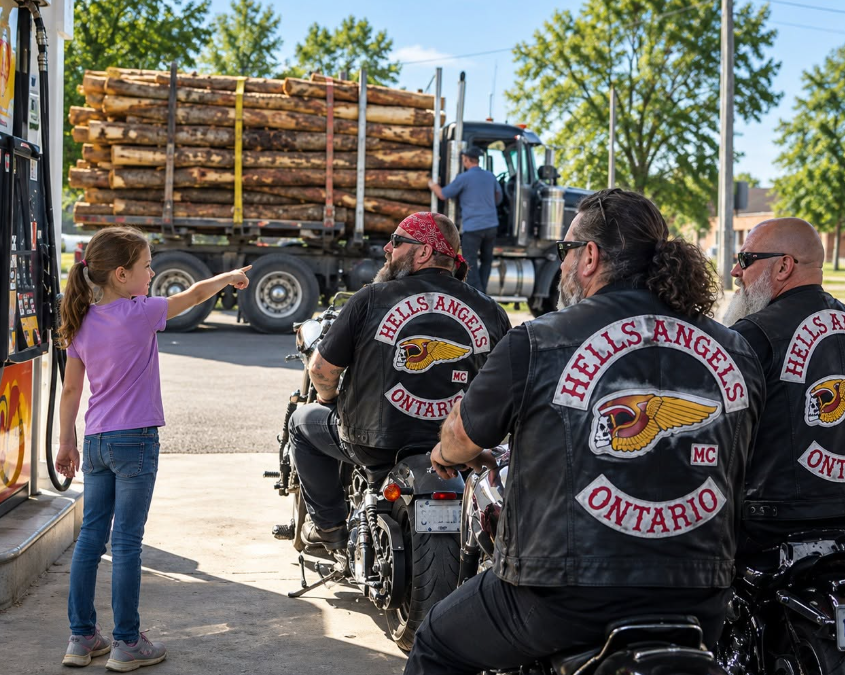
A7-Year-Old Girl Stepped in Front of an 18-Ton Logging Truck at a Gas Station—Then She Pointed Between the Logs and Begged One Old Biker to Look Closer.
The whole gas station saw a seven-year-old girl standing in front of eighteen tons of steel and decided she was either lying or confused.
I was the old biker who knelt down and asked her to say it again, because fear in a child’s voice has a shape you do not forget.
By sunset, five hundred engines were rolling toward the desert, and every person who had judged us by our leather was about to learn what listening could save.
I had already decided that afternoon would be my last ride at the front.
I had not told the club.
Men like me are stupid that way.
We will tell another man to see a doctor.
Call his daughter.
Fix his brakes.
Stop ignoring chest pain.
Talk to someone before grief eats him alive.
But when our own hands start shaking, we hide them under the table and call it weather.
My right hand had begun trembling two months earlier.
Not much at first.
A twitch near the thumb.
A little shake when I poured coffee into a full mug.
A delay when I buttoned my cuff.
The neurologist in Riverside used soft words because doctors believe soft words make hard news land better.
Progressive.
Management.
Idiopathic.
Possible Parkinson’s.
Possible.
That word did not comfort me.
Possible meant I could still pretend.
So I did.
I pretended while leading rides.
Pretended while signing receipts.
Pretended while gripping handlebars harder than I needed to.
Pretended while younger men in the club looked to me at intersections, waiting for the old man to point the way.
They called me Deacon.
My real name was Roy Kesler, but few people used it anymore.
Names change when life changes.
I had been Lance Corporal Kesler once.
Then Officer Kesler with the California Highway Patrol.
Then Detective Kesler in accident reconstruction.
Then early-retired Kesler after I refused to stop asking why commercial hauling routes kept showing the same impossible patterns around missing girls and suspicious wrecks.
After that, I became Deacon.
Old biker.
White beard.
Bald head.
Bad knees.
Leather vest.
A Red Rock patch over my heart.
PART2:
The kind of man grandmothers warned children about before lowering their voices and pretending warning was the same thing as wisdom.
I knew what people saw when we pulled into Callahan’s Fuel and Grocery that second Thursday in July.
They saw trouble.
They saw loud engines.
Black leather.
Ink up thick forearms.
Patches across wide backs.
A dozen motorcycles became two dozen, then more, until the windows buzzed with the sound of all those engines settling into the lot.
The Route 66 charity poker run had staged nearby that morning, and riders were stopping for fuel, water, cigarettes, coffee, and the kind of snacks men buy when they know better but pretend calories do not count on the road.
Inside the store, Vivien Callahan reached for the phone the way she always did.
I saw her through the glass.
Seventy-four years old.
Thin as a fence post.
Hair pinned tight.
Eyes sharper than any pocketknife in the county.
Vivien had run that gas station since before half the riders in our group knew how to spell carburetor.
She did not trust motorcycle clubs.
She never had.
Maybe she had reasons.
Maybe she had stories.
Maybe some of them were even true.
People’s fear usually has roots somewhere, even when it grows in the wrong direction.
What I did not see at first was the girl.
Ruby.
Vivien’s granddaughter.
PART3:
Seven years old and small enough that the ice cream case nearly hid her from my view.
She was holding a box of drumsticks, staring through the glass door with the open fascination children have before adults teach them which strangers to fear.
Then the logging truck pulled in.
It came off the eastbound ramp slow and heavy, brakes hissing, diesel engine rattling like something tired of its own weight.
The flatbed carried peeled pine logs stacked high and strapped down with yellow ratchet straps.
Dust caked the mud flaps.
The company logo on the driver’s cap did not match the plain white trailer sides.
That was the first thing that bothered me.
Small thing.
Wrong thing.
I had spent twenty-two years reading the language of vehicles after disaster had already happened.
Tire marks.
Crush patterns.
Axle weight.
Brake failure.
Load shift.
False compartments.
Men lie.
Steel lies less often.
The second thing that bothered me was the passenger.
He jumped out before the truck fully stopped.
Not climbed.
Jumped.
Boots hitting asphalt before the air brakes finished their long exhale.
He glanced back toward the load, quick and nervous, checking something he did not want anyone else to notice.
My hand tightened around the handlebar.
Then Ruby moved.
She set the ice cream down on the floor inside the store and walked past the register.
Vivien called after her.
Ruby did not stop.
The bell over the door jingled as she stepped into the Inland Empire heat.
She walked straight across the lot toward the truck’s exit path.
One arm up.
One finger pointing at the logs.
Her voice cracked through the diesel rattle.
“There’s somebody in there!”
The driver’s door opened.
The man behind the wheel was heavyset, unshaven, sweating under a faded cap.
“Move it, kid.”
Ruby did not move.
“There’s somebody in the logs!”
Every person at those pumps had already decided who she was.
A child in the way.
Confused.
Overheated.
Looking for attention.
Every person had already decided who we were too.
Bikers.
Danger.
Problem.
Trouble before a word was spoken.
I killed my engine and got off slowly.
My knees cracked loud enough that a younger rider nearby winced for me.
I ignored him.
The truck rolled forward an inch.
Not much.
Enough.
Vivien was coming fast from the store, terror turning her face pale.
I reached Ruby first.
Instead of grabbing her, I knelt in front of her.
That matters.
You do not stand over a frightened child and ask for truth.
You get down where truth can reach you.
“Say it again,” I told her.
Quietly.
Ruby’s finger shook.
“There’s a hand,” she said, and now that someone was listening, fear caught up with her all at once. “Between the logs. I saw a hand. It went away when the door shut.”
Behind me, engines cut off one by one.
The lot began to change.
Curtis Landry came forward first.
Thirty years younger than me and built like a refrigerator with a temper he had spent the last decade learning to fold properly before putting it away.
Two more riders followed.
Then three.
Not crowding.
Not threatening.
Just present.
The driver looked from Ruby to me to the wall of leather forming around his cab.
His face changed.
Annoyed became calculation.
“Get that kid out of my way,” he said. “Or there’s going to be trouble.”
“You’re not going anywhere,” I said.
I did not raise my voice.
I did not need to.
“Not until somebody looks at that load.”
“It’s timber. Peeled pine. You want the manifest? I got a manifest.”
“Then showing it costs you nothing.”
The passenger had drifted toward the far side of the trailer.
Fast.
Low.
The way men move when their body has already voted to run and their brain is still filling out paperwork.
Curtis stepped into his path.
One big hand landed flat on the man’s chest.
Not a shove.
A wall.
“Where you headed, partner?”
“Nowhere. I don’t know what she’s talking about.”
“Didn’t ask what you knew. Asked where you were headed.”
Vivien reached Ruby and pulled her back against her side.
Up close, she looked at me for the first time not like a biker, not like a threat, but like a man who had listened to her granddaughter before she had.
It was not trust yet.
Nothing that generous.
But it was the first crack in a wall that had been standing a long time.
“She could be lying,” the driver said.
Softer now.
Wheedling.
“Kids see things. It’s hot. Everybody’s imagining.”
“Then it’s a two-minute problem,” I said. “You show the load, we all go about our day, and I’ll buy you coffee for the trouble.”
That was when the deputy arrived.
No siren.
Lights turning.
Deputy Ellis Marsh was young.
Twenty-six maybe.
Four years on the job.
Every lesson he had ever heard about motorcycle clubs already sitting behind his eyes.
He stepped out with his hand resting near his belt.
The first thing he saw was two dozen bikers surrounding a truck.
The story wrote itself in his head.
I watched it happen.
“Everybody back away from the vehicle,” Marsh ordered. “Now.”
“Deputy,” I said, turning with my hands visible, “there’s a girl here who says there’s a person hidden in that load. We’re not doing anything except standing here until somebody checks it.”
“I got this. Step back.”
“Then check it. That’s all we’re asking.”
Marsh looked at Ruby.
Small.
Shaking.
Pressed against Vivien’s side.
Then he looked at the driver, sweating harder now though the late afternoon had begun to cool.
Then he looked at us.
Twenty or so leather-clad riders who had, even through his suspicion, done nothing except stand in a half circle and ask for a truck to be searched.
He walked to the flatbed.
Put his hand on the ratchet strap.
The driver bolted.
Not for the cab.
Toward the tree line behind the diesel pumps.
Curtis caught him inside fifteen yards, taking him into the gravel shoulder with the flat, undramatic efficiency of a man who had done harder things and bragged about none of them.
The passenger tried running the other way and ran directly into three riders who had shifted without any visible signal into exactly the places he needed to escape through.
Marsh half-drew his weapon.
“Everybody down!”
I stepped into his line of sight with my hands raised.
“Deputy,” I said, calm as I could make my voice, “look at the truck first.”
His eyes locked on mine.
“Whatever is happening with those two,” I said, “it isn’t going anywhere now. Look at the truck.”
He hesitated.
Ruby would remember that hesitation for years.
The length of it.
The weight of it.
A young man caught between the story he had been taught about men like me and the story happening right in front of him.
Then he holstered his weapon.
He cut the strap with his pocketknife.
The logs shifted.
Groaned.
Settled two inches.
And in the shadowed gap behind the third row, curled into a space no person should have fit inside, was a girl.
Fifteen, maybe.
Filthy.
Sunburned along one arm.
A rag tied around her wrists loose enough that she had almost worked herself free.
Her eyes were huge, blinking against the sudden light like something surfacing from deep water.
Nobody spoke for three full seconds.
Then Vivien Callahan, still holding Ruby, said the first sensible thing anyone had managed in ten minutes.
“Somebody get that child water, and somebody call an ambulance. Not just the sheriff.”
The lot exploded into motion.
Marsh called dispatch.
A rider brought water.
Another grabbed a blanket.
Curtis pinned the driver face down with one knee near his back and did not look even a little sorry about it.
I looked at the girl in the logs.
Then at the two men in the gravel.
Then down Foothill Boulevard toward the on-ramp.
East.
Toward the interstate.
Toward two hundred miles of desert highway where a girl could disappear between exits and become a photograph on a flyer nobody wanted to believe they had seen before.
A thought moved through me so cold the July heat vanished.
“She’s not the only one,” I said.
Curtis looked up.
“Deacon?”
“A man doesn’t build a truck like that for one girl. Check the manifest. Check where else this route has been running.”
Marsh finally got the driver to stop lying long enough to produce paperwork.
The manifest listed a delivery address that did not exist and a hauling company that had dissolved eight months earlier.
Then Curtis found the route sheet.
Folded behind the registration inside the glove box.
Two stops circled.
Not one.
The second was a rest area off Interstate 10 near Cabazon.
Forty minutes east.
The pickup window on the sheet had closed eleven minutes ago.
I read it twice.
My eyes had started playing tricks on me sometimes, and I no longer trusted the first read of anything important.
Then I handed it to Marsh.
“There’s another truck.”
His face tightened.
“Same operation?”
“Different driver. If he doesn’t get a call in the next ten minutes telling him this stop is blown, he’ll sit there waiting. Somebody’s going to walk whoever is with him right up to that trailer.”
Marsh was already on the radio.
Requesting units.
Requesting California Highway Patrol.
Requesting anyone available east of Ontario.
But Cabazon was outside his jurisdiction.
Outside easy radio range through the pass.
The nearest available unit was twenty-five minutes out, running lights the whole way.
Twenty-five minutes.
Everybody in that lot understood what that meant.
Enough time for a pickup to happen.
Enough time for a truck to vanish.
Curtis said what half the club was already thinking.
“We ride.”
Marsh turned.
“You can’t just—”
“We’re not stopping anybody,” Curtis said. “We’re not touching anybody. We’ll sit on that rest area until your people arrive and make sure nobody drives out in the meantime.”
Marsh stared at him.
Curtis glanced around at the growing line of bikes.
“Five hundred witnesses is a hard thing to argue with, Deputy.”
Five hundred was not exaggeration.
That was the one piece of luck none of us had engineered.
The Route 66 Poker Run was an annual charity ride that funded burn treatment for children at the regional medical center.
Riders were staged less than two miles away.
By the time word reached them over the club’s radio net, bikes were already peeling off in twos and threes.
Then long unbroken columns.
Foothill filled with engines.
The eastbound lanes shook.
From the overpass camera, the highway patrol would later say it looked less like a motorcycle club and more like a slow-moving wall.
Ruby wanted to go.
She said so loudly.
Twice.
Vivien overruled her both times.
Her granddaughter had done enough saving people for one afternoon.
She could finish the job at the gas station with a bag of ice on her scraped knee from tripping over a curb during all the chaos.
What Ruby did not know was that I did not ride at the front.
I rode in the support truck.
Curtis found me in the passenger seat, knuckles white around a road atlas I did not need.
“You good?”
“I’m fine.”
He looked at my hand.
The tremor had gotten worse.
I hated that he saw it.
“I said I’m fine, Curtis.”
The words came sharper than I meant.
Sharp enough that he stepped back half a pace.
Silence sat between us.
Then I watched my own right hand tremble against the atlas cover and hated it with a purity I had not felt about anything in years.
“Just drive the truck,” I said.
Curtis climbed behind the wheel.
For once, he did not argue.
We made the rest area in eighteen minutes.
Bikes spread into position along the shoulder in a slow, deliberate blockade that left no lane for a semi to slip past unnoticed.
Nobody revved.
Nobody shouted.
Nobody played outlaw for the crowd.
They simply placed themselves where leaving would require being seen.
For four long minutes, nothing happened.
The second truck sat exactly where the route sheet said it would.
Engine idling.
Driver inside.
Watching five hundred motorcycles arrange themselves around him with the expression of a man doing fast math and hating every answer.
Then he reached toward the passenger seat.
Curtis lifted binoculars.
His voice dropped.
“Gun.”
My hand shot out.
“Give me those.”
He hesitated.
“Deacon—”
“Now.”
For one terrible second after I raised the binoculars, the image swam.
The truck cab blurred.
The driver’s hands became shapes.
The passenger seat dissolved into motion and shadow.
My hand shook so badly I could not hold focus.
Behind me, I heard one of the younger riders mutter something too quiet to make out.
I did not need to hear the words.
Old man losing his nerve.
Maybe Deacon should not be calling this.
Maybe he should not be out front anymore.
Maybe they were right.
I let that sit exactly as long as it took to brace my elbow against the truck’s window frame.
Bone instead of muscle.
That was how you steadied a shaking hand.
I had learned it decades earlier for different reasons, in a place where fear made young men shake and pretending not to shake got people killed.
The image sharpened.
Not a gun.
A phone.
The driver was dialing fast.
Panicked.
Whatever he was about to say would decide whether the person in that trailer stayed alive or disappeared into the desert on foot the moment he found an opening.
“He’s not armed,” I said.
My voice was flat.
Certain.
The tremor was gone from it even though my hand still shook.
“He’s calling for instructions. We need eyes on that trailer door before he gets an answer he likes.”
Nobody argued this time.
At 5:52 p.m., with the sun low and orange behind the Cabazon windmills, I climbed down from the support truck and walked toward the semi.
My hands hung loose at my sides.
My knees hurt.
My right hand trembled.
My legs remembered what to do anyway.
I had walked toward worse things.
Panama City, 1989.
Twenty years old.
Lance corporal.
Hot air.
Concrete stairwell.
Someone screaming for a medic in a language I barely understood.
Nobody else moved.
So I did.
Later, with the Highway Patrol, I walked toward wrecks other men looked away from.
Crushed cars.
Jackknifed haulers.
Trailers with compartments that should not have existed.
Evidence written in steel and rubber and blood.
You learn something doing that work.
The truth does not care how badly your hands shake.
It only cares whether you are willing to look.
Behind me, five hundred people tried very hard to stay quiet.
Boots shifted on gravel.
A radio crackled and was hushed.
Engines idled low.
I did not look back.
Looking back is how a man loses his nerve.
I stopped thirty feet from the cab.
“You’ve got about ninety seconds before that trooper decides to stop being patient,” I told the driver.
My tone was conversational.
Almost bored.
“After that, it won’t be me standing here asking nice.”
“Back up,” he shouted through the open window. “Back up, or I swear—”
“You swear what? Curtis already saw you don’t have a weapon.”
His eyes flicked to the mirrors.
To the bikes.
To the riders.
To the empty spaces that no longer existed.
“And even if you did,” I said, “you’re looking at hundreds of witnesses, half the California Highway Patrol on the way, and a line of riders who are not going to blink just because you discovered volume.”
His hands shook on the wheel.
Worse than mine.
I noticed that with a strange distant clarity.
“There’s exactly one version of tonight where you go home and see your own family again,” I said. “It’s the one where you open that trailer door right now.”
Nothing happened.
The wind came down through the pass hard enough to push dust across the cracked asphalt.
The driver stared at me.
I stared back.
Then the door opened.
Inside the trailer, behind a false partition built with exactly the compartment logic I had feared, were three girls.
None older than sixteen.
Huddled together in a space meant to look, from any casual inspection, like unused cargo room.
One flinched so hard from the sudden light that she hit her head against the partition wall.
Curtis reached her first.
Not me.
Curtis Landry, who looked like he had been carved from anger and old engine parts, dropped to his knees on the trailer floor and spoke in a voice I had never heard from him before.
Gentle.
Broken open.
“You’re safe. You’re out. Nobody’s taking you anywhere. You’re safe.”
The California Highway Patrol took the driver into custody at 6:04 p.m.
Two more units arrived.
Then county deputies.
Then a sheriff’s helicopter.
By full dark, the Cabazon rest area looked less like a crime scene and more like a small chaotic town built out of ambulances, red-blue light, parked motorcycles, radios, foil blankets, and people trying to breathe around the size of what had almost happened.
A paramedic wrapped one of the girls in a silver blanket and asked her name three times before she trusted her voice enough to answer.
Curtis stood a few feet away, arms crossed, refusing to leave until he saw the ambulance doors close.
Deputy Marsh found me sitting on the tailgate of the support truck afterward.
My right hand was pressed flat against my knee to still it.
He held a notebook but had stopped writing.
“CHP ran your name,” he said.
I looked at the ambulances.
“Did they?”
“Accident reconstruction. Twenty-two years.”
“That what it said?”
“Why didn’t you tell me back at the gas station?”
I considered the question slowly.
Questions deserve that when the day has been long.
“You’re twenty-six, aren’t you?”
He frowned.
“Twenty-six.”
“You looked at twenty bikers surrounding a truck and already knew the story. Badge or no badge, a résumé wasn’t going to change what you saw first.”
He did not answer.
I looked up at him.
There was no bitterness in me.
Only a tired patience I had spent years earning the hard way.
“A man doesn’t need a badge to tell the truth, Deputy. He just needs somebody willing to listen before deciding what he is.”
The story hit local news by ten that night.
By morning, it had moved farther.
Within a week, investigators connected both trucks to a route that had been moving through Southern California rest stops for nearly two years using timber hauls as cover because nobody thought twice about a logging truck.
Six more girls were recovered from two other vehicles after the network unraveled.
The girl from the first truck went home to her family nine days after her fifteenth birthday.
The birthday she had spent curled in a false compartment, listening to radio traffic from a rescue she did not yet know was coming.
Ruby became, for about two weeks, the most talked-about seven-year-old in San Bernardino County.
She hated most of it.
Strangers kept crouching to ask questions in that bright voice adults use for children they have decided are remarkable.
All Ruby wanted was to restock the ice cream case, ride her bike around the parking lot after closing, and stop being asked how it felt to be brave.
Kids know when adults are fishing for a quote.
What she did not hate was my visit three days after the rescue.
I came alone.
No engines.
No leather crowd.
Plain jacket.
Old truck.
I sat at the little table by the window and asked Vivien Callahan, with more nervous formality than I had shown in front of a semi driver, whether I could buy her granddaughter a milkshake.
Vivien studied me.
Then said yes.
In fact, she made the milkshake herself.
She stood behind the counter afterward with her arms crossed and her expression unreadable, watching Ruby and me talk for forty minutes about nothing in particular.
Dogs.
Bicycles.
Whether chocolate or strawberry was better.
Whether a seven-year-old should be allowed to carry a pocketknife.
No, according to Vivien.
Absolutely no.
Ruby disagreed but did not win.
Halfway through the milkshake, Ruby asked me the kind of question only children ask because adults have learned to take the long road around honesty.
“Why was everybody scared of you and your friends when all you did was help?”
I set my coffee down.
Carefully.
“People get scared of what a thing looks like before they find out what it does.”
She watched me.
“Leather,” I said. “Tattoos. Loud engines. That’s easy to be scared of. Takes about two seconds. Finding out what’s underneath takes longer. What a person is made of. What they’ll do for a stranger on a bad day. Most folks don’t bother putting in the time.”
Ruby frowned with deep seriousness.
The way children do when they are deciding whether an adult has said something wise or just long.
“Doesn’t matter if it’s an old biker,” I said, “or a scared kid standing in front of a truck nobody else believes. You don’t measure what somebody’s worth by what they’re wearing on the outside. You measure it by what they do when it costs them something.”
Ruby took a sip of milkshake.
Then looked at my right hand.
“Does your hand shake because you’re nervous?”
Vivien went still behind the counter.
I had told exactly one doctor and one club brother about the tremor.
I had flinched from every adult question that came near it.
But somehow, facing a seven-year-old who had stood in front of eighteen tons of steel, lying felt cheap.
“It’s called Parkinson’s,” I said.
Ruby’s straw stopped halfway to her mouth.
“Started a couple months back. Doctor says it’ll get worse before it gets better. Might not ever get better. Not all the way.”
“Does it hurt?”
“Not much.”
“Does it make you sad?”
I smiled a little.
“Sometimes.”
“Why?”
“Because it made me wonder whether I still belong out front.”
Ruby thought about that.
“But you rode anyway.”
“I rode anyway.”
“Then it doesn’t matter that your hand shakes.”
She said it with the flat, unimpeachable logic of a child who has not yet learned that adults sometimes need permission to believe simple things.
Then she went back to her milkshake as if she had not just handed an old man a truth he would carry for the rest of his life.
By the end of August, arrests had been made across three counties.
Most of the credit went where it belonged.
To the deputies.
Highway patrol investigators.
Federal agents.
The people who did the slow, unglamorous work after the noise faded.
Paperwork.
Interviews.
Warrants.
Financial records.
Routes.
Registrations.
Shell companies.
Men caught not by drama, but by patient people refusing to stop pulling threads.
But every officer who worked that case knew the first thread had been a child’s shaking finger.
A girl who refused to move.
And an old biker who knelt down long enough to listen.
Deputy Marsh changed too.
Six weeks later, he showed up at our clubhouse on Mission Boulevard with a box of donuts and an offer to help coordinate traffic control for the following year’s charity ride.
Nobody made him do it.
Curtis opened the door and stared at him for one long silent second.
Then he stepped aside.
Marsh told me later it was the closest he had ever come to being knighted.
I kept riding.
My hand kept shaking.
Some days worse than others.
Eventually, there would come a year when the highway became too much risk, and I would hand my bike over to Curtis and ride in the support truck instead.
Nobody in the club would suggest that made me less of a rider.
But that was still ahead.
Unwritten.
The evening this story really ends came three weeks after Cabazon.
Vivien Callahan closed the gas station at nine the way she had for years.
Flipped the sign.
Counted the register.
Locked the door.
Then, instead of heading upstairs, she walked back out to the pumps.
On the diesel pump, taped there since June, was a little cardboard sign written in her sharp block letters.
NO LOITERING.
Everybody knew what it meant.
No motorcycles.
No leather.
No trouble.
Vivien stood in front of it for a long moment.
Then she peeled it off with her thumbnail.
Folded it once.
Dropped it in the trash can by the door.
She did not make an announcement.
Did not apologize to anyone.
Did not turn the moment into something dramatic enough for witnesses.
She simply retired a thought she no longer needed.
Then she went inside to start the coffee for the next morning’s early trucks.
I saw it from across the lot.
So did Ruby.
She was sitting on the curb beside her bicycle, one scraped knee almost healed, one melting popsicle in her hand.
She looked at me.
I looked at her.
She raised her finger, the same finger she had pointed at the logging truck.
This time, she pointed at the trash can.
“See?” she said.
I nodded.
“I see.”
The sun had already disappeared behind the foothills, leaving the pumps glowing under white lights.
Traffic whispered along Foothill Boulevard.
Somewhere in the distance, an engine downshifted toward the old Route 66 alignment.
Ruby stood and rolled her bike toward the store.
Before she went inside, she turned back.
“Deacon?”
“Yeah?”
“Next time I see something, I’m still going to say it.”
I felt my hand tremble at my side.
I did not hide it.
“Good,” I said. “Next time, I’ll still listen.”
She smiled.
Then she disappeared through the door above the little bell.
The world did not change all at once that day.
Worlds rarely do.
The gas station still smelled like fuel and burnt coffee.
The asphalt was still cracked.
My hand still shook.
Vivien still trusted slowly.
Deputy Marsh still had to learn what his first glance had cost him.
The rescued girls still had long roads ahead no headline could walk for them.
But something had changed.
Small.
Ordinary.
Permanent.
A little girl had looked at a truck everyone else dismissed and refused to move.
An old man had looked past his own fear of becoming useless and walked toward danger one more time.
Five hundred riders had made themselves into a wall, not to threaten, not to show off, but to make sure evil had nowhere quiet left to go.
And a town that had spent years saying biker like a warning learned that sometimes the people you fear by sight are the very people who will stand between danger and the door.
People asked me later what saved those girls.
They expected me to say the riders.
Or the deputy.
Or the route sheet.
Or the highway patrol.
Those things mattered.
But the truest answer is simpler.
Ruby was believed.