PART3:
My father stood in it wearing a white T-shirt and work pants, one hand resting on my eight-year-old shoulder. My baby sister Emma sat on his other arm, two years old, hair in soft brown curls, mouth open in the kind of laugh babies give before life teaches them to ration joy.
I touched the frame once.
“Not tonight,” I whispered.
But the past does not ask.
It climbed onto the bike with me.
Forty minutes of rain in my face will wake up anything buried.
The road shone black beneath the headlight. Water ran in silver ribbons along the edges. My gloves were soaked before I reached the county line. The cold got through my jacket, through my shirt, through skin, into bone. It felt good in a punishing kind of way. I have always trusted weather more than silence. Weather tells the truth about what it is doing to you.
I rode past shuttered gas stations and dark farmhouses, past a church sign that said GRACE STILL FINDS US, past the bridge where three teenagers had died drunk one summer and every parent in town still slowed down without realizing it.
The address was in a small neighborhood off Maple Hollow Road. Not rich, not poor. One-story houses with basketball hoops in driveways, plastic toys on porches, flags hanging limp in the rain.
You could smell the fire before you saw it.
That bitter, wet, black smell.
Smoke and insulation and melted plastic and burned wood and something else nobody wants named.
There were three fire engines out front, red lights spinning against the rain. An ambulance sat angled near the curb with its back doors open. Two police cruisers blocked the street. Hoses snaked across the yard like dark veins. Steam rose from the roof in slow ghosts.
The house itself was still standing, mostly. White siding blackened above the front windows. Living room glass blown out. Front door hanging crooked. Smoke rolled from the eaves in lazy gray ribbons.
But nobody was moving like the emergency was over.
Six firefighters stood on the lawn.
I knew some of them. Not close, but well enough. Men who had eaten pancakes at our charity breakfasts. Men who had stood beside us during funeral escorts. Men who could lift two hundred pounds of equipment and still crack jokes about whose chili was worse.
Every one of them had tears on his face.
That stopped me harder than the fire.
A captain came down the walkway as I killed the engine. He was tall, maybe forty-five, helmet tucked under one arm, face streaked with soot and rain. His name was Captain Roy Mercer. I’d met him twice. Good man. Square jaw, steady voice, the kind of guy people look for during bad moments.
His hands wouldn’t stay still.
“Danny,” he said.
“Roy.”
He looked relieved and ashamed at the same time, as if needing help had offended him.
“He’s inside.”
“Tell me.”
Roy swallowed.
“The boy’s five. Marcus. Smoke alarms went off. He smelled smoke, went to wake his mom. She got him out of bed. Hallway was already filling. She pushed him toward the front door, told him to run outside and dial 911 from the neighbor’s porch.”
“He did?”
“He did exactly what she said.”
“Where was she?”
“Behind him. Best we can figure, she got him to the door, maybe shoved him through. Then she turned back or went down. We found her in the hall.”
The rain tapped his helmet.
“She didn’t get out,” I said.
Roy shook his head.
“Smoke got her. Burns too, but smoke first. She was maybe ten feet from the door.”
My stomach tightened.
Ten feet is nothing.
Ten feet is a lifetime.
“Where’s Marcus?”
“Kitchen. Back of the house. We brought him in there after EMS checked him at the neighbor’s. He bolted back toward the house screaming for her. Took four of us to stop him. He won’t let us near now. He keeps saying he killed her because he called 911 instead of dragging her out.”
I looked toward the house.
The front door was open.
Beyond it, the hallway was black.
“Is it safe?”
“As safe as it’s getting tonight. Fire’s out. We’ve got crews watching hot spots. Kitchen has smoke but no flame damage. Watch your footing.”
“Anyone else in there?”
“Two firefighters in the doorway. Social worker’s on the way. Police are trying to locate family.”
“And the mother?”
Roy’s face changed.
“Already transported.”
He meant her body.
I nodded.
“What was her name?”
“Sarah Reed.”
A name matters.
Even if you are about to walk into a room where the living need you more than the dead, the dead deserve their name.
“Tell me about Marcus.”
Roy wiped rain from his forehead and left soot behind.
“Small kid. Curly hair. Yellow pajamas. Bare feet. He’s been screaming for almost forty minutes. Then whispering. Then screaming again. He keeps asking if we’re lying. Keeps asking where her body is. Keeps saying he’s big enough, he should’ve pulled her.”
Roy’s voice broke on the last word.
He turned his head away.
“I’ve got kids,” he said.
“I know.”
“I couldn’t—” He stopped. “I couldn’t get him to hear me.”
“That’s not your failure.”
He nodded like he didn’t believe me.
No responder ever does.
When someone breaks in front of you and your training cannot put them back together, it feels personal, even when it isn’t.
I stepped onto the porch.
Roy caught my sleeve.
“Danny.”
I turned.
“He’s little.”
I looked through the open door.
A child’s sob echoed from somewhere inside the house.
“I know,” I said.
The front room was destroyed.
Not fully burned to the studs, but ruined in the way fire ruins things even when it leaves shapes behind. A couch sat soaked and blackened. Family photos on the far wall had cracked under heat, faces warped behind glass. A little blue backpack lay near the doorway, wet from hose water. A sneaker floated in a shallow puddle by the baseboard.
I stepped carefully over debris and followed the sound.
The hallway was worse.
Dark smoke stains climbed the walls. The carpet squished under my boots. Halfway down, near the place where Sarah had fallen, someone had laid a clean white sheet over the floor after removing her.
I did not look at it long.
There are places you do not stare unless you must.
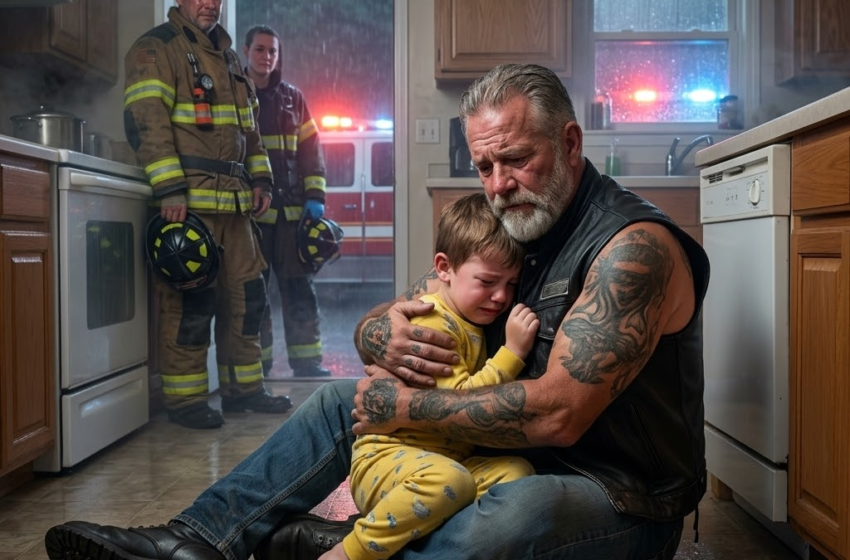
The kitchen sat at the back of the house. Yellow walls, white cabinets, a table with two chairs, refrigerator covered in magnets and kindergarten drawings. The fire had not reached it, but smoke had. Everything looked gray, as if dusted with grief.
Marcus was jammed into the corner between the lower cabinets and the refrigerator.
He wore yellow pajamas with little rockets on them. His knees were pulled to his chest. His feet were filthy. Soot streaked one cheek. His face was blotchy and wet, his mouth open around sobs that sounded too large for his body.
His whole frame shuddered hard enough that I could hear his teeth clicking together.
Two firefighters stood nearby, helpless in full gear.
Marcus kept saying the same sentences.
“I killed my mommy. I killed my mommy. I was supposed to save her. I killed my mommy.”
Not crying them.
Not exactly.
Confessing them.
As if repetition might become punishment enough to bring her back.
The two firefighters looked at me when I entered.
One was maybe twenty-five, eyes red, jaw clenched so tight a muscle jumped near his ear. The other was older, broad, soaked, staring at the floor because looking at Marcus was destroying him.
I nodded once.
They stepped back.
I lowered myself to the tile maybe three feet away.
Slow.
No sudden anything.
A child in terror does not need adults crowding him. He does not need booming voices, grabbing hands, lies, or promises nobody can keep.
He needs the room to stop attacking him.
I sat with my back against a cabinet and let my hands rest open on my knees.
Marcus kept rocking.
“I killed her. I killed her. I killed her.”
“Hey, pal,” I said.
My voice sounded rougher than usual.
“I’m Danny. I’m gonna hang out right here for a bit. That okay?”
The screaming cut off for half a second.
He looked at me.
I saw him clock everything at once.
The size of me.
The beard.
The tattoos running down both arms.
The leather vest.
The patches.
The rain dripping off me onto his kitchen floor.
His eyes widened.
Maybe I looked like danger.
Maybe I looked like something from outside his world.
Maybe I looked strange enough to interrupt the loop in his head.
Then he whispered, “I killed her.”
The two firefighters flinched.
I did not.
“Marcus,” I said, “I heard you’ve been saying that.”
“It’s true.” His voice cracked. “Mommy said go outside and I went and now she’s gone and it’s because of me.”
I nodded slowly.
Not agreement.
Just letting him know I heard every word.
“Can I tell you what I know?”
He shook his head hard.
“No. No, no, no. I did it. I left her.”
“You obeyed her.”
His face twisted.
“I left her!”
“You did what your mom told you to do.”
“I was supposed to save her!”
“You were five years old in a burning house.”
“I’m big enough!” he screamed. “I’m big enough! I can carry stuff! I carry groceries! I could’ve pulled her!”
The words tore through the kitchen.
One of the firefighters turned away and pressed his gloved hand over his mouth.
I waited until the echo faded.
Then I said, “Can I tell you something true, even if it’s hard?”
Marcus stared at me.
His little chest pumped too fast.
“Your mom told you to go outside because there was nothing on this planet she loved more than you. She needed you out of that house. Getting you through that door mattered more to her than her own breath.”
His face crumpled.
“No.”
“Yes.”
“No, because she’s dead!”
“I know.”
“If I stayed, I could’ve helped!”
“No, buddy. You couldn’t. And your mom knew that. That’s why she sent you. If you had stayed to help her, there would be two people gone right now instead of one. She wasn’t going to let that happen.”
He slammed both fists against his knees.
“But I don’t have anybody!”
The words were not loud.
That made them worse.
“I don’t have anybody and she’s dead and Daddy left and now Mommy’s gone and I killed her because I didn’t save her.”
There are moments when your own past rises so fast it feels like choking.
I looked at the refrigerator behind him.
Magnets shaped like alphabet letters. A crayon drawing of a woman and little boy under a bright red sun. A grocery list: milk, eggs, cereal, apples, laundry soap. A school calendar with a gold star sticker on Friday.
Normal life, still taped in place after the world ended.
“Marcus,” I said softly, “mind if I tell you something about me?”
He looked at me.
He didn’t nod.
Didn’t shake his head.
Just looked.
“When I was eight, our house went up too.”
The firefighters became very still.
They knew pieces of my story. Most people in the club knew pieces. Nobody knew all of it unless they had caught me on the wrong night with too much whiskey and too little pride.
I had not planned to tell it in that kitchen.
But sometimes the thing you have spent your whole life carrying becomes useful only when you hand it to somebody smaller.
“My dad shook me awake,” I said. “Smoke was already in my room. I remember my throat burning. I remember him lifting me out of bed and telling me, ‘Danny, listen to me. Out the window. Run to the neighbors. Don’t look back.’”
My hands curled against my knees.
“He said he was going down the hall to get my baby sister, Emma. She was two. Her room was closer to the back.”
Marcus’s breathing slowed just a little.
“I did exactly what my dad said. Climbed out the window. Fell into the bushes. Cut my arm on glass. Ran barefoot across the yard to Mrs. Hanley’s house next door. I stood on her porch waiting for my dad and Emma to come out.”
The kitchen blurred for a second.
Forty-six years vanished.
I could smell smoke again.
Not this house.
Mine.
Old curtains burning. Wood varnish. Plastic toys. Wet grass under my bare feet. Mrs. Hanley screaming behind me. The orange glow of my bedroom window. My father’s voice saying, Run, Danny.
I swallowed.
“They never came out. The roof came down before firefighters got to them.”
Marcus’s face changed.
“Your daddy died?”
“And my baby sister.”
“Emma?”
“Yeah. Emma.”
He looked at the floor.
“Was she little?”
“Very little.”
Marcus wiped his nose with his sleeve.
“Did you think you did it too?”
My throat closed.
There it was.
The bridge.
Built by a five-year-old who had no idea he had just handed me the question I had spent half my life trying to survive.
“For a long time, buddy,” I said. “I thought maybe if I had gone back through the window, both of them would still be here. I thought maybe if I had yelled louder or run faster or been stronger, I could’ve changed it. I walked around thinking I was the reason they died.”
Marcus stared at me.
“But you were only a kid.”
I let those words sit between us.
Then I said, “So are you, pal.”
Something in his face moved.
Barely.
But it moved.
Like a locked door hearing the first click of a key.
“So are you,” I said again.
His mouth trembled.
“But Mommy…”
“I know.”
“She told me to run.”
“Because she was your mom.”
“She told me not to come back in.”
“Because she was saving you.”
“She was coughing.”
“I know.”
“She fell down.”
“I know.”
“I saw her fall down.”
His voice shrank.
“I saw her fall down and I ran.”
I leaned forward slightly, still not touching.
“That was the bravest thing you could do.”
“No.”
“Yes.”
“No, brave is saving people.”
“Sometimes brave is obeying when every part of you wants to go back.”
His eyes filled again.
“I wanted to go back.”
“I believe you.”
“I tried. The fireman grabbed me.”
“I know.”
“I kicked him.”
“He knows why.”
“I bit him.”
“He knows why too.”
From the doorway, the younger firefighter gave a broken little laugh and wiped his face.
Marcus looked toward him, ashamed.
The firefighter stepped closer, crouched, and held up his wrist where a small red mark showed above his glove.
“Best bite I ever took,” he said, voice rough. “Means you loved your mom.”
Marcus stared at him.
Then his face crumpled again.
This time the sob that came out of him was different.
Less like confession.
More like grief.
“Would it be all right if I got closer?” I asked. “I won’t touch you unless you want me to. But sitting through this by yourself isn’t right.”
He did not answer with words.
He threw himself across the tile and into me.
A full-body collision.
He mashed his face into my vest, tiny hands clutching leather, and let the crying take him all the way under.
I wrapped both arms around him.
Careful at first, then tighter when he clung harder.
His whole body shook. His pajamas were damp with sweat and smoke and rain. He smelled like soot, kid shampoo, and terror. His fingers dug into my vest as if he were hanging from a cliff.
“I want my mommy,” he sobbed. “I want my mommy. She can’t be dead. She was just talking to me. She made pancakes. She said we could watch turtles after school. She can’t be dead.”
I rocked him on the kitchen floor.
“I know, buddy.”
“I want her.”
“I know.”
“Make her come back.”
The firefighters in the doorway broke.
Not loudly. Not in a way that disturbed him. But I heard it. The little sharp breaths of men trying and failing to hold themselves together.
“I can’t,” I whispered.
Marcus screamed into my chest.
I took it.
There was nothing else to do.
People think comfort means making pain smaller. It usually doesn’t. Sometimes comfort means becoming a place where pain can be as big as it is without destroying the person carrying it.
So I held him.
Minutes passed.
Then more.
The firefighters slowly came into the kitchen and sat down too. One against the stove. One by the back door. Captain Mercer lowered himself near the table, elbows on knees, helmet beside him on the floor. Nobody said much. Nobody needed to.
At some point, an EMT stepped in and checked Marcus’s oxygen level while he stayed in my arms. He fought for half a second, then let her clip the little monitor to his finger.
“You’re doing good,” she said.
“I’m not,” he whispered.
She looked like she might cry.
“You’re breathing,” she said. “That counts tonight.”
He tucked his face back into my vest.
I held him for two hours.
People came and went. A police officer asked questions in the hallway. An investigator moved quietly through the front room. Someone brought a blanket from the ambulance and draped it over Marcus’s back. Someone else handed me a bottle of water I could not open because Marcus had both my hands trapped.
The house cooled.
The rain softened.
The awful energy of emergency slowly shifted into the hollow after.
Marcus cried until he hiccuped. Then whimpered. Then stared at nothing. Then cried again.
Every so often, he whispered, “I killed her.”
Every time, I said, “No, buddy. The fire took her. You didn’t.”
At first, he argued.
Later, he only listened.
By the time the sky outside began turning gray, his body had gone limp against me. His eyes were barely open, lashes wet, cheeks streaked. One small hand still gripped the edge of my vest.
Captain Mercer crouched down beside us.
“Child services just got here,” he said softly.
Marcus’s eyes snapped wide.
“No.”
His fingers dug into me.
“Marcus,” Roy said gently.
“No! I’m staying with Danny!”
The social worker appeared in the kitchen doorway. She was a Black woman maybe in her forties, hair pulled back, raincoat dripping, face tired in a way that told me she had seen too many kitchens like this one. Her badge read L. HARRIS.
She did not rush in.
That told me she was good.
Marcus saw her anyway.
“No! Don’t make me go! I’m staying with Danny!”
My chest tightened.
Ms. Harris lowered herself slightly, keeping distance.
“Marcus, my name is Lena. I’m here to make sure you’re safe.”
“I’m safe with him!”
“I can see he’s helping you.”
“Then he comes!”
Her eyes moved to me.
I knew that look.
Assessment.
Risk.
Adult male. No relation. Biker. Tattoos. Leather vest. Child attached. Crisis situation.
I also knew rules.
Rules do not bend easily, and when they do, people get blamed.
“You’re Danny Walsh?” she asked.
“Yes, ma’am.”
“Crisis line volunteer?”
“Club crisis response. Informal support. Dispatch called.”
She looked at Captain Mercer.
He nodded.
“He’s the only person Marcus has let near him.”
Marcus clutched me harder.
“Please,” he said. “Please don’t leave me. Everybody leaves. Daddy left. Mommy’s gone. Please don’t leave me too.”
There are things children say that make every adult in a room feel accused by the entire universe.
I looked at Ms. Harris.
“Any way I can go with him? Just today. Wherever you need to take him. Hospital, foster placement, office, whatever. I won’t interfere. He just needs a familiar face.”
Her mouth tightened.
“That’s not really how this works. You’re not family.”
“I know.”
“We don’t know you.”
“Dispatch does. Fire does. County domestic violence office does. I’ve been background checked for supervised crisis response with minors through the club program.”
She blinked.
That surprised her.
People don’t expect paperwork from bikers.
I reached carefully into my vest, moving slow so Marcus wouldn’t think I was letting go, and pulled out the laminated card we all carried. Lena took it, read it, looked at Roy again.
“He’s legit,” Roy said. “And right now, he’s what the kid has.”
Marcus whispered, “Please.”
Lena Harris looked at him.
Not at me.
At him.
Really looked.
A five-year-old boy in yellow pajamas, mother dead, house burned, arms locked around a stranger because that stranger had told him a story shaped like his own.
Something in her face softened.
“One day,” she said quietly. “You can ride with us today. After that, we reassess.”
Marcus buried his face in my vest.
I looked at her.
“Thank you.”
She nodded once.
“Don’t make me regret it.”
“I won’t.”
The next hours blurred into fluorescent lights and paper cups and impossible questions.
They took Marcus to the hospital first. He would not sit on the stretcher unless I sat beside it. He would not let the nurse listen to his lungs until I let her listen to mine first. He would not put on the little hospital gown because “Mommy says clothes stay on at the doctor,” and that nearly broke the nurse in half. They compromised by letting him keep the pajama pants and changing only the top.
He had mild smoke inhalation. No burns. Scratches on one foot. Bruising on one knee from falling on the porch. Physically, he was lucky.
Everyone kept saying that.
Lucky.
I hated the word that morning.
Luck is a cruel thing to call survival when the person you love did not survive with you.
Marcus did not let go of my hand during the exam. His fingers were sticky from apple juice. Every time someone opened the curtain, he startled.
“Is that Mommy?”
No one knew how to answer.
Finally, I said, “No, buddy.”
He looked at me like he hated me for telling the truth.
Then he leaned against my arm anyway.
A detective came by to ask me what Marcus had said. I repeated the words carefully, without adding meaning that wasn’t there. Fire investigators were working. Electrical panel. Space heater. Smoke alarms. Timeline. Cause undetermined, but nothing suspicious so far.
Just an old house.
Just faulty wiring.
Just one of those ordinary things that becomes a monster at the wrong hour.
Lena Harris stayed close. She made calls. She found the grandmother in Oregon. Sarah’s mother, Ruth Bennett. Already booking the first flight she could get. Crying so hard Lena had to repeat herself three times.
No father located yet.
Or rather, father located and useless.
His name was Tyler Reed, and when police finally reached him two towns over, he said he hadn’t seen Marcus in nearly three years and “wasn’t in a position” to take him.
I heard Lena repeat that phrase over the phone.
Wasn’t in a position.
Marcus was asleep against my side in a hospital chair, one hand wrapped around my thumb.
I looked out the window and imagined finding Tyler Reed.
Not to hurt him.
I am too old to pretend violence fixes abandonment.
But maybe to stand in front of him long enough for him to feel the size of what he had left behind.
By noon, Marcus was released.
Lena found an emergency foster placement with a woman named Joanne, who took short-term crisis placements and lived twenty minutes away. She had a clean background, a soft voice, and a house that smelled like toast.
Marcus stood on her porch and refused to go in.
“No,” he said.
Lena crouched.
“Marcus, this is just until your grandma gets here.”
“No.”
“I know it’s scary.”
“No.”
Joanne opened the door wider.
“Hi, sweetheart. I made scrambled eggs.”
“I hate eggs.”
“You told me eggs are okay,” I murmured.
He glared at me.
“I hate her eggs.”
Joanne, bless her, only nodded.
“That’s fair. You haven’t tried them.”
Marcus gripped my hand.
“You come.”
“I’m coming in.”
“You stay?”
“For today.”
His face crumpled.
“Not tomorrow?”
I could have lied.
I wanted to.
Every adult instinct in me wanted to say, I’ll stay as long as you need, because that is what a hurting child deserves to hear.
But children like Marcus already know how expensive broken promises are.
“I don’t know about tomorrow,” I said. “But I’m here today. And when I have to leave, I’m going to tell you. I won’t disappear.”
His lip trembled.
“You promise?”
“I promise.”
He studied me.
Then he stepped inside.
He did not eat eggs. He poked at them until they turned cold.
“Danny?” he said.
“Yeah, pal?”
“Did the feeling ever go away?”
“What feeling?”
“Like you killed your daddy and your sister.”
Joanne froze near the counter.
Lena looked at me from the doorway.
I kept my eyes on Marcus.
“Took a bunch of years,” I said.
“How many?”
“A lot.”
“Like ten?”
“More.”
His shoulders fell.
“But it did get smaller. Not gone. Smaller. And somewhere in there, I figured out my dad made a choice. He picked me. Same way your mom picked you.”
Marcus pushed egg around his plate.
“What if they picked wrong?”
The room seemed to stop.
I leaned closer.
“They didn’t.”
“How do you know?”
“Because parents like that don’t choose based on math. They choose based on love. Your mom didn’t stop and think, ‘Which life matters more?’ She saw smoke, saw you, and did what her whole heart told her to do. She got you out.”
“But now she’s gone.”
“I know.”
“I don’t want to be here without her.”
There is no good answer to that.
Anyone who tells you otherwise has never sat across from a child who means it.
So I gave him the only honest thing I had.
“I didn’t want to be here without my dad and Emma either.”
“What did you do?”
“Some days? Just breathed.”
“That’s all?”
“Some days, yeah.”
“That doesn’t sound like enough.”
“It isn’t. But it gets you to the next day.”
He looked down.
“How am I supposed to do that?”
“Day by day, buddy.”
He hated that answer.
I could tell.
I had hated it too.
That afternoon, he fell asleep on the couch with his head against my thigh. I sat there for three hours while cartoons played softly on the television and adults whispered in the kitchen.
Lena came in around four.
“Grandmother’s flight lands tomorrow afternoon,” she said quietly. “She’ll come straight here.”
“Good.”
“You did good today.”
I looked at Marcus.
“No. He did.”
Lena sat in the chair across from me.
“You understand I can’t authorize ongoing contact without guardian approval.”
“I know.”
“If his grandmother says no—”
“I know.”
She studied me.
“You’ve done this kind of thing before?”
“Sat with kids? Some. Veterans. Domestic violence survivors. Addicts. Runaways. Whoever they call us for.”
“No license?”
“No.”
“Training?”
“Some.”
“Trauma-informed?”
I almost smiled.
“Not in the academic sense.”
“In what sense?”
I looked down at Marcus’s sleeping face.
“In the surviving sense.”
Lena nodded slowly.
“Sometimes that reaches places training can’t.”
“Training matters.”
“I know.”
“So does this.”
She looked at Marcus.
“Yes,” she said. “It does.”
At sunset, Marcus woke up panicked.
For three seconds he forgot where he was.
Then he remembered.
His scream turned into a sound I still hear sometimes when I’m half-asleep.
“I want Mommy!”
He thrashed so hard he nearly fell off the couch. I caught him. He fought me until he realized who had him, then collapsed against my chest.
“I know. I know.”
“I forgot she died,” he sobbed. “I woke up and forgot and then I remembered!”
That is one of grief’s ugliest tricks.
It lets you sleep.
Then charges interest.
“I know, buddy.”
“Make it stop!”
“I can’t.”
“Please!”
“I would if I could.”
He cried until he threw up.
Joanne cleaned the carpet while crying silently. Lena called the therapist on call. I held Marcus in the bathroom while he rinsed his mouth. He kept apologizing for making a mess.
That, more than anything, made me want to break something.
“You never have to apologize for grief,” I told him.
“What’s grief?”
“It’s love after someone dies.”
He thought about that, eyes swollen.
“It hurts.”
“I know.”
“Then I don’t want love.”
I wet a washcloth and wiped his face.
“Sometimes I didn’t either.”
“Do you want it now?”
I thought about my father. Emma. The club. The men I had buried. The kids I had sat with. The ache that had followed me into every room for forty-six years.
Then I thought about Marcus asleep against my leg, trusting me because I had told him the truth.
“Yeah,” I said. “I want it now.”
“Why?”
“Because the hurt means they mattered.”
He leaned his forehead against my chest.
“Mommy mattered.”
“She sure did.”
“You didn’t know her.”
“No.”
“She made dinosaur pancakes.”
“That sounds important.”
“She said T. rex ones were hard because their arms are little.”
“She sounds smart.”
“She smelled like apples.”
I closed my eyes.
“Tell me more.”
So he did.
On that bathroom floor, after the worst day of his life, Marcus told me about Sarah Reed.
She worked at a dental office. She sang badly in the car. She hated mushrooms. She called him “Moon Man” because when he was a baby, he stared at the ceiling fan like it contained secrets from space. She made dinosaur pancakes on Saturdays. She kissed his forehead twice every night, once “for now” and once “for later.” She kept a jar of quarters for laundromat machines and ice cream trucks. She cried during animal commercials. She said bad words at traffic lights but told Marcus he couldn’t say them until he paid bills.
Every detail mattered.
Every ridiculous, ordinary, sacred detail.
That is how you keep the dead from becoming only the way they died.
You say who they were.
When I finally left that night, Marcus stood in the doorway wrapped in a blanket.
“You promised you wouldn’t disappear,” he said.
“I’m not disappearing.”
“You’re leaving.”
“Leaving and disappearing aren’t the same.”
“They feel the same.”
That almost got me.
I crouched in front of him.
“Your grandma is coming tomorrow. I’m going to talk to her. If she says it’s okay, I’ll call you. And I’ll come see you if she lets me.”
“What if she doesn’t?”
“Then I’ll still be glad I met you.”
His eyes filled.
“That’s not enough.”
“No,” I said. “It isn’t.”
He launched into me again.
I hugged him hard.
Then I left before I broke the promise by staying longer than I was allowed.
I rode home in the dark with wet jeans, an aching back, and a hole in my chest that felt both old and brand new.
When I got inside, I did not turn on the lights.
I went straight to the dresser, picked up the photograph of my father and Emma, and sat on the edge of the bed.
For most of my life, I had carried that night like a sentence.
My father told me to run.
I ran.
He died.
Emma died.
Therefore, some hidden part of me had always believed, I lived wrong.
Therapists told me I was a child. My mother told me my father would have wanted me safe. Priests told me God had a plan, which mostly made me want to punch them. Friends told me not to think about it.
None of it reached the place where the guilt lived.
Then a five-year-old in yellow pajamas looked at me and said, “But you were only a kid.”
I held the photograph until morning.
Ruth Bennett arrived the next afternoon.
I met her at Joanne’s house because Lena called and said Marcus had asked for me. Ruth was seventy-one, small but sturdy, white hair in a braid down her back, Oregon raincoat still smelling like airplane and weather. Her face looked shattered in the way only a mother’s face can look when her child dies before her.
Marcus saw her and froze.
For one awful second, I thought he wouldn’t go to her.
Then Ruth opened her arms and said, “Moon Man.”
Marcus ran.
She dropped to her knees and caught him with a sound that was half sob, half prayer.
They clung to each other in the hallway while every adult pretended to be busy looking elsewhere.
After a long time, Ruth lifted her eyes to me.
“You’re Danny.”
“Yes, ma’am.”
She held Marcus with one arm and reached for my hand with the other.
“Thank you for holding my grandson when my daughter couldn’t.”
I had no defense against that.
I looked down.
Marcus turned in her arms.
“He gets it, Grandma.”
Ruth looked at me more closely then.
I saw the question.
Lena must have told her some, but not all.
“I lost family in a house fire when I was a kid,” I said.
Ruth closed her eyes.
“Oh.”
That was all.
But it was enough.
Over the next two days, Ruth met with social services, police, funeral directors, insurance people, school staff, and a grief counselor. I have watched combat veterans handle less paperwork than that woman handled while her daughter’s body waited for burial.
The fire investigation concluded faulty wiring in the wall behind the living room outlet. Old house. Cheap landlord. Extension cords because outlets were limited. Smoke alarms worked, but by the time Sarah woke, the hallway was already thick.
There was no villain to arrest.
That bothered Marcus.
Children understand bad guys better than accidents.
“Who did it?” he asked me the day after Ruth arrived.
We were sitting on Joanne’s porch while rain dripped from the gutters.
“The fire investigator thinks it started in the wall.”
“But who made it start?”
“Probably nobody meant to.”
His face hardened.
“That’s not fair.”
“No.”
“If nobody did it, then who do I get mad at?”
I looked out at the wet street.
“That’s one of the hard parts.”
“I’m mad at Mommy.”
There it was.
I kept my face steady.
“That makes sense.”
His head snapped toward me.
“It does?”
“Yeah.”
“But she died.”
“You can be mad at people who died.”
His eyes narrowed like he suspected a trap.
“You can?”
“I was mad at my dad for years.”
“Why?”
“For leaving me. Even though I knew he didn’t choose to leave. Even though I knew he saved me. I was still mad.”
Marcus looked down at his hands.
“I’m mad she told me to run.”
“I know.”
“I’m mad she didn’t come.”
“I know.”
“I’m mad she died.”
“Me too.”
“You didn’t know her.”
“I’m mad for you.”
His lips trembled.
“Will she be mad I’m mad?”
“No, buddy. If she could sit here, I think she’d say, ‘Be mad if you need to. Just keep breathing.’”
He leaned against me.
“Mommy didn’t like mushrooms.”
“You told me.”
“She said mushrooms are slugs wearing hats.”
I smiled.
“She was right.”
The funeral was four days later.
Ruth asked if I would come.
I said yes.
Not because funerals are easy for me.
They are not.
The smell of lilies still makes my skin crawl. The soft organ music. The low voices. The casseroles in foil pans. The way people say “at peace” because they do not know what else to do with unfairness.
But Marcus asked if I would stand in the back where he could see me.
So I did.
The church was packed.
Sarah Reed had been loved. That was clear the moment I stepped inside. Dental office coworkers stood in a tight group, crying into tissues. Neighbors filled two pews. Parents from Marcus’s kindergarten class brought drawings. The fire crew came in dress uniforms and sat together, faces carved from stone.
Captain Mercer nodded when he saw me.
Marcus wore a small blue suit that did not fit quite right. Ruth sat beside him, one hand on his shoulder. He looked too small to be that still.
On the easel near the casket was a photograph of Sarah.
She had brown hair, kind eyes, and a grin that looked like she had just said something sarcastic. Marcus stared at the picture for most of the service.
When the pastor said Sarah had given her life for her son, Marcus flinched.
I saw it.
So did Ruth.
Words matter around guilt.
Even true words can cut wrong.
After the service, at the cemetery, Marcus refused to throw a flower onto the casket.
People waited.
Ruth whispered to him.
He shook his head.
Then he turned and looked for me.
I stepped closer.
“I don’t want to,” he whispered.
“Then don’t.”
“Everybody is.”
“You’re not everybody.”
“Will Mommy be sad?”
“No. She knows flowers aren’t the only way to love somebody.”
“What if I want to keep it?”
“Then keep it.”
He clutched the white rose to his chest all the way back to the car.
Later, Ruth pressed it in a book for him.
That was Ruth.
She understood small survivals.
Two weeks after the fire, Ruth took Marcus back to Oregon.
Emergency custody had been granted. The plan was permanent guardianship unless his father suddenly developed a conscience, which nobody expected and nobody wanted.
The morning they left, I met them at the airport.
Marcus wore a dinosaur backpack and held a stuffed turtle someone from the fire department had given him. He looked exhausted in the way grief makes children look older and younger at the same time.
“You’ll call?” he asked.
“If your grandma says it’s okay.”
Ruth said, “It’s okay.”
“You’ll visit?”
“If your grandma says it’s okay.”
Ruth wiped her eyes.
“It’s okay.”
Marcus stared at me.
“People say stuff.”
“I know.”
“Then they don’t do it.”
“I know.”
“Don’t say it if you won’t.”
I crouched in front of him.
“I will call. I will visit if I can. And if something changes, I’ll tell you the truth.”
He studied me like a tiny judge.
Then he hugged my neck.
“Bye, Danny.”
“Bye, pal.”
He pulled back.
“Don’t crash your motorcycle.”
“I’ll do my best.”
“That’s not a promise.”
“No. It’s the truth.”
He accepted that.
I watched him and Ruth disappear through security.
Then I went outside, sat on my bike in the airport parking garage, and cried into my hands like I had been waiting forty-six years for permission.
The first call came three days later.
Ruth put him on speaker.
“Danny?”
“Hey, pal.”
“I’m in Oregon.”
“I heard.”
“It rains a lot here.”
“Yeah?”
“But Grandma says it’s different rain.”
“How?”
“She says Kentucky rain sounds sad and Oregon rain sounds busy.”
I smiled.
“Your grandma sounds smart.”
“She is. She has a dog.”
“What’s the dog’s name?”
“Biscuit.”
“Excellent dog name.”
“He licked my sock.”
“Sounds like Biscuit.”
“Danny?”
“Yeah?”
“Did you cry after you left the airport?”
I looked at my garage wall.
Kids are terrifying because they ask the questions adults walk around.
“Yeah,” I said. “I did.”
“Me too.”
“I figured.”
“Grandma cried too. Biscuit didn’t.”
“Biscuit lacks depth.”
Marcus giggled.
It was the first time I heard him laugh.
Just a small sound.
But Ruth gasped softly in the background.
I closed my eyes.
There are moments so small they would look like nothing to anyone else.
A five-year-old laughing at a dog insult over speakerphone.
But I knew what I had heard.
Not healing.
Not yet.
But breath.
We talked every Sunday after that.
Sometimes for five minutes. Sometimes for forty. Sometimes Marcus talked the whole time. Sometimes he said almost nothing and Ruth told me he just wanted the phone nearby while he built blocks.
He started therapy with a child trauma specialist named Dr. Elena Ortiz. He hated going at first because “she has too many feelings toys,” which I understood. Then he liked her because she let him draw fire as a monster and then draw water dragons attacking it.
He had nightmares.
He wet the bed twice and cried because he thought Ruth would send him away. Ruth told him sheets were washable and children were not returnable.
He refused pancakes for three months.
Then one Saturday, Ruth made regular round ones, not dinosaurs, and he ate half of one.
He carried the pressed rose in a plastic sleeve inside a memory box.
He asked once if smoke could follow airplanes.
He asked if heaven had doors.
He asked if his mother was mad that he had forgotten her voice for a minute.
He asked if I remembered Emma’s laugh.
“Yes,” I said.
“What did it sound like?”
“Like hiccups and bells.”
“That’s weird.”
“She was a weird baby.”
He liked that.
Children grieving need permission to know the dead as more than holy. They need the people they lost to remain human. Funny. Annoying. Bad singers. Mushroom haters. Pancake makers. People who left socks on the floor and burned toast and kissed foreheads twice.
So I told Marcus about Emma throwing peas. About my father snoring. About the way Dad used to make grilled cheese too dark and claim it was “flavor.” Marcus told me Sarah once slipped on a grape in the grocery store and laughed so hard she sat on the floor.
We built our dead out of details.
Once a month, I rode to Oregon.
Six hours on the bike the first time, then a flight when Ruth scolded me about winter roads, then the bike again when weather cleared because some promises need an engine beneath them.
Ruth lived in a little blue house outside Eugene with a fenced backyard, two apple trees, and Biscuit, who looked like three breeds had collided at high speed and decided to remain friends.
Marcus showed me his room. Dinosaur sheets. A nightlight shaped like the moon. A picture of Sarah beside his bed. A drawing from therapy taped to the wall: a small stick figure standing beside a large stick figure in leather, both holding swords against a scribbled black monster labeled GILT.
“He means guilt,” Ruth whispered.
“I know.”
On my first visit, Marcus would not let me out of his sight. If I went to the bathroom, he sat outside the door. If I walked to the garage, he followed. If Ruth asked him to help set the table, he dragged me by the hand.
At dinner, Ruth watched this with a careful face.
After Marcus went to bed, she made coffee and sat across from me at the kitchen table.
“I don’t want him to attach to you so hard that it hurts him later,” she said.
I respected her for saying it.
“I know.”
“But I also don’t know how to tell him to let go of the person who reached him when none of us could.”
“I’m not trying to replace anybody.”
“I know that too.”
She looked tired.
Older than seventy-one suddenly.
“I lost my daughter,” she said. “Now I’m raising her son, and some days I wake up terrified I’ll do one wrong thing and lose him in some other way.”
“You won’t.”
“You don’t know that.”
“No,” I admitted. “But I’ve watched you with him. You tell the truth. That matters.”
She stared into her coffee.
“Sarah used to say the same thing about me. That I was too honest.”
“Sounds like Sarah was wrong about mushrooms and right about you.”
Ruth laughed, then cried.
That became part of our friendship.
Coffee after Marcus slept.
Truth at the kitchen table.
No pretending grief was tidy.
On my third visit, Marcus took me to the backyard to throw a baseball.
He was terrible at it.
So was I, mostly, but being large gives people the illusion you understand sports. The ball bounced off my shin twice. Biscuit stole it three times. Marcus laughed so hard he fell over.
Then, without warning, he sat in the grass and said, “I hate Daddy.”
I lowered myself beside him.
“Okay.”
“He didn’t come.”
“No.”
“He knows Mommy died?”
“Yes.”
“He knows I’m here?”
“Yes.”
“He still didn’t come?”
I hated Tyler Reed in that moment with a clarity that felt almost clean.
“Yes,” I said. “He still didn’t come.”
Marcus picked at the grass.
“Is it because of me?”
“No.”
“You always say no fast.”
“Because that one is easy.”
He looked at me.
“Maybe I’m too much.”
“No, Marcus.”
“Mommy had to work a lot. Daddy left. Maybe I’m too much.”
I turned fully toward him.
“Listen to me. Adults leave because of things broken in them, not because children are too much.”
His chin wobbled.
“Then why don’t they fix their broken?”
That question deserved more than slogans.
“Some don’t know how. Some are scared. Some are selfish. Some had people hurt them and never learned how not to pass it on. None of that makes it your fault.”
He threw a handful of grass.
“I still hate him.”
“You’re allowed.”
“Mommy said hate hurts the person holding it.”
“Your mom sounds wise. But sometimes hate shows up before hurt is ready to speak politely.”
He gave me a strange look.
“Did you learn that in biker school?”
“Yes. Between leather vest math and advanced beard studies.”
He snorted.
Biscuit dropped the baseball in my lap, covered in dog spit.
“Gross,” Marcus said.
“Biscuit is emotionally complex.”
“He’s nasty.”
“That too.”
The hate did not disappear.
Neither did the guilt.
They rode with Marcus the way grief rides with anyone who survives something unfair. But over time, he learned to name them. That was Dr. Ortiz’s gift. She gave him language. Guilt was “the liar voice.” Grief was “the missing.” Anger was “the fire inside that doesn’t burn houses.” Fear was “the smoke alarm in my body.”
He drew them.
Built them from clay.
Yelled at them into pillows.
Sometimes he called me and said, “The liar voice is loud today.”
I would ask, “What’s it saying?”
“That I left her.”
“What do we say back?”
His voice would get small.
“I obeyed her.”
“And?”
“She picked me.”
“And?”
“The fire did it. Not me.”
“And?”
“I’m allowed to live.”
That last one took months.
The first time he said it without me prompting him, I had to pull the bike onto the shoulder because I couldn’t see the road.
Eight months after the fire, I rode out in early spring.
The Oregon air smelled like wet leaves and cut grass. Ruth’s apple trees had tiny buds on them. Marcus had grown. Kids do that in secret. You leave them one size and come back to find their jeans too short, their face different, their grief sitting in a new place.
He met me in the driveway.
“Uncle Danny!”
I froze.
He froze too, as if the words had jumped out before permission.
Ruth stood on the porch holding a dish towel.
Biscuit barked at everyone, contributing nothing.
Marcus’s face went red.
“I mean Danny.”
I took off my helmet slowly.
“What’d you call me?”
He shrugged hard.
“Nothing.”
“Sounded like Uncle Danny.”
He looked at his sneakers.
“I don’t have any uncles.”
I swallowed.
People have called me many things in fifty-four years.
Criminal.
Thug.
Deadbeat.
Biker trash.
Trouble.
Sir, when they were afraid.
Brother, when they meant it.
But nobody had ever called me Uncle like it was something sacred.
Marcus kicked a pebble.
“You don’t have to like it.”
I crouched in front of him.
“Hey.”
He looked up.
“Uncle Danny works.”
His face opened.
Not a smile exactly.
Something better.
Relief.
He slammed into me, arms around my neck.
I hugged him back and looked over his shoulder at Ruth.
She was crying into the dish towel.
Biscuit tried to join the hug and knocked us both sideways.
That afternoon, Marcus showed me a school project about community helpers. Most kids had chosen doctors, teachers, firefighters, police officers.
Marcus had drawn a motorcycle.
Under it, in careful handwriting, he had written:
My Uncle Danny helps people who are sad because he was sad too and he knows where to sit.
I read it three times.
“Is it okay?” he asked.
I folded the paper carefully.
“Yeah, pal,” I said. “It’s okay.”
That night, Ruth took me aside after Marcus went to sleep.
“He had a dream last week,” she said.
“He told me he wanted to call and tell you himself. Then he got nervous.”
“What dream?”
Ruth leaned against the counter.
“He dreamed about Sarah. She was standing in the old kitchen, but it wasn’t burned. She was making pancakes. She told him she was proud of him for calling 911.”
My throat tightened.
“He told Dr. Ortiz. She said it’s a good sign. His mind may be beginning to let her comfort him instead of only replaying the trauma.”
I nodded, though honestly, I wasn’t thinking like that.
I was thinking about a five-year-old boy being given one gentle dream after months of smoke.
“He still has bad nights,” Ruth said.
“I know.”
“But that morning, he woke up and asked for pancakes.”
I closed my eyes.
“Dinosaur?”
“Round. He said dinosaur arms are too hard.”
I laughed quietly.
“So Sarah was right.”
“She usually was.”
Ruth looked toward the hallway.
“You brought him back that night.”
“No.”
“Yes.”
“All I did was tell him my story.”
“You made sure he knew he wasn’t alone in it.”
I did not answer.
“When somebody is broken like that,” Ruth said, “knowing they’re not alone is the whole thing.”
I thought about my father telling me to run.
About Emma’s laugh.
About all the years I had believed survival was a debt I could never repay.
Maybe Ruth saw my face because she touched my arm.
“You were a child too, Danny.”
People had told me that before.
Therapists. Friends. My mother, before grief hollowed her into silence.
But Ruth said it like Marcus had.
Plain.
Certain.
Not as comfort.
As fact.
“I know,” I said.
For the first time in forty-six years, I almost believed it.
Marcus called me a week later.
I was riding back from a veterans’ benefit when my phone buzzed through the helmet speaker. I pulled into a gas station lot and answered.
“Hey, Moon Man.”
“Don’t call me that. That’s Mommy’s name for me.”
“Sorry. Hey, Marcus.”
A pause.
“You can call me it sometimes.”
“Good to know.”
“I had the dream again.”
“With your mom?”
“Yeah. She was smiling at me. She said she’s proud of me. She said thank you for being brave. She said she’s glad I called 911.”
My vision blurred so fast I had to put both boots down hard to steady the bike.
“That’s a beautiful thing, buddy.”
“Do you think it was really her?”
I looked at the gray highway, the gas pumps, the pickup idling nearby, the whole ordinary world that had no idea what question had just been asked inside my helmet.
“I don’t know exactly how dreams work,” I said. “But I know love finds ways to speak.”
“She looked not burned.”
“I’m glad.”
“She had apple smell.”
I closed my eyes.
“Then that sounds like her.”
“Danny?”
“Yeah?”
“Do you ever dream about your dad?”
“Sometimes.”
“What does he say?”
The honest answer was that for years, my father said nothing. He only stood in smoke, unreachable.
But lately, since Marcus, the dreams had changed.
“He tells me to stop standing outside the house,” I said.
Marcus was quiet.
“What does that mean?”
“I think it means I can quit waiting for a different ending.”
He breathed into the phone.
“Can I quit too?”
“Not all at once. But maybe little by little.”
“Okay.”
A car pulled up beside me.
Someone glanced at the big biker sitting motionless on his Harley, crying behind sunglasses.
Let them look.
“Danny?”
“Yeah, pal?”
“Can I ask you something?”
“Anything you want.”
“Can I call you Uncle Danny all the time? Not just when I forget?”
I wiped my face with my sleeve.
“Yeah,” I said. “All the time.”
“Good.”
“Yeah. Good.”
“I have to go. Biscuit ate a crayon.”
“Emergency.”
“Grandma says he’s not emotionally complex, he’s just dumb.”
“Your grandma may be right.”
Marcus laughed.
The call ended.
I sat there a long time before starting the bike.
For most of my life, I thought surviving meant I had failed to die when better people didn’t get the choice. I thought every breath after that fire was borrowed. I tried to spend it on useful things—rides for charity, crisis calls, veterans who needed someone to sit with them at 2 a.m., women moving out of dangerous houses, kids who needed a wall of motorcycles between them and whatever monster they were facing.
But usefulness is not the same as forgiveness.
That morning, in a gas station parking lot, with rain clouds gathering over the highway and Marcus’s voice still echoing inside my helmet, I understood something I had resisted for forty-six years.
My father had not sent me out the window so I could punish myself forever.
Sarah Reed had not sent Marcus out the door so he could spend his life calling survival murder.
They had made the only choice love could make in a room filling with smoke.
They chose the child.
The best way to honor a choice like that is not to stand forever at the edge of the fire asking why you lived.
It is to live.
Not perfectly.
Not without guilt.
Not without nights when the smoke comes back.
But live anyway.
Grow.
Love.
Show up.
Answer the phone at 3:07 in the morning.
Ride forty minutes through freezing rain.
Sit on a kitchen floor with a child who believes the worst thing about himself and tell him the truth until he can borrow it.
The firefighters called me out to hold a boy who thought he had killed his mother.
What they actually did was hand me a nephew.
They gave me something to do with all the hurt I had been dragging behind me like a chain. They gave me a reason to believe the worst night of my life had not only taken something from me, but had also left me with a language somebody else would one day need.
I still have the photograph of my father and Emma on my dresser.
I still touch the frame sometimes before I leave for a crisis call.
But now, beside it, there is another picture.
Marcus in Ruth’s backyard, missing both front teeth, one arm around Biscuit, the other raised in a biker peace sign I taught him and Ruth hates.
On the back, in crooked kid handwriting, he wrote:
To Uncle Danny.
We are allowed to live.
Love, Marcus.
I keep breathing for that.
For my father.
For Emma.
For Sarah.
For the firefighters who cried on the lawn.
For Ruth making pancakes in Oregon.
For Marcus, who still has bad dreams sometimes but now knows how to wake up and name them.
And maybe, finally, for me.
Because I made it out of that fire forty-six years ago.
Because my father chose me.
Because Sarah chose Marcus.
Because one night, on a smoke-stained kitchen floor, two scared boys—one five years old, one fifty-four—looked at each other across all the years between them and realized neither of them had been guilty.
They had been loved.