PART2:
She must have seen something in my face because she added:
“Social services knows.”
That did not make me feel better.
I looked at the flyer.
Cheap library paper.
Black-and-white photograph.
A man in his late forties, maybe early fifties.
Thin.
Tired eyes.
Kind smile.
RICHARD MORAN.
FUNERAL SERVICE.
MONDAY, 10:00 A.M.
GRACE METHODIST CHURCH.
Below the information, in careful handwriting:
Please come.
He was a good man.
He just didn’t know a lot of people.
I read that line twice.
“How many of these did you make?”
“A hundred.”
“Where?”
“Library.”
“You printed a hundred funeral flyers at the library?”
“The librarian helped.”
“And you’re handing them out?”
“Yes.”
“To strangers?”
She looked around at the motorcycles.
“My dad liked motorcycles.”
That answer somehow made sense to her.
“Did he ride?”
“No.”
“Then why bikers?”
Sophie shrugged.
“He always said bikers stop when somebody’s broken down.”
Several men within earshot looked away.
She continued.
“He said they look scary, but they help.”
I almost smiled.
“Your dad say that?”
“Yes.”
Then she added:
“He wanted a motorcycle when he was younger, but Mom said no.”
Ricky laughed once.
Quietly.
Sophie glanced down at the remaining flyers.
“I should keep going.”
“Wait.”
She stopped.
I crouched slightly so we were closer to eye level.
“Who have you already asked?”
“Family.”
“How many?”
“Eleven people.”
“And?”
“My grandma said she’d think about it.”
Her tone stayed steady.
“My uncle lives in Arizona. He said the flight was too expensive.”
“Anybody from your dad’s work?”
“I called his school.”
“What did they say?”
“The secretary said they’d send an email.”
“And the other jobs?”
“His delivery boss said he’d try.”
She looked at the flyers.
“Nobody said yes.”
That was the moment something shifted in me.
Not anger yet.
Anger came later.
At that moment it was simpler.
I imagined this girl sitting in a public library printing a hundred pieces of paper because no adult had taken responsibility for making sure her father was not buried alone.
“What did your dad do?”
“Janitor.”
“At what school?”
“Lincoln Middle.”
I knew it.
Everybody did.
Large brick building on the west side.
About eight hundred kids.
“He worked there eleven years.”
Eleven years.
Hundreds of students every year.
Teachers.
Administrators.
Parents.
And his twelve-year-old daughter was standing in a biker parking lot begging strangers to attend his funeral.
“What happened to him?”
“Heart attack.”
Her eyes finally shifted.
Just slightly.
“At work.”
I felt my jaw tighten.
“I’m sorry.”
She nodded.
People had probably said those words fifty times.
They were beginning to sound like punctuation.
She held out another flyer.
“Would you come?”
I took it.
“Yes.”
Her face changed.
Barely.
“You will?”
“Monday. Ten.”
She nodded.
“Thank you.”
Then she moved toward the next bike.
I stood.
Pulled out my phone.
Opened the Dead Iron Motorcycle Club group chat.
Typed:
Monday.
10 AM.
Everyone.
Then I photographed the flyer.
Sent it.
Our club president, Danny Ruiz, responded first.
Funeral?
I wrote:
Janitor. Single dad. 12-year-old daughter. Nobody coming.
Three dots appeared.
Then:
Address?
I sent it.
Danny replied:
We’ll be there.
I thought that meant maybe fifteen motorcycles.
Twenty if guys could get off work.
I had no idea what Danny did next.
Sophie distributed thirty-seven flyers that morning.
I know because she counted the remainder while sitting at our diner table drinking orange juice someone bought for her.
The bikers kept finding reasons to walk past.
One left twenty dollars beside her plate.
Sophie immediately called him back.
“You forgot your money.”
“It’s for you.”
She frowned.
“I’m not asking for money.”
“I know.”
“Then I can’t take it.”
The biker, Tommy Shaw, looked completely helpless.
This was a man I had watched negotiate with state troopers.
A twelve-year-old defeated him in eleven seconds.
“It’s lunch money.”
“I have lunch money.”
“Then…”
He looked around.
“For bus fare.”
“I have a bus pass.”
Tommy took the twenty back.
“Yes, ma’am.”
Sophie returned to her orange juice.
I sat across from her.
“When did you last eat?”
“This morning.”
“What?”
“Cereal.”
“What kind?”
“Corn flakes.”
“With milk?”
She looked offended.
“Yes.”
“Just checking.”
We ordered pancakes anyway.
She ate all of them.
While she ate, I asked about Richard.
At first Sophie gave short answers.
Then something opened.
Not grief exactly.
Memory.
“My dad makes better pancakes.”
“Made.”
The word left my mouth before I could stop it.
Sophie froze.
I wanted to punch myself.
“Sorry.”
She looked down.
Then whispered:
“I know.”
That was the first crack.
Tiny.
Then she continued.
“He put cinnamon in them.”
“Good trick.”
“And chocolate chips if we had money.”
“If?”
“We didn’t always.”
I said nothing.
Sophie poured syrup carefully.
“He worked a lot.”
“How much?”
“Three jobs.”
I thought I had misheard.
“Three?”
She nodded.
“Janitor at Lincoln.”
“Full-time?”
“Yes.”
“He did deliveries Saturday and sometimes Sunday.”
“What else?”
“Night stock at Greenway Grocery.”
My fork stopped.
“When did he sleep?”
Sophie shrugged.
“He’d come home around four.”
“In the morning?”
“Yes.”
“Then?”
“Sleep until seven.”
“Three hours?”
“He slept more Sunday sometimes.”
“What happened at seven?”
“He made my breakfast.”
I stared.
“After working all night?”
“He always made breakfast.”
She said it like gravity.
Unremarkable.
“He packed lunch too.”
“Then school?”
“We went together.”
“He worked there.”
She nodded.
“He’d leave around three-thirty unless something happened.”
“Then delivery?”
“Some days.”
“And grocery store?”
“Ten at night.”
I sat back.
Richard Moran had apparently constructed his entire life out of exhaustion.
“How long?”
“Couple years.”
“Three jobs for a couple years?”
“After Mom died, he only had two.”
Only.
I looked at the tired-eyed man on the flyer.
Suddenly the photograph made sense.
“What did your dad do for fun?”
Sophie thought.
“Sunday.”
“What about Sunday?”
“That was fun.”
“What did you do?”
“Pancakes.”
She smiled.
“Movies.”
“What kind?”
“Old ones.”
“Good old or bad old?”
“Bad.”
“Excellent.”
“He liked westerns.”
“Tragic.”
She almost laughed.
The sound disappeared quickly, but I heard it.
“What else?”
“Sometimes we walked by the river.”
“Friends?”
She shook her head.
“His friends?”
Another shrug.
“Dad knew people.”
Not the same thing.
That sentence stayed with me.
Richard knew people.
But apparently nobody knew Richard.
On Sunday morning, I drove to Sophie’s house.
I told myself I was checking whether she needed a ride.
That was partly true.
The address took me into an older working-class neighborhood where yards were small and chain-link fences common.
The duplex was beige with peeling trim.
Grass nearly knee-high.
An old bicycle leaned beside the porch.
I knocked.
Sophie opened the door wearing jeans and one of her father’s T-shirts.
It reached almost to her knees.
“Jake?”
“Hey.”
“What are you doing here?”
“Checking on you.”
“I’m okay.”
“I figured.”
She stepped aside.
The house told me more about Richard than the flyer had.
Not dirty.
Never dirty.
Just worn.
Secondhand furniture.
Old carpet.
Television with tape on one corner.
A patched sofa.
Books stacked beneath an end table because one leg was shorter than the others.
On the kitchen table were two chairs.
Exactly two.
I looked around.
No third.
No spare.
No dining room.
Just a small kitchen table designed for the number of people who lived there.
Two.
Sophie noticed me looking.
“Dad broke the other chairs.”
“How?”
“He brought them from Grandma’s when Mom died.”
She pointed.
“They were already old.”
I nodded.
On the refrigerator were school certificates.
Sophie’s spelling award.
Perfect attendance.
A B-plus math test with a handwritten GREAT JOB! in black marker.
And dozens of small yellow sticky notes.
BE BRAVE TODAY.
DON’T FORGET LIBRARY BOOK.
PIZZA FRIDAY!
YOU’VE GOT THIS.
At the bottom of the refrigerator was one more.
YOU ARE MY BEST THING.
LOVE, DAD.
My throat tightened.
“He wrote these?”
“Every morning.”
“Every morning?”
“In my lunch.”
She opened a kitchen drawer.
Inside were dozens more.
Folded.
Saved.
Not all.
Maybe one hundred.
Maybe more.
“I kept the good ones.”
I looked at her.
“What made one good?”
She shrugged.
“Depends on the day.”
She pulled one out.
TESTS DON’T KNOW HOW SMART YOU ARE.
Another:
IF TODAY IS BAD, COME HOME. WE HAVE ICE CREAM.
Another:
YOUR MOM WOULD BE PROUD.
Sophie folded that one quickly.
I pretended not to notice.
“Want coffee?”
she asked.
“No.”
“You look like you drink coffee.”
“I do.”
“Dad did too.”
That settled it.
She made instant coffee.
Badly.
I drank it.
We sat at the two-chair table.
“What happened Tuesday?”
I asked.
Sophie stared into her juice.
“They pulled me out of science.”
“Who?”
“Counselor.”
Her voice became flatter.
“She said there had been an emergency.”
I waited.
“I knew.”
“How?”
“Dad worked there.”
Of course.
“They took me to the hallway near the gym.”
My stomach tightened.
“Why?”
“I don’t know.”
She stared past me.
“There were people.”
“Paramedics?”
“Yeah.”
“And teachers.”
She swallowed.
“Dad was on the floor.”
I stopped breathing.
“They were working on him.”
“Sophie…”
“He had been mopping.”
She looked at her hands.
“Bucket was tipped over.”
Her voice became small.
“Water everywhere.”
Then:
“My first thought was he was going to be mad.”
“Why?”
“Because the floor was dirty again.”
I looked away.
Outside, someone started a lawn mower.
Ordinary Sunday.
Someone washing a car.
A dog barking.
And inside that small kitchen a twelve-year-old girl was telling me she had seen her father die on the floor he had just cleaned.
“Did somebody take you away?”
“Counselor.”
“Who came with you?”
“Mrs. Delaney.”
“Family?”
“No.”
“School people call afterward?”
Sophie shook her head.
“Principal?”
“No.”
“Teachers?”
“No.”
“Anybody?”
“No.”
I felt heat rise up my neck.
“Eleven years.”
She nodded.
“He knew every locker combination.”
“What?”
“If kids forgot, he helped.”
A tiny smile.
“He knew everybody.”
I wanted to say:
Apparently they didn’t know him.
I did not.
“What about the grocery store?”
“They sent flowers.”
“Delivery company?”
She looked at me.
“The boss asked if I knew anyone who wanted Dad’s Saturday route.”
I thought I had misunderstood.
“What?”
“He called Thursday.”
“After your dad died Tuesday?”
“Yes.”
“And asked you?”
“If I knew somebody.”
“How old did he think you were?”
Sophie shrugged.
That was when anger arrived.
Not loud anger.
The cold kind.
Richard Moran had spent years cleaning up after other people’s children.
Stocking food while families slept.
Carrying packages on weekends.
Working his body until his heart failed at forty-nine.
Then the world had continued before his daughter had even found something black to wear.
I looked around.
Sparse kitchen.
Two chairs.
No luxury.
No savings visible.
Everything Richard had earned had gone somewhere.
Food.
Rent.
School supplies.
His daughter.
“What happens after the funeral?”
I asked.
Sophie’s face changed.
“Grandma might take me.”
“Might?”
“She lives two hours away.”
“What do you want?”
“I don’t want to move.”
Of course she didn’t.
“Can you stay here?”
“No.”
“What about Mrs. Delaney?”
“She’s seventy-six.”
I rubbed my face.
“Social worker?”
“Coming Tuesday.”
One day after Sophie buried her father.
“Okay.”
She looked worried.
“Am I in trouble?”
“What?”
“You look angry.”
“No.”
I forced my hands to relax.
“You’re not in trouble.”
“Then why are you mad?”
I looked around the house.
“At adults.”
She nodded as though that made complete sense.
Before I left, she showed me Richard’s closet.
Four work uniforms.
Two pairs of jeans.
Three T-shirts.
One dress shirt.
Work boots.
The soles were nearly smooth.
One had a hole beginning near the toe.
“Those were his good boots.”
Sophie said.
I stared.
“Good?”
“He had another pair.”
She pointed.
Worse.
“Why didn’t he buy new ones?”
“He said mine mattered more.”
I looked down at her sneakers.
Scuffed.
But intact.
Later, I would remember that detail when Sophie spoke at the funeral.
His shoes had holes.
Hers didn’t.
Richard had built fatherhood out of substitutions.
His sleep for hers.
His meals for hers.
His shoes for hers.
His years for her future.
On Sunday afternoon, I went to the Dead Iron clubhouse.
The parking lot was fuller than usual.
Danny stood beside the bar.
Broad shoulders.
Gray beard.
Former Army mechanic.
Club president for thirteen years.
He nodded at me.
“You saw the house?”
“Yes.”
“How bad?”
“Two chairs.”
Danny frowned.
“What?”
“Kitchen table.”
I sat.
“Only two chairs.”
He understood.
“Damn.”
I told him everything.
Three jobs.
School.
Heart attack.
No calls.
Delivery manager.
The lunch notes.
Danny did not interrupt.
When I finished, he looked around the clubhouse.
Twenty-three members were there.
“So tomorrow?”
I asked.
Danny smiled strangely.
“What?”
“You still think this is just us?”
I frowned.
“What did you do?”
“Sent your flyer.”
“To who?”
“Everybody.”
My stomach dropped.
“Define everybody.”
“Veterans Riders.”
“Danny.”
“Iron Brotherhood.”
“Oh God.”
“Widow Sons.”
“Danny.”
“Independent guys.”
“How many?”
He shrugged.
“People are sharing it.”
I stared.
“We’re going to terrify the church.”
“Good.”
“No.”
“Yes.”
“This is a funeral.”
“Exactly.”
He leaned forward.
“That girl printed a hundred flyers because nobody in her world would promise to stand beside her.”
His expression hardened.
“We can stand quietly.”
I nodded.
Monday morning arrived gray.
Thin mist.
Not rain.
The kind of weather that makes everything look washed out.
I reached Grace Methodist at 9:05.
Sophie was already there.
The church was small.
White siding peeling along the western wall.
A short steeple.
Maybe two hundred seats if people sat close.
Parking lot empty except for the hearse, a funeral-home sedan, Mrs. Delaney’s Buick and my motorcycle.
Sophie stood on the steps.
Same black dress.
Too large.
Sneakers underneath.
She held one folded flyer in her hand.
When she saw me, she smiled.
Small.
“Hi.”
“Hey.”
I parked.
Walked up.
“Where’s your grandma?”
“Not here yet.”
“Uncle?”
“No.”
“School?”
She looked at the parking lot.
“No.”
9:10.
Nothing.
Sophie kept checking the street.
Each time a car appeared, her posture changed.
Each time it passed, she looked down.
I wanted to call every adult she had invited.
I wanted to ask what could possibly be more important.
Instead I stood beside her.
At 9:15, Sophie said:
“Thank you for coming.”
“Of course.”
“If it’s just you, that’s okay.”
“It’s not.”
She looked at me.
“How many?”
I honestly did not know.
“Some.”
She smiled.
“Dad would like your motorcycle.”
“Your dad had taste.”
“He wanted a red one.”
“We’d have argued.”
She laughed softly.
Then stopped.
Her head turned.
A sound.
Distant.
Low.
At first it could have been construction.
Then the rhythm separated.
Motorcycle engines.
Many.
Sophie looked at me.
“What is that?”
I smiled.
“Some.”
The sound grew.
Not one engine.
Dozens.
The rumble seemed to rise through the pavement.
Around the corner came two headlights.
Then four.
Six.
Ten.
Danny at the front.
American flag mounted behind his bike.
Beside him, Ricky.
Behind them, Dead Iron.
Then Iron Brotherhood.
Then Veterans Riders.
Then patches I did not recognize.
Independent riders.
Men.
Women.
Old Harleys.
New Indians.
Touring bikes.
Cruisers.
One ancient Honda that sounded like it might die before reaching the parking lot.
They came two by two.
Then more.
And more.
The empty lot filled.
The street filled.
Motorcycles parked along the curb.
Across from the church.
Around the side.
Sophie did not move.
Both hands covered her mouth.
Tears began running down her face.
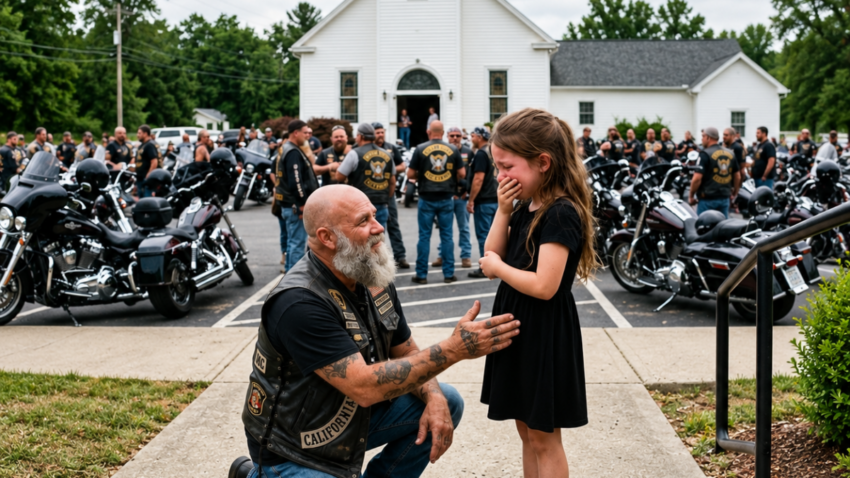
I watched eighty motorcycles arrive.
Then lost count.
Danny told me later the final number was one hundred fourteen.
One hundred fourteen motorcycles.
One hundred fourteen riders who had never met Richard Moran.
Engines shut down one after another.
The thunder disappeared.
Silence replaced it.
Danny removed his helmet.
Walked toward Sophie.
He was fifty-eight.
Six-foot-two.
Leather vest.
Gray beard to his chest.
Sophie looked tiny in front of him.
Danny stopped one step below her.
Then knelt.
“Sophie?”
She nodded.
“I’m Danny.”
He pointed behind him.
“We heard about your dad.”
She looked at the motorcycles.
Then him.
“Why did everybody come?”
Danny answered without thinking.
“Because nobody deserves to leave this world without someone standing up and saying they mattered.”
Sophie broke.
The controlled little girl who had taken a bus alone.
Printed flyers.
Answered practical questions.
Explained death like a schedule.
She threw both arms around Danny’s neck.
Sobbed into his leather vest.
Danny’s face collapsed.
He closed his arms around her.
Behind him, one hundred thirteen bikers stood silent.
Nobody took a photograph.
Nobody cheered.
Nobody turned it into a spectacle.
We just stood.
A wall of strangers around one grieving child.
At 9:34, the first school employee arrived.
Assistant principal.
Then a teacher.
Then two cafeteria workers.
Maybe the email had worked after all.
They looked stunned by the motorcycles.
Several more came.
Not many.
Richard had worked there eleven years.
I counted nine school employees.
His grocery-store manager arrived at 9:48.
Two coworkers with him.
The delivery boss did not.
Neither did Sophie’s uncle.
Her grandmother remained absent.
The church doors opened.
We filled every seat.
Then the aisles.
Then the back wall.
Then the vestibule.
People stood outside.
A funeral-home employee whispered to me:
“We didn’t print enough programs.”
“Good.”
He looked confused.
I smiled.
“Good problem.”
The service began.
A pastor who had apparently met Richard only twice spoke first.
He said the usual things.
Kind.
Hardworking.
Devoted father.
Taken too soon.
All true.
But too clean.
Richard’s life had not been clean.
It had been exhausting.
Then the school principal spoke.
He said Richard was reliable.
Rarely missed work.
Knew the building better than anyone.
“He took pride in his work.”
I watched Sophie.
No expression.
Then the principal said:
“Richard was a valued member of the Lincoln Middle School family.”
Something in me hardened.
Family.
Nine staff members.
Eleven years.
No calls to his daughter.
But this was not the place.
Not the day.
I kept quiet.
The pastor asked whether anyone else wanted to speak.
Sophie stood.
Mrs. Delaney reached for her hand.
Sophie shook her head.
Walked alone.
The podium was too tall.
Danny quietly stepped forward and lowered the microphone.
Sophie looked at him.
“Thank you.”
Then faced the room.
Leather.
Tattoos.
Work boots.
Teachers.
Neighbors.
Strangers.
Her father’s casket at the front.
For several seconds, she said nothing.
Then:
“My dad’s name was Richard Moran.”
Her voice was small.
Nobody moved.
“He was a janitor.”
She looked toward the school staff.
“He cleaned toilets.”
A few people shifted.
“He picked up trash.”
“He scraped gum off desks.”
“He cleaned cafeteria food off floors.”
“Sometimes kids threw things down right after he picked them up.”
She paused.
“He said that was okay because somebody had to clean it.”
Her hands gripped the podium.
“Some kids called me Mop Girl.”
My jaw tightened.
Sophie continued.
“I didn’t tell him at first because I knew he’d feel bad.”
Her voice trembled.
“But he found out.”
“What did he say?”
She seemed to be talking to herself now.
“He said, ‘There is no shame in honest work. Never let somebody who benefits from your work make you ashamed of doing it.’”
A murmur moved through the church.
Sophie reached into her dress pocket.
Pulled out a folded yellow piece of paper.
“My dad wrote notes in my lunch.”
She unfolded it.
“I kept this one.”
Her voice cracked.
“It says…”
She stopped.
Breathed.
“You are my best thing. Love, Dad.”
Somewhere behind me, a man began crying.
Sophie stared at the note.
“He wrote one every day.”
She folded it carefully.
“He worked at my school.”
“Then deliveries.”
“Then a grocery store.”
“Sometimes three jobs.”
She looked up.
“I asked him once why.”
“He said college costs a lot.”
A few people laughed softly through tears.
“He didn’t go to college.”
“He wanted me to.”
She swallowed.
“His boots had holes.”
Now her voice was breaking.
“But I always had new shoes for school.”
She looked down at her sneakers.
“He ate peanut butter sandwiches for dinner sometimes and said he wasn’t hungry.”
“I found out later he was saving the chicken for me.”
The church was silent.
“He was tired all the time.”
“But when I wanted to talk, he listened.”
She wiped one cheek.
“He fell asleep during movies a lot.”
A tiny smile.
“I used to get mad.”
“Now I wish he was here falling asleep.”
That hurt every person in the room.
She looked at the bikers.
“I asked eleven people to come today.”
The school principal lowered his eyes.
“People who knew my dad.”
“Most of them aren’t here.”
She paused.
“But you are.”
Her voice cracked completely.
“And you didn’t even know him.”
Danny stared at the floor.
Sophie pressed the lunch note against her chest.
“My dad said you can tell who somebody really is by what they do when there is nothing in it for them.”
She looked across the room.
“I think he would’ve liked you.”
Nobody clapped.
Applause would have ruined it.
The silence was heavier.
Better.
One hundred fourteen strangers sat inside that silence and allowed a twelve-year-old girl’s father to matter.
The casket left the church at 11:07.
Then came the motorcycles.
All one hundred fourteen.
Two lines.
Slow.
Hearse ahead.
American flags on several bikes.
The procession stretched nearly half a mile.
Cars pulled over.
Some drivers removed hats.
Pedestrians stopped.
People on sidewalks watched.
They did not know Richard Moran.
Maybe that was the point.
For that morning, strangers made visibility contagious.
At the cemetery, Sophie walked between two rows of bikers toward the grave.
A single white rose in her hand.
Danny and I followed several feet behind.
The casket rested above the ground.
Sophie placed the flower.
Touched the wood.
Then whispered:
“Bye, Dad.”
She looked over her shoulder.
At the riders.
“Look at all these people.”
Danny made a sound beside me.
I turned.
He was crying.
Not politely.
He removed his sunglasses.
Wiped his face with both hands.
“I’m fine.”
“No, you’re not.”
“Shut up.”
After the burial, everyone remained.
Nobody knew what to do.
Funerals have a strange ending.
There is no natural transition between burying someone and deciding where to eat lunch.
Sophie stood near the grave.
People approached.
Introduced themselves.
Told her they were sorry.
A biker named Sheila handed her a small pin from her vest.
A Vietnam veteran named Carl gave her his club coin.
Ricky, the giant man she had approached first, said:
“Your dad raised a brave girl.”
Sophie answered:
“He raised me.”
That distinction mattered to her.
At 12:36, Mrs. Delaney pulled me aside.
“What happens to her now?”
“I don’t know.”
“I can keep her a few days.”
“A few?”
She looked ashamed.
“I’m seventy-six.”
“I know.”
“I love her.”
“I know.”
“But I can’t raise a twelve-year-old.”
She looked toward Sophie.
“There’s a grandmother.”
“She didn’t come.”
Mrs. Delaney’s mouth tightened.
“I know.”
Danny overheard.
“What about money?”
Mrs. Delaney laughed bitterly.
“What money?”
Richard had a small life-insurance policy through the school.
Barely enough for burial expenses and several months of rent.
No college savings anyone could find.
No significant estate.
Just notes.
Clothes.
A used car.
A daughter.
Danny looked at me.
I saw the thought arrive.
“No.”
“What?”
“You are not starting something.”
“I didn’t say anything.”
“That face starts things.”
He walked away.
Twenty minutes later he posted one photograph online.
Not Sophie.
Not the casket.
Richard’s funeral flyer.
Caption:
This man worked three jobs so his daughter could have a future.
His name was Richard Moran.
He mattered.
We’re making sure his girl gets the future he worked himself to death trying to give her.
Donation link followed.
I called him.
“Danny.”
“What?”
“Did Sophie agree?”
“Mrs. Delaney did.”
“She’s twelve.”
“I know.”
“This could explode.”
“Good.”
It did.
By midnight, forty-seven thousand dollars had been donated.
By the next afternoon, more than eighty thousand.
Local news picked up the funeral procession.
A video showed motorcycles arriving.
Sophie standing on the church steps.
Danny kneeling.
Then somebody posted part of her eulogy.
You are my best thing.
That line traveled.
Parents shared photographs of lunch notes they wrote their children.
Teachers wrote:
Richard cleaned our school.
Former students posted memories.
Mr. Moran found my phone.
Mr. Moran stayed late when I missed my bus.
Mr. Moran fixed my locker.
Mr. Moran gave me lunch money once.
Mr. Moran found my inhaler.
Mr. Moran told me to stop picking on a kid.
The comments kept coming.
People knew Richard.
Hundreds.
They simply had not understood knowing someone could create an obligation.
Not until too late.
The school superintendent called Sophie publicly.
Privately too.
Lincoln Middle announced a memorial scholarship for children of support staff.
The grocery chain donated ten thousand dollars.
The delivery company donated nothing initially.
Then the story named them.
Forty-eight hours later, their corporate office announced a twenty-five-thousand-dollar contribution.
Danny laughed.
“Nothing in it for them, huh?”
I understood his cynicism.
But I accepted the money anyway.
Richard would have.
The fund eventually crossed two hundred thousand dollars.
Enough for college if handled carefully.
A trust was created.
Lawyer donated his time.
No biker controlled the money.
Neither did the internet.
Richard’s last dream became something legally protected.
Then Sophie’s grandmother appeared.
Two weeks after the funeral.
Her name was Helen.
Sixty-four.
She arrived at the duplex driving a silver SUV.
I happened to be there with Danny helping clear Richard’s work clothes.
Sophie opened the door.
Helen stood on the porch crying.
“I’m sorry.”
Sophie stared.
Helen said:
“I should have been there.”
“Yes.”
No cruelty.
Just fact.
Helen flinched.
“I got scared.”
“Of what?”
“I hadn’t seen your father in years.”
Family history, apparently.
Old resentment.
Richard and Helen had argued after Sophie’s mother died.
Helen believed he should move closer.
Richard refused.
Pride hardened.
Years passed.
Then death arrived before reconciliation.
Helen saw Sophie’s eulogy on television.
Drove two hours.
“I don’t deserve you to forgive me.”
Sophie looked at her grandmother.
Then stepped forward.
Hugged her.
Instantly.
No lecture.
No punishment.
Later I asked why.
Sophie looked confused.
“She said sorry.”
“That’s enough?”
“My dad said when somebody gives you a real apology, don’t make them crawl.”
I stared at her.
“Your dad said a lot.”
“He talked a lot.”
She smiled.
Sophie eventually moved with Helen.
Not immediately.
Social services inspected.
Lawyers.
School transfers.
Paperwork.
A thousand adult systems finally began moving around the child they should have protected earlier.
Before leaving town, Sophie asked to visit our clubhouse.
Saturday morning.
Same time she had first arrived.
She walked in carrying no flyers.
Everyone stood.
That embarrassed her.
“Sit down.”
Nobody did.
She laughed.
Danny came from behind the bar.
Sophie handed him an envelope.
“What’s this?”
“Read it later.”
“Why?”
“Because you’ll cry.”
The entire room exploded.
Danny glared.
“I don’t cry.”
Every person there had seen him at the cemetery.
Sophie smiled.
“Okay.”
She hugged him.
Then me.
Then Ricky.
Then half the club.
After she left, Danny opened the note.
He got four lines in.
Stopped.
Hand over face.
I took it.
Sophie had written:
Danny,
Thank you for making sure my dad wasn’t alone.
Thank you for making people know his name.
My dad always told me I was his best thing.
For one day, you made him everybody’s best thing too.
You are my best thing.
Love,
Sophie.
I did not make fun of Danny.
Nobody did.
The note went into a frame.
Richard’s flyer did too.
We mounted both above the bar.
Then Danny ordered a brass plaque.
RICHARD MORAN.
JANITOR.
FATHER.
BROTHER.
NO MAN WHO WORKS FOR HIS CHILD IS SMALL.
I thought the last line was a little dramatic.
Danny refused edits.
Six months passed.
Sophie wrote letters.
Actual letters.
Paper.
Envelope.
Stamp.
Danny read every one during meetings.
The first:
School is okay.
Grandma snores.
College fund lady says I cannot buy a motorcycle with college money.
Danny paused.
Ricky shouted:
“Smart lady!”
The next letter:
I made honor roll.
The next:
Grandma and I made Dad’s pancakes but hers were bad.
Another:
A kid at school called the janitor gross.
I told him my dad was a janitor.
He apologized.
Another:
I got my first B in math and cried, then I remembered Dad’s note that tests don’t know how smart you are.
Maria—our club secretary—started keeping every letter.
Two years later, Sophie came back for the anniversary of Richard’s death.
Fourteen.
Taller.
Hair shorter.
Still wore sneakers.
We met at the cemetery.
Twenty-two motorcycles that year.
Not 114.
Didn’t need 114.
Sophie touched the stone.
RICHARD JAMES MORAN.
BELOVED FATHER.
She put a folded note beneath a small rock.
“What does it say?”
I asked.
“Private.”
Fair.
We went to the diner afterward.
Same table where she had eaten pancakes after handing out flyers.
She ordered pancakes.
I asked:
“Cinnamon?”
“Obviously.”
Then she told me something.
“I used to be mad nobody came.”
“To the funeral?”
“Yeah.”
“You had 114 bikers.”
“You know what I mean.”
I did.
The eleven people.
School.
Family.
People who had known him.
“But I’m not anymore.”
“Why?”
She thought.
“Because I think Dad’s life looked small from the outside.”
I said nothing.
“He worked.”
“Came home.”
“Worked.”
“Came home.”
“Didn’t go places.”
“Didn’t have social media.”
“Didn’t have hobbies.”
She looked down.
“So people probably thought nothing was happening.”
“And?”
“Everything was happening.”
I smiled.
“How?”
“He was raising me.”
There it was.
Richard’s entire biography.
Three words.
He was raising me.
At sixteen, Sophie got a part-time job.
Not because she needed the money.
The trust was secure.
Helen could provide basics.
Sophie insisted.
Where?
Lincoln Middle School.
Not janitorial.
Library assistant.
But every afternoon she walked past the hallway where Richard died.
The first week was brutal.
She called me.
“I thought I could handle it.”
“You don’t have to prove anything.”
“I know.”
“Then quit.”
“I don’t want to.”
“Then don’t.”
“That advice is useless.”
“I’m a biker.”
“Fair.”
She stayed.
Eventually the hallway became a hallway again.
Not completely.
Grief never gives territory back in the exact same condition.
But enough.
At eighteen, Sophie graduated high school.
The school invited Helen.
Mrs. Delaney.
Teachers.
And one hundred fourteen bikers.
That was ridiculous.
We did not all come.
Ninety-three did.
Still ridiculous.
The school principal—different principal by then—reserved a section of bleachers.
Sophie walked across the stage.
When her name was called, ninety-three bikers stood.
No screaming.
She had threatened us.
Just stood.
Sophie saw.
Stopped for half a second.
Then touched the small yellow note tucked inside her graduation cap.
You are my best thing.
Love, Dad.
She had carried the original.
After graduation she came toward us.
Danny had aged.
More gray.
Bad knee.
Still intimidating.
Sophie hugged him.
“College next.”
He said:
“Your dad won.”
She cried.
So did he.
Again.
By then the trust had grown.
Scholarships helped.
Sophie chose nursing.
I asked why.
She shrugged.
“Dad died at work.”
I waited.
“I want to be somebody who knows what to do when that happens.”
There are motivations too deep to argue with.
She attended a state university.
First in Richard’s family to go to college.
On move-in day, Helen drove.
I rode separately with Danny and three others.
Dormitory staff looked alarmed when motorcycles arrived.
Sophie was mortified.
“Please go home.”
Danny carried a box.
“No.”
“I can carry that.”
“No.”
“You’re old.”
He stopped.
“What?”
I walked away quickly.
Sophie laughed.
Inside her dorm room, above the desk, she placed three things.
Photograph of Richard.
His lunch note.
A small motorcycle-club coin.
I looked at them.
“Seems balanced.”
She smiled.
“My family.”
That word hit me harder than I expected.
Richard had been right about something.
Family was not always the people who attended because obligation said they should.
Sometimes it was the people who showed up when nothing in it for them existed except the showing up.
Years passed.
Our club changed.
Men retired.
A few died.
New riders joined.
Somebody always asked about the photograph over the bar.
“Who’s Richard?”
We told the story.
Not the viral version.
The real one.
Tired janitor.
Two chairs.
Three jobs.
Shoes with holes.
A daughter who rode a city bus carrying funeral flyers.
And every time, someone new would stare at the photograph.
Then the plaque.
Then Sophie’s note.
Richard became part of a club he never joined.
A brother who never owned a bike.
Danny once said:
“Probably safer that way.”
I told him:
“His daughter said he wanted a red motorcycle.”
Danny frowned.
“Then he had questionable judgment.”
The photo stayed.
When the clubhouse moved to a larger building, Richard’s plaque was the first thing mounted.
Before our own club logo.
Nobody objected.
Sophie graduated college at twenty-two.
Nursing degree.
Honors.
She invited us.
This time she limited motorcycles explicitly.
“Ten.”
Danny wrote:
Fifteen.
She replied:
Ten.
He sent:
Twelve.
She sent:
I control your future medical care.
We brought ten.
At the ceremony, she wore Richard’s note inside her gown.
Afterward she handed me her diploma for a second while she fixed her hair.
I looked at her name.
SOPHIA MORAN.
I thought about the girl in the parking lot.
“My dad worked three jobs so I could go to college.”
He made it.
Not physically.
But the work arrived.
Every 4:00 a.m. shift.
Every hole in his shoes.
Every peanut-butter sandwich.
Every night of three hours’ sleep.
All converted into this.
His daughter in a graduation gown.
I handed the diploma back.
“Your dad would lose his mind.”
She laughed.
“He’d complain about parking first.”
“Probably.”
Then she hugged me.
“Thank you.”
“For what?”
She looked annoyed.
“You know.”
“I showed up at a funeral.”
“You all did more.”
“No.”
I pointed toward her.
“He did more.”
Sophie nodded.
“I know.”
That distinction mattered.
We had not saved Sophie.
Richard did.
For twelve years.
We simply caught part of what he threw into the future.
At twenty-five, Sophie returned to town as a pediatric nurse.
She could have gone anywhere.
Bigger hospital.
More money.
She chose the regional medical center twenty minutes from Lincoln Middle.
Helen asked why.
Sophie said:
“Home.”
Her first year, a janitor named Mr. Alvarez worked the pediatric floor.
Sixty-three.
Quiet.
Immigrant.
Three grandchildren.
One night Sophie saw a family leave fast-food containers everywhere after visiting a sick child.
Mr. Alvarez entered to clean.
The father barely acknowledged him.
Something in Sophie changed.
She helped.
Mr. Alvarez protested.
“You nurse.”
“You janitor.”
“Yes.”
“We both work here.”
He smiled.
From then on she knew his name.
His wife’s name.
Grandchildren.
Favorite baseball team.
When his granddaughter graduated high school, Sophie attended.
That story would not go viral.
Nobody thundered down a street.
But maybe that was Richard’s real legacy.
Not one funeral.
Attention.
Seeing people whose work makes them disappear.
Years after that Saturday morning, Sophie spoke at our clubhouse anniversary.
She was twenty-eight.
Confident.
Nurse.
Married.
No kids yet.
Still sneakers under nice dresses whenever possible.
She stood beneath her father’s photograph.
“I used to think you made Dad matter.”
She looked at Danny.
At me.
At everyone.
“But I was wrong.”
Danny raised an eyebrow.
Dangerous opening.
Sophie smiled.
“Dad already mattered.”
Silence.
“You showed me that other people could recognize it.”
She turned toward the photograph.
“My dad never knew 114 bikers would come to his funeral.”
“He never knew strangers would donate money.”
“He never knew people across the country would write notes to their kids because of something he put in my lunch.”
Her voice softened.
“He thought his life was tiny.”
“I know because he said things like, ‘Maybe someday you’ll do something important.’”
She shook her head.
“I wish I had been old enough to tell him.”
“He already did.”
Danny looked down.
Sophie continued.
“Every breakfast.”
“Every packed lunch.”
“Every floor.”
“Every shelf.”
“Every delivery.”
“Every time he stayed awake when he wanted to sleep because I wanted to tell him about school.”
“That was important.”
She touched the plaque.
“My father did not change the world.”
She paused.
“He changed mine.”
Nobody needed anything after that.
Years later, I began understanding why Richard’s story had affected so many people.
At first, I thought it was the motorcycles.
The spectacle.
One hundred fourteen engines.
The little girl in black.
That was certainly the image people remembered.
But that was not why the story stayed.
It stayed because most lives resemble Richard’s more than we admit.
Quiet work.
Small houses.
Bills.
Fatigue.
Children.
Parents.
Promises.
People doing necessary things without applause.
Most good people do not receive ceremonies while they are alive.
No one stands in their kitchen and announces:
We see what this costs you.
No one applauds a father packing lunch at seven after sleeping three hours.
Nobody photographs the peanut-butter sandwich he eats so his daughter gets chicken.
Nobody presents a medal for wearing boots with holes because school shoes cost money.
Those moments vanish.
Unless somebody remembers.
Sophie remembered.
That was enough to bring a hundred flyers into the world.
Then strangers remembered with her.
Richard’s funeral was never really about bikers rescuing an abandoned child.
I hate when people tell it that way.
Sophie was not helpless.
She found us.
At twelve.
Alone.
Bus ride.
Backpack full of flyers.
She solved the problem adults had created.
Nobody is coming.
Find people.
What kind of people might come?
Bikers stop for people.
Go find bikers.
Simple.
Brave.
Heartbreaking.
We responded.
But the first act of courage belonged to Sophie.
Just as the years of courage before it belonged to Richard.
The bikers were the echo.
I am sixty-two now.
Danny is older.
Retired from club presidency.
Bad knees got worse.
Ricky finally cut his beard.
Terrible decision.
The Dead Iron clubhouse still has Richard’s photograph.
A little faded.
We replaced the brass plaque once because the first tarnished.
Sophie objected.
“I liked the old one.”
Danny said:
“Tough.”
She is thirty now.
Two children.
A daughter named Grace.
A son named Richard.
Of course.
Every school day, Sophie puts a note inside their lunch bags.
Every day.
Sometimes:
Good luck on your test.
Sometimes:
Be kind today.
Sometimes:
Don’t trade your sandwich for candy.
And sometimes:
You are my best thing.
Love, Mom.
She sent us a photograph once.
Two lunch boxes.
Two folded notes.
Behind them, on the refrigerator, her father’s original note in a frame.
Danny cried.
We no longer mock him for that.
Age improves some men.
Not all.
The last time Sophie came to the clubhouse, her little boy asked:
“Who’s that?”
He pointed toward Richard’s photograph.
Sophie lifted him.
“That’s Grandpa.”
“Did he ride motorcycles?”
“No.”
“Then why’s he here?”
Every person nearby went quiet.
Sophie smiled.
“Because he had friends.”
I looked at her.
She saw.
Her eyes filled slightly.
Her son asked:
“Lots?”
Sophie looked around the clubhouse.
At the patches.
Photographs.
Men and women her father never lived long enough to meet.
“Yeah.”
She whispered.
“Lots.”
Richard Moran lived forty-nine years believing he did not know many people.
Maybe he was right.
He did not have hundreds of contacts.
Did not attend parties.
Did not build networks.
Did not collect friends online.
His circle consisted mostly of one daughter, one elderly neighbor, a handful of coworkers and people who barely understood what he carried.
But connection is not always measured while a person is alive.
Sometimes the life itself sends ripples later.
A child remembers.
A stranger stops.
Someone shares a name.
A hundred people show up.
Then one life becomes visible.
Richard’s plaque has been on our wall for nearly two decades now.
JANITOR.
FATHER.
BROTHER.
I have stared at those words thousands of times.
The first title is what most people would have used to describe him.
Janitor.
A job.
The second is what consumed his life.
Father.
The third is what he became after death.
Brother.
Not because he wore our patch.
He never did.
Because fraternity, at its best, means deciding another person’s dignity is your concern.
That Monday, Richard became ours.
Not because we knew him.
Because Sophie asked.
Sometimes that is enough.
A question.
Would you come?
Those three words changed everything.
If she had been too embarrassed to walk into our lot, maybe twenty people would have attended.
Maybe fewer.
If I had assumed some adult would handle it, maybe nobody from our club would have known.
If Danny had kept the flyer inside our group, maybe fifteen bikes.
Every step could have stopped.
It did not.
That is how kindness usually works.
Not as one giant act.
As a relay.
Sophie printed.
The librarian helped.
She rode the bus.
She asked.
I listened.
Danny shared.
Riders came.
Someone posted.
Someone donated.
A lawyer created a trust.
A grandmother returned.
A girl went to college.
A nurse learned everyone’s name.
Children now receive lunch notes from a grandfather they never met.
One act carried by another.
Then another.
Richard spent his life doing the same thing.
He worked.
That work became rent.
Rent became home.
Work became shoes.
Shoes became school.
Work became food.
Food became growth.
Work became notebooks.
Homework.
College.
Future.
He died before seeing what all those exhausting hours became.
That may be the cruelest part.
Or perhaps not.
Maybe parents rarely see the full result.
We plant ourselves into children and hope.
Richard hoped.
Sophie became the answer.
Sometimes I still think about the first morning.
Her dress.
Those sneakers.
Backpack.
Flyers.
She walked toward a motorcycle covered in chrome.
Ricky looked like the last human being a twelve-year-old should approach alone.
Sophie did not care.
“My dad’s funeral is Monday.”
“Would you come?”
Nothing manipulative.
No dramatic speech.
No tears.
Just a request.
And when Ricky did not immediately answer, she moved to the next bike.
That detail stays with me.
She kept asking.
Eleven people from her own life had failed to say yes.
She asked number twelve anyway.
Then thirteen.
Fourteen.
Fifteen.
Imagine if she had decided eleven noes were enough.
The church would have looked very different.
Her life too.
That has become something I think about whenever rejection tells me to stop.
Maybe the right person is number twelve.
Or one hundred fourteen.
You do not know.
Sophie once asked me whether I remembered exactly what Richard’s flyer looked like.
I said yes.
Cheap copy.
Grainy photograph.
She laughed.
“It was terrible.”
“Marketing wasn’t your strength.”
“I was twelve.”
“Excuses.”
She smiled.
Then asked:
“Did you believe it?”
“What?”
“The bottom.”
Please come.
He was a good man.
He just didn’t know a lot of people.
I thought.
“Yes.”
“Which part?”
“All of it.”
She looked toward her father’s photograph.
“I don’t anymore.”
“What changed?”
She smiled.
“He knew enough people.”
I understood.
Richard knew Sophie.
One person.
Sometimes one person is an entire world.
And because Richard spent every resource he had building that one world carefully, she carried his goodness outward after he was gone.
That is why people remember him.
Not because 114 motorcycles came.
Not because money was raised.
Not because the story spread.
They remember because beneath all of it was something painfully simple.
A tired man went to work.
Again.
Again.
Again.
Because a little girl needed breakfast.
Needed shoes.
Needed homework help.
Needed somebody to listen.
Needed a note in her lunch bag.
Richard never became important in the way people usually mean.
No title.
No fortune.
No audience.
He cleaned up after other people.
Drove packages.
Stocked grocery shelves.
Then went home.
Made pancakes.
And if Sophie is right—and I believe she is—he would have been embarrassed by all the attention at his funeral.
He would probably have asked whether someone needed to clean the church afterward.
He might have worried we parked the motorcycles illegally.
Danny insists Richard would have wanted to ride with us.
I suspect he would have chosen the cheapest used bike available and spent ten years refusing to replace it.
Sophie says that sounds accurate.
I wish I had known him.
That may be the strangest part.
I miss a man I never met.
I know him through his daughter.
His notes.
His shoes.
His kitchen table.
The way Sophie talks about Sundays.
Maybe that is another form of knowing.
Maybe people survive through the habits they leave in others.
Richard survives every time Sophie packs a lunch note.
Every time she learns the janitor’s name.
Every time she listens when she is exhausted.
Every time her children wear better shoes than she does.
Every time she forgives someone who apologizes honestly.
The world did not forget Richard Moran.
Not because he knew many people.
Because he loved one person so thoroughly that when he died, she walked into a parking lot full of strangers and made us understand exactly who we were about to lose.
Monday.
10 a.m.
Everyone.
I typed those words without understanding what they would become.
I understand now.
They were not instructions for a funeral.
They were an answer to a twelve-year-old girl asking whether her father’s life had been large enough for anyone to notice.
Yes.
It was.
Richard had cleaned floors most people walked across without seeing him.
But on the morning we buried him, one hundred fourteen motorcycles shook the windows of a little white church.
Not because he was famous.
Not because he was wealthy.
Not because anybody owed him anything.
We came because his daughter asked strangers to bear witness.
And once we understood what that exhausted man had done with his life, staying home would have felt impossible.
He worked three jobs.
Slept three hours.
Wore holes through his shoes.
Packed lunches.
Wrote notes.
Raised Sophie.
Then left the world believing he was ordinary.
Maybe that is the part I wish I could change.
If I could go backward, not to save him—we could not—but just to stand beside him once after a night shift, I think I know what I would say.
Richard.
Go home.
Sleep.
Your daughter is going to be all right.
She is going to graduate.
She is going to become a nurse.
She is going to have children.
They are going to know your name.
People you never met will hang your photograph on a wall.
Strangers will tell your story.
And years after your heart stops on a freshly mopped school floor, men with gray beards and bad knees will still raise a glass to you on the anniversary of your death.
Not because you were extraordinary in the way the world usually rewards.
Because you did the ordinary thing extraordinarily well.
You stayed.
For Sophie.
Every day.
Until your body could not do it anymore.
And when you finally had to leave, she went looking for people who would stand with her.
She found us.
We came.
We are still here.
So was she right when she wrote at the bottom of that flyer:
He was a good man.
He just didn’t know a lot of people?
Almost.
He was a good man.
That part was exactly right.