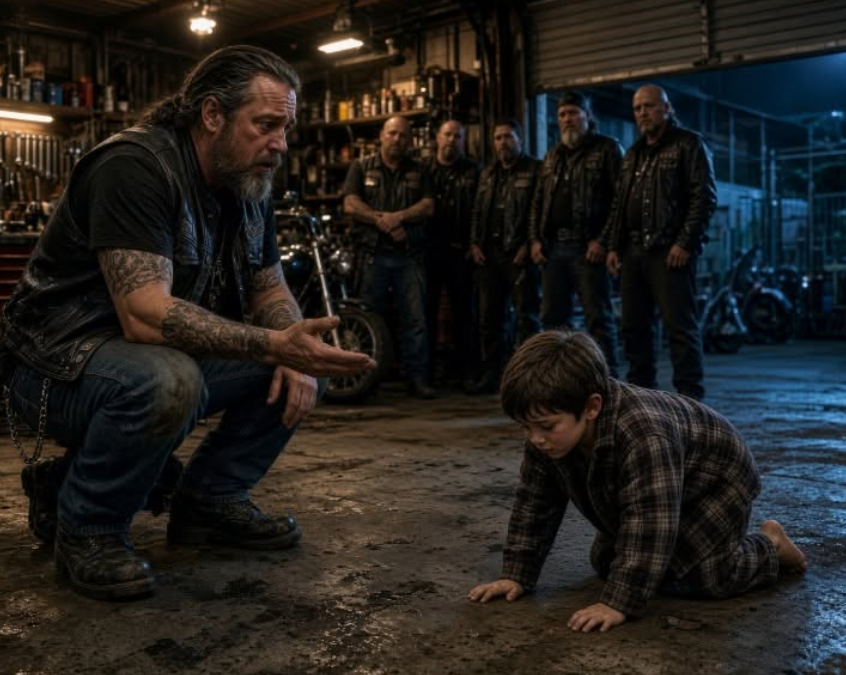
PART3:
He crossed to a hook near his workbench and pulled down an old red-and-black flannel jacket. It smelled like coffee, motor oil, and cold garage air.
He carried it back but did not place it directly on the child.
He laid it halfway between them.
“You can take that.”
The boy stared at the jacket.
“It’s ugly,” Grant said. “But it’s warm.”
No response.
Grant sat on an overturned milk crate.
He turned slightly away.
That helped.
After nearly a minute, the boy reached for the jacket.
He pulled it around his shoulders.
The sleeves swallowed his hands.
Grant pretended not to notice how relieved that made him feel.
“There you go.”
The boy watched him.
Grant nodded toward the back of the garage.
“I’ve got hot chocolate.”
Silence.
“Probably expired.”
A tiny change touched the boy’s face.
Not quite a smile.
Grant took it as permission.
He went to the small kitchenette in the back and filled an old ceramic mug with hot water. He found a packet of chocolate mix that had probably been sitting beside the coffee cans for a year.
He checked the date.
“Still legal.”
He stirred it and carried it over.
The boy accepted the mug with both hands.
He did not drink immediately.
He just held it.
Warmth traveled into his fingers.
Grant sat again.
For ten minutes they said nothing.
The boy finally took a sip.
Grant glanced at the clock.
3:24.
A six-year-old child was sitting barefoot in his garage after crawling beneath the door in the middle of the night.
There was no version of this situation in which Grant could simply send him away.
He took out his phone.
The boy’s eyes locked onto it.
His whole body changed.
The mug began trembling in his hands.
Grant stopped.
“Hey.”
The boy stared at the phone.
Grant lowered it.
“I need to call someone.”
The boy shook his head.
First small.
Then violently.
“No.”
It was the first word he had spoken.
Grant went still.
“No police?”
The child’s breathing quickened.
“No.”
Grant put the phone face down on his knee.
“Okay.”
The boy stared at him suspiciously.
Grant had no intention of promising something he could not keep.
“I didn’t say I wouldn’t call. I said okay. Means I heard you.”
The child looked down.
Grant waited.
“What’s your name?”
Long silence.
Finally:
“Eli.”
Grant nodded.
“Eli.”
The boy looked up.
“I’m Grant.”
“I know.”
That surprised him.
“You know me?”
Eli nodded.
“How?”
The boy glanced toward the motorcycles.
“My uncle says you’re bad.”
Grant almost laughed.
“Your uncle might be right.”
Eli did not smile.
The next sentence changed everything.
“He said you’d never help me.”
Grant felt something cold move through his chest.
“Who’s your uncle?”
Eli’s hands tightened around the mug.
Grant did not push.
“Okay. Different question. Is anyone going to be looking for you?”
The boy whispered, “Maybe.”
“Your parents?”
Eli shook his head.
“Mom?”
Another shake.
“Dad?”
Nothing.
Grant leaned forward slightly.
“Eli, did somebody hurt you?”
The boy went so still that Grant knew the answer before he heard it.
“I don’t want to go back.”
Grant’s jaw tightened.
“To your uncle?”
Eli stared into the hot chocolate.
Grant waited.
Then the boy whispered:
“He told me if I ran again, next time nobody would find me.”
Grant Caldwell had spent twenty-five years learning how not to react.
He had been hit with bottles.
He had watched motorcycles slide across asphalt with friends still attached.
He had been handcuffed twice when he was young and stupid.
He had sat beside his mother’s hospital bed while cancer reduced the strongest woman he knew to eighty-nine pounds.
Through all of it, Grant had learned stillness.
But hearing those words from a child nearly broke it.
He stood.
Eli flinched.
Grant immediately forced himself to slow down.
“I’m not angry at you.”
Eli kept staring.
“I need to call the sheriff.”
“No.”
“I know.”
“Please.”
Grant crouched.
“You came here because you wanted help.”
The boy’s eyes filled.
Grant spoke carefully.
“I can keep this door locked tonight. I can keep anyone outside from walking through it. But I can’t fix the rest alone.”
Eli swallowed.
“What if they make me go back?”
“I don’t know.”
That was not the answer a child wanted.
But Grant would not lie.
Eli looked devastated.
Grant continued.
“I can tell them what you told me.”
“They won’t believe me.”
“I do.”
The words came so quickly that Grant surprised himself.
Eli looked up.
Grant repeated them.
“I believe you.”
The boy blinked.
A tear finally slipped down his cheek.
One.
Then another.
Grant turned his phone over.
“Can I call now?”
Eli stared at him for a long time.
Then nodded.
Grant called the Knox County Sheriff’s Office.
He gave his full name.
His address.
He told the dispatcher a child named Eli had entered his garage barefoot at approximately three in the morning.
He reported what Eli had said.
Then he hung up.
“They’re coming.”
Eli stared at the garage door.
Grant saw the panic returning.
“You don’t have to sit out here.”
The boy looked at him.
“There’s an office in the back. Door locks.”
“You’ll come?”
Grant frowned.
“Where?”
“With me.”
Grant understood.
“Yeah.”
Eli carried his hot chocolate into the office.
Grant dragged the milk crate behind him.
He left the office door open.
But he sat in the doorway.
Between Eli and the garage.
The deputies arrived twenty-three minutes later.
Grant heard tires on gravel first.
Then radios.
Then two knocks.
“Sheriff’s department.”
Grant opened the side door.
The first deputy was young and clean-shaven, maybe thirty. His eyes immediately scanned Grant’s tattoos, his beard, the leather vest hanging from a peg, the motorcycles, and the locked garage.
Grant recognized judgment almost as quickly as he recognized the sound of a bad bearing.
“You called about a child?”
“He’s in the office.”
“Your child?”
“No.”
“How did he get here?”
“Crawled under my garage door.”
The deputy’s expression changed.
His partner, an older woman named Deputy Morales, entered behind him.
“Where is he?”
Grant pointed.
“Back there. He’s scared.”
The younger deputy started walking.
Grant caught his arm.
Not hard.
The deputy immediately tensed.
Grant released him.
“Slow.”
The deputy looked offended.
Morales did not.
She nodded.
They approached the office.
Eli saw the uniforms and backed against the wall.
Morales crouched.
“Hi, Eli.”
No answer.
“My name is Rosa.”
Eli looked past her.
At Grant.
Grant stayed where he was.
The younger deputy noticed.
“Does he know you?”
“Only since tonight.”
Eli spoke.
“He believes me.”
The room fell silent.
Morales looked at Grant.
Then back at Eli.
“We want to believe you too.”
It took nearly two hours to piece together enough information.
Eli’s full name was Elijah Whitmore.
Six years old.
He had been placed temporarily with his mother’s older brother, Marcus Whitmore, and Marcus’s wife, Denise, after Eli’s mother entered long-term rehabilitation following a serious car accident and complications from prescription medication.
His father had been absent for years.
Social services had approved the relatives.
On paper, Marcus had a stable job.
Clean house.
Church membership.
No criminal record.
The sort of man people trusted automatically.
Eli had walked almost three miles barefoot through wet streets to reach Grant’s garage.
“Why here?” Deputy Morales asked.
Eli did not answer.
Grant did not either.
At 6:15 in the morning, a social worker arrived.
Dorothy Phelps was fifty-eight, compact, sharp-eyed, and carried a clipboard with enough authority to make Grant dislike it immediately.
She interviewed Eli.
Then Grant.
She inspected the garage.
She photographed the flannel jacket.
She wrote down the hot chocolate.
She asked Grant about his background.
“Occupation?”
“Mechanic.”
“Specifically?”
“Motorcycles.”
“Marital status?”
“Divorced.”
“Children?”
“No.”
“Criminal history?”
“One DUI when I was twenty-three. Disorderly conduct at twenty-six. Both resolved.”
Dorothy looked over her glasses.
“Any current charges?”
“No.”
“Gang affiliation?”
Grant stared at her.
“Motorcycle club.”
“Name?”
“Iron Angels.”
Her pen paused.
“The Iron Angels Motorcycle Club?”
“Yes.”
“You’re a member?”
“Twenty-two years.”
“Officer?”
“Road captain.”
Dorothy wrote longer this time.
Grant almost smiled.
He knew exactly how good that sounded on child-protection paperwork.
At 7:02, she told Eli they needed to leave.
The boy had said almost nothing for the previous hour.
Now he climbed down from Grant’s office chair.
He removed the oversized flannel jacket.
Carefully folded it.
Then placed it on the workbench.
Grant felt something twist inside him.
Dorothy extended a hand.
Eli ignored it.
He walked instead to Grant.
Stopped beside him.
And quietly pressed his forehead against Grant’s arm.
Nobody moved.
Grant looked down.
He did not touch the child at first.
Then slowly, carefully, he placed one hand on Eli’s shoulder.
Dorothy watched.
“Eli,” she said softly. “We need to go.”
The boy whispered something.
Grant almost did not hear it.
“What?”
Eli looked up.
“Can I come back?”
Grant’s throat tightened.
“I don’t know.”
Eli’s face fell.
Grant added:
“But if they let you, I’ll be here.”
The boy studied him as if determining whether adults could still mean things.
Then he nodded.
He walked away with Dorothy.
Grant stood in the doorway as the county vehicle disappeared down Cedar Lane.
The garage became silent again.
It should have felt normal.
Instead, it felt empty.
Grant returned to the workbench.
The Harley sat exactly where he had left it.
The wrench lay beside the engine.
The fluorescent light hummed.
He could not concentrate.
His eyes kept moving toward the folded flannel jacket.
Finally Grant picked up his phone.
He called Neil Ashford.
Neil answered on the fourth ring.
“Someone better be dead.”
“Neil.”
Pause.
“Grant?”
“I need a family lawyer.”
Longer pause.
“You don’t have a family.”
“I know.”
“What happened?”
Grant looked at the jacket.
“A kid crawled under my garage door.”
Neil said nothing for several seconds.
Then:
“I’m getting dressed.”
The investigation into Marcus and Denise Whitmore moved faster than Grant expected and slower than he wanted.
Eli was placed in an emergency foster facility while social services reviewed the relatives’ home.
Marcus denied everything.
He claimed Eli had behavioral problems.
He claimed the boy lied for attention.
He said Eli ran away whenever disciplined.
Denise backed him.
Neighbors called the Whitmores quiet and respectable.
Their pastor described Marcus as dependable.
Grant hated the word respectable more every day.
Then investigators found previous school reports.
Eli had begun missing classes.
He sometimes arrived hungry.
His teacher, Karen Lockwood, had documented sudden silence, fear of going home, and unusual anxiety around dismissal time.
None of it had been enough alone.
Together it formed a pattern.
Grant learned this information from Neil.
“What happens now?” Grant asked.
“Investigation continues.”
“And Eli?”
“Temporary foster placement.”
Grant looked across the garage.
“And if I wanted…”
Neil stared at him.
“If you wanted what?”
Grant hated the expression on his friend’s face.
“You heard me.”
“No. I absolutely did not.”
“If I applied.”
“For placement?”
Grant nodded once.
Neil rubbed both hands over his face.
“You met this child for four hours.”
“Five.”
“That correction makes this worse.”
Grant crossed his arms.
Neil studied him.
“Why?”
Grant looked toward the garage door.
Because Eli had chosen it.
Because the kid had whispered I believe you with his eyes before Grant said it aloud.
Because Grant knew what it felt like to be young and have adults decide your truth was inconvenient.
Because nobody should learn at six years old that being quiet was safer than asking for help.
Grant did not say any of that.
Instead:
“He asked if he could come back.”
Neil exhaled.
“That isn’t enough to qualify you as a guardian.”
“I didn’t ask whether I qualified.”
Neil looked at him for another moment.
Then he opened his briefcase.
“This is going to be ugly.”
Grant pulled over the milk crate.
“Tell me where to sign.”
The home inspections started.
Grant Caldwell had never owned childproof cabinet locks.
Now he owned twelve.
He had never wondered whether motorcycle parts should be stored behind a locking steel partition.
Now every chemical, tool, knife, battery, fuel container, and piece of shop equipment had a designated secured area.
His house, a three-bedroom ranch behind the garage, had spent years looking like a place where furniture had been arranged around one man’s indifference.
That changed.
Grant cleared the spare bedroom.
He bought a bed.
Then stood in a department store staring at children’s sheets for twenty-seven minutes because he had no idea whether six-year-old boys still liked dinosaurs.
A woman pushing a shopping cart eventually asked if he needed help.
Grant looked at her.
“Do six-year-olds like dinosaurs?”
She glanced at his tattoos.
Then the rocket-ship comforter in his hand.
“Some do.”
“Helpful.”
She laughed.
He bought dinosaurs.
Then returned them the next day and bought planets because Eli’s pajama pants had rockets on them.
Grant did not tell anyone why.
Dorothy visited again.
She inspected the bedroom.
She opened cabinets.
Checked smoke alarms.
Verified locks.
Reviewed his finances.
Asked about his support system.
Grant hesitated.
“Friends.”
“How many?”
Grant shrugged.
Dorothy stared.
“Mr. Caldwell, if a child is placed here and you have an emergency, who helps?”
Grant took out his phone.
He sent one text.
Ten minutes later, motorcycles began arriving.
First Preacher.
Then Mouse.
Then Big Tom.
Then Rosie.
Then twelve others.
Dorothy watched through the living-room window as men and women in Iron Angels vests filled Grant’s driveway.
“What is happening?”
“You asked about support.”
Grant opened the front door.
Preacher walked inside carrying a fire extinguisher.
“Where’s the kid?”
“No kid yet.”
“Then why’d you say emergency?”
“I didn’t.”
“You sent ‘Need you.’ That’s an emergency.”
Dorothy stared.
Within twenty minutes, Iron Angels members had checked every smoke detector, repaired the back gate, installed a railing beside the basement steps, brought groceries, donated children’s books, and argued loudly about whether a six-year-old should have a bicycle before anyone knew if he would ever live there.
Dorothy wrote notes.
A lot of notes.
Grant watched her.
“Still calling me isolated?”
She looked over her glasses.
“I’m revising.”
Supervised visits began three weeks later.
Grant arrived fourteen minutes early for the first one.
Eli was already waiting.
He sat in a plastic chair at the social services office with his hands tucked beneath his legs.
When Grant entered, the boy’s whole body changed.
Not dramatically.
His shoulders simply lowered.
Grant noticed.
So did Dorothy.
“You came,” Eli said.
Grant sat opposite him.
“Told you I would.”
Eli looked at his boots.
“You said if they let me.”
“They let me.”
The boy nodded.
That first visit was awkward.
Grant had brought a toy motorcycle.
Eli barely touched it.
They drank vending-machine cocoa that both agreed was terrible.
Grant asked about school.
Eli shrugged.
Eli asked about the Harley.
Grant talked for twelve minutes before realizing he had given a six-year-old a detailed explanation of carburetor synchronization.
Eli listened anyway.
At the end of the visit, Grant stood.
“I’ll see you Thursday.”
Eli’s eyes sharpened.
“You promise?”
Grant stopped.
Promises frightened him.
Not making them.
Breaking them.
He crouched.
“Thursday. Four o’clock.”
Grant arrived Thursday at 3:41.
Then every Tuesday.
Every Thursday.
For four months.
Never late.
Never absent.
Not once.
The neighborhood noticed too.
Some people approved.
Others did not.
Ray Sutton, who lived two houses down, became Grant’s loudest critic.
“You’re telling me they’re thinking of giving a six-year-old to Caldwell?” he said at the local diner.
Someone reminded him temporary placement was not adoption.
Ray waved that away.
“Same difference. Guy has three hundred bikers at his place every other weekend.”
“They raise money for veterans.”
“They’re still bikers.”
“Grant fixed your daughter’s car for free last winter.”
“That’s different.”
People like Ray were very skilled at making evidence different when evidence threatened prejudice.
Grant heard the rumors.
He ignored them.
Mostly.
One evening Preacher found him tightening the same bolt repeatedly.
“You’re going to snap that.”
Grant stopped.
“Heard what Sutton’s saying.”
“Everybody has.”
Grant’s jaw tightened.
Preacher leaned against the workbench.
“You want us to talk to him?”
“No.”
“Very respectful talk.”
“No.”
“Moderately respectful?”
“Leave him alone.”
Preacher sighed.
“You’re no fun since you became somebody’s dad.”
Grant froze.
Preacher noticed.
“Too soon?”
Grant turned back toward the motorcycle.
“He’s not my kid.”
Preacher watched him.
“No?”
Grant did not answer.
At the next supervised visit, Eli handed him a folded piece of paper.
Grant opened it.
A crayon drawing.
A garage.
One large person.
One small person.
Several motorcycles.
Above them, a crooked yellow light.
Across the top, Eli had written:
MY SAFE PLACE.
Grant stared at the words.
He folded the paper carefully and put it inside his shirt pocket.
It stayed there.
Through every hearing.
Every evaluation.
Every sleepless night.
The investigation into Marcus Whitmore eventually substantiated serious neglect and intimidation in the home. Criminal proceedings were handled separately, and social services permanently removed the Whitmores from consideration as caregivers.
But that did not automatically mean Eli could live with Grant.
The county had other foster families.
Married couples.
People with parenting experience.
People whose garages did not contain twenty motorcycles on a busy Saturday.
The final placement hearing was scheduled for February 14.
Grant hated Valentine’s Day already.
He hated it more when Neil told him the hearing had attracted attention.
“How much attention?”
Neil avoided eye contact.
“Some.”
“Neil.”
“Karen talked to teachers.”
“Okay.”
“Teachers talked to parents.”
Grant stared.
“Parents talked to churches.”
“No.”
“And somebody mentioned it at the Iron Angels clubhouse.”
Grant closed his eyes.
“How many?”
Neil looked uncomfortable.
“Possibly all of them.”
The Knox County Juvenile and Family Court had approximately eighty public seats.
Nearly three hundred Iron Angels and supporters showed up.
They did not arrive revving engines.
Preacher had made that clear.
“No colors inside unless security allows it. Nobody intimidates anybody. Nobody talks during proceedings. Nobody gets us thrown out because Grant will murder me afterward.”
Motorcycles filled three nearby parking lots.
Gray-bearded riders stood beside teachers.
Mechanics stood with social workers.
Veterans stood next to suburban mothers.
The sight was strange enough to make local television crews appear.
Grant pulled up and nearly turned around.
Neil stopped him.
“No.”
“There are three hundred people.”
“You noticed.”
“I hate everybody.”
“Later.”
Inside, Grant wore a white button-down shirt.
Long sleeves.
Neil had insisted.
Grant had fought him.
“These tattoos have been in every home inspection.”
“This is court.”
“They’re part of me.”
Neil sighed.
“Fine.”
Grant rolled his sleeves halfway up.
Dorothy Phelps testified first.
She described her initial concerns.
Single man.
No parenting experience.
Old criminal history.
Motorcycle-club affiliation.
Unconventional lifestyle.
Then she described everything that had happened after.
Every passed inspection.
Every completed class.
Every background check.
Every visit.
Every appointment.
Every request Grant had followed without argument—even when she had personally expected him to refuse.
The county attorney asked:
“Mrs. Phelps, what changed your opinion of Mr. Caldwell?”
Dorothy paused.
“Consistency.”
“Explain.”
“Anyone can behave correctly for one afternoon. Anyone can clean a house before an inspection. Anyone can say what a caseworker wants to hear.”
She looked at Grant.
“Mr. Caldwell did something far less dramatic and far more persuasive.”
“What?”
“He kept showing up.”
The courtroom was silent.
“For four months,” Dorothy continued, “Eli has tested, consciously or unconsciously, whether Grant Caldwell disappears. Grant has answered that question the same way every time.”
The attorney waited.
Dorothy said:
“He doesn’t.”
Karen Lockwood testified next.
She described the Eli she knew before the garage.
Quiet.
Withdrawn.
Watching doors.
Jumping at loud adult voices.
Hiding food from lunch inside his backpack.
Then she described the change.
“After he began visiting Mr. Caldwell, he started talking about the future again.”
The judge looked up.
“What do you mean?”
“He started saying things like, ‘When Grant teaches me how to change a tire.’ Or, ‘When I get big enough to ride a bicycle near the garage.’”
Karen smiled sadly.
“Children who feel unsafe stop speaking about later. Later is too uncertain. Eli started believing in later again.”
Three hundred bikers sat absolutely still.
Grant stared at his hands.
Then the child psychologist testified.
Then the foster-home supervisor.
Each said versions of the same thing.
Eli trusted Grant.
Eli regulated emotionally around Grant.
Eli felt safe with Grant.
Separating them now could cause significant harm.
Finally Neil stood.
“Mr. Caldwell.”
Grant entered the witness chair.
He hated every second.
Neil asked simple questions first.
Work.
Home.
Finances.
Visits.
Then he asked:
“Why do you want Eli placed with you?”
Grant had rehearsed an answer.
Neil had written part of it.
Grant had practiced it twice in front of the garage mirror and hated himself both times.
Now he looked around the courtroom.
Three hundred bikers.
Neighbors.
Teachers.
Social workers.
Strangers.
Ray Sutton in the back row.
Then Grant found Eli.
The boy sat near Dorothy.
Small suit jacket.
Blue shirt.
Hands folded.
Watching.
Waiting.
Grant abandoned the prepared speech.
“I’m not the best person on paper.”
Neil remained silent.
Grant continued.
“I know what I look like.”
A few bikers shifted.
“I know what my life looks like. Motorcycles. Tattoos. Garage open half the night. I’ve made mistakes. I’ve got an old record. I got divorced because I was better at fixing engines than talking about what was wrong inside my own house.”
He swallowed.
“I’m not going to tell this court I suddenly became perfect because a kid crawled under my garage door.”
The judge watched closely.
“I didn’t.”
Grant looked toward Eli.
“But that boy was barefoot at three in the morning.”
His voice roughened.
“He was six years old and more afraid of going home than he was of crawling into a garage owned by a stranger everybody told him was dangerous.”
No one moved.
“I gave him a jacket.”
Grant rubbed one thumb across his palm.
“Made bad hot chocolate.”
A quiet laugh moved through the courtroom.
Then disappeared.
“And when I picked up my phone, he looked terrified.”
Grant stopped.
For a moment he could not continue.
“When he told me why…”
His jaw worked.
“I believed him.”
Grant looked directly at the judge.
“Maybe that sounds small.”
“It isn’t,” Dorothy whispered from her seat.
Grant heard her.
“So why do I want him?”
He looked back at Eli.
“Because he shouldn’t have to spend the rest of his childhood earning the right to be believed.”
Silence.
“Because when I tell him I’ll be there Thursday, I want him to know Thursday means Thursday.”
Grant’s voice broke slightly.
“Because nobody should be six years old and already know how to disappear.”
Preacher looked down.
Mule removed his glasses.
Grant breathed.
“I don’t know if that makes me his father.”
Then his eyes returned to the judge.
“But if you let me, I’ll spend the rest of my life making sure he never has to crawl under another door looking for somebody who’ll protect him.”
Grant sat down.
Three hundred Iron Angels said nothing.
The judge called a recess.
Grant stepped into the hallway.
Preacher approached.
For once, he had no joke.
He put a hand on Grant’s shoulder.
“You good?”
“No.”
“Good answer.”
Grant looked through the courtroom doors.
“Where’s Eli?”
“With Dorothy.”
Then a caseworker appeared.
“Judge Brangan wants to speak with Eli privately before reconvening.”
Grant’s stomach dropped.
“Why?”
Neil answered.
“Normal.”
Nothing about it felt normal.
Twenty minutes later, everyone returned.
The judge entered.
But before he announced a decision, he looked toward Eli.
“Young man.”
Eli looked up.
“You asked to say something.”
Grant turned sharply.
Neil whispered, “I didn’t know either.”
Eli stood.
Dorothy started to accompany him.
He shook his head.
He walked alone toward the front.
He was so small against the courtroom furniture that even the judge seemed to soften.
Judge Brangan leaned forward.
“You don’t have to speak if you don’t want to.”
“I want to.”
“Okay.”
The judge smiled.
“Tell me what you want me to know.”
Eli turned around.
His eyes moved across the room.
Across the hundreds of leather vests.
Across enormous men with shaved heads, gray beards, scarred hands, and club patches.
Finally he looked at Grant.
Then he spoke.
“My uncle told me bikers were bad people.”
Nobody breathed.
“He said if I ever ran away, nobody good would help me.”
Grant felt his chest tighten.
Eli continued.
“That night I saw Grant’s garage light.”
His hands trembled.
“I knew where it was because we drove past it before.”
He looked toward Grant.
“My uncle said that was where bad men went.”
A few Angels lowered their heads.
The judge asked gently:
“Then why did you go there?”
Eli looked confused by the question.
Like the answer should have been obvious.
“Because bad men were already at my house.”
The courtroom froze.
Three hundred bikers who had ridden through wars, buried friends, survived wrecks, spent nights in jail, lost brothers, rebuilt lives—
not one moved.
Eli’s voice grew smaller.
“I thought maybe the scary man in the garage would be different.”
Grant covered his mouth.
The boy looked at him.
“He was.”
Someone in the back quietly sobbed.
Eli continued.
“He didn’t grab me.”
“He didn’t yell.”
“He gave me his coat.”
“He asked before he called the police.”
The boy swallowed.
“And when I told him something bad happened…”
He paused.
“He said, ‘I believe you.’”
Grant shut his eyes.
Eli looked toward the three hundred Iron Angels.
“People kept telling me Grant looks scary.”
His face tightened with six-year-old seriousness.
“But I think scary is when someone makes you afraid in your own bedroom.”
The room became impossibly still.
“Grant doesn’t make me afraid.”
Eli looked back at him.
“He makes the afraid stop.”
Grant Caldwell broke.
Not dramatically.
No loud sob.
His shoulders simply dropped.
His eyes filled.
For years, the Iron Angels had watched Grant survive everything with his face locked behind stone.
Now three hundred of them watched tears roll into his gray beard.
Eli faced the judge again.
“I want to go home with Grant.”
Judge Brangan removed his glasses.
He did not speak for several seconds.
Then:
“Thank you, Eli.”
The boy walked back.
But instead of returning to Dorothy, he went directly to Grant.
He stood beside him.
Grant reached for his hand.
Eli took it.
Judge Brangan reviewed the findings.
The investigation.
The psychological evaluation.
The social-worker recommendations.
Grant’s compliance.
The support network.
The bond.
Then he looked over the packed courtroom.
“This court is not responsible for deciding which family looks most conventional.”
His gaze returned to Grant and Eli.
“It is responsible for deciding what serves this child.”
Grant tightened his grip on Eli’s hand.
“Mr. Caldwell, I am granting temporary legal guardianship of Elijah Whitmore to you effective today, subject to continued monitoring and review in six months.”
Grant did not move.
Neil touched his shoulder.
“Grant.”
Nothing.
“You won.”
Grant looked at him.
Then at the judge.
Then at Eli.
The boy smiled.
A real smile.
“Can we go home now?”
That nearly destroyed what remained of Grant’s composure.
He dropped to one knee.
Same cracking knees.
Same position as four months earlier.
Only this time the boy did not keep his distance.
Eli threw both arms around Grant’s neck.
Grant held him.
Not tightly.
Carefully.
As though even now he was afraid of holding something precious too hard.
“Yes,” Grant whispered.
His voice cracked completely.
“We’re going home.”
Behind them, three hundred Angels rose.
Nobody had instructed them.
Nobody clapped.
They simply stood.
One after another.
Rows of leather vests.
Club brothers.
Veterans.
Mechanics.
People Grant had pulled from wrecks.
People who had pulled Grant out of bars.
Men who had spent decades pretending nothing could reach the softest parts of them.
They stood silently while a six-year-old boy held onto their road captain.
Preacher wiped his eyes.
Mule caught him.
“You crying?”
“Shut up.”
“You’re absolutely crying.”
“So are you.”
“That’s allergies.”
“In February?”
“Violent allergies.”
Grant laughed into Eli’s hair.
It was the first sound of pure happiness Neil had heard from him in years.
Outside the courthouse, reporters waited.
Grant wanted no part of them.
He carried Eli through a side exit.
But what he found outside stopped him.
Motorcycles.
Hundreds.
Parked in long disciplined rows.
The Iron Angels had formed a corridor from the courthouse steps to Grant’s truck.
Not a roaring spectacle.
No engines.
No shouting.
Every rider stood beside a motorcycle.
Quiet.
Eli looked up.
“Are they all your friends?”
Grant glanced down the line.
“Unfortunately.”
Preacher called from the front:
“We heard that.”
Eli smiled.
Grant started walking.
As he passed, individual riders nodded to the boy.
Nobody touched him.
Nobody crowded him.
They simply acknowledged him.
At the end of the line stood Ray Sutton.
The neighbor.
Grant stopped.
Ray looked uncomfortable.
He held a paper bag.
“What’s that?”
Ray handed it to Eli.
Inside was a small pair of red sneakers.
Eli stared.
Ray cleared his throat.
“My wife guessed the size.”
Grant said nothing.
Ray looked at him.
“I was wrong.”
Grant could have made him suffer.
Could have reminded him of every rumor.
Instead he nodded.
“Yeah.”
Ray almost smiled.
“Still terrifying, though.”
“Go home, Ray.”
Three days later, Grant closed the garage at nine o’clock.
Not three in the morning.
Nine.
Because his schedule had changed.
The house now contained bedtime.
Eli brushed his teeth at 8:15.
Pajamas at 8:25.
One story at 8:30.
Two stories if Grant got tricked.
Which happened frequently.
On that third night, Grant found Eli sitting on the new bed beneath the planet comforter.
Grant leaned against the doorframe.
“You like the room?”
Eli nodded.
“Too much blue?”
“No.”
“Preacher says we need posters.”
“Motorcycle posters?”
“No.”
Eli considered.
“Space.”
Grant nodded.
“Space.”
He turned to leave.
“Grant?”
He looked back.
“Yeah?”
“Door open?”
Grant understood.
“Always.”
He switched off the overhead light.
The hallway cast a narrow gold stripe across the bedroom floor.
Grant walked downstairs.
He entered the garage.
The old Softail still waited on the lift.
For months, he had barely touched it.
He picked up a wrench.
Then noticed something on the corkboard.
Eli’s drawing.
Grant had pinned it there after the hearing.
Two figures.
A garage.
Motorcycles.
A yellow light.
MY SAFE PLACE.
Grant stared at it for a long time.
Above him, a floorboard creaked.
Then another.
Small footsteps crossed Eli’s bedroom.
Grant smiled.
For decades, he had worked at night because silence felt safer than people.
Now the house was not silent.
Pipes ran when Eli brushed his teeth twice because he forgot the first time.
A bedroom floor creaked.
Sometimes a toy dropped.
Sometimes Grant heard a child talking quietly to himself because six-year-olds apparently had important business long after bedtime.
Grant had never realized how much comfort noise could contain.
Six months later, the guardianship review lasted less than an hour.
Dorothy recommended permanent placement.
Karen submitted school reports showing Eli was thriving.
The psychologist documented significant improvement.
The judge asked Grant whether anything had surprised him about parenting.
Grant answered:
“Everything.”
The judge smiled.
“Anything especially difficult?”
Grant thought.
“Lunch boxes.”
The room laughed.
“I can rebuild a transmission blindfolded. Somehow sandwiches are complicated.”
Eli whispered loudly from his seat:
“He cuts them wrong.”
Judge Brangan looked interested.
“How?”
“Triangles.”
Grant frowned.
“You said triangles.”
“I changed my mind.”
The judge nodded solemnly.
“That does sound challenging.”
The final order was approved.
Grant Caldwell became Eli’s permanent legal guardian.
Outside, only about forty Angels waited this time.
Grant considered that an improvement.
Preacher disagreed.
“We showed restraint.”
“You blocked the courthouse parking lot.”
“Forty motorcycles is barely a gathering.”
Eli climbed onto Grant’s shoulders.
He had shoes now.
A coat.
A backpack.
A bedroom.
A school routine.
People who knew where he was supposed to be.
And if he was five minutes late anywhere, approximately three hundred bikers seemed prepared to organize a search party.
A year after the night he crawled beneath Grant’s garage door, the Iron Angels held their annual charity ride.
Traditionally, the money went to veterans and injured riders.
That year, Grant added something new.
Emergency assistance for children entering foster care.
Backpacks.
Pajamas.
Shoes.
Toothbrushes.
Books.
Night-lights.
Everything a child might need when removed suddenly from a home without time to pack.
They called it Eli’s Garage Fund.
Grant hated the name.
Eli loved it.
Three hundred motorcycles gathered at the clubhouse before sunrise.
Eli stood on a wooden platform beside Grant.
The boy was seven now.
Still small.
Still sometimes quiet around strangers.
But stronger.
Preacher handed him a microphone.
Grant immediately frowned.
“Whose idea was that?”
“Democracy.”
“We’re not a democracy.”
Eli tapped the microphone.
Three hundred conversations stopped.
He looked at the crowd.
Grant stood behind him.
Eli reached backward and found Grant’s hand without looking.
Then he spoke.
“A year ago, I didn’t have shoes.”
The Angels went quiet.
“I didn’t have my backpack.”
Quieter.
“I didn’t know where I was going to sleep.”
Grant stared at the ground.
Eli squeezed his hand.
“But I found Grant’s garage.”
A few riders smiled.
“I used to think I was lucky because his light was on.”
Eli looked up at Grant.
“Now I think maybe he left it on because he needed somebody too.”
That hit harder than anything said in court.
Grant blinked rapidly.
Preacher turned away.
Mule immediately accused him of allergies again.
Eli looked at the bikers.
“So the bags we’re giving kids today have flashlights.”
He pointed toward hundreds of donated backpacks.
“Because sometimes you have to find a light.”
Then he smiled.
“And sometimes you have to be one.”
For the second time, hundreds of bikers fell completely silent because of a small boy.
Grant looked out over the sea of motorcycles and leather.
Then down at Eli.
A year earlier, the child had crawled into his garage believing he had found the least dangerous bad man in town.
Instead, he had found a home.
And Grant Caldwell—the biker everyone crossed the street to avoid—had discovered that the most important thing he would ever repair had never been an engine.
It was trust.
Slowly.
Patiently.
One Tuesday.
One Thursday.
One bedtime.
One promise kept at a time.
That night, long after the charity ride ended, Grant walked through the garage shutting down the lights.
Only the small bulb over the workbench remained.
Eli stood in the doorway wearing rocket-ship pajamas.
Grant raised an eyebrow.
“You’re supposed to be asleep.”
“I needed water.”
“Kitchen’s upstairs.”
“I know.”
Eli walked toward the garage door.
He looked at the narrow rubber seal along the bottom.
The same place he had once forced his tiny fingers through in darkness.
Grant watched him.
“You okay?”
Eli nodded.
Then the boy looked up.
“Can we leave this light on?”
Grant glanced at the workbench lamp.
“Why?”
Eli shrugged.
“In case somebody else needs to find it.”
Grant could not speak for a moment.
He looked at the garage.
The motorcycles.
The tools.
The flannel jacket still hanging from its hook.
The drawing pinned above his workbench.
Then back at the boy.
“Yeah.”
Grant switched off every other light.
But he left that one glowing.
A single warm square shining beneath the garage door into the dark Tennessee night.
Because once, at three in the morning, a frightened little boy had crawled toward the man everyone else feared.
And the first thing that man gave him was not a home.
It was not a courtroom victory.
It was not three hundred motorcycle brothers standing behind him.
It was something much smaller.
A warm jacket.
A terrible cup of hot chocolate.
And four words the boy had been waiting his entire young life to hear.